Posts by Edward Champion

Edward Champion is the Managing Editor of Reluctant Habits.

Meta Meta Meta

Darby Dixon points to a troubling new trend among today’s cultural tastemakers. Today, a professional writer can now be employed to write about reading about writing or reading about writing about reading, with several nots thrown in at random intervals, if we assume the writers to be keeping track. I must confess that all this gives me a headache. The silence is not pillowy exactly. But it is certainly quite silly and possibly Freudian.

I feel that I have contributed to this atmosphere with lengthy blog posts responding to reviews of books, and therefore exhort all to point to my culpability in the matter. In my defense, I should note that I never suggested to an editor that I should collect a check for writing such a piece. But now I am writing about writing about writing about reading, thereby adding a fourth layer of self-reference. And should you, dear readers, decide to comment upon this post, you will be writing about writing about writing about writing about reading. And how then can we live with ourselves?

All this sets a bad precedent for meta, dutifully putting the Quine in quinine. (Quite literally.) Or does it? Is there no limit to the onion?

Of the three paragraphs I have now written, I think the first one is probably the best, although I’ll probably change my mind when I approach this sentence’s period.

I am still unaware of how one “stabs over” to an online bookstore. This suggests that the online bookstore is a carapace to be pierced. And perhaps it is, assuming that it possesses the corporeal qualities of reference. Perhaps the preposition is the dagger I see before me or just a creepy beast caught in the morphological undertow. So I’ll see your self-reference and raise you with evidence to the contrary:

The Early Films of Jim Henson

Before the days of Sesame Street and The Muppet Show, Jim Henson was an independent filmmaker in New York, making experimental films between commercial gigs. It was the mid-sixties. According to John Bell’s Strings, Hands, Shadows: A Modern Puppet History, Henson was sharing a workshop space for a few months in the basement of a New York City library with a German sculptor and choreographer named Peter Schumann. Schumann specialized in avant-garde performances, entertaining crowds with masks, puppets, and postmodern dance, often employing these for political demonstrations.

In watching 1965’s “Time Piece,” seen above and recently unearthed by Metafilter, it’s difficult to consider it without Schumann in mind. The film played in New York theaters on a double bill with Claude Lelouch’s A Man and a Woman and concerns itself with a man (played by Henson) being examined in a hospital. As the clock ticks away, a grand surrealistic array of experiential memories overtakes his existence. Gorillas bounce on pogo sticks. There is the quiet Kermit-like plea of “Help!” Chickens emerge in strip clubs. And all this is intercut with optically printed pixellated squares.

The film is set to a intermittent drum rhythm that echoes the heartbeat of time. What’s particularly intriguing is that, according to David P. Campbell’s The Complete Inklings, “Time Piece” so captured Campbell’s imagination that the film was shown at an a seminar at the Minnesota Statewide Testing Program annual conference, with Henson’s film projected on one screen and the test results of a random individual projected on another. The idea was to show Henson’s film, with Campbell announcing to the students, “We should always remember that there is a person behind each of these test scores; to make that point dramatically, here is one person’s test scores and here is a product of his considerable imagination.”This permissive cultural climate permitted Henson to make “The Cube” in 1969, a teleplay that independent filmmaker Vincenzo Natali appears to have handily pilfered from.

A protagonist, known only as “The Man in the Cube,” is trapped inside a cube of white rectangular panels, with strange individuals who enter and exit through other doors. This premise gave Henson the opportunity to explore a wide variety of topics: racism, sexism, the realm between reality and fantasy. There is even reference to the fourth wall. At one point, a professor addresses the man, pointing out that he is in a television play.

Believe it or not, “The Cube” was commissioned for a television series called Experiment in Television, a now forgotten program that aired on NBC between 1968 and 1971. This series came about because NBC needed filler material to provide late Sunday afternoon programming when the football season had ended. And they decided, quite amazingly, to provide a venue without commercials for documentaries and experimental films.

In the end, it was public television that secured Henson’s rise to fame. But today, unless you’re as squeaky-clean as Ken Burns, your prospects for national exposure are slim. Now that the first season of Sesame Street has been issued on DVD, it’s been issued with a parental advisory reading, “These early ‘Sesame Street’ episodes are intended for grown-ups, and may not suit the needs of today’s preschool child.” The idea of children running around an inner city, looking to learning as a way out, is apparently too threatening a concept.

Given this drastic shift in priorities — the unusual idea of commissioning an experimental film for a testing conference, the now antediluvian notion of creating a space on national television where filmmakers can pursue alternative ideas, and the censure on anything slightly offensive to “suit the needs” of children — one is forced to contemplate the current media atmosphere. Certainly, there is YouTube and the Internet. But this online landscape increasingly values views — and thereby advertising revenue — over notions that are not popular or lucrative, and one wonders just how tomorrow’s Hensons will thrive. Of course, any artist who feels compelled to create will not let any obstacle stop him. But by hindering the spectrum of expression with our priorities (what sells, what’s safe, et al.), I’m wondering if we’re closing the floodgates to those who might have new and innovative ways to get a mass audience excited about the world around us.

David Kamp, Blog Snob

Ten years from now, we’ll all be inured to David Kamp. A whole generation will have grown up as his book, The United States of Arugula, has been long forgotten — the remaining copies pulped or perhaps used as oversized skeet shooting pellets, because they couldn’t even sell as remainders. For what imagination can one expect from a hack writer whose grand contributions to letters include The Food Snob’s Dictionary, The Film Snob’s Dictionary, The Rock Snob’s Dictionary, and The Wine Snob’s Dictionary? (One senses a trend. A writer so content to plant the word “snob” to his contributions in four different terrains, even satirically, must truly be an insufferable asshole.)

Right now, this great parvenu David Kamp has turned the prick of his pen to blogs. Using the finest epithets that 1999 had to offer, Kamp rails against the “untamed blogosphere” and the “Wild Web.” He displays his considerable ignorance in suggesting that the Smoking Gun is merely a place “best known for the documents it unearths via the Freedom of Information Act,” failing to understand that it was indeed the Smoking Gun that broke the James Frey scandal. This was the kind of lengthy investigative journalism that the New York Times once practiced, before it turned its resources to the women who New York governors were schtupping. (There’s also this neat little thing called the Internet Archive! Wow! That’s even better than the brand new 56k modem I bought last month from a guy on the street who said that it was “cutting edge.”)

He is content to cast aspersions about specific blogs based entirely on their titles (“cutesie-poo,” “mock-suave,” et al.), without bothering to cite any specific examples as to how the content lives up to these modifiers. (Look, I think the name “David Kamp” sounds like some cult member waiting for the big day when his shaky pyrotechnics knowledge will be enlisted in the jihad, or, failing that, the sad and klutzy moment when he accidentally blows off his hands and it’s all settled up as a dutiful sacrifice to The Leader. But you won’t see me belittling the man’s three syllables. Particularly when his piss-poor argument is so patently ridiculous.)

Indeed, Kamp appears so deaf to the idea of text that he compares Sarah Boxer’s post-excerpt pages to Johnny Carson. In this age of Quark and word processors, Kamp can’t seem to wrap his head around the concept of text being read on an LCD screen and later transposed to book form. It’s certainly bad enough that Kamp can’t even get his medium right. But in citing Johnny Carson, a dead talk show host who has been rotting under the earth quite well for three years and who hasn’t aired on a regular basis in sixteen years, Kamp demonstrates that he is as culturally au courant as a Deadhead who doesn’t quite understand that Jerry Garcia’s fat ass has been long chewed up by the maggots.

In Kamp’s view, a blogger cannot just have an “esoteric interest.” He feels compelled to add the word “obsessive,” as if those who compose their words for a screen are no different from Branch Davidians. He is quick to tell us that “[i]n the case of the blogger Benjamin Zimmer, a linguistic anthropologist, it’s language that turns him on.” That reminds me of the case of the quantum physicist who was turned on by quantum physics. Or David Kamp, the dumbass book critic who was turned on by dumbass observations.

Of course, reading sections of a 368 page book — composed of speedy prose, no less — was “a chore” for poor David Kamp. Kamp doesn’t report if he’s ever done a day of hard labor in his life, something like working on a farm or in a warehouse that might offer a sufficient comparative basis. (I’ll take a wild guess: no.) He doesn’t say what or why. That, of course, would involve actual thought. He merely says that what David Byrne does on his blog is a thousand times better than what Momus does on his. When Kamp resorts to ratios like this, he demonstrates that the true soporific wonkery on display here is not found within blogs, but in Kamp’s utter failure to provide any substantive analysis.

Leafing through much of David Kamp’s indolent and hastily assembled review — lightweight thought, lack of curiosity, comic misfires, recountings of personal travail (i.e., the “chore”) — I was reminded less of a book review than of a dreary speech delivered by a doddering conspiracy theorist for a Rotary International chapter. Sure, you want to encourage the man. But you would never expect his ramblings to be published in The New York Times Book Review. Not without a team of editors to rival a junta. And even then, there’s the old adage about cooks and broth.

And who is Kamp to speculate about Boxer’s vacillating motivations in writing the book? Can’t Boxer change her mind?

A thoughtful, and even critical, review of blog writing is by no means a dreadful idea for a newspaper piece. But this particular review goes well beyond a missed opportunity. If the NYTBR has any good sense, it will have a team of security guards punch David Kamp in the face if he ever tries to set up a lunch meeting with Sam Tanenhaus or Dwight Garner again.

NYPL: Nicholson Baker & Simon Winchester

On Thursday night, a crowd congregated into a subterranean hall of the New York Public Library to listen to Simon Winchester interview Nicholson Baker. Mr. Baker wore a green vest and a low-key suit. Mr. Winchester was dressed in a gaudy blue pinstriped suit and a yellow shirt, with a dark red handkerchief drifting out of his outer pocket like a haphazard eleventh-hour accessory.
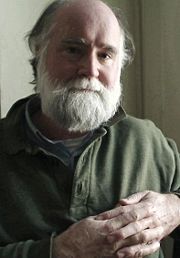
nickbaker.jpgBaker was soft-spoken, effusive with his hands, and sometimes quietly gushed, particularly when talking about the “lush, colorful” nature of the New York World, one of the early 20th century newspapers that had been in his prodigious collection. Winchester was often sharp and crisp with his questioning, exuding the aura of a fussy countertenor waiting for a cadre choristers to marvel upon his ostensible magnificence, but he was good enough to point out that it was “Nick’s night.” At one point, Winchester poured water only into his glass. Baker, by contrast, filled both his own glass and Winchester’s. Winchester kept his gaze upon Baker throughout the conversation, rarely glancing to the audience. Baker, by contrast, regularly opened himself to the audience when expressing himself.

Shortly after sitting in his seat, Winchester announced to the crowd, “This is not going to be a lovefest.” But despite this pledge of pugilism, Winchester played it relatively safe. He had snide comments pertaining to Adam Kirsch’s review. Contra Kirsch, he pointed out that “stupid, but scary” seemed an appropriate line to discuss war.

Alluding to Checkpoint, Baker observed that his purpose in writing that novel was to ask a simple question: “If you think that your single action can solve the problem, is there a way that someone can talk you out of the problem?” But Baker pointed to Emily Dickinson’s maxim about telling all the truth but telling it slant. Fiction could only go so far. And thus, Human Smoke emerged from these meditations.

Baker pointed out that for every book he has written, he would generally get one third of the way into it before “something goes wrong.” Then, he sets it aside. But he had been working on a book-length history of the Library of Congress, dwelling in particular upon Archibald MacLeish, who was the Librarian of Congress in 1939. MacLeish would go onto become a key propaganda figure during the war. And thus Baker found himself immersed in “an interpretive problem.” He had to understand World War II. So he put aside this project and Human Smoke began to take shape.

In discussing the difference between his fiction and nonfiction, Baker noted, “Fear plays a large part in all this. You want to avoid exposing himself.” It was with this attitude that he tackled the more elaborate project of Human Smoke, of which he pointed out that he couldn’t do justice to the full experience of the war.

Winchester asked Baker about whether it was reasonable to rely almost exclusively on newspapers — the so-called first draft of history — for his book at the expense of historians who came later. Baker pointed out that the reporter who wrote about a major event he experienced “had the balance of things in his mind that brings you to the moment.” He cited the exploding soup cans during the bombing of Coventry — a detail that seemed particularly apposite to his framing of history. He pointed out that newspapers would reprint the entire text of a radio speech and noted that, within the letters to the editor section, one could find a great array of voices.

In dwelling upon Human Smoke‘s cast of characters, Baker expressed great curiosity about Herbert Hoover and pointed out that Victor Klemperer was “an interesting man, a sad man.” But he pointed out that just because he put a quote into the book, this did not mean that he necessarily believed in it. Of Gandhi, he observed, “Sometimes there’s a coldness that’s very disturbing.”

Baker appeared deeply troubled by World War II priorities. He said, “It was easier to fight a war against Germans than it was to allow Jewish refugees.” But he pointed out that he was not qualified. On the question of whether America knew about the Pearl Harbor invasion in advance, Baker opted to “defer to the experts.” Later in the evening, Baker said, “Who were the people who came out of the war with greatness and nobility? The Jews.” And there was an uncomfortable silence from the audience, who began to grow a bit restless.
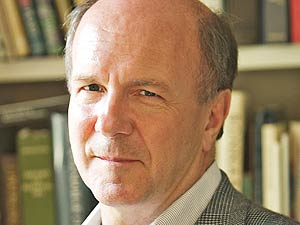
When I interviewed Mr. Winchester in late 2006, he insisted to me that he was a historian, not a journalist, and expressed umbrage at my notion that he was “covering” the 1906 earthquake, pointing out that historians look back on events with “perspective.” This perspective, however, was not particularly evident last night.

Four of his questions pilfered very specific points that were presented during the Human Smoke roundtable discussion — all, of course, without reference. Not only did Winchester read aloud the exact same section from Checkpoint that was referenced on these pages, but he also brought up Jeanette Rankin, the controversy involving the Treaty of Versailles (raised by Colleen Mondor), and the efforts by Cardinal Clemens von Galen to suspend the T-4 program. I wondered if Winchester had spent that afternoon Googling to prepare for a book that had slipped his mind since he blurbed it many months ago.

There was a telling indicator of this propensity during the post-discussion Q&A. Asked about Human Smoke, Mr. Winchester pointed out that he had problems with Baker’s book, but that he would defend his right to write it. The delightful and quick-thinking Paul Holdengräber pointed out that Winchester’s line had originated from Voltaire.

Despite these quibbles, I actually liked Winchester. He was dry and mostly unsmiling, save through a few belabored grimaces that seemed more directed at the CSPAN cameras dutifully videotaping this conversation for Book TV than the audience who had shelled out $15 a head to see this. But he was quite entertaining as a Jeremy Paxman-style interviewer. At one point, he asked Baker point blank about the apparently unquestionable natural impulses that cause people and creatures to kill, citing a gorilla video that had been emailed to him, and some incident involving chickens on his cozy farm in Connecticut as evidence of these apparent impulses. He even managed to find a way to name drop Tom Brokaw — “who is a friend and who I like.” Winchester was an enjoyable blowhard, more Phineas Barnum than Phineas Finn. And juxtaposing his blustery presence with the more empathic Baker worked quite well.

Despite revealing himself later to be a dedicated Malthusian (and this charge seemed more a piece of contrarian theater than bona-fide ideology), Mr. Winchester partially acquitted himself when he bailed Baker out as he was responding to a question from the audience about whether America should now begin negotiating with Islamic fundamentalists. As Baker fumbled for an answer, Winchester quickly pointed out that the Northern Ireland crisis was resolved by talking the issue out through back doors.

As the crowd dissembled, Winchester ran up and down the signing line, balancing books like a juggler signed on for a circus at the last minute. I kept wondering whether he was carrying out some intriguing one-man dramatization of a Tom and Jerry cartoon, but this was not the case. He asked a few folks in the queue if anyone else wanted him to sign his book so that he could go home.

Baker appeared a bit worn out by all the publicity he’s been doing for Human Smoke. But despite his energies waning near the end, he maintained a great humility and offered some lively remarks for a book that is likely to keep fanning the flames of controversy for quite some time.

Growing Pains for the Litblog

As observed yesterday by Dan Green, the Litblog Co-Op is shutting down. This is a pity, because the LBC was a remarkable conduit for many overlooked authors to receive dutiful attention often denied them by more traditional outlets. (To get a sense of perspective on what this means, as observed last week by The Book Publicity Blog, collectively, all of the national NPR programs interview a mere 600 authors a year. Thus, there can never be enough conduits for long-form discussions and interviews with authors. The world needs more litblogs, more literary podcasts, and more literary teleprojects, however clumsily executed.)

Thankfully, none of this has stopped litbloggers from committing these energies on their own sites — see, for example, Colleen Mondor‘s invaluable roundtable discussions of YA and genre authors, aptly demonstrating that there remains plenty of room for community left in litblogs. But litblogging itself, as Dan quite rightly observes, has become more decentralized, with the litbloggers themselves becoming immersed in the great demands of their own projects. (Mark Sarvas has written a novel, Dan Wickett has formed a publishing company, many litbloggers have become regular print critics, while others have become dedicated bloggers for newspapers.) While I had a long run with the LBC, I was forced to back out for similar reasons. There were too many nights mastering podcasts until 3:30 AM when I had to wake up only a few hours later. I love literature as much as anybody. But it became necessary to step away, if only to ensure my own sanity. I didn’t want to become jaded or indolent about the authors I devoted time, thought, and attention to. (And, in fact, a number of forthcoming Segundo podcasts will feature return appearances by authors featured by the LBC.)

Stepping down from the LBC saw much of this approach shifted over to this site. While I have attempted to go out of my way to involve other voices in generating content and to include authors that Sam Tanenhaus would never devote even a column inch to, I nevertheless contemplate my own culpability in “doing my own thing.” If litblogging is galvanized by community, then does doing one’s own thing run counter to this medium’s strengths?

I find myself somewhat troubled by where litblogs are now heading. I certainly don’t exonerate myself from these developments. To use a pop cultural metaphor, it is as if the Beatles have broken up, with all of us pursuing our metaphorical solo albums. The early energy of individual projects is certainly there, but let’s not forget that John Lennon followed up his classic album, Plastic Ono Band, with the decidedly spotty Mind Games. But the communal DIY punk rock ethos that was once an inseparable component from what litblogging was about has been replaced by a competitive streak of who gets the story first. (Indeed, Galleycat’s tagline is “the first word on the book publishing industry,” when being “first” doesn’t always mean that you’re going to write something sufficiently purposeful.) Litblogs have been redesigned to accommodate advertising — in some cases, with intrusive graphics embedded within posts that detract from the thoughtful content. (What next? Newspaper-style pop ups and registration?) Some bloggers have even taken money from publishers and have flown, Harry Knowles-style, around the globe. Meanwhile, other voices are ignored because of personal differences, with variegated parties not understanding that this runs counter to the great neural network that litbloggers laid down. (And why can’t there be civil disagreement as well as lively fireworks?)

So what makes this fragmentation any less different from the tendentious gatekeeping one sometimes sees in newspapers? I think it’s safe to say that the print vs. online debate is more or less moot. Litblogging is here to stay. And while I certainly can’t speak for other bloggers, I believe the early passion that drove litbloggers to create a fantastic medium has been partially replaced by an obligation to put something up on a daily basis.

If bloggers are to hold themselves up to the same standards with which they frequently (and justifiably) savage newspaper critics, then the time has come to look inward and consider the things they may be doing wrong. The time has come to be humble and inclusive towards the community. Bud Parr had this idea very much in mind with Metaxucafe. Bud dutifully (and remarkably) tracked all the known litblogs and united them under one umbrella. But what was once a centralized site with considerable discussion has regrettably become less vociferous. This may be because the spirit of interconnectedness starts from individual litblogs, however “clubby” it may be (as once described by Jennifer Howard in November 2003; in a troubling indicator of online newspaper impermanence, her article has regrettably been removed from the Washington Post site).

The bloggers who best accomplish this interconnectedness are Maud Newton and Frank Wilson. Maud is perhaps the most concise of all litbloggers, and is very good about acknowledging where she has located her links (a basic courtesy that seems to be falling out of practice and that, oddly enough, was the subject of a controversy in the early days of litblogging.) Frank often links to litblogs that I haven’t heard of, and which I frequently add to my RSS feeds.

But I don’t know if these individual efforts really go far enough. If litblogging is becoming exclusively about promoting one’s own personal connection to books, at the expense of other personal connections, the litblog, as we once knew it, is dead. The Internet, lest we forget, has a very important prefix that caused this marvelous literary community to propagate. And when projects like the LBC die, I can’t help but wonder if we’re all just as incorrigible as the print critics we once railed against.