I must have the same thing Tayari had. A deadly strain, not unlike the vicious superflu portrayed in Fiona Maazel’s Last, Last Chance, has knocked your faithful correspondent on his ass. So PEN World Voices coverage remains stalled for the present time. I’m going to see how I feel tomorrow and, if I feel better, I will venture out and report what I can. In the meantime, you can check out my review of Susan Hubbard’s The Year of Disappearances in Saturday’s edition of The Los Angeles Times.
Category / Uncategorized
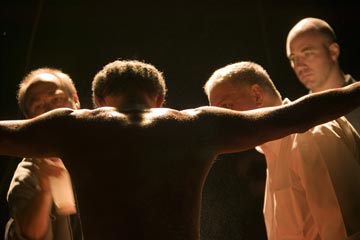
Standard Operating Procedure
It seems particularly fitting to remark upon Errol Morris’s latest film, Standard Operating Procedure, as Armond White offers yet another hysterical fulmination about how online culture is apparently destroying exegesis, ranting in particular about “the shame of middle-class and middlebrow conformity that critics follow each other when praising movies that disrespect religion, rail about the current administration or feed into a sense of nihilism that only people privileged with condos and professional can tenure.”
This colorful sentiment is, to say the least, a disingenuous generalization. For Morris’s documentary (and the accompanying book written by Philip Gourevitch) would seem to suggest that one cannot approach an important subject like Abu Ghraib without a sense of outrage. That no matter how rational one is in investigating the events behind this nightmarish aperçu into America’s dark underbelly, journalist, filmmaker, and audience member alike must shout to the high ethical heavens. But is it really an act of conformity — class-driven, no less — to be appalled by what is revealed in the photographs? Is it conformist to speculate upon why Sabrina Harman offered a thumbs-up signal or whether or not Lynndie England was coerced by Charles Graner into holding a dog leash?
An innate sense of inquiry cannot be called conformist if it involves an independent series of perceptions that involve grasping some aspect of the truth, subject to change upon additional thought and information. And yet the main problem with Morris’s fascinating new film is that, with the ancillary and rather fixed reenactments photographed by Robert Richardson, it is possible that Morris may be holding the viewer’s hand too much, urging her to care when the interviews alone offer enough unknowns and the horrific glimpses into a soldier’s dead eyes four years later are enough to make one uncomfortable.
In watching these soldiers, I couldn’t help but consider the scene in Claude Lanzmann’s Shoah in which barber Abraham Bomba works in his shop, reproducing the precise grooming moves he employed while cutting the hair of victims about to be gassed in Treblinka. It is an eerie echo from the past that cannot altogether be shaken off in the present. And in my painful determination to understand, however limited, why these soldiers had done what they did and how the Abu Ghraib experience had shaken them, I wanted to know more about how the idea of getting used to anything — even the rough interrogation and humiliation of prisoners — was carried back to the homeland. This may not be an entirely fair request of Morris. His film is, as he contends in the press notes, an investigation into the Abu Ghraib photographs. But if, as Susan Sontag observed, “the photographs are us,” is it entirely unreasonable to ask the investigator to venture further?
It isn’t mentioned in the film, but Javal Davis, who comes across as a smooth, free-wheeling raconteur, is revealed, in Gourevitch’s book, to be “in sales. The career path that I have now, you know — comfortable. I deal with people on the regular basis. I’m not handling anybody’s problems. I’m not dealing with anything violent. So I’m business to business, all personal, ‘How you doing? I’m Javal Davis. Nice to meet you.’ Everybody’s happy. I like that. Sales. I’m a salesman.” And because Morris has flown out Davis, along with all the other soldiers, to his Cambridge headquarters to conduct these interviews, we do not see these soldiers in their current habitat. For all we know, Davis could have viewed his trip to Cambridge as a business trip. Business to business. And he could have adjusted accordingly.
It’s possible that Richardson’s visuals serve as a device similar to Comte de Lautréamont’s unusual narrator. In Maldoror, Lautréamont offered a unique device in which the narrator often parodies feelings by willfully distorting or rethinking the sordid events that are presented. Likewise, by illustrating what his interviews are telling us through these visual reenactments, this may be Morris’s heavy-handed help to us that we must rethink our own thoughts and feelings concerning these photographs. Or perhaps it’s more visceral. As I learned in an interview I conducted with Morris this week, outrage was also involved in these reenactments.
The outrage is conveyed as a prisoner is described having his eyebrows shaved off, with Morris including a close-up of a razor deracinating a tuft of hair. Morris likewise dramatizes a dog that terrorizes another prisoner. But Morris has the dog menacing the prisoner in slow-motion, with a melodramatic sound mix depicting the dog’s bottom jaw snapping shut like a steel trap.
Given the intriguing ambiguities unearthed during the interviews, this seemed to me to spoon-feed the audience too much. And I wasn’t alone. In an essay for Artforum, Paul Arthur took umbrage with these visuals, observing:
Their style, however, belongs to a film genre that provides titillation through horror. To employ this rhetoric in a documentary about actual horror is obscene, yielding familiar aesthetic thrills as a substitute for specificity of meaning. We aren’t prompted to contemplate the Iraq occupation’s signature scandal as the product of a mercenary chain of executive decisions, cultural attitudes, venalities, and personal pathologies; we are, as it were, let off the hook. It’s only a movie.
If a generic sense of horror is what is required to get through to the average moviegoer, then I cannot quibble as strenuously as Arthur does (and perhaps White will). But if a complex issue requires complex consideration, then any reenactment that will help a viewer construct a “map of reality” must not dictate too much. It is reasonable to accept the shaved eyebrow, but the dog goes over the top.
Likewise, in the book, Gourevitch maintains a level-headed, mostly objective tone for almost 160 pages before writing:
There is a constant temptation, when rendering an account of history, to distort reality by making too much sense of it. This temptation is greatest when the history is fresh and deals with crises that are ongoing — crises that mold our understanding of our world and ourselves. Surely, if you have come this far in this sordid tale, you must crave some relief, some release, from the relentless, claustrophobic annihilation of the dungeon: a clear and cleansing note of sanity, an interlude of avenging justice or an eruption of decency, the entry of a hero. But surely you don’t want to be deceived. There is no such solace or sanctuary in this story.
Gourevitch then launches into a grand attack on what the Abu Ghraib atrocities say about America, pointing to the famous precedent of treating enemy prisoners well set by George Washington and fulminating against the Bush Administration. Not even a journalist as dutiful as Gourevitch can look at the photos and the complicit involvement of these bad apples without exploding.
 Others will likely perceive this film to be mostly about the visuals atop the visuals, the analysis atop the analysis, the meta within the meta. But the real “standard operating procedure” explored in this film isn’t so much the pedestrian issue of how war caused the lines of basic human decency to become fuzzy, but the manner in which a great filmmaker has partially abandoned his subtleties to get Americans hopping mad. The faults lie not in the filmmakers and not, as White suggests, the critics. They’re doing their best to continue the dialogue, but their efforts have increasingly fallen upon deaf ears. For Abu Ghraib does not entertain. And neither does moral outrage.
(To listen to my podcast interview with Errol Morris, go here.)
Open Source Sodomy
“This should be a better world,” a science fiction convention attendee said. “A more honest one, where sex isn’t shameful or degrading. I wish this were the kind of world where you could say, ‘Wow, I’d like to sodomize you with my nightstick,’ and people would understand that it’s not a way of reducing you to an asshole and ignoring the rest of you, even though the request inherently objectifies the person you ask, but rather a way of saying that I may not know your mind, but your body is beautiful.”
We were standing in the hallway of ConStipation, about nine of us, three hadn’t had sex since the Twin Towers fell, and we all nodded. Then another friend spoke up.
“You can penetrate me,” he said to all of us in the hallway. “It’s no big deal.”
Now, you have to understand the way he said that, because it’s the key to the whole project. It was an Ayn Rand novel come to life. When dealing with a request along these lines, you have to completely ignore the meaning of the sentence in order to rationalize the manner in which you objectify someone. Consent is the important part of avoiding a sexual harassment lawsuit. You can tell your lawyer that you didn’t objectify the other person because they said yes. The spirit of everything was formed within those eight words. The Open Source Sodomy Project would have died had we not insisted that there was always a way to rationalize a request, to take the fun of seduction away, to simply pump my friend’s asshole right there in the hallway and ejaculate inside him.
Yet it wasn’t a come-on, either. There wasn’t that undertow of desperation because someone had said the sentence. When you skip out on hindsight, it’s always a marvelous thing. There was no promise of anything but a simple fuck.
We all dropped our pants in the hallway, our cocks erect and our friend quite willing to be part of our impromptu experiment. And lo, we all fucked our friend in the ass — taking turns to thrust, all of us coming. These were awesome asscheeks, plump but serviceable. And the sounds of all of us coming were beautiful. I understand that someone recorded all this and a podcast will be released soon.
And life seemed so much simpler.
It could have been base lechery. But in order for the Open Source Sodomy Project to work, we needed to flaunt our intellectual superiority, this quintessentially American way of justifying everything from looking at a complex moral dilemma with solipsistic naivete to stacking naked prisoners into a human pyramid and snapping pictures. There was always a reason. Always some excuse you could make to evade culpability. Now this wasn’t a case of only following orders, but of only following our desires. Innocence. We knew we couldn’t go further, but being allowed inside this area of somewhat restricted access with nothing more than a question was simply amazing.
We stood there afterwards, a little shocked, wondering if we should take some showers to get the smell of sex off of our bodies. Then someone else spoke in the same tone of voice.
“You can penetrate me, too!”
And my God! Many of us became hard and some of us exploded again! We weren’t degenerating into an orgy, but rather exploring the amazement of how beautiful the body was and how wonderful it was to have access to it. I should point out that those who requested sodomy only dropped their pants. They kept their tops on the whole time. Therefore, there was no objectification.
And every person in that hallway was then asked the question: “Can I penetrate you?” A few took offense and some of us were kicked in the nads. But some said yes. And the unfettered sex continued.
And my Lord, I’ve experienced sodomy in my time, but having so many sodomy opportunities in front of me was beautiful. We hadn’t even rented out a hotel suite! Who needed that when we could fuck anybody we wanted? And who needed to bother with getting to know a person? These were ripe assholes. Wondrous and mindless orifices to ejaculate into! We’d never consider sex with emotions again. We’d look at every person walking down the street and say to ourselves, “I wonder what it’s like to explode into his asshole! If he refuses, is he an asshole?”
We did not wish to offend. But one person we asked took offense when we asked to penetrate him. He was a large, muscular man who proceeded to beat the shit out of one of my friends after my friend posed the question. Something about assuming he was queer. We didn’t understand. Our friend’s in the hospital now. But, of course, he won’t be pressing charges. You simply don’t do that in an idealistic world. It’s like Esperanto. You believe in it no matter how problematic it is. Even though my friend was served with court papers and his attorney said that he’d require a five thousand dollar retainer. A small price to pay for the beauties of utopia!
By the end of the evening, others were coming up to us! Pretty soon, we were dropping our pants and there was more fucking.
I’ve left off the names, because frankly, people should reveal for themselves whether they’re Open Sourcers or not. People should speak out so that the natural spirit of evading the complexity of another person’s feelings can be sidestepped through this carnal simplicity. Who cares what the larger ramifications are? And who cares if an asshole is full of shit?
(Hat tip: Bookslut)
Simple as Pie
Ladies and gentlemen, you may have observed the relative silence around these parts of late. This is because I am very angry — furious about Hillary Clinton’s willingness to say anything to get elected, indignant about the White House’s denial about torture, prepared to apply a baseball bat to newspaper racks because the international food crisis and war casualties aren’t appearing in 42 point type on the front page, etcetera. I have been trying to figure out the precise way in which I can articulate my outrage, in which I can respond with something constructive. Why Americans aren’t storming the streets right now and why they continue to accept our slow slide into a Mad Max dystopic sideshow are mysteries I’m still trying to unravel.
But then my spirits were lifted by this YouTube video.
These kids may not know how to aim their pies properly. But it seems to me that throwing more pies at more figures is part of the solution.
And speaking of double standards, I wonder why we begrudge these merry pranksters, while we have no problem propping up a 75-year-old woman who took a hammer to Comcast. Casual dissent, it seems, is the new dissent.
On the Exchange of Moments
Dude, like, there’s this whole web conservation moment going down. The same bullshit about how there’s all this bullshit on the Web and how it’s up to us to be responsible and all for our content. I hereby abdicate editing on this post. Because I want to tell you about why I’m up right now and, hell, maybe I’ll go into the the mistake I made of imbibing two cups of coffee and a rather large bottle of Coca-Cola to meet two deadlines and to get through a rather long day. The thought of pressing the backspace key and giving into this prim and proper nonsense might appall me if I didn’t view it as so laughable. Ha ha! How trivial it is to type those five characters and a space! I just watched the first episode of the fourth season of Doctor Who and HOLY SHIT! Rose Tyler has returned! She looks utterly gloomy and it’s very clear that Russell T. Davies is trying to go for a big finish here before he hands over his car keys from the producer who’s going to take over. Within long paragraphs, there may be meaning or there may not be. In gushing about Doctor Who, which I railed against not long ago because of its campy qualities, am I confessing to readers that I am going back on my original promise, which involved something about boycotting the show and suggesting in some language or some such that Russell T. Davies should be stopped? I’m too indolent and otherwise worn out to drag up the post. I don’t think it’s particularly important. In dwelling upon that important moment, am I perhaps finding another important moment? Or am I discounting the importance of that moment by describing that moment as important? Well, all I have to say is that I found a YouTube clip and I watched the surprise disappearance of Rose Tyler FOUR times! In a row. Just to be sure. Now that particular process of watching Rose Tyler reappear with a melodramatic sad glimmer on her face was, for some strange reason, important. But it is not important by the new rules of the game. Queen Victoria has suggested that because that moment is not thought out, because I am simply gushing on about a YouTube clip replaying a moment that I watched on an illicitly downloaded torrent, it is therefore invalidated by the new criteria of selecting precisely what it is I need to write about. But since I have spent a good portion of the day — deadlines, yo — selecting text and moving it around, why then should I bother to do it again? Am I not allowed one moment of expressing this moment? Or is meaning exonerated here? If I am not permitted to write about a moment about a moment about a moment, then I am somehow a lesser life form by these new rules. If I am fumbling around in the dark for the keys to that moment, producing much noise and less signal, but otherwise removing myself viscerally into this great realm of Deep Thought and Substance, then I am doing the Lord’s Work. How one chooses to express themselves is their own concern, really. How one chooses to publicly embarrass themselves about, say, Rose Tyler returning in Doctor Who is really that one person’s moment. Who is anyone to take that moment away from this person? If I hear an annoying conversation, I ignore it. Or better yet, I participate it and see if I can raise some hell. I am my own filter. You are your own filters too. Together the common filters come together and we all boogie and bust out the bourbon and otherwise figure out what that moment might have meant. Perhaps we all shared some shred of that moment and wanted to come to terms with it. Perhaps all of us are fumbling in the dark and perhaps all of us can find moments atop those moments. And then just as we experience another seemingly inconsequential moment in the real world — by feeling a gust of air, by hearing the clink of a quarter atop the counter at a bodega, by examining the slide of a window going up so that it’s not so hot in the apartment — we can then find additional stimuli to respond to. And you know what? Even though the little scroll bar on the right side of this window within a browser window is advancing, I’m not going to go back and check what I just wrote. Perhaps there’s some purpose in simply rattling on like this. Perhaps not. But once it is out there, it’s up to others to make sense of it or ignore it. I think it’s a colossally arrogant thing for this Publishing 2.0 guy to say. And I say this as someone who does value the editing and massaging of content. You wouldn’t tell some person spinning a hula hoop to stop spinning the hula hoop because it’s purposeless. Because it doesn’t add anything to the universe. Because it’s utterly trivial and without intelligence. The point is that the person spinning the hula hoop is having a good deal of fun and perhaps others who are watching this person with the hula hoop are also having fun, and maybe they are thinking that they should go out and get a hula hoop and have a bit of fun themselves. And they in turn might inspire other people to spin hula hoops around their hips. And then perhaps the sensation of the hula hoop might inspire another thought, another feeling, that could lead to something important. The Archimedes principle in action. People often blog or produce content because it leads to other things, other thoughts, other feelings. And to wave a schoolmarmish finger at those who produce blather is to be a humorless asshole. When you can just ignore it and move on to others who are spinning the hula hoops that keep things grooving.
ComicCon podcast forthcoming!