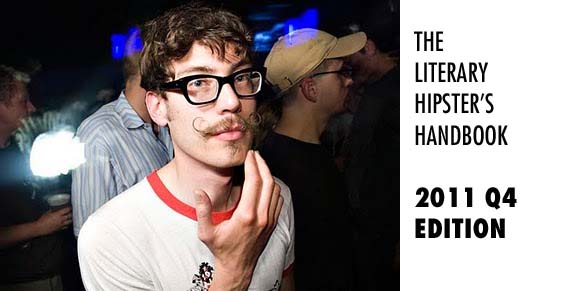
The Literary Hipster’s Handbook — 2011 Q4 Edition

It has been five years since we last published a quarterly installment of The Literary Hipster’s Handbook. But the literary hipsters are still chattering.

“Ames it up”: The act of abandoning all literary activity to write for a television series. Also known as selling out or washing up. Literary hipsters who Ames it up are generally in their late 30s and early 40s and have lost much of their desire to write fiction. They beseech HBO and Showtime to give them a deal, attending dull meetings that are often spearheaded by illiterates, and, more often than not, end up writing material that is of noticeably inferior quality to their fiction. Literary hipsters who Ames it up continue to be observed at cocktail parties, where they are pitied by those who value art and passion more than money and vacuity.

“Duncan donuts”: 1. A hastily written essay written by a marginal literary figure (often of snobbish and humorless temperament) that only serves to widen the chasm initially created by said marginal literary figure. 2. An undesirable meal that literary hipsters should avoid. It is believed that the term was coined by two inebriated literary hipsters attempting to sober up in Dunkin Donuts while discussing Glen Duncan’s review of Colson Whitehead’s Zone One, but has since been used as a way to discourage other literary hipsters from eating anything from Dunkin Donuts.

“Dyer Maker”: A tedious and annoying individual who urges literary hipsters to read the latest essay written by Geoff Dyer. Dyer Makers are considered to be more insufferable than the Bolaño dilettantes, who can be easily forgiven. After all, the Bolaño acolytes are reading actual novels. Dyer Makers, by contrast, are merely reading mean-spirited criticism that has nothing especially original or substantive to say. In response to the Dyer Maker epidemic, several independent bookstores have created 86 lists identifying Dyer Makers in their community. The Dyer Maker is removed from the list once she can demonstrate sufficient knowledge and enthusiasm for D.H. Lawrence’s fiction, rather than some limey asshole’s reductionist take on Lawrence.

“Eugenides Vest”: Inspired in part by the Twitter account, a Eugenides Vest is a garment that a literary hipster wears, but ultimately discards after other literary hipsters have called attention to it. Much as Jeffrey Eugenides has failed to wear a vest at any public appearance after the Times Square billboard, the literary hipster’s Eugenides Vest, which is sometimes identified as a sweater or a scarf, is often considered to be a source of profound shame. It never occurs to the literary hipster that wearing the vest may actually augment the literary hipster’s approval within the community. In DUMBO, the term has also become an alternative term for Dumbo’s Magic Feather.

“to Keith”: To seek publicity and/or media attention by getting arrested at Occupy Wall Street. Literary hipsters who are Keithed generally have little interest in the actual movement and more interest in fulfilling their narcissistic fantasies. Much like those who are woodwinked, literary hipsters opting to Keith seek any excuse to avoid doing work or creating something that is truly ambitious and revolutionary.

“Rowan job”: Inspired by the recent Quentin Rowan plagiarism scandal, some literary hipsters have started to mimic other people’s seduction techniques, attempting to pass these moves off as their own. When the source of these seduction techniques is discovered, the literary hipster is then asked to withdraw from the dating scene due to “legal reasons.” (Note: Not to be confused with rim job.)

“woodwinked”: A feeling of crippling inferiority or needless resentment, sometimes expressed in published form and often mimicking the tone of a drama queen, whereby a literary hipster blames other people for his failure to produce a new novel. When woodwinked, the literary hipster spends much of his spare energies fixating upon some past incident (for example, a review written by James Wood from eight years ago) instead of working on new material. (Ex. Yeah, I’d go bowling with Toby, but he’s been such a drag ever since he got woodwinked.)

National Book Awards — Live Coverage

Reluctant Habits will be reporting from the floor of this year’s National Book Awards, which are being held on the evening of November 16th. Managing Editor Edward Champion will be offering strange observations, photographic evidence, and audio clips on this very page as they come in. He will also be tweeting various thoughts falling within the 140 character range. Please keep checking this page and the Twitter page throughout the evening.

3:28 PM: I have just shaved my head, in large part because my stubble was not long enough this year. For this, I apologize. I have donned a beard when attending previous National Book Award ceremonies. Maybe there will be National Book Award beards that I might grow in the future. The most compelling thought I have right now? Never count out any facial hair configuration. Styles change. So do temperaments.

I have printed off my press credentials. This is apparently a requirement for “entry” and I can’t help but marvel that the National Book Foundation is relying upon quaint paper technology as provenance. I’ve been informed by email that there will be numerous celebrities in attendance, including Michael Moore, John Ashbery, Yusef Komunyakaa, Nell Freudenberger, Yiyun L [sic], and John Waters. I am wondering if Yiyun, who is very friendly, a great writer, and someone who once appeared on The Bat Segundo Show, has shortened her name from Yiyun Li to Yiyun L to augment her street cred among troubled Southern California youth. This is quite a sacrifice. I mean, after the Shine/Chime mess, I find it inconceivable that someone could make a typo on a two-letter surname. I can only draw this conclusion.

Because I don’t usually wear neckties, I have been alarmed to discover that some among my modest collection have decomposed within the closet due to disuse. I have found a workaround and will be dressing up very shortly.

6:14 PM: I have arrived at the Cipriani Ballroom, feeling — after my considerable Occupy Wall Street coverage from weeks before — to be weirdly on the other side of what I usually cover. Policemen have told some of the press assembled here that the Kundera meets Umbrellas of Cherbourg vibe outside, whereby well-dressed rich people walk in straight rectilinear ways and numerous policemen stand on the sides of streets, has only been going down for a few days. Which is a hoot for anyone who has noticed the cops for the past few months. I just talked with the main man Harold Augenbraum and asked him if this was the craziest National Book Awards, security-wise, he’s ever dealt with. Not so. “One year I actually hired security,” said Augenbraum. “Someone threatened to disrupt the ceremonies. We hired security guards.” Apparently, some party objected to the specific choices that year — which may have been 2005. Of course, nobody ever did disrupt the ceremonies. And there aren’t security people that I’m aware of inside. Yet I can’t help feeling too comfortable in here — even if I’m wearing a suit, which is not something I entirely associate with comfort.

7:19 PM: I must say that Edith Pearlman is pretty punk rock for 75.

Correspondent: So here’s the question. Do you think that the Award — how much does it matter do you think? Compared to say the act of writing itself?

Pearlman: Oh! Compared to the act of writing, it doesn’t matter at all. I mean, I think writing is what matters most.

Correspondent: So why are you here then?

Pearlman: Because it matters some.

Edith Pearlman (Download MP3)

This text will be replaced

7:49 PM: My audio conversation with Mary Gabriel, nonfiction finalist of Love and Capital: Karl and Jenny Marx and the Birth of a Revolution.

Mary Gabriel (Download MP3)

This text will be replaced

8:55 PM: There’s been much talk about Occupy Wall Street at the press table (PW‘s Cal Reed says he’s gone down and will again) and among many of the attendees, but the only person who has mentioned it on stage is Ann Lauterbach. Other than Lauterbach, there hasn’t been a single person willing to address it on stage. And, as I learned in talking with nonfiction finalist Lauren Redniss (Radioactive), even some of the finalists lack the guts to air their views. “I have many thoughts, but I’d rather not comment. Thank you so much,” said Redniss at the close of the following radio interview, as she slunk into the clutches of yet more half-baked talk.

Lauren Redniss(Download MP3)

This text will be replaced

The Winners:

Fiction: Jesmyn Ward’s Salvage the Bones
Nonfiction: Stephen Greenblatt, The Swerve: How the World Became Modern
Poetry: Nikky Finney, Head Off and Split
Young Adult: Thanhha Lai, Inside Out & Back Again

The Bat Segundo Show: Téa Obreht

Téa Obreht appeared on The Bat Segundo Show #421. She is most recently the author of The Tiger’s Wife, winner of the Orange Prize and finalist for the National Book Awards (to be announced on Wednesday: check out Reluctant Habits and our Twitter feed for live coverage from the floor that evening).

Condition of Mr. Segundo: Pondering a future in which writers are trained by Carl Weathers.

Author: Téa Obreht

Subjects Discussed: Survivor’s “Eye of the Tiger,” how much one needs to know about tigers, being a National Geographic nerd, research and laziness, readers who have different takes on a story, clumsiness, musicians who become butchers, precise metaphors within The Tiger’s Wife, having the illusion of knowing what you’re doing, talking in first person plural, storytelling and The Secret, regularly arriving at the wrong formula, the elephant scene, deathless men, finding inspiration at the Syracuse Zoo, why brains need to sit with ideas, working in a faux Balkans world, finding verisimilitude for faraway places within common present-day incidents, sharing earbuds on Walkmen and iPods, immediate points within life that connect you to stories, family members who avoid writers, writing what you know “at the moment,” trigger points, similarities between Underground and The Tiger’s Wife, Emir Kusturica, gypsy film soundtracks, learning English from Disney films, legends particular to Belgrade, the Kalemegdan fortress, film as a greater influence for dialogue than real life, Howard Hawks, bad cinematic trilogies, the Qatsi Trilogy, treating fiction as something fabricated, relationships between truth and fabrication, humor bridging the gap between magic and realism, laughing over awful events, Shoah, The Gulag Archipelago, Gabriel Garcia Marquez, The Master and Margarita, finding a humorous path to the real, Stewart O’Nan’s A Prayer for the Dying, bonding emotional with a book, whether death is inherently funny, Fawlty Towers, coffee grounds as personal mythology, thick Turkish coffee in the Balkans, parrots that quote poetry, legends that tend to spring up about English Bull Terriers in Belgrade, Kipling’s The Jungle Book vs. the 1967 Disney film, mythological animals, the rosy Disney view, reading from a non-American standpoint, being shocked by Kipling’s imperialism when discovered later in life, the dangers of embedded narrative, academics obliged to find silly interpretations in order to keep their jobs, mythology that is tied to a specific place, learning everything from Disney, American mythology, cowboy hats and immigrant stories, unnecessary suburban symbolism, hostile reviews from women, being confused as a YA novelist, paying attention to reviews, good art and polarizing people, The Unbearable Lightness of Being, critics who see things that the author never intended, standing by work, having doubts about early work, the inevitability of a few clunkers, deleting pages, overexposure and overexplaining, the possibility of Obreht turning into Smeagol if she wins the National Book Award, becoming corrupted by attention, J. Robert Lennon, insulating one’s self from attention, Sunset Boulevard, the importance of humility, defending the pursuit of writing and the need for books in a terrible economy, Richard Powers’s “What Does Fiction Know?”, the Occupy movements, and fiction as a form of help.

EXCERPT FROM SHOW:

Correspondent: I must confess that Survivor’s “Eye of the Tiger” was in my head on the way over here the entire time. And I have you to blame for that.

Obreht: (laughs) Thank you. I keep hearing it on radios now. Like whenever I do, I get embarrassed.

Correspondent: Really? You get embarrassed? You get shamed?

Obreht: I don’t know why. Because I get really into it. It’s pertinent now. And then I get embarrassed about myself.

Correspondent: Do you get sick of tigers now that you have dwelt upon them quite heavily and you have to constantly talk about them?

Obreht: You know, I don’t think I do. I think it’s just getting more and more entrenched into what I do every day. Every email I send has a tiger picture attached to it that’s pertinent to the conversation.

Correspondent: (laughs) Wow.

Obreht: I’m sure that at aome moment a big break will come and I’ll say, “I never want to see any feline again!” And I’ll kick cats as I go down the street. No, not really. Not really.

Correspondent: (laughs) Violence is welcome on this program.

Obreht: (laughs)

Correspondent: Even hypothetical violence. So you have to become a tiger expert, I presume? Have you been reading up on cats and the like?

Obreht: You know, I studied tigers a little bit for the writing of the book and went and sat in zoos a lot. And I’m a total National Geographic nerd anyway. So it came naturally.

Correspondent: Well, let’s talk about nerdom. National Geographic nerdom.

Obreht: Yay!

Correspondent: How much do you have to know about tigers to know about them? Or do they exist within the wonderful theater of the mind? What’s up?

Obreht: I’m a big believer in the theater of the mind. Especially when you’re dealing with fiction. I mean, there’s only so much you can know. And then there’s only so much of what you know that you can transmit before it begins to be clinical. So I think research, while it helps, can sometimes destroy you. And I was very happy to take a little bit of what I knew and run with that and let a thousand imaginations bloom about tigers.

Correspondent: Wow. So you’ve learned this fairly early on. A lot of writers have to wait decades before they realize sometimes, “You know, maybe I shouldn’t read every book on a subject.” You’ve actually managed to avoid that from the get-go. To what do you attribute this extra wisdom?

Obreht: Laziness. (laughs)

Correspondent: Laziness? Oh, I see. I see. Practical temperament concerns. (laughs)

Obrhet: No. I think I’m always terrified — I think a lot of students that I have had at Cornell have been terrified of not making their intentions known in their writing or not having something clear in their writing. I’ve always been terrified of the exact opposite. I’ve always been afraid of letting too much be known too quickly or hitting the reader over the head with something. Because I know that used to be one of my flaws. So I’m so overly cautious about it that I think that it sometimes cripples me. I think that there are some things that I could research a little more heavily or whatever I write about them.

Correspondent: Being too explicit about stuff. Like. Such as?

Obreht: Such as? I don’t know. I think that such as a particular kind of character interaction or…

Correspondent: Such as?

Obreht: Such as — well, actually I’m thinking about my short story — for some reason I can’t think of an example from the book, but my short story, “The Laugh” — there’s this tension between the two main characters. One is the husband of a recently deceased woman. And the other is his best friend, but also someone who was interested in the deceased wife. And I was terrified of laying this out too quickly and immediately and explicitly at the beginning of the story. Because it would totally break the tension. And so in an early — in the first five drafts of the story, it wasn’t clear at all. And people were like, “Why is this happening?” And I was like, “Well, he likes her! Or used to and now she’s dead.” So, for me, it’s always this holding back and then trying to ease into being okay with the information being there.

Correspondent: Is this one of the chief concerns when you’re going through this endless rewriting and endless revising? To find that tonal balance that really strikes between what the reader needs to know and what the reader needs to infer?

Obreht: Absolutely. And that’s one of the great endeavors of the short story — this negotiation between the reader and the writer and how that information is being transferred. And you can transfer information in a way where the reader knows. Like the implication is already there and all you have to do is trigger it with that one word for the reader’s neural pathways to open up in that particular direction. And it’s so much fun.

Correspondent: You sound like a drug dealer. Dopamine hits or something. (laughs)

Obreht: I do use a lot of caffeine! (laughs) But as a reader, I enjoy seeing how that happens. You know, how I came to the same conclusion as anther reader. That was one of the great exercises of workshop. How did you get to this place with this story? And I got to a completely different place? Or how did we arrive at the same place? Where was the information that led us both there? I love that as a reader. So I enjoy that as a writer as well.

Correspondent: But if you’re constantly revising to get that precision, how do you keep yourself in surprise? Because that, of course, is very important to maintain the life of a story.

Obreht: Oh, that just comes normally. Because I have no idea what I’m doing! (laughs)

Correspondent: Yeah. The big thing that nobody really understands. That writers really don’t know what they’re doing often.

Obreht: Yeah. Exactly. You know, you stumble into things. And you’ll be 75% of the way through something and suddenly it’s like, “Oh, I changed my mind! Actually, this is going to happen because it feels more normal, more natural.” Then you have to backtrack and shift everything. (flourishes with considerable exuberance, nearly knocking an object over)

Correspondent: (reflexes kicking in, saves object from falling off table) Almost knock things over.

Obreht: I’m gesticulating here!

Correspondent: No, no, no. If we knock something over, it will make this conversation 300% better.

Obreht: That’s awesome.

Correspondent: It’s already going very well.

The Bat Segundo Show #421: Téa Obreht (Download MP3)

This text will be replaced
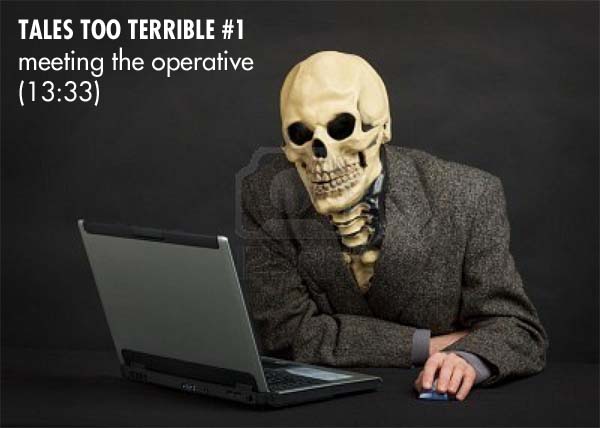
Tales Too Terrible #1: Meeting the Operative

“This is a tale too terrible. It was so terrible that it was plucked from a looseleaf notebook that I discovered from Gregory Stetson. Gregory Stetson. I have made efforts to track this gentleman down. But he cannot be located. The notebook was discovered in a library. It was left on a table. And regrettably there was no address. There was no phone number. There was no email address. What I was able to discover was that this Tale Too Terrible took place on November 19, 2009.”

This is the first in a new project called Tales Too Terrible, whereby mysterious fragments that have been lost or abandoned or disowned by various parties are resuscitated into radio stories running somewhere between ten and fifteen minutes. If you listen very closely, you may discover certain referential clues to other narratives that you may or may not be familiar with. However, for listeners who aren’t interested in such silliness, the Tales are also designed to be heard in sequential format.

There is no set schedule for this project. Whole months may pass by before you get another installment. Or you may get three new installments over the course of the week.

The first installment, “Meeting the Operative,” is thirteen minutes and 33 seconds long and can be listened to below. Click here to go to the second installment.

Tales Too Terrible #1: Meeting the Operative (Download MP3)

This text will be replaced

The Bat Segundo Show: Lawrence Weschler

Lawrence Weschler appeared on The Bat Segundo Show #420. He is most recently the author of Uncanny Valley.

Condition of Mr. Segundo: Feeling 95% himself, wondering why he recoils at his mirror image.

Author: Lawrence Weschler

Subjects Discussed: Masahiro Mori’s “uncanny valley,” Zeno’s paradox, the difficulties of animating the face, getting past the uncanny valley in our lifetime, Quidditch matches, the human face as the welter of emotions, Paul Ekman’s Action Units, how humans are attuned to the slightest variation, human and robotic faces, engineers and college experiments, Nicholas of Cusa and his arguments with Aquinas, circles and polygons, the beginnings of the “leap of faith,” narrative, Peter Paul, and Mary’s “The Great Mandala,” “Marcel the Shell With Shoes On,” Avatar, the human brain secreting stories, the Capgras delusion theory, the Oakes twins, reconfiguring perspective onto a convex plane, Stephen Wiltshire, Oliver Sacks’s An Anthropologist on Mars, tracing the world purely through the eyes, the difficulties in confining thoughts to footnotes, Kepler and how to observe comets, Cinerama, curved projection and straight perception, David Hockney, the illusory nature of “straight” streets, architects who cannot compensate for bowing, natural bowed perception and digital rectilinear recreation, Walter Murch, In the Blink of an Eye, teaching a class with 50% poets and 50% reporters, analog vs. digital editing, the Apocalypse Now Valkyrie sequence reconfigured in Jarhead, crazy remarks uttered by John Milius, whether or not war films inevitably transform into war pornography, Anthony Swofford, authentic war movies, Samuel Fuller, contemplating the idea of a film capable of killing an audience through its authenticity, confusing moths for motes within the twin lights of the 9/11 WTC memorial, Decasia, trusting visual associations when our ocular proof is so unreliable, Everything That Rises, apophenia, confronting paradoxical forms of art, Freud’s unheimlich, a 1982 anti-nuclear protest at Denmark’s Louisiana Museum, responding to David Ulin’s knee-jerk hostility to anarchism, Occupy Wall Street, whether protest is nullified if the activists aren’t aware of the symbolism, Bill Zimmerman, comparisons between the Occupy movement and Polish resistance in the 1960s, politics as theater, “No Drama” Obama, Tahrir Square, the generational conditions of protest, comparisons between Ugandan corruption and American corruption, the lack of an “enoughness” concept, and the acquisition of wealth and the uncanny valley.

EXCERPT FROM SHOW:

Correspondent: Let’s start off with the basis of this book. The uncanny valley. Masahiro Mori’s notion where at a certain point in the evolution of robots — maybe 90 or 95% — suddenly humans tend to recoil if the look or the feel is just not human. The opening essay in this book, which appeared in Wired nearly a decade ago, juxtaposes this issue against Zeno’s paradox, where you’re forever trying to travel the half distance, then the half distance after that, and you’ll never actually reach the end point. You declare “Close Enough for All Practical Purposes” to be the engineer’s ultimate response — this essay, of course, being one in regard to animating the face. But I’m wondering if there’s any legitimate way to reconcile Mori and Zeno. And also, based off of recent developments, is getting past the uncanny valley possible in our lifetimes on the robotics front? What of this? Let’s start off here.

Weschler: (laughs) Well, lots of stuff there. The piece is indeed a piece that I was doing about digital animation of the face. The first of the many pieces in the book. But it sets up a whole set of themes in the book, as you say. At the time, ten years ago, the digital animators had gotten to the point where they could do a hand. They could do a body. They could do a war. They could do a Quidditch match. They could do all kinds of things. But they seem to have hit this wall with the face. And they were getting to the point where it’s interesting — because the face on the one hand is possibly the welter of emotion and things that happen on the face may be the most complicated thing we know. Much the way that it is emphatically the case that the human brain is the most complicated thing we’ve encountered in the world. The human face may be the most complicated thing we’ve encountered in nature in the sense of — it’s a thing where 42 muscles, many of them not attaching on their own, but to other muscles with incredible subtlety and so forth.

Correspondent: Ekman and his Action Units. Unfortunately reduced by Gladwell.

Weschler: Right. Well, there you go. But the point is that, on the one hand, the face itself is complicated. On the other hand, and parallel to that, humans are incredibly attuned to the slightest variation. You could look across the street and see what somebody is looking at. Think about that for a second. Basically, what you’re doing is you’re zoning in on where the whites of the eyes are compared to the pupils and how much squint is happening. There’s tons of stuff going on in the brow. But that allows you to triangulate from — if you think about how tiny a part of your visual field that is, you get all that information. So we are incredibly attuned to that! We’re not particularly attuned to bellies or to kneecaps. But faces we’re attuned to. So indeed you get this problem that it’s both the most complicated thing and we have the most complicated response to it. And the question that was beginning to arise with these people was whether it was ever going to be possible at all to do it. And they indeed talked about the uncanny valley. Now interestingly, Mashairo Mori’s idea was about robots. And he would say that if you got 95%, great. That was fantastic. But 96%, suddenly it was revolting. It was a kind of revulsion. And one way of thinking about that is that, at 95%, it’s a robot that’s incredibly lifelike. And 96%, it’s a human being with something that’s wrong. You can’t figure out what. Now the interesting thing about robots. Forget the face for a second. But robots — the valley you go into, where it’s revolting, maybe only goes up to about 98% and then it comes out of it again. The whole thing is that you do get out of the uncanny valley. The questions with faces is whether you ever get out of the uncanny valley. Whether if you made it 99.999999% perfect, it would still be icky. In fact, we’d get ickier and ickier. In some vague way that we can’t quite identify.

Correspondent: And even if you could, perhaps there would be a new uncanny valley with which to mimic.

Weschler: Well, and that brings us to Zeno’s paradox. The paradox of: you can get halfway there and halfway to halfway. The whole point was that if you shoot an arrow, and the arrow gets halfway to its target, and gets halfway to its target again, before it gets halfway to its target in that remaining distance, therefore it could never get to its target.

Correspondent: There’s also a Cal Poly variation of that. Where they have these students gradually move half the distance, half the distance, with a very attractive woman at the other end.

Weschler: And that’a a variation on the old joke about the Oxford dons. They’re talking with each other. One of them’s an engineer. The other’s a mathematician. I think you referred to that in your opening question. And they’re talking about Zeno’s paradox. And at that moment, a beautiful woman walks by. And the mathematician despairs of ever being able to attain her, but the engineer knows that he can get Close Enough for All Practical Purposes.

The Bat Segundo Show #420: Lawrence Weschler (Download MP3)

This text will be replaced