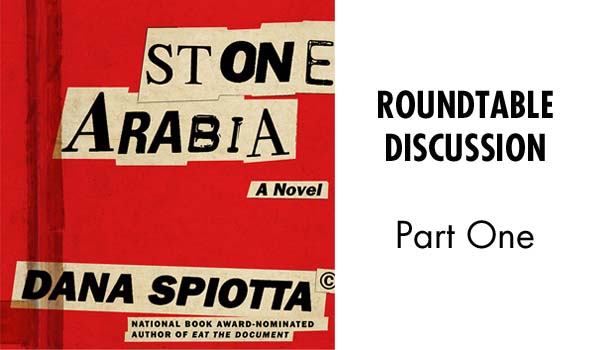
(This is the first of a five-part roundtable discussion of Dana Spiotta’s Stone Arabia. Additionally, Spiotta will be in conversation with Edward Champion on July 20, 2011 at McNally Jackson, located at 52 Prince Street, New York, NY, to discuss the book further. If you’ve enjoyed The Bat Segundo Show in the past and the book intrigues you, you won’t want to miss this live discussion.)
Additional Installments: Part Two, Part Three, Part Four, and Part Five
This week, Dana Spiotta’s third novel, Stone Arabia, hits bookstores. Spiotta is previously the author of Lightning Field and Eat the Document and also appeared on The Bat Segundo Show #28. Reluctant Habits will be devoting the entire week to authors, journalists, critics, bloggers, and various readers discussing Spiotta’s book further. We’ll be serializing the conversation in five chunky installments from Monday through Friday.
Edward Champion writes:
I don’t want to give away the ghost from the outset (although it’s possible that I may be remarking on a spectre), but it’s interesting that a novel depicting how we respond to art should begin with an epigraph from Jean Dubuffet, who believed very much in the idea of lower art (specifically images and paintings) possessing greater authenticity and humanism than loftier cousins, while ending on the ultimate image wish fulfillment: in 1972, Nikolas Kranis (aka Nik Worth and possibly the sketchy Nik Kat) is photographically positioned as rock star paragon for his sister Denise and his then girlfriend Lisa. But that artistic status is also there in the order of his room, the makeshift coffee table, and the sundry posters arranged in “idiosyncratic” spots throughout his garage studio. So the big burning question I have for you good folks, one I’ve been dying to ask you for weeks, is what you think this all amounts to.
 Here we have Nik, a musician who has devoted decades of his life (1970s-2003, a time period that intriguingly matches how long it took Brian Wilson to get around to finishing Smile, which I bring up because the Wilsons features prominently in Spiotta’s previous book, Eat the Document, and also because the gloriously hallucinogenic “Mrs. O’Leary’s Cow” now blasts through my speakers; but I digress) to two bona-fide private projects: the Chronicles, a written compendium of journal entries, press clippings, and assorted articles in which much of the biography has been fabricated (and which contains, moreover, any number of inside jokes and prevarications), and The Ontology of Worth, a twenty album project released in descending order (last volume timed with his fiftieth birthday) to Nik’s immediate circle of family and friends. For Denise (our primary guide through this book) or Ada (Denise’s daughter, a documentary filmmaker who soon beings work on Garageland, a Nik documentary named after a notable Clash song that begins “Back in the garage with my bullshit detector…”) to make sufficient sense of this, they must wade through a bogged labyrinth of invented personae, cruel parodies mimicking and meticulously referencing their real lives, and other wetware manifestations that serve in lieu of the truth (Nik, washed out rock star suffering from gout, reliant upon family handouts, brittle vocational truth not revealed until very late in the book). (“Versions of Me” indeed!) So we are forced to confront difficult questions: Is Nik, who is clearly capable of impressive encyclopedic insularity, building up to his own masterpiece akin to Smile? Or is he, as many of the characters in Spiotta’s previous novels have been, an impostor? Some go-nowhere bum to be pushed into reality or an unhatched autodidactic genius who requires encouragement? Is Nik’s private work, emerging from the house he calls Cafe Real (perhaps with a shit-eating grin or a “smiley smile”), more humane and authentic in its lower and personal efforts than his efforts to pin down power pop through The Fakes or glam aspirations with The Demonics?
On the other hand, what right do any of us have to make judgments on artistic intentions — even the fictional ones contained within this book? Just to be clear on this, I certainly don’t wish to hinder any of you from doing so! But to my mind, Spiotta promulgates a legitimate question: What are our judgements worth when so many people (including the characters in this book) are talking over the cinematic soundtrack, providing their own commentary? (Even Nik is seen writing “while someone is talking to him.”) That goes for the YouTube commenters seen near the end of the book, who present their own theories and are mostly interested in the old Fakes footage, as well as the “scripted” interviews from Ada’s film-in-progress — a stylistic technique Spiotta also deployed in Lightning Field. To what degree is the text that Nik or Denise present commentary? And if Nik’s Chronicles are “a private joke he doesn’t have to explain to anyone,” why then has he (or, for that matter, Spiotta) layered the joke with so many inside jokes (some explicitly mentioned, such as Neil Young’s Skyline Drive; some not, such as the Garageland reference I pointed out above)?
 Would we be more satisfied accepting art on its own emotional terms? That’s a big question too. Because just look at the serious grief Denise offers in response to the news cycle, the ostensible “reality” that she feels compelled to confront. She can’t even name Lynndie England as she takes in the Abu Ghraib photos, but, much as many (including Nik) speculate on Nik’s character, she finds herself fixating on England’s “storm chasing,” even after Denise confesses that she “eluded any explanations.” Perhaps this is the ultimate response to Debuffet. And if we want to bring up Susan Sontag’s “Regarding the Torture of Others” into this discussion, to what degree do you think Sontag’s thoughts (“To live is to be photographed, to have a record of one’s life, and therefore to go on with one’s life oblivious, or claiming to be oblivious, to the camera’s nonstop attentions. But to live is also to pose. To act is to share in the community of actions recorded as images.”) inform this novel or even our experience beyond the novel? Must we accept all this if we wish to have a relationship with art? Has the advancement of artistic creation and artistic commentary made us merely Able-Bodied Adults Without Dependents, Voluntary Missing Adults, or (to offer a pleasantly overreaching take on the book’s affinity for acronyms) inversions of “dad” (Ada) who feel compelled to shoot attention-seeking video instead of seeking “basic words of familiar vocabulary hid behind missing letters”?
I realize that’s quite a lot to trot out, especially since I haven’t mentioned Denise’s twin concerns of aging and declining memory, to say nothing of the book’s frequent concern with trading off accumulation for elimination. I’ll leave others to remark on some of this before I jump in again. But I can’t resist closing this jam-packed opening with Spiotta’s joke about Denise having a “sort-of boyfriend” named Jay, who teaches art history (and sometimes film). This is a pretext to get laid and watch James Mason films in lieu of actually living outside the house. But the truly sad thing is Jay’s interest in Thomas Kinkade and how this meaningless affair is, for Jay, an excuse to maintain a minimum of grooming habits. I have to ask whether you folks think there’s anything redeemable in this relationship. Or is this relationship, like many of the distractions presented in the book, a reflection of some new dull narcotic and wholly insufficient existence in bloom? Perhaps it’s something referenced to the Stones’s “Dead Flowers” — an especially bleak song representing the Stones’s effort to shift to country that Nik likes to play every New Year — “I’ll be in my basement room, with a needle and a spoon.” Steering from your natural voice creates some fairly rocking material, but at what gloomy cost? Another of Spiotta’s inside jokes, especially since the Stones refused to play this song live for quite a long while.
Sarah Weinman writes:
There is so much to unpack in Stone Arabia, and, by extension Ed’s wonderful and jam-packed opening salvo, that it almost threatens to do my head in! As such, I’m going to do an end-run and touch on a couple of topics Ed didn’t bring up, with the hope of circling back a little later on.
 First is the idea of audience, and even that idea, as filtered through Spiotta’s novel, goes off in a number of different directions. There’s young Nik playing and posing to his girlfriend Lisa and Denise, the image Spiotta returns to in a big way at the end of the book (and which led me to a particular conclusion about the book that I’ll get to in a bit). Obviously, there is Nik’s choice to conduct his massive project more or less privately, with Denise as his primary audience, commentator and admirer. There’s Ada and her documentary, wishing to bring her uncle into the light of a greater audience. All have intentions, noble and selfish, thoughtful and venal – and that’s one of the many things that so impressed me about Stone Arabia, which is that it tackles the notion of whether the expression of art is “purer” with a tiny audience while also subverting it. Does art function in a vacuum? Is “selling out” a less worthy or more worthy goal? Spiotta simply presents possibilities here, but it’s up to us, as readers, to come to our own judgments, and then, in reaching them, get hoisted by our own petard because we sought some element of rightness or wrongness here.
Then there’s the relationship closeness of Nik and Denise: she’s his closest confidante and supporter, he’s the conduit by which she can express her own nascent artistic desires, or think she can. There’s some double-fold work here, because, on the one hand, brother-sister closeness seems to resonate a little less in literature than same-sex sibling relationships — unless there’s some cliched element like “brother protecting little sister from bad boyfriend” or vice versa. (I love, too, that the deepest love in Stone Arabia is familial — brother-sister, mother-daughter — and romantic attachments are almost incidental, never measuring up in terms of emotional power.) But in this case, Nik and Denise are both protecting and perhaps enabling each other: if Denise wasn’t around to be Nik’s #1 admirer, might he have reached that larger audience? Or was her active support really the only way for him to produce those many albums and to stay on the “right side” of artistic integrity? And is Ada, Denise’s daughter, representative of Denise’s admiration the next generation over, or is she part of some weird familial artistic triangle that will upend everything?
Based on what happens to Nik — his disappearance and his canny self-obituary, seemingly left for Denise to find after he’s gone — it seems like the explosive triangle is the likeliest option. But again, I love that Spiotta leaves it open for interpretation. Which is ultimately why I read the end of Stone Arabia as Denise’s attempt to rewrite her own family history, to put Nik on some kind of artistic pedestal while also finding a framework to focus her own thwarted ambitions. (“I feel like I am him, this is my little edge of want.”) Or, to riff off of the “impostor” idea Ed mentioned, Nik and Denise’s artistic output are the same, manifold in different expressions, and even if it turns out that this whole massive project may be in Denise’s head, a manifestation of shifting (even failing) memory, or that she essentially created “Nik Worth” so she had a more legitimate way of expressing her artistic self (which would also help explain her evasion on camera when talking to Ada — her own daughter! — about the so-called origin events of how Nik came to be a rock star) it still doesn’t negate the artistic truth of what’s been expressed. Or, to state it more simply, does it matter who created or who expressed art when the art itself carries so much meaning for whomever experiences it?
I came away from reading Stone Arabia wanting to experience art more fully and more deeply, but also caring a little less about the semantics of it all. There’s so much to rewrite and rework and reshape that, ultimately, it’s the context any audience member or reader or observer brings that adds vital truth to it – especially if the bonds are so strong, so familial, as to attach even greater importance to what’s being created.
Levi Asher writes:
Well, I think I’ll take a cue from Sarah and avoid responding to Ed’s impressive questions (because I don’t know how to answer these questions) and instead kick off with my own first impressions of the novel. There will be time to circle back in this roundtable later, I’m sure.
First, unlike Ed and possibly Sarah, I never entertained for a minute the idea that Nik Worth could be considered an artistic success, or that he could be seen as having any artistic integrity based on his extremely weird decision to fork off a fantasy career as a rock star after the evident failure of his real career as a rock star.
He is a gigantic success, in my opinion, as the central character in this novel — I love the character (and, since it happens I’m nearing the age of fifty myself, and am also grappling with the gap between my own fantasy career and reality career as a writer, I relate to him more than I want to admit). But Nik Worth could not have seen himself as a success, and neither Denise nor Ada nor anyone else could possibly have been proud of him. His retreat into fantasy seems to me a mild analog to schizophrenia. His decision to detach himself from reality and find solace in a world of sarcastic self-reference is like Alonso Quijana’s decision to become Don Quixote. And everybody knew that Don Quixote was mad.
 I think Ed and Sarah have done a better job than me of analyzing the many connections in the novel — I didn’t think about Brian Wilson, though I did think of Spiotta’s great Eat The Document often while reading Stone Arabia — but I did form one strong impression that neither Ed nor Sarah focused on. To me, it’s obvious that this is a book about memory. There are five characters in the book: Denise, Nik, their mother, Jay the boyfriend, and Ada. They form a pentagon of attitudes about memory.
Denise feels everything, remembers everything, takes responsibility for correcting everybody else’s memorial imperfections. She’s not only her family’s conscience, but also the conscience of the world, and she both suffers mildly for this and rewards herself for her honesty.
Nik, of course, is remarkable for his protest against truth. He doesn’t like the world, he doesn’t like the way New Wave and power pop and MTV destroyed the operatic classic rock visions of the great 1970s, and so he tells the world to fuck off and departs from reality: first mentally (when he begins the Chronicles) and then physically when he drives off with his car and guitars into complete oblivion.
Their mother represents the tragedy of memory — she needs it as much as all of us do, but it has left her, and she’s struggling without it.
Jay the boyfriend represents the same escape impulse as Nik Worth, but he escapes in a more “normal” and socially acceptable way: by absorbing himself in Thomas Kinkade paintings, elegant 1950s cinema, and friendly lukewarm sex.
Ada the cheerful filmmaker-daughter represents the youthful fascination of memory. Charged with creative spirit, but too young and unformed to obsess (yet) over her own thoughts, she feeds rapaciously on Nik’s quiet insanity, turning it into YouTube fodder. The fact that she barely seems to care when her uncle disappears demonstrates the lack of depth — a condition of the very young, I suppose — of her own memory at this point, though of course the crises of life await her.
That’s my first takeaway. The other thing I want to say about Dana Spiotta’s writing is that, more than anything else, I appreciate reading a novelist who truly understands the grand masterpiece proportions of 1970s rock music. An Aladdin Sane birthday cake, indeed!
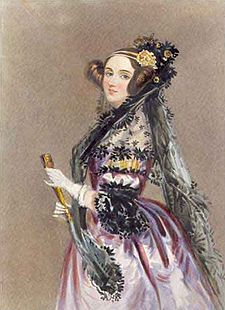
I will attempt one response to Ed’s avalanche of conversation-starters. Ed suggests that the name Ada is an inversion of “Dad,” which is intriguing, and I’d like to hear more examples of acronym-play and inversion-play in this novel. However, I’m completely sure that Dana Spiotta named this daughter after a famous daughter named Ada. Ada Lovelace was the daughter of Lord Byron, and was notable for her own work on early computer prototypes. The computer language “Ada” was named after her, and since computers do nothing but operate upon memory, this connection supports my idea that the whole book is about memory.
But the reference to Ada is a clever inversion of a different kind, because, of course, Ada’s father Lord Byron was widely believed to have had a sexual affair with his sister.
Diane Leach writes:
I’m with Levi — I’m not touching Ed’s analysis.
I had a strongly personal reaction to this book. My brother is a professional musician who, until recently, worked exclusively in Los Angeles. My brother deals with much of the bullshit Nik endures, though, unlike Nik, he is functional and earns a living. I also found this difficult from the same standpoint Levi did: at 43, I find myself gaping at the yawning pit between my “real” writing career and the one that did not happen.
I interpreted Nik’s retreat from the music business and the conventional definitions of artistic success (this may be self-serving on my part) not as failure, but as a decision. Nik is clearly a brilliant guy whose talents would permit him to do whatever necessary to attain broad popular success. Look at the Lux Smith interlude — Los Angeles is full of these guys. Nik is hardly the type who will tolerate such people. Is retreat a form of purity? I suppose it depends on what one wants from her art. The great ballerina Suzanne Farrell, in her biography Holding On to the Air, writes that she hardly intended to spend her life dancing in her living room. Does this make her art better or more important than Nik’s? I don’t think so. Our current artistic culture — in all the arts — is too often a definition of the lowest common denominator. Where would a polymath like Nik Worth fit? In today’s culture, he’d be reduced to a “niche market.”
Interesting to me that nobody noted that Stone Arabia was about loving somebody who is incapable of returning that love. Though Nik loves Denise, as he ages, the relationship moves from siblings on reasonably equal footing to a caregiving situation. Denise is also left as sole caregiver of her mother; Nik rarely even visits. We’ve all known or loved Niks — people who are so gifted, so charismatic, that we fall for them and continue to accept bad behavior long after we should have cut them off. Think Kurt Cobain, Jim Morrison, or the dazzling lover or friend who took your life over, fucked with your head, and who is now gone (interesting how so many of these people end up dead). But this type continues to absorb too much available brain space. Denise is fully cognizant of Nik’s shortcomings, particularly his drug abuse:
If it came up at all between us, it was usually because I decided I wanted him to change his habits out of simple health…He would simply tell me that this was his consolation. And what could a sister say to answer that?
Yet she defends him to Alize:
“This is a person, if ever there was a person, who will not change. I promise you, all you have is all you will ever get…”
Denise sticks around. Alize does not.
The changes in POV are interesting too. Here is a book-within-a-book, possibly two books: the third-person narrative focusing on Denise, Denise’s frantic first-person correction of Nik’s extensive Chronicles. Atop all this is Ada’s film, which is posted to the media of the moment: YouTube, where Nik’s life becomes an object for public dissection.
Spiotta throws in a lot (to borrow a word from the book) about perviousness of media. The news, such as it is, has become inescapable. Those hideous crawl strips throwing more information at us even as we watch Chechens attack children. We turn off the televised images of Abu Ghraib only to find them on the Internet. Denise is aware that her tears are self-indulgent, but cannot stop crying. Perhaps her obsession with news is a way of coping with the loss of her family — it’s far easier to cry over the suffering of strangers. Then again, how are we to cope with the endless procession of horrors?
Ada is very much of her generation: specifically, younger adults who don’t recall life before the Net. They post extensively on their own lives and the lives of others; there is a compulsion to document every moment publicly. Her decision to be a filmmaker is not surprising. Nor is her blogging.
 As for Jay, he seemed to me an aside. His twee obsession with Thomas Kinkade kitsch and lukewarm kindness means Jay lacks the capacity to harm Denise. He’s a warm body. Given that all of Denise’s energies are tied up in Nik and her mother (Ada is independent enough that Denise arguably needs Ada more than Ada needs her), she hasn’t room or inclination for anything more in her life.
One more note before closing this missive: As the book moves toward the end, we realize Nik is going to commit suicide. Denise decides she cannot stop him. She would never interfere with what she knows to be a carefully thought-out plan. But she goes on to say she was meant to “endure.” To see things through — aging, burying their mother, taking full responsibility for Nik’s archives. “I would stay, waiting for the terms to unfold around me. That’s the price you pay for staying around.” Or, that’s the price you pay for compromising, for accepting the mortgage payments, the dental appointments, the day job with health insurance, from turning away from the uncertainties of the artistic life. The page left me sad. Nik’s life may not have been what he wanted — it’s hard to say — but Denise’s love and devotion leave her with scarcely little happiness.
Our Next Installment: Part Two features a footnote-charged cover dissection from Darby Dixon, thoughts on reader obligation from Robert Birnbaum, insights into concession from Insulted by Authors’s Bill Ryan, and connections to hoarding from Roxane Gay.