The Bat Segundo Show: Ross Perlin

Ross Perlin appeared on The Bat Segundo Show #393. He is most recently the author of Intern Nation.

Condition of Mr. Segundo: Wondering if he somebody signed him up for an unpaid internship.

Author: Ross Perlin

Subjects Discussed: Economic origins of the intern, Gary Becker and human capital theory, how economics contribute to intern culture, humane paid internships and varying definitions of “investment,” spending money to work for free, theological comparisons between internships and indentured servitude, free will and the virtual requirement of internship, Max Weber, the Fair Labor Standards Act, legal exemptions for trainees that permit unpaid internships to run rampant, Walling v. Portland Terminal, “employee” vs. “trainee,” the Department of Labor’s failure to enforce the FLSA, the loss of union and labor power in the last several decades, the six criteria for unpaid interns, why the internship phenomenon is largely white-collar, the many permutations of “perma,” college students who sacrifice considerable money but don’t get the college credit, education institutions who outsource oversight to corporations, the myth of academic credit in college interns, the assumption that college students know what they’re getting into, Lippold v. Duggal Color Projects (link to PDF), Lowery v. Klemm, sexual harassment of interns, discrimination and civil rights, interns forced to prove to the courts that they are legitimate employees before they can pursue grievances, power dynamics between interns and employers, the false sentiment that you can’t be a student and a worker, Marc Bousquet’s How the University Works, addressing correlation between increased wages and economic cycles, unpaid interns as the new temps, how short-term economic logic galvanizes present employment practice, middle-class hypocrisy as epitomized by Benjamin Kunkel, living wage movements, apprenticeships as both a legitimate alternative to internships and “the best kept secret,” the Fitzgerald Act, interns as the subject of cultural ridicule, the complicated class dynamics of internship, being privileged and exploited at the same time, interns and the working poor, the “winner take all” nature of the white-collar world, US vs. UK attitudes about interns, the difficulties of corroborating a secret world, and journalism as the first draft of history.

EXCERPT FROM SHOW:

Perlin: It’s really clear that interns are used to plug holes. They’re used to plug operational holes. They’re used when there’s a hiring freeze. Whenever the wall has been hit in terms of labor costs supposedly for the employer. So that much is clear. In terms of the businessman who says, “Well, economically I can’t pay these people. I can’t do this. I’ve got a business to run,” I would say that is short-term economic logic at best. And at worst, it’s kind of a dangerous move.

Correspondent: Well, elaborate on that. Short-term, dangerous — what do you mean by that?

Perlin: Short-term in the sense that, by every measure, paid internship programs are better than unpaid. And so cycling back to something we had mentioned earlier, taking the long-term view — investing in people, investing in interns, investing in your newest employees in general — is something that has been shown to pay great dividends. To make it more concrete, I mention one example in the book of an employer that saves substantial money through a paid internship program. Because they save on recruiting costs. It’s used as a talent pipeline. Their success metric — something like over 50% of their interns can be hired in full-time roles. They basically calculated that their costs, as opposed to just having to go out and recruit new full-time employees — would be lesser if they could bring people in as interns. Interns are always going to be lower paid than regular employees. The costs are not that great. I mean, if you’re just talking about minimum wage for interns, this is not something which is really going to affect the bottom line that much. I mean, in a huge number of companies, you can have 1,000 interns for the price of one executive. I mean, that is the kind of spread we’re looking at these days in terms of salaries. So a company like this sees the economic sense. They do hire people. So, of course, if you don’t hire people at all, then maybe this sense would break down. But there’s a huge difference between the company which just uses interns on a short-term basis — unpaid. They have access to a narrower applicant pool for their internships. They don’t have access to the widest array of talent. A number of people I talked to reported that when they were going from paid to unpaid, or unpaid to paid, the quality of the people you get changes a great deal. Because if you have a paid internship program, just about anybody can apply, relatively speaking. Also, if you advertise it transparently, if you put it out there kind of like a job more or less, you’re going to have access to a broad talented pool of people.
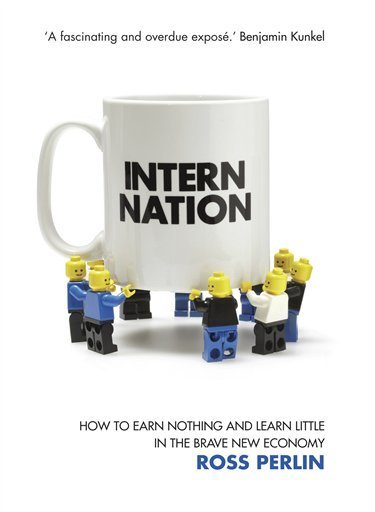
Correspondent: Well, I was going to say that just having a short-term viewpoint isn’t enough. I want to give you a very good example. It’s right on the cover of your book. You have Benjamin Kunkel. He is one of the editors of n+1. He’s blurbed this book and he’s called it “a fascinating and overdue exposé.” But n+1, they, by the way, have interns who are not paid, who are involved according to the n+1 website with “printing, distribution, publicity, subscriptions, web administration, transcription, carrying boxes, and bartending.” So, in other words, it doesn’t sound all that different from say the Disney College Program or even a government internship, which we haven’t even talked about. There’s even an alleged Twitter feed of the n+1 interns. And I’m not sure if it’s a joke or if it’s actually them. But if Kunkel can commend your book and call it a muckraking exposé, while simultaneously turning a blind eye to the fact that, well, he’s not going to be able to keep n+1 going without his interns, isn’t there a certain hypocrisy in this? I mean, if middle-class society uses and exploits interns, then what hope is there for changing people’s minds? Will they ever even see beyond the short-term? I mean, I agree with you that they probably should. But Kunkel, liberal-minded gent, look at what he’s doing.

Perlin: The publishing industry is one of the worst. It’s one of the worst offenders. The publisher of this book, Verso, has announced, making me very happy, that they have a well-paid, well-structured program. And I know they’re trying to spread that model in the world of independent, even left-wing publishing. But truly this has been an unpoliticized issue that it doesn’t rise to the level of consciousness. All kinds of people who see themselves as championing workers’ rights or who see themselves as liberal completely ignore this issue. Or they figure that all these interns are rich kids. So they can afford it. “It’s not a big deal if we don’t pay them.” Well, that’s an interesting statement. But, first of all, I would uphold the right of everybody to be paid for labor no matter what their background. And so I think to introduce a double standard is actually a dangerous idea. Even though people informally air that kind of opinion all the time. But, second of all, if indeed they are kids born with a silver spoon in their mouth, the question is: Why are those your interns? Well, because they’re the only ones who can afford to work for the non-pay that you’re offering. There probably are some smaller organizations getting off the ground that would have trouble surviving if they didn’t have interns. But in most cases, whether it’s a small liberal magazine in Brooklyn or a startup in the Midwest, whatever it is, they use interns to extend what they can do. To build up their capacity. To try and do more. They do it because they can. Because it’s there. And they haven’t questioned it. And one thing I’m hoping to do with the book is to politicize it such that anybody who wants to get up on soapboxes and say, “This or that is liberal. We should fight for workers. Protect workers and social mobility and social justice and talk about these kind of things,” will also look at their own workplace practices. But this is a much larger issue of people practicing what they preach, right?

Correspondent: Yes.

Perlin: In terms of work. In terms of labor. There’s so often a disconnect. Look at college campuses. Supposed hotbeds of liberalism. You walk into the lecture halls and you have Marxist professors elaborating on this or that. Until a few years ago, and this has only been in a limited kind of area, the people you had actually picking up the trash and keeping a campus running, cooking the food, etc., there was often very little connection between those big picture ideologies which are going on in the classroom and the treatment of those workers. The living wage movement on some campuses tried to rectify that and made a connection, but often you had people on those campuses theorizing about things that were happening in China or around the world, but not noticing the realities of work on their own campuses.

Correspondent: Well, interns — not only are they invisible to even the liberal-minded, but they also are something that people don’t want to see. I mean, you have people who are the working poor who are invisible. What is the solution to making them more visible? They are people too. They have debts they must pay. On the other hand, you also bring up apprenticeships in this book. But even electrician Don Davis tells you that apprenticeships remain the best kept secret. The interesting thing about apprenticeships is that they do pay an hourly wage. Some of them even provide healthcare, pension plans, day care, and the like. Is it really a matter of trying to make people more aware of something that’s secret? And if people in a business become more aware of something like apprenticeships, well, they may very well declare war upon them in the same way that they keep the concept of an intern invisible within their own folds. So do we start replacing internships with apprenticeships? Not necessarily just with books, but with people raising pitchforks in the streets?

Perlin: It’s amazing the extent to which apprenticeships — these are trade apprenticeships; blue-collar apprenticeships — are invisible to people who are not in that world, who are not in the trades. Especially in construction, which accounts for generally about 60%. 60% of all apprenticeships are engaged in construction overall. So unfortunately, yeah, if you raised more awareness about apprenticeships, it’s possible that there could be more of an attack on them. That there is legislation relating to it — the Fitzgerald Act, which established a registered apprenticeship program and standards that I see as a kind of model. Again, not incidentally, in the 1930s, as part of the golden age of labor legislation. I think that the reason apprenticeships have remained as they are is because these are generally heavily unionized fields where there are certain standards about what work should look like, what the humane experience is like, and because they work in a longer-term mentality. It’s something that’s been going on for seventy years. And from the employer’s point of view, a lot of employers welcome apprenticeships. And, in fact, the battle often is between the union and the employer over overuse of the apprentices by the employer. Because, even though apprentices are being well-paid and have a lot of benefits, as you say, relatively they’re still cheaper than using a post-apprentice union member worker. Which to me is indicative of the fact that internships would survive quite well, even if there was more regulation. Because again, interns will still represent quite a cheap reasonable solution for businesses to bring on new workers and to accomplish certain work. Even if they have to pay minimum wage, there will be quite a lot of scope for internships.

In terms of raising pitchforks in the street, I think apprenticeships are a real model for internships to look to. But it’s a huge hurdle to bring a blue-collar practice into the white-collar workforce in an era when the white-collar workforce is seen as the norm and the vanguard and setting the standard. It was shocking to me. And I think it’s shocking to a lot of people that here’s something that the blue-collar world is doing so much better. Training and bringing in young people and having a humane program. Invisibility? Yeah. I think there’s an invisibility about labor more generally. Interns are not invisible in the same way that apprentices or the working poor are. They’re featured in pop culture. Everybody sees them around. It’s known who’s the intern. They might wear a certain badge. Like in Washington DC, there’s a particular intern badge everybody knows on Capitol Hill. And people like to talk about interns. And it’s funny.

Correspondent: But they’re also the subject of ridicule.

Perlin: But often that visibility is that they’re kind of a laughing stock and that they’re figures of fun. But I think people do look at interns and they see middle-class kids. They see people who might become them, who they might work with later on. So there’s an atmosphere of civility. And there’s not the class distance often that there is with the working poor or with blue-collar workers, where there’s this feeling like, “Oh, that’s almost the other.” That’s a different somebody else. So that, in itself, represents an interesting problem. The class dynamics of internship are complicated for that reason.

Correspondent: But you’re dealing also with a certain dichotomy of perception. Wisconsin. People are really supporting the unions there. Interns? Not so much. Because of this idea: “Well, they knew what they were getting into.” It’s fascinating to me that there would actually be a strange inverted disparity with the unpaid white-collar worker versus the paid blue-collar worker. Or the paid social services worker. Do you think that’s part of the problem too? I mean, is there any way you can change that cultural perception? Especially since you have it supported not just by media reinforcement, but also by the fact that the U.S. government alone uses a lot of interns in various capacities. And it’s highly competitive. For the reasons we talked about earlier.

Perlin: Well, I think it’s hard to know what the degree of public support for interns is. In the UK, the public has been polled on the issue. And there’s a very strong feeling that interns should be paid. And a very strong majority feels that what goes on now is wrong. In the U.S., it’s hard to know. But I suspect you would still see most people thinking interns should be paid. But there are complex feelings. And I think that part of it is because there is, as you say, a strange dichotomy. Interns are both privileged and exploited at the same time. They’re privileged in the sense that they do have access to this experience that might put them over the top. That they can get into the white-collar workforce. They’re not in as bad a situation, arguably, as people who simply cannot pay to play and will never break into the white-collar workforce.

(Image: “The New Interns” by Nik Wilets)

The Bat Segundo Show #393: Ross Perlin (Download MP3)
This text will be replaced

Review: Cave of Forgotten Dreams (2011)

There was a time not long ago when I was a booster of all things Werner. Here was a man who contended with the twin terrors of Klaus Kinski and Bruno S. – the former was given a fascinating documentary, My Best Fiend – allowing them to explode into mad rages on set. He had stolen a movie camera to get his career started. He had moved a boat over a mountain. He had been shot during an interview and carried on talking. For Little Dieter Needs to Fly, he explored a Vietnam vet’s experience of being tortured and starved by hiring Laotian locals to tie him up and recreate the experience. Herzog was a bona-fide original, a maverick devoting decades of his life pursuing the perverse and the idiosyncratic.

But my feelings on Herzog changed a few years ago when he decided to rethink Abel Ferrara’s masterpiece, Bad Lieutenant, without respecting the artistry of the original. Ferrara wasn’t pleased. “I wish these people die in hell,” said Ferrara at a press conference. “I hope they’re all in the same streetcar, and it blows up.” Herzog replied, “I have no idea who Abel Ferrara is. I’ve never seen a film by him. Is he Italian?” This seemed out of character for a man who had gone out of his way to chronicle the misfits and the misunderstood. Surely a man as thorough as Herzog would have checked out the original film before signing on. While the resulting film, Bad Lieutenant: Port of Call New Orleans, had its moments, it served as a sad concession to the sausage factory. Herzog had at long last gone part Hollywood. David Lynch helped Herzog make My Son, My Son, What Have Ye Done? with schlocky results. And now we have Cave of Forgotten Dreams, a 3D documentary about the Chauvet Cave.

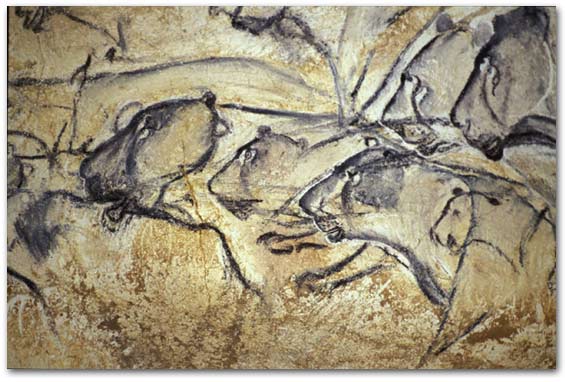
The Chauvet Cave, a subterranean treasure trove of Paleolithic paintings discovered in 1994, is a near foolproof subject for 3D. The paintings depict now extinct panthers of which there is scant trace of fossils. There are depictions of Venus-like figures, along with striking perceptive shifts created by the cave dwellers over time. The cave itself has been sealed off from the public to prevent Lascaux-like destruction. Film is the only way in which we’re likely to see it. That Herzog managed to get what he did, when he was limited to staying on the paths and when he could only shoot for four hours a day, is a testament to his tenacity. Sure enough, the dripping calcite compounds, the plentiful passages, and the stark stalacites framing the cave art certainly inspire a genuine sense of awe as you’re wearing the glasses.

The problem here is that we’re dealing with the post-Bad Lieutenant Herzog, a carnival barker more interested in badgering us into wonder rather than seducing us into how people live. Herzog is the type of narrator who compelled to boom “How did they live?” multiple times while the viewer is trying to form her own impressions of the art. And this becomes an annoying intrusion. I mean, imagine that you’re staring at Guernica and some intense German sneaks up behind you and keeps saying, “Do you see how great this is? Do you see how they died?” You begin to wonder if it’s possible for some authority in Madrid to issue a temporary restraining order so that you can rid yourself of the creepy man who wants to get inside your pants but won’t take no for an answer. That Herzog’s overbearing narration comes with bad Baywatch jokes doesn’t help matters. Who knew that Herzog was the Paul Reiser of tour guides?

Because Herzog’s approach is so corny and melodramatic, it takes away from some of the film’s more successful quieter moments, such as the former circus juggler who turned archeologist and another expert who presents a reconstructed ivory flute and who speculates the type of music our ancestors were likely to play.

Given how Herzog fabricated aspects of Bells from the Deep, hiring two drunks to stand in as pilgrims, these over-the-top moments shouldn’t come as much of a surprise. But given that this is a film professing to explore the nuances of artistic eloquence, such an artless approach is severely misplaced. Cave of Forgotten Dreams feels like one of James Cameron’s narcissistic explorer documentaries rather than something that can stand toe-to-toe with Grizzly Man or The Dark Glow of the Mountains. Herzog had the rare, once-in-a-lifetime opportunity to chronicle some of the oldest art on this planet. I was left asking myself, “I have no idea who this new Werner Herzog is. Is he an artist? Or has the old Herzog left us for good?”

The Bat Segundo Show: Lynne Tillman

Lynne Tillman appeared on The Bat Segundo Show #392. She is most recently the author of Someday This Will Be Funny.

Condition of Mr. Segundo: Wondering if he should laugh today or five years from now.

Author: Lynne Tillman

Subjects Discussed: Giddy book titles, William S. Burroughs as a slob, Flaubert’s writing maxim, how writers stay adolescent, the soul-sucking atmosphere of Forbes magazine, the story behind the writing of the story “Dear Ollie” as perpetuated by Lynne Tillman and Paul Maliszewski, mining from personal history, the death of cats, audience reaction to animals, material that readers fill in themselves, the essaylike trajectory of American Genius echoed in “That’s How Wrong My Love Is” and “Impressions of an Artist With Haiku,” editors who have been confused about what Tillman is trying to teach them, fiction and pedagogical requirements, whether women writers are allowed to play with ideas in the way that men are, Nicholson Baker, neurotic women protagonists, Moby Dick, daily minutiae, when ideas emerge from perspective, American Genius originating from the concept of sensitivity, pronoun happy prose, Tillman’s reluctance to initially name character names and what the reader earns, first name familiarity with celebrities, disconsolate shorthand for people in American Genius, using plain names in Haunted Houses, choosing names that are sturdy, clarifying Tillman’s stance on “backstory,” Hemingway’s iceberg theory, the appropriateness of ambiguity, Method acting, film and theater crossing into contemporary fiction, Antonioni’s L’Aventura and Edith Wharton, architecture indicating people’s positions in life, when certain aspects of fiction are spelled out too much for a reader, Cast in Doubt, approaching sex and relationships from an oblique vantage point, thinking about sex every seven minutes, Weird Fucks and “getting the fucks out of your system,” Edmund White’s sexual imagination, the tongue being privileged with information, Dennis Cooper, Tillman’s apothegmatic moments, whether shame is a necessary component of fiction, Leslie Fiedler and guilt shaping the American novel, and being shocked by what you’ve written.

EXCERPT FROM SHOW:

Tillman: I’m happy that I was finally able to title a book Someday This Will Be Funny. And if you’ve noticed, there’s no story called “Someday This Will Be Funny.”

Correspondent: Exactly.

Tillman: In the book.

Correspondent: It’s literally a grab bag for the reader. They can determine if it’s funny or it’s not funny. Or if it will be funny tomorrow or six years from now.

Tillman: Or never! (laughs)

Correspondent: Irony, it seems! I wanted to first of all start from an unusual tack. In Brandon Stousy’s Up is Up But So is Down, you bring up an interview with Lou Reed and William S. Burroughs where they’re talking about Kerouac. And Reed says he cannot understand how such a great writer was a slob. This is an anecdote you bring up. You’re just fascinated by this. That he just drinks beer in front of the TV. And then Burroughs responds, “Well, Kerouac did that while he was young. And he just grew up to be an old slob.” This is a very interesting pretext to talk about, well, what do you have to give up to be a writer? To stay fresh as a writer? I mean, it’s said that you often have to stay young. Then there’s the Flaubert maxim: “be calm and orderly in your life so you can be violent and original in your work.” So I must ask you, Lynne, in light of the fact that you’ve struck such a variegated crop here yet again, what you had to give up and what have you not given up? I mean, how adult are you? (laughs)

Tillman: Oh, I’m just a child. Totally immature. Give up. Well, I had to give up making a lot of money. I mean, it was never in my legend anyway. I never really thought about it. Only as you get older do you realize that you made a choice in life that is not financially wise. But what do I give up? I don’t think very much. Because this is what I want to do. I guess I give up a certain kind of calm or sanity because trying to write your next story or find your next book, your next novel, what you want to do, can be extremely difficult and painful and there’s no reassurance in it. I guess I’ve given up reassurance in a way. When I worked as a proofreader one week on, one week off — actually at Forbes Magazine.

Correspondent: The ultimate soul-sucking atmosphere.

Tillman: Ultimate! Ultimate. I knew that where I would be for twelve hours a day for five days. And in its tedium, it had its calming effect. And in that time, I didn’t have to think about anything. I just had to be a good proofreader. Which wasn’t that hard for me. But when you’re writing, there are no assurances. So if I’ve given up anything, it’s the sense that I can feel satisfied. Because as any writer will say to you, it’s always the next book you’re worried about.

Correspondent: Yes. You may be giving up assurances, but, on the other hand, you’re getting liberty in return. You’re getting freedom. The question I had was whether there’s some lingering adolescent quality that you’re holding onto or is it really just this idea of getting used to the idea that there is no assurance? That that, in its own way, is also creatively liberating even if you have no specific timetable for when your next story or when your next novel is going to come out of you?

Tillman: I don’t know that those two ideas are entwined with each other. I haven’t given up my childhood in the sense that it’s still a source of material for me. Not that I write autobiographically, particularly; but that whatever the desire was that made me want to be a writer from a very early age, it’s still there. It must still be there. Because I keep going.

Correspondent: I’m glad you brought that up. Because I wanted to bring up “Dear Ollie,” because a person named Lynne Tillman is the author of that letter. What’s also interesting is I know that appeared in 2002 in McSweeney’s, although it’s not actually named in the book.

Tillman: It isn’t?

Correspondent: No. It’s the one credit that’s missing! I can show you.

Tillman: Is it really? Wow. You can show me later.

Correspondent: I didn’t know if you were trying to hide the origins.

Tillman: No! I wasn’t at all.

Correspondent: Really? Okay.

Tillman: That’s probably a mistake.

Correspondent: I mention this because you recently did an interview with Lydia Davis for Electronic Book Review and you said, “By the time I use something autobiographical, it’s not about me and my life.” And we were just discussing that. Your discussion of autobiography triggered this. Does this mean you’re dispensing with emotional investment when you use something autobiographical? Are you, in the case of say “Dear Ollie,” approaching the autobiographical form from an entirely new emotional vantage point?

Tillman: Well, it would be new to me in the sense that I’m working out of stuff that happened. In this case, it had to have happened. Paul Maliszewski edited this section. And we all had to put our last names. We had to use our real names, as far as I recall. And that’s why the name is included. It’s the only time that I’ve ever done that.

Correspondent: Oh really?

Tillman: That the narrator and the author are the same.

Correspondent: You were a friendly witness.

Tillman: Exactly. Or unfriendly.

Correspondent: (laughs)

Tillman: Ambivalent anyway. And that was not difficult material to write about it. I mean, it wasn’t terribly emotional for me.

Correspondent: There was an Ollie?

Tillman: There was an Ollie. And there was a prank. It had to be — Paul wanted a real prank. And I thought, “Well, this was a prank I participated in.” A wonderful practical horrible joke.

Correspondent: This explains a lot. ‘Cause when I read that, it just sticks out. Wait a minute! Why is there this absolute need to correct the public record? Because I think of your work and I think, “I don’t think she’s the kind of person who needs to do this.” But if you were actually asked to do so, this makes complete sense.

Tillman: Oh, it’s completely invented. The writer in there.

Correspondent: Oh, I see! Got it.

Tillman: That’s the invention. I use the device of writing. It had to be a letter. And I use the device of writing to someone who had also been in this situation and who then went on to become a writer. And his characterization of this event, I objected to. And of course, the “I Lynne Tillman” who is writing this objected to it. There was an Ollie. He was a musician. There was no writer.

Correspondent: Well, I’m curious about this idea of autobiography. I mean, when you’re mining from it after you’ve experienced it, after you’ve thought about it, what dregs are left generally? Is there anything left to mine? Are there incidents that are the basis for two separate stories sometimes?

Tillman: Well, it’s not drained of all feeling. But you’re able to see in an incident that you yourself experience, with more distance, a way that it has pertinence for other readers. In other words, it’s not so close to me anymore that I can’t give it up, so to speak. It exceeds my own personal history.

The Bat Segundo Show #392: Lynne Tillman (Download MP3)

This text will be replaced

Jason Allardyce: How a Sunday Times Journalist Ripped Off Ian Rankin, Bat Segundo, the Observer, and an Australian Producer

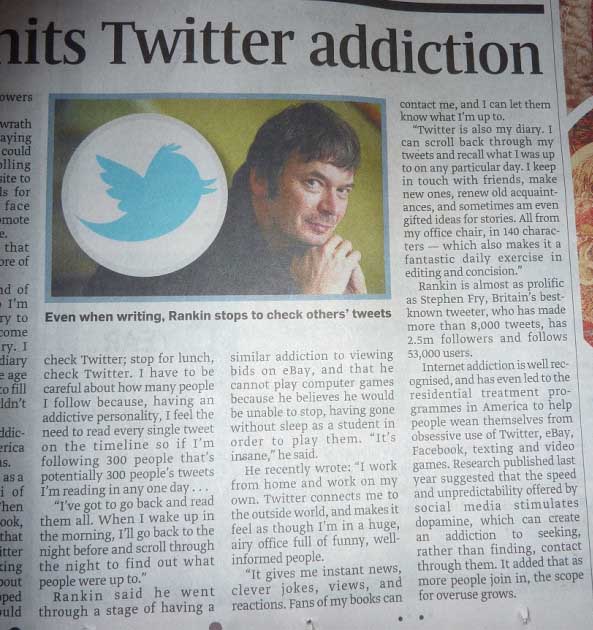
On April 24, 2011, the Scottish edition of The Sunday Times published “Rankin admits Twitter addiction” on page 21. It was written by Jason Allardyce, a 40-year-old who was named “Scottish Journalist of the Year” in 2003. His MySpace page states that he likes to go by the name “wolfspider” and that he is based out of Callander. But “wolfspider” is a lonely man. He only has two friends on MySpace: the ever-popular Tom and MySpace UK.

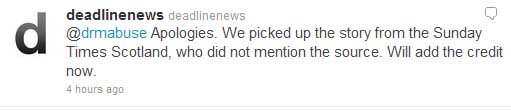
On Easter morning, I knew nothing about Allardyce. A friend had forwarded me this Deadline News report by Peter Laing, in which I recognized quotes identical to my conversation with Ian Rankin on The Bat Segundo Show. The conversation was not accredited. As someone who had investigated the Cooks Source scandal and who remembered the online tarring and feathering, I was appalled that anybody would still consider that ripping off other people’s journalism — even from behind a paywall — would still be okay. But this time, I was on the receiving end for a project that I make little to no money on. For the Rankin show, I had devoted perhaps 25 to 30 hours of my life to reading Rankin’s books, conducting research, interviewing the man for an hour, and mastering the audio. My labor was being exploited. I immediately contacted Laing by email. And on an Easter Sunday, a little less than an hour after I contacted him, he replied back on Twitter:

The Sunday Times? Murdoch’s newspaper? I told people on Twitter about what had happened and asked if anybody could send along the article. And a very friendly pescatarian vegetarian in Scotland going by the name of @SeymourSunshine located the article and photographed it for me.

I transcribed the article. I was stunned to learn that 215 of the 758 words in Jason Allardyce’s article were taken directly and without attribution from my Bat Segundo interview with Ian Rankin. I emailed Alladyce and his editors. And then I discovered that I wasn’t the only one getting played by the wolfspider. An additional 126 words in Allardyce’s article were lifted wholesale and without attribution from two whole paragraphs that Rankin contributed to this Gaby Hinsliff compilation in The Observer from February 13, 2011. To add insult to injury, Allardyce plagiarized a third source, pilfering a good 74 words from this Lisa Zilberpriver piece from World News Australia (January 18, 2010). For all three original pieces that Allardyce has used, a copyright notice was clearly listed on each of the pages.

In other words, Allardyce did not obtain a single original word from his subject for his article.

Ian Rankin was kind enough to confirm with me that nobody from The Times had contacted him. So if we add up the tally, 415 of Allardyce’s 758 words, or 54% of his article, were taken from three separate sources. That’s considerably more words than a famous fair use case here in the States, where The Nation published 300 to 400 words of verbatim quotes from a 500 page Gerald Ford memoir without obtaining permission, was sued, and lost. So that it can all be made clear, here is a breakdown of Allardyce’s liberties (with the unattributed quotes indicated in bold and, for Bat Segundo, the specific times in the program where the words are mentioned):

The writer admitted that Twitter was “taking up more of my life than it should.” [Bat Segundo interview, 27:08-27:09]

He added: “I’ve a kind of addictive personality so I’m always very careful to try to avoid things that can become addictive. [Bat Segundo interview, 27:01-27:06] It’s like a diary. I used to keep a page-a-day diary when I was a kid from the age of 12 till I was 29 and I had to fill up every single page. I couldn’t leave any blank space.” [Bat Segundo interview, 27:49-28:00]

He conquered the diary addiction after moving to America with his wife for six months. [This part is paraphrased from Bat Segundo interview, 28:00-28:30]

But I use Twitter like it, as a kind of memento mori of everything I have done. [Bat Segundo interview, 28:33-28:37] When I started writing a new book, I made a vow to myself that I wouldn’t go near Twitter until the end of the working day and I kept that up for about three weeks. Then, if I stopped for a cup of coffee, I would check Twitter; stop for lunch, check Twitter. I have to be careful about how many people I follow because, having an addictive personality, I feel the need to read every single tweet on the timeline so if I’m following 300 people that’s potentially 300 people’s tweets I’m reading in any one day…. [Bat Segundo interview, 30:24-30:49]

I’ve got to go back and read them all. When I wake up in the morning, I’ll go back to the night before and scroll through the night to find out what people were up to.” [Bat Segundo interview, 30:51-31:00]

Rankin said he went through a stage of having a similar addiction to viewing bids on eBay, and that he cannot play computer games because he believes he would be unable to stop, having gone without sleep as a student in order to play them. “It’s insane,” he said. [Bat Segundo interview, plagiarized paraphrase, “I went through a stage of buying vinyl on eBay, buying records…,” 31:02-31:09; “…if I finished browsing eBay…,” 31:10-31:12; direct “It’s insane,” 31:21-31:22]

He recently wrote: “I work from home and work on my own. Twitter connects me to the outside world, and makes it feel as though I’m in a huge, airy office full of funny, well-informed people.

“It gives me instant news, clever jokes, views, and reactions. Fans of my books can contact me, and I can let them know what I’m up to.

“Twitter is also my diary. I can scroll back through my tweets and recall what I was up to on any particular day. I keep in touch with friends make new ones, renew old acquaintances, and sometimes am even gifted ideas for stories. All from my office chair, in 140 characters – which also makes it a fantastic daily exercise in editing and concision.” (The last three paragraphs taken entirely from this Guardian article.)

Internet addiction is well recognised, and has even led to the residential treatment programmes in America to help people wean themselves from obsessive use of Twitter, eBay, Facebook, texting and video games. Research published last year suggested that the speed and unpredictability offered by social media stimulates dopamine, which can create an addiction to seeking, rather than finding, contact through them. It added that as more people join in, the scope for overuse grows. (Taken from World News Australia article.)

While it is true that Section 30 of the UK Copyright, Designs, and Patents Act of 1988 specifies a fair dealing exception “for the purpose of criticism or review,” the attribution must contain “a sufficient acknowledgment.” Furthermore, according to English law, there’s very little I can do to stop Allardyce or any other person “reporting current events” from infringing upon copyright provided that “it is accompanied by a sufficient acknowledgment.”

What is a sufficient acknowledgement? Well, unlike much of the American tax codes, you can always count on English law to be concise and thorough. Here’s Section 178 of the CDPA:

“sufficient acknowledgment” mean an acknowledgment identifying the work in question by its title or other description, and identifying the author unless—

(a) in the case of a published work, it is published anonymously;

(b) in the case of an unpublished work, it is not possible for a person to ascertain the identity of the author by reasonable inquiry;

It may very well be a common practice for some UK journalists not to provide attribution. But when they don’t, they are clearly breaking the law. And they are exposing the newspapers and outlets that they write for to considerable legal liability. But more important than such legal propriety, it’s just plain rude and antithetical to the spirit of human togetherness.

But Allardyce’s failure to credit any of his original sources extends far beyond the prospect of fair dealing and fair use. His disingenuous usage could be interpreted as an intent to deceive.

Let’s approach the question form a practical position. Why is attribution important? Well, take this UPI report from September 5, 2010. The UPI quotes Cardinal Keith O’Brien: “Our detailed research into BBC news coverage of Christianity in general and Catholicism in particular, together with a systematic analysis of output from the Catholic church, has revealed a consistent anti-Christian institutional bias.” That’s an extraordinary statement. If you’re at all interested in the many opinions, you’ll want to know where it comes from. And the UPI, because it is a responsible service, notes in its article that The Sunday Telegraph first reported the Cardinal O’Brien quote.

Jason Allardyce, on the other hand, doesn’t make such a distinction when he produces the same quote in his article, and he doesn’t attribute The Telegraph. This causes the Richard Dawkins Foundation (where I found Allardyce’s article, now conveniently hiding behind a paywall) to believe that Allardyce is conducting original reporting. This also causes confusion for the BBC, which erroneously reports that Cardinal O’Brien said these words “in an interview with the Sunday Times.” So Allardyce and The Sunday Times gets credit for a quote that they cut and pasted from another newspaper.

Now let’s say that, several years from now, a historian is looking into biases against religion (or the mythical claims of biases) during the early 21st century. The historian will want to go straight to the original source so that she can ensure that the quote and the context is accurate. But if she has to wade through Allardyce’s misleading attribution, this is going to cause needless work for the historian. Allardyce’s misleading attribution also creates the false impression that the Sunday Times was the central place for that news story.

And because Allardyce has published his “article” in a prominent newspaper, with anyone who reads the article believing that the interview comes from him, there’s very little that I can do to get proper credit or compensation.

I have emailed Allardyce the following terms for resolution:

(a) a public apology, both prominently in print and online, for taking my quotes without asking or attributing;

(b) the issuance of a correction, both prominently in print and online, indicating that the Sunday Times and Jason Allardyce lifted quotes from my radio program, along with a URL directed to my site,

(c) a donation of £500 (as compensation for using my quotes and others without permission or attribution) to Reporters Without Borders.

It’s impossible for me to be entirely objective in this report. I am doing the best that I can to keep a level head. Still, in an age where Arianna Huffington insists that it’s “wrong and offensive to insist that HuffPost is exploiting journalists,” the time has come to stand up against anyone who believes that they can get away from stealing anybody’s labor. If ostensible professionals feel that they are above the law and above the decency of community, then what’s the purpose of their collective existence?

[4/26/11 UPDATE: As of Tuesday afternoon (UK time), Jason Allardyce has not returned my telephone calls and emails.]

The Magus (Modern Library #93)

(This is the eighth entry in the The Modern Library Reading Challenge, an ambitious project to read the entire Modern Library from #100 to #1. Previous entry: Wide Sargasso Sea)

Over the course of several interviews, John Fowles enjoyed recycling one particular anecdote concerning The Magus. The then bigshot author once received a letter from a woman who didn’t care for his book. The woman asked Fowles if two of the novel’s characters got together at the end. Fowles wrote back and said, “No.” He received another letter from a New York attorney dying of cancer in a hospital. The lawyer asked the same question, but, unlike the woman, informed Fowles that he enjoyed the book. Fowles replied, “Yes.” In 1986, Fowles would tell a dull interviewer seeking literal-minded answers, “I tell that story because that’s how I feel — I don’t know the answer. And I tend to react as people want, or don’t want it — if they’ve annoyed me — to end.” But Fowles’s story after the story does have me wondering about the novelist’s responsibility. If a novelist leaves his volume open-ended, does he not have some duty to know every aspect of his characters as he knows the back of his hand? On the other hand, if Fowles led his narcissistic schoolteacher Nicholas Urfe to a specific point, perhaps he’s off the hook for anything beyond these final words:

cras amet qui numquam amavit
quique amavit cras amet

Some takes on these closing lines, repurposed by Fowles from The Virgil of Venus (3rd century AD), can be found at the most definitive online place for all things Fowles. Loosely translated, the Latin reads: “Tomorrow let him love, who has never loved; he who has loved, let him love tomorrow.” While this suggests that Fowles wanted the frequently callous Nicholas to love again, the lingering question I had after finishing The Magus was whether Fowles even cared about people. I realize it’s important to separate the novelist from the novel, but I think my impressions were colored by The Magus‘s repugnant first-person perspective:

We both smiled, and we both knew we smiled to hide a fundamental truth: that we could not trust each other one inch.

At the risk of oversimplifying a big burly opus, this is the general timbre in which Nicholas relates to people. People don’t exist to feel. They exist to be used. At one point, there’s the possibility that Nicholas’s actions may have caused another person to commit suicide. It wasn’t too much of a surprise to learn from Eileen Warburton’s John Fowles: A Life in Two Worlds that Nicholas Urfe and John Fowles weren’t terribly far apart. The young Fowles, teaching at the University of Poitiers, was “a shy, self-absorbed young man” who was unable to write much of anything aside from his diaries. Yet even more than a decade after Fowles first talked shit about his friends and colleagues in his wildly bitter journals (collected in two volumes and loaded with the kind of vinegar and vitriol that one expects from a sociopath-in-training), he remains quite singularly absorbed in himself:

11 October 1963 It enrages [Elizabeth Whitton, Fowles’s wife] that my priority isn’t the getting of a house, it enrages me that her priority isn’t giving me the time (or peace) to finish The Magus. So we live at cross-purposes.

Fowles began work on The Magus (originally titled The Godgame) when he was 28, and then dropped the project for ten years. One quotation Fowles relied on during the writing of The Magus was from Henri Alain-Fournier’s Le Grand Meaulnes: “I like the marvelous only when it is strictly enveloped in reality.” And yet the one thing distinct about The Magus is the frequent lack of reality. We are asked to believe that Nicholas, a learned man, would not conduct some serious research into Maurice Conchis, the apparent World War II veteran who charms Nicholas into his manipulative world, after so many inconsistent stories. (To cite just one example, if you are a young and self-absorbed man with poetic aspirations and a man tells you, “Words are for facts. Not fiction,” would you not doubt him?) Nicholas does look into Conchis and his ostensible associates eventually, but only after the terrain has shifted into the ridiculous, with Nazi reenactments and implausible impersonations.

It has been put forth by some critics that The Mysteries of Udolpho was an influence upon The Magus (both books initiate a series of adventures from the discovery of a poem), yet Fowles was to dismiss Ann Radcliffe in a 1956 diary entry: “not much ear, but some pleasant fragments of 1800 delight in batsy gloom and soft despair.” One accidental influence may have been Dickens’s Great Expectations. In a 1980 interview, Fowles was to speak approvingly of one dissertation making this connection, in large part because the student didn’t know that Fowles had taught Great Expectations while writing The Magus. (In a 1959 diary entry, Fowles, who mostly didn’t care for Dickens, called Chapter 29, where Pip returns to Miss Haversham’s house, “one of those remarkable seminal chapters in Dickens which really touch upon something vast and deep.”)

27 May 1964. I cut everything that stands in the way of the narrative thrust; anything that lapses beneath a certain state of tension. Because this seems to me the essence of the novel — the exact harmony between subject-matter (symbolisms, intellectual and stylistic aims) and narrative force (simple old readability). The words on a page have got to life it over. Narrative is a sort of magnetism.

When Nicholas tells Alison, the purported paramour whom he proceeds to treat like dirt, about the tricks that Conchis has been up to, he says, “It’s not that I believe any of these things in the way he tries to make me believe them….It’s simply that when I’m with him I feel he does have access to some kind of power.” And yet Conchis’s magnetism is clearly a load of bunk. When a man you confuse with “an Elizabethan nobleman” sends you a note not to come around again shortly after you have had to cut yourself free from German soldiers who have tied you up (and where did they come from by the way?), only to send you another message through his courtesan, surely there is a point in which you realize your homemade cork needle isn’t bobbing the way that you hoped.

On the other hand, hokum does sustain readability. In a 1971 interview with Daniel Halpern, Fowles would cop to going back to Chandler and Hammett in order to get a handle on craftsmanship. He admired Chandler especially, telling Halpern that “his best paragraphs are absolutely tight and hard. Like good furniture.” Sure enough, The Magus proves to be a learned man’s attempt to simulate pulp. Consider the early hookup between Nicholas and Alison:

“You don’t know what its like waking up with a man you didn’t even know this time yesterday. It’s losing something. Not just what all girls lose.”

“Or gaining something.”

“God, what can we gain. Tell me.”

“Experience. Pleasure.”

“Did I tell you I love your mouth?”

“Several times.”

She stubbed the cigarette out and sat back.

“Do you know why I tried to cry just now? Because I’m going to marry him.”

Hundreds of pages later, we get “I HATE YOU!” in all caps. We have words “spat out like a grape pip.” We have plenty of purple pots boiling: “Her eyes were very direct, so direct I looked down from them.” (These examples were culled from the revised edition, which was the only copy I could find. Yes, Fowles would revise The Magus in 1977, which he would declare the favorite of his novels “in the sense that one might love a crippled child more than normal children.”)

So when we tally up Fowles’s concern for taut narrative, the desperate approximation of tough guy craftsmanship, and the desire to write Dickensian chapters communicating epiphany (but stopping short of that “vast and deep” artistry through gesture; hence all the Jung and the philosophy and the psychoanalytic bullshit), it is especially interesting that he would write novels that weren’t interested in the most peremptory reader wish fulfillment: resolution. (Fowles wouldn’t confine his desire for open and alternative resolutions to his correspondents. His third novel, The French Lieutenant’s Woman contains three possible endings.)

Of Anthony Burgess, Fowles was to write in his journal: “It is a mistake when fine minds wear a mask of plebeian coarseness to excuse themselves, even truth can’t pardon that.” I can’t help but feel this way about Fowles, a novelist who preferred the company of readers over critics and who, for a time, received the twin triumphs of unmitigated sales and critical acclaim. But stacked against Jean Rhys’s pith and Iris Murdoch’s layered comedy, for me, The Magus was the reading equivalent to watching an untrained wrestler without confidence attempt to fight himself.

It’s very possible that I was a tad too old to read this book. For many, I suppose The Magus is a bit like Zen and the Art of Motorcycle Maintenance. But I’m certain there were other stumbling blocks having little to do with the philosophy. Self-described centathlete Michael Menche, also working his way through the Modern Library, observed that Fowles shares a quality with Herman Hesse: namely, an inability or unwillingness to make the reader laugh.

What’s especially interesting is that when The Magus came out, it was widely ridiculed in England. But in the United States, it was championed as a masterpiece. Whether trash or gem (and I suspect that Fowles would have agreed with both), I’ll let the novelist have the last words:

Novels, even much more lucidly conceived and controlled ones than this, are not like crossword puzzles, with one unique set of correct answers behind the clues — an analogy (“Dear Mr. Fowles, Please explain the real significance of…”) I sometimes despair of ever extirpating from the contemporary student mind.

Next Up: William Kennedy’s Ironweed!