The Bat Segundo Show: Insulted by Authors

Bill Ryan recently appeared on The Bat Segundo Show #384. He is the proprietor of the website Insulted by Authors.

Condition of Mr. Segundo: Insulted by humorless people.

Guest: Bill Ryan

Subjects Discussed: Taking unexpected tumbles in life, why insults are the best way to pop the cherry of the author-reader relationship, being the son of a scientist, dodging dodgy publicists, being identified as “The Bill Plus Insult Guy,” picking away at the celebrity industrial complex that has been built up around the author, being frightened by Salman Rushdie, whether there is something inherently wrong in asking an author to insult the reader, difficulties with humorless authors, Nicole Krauss’s post-profanity titter, how the prelude to an author interaction sets up strange expectations, Rick Moody’s refusal to sign older books, book autograph prospectors, being afraid of preconceptions, taking the denial of an insult personally, when joie de vivre is mistaken as a threat, hero worship and naivete, the protective personality traits of authors, looking at the dilemma from the “why not an insult?” position, ideal readers vs. material readers, Banksy, being inclusive of quirky ideas within a marginalized medium, non-monetary value and books, and the dangers of being drawn too close to the apotheosis of fame.

EXCERPT FROM SHOW:

Ryan: Salman Rushdie was in my top four of insults I’d love to get. The Mount Rushmore of insults or whatever. I was so frightened ahead of time for some reason, despite the fact that this is a guy who’s reading a children’s book in front of a crowd of people who showed up at an art gallery. To hear someone read a children’s book. I was nervous! Because it’s Salman Rushdie. And I approached him. And I have tweaked my approach, depending upon the author. Like with Salman Rushdie, I was very deferent. “Mr. Rushdie, I’m sorry to be the kind of person to ask you this. But if you have a moment, if that’s okay, could you add an insult to my personalization?” And I’m worried almost that the fact that I’m scared, intimidated by the very thing that I kinda want to break down, is maybe a problem with my scientific approach. (laughs) Do you know what I mean?

Correspondent: Well, maybe it’s an emotional approach. Because here you have Rushdie. You hope that he will defy your expectation, that he will insult you. And what does he do? He decides, “Why do you want to do that?” And it’s sort of a big letdown. It’s almost like maybe you were nervous about setting yourself up for this letdown. Is that safe to say?

Ryan: It’s like: What did I do wrong? Okay. Exactly, yes! The scientific approach where I was waiting in line and I had everything lined up like a series of actions that I had just lined up in my mind. And I’m like, “Okay, I’m going to approach Mr. Rushdie. I’m going to set down my book. Very gently.” I’m going to say, “Mr. Rushdie, thank you very much. Blah blah blah. By the way, my name’s Bill. Insulted by Authors.” So I went back over after the fact. And for whatever reason, I got really really nervous and really excited. Just the fact that I’m disrupting whatever silly little convention that there is behind the whole signing of a book. I may be blowing it up way, way too big in my mind. But afterwards, my heart was pumping. And I was like, “Okay, what did I do wrong? What was it that Mr. Rushdie didn’t understand about….”

Correspondent: Just call him Salman. (laughs) Mr. Rushdie? He won’t appear on this program. So we can go ahead and be informal about him. If it’s any consolation.

Ryan: (laughs) So Salman. Yeah, I had to go over for the next twenty minutes. And I actually, literally, sat right outside the signing — or stood right outside the signing — and was breathing deep. And all these people.

Correspondent: Breathing deep?

Ryan: Yeah. I was breathing deep. I was actually…

Correspondent: Hope you weren’t hyperventilating.

Ryan: A little bit! A little bit, man. This is how much I put into this for whatever stupid reason. And all these people who had heard me talking to myself in line slowly filtered out around the corner. What did I do wrong? How can I perfect this asking for an insult? How can I make this more accessible to the Rushdies of the world? But also equally accessible to the AL Kennedys of the world.

Correspondent: Or the Amy Sedarises.

Ryan: Exactly. Exactly.

Correspondent: Well, on the other hand, what do you to deal with the reality that some authors — particularly the Old World, anti-online, anti-Tumblr, anti-Twitter types — they’re going to go ahead and say, “I’ll never stoop to that. Because I am an author.” Rushdie may be one of the last ones. Along with say, maybe, Richard Ford. I don’t think he would insult you.

Ryan: Probably not.

Correspondent: Philip Roth might, I think.

Ryan: I’d like to think that.

Correspondent: (laughs) I’d like to think that he would. Cynthia Ozick might, if you could get her.

Ryan: Yes!

Correspondent: But, on the other hand, you’re dealing with a lot of self-important authors who, let’s face the facts, are humorless. So where does the challenge kick in? Is it less about trying to bump your head against the wall? And more about seeing how they will react? I mean, it was actually rather astonishing to me to learn that Allegra Goodman would refuse to insult you and that post has not gone up, I noticed.

Ryan: Not yet. Not yet. I went through a transition between — I still don’t quite know what I’m trying to do with all this. Like I’m just trying to have fun. And I’m a book collector, in general. And I treat books as objects in addition to being books. Which is somewhat tragic, I’m sure. But also — whatever. I mean, everybody has something they’re trying to change about them. But I feel like everyone would be able to give me an insult if I somehow approached them in the right way or it was the right situation. Or something. There’s all these other outline — like little things that can mess with my amazing idea, incredible idea for insults.

Correspondent: You think you can develop the perfect pretext for any situation.

Ryan: (laughs) Exactly.

The Bat Segundo Show #384: Insulted by Authors (Download MP3)
This text will be replaced

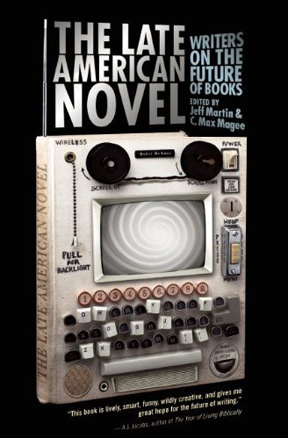
A Hasty Response to The Late American Novel

I remember reading Jeff Martin and C. Max Magee’s anthology, The Late American Novel, a few years ago when it was called Kevin Smokler’s anthology, Bookmark Now. Kevin Smokler has more followers than I do on Twitter and is paid by Chris Anderson to do something in relation to books and marketing. When I read Bookmark Now in 2005, I had a beef with Kevin Smokler. But now I do not, although Smokler doesn’t follow me on Twitter. And I don’t follow him. I do not have a beef with either Jeff Martin and C. Max Magee, but Max and I follow each other on Twitter. It may be that I am less angry now than I was in 2005, or that I like Max more in 2011 than Kevin in 2005. I feel compelled to point out that it is not 2005. I know this because I have less hair. The Late American Novel may have spoken to me six years ago, but I am not quite sure that it speaks to me in 2011. But then I have not yet opened its contents. I am about to. I will say that I do not see the Internet as a distraction or even an enhancement. It is a bit like a sex toy that I plug in from time to time. I am certain that I am not the only one that feels this way. If the Internet were to go away, I’d be perfectly happy. Because, aside from my extracurricular activities, I am surrounded by books and, if websites were to go away, you would find me in the streets disseminating pamphlets and circulars. You would find me giving speeches in obscure town halls. (Come to think of it, you may be finding me there even with the Internet. I comfortably wear the Internet as a surplice, but it is not the end all and the be all. It has yet to design the intellectual equivalent of exciting underwear.)

It remains unclear whether Jeff Martin and C. Max Magee will, in five years time, be paid by Chris Anderson (or some other dimwitted man who plagiarizes from Wikipedia and hosts conferences and edits overrated magazines and pays quirky and interesting voices a lot of money to transform into uncritical hacks in a few years) to do something in relation to books and marketing. But I don’t think they will. Jeff Martin and C. Max Magee are certainly more admirable and interesting in their 2011 pursuits than Kevin Smokler was with his 2005 pursuits. Looking at the list of contributors in The Late American Novel, there are only three names that make me want to throw the book against the wall and rage like a deranged animal for another random anthology so that I can peform the same eccentric test. And I have to say that, as anthologies go, this is a pretty decent batting average. I think there were more contributors who annoyed me in Bookmark Now.

I’m not sure I needed Thomas Allen’s “Notes on the Cover.” If you have to explain your book cover, it’s my feeling that you’re slumming it in some way. I also didn’t need Reif Larsen’s “The Crying of Page 45.” Larsen, who has littered this essay with annoying postmodernism (“Figure 3: The order of Chapters in Cortazar’s Rayeula“) didn’t get the memo that, thanks to the twee approach of McSweeney’s, pomo will be quite dormant for the foreseeable future. “I never arrived at page 45,” writes Larsen. And one longs to tell this precious writer that he’s not exactly making it easy to push beyond the third paragraph. One also wishes to tell Larsen that nostalgia is a terrible reason to read. One reads to get some sense of being alive. Or at least this reader does.

Which brings us to Marco Roth’s “The Outskirts of Progress,” with its second-person East Coast assumptions. First off, Marco, I may be skeptical, but I’m not pessimistic. Like you, I’m not a slave to technological progress. But unlike you, frequent railroad landscapes do not bore me. I also quibble with your suggestion that I am deracinated. I was just watered and taken for a walk. No knowledge is lost, if one looks hard for it. Please take more time formulating your thoughts.

The widely disseminated Davey Gates-Johnny Lethem exchange from PEN America (collected here as “A Kind of Vast Fiction”) is something one can get behind, especially in response to Gates’s idea about the “instantaneous opinion marketplace” and whether all future novels are, in some sense, historical. But then my own long-winded online presence would suggest that Gates and I are simpatico on this score. I also liked Deb Olin Unferth’s “The Book,” in which bullet points demonstrate the futility of attempting to announce the death of a medium. Elizabeth Crane humbly writes, “So I’m the last person to have any predictions about the fate of fiction in the future. Are there any original ideas anymore?” Hucksters and e-cult members: take note.

Leave it to Emily St. John Mandel to cut through the bullshit by opening her essay with this sentence: “There are certain divisions in the world that seem unnecessary to me.” Bookmark Now prided itself upon insisting quite rightly that books were still alive in a digital age. The Late American Novel insists quite rightly that we are all no longer on the same team. Yet I flit around for an essay hoping to acknowledge this fragmentation and I find Katherine Taylor offering the advice: “Don’t go back to Fresno.”

That’s a bit like referring to “flyover states.” It’s impolite.

Maybe going to Fresno might give some of us a more reasonable idea about where books are heading and what regular people are reading. The Late American Novel, while refreshingly cheerful, doesn’t quite acknowledge this. But then neither did Bookmark Now. Rudolph Delson is wrong to suggest that there isn’t pleasure in knowing about novels. That’s like saying there isn’t pleasure in knowing about people. We should know about everything. But perhaps The Late American Novel is a necessary kickstart.

The Bat Segundo Show: Aminatta Forna

Aminatta Forna appeared on The Bat Segundo Show #383. She is most recently the author of The Memory of Love.

Condition of Mr. Segundo: Trying to remember where his lost car keys are so he can learn to love again.

Author: Aminatta Forna

Subjects Discussed: Writing about Sierra Leone without naming the country, adopting a tone that is simultaneously universal and specific, combating the “news vision” of the Western mind set, the moon landing and the historical sense, “Kung Fu Fighting” in a different context, media mechanisms and attempts to memorialize, Albert Dada and roaming travelers, fugue controversy, narrative ideas emerging out of research, having to leave some research behind, entering other people’s lives, spending two weeks in an operating theater, carrying over the character of Adrian from Ancestor Stones, when “lesser” countries are asked to explain their existence, Adrian playing a role for the reader, the disparities between Kai and Adrian in The Memory of Love, kinship between cooking and surgery, challenging someone to a race on a beach and breaking an Achilles tendon, how similar character qualities can be a benefit and a risk, characters and a prefigured narrative, writing a perspective from the male vantage point, roadside stops and car moments used to foreshadow tragic events, getting arrested, the ethics of colluding with corruption, “writing like a scientist,” avoiding conscious thinking about metaphor, conflating fiction with fact, how a “unique” Sierra Leone story is ubiquitous in Sierra Leone, Argentina as an early influence for The Memory of Love, “pasting the facsimile of a smile on my face,” being a people person, why “not being evil” doesn’t necessarily make you good, PTSD as a normal characteristic, “write about what you know” versus “write about what you want to find out,” and the novel as a medium for relative normality.

EXCERPT FROM SHOW:

Correspondent: I wanted to talk about Albert Dada, who is a figure in A History of Mental Illness, the invented book within the book. You have Adrian come across the case of this guy, who decided to abandon his gas station. And this, interestingly enough, is a psychiatrist. And then he goes ahead and starts traveling at 70 kilometers a day. Just becoming this crazy, wild, roaming traveler. I’m curious how that served as this cultural reference point. Because he’s not exactly as popular as, say, Neil Armstrong.

Forna: Oh, well it went the other way around actually. It went the other way around. I was told a story about a woman. A true story. By a human rights worker. A Sierra Leone human rights worker. And I was told a story about what this woman had suffered during the war. How she had fled to a refugee camp in a neighboring country and then come back. And what she found, this human rights worker told me. And I don’t want to give the story away. But it was so shocking. It absolutely left me speechless. And that story returned to me when I came to write The Memory of Love. And I wanted to create a patient for Adrian. You know, Adrian is there looking — he’s there to help himself as well. But anyway, what happened was that I tried to think of, to actually imagine, if that happened to you, what your mind would do. Or what it would do to your mind. How can we survive that? And I came up with something that I had already seen happen a little in Sierra Leone, which was that people often did step out of their lives. And women in particular often did just step out of their lives and go walking. Not in that fugue state. Not in a dissociative state. It was just a self-healing thing. They would say, “I’ve got to get away from here for a bit.” And they would just go traveling and they would come back. And nobody thought this was curious. It was just part of the culture. So I thought, “Well, here’s something she might do.” Because she has suffered this extreme trauma.

So I began to read about fugue. And then I realized that there was this whole controversy around it. I wrote a book about it. And it all seemed to fit. It fit with what Adrian was there to do, which was try to find something that might advance his career. As well as help the country, of course. But you know, he had other motivations. It fit with Agnes: the character, the patient he sees. So these are wonderful moments where you get this perfect storm in your research. But that’s the way I work. I do quite a lot of research and after the research comes the ideas usually. I go places. I know some writers work like this and others have a plot and then they fit everything to the plot. But I tend to go and see. And then the stories arise out of that.

Correspondent: But there must be a danger in getting bogged down in too much research. The idea perhaps that you attempt a narrative, but that it doesn’t necessarily flesh out. Is this an issue with you?

Forna: Yes. Both of them. (laughs) The “too much research” — it’s less of a problem because I used to be a journalist. So we got used to having to leave some of our research out. We knew that you can’t get it all in. Which is always the danger. The first failing of young journalists. Attempt to use everything they’ve discovered. I know that there will always be a place for it in a later book. And I was once asked this by a creative writing class that I was talking to. “Well, what do you do with the research that you don’t use?” And I said, “Well, it’s usually the next book.” Or it’s the one after it. So nothing’s ever lost. I don’t worry too much about that. And what was the other part of the question?

Correspondent: Oh. It was about the amount of research and also what happens if some finding doesn’t work its way into the narrative. Yes.

Forna: Well, of course, my books are character-led rather than plot-led. So I will always refine the plot to what they are likely to do. But research is important for all kinds of reasons to me. Because it sparks so much. I love it. The reason I am a writer, the reason I was a journalist, is because I love entering other people’s lives. So in that period before I actually sit down to inhabit the character that I’ve created and become that person, I spend quite a lot of time trying on parts of their life. So for Kai, I spent two weeks in an operating theater. For Adrian and Attila, the African psychiatrist that is rather ill-tempered who he works with, I also spent two weeks in a mental hospital in Sierra Leone. So I try on their lives to see if they’ll fit when I come to create the characters. Somebody called it “method writing.” And maybe sometimes I go too far. But I enjoy it a great deal. I enjoy all of that. And when I come to write it, I feel that I fully constructed this person. And now I can be them.

The Bat Segundo Show #383: Aminatta Forna (Download MP3)

This text will be replaced

In Defense of Jaume Collet-Serra

It’s been two weeks since I attended a press screening for Unknown, and I am dilatory with my dispatch. But there’s been some distinctive quality about director Jaume Collet-Serra I’ve been trying to pin down. The hope here was that a few extra days of thinking would get me closer. After all, The Stranger‘s Paul Constant informed me that he received “drunken hate mail for weeks” after he praised Orphan – a movie that I also found to be fun and stylish and needlessly maligned by a few uptight critics.

But my interest quickly got out of hand. Now that I’ve seen all of Collet-Serra’s previous films (House of Wax, Goal 2, and Orphan), and I liked them all, I’m going to put forward the brazen suggestion that Jaume Collet-Serra may be another John Frankenheimer in the making. Like Frankenheimer, Collet-Serra includes several gradients of realist acting in his movies, however half-baked and unrealistic the scripts may be, to accentuate his more tasteful visual balance. Many of the complaints against House of Wax, for example, were leveled at Paris Hilton’s one-note acting (and I suspect that her overfrequent media presence in 2005 didn’t exactly help matters), but this severely discounted Elisha Cuthbert’s more realist performance and Brian Van Holt’s melodramatic double role. These complaints also weren’t especially fair when one considers Collet-Serra’s eye for the camera.


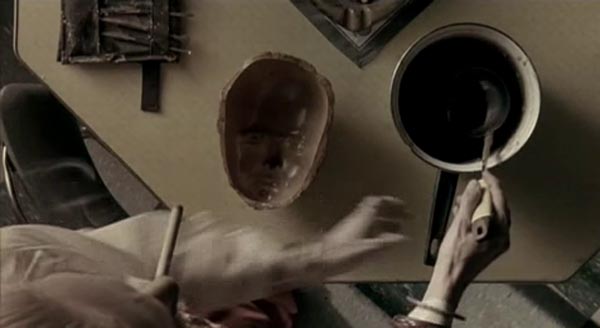
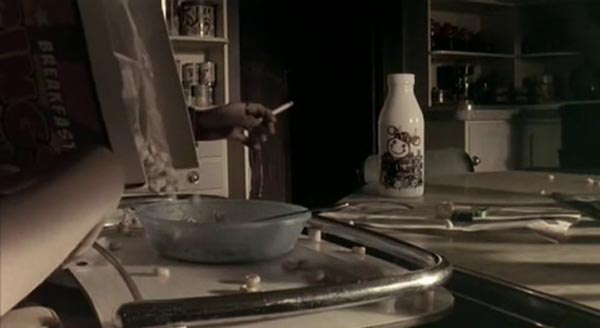
House of Wax: Certainly Collet-Serra’s background in commercials and music videos are largely responsible for this marvelous and unsettling opening sequence, in which we are introduced to a psychotic family. Notice the fine details contained within this montage. In the first shot, we see an older woman smoking her cigarette, the jasper angled askew and matching the wax bowl on the right. The table’s octagonal nature accentuates this psychology, especially since none of the hands or the cigarettes approach the table at a perpendicular angle. Then in the second shot, we see that the domestic scene is quite orderly. We see cereal poured into a bowl in a manner we might be familiar with. What’s unfamiliar here is the cigarette angled up in the air, neatly matching the arm clutching the cereal box. The milk bottle, with its smiling diagram, is also a nice touch, suggesting that some comical order or tranquility might be possible if you stick around long enough.

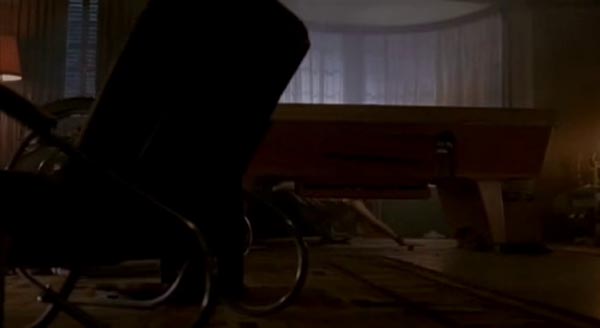
House of Wax: The camera, positioned very low, demonstrates that human life doesn’t matter much in Ambrose, the ghost town revealed to be a disturbing museum. We see a woman crawling beneath a pool table (underneath Ambrose’s “game”) in an effort to escape a mechanic who wants her to be part of this “museum.” Collet-Serra, who likes using shallow focus, makes the chair more prominent than the young woman. Even the lamp on camera left registers more than the woman.

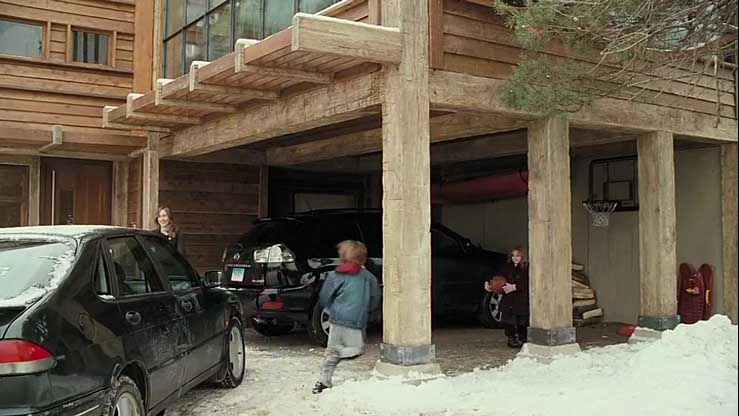
Orphan: Believe it or not, this striking visual is a throwaway shot. Like Tony Scott, Collet-Serra has this tendency to offer a magnificent composition and cut it into a sequence for less than a second. It’s almost as if he doesn’t want people to know that he’s got the chops. Or perhaps we’re meant to investigate further with the pause button. What we see here is the Coleman family before Esther’s arrival. Daniel runs from camera left to camera right towards Max, deaf and holding a basketball. Aside from the clever way in which Collet-Serra intimates that this family is as solid as the house itself (with mom hidden behind the car and Max very slightly occluded by the column), there’s also the muted burgundy (increasingly darker) from left to right: the car’s tail light, Daniel’s hood midway, and the basketball that Max is holding.

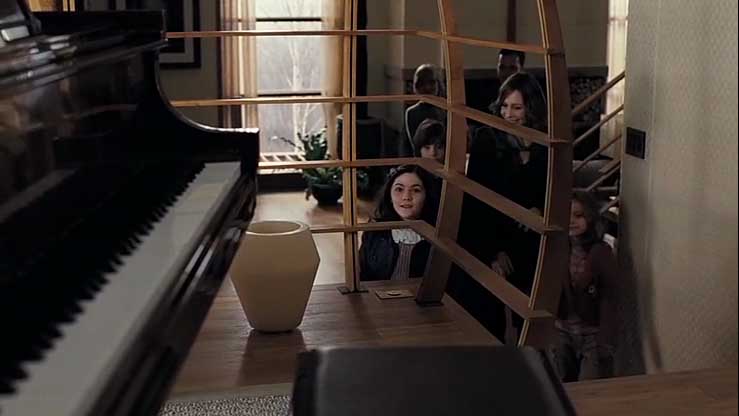
Orphan: Once Esther invades the family home, we see that, unlike the previous shot and unlike the Coleman stability, her face cannot be hidden by any architectural detail. She stares at the piano with materialistic delight. The back window tries to illuminate the situation to the Colemans (“Hey, family! You may have taken in a murderous little girl! Look around”), all clustered in the dark and too ensnared by domestic bliss to see what’s in front of them. And just as Collet-Serra placed the milk bottle on the table in the House of Wax opening sequence, we see that he’s placed an almost hexagonal vase on camera left.

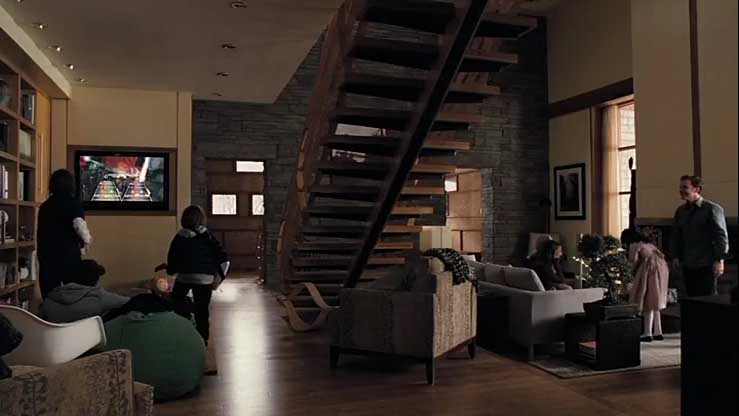
Orphan: This is one of my favorite shots in the movie. Who knew that Rock Band could portray a fragmented family? We see the boys having a grand old time tapping notes on the left. Meanwhile, the Old World girl with the old dress is inveigling her way in at the right. Again, Collet-Serra is careful to include a window near center frame, with its shaft of light trying to convey to the family that Esther is bad news. You wouldn’t know from the jagged diagonal staircase and the slightly incongruous textures that the production designer here was the same guy behind Blue Crush.

* * *

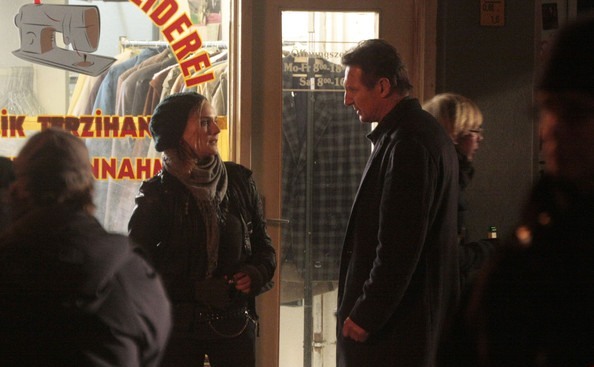
Unknown, Collet-Serra’s fourth feature film, from a screenplay by Oliver Butcher & Stephen Cornwell, based on a novel by Didier van Cauweleart, is well directed. Like Collet-Serra’s previous films, the cinematography is symmetrically stellar, its use of split focus reminiscent of early Brian DePalma (there’s one great shot where a body is being dragged away on camera right, while another body stays recumbent is on camera left) and a car chase shot with an idiosyncratic claustrophobia (many of the shots are confined inside the vehicle, but we don’t get too many driver’s perspective angles). The acting, especially by Bruno Ganz as a former Stasi man, is surprisingly realistic. The script contains an improbable series of coincidences (nearly every character is part of the conspiracy!) and a very forgiving German police force (if you carjack a taxi from an airport, I’m pretty sure the authorities aren’t just going to let you drive away). But Collet-Serra’s pacing is, for a good stretch of Unknown, so classy and so relaxing that I became more forgiving with these lapses in story logic.

Before seeing Unknown, it had never occurred to me that Liam Neeson was filling in the role once occupied by Harrison Ford. Ford, now a doddering and growling caricature of his former self, once charmed movie audiences as the forceful Everyman we could relate to. The whole “Get off my plane!” business was the point of no return for Ford. But before that, Ford was the star of The Fugitive and Frantic, playing a very believable middle-aged man on the run.

I’m certainly not the only person to have found Neeson’s recent reinvention as an action star to be somewhat peculiar. While this very tall slim actor can’t drift from his slightly Americanized Irish brogue to save his life, he has carried notable authority in Schindler’s List, Michael Collins, and Rob Roy.

But Neeson is also very good at melodrama. Most people forget that Sam Raimi made a marvelous comic book movie called Darkman starring Neeson in the title role. There’s a very fun scene in which Neeson is confronting a carnie over a pink elephant, and Neeson plays it so perfectly over-the-top: his voice grating with a gravelly bark, his face spasmodic (thanks to the limited time Darkman has wearing the “Neeson face” in daylight). While Collet-Serra doesn’t quite go off the glorious deep end the way that Raimi did in Darkman, one sees something close to this quality in Unknown, when Dr. Martin Harris is trying to persuade people that he is the genuine article.

Consider this question. Twenty years ago, if you had been told a video store clerk that Sam Raimi (director of Evil Dead 2) and Peter Jackson (director of Dead Alive) would be directing some of the most successful Hollywood movies of all time, you would have been laughed out of the store.

Unknown is enjoyable, but it does see Collet-Serra playing it a bit safe. But if Sam Raimi can serve us the gloriously vivacious jazz club scene in Spider-Man 3, then perhaps Collet-Serra’s visual panache will branch out in intriguing directions.

The Bad Prose Reading Project #1 (“Disinterested Thrusting”)

Every now and then, you encounter prose so wonderfully preposterous that it feels quite a crime not to share it with other appreciative readers. Some, of course, confine this morbid pleasure to the Bad Sex in Fiction Award handed out yearly by the Literary Review. (How easy it is for us to confront bad prose when it’s being declared “bad” by an independent authority!) Others test their mincing mettle by contributing their own exemplars to the annual Bulwer-Lytton Contest.

But as we all know, the best bad prose isn’t always planned. It’s written and discovered by accident.

With all these factors in mind, I offer The Bad Prose Reading Project, where I will be offering audio dramatizations of any bad prose I discover during my reading adventures.

During the course of these dramatizations, I won’t actually name the author, the story, or the novel that I’m reading. I feel this is fair to those who may judge the prose to be excellent. Needless to say, if I’m dramatizing it, it’s probably been published somewhere in the last few months. But that’s also part of the fun. Perhaps in dramatizing “bad” prose, the oral delivery may transform it into “good” prose because my dramatization is “bad.” Or perhaps I’m overthinking the experiment.

In any event, I invite listeners to judge the results. The first installment of The Bad Prose Reading Project features the phrase “disinterested thrusting” and can be listened to below.

Bad Prose Reading Project #1 (“Disinterested Thrusting”) (Download MP3)

This text will be replaced