Meaningless Infograph #2
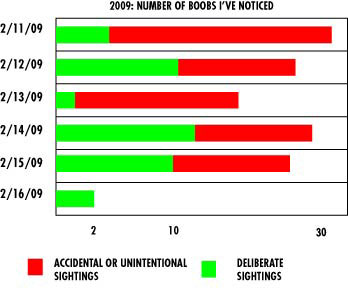
This above graph continues our very important series, Meaningless Infographs, in which various infographs, often of a personal nature, are presented to the public in an effort to demonstrate that blogs can present just as much meaningless data as newspapers. Now here we have an infograph with some very disturbing information. On February 16, 2009, the subject stayed inside most of the day. He had work to do. We can aver that the two boobs he noticed were likely someone close to him and permit other scientists to draw their own conclusions. However, we also know that the subject stayed inside for most of the day on February 15, 2009, save for a few errands that he had to run, which entailed leaving the house. Apparently, while the subject ran those errands, he went out of his way to deliberately espy boobs. What accounts for the discrepancy? Is the subject a sexist pig? Or is he merely a red-blooded male who likes boobs? Is it possible that the subject was somehow surrounded by too many boobs, thus causing an unexpected spike in boob sightings?
The data that most confounds our scientists is the set for February 13, 2009, in which the subject deliberately noticed one boob, but not two. Is it possible that the subject observed one pair of boobs, deliberately glimpsing one boob while accidentally or unintentionally glimpsing the other? Is this the lustful answer to continuous partial attention?
Meaningless Infograph #1
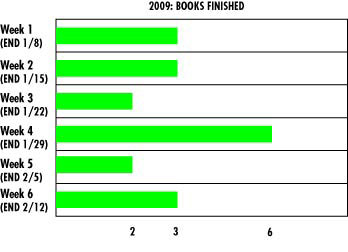
In an effort to keep things somewhat unpredictable, I will be juxtaposing meaningless infographs — most of them of a personal nature — at random intervals on this website. Since other newspapers seem needlessly fond of meaningless infographs and these newspapers continue to view blogs as threats to their business models, it makes sense for blogs to begin inserting meaningless infographs on their pages. In this way, the newspapers and the blogs can work together to saturate the media landscape with meaningless data, rather than information that minds can masticate upon.
New Review: George Friedman’s THE NEXT 100 YEARS
Well, the Gerald Celente post continues to draw plenty of haters to this site. And that’s fine. Because everybody needs a hobby. But I’m pleased to report that I’ve taken on another dubious futurist in the fine pages of the San Francisco Chronicle. I had truly hoped for more from the book. I have a soft spot for futurists and I always start reading a book hoping for the best. But, alas, it proved to be grand bunk.
Today, if you’re in the San Francisco Bay Area, you can pick up the paper and read my review of George Friedman’s The Next 100 Years: A Forecast for the 21st Century. Unless, of course, you want to read it now. I can’t possibly predict the future of your own decision, but I’m all too happy to embrace the uncertainty of the present.
Roundtable Discussion: Eric Kraft’s FLYING
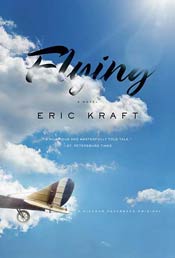
Beginning on March 2, 2009, this website will be kickstarting a lengthy roundtable discussion of Eric Kraft’s Flying over the course of the week. (For those hoping to follow along with the discussion, this is the same week that the book comes out.)
Who is Eric Kraft? Well, as I learned when enlisting roundtable participants, a lot of people aren’t all that aware of him. In fact, I only found out about the guy by accident about a decade ago, when I stumbled upon a series of paperbacks labeled The Personal History, Adventures, Experiences & Observations of Peter Leroy at City Lights. I flipped through the pages, and found a number of pleasantly fabricated pictures, diagrams, and illustrations, ended up purchasing a number of these books, and began reading.
Peter Leroy, as it turned out, was a guy in the present writing his “memoirs.” Except that these memoirs are fabricated from hazy childhood memories. Or are they more accurate than can be believed? One of the pleasant side effects is that the lie of the “memoir” often reveals ebullient truths about the human condition. But we never quite know how much of this is invented and how much of this is true. Why is Peter’s wife, Albertine, so patient with his imaginative condition? Or is this likewise a put on? One character, Matthew Barber, is a miserable toy executive with an alter ego named B.W. Beath who he impersonates when he reviews restaurants for the newspaper. In Reservations Recommended, we initially believe Barber to be real. But we learn in that book, and, most notably in Passionate Spectator, that he is fabricated and that the alter ego within the alter ego is of great importance to the “real” Leroy.
Now my description here suggests that Kraft’s novels are needlessly complicated and will give you a headache. But they’re really not. What’s especially striking about Kraft’s work is that none of these postmodernist tricks come across as exceptionally showy. His books are perverse, funny, obsessive, entertaining, and sometimes quite heartbreaking.
But Kraft hasn’t quite found the great audience that he deserves. And one of the reasons I maintain this website is to draw attention to overlooked and underrated authors.
So in a few weeks, we’re going to have about fifteen people here discussing Kraft’s latest book. There is also a separate podcast interview with Kraft in the works, in which I will do my best to conduct as definitive an interview as I can. (I have read all ten books in the Leroy series. This is the first author interview in which I have conducted this kind of insane preparation.)
The book that we will be discussing is Flying.
Flying is composed of three novellas (“Taking Off,” “On the Wing,” and the previously unpublished “Flying Home”) and follows Peter Leroy’s pursuits, as he sets out to build a flying motorcycle that will carry him to such exotic places as New Mexico. Each novella takes on one part of the journey, and the “journey” often involves numerous side quests and other divagations. But how much of this adventure is by design? What of the reconstructed Babbington Historical District that looks suspiciously similar to the Babbington in which Peter Leroy grew up? And what does all of this have to say about memory, permanence, and experience?
Well, we hope to answer these questions and more when the roundtable discussion begins. Until then, keep watching the skies!