Jose Saramago: Death Takes a Breather

Goodloe Byron, who is not to be confused with the late Congressman, is a kind and excitable gentleman who permitted me to use a corner of his table to hawk Bat Segundo CDs at last year’s Independent and Small Press Book Fair. He is the author of The Abstract, a self-published book that he has released without a dollar value into the world. (He informs me that he is sitting on numerous copies of his book in his barn.) But he is also a big fan of Knut Hamsun and, as it turns out, Jose Saramago. What follows is an essay in which Mr. Byron has presented his thoughts on the latter.
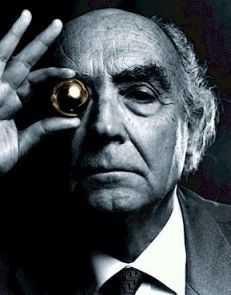
saramagoThe Portuguese writer Jose Saramago describes humanity with the same alien fascination with which the Belgian naturalist Maurice Maeterlinck used to describe insects. This foreign view of civilization is entirely appropriate, as Saramago looks less like a man than a Methuselahan turtle, peering around with a goggly apparatus strapped to his temple.

In Saramago’s view, the world is not balancing on a precarious pin, but is pinned to the floor by violence and power. Suddenly, the impossible becomes possible: Blindness comes to replace selective attention with something that no longer selects anything; private regret transforms into public lucidity in Seeing. In The Cave, the Vegas/Wal-Mart/Condominium/uber-complex called The Center, a simulacra of Plato’s Cave, is built atop a buried allegorical site which realizes the simile as a literal state of being. But in these novels, society also accommodates the intruding impossibility: the blind are quarantined in dark cells; lucidity is diffused by propaganda, and the cave is turned into a spectacle itself. Since Blindness, Saramago’s seemingly impossible inspirations have become finely attuned Chestertonian paradoxes, and these situations, in turn, break the smooth surface of reality, exposing the tender and often stupid mess underneath. He’s studying the human being by injecting our world with an unstable but vivid isotope.

Saramago’s latest experiment has finally arrived in the United States. Death with Interruptions is about a country where people stop dying. This is not a book of wishful thinking. Death is such a pivotal structural entity in our world that any attempt to carry out our experience without it would transform it into an absurd character; insurance companies introduce a “working” death at the age of eighty four, funeral directors petition to transfer the commodities of mourning to pets and parakeets. These may seem satirical, but these exigencies are as real as the subsidies creating grain surpluses which are subsequently burned. Counterbalancing this bureaucratic response is a terrible self-honesty that would necessarily follow; our sympathy for the elderly and the infirm is not empathy. It is only because the predator of death is out somewhere ready to strike that we can rally ourselves and attempt to stave it off. Saramago pictures this dilemma as if these marked souls will linger here forever. They are not in danger; we cannot save them. Suddenly these regular tasks define a new unromantic role: the custodian of the all but dead. Knowing that their condition can only get so much worse, I personally suspect it would be tempting to place the person in a storage locker and go to Atlantic City, but maybe this admission will jeopardize my babysitting career.

Not many of us are violent or wish death on others, but we all know that a steady stream of blood turns the mill. The mill is not turning here, but the poor are saddled with the financial burden of the permanently dying. With compassion for the ethical havoc that this would wreak on us, Saramago indicates the brutal solution at which we would certainly arrive; if no one had to die, these people would be required to die.

But thankfully, death returns! She is classically personified, coming to us with skull, scythe, and all, a contrast to the modern view of death as a biological process. Now the story happens again, localized to a single character: an unsung cellist whom death is unable to kill. Suddenly, the story focuses and takes on the tone of an old school romance, and interestingly shares some traits with romantic obsession narratives such as Marc Behm’s Eye of the Beholder. It is a Da Capo al Fine move, repeating the central premise of the book but altering environmental physics from the purely positive world of his later phase, into the classical fables that characterized his first. Though something along this lines was hinted at in Seeing, to my mind, this is a transition radical enough to be considered entirely new for Saramago, and it presents us with the skeleton key to the book. This time, Death is amazed by her own impotence in the face of the human being, who remains ignorant of her, a nice reversal of the working order. This goes to the core of what Saramago’s all about, recalling the distinction between the human will (the mortal, individual spirit that dies with or before us) and soul (the eternal part of man removed from its human excess) that he explored in Baltasar and Blimunda. Instead of judging humanity by what is naturally effective (a la Deng Xiaoping), Saramago is suggesting that we should judge nature by what is morally affective (which, for Saramago, is grassroots Marxism).

Lastly if I may please note: English speakers are very lucky that Saramago’s phase shift, with the arguable exception of Blindness, has been so well-amplified in the opposed translation styles of Giovanni Pontiero and Margret Jull Costa. Obviously this distinction is a bit twisted, as this good fortune has come with the expense of Mr. Pontiero’s untimely demise. Whereas Mr. Pontiero’s style appears to radiate with a formal erudition, in the service of the most exact representation possible, Ms. Costa’s weapon of choice appears to be her imagination, in which she welds with her efforts to preserve the overall style and impression of the book. This is further evidenced by her chameleonic translations of Eca de Quieroz. As a person who can only read one language, I acknowledge being a bit of a straw man on this topic. That she would be trying to single-handedly import a neglected culture into English would be commendable as a doomed enterprise, and that she appears to be succeeding at it (and perhaps this is an area where appearing to succeed is all success really is) is awesome.

Saramago doesn’t show any sign that he will rest on his laurels, nor would anyone familiar with his work expect that he would be the sort of person to consider such a thing to be a worthwhile activity. Not long ago he completed his newest book The Elephants Journey, so now Saramagoons such as myself will have something to wait for.
Time to Reboot My Privilege

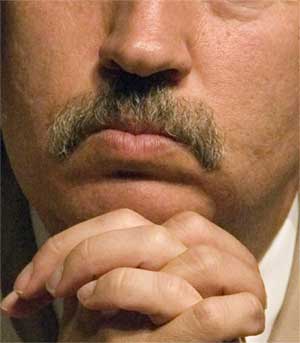
I had a bad day last Friday, a day considerably worse than Thomas L. Friedman’s, but it was an all-too-typical day for America. Because, as we all know, my own comforts and needs naturally reflect everything we need to know about America. Mr. Friedman has a ratty moustache. But I have a beard. Which means there are more follical receptors on my face for America to kowtow to my seer-like economic prophecies.

My day actually started well, where I was taking the collective virginity of three underage girls in Bathsheba, Saint Joseph, Barbados, pissing into the mouth of one, while observing two other descendants of slave laborers cry. The two crying girls had realized that they had made a big mistake, but, since I throw around money more carelessly than Thomas L. Friedman, they had agreed to my specific carnalities. I stood under the magic cabbage palm trees, and talked to my girlfriend back home, static-free, using a friend’s iPhone. Then I played around with the iPhone Fart App, and sent a few snarky emails to Paul Krugman. (Krugman may have won the Nobel, but he refuses to understand the joys of being alive. He insists on being thoughtful, and refuses to remain ecstatically ignorant. He insists that the economic underclass is composed of real people with feelings. I do not understand.) A few hours later, I took off from the Grantley Adams International Airport, after riding out there in a taxi that thankfully did not permit me any glimpse of the downtrodden. I was surrounded by rich and wonderful white people! The wireless connectivity was so good I was able to enjoy porn on the Web the whole way on my laptop.

Landing at Kennedy Airport from St. Joseph was, as I’ve argued before, like going from Mr. Belvedere to Family Matters. St. Joseph was like enjoying Christopher Hewett sparring with Brice Beckham. But you knew that Mr. Belvedere always held the upper hand and that you were paying him a lot of money, that your comforts were never interceded by the troubling presence of black people, and that good money could always be used along the way to mold assorted people like golems into the figures you needed. But at Kennedy, there was a sargasso sea of low-class Urkels to endure while picking up your luggage. Other people, who made considerably less money than I did, actually had the effrontery to stand very close to me. (Couldn’t we at least supply foreign visitors with a complimentary whore, who will willingly bob up and down on your cock and tell you what a genius you are as you wait for your precious luggage?) As I looked around at this dingy room, it reminded me of somewhere I had been before. Then I remembered: It was when I first started out as a journalist and the women wouldn’t sleep with me and they all laughed because I didn’t yet write books that were international bestsellers and that regularly insulted the intelligence of thinking people.

I then went to Penn Station, where I traveled in something that people called a subway. I saw a rat scamper underneath the tracks. I took the E line. On the train, there were odious buskers who asked me for change. There was even a man who appeared on the train with his wife and daughter, announcing that he had become unemployed because of the recent job cuts and telling all who would listen that he needed money. How dare he interrupt my ruminative ride home! How dare he attempt to usurp my happy reality! I pondered punching him into the face or maybe hiring his wife and daughter to service me, or even urging him in the strongest possible terms to read my book, The Carrera and the Olive Branch. There needed to be a way to get this man to control himself. Along the way, I tried to use my cellphone to send a picture message of my expensive chateau in the Hamptons to Paul Krugman, just to spite the bastard, but I could not receive a signal within this goddam sewer.

All I could think to myself was: If we’re so smart, why do people like me have to suffer? What has become of our infrastructure, which is crucial in subsidizing men who fall into the highest income bracket?

My fellow Americans, we can’t continue in this mode. We’ve indulged ourselves for too long with this uppity talk of Main Street, when we really need to provide for the needs of Wall Street, even if it means executive suites and high-priced hookers. It is absolutely vital that people like me have everything they want, no matter how spurious the possession may seem to Joe Sixpack, in this economic downturn. It is also important that this nation accommodate my rich Redwood-sized ego at every turn.

John Kennedy grew up in a privileged environment. Obama needs to lead on us a journey to rediscover the importance of privilege, where we can then maintain our wondrous disparity between the haves and the have nots, and I can jet around the world without thought or guilt, hiring anyone who makes under $40,000 a year to serve as a professional footstool to prop up my pedicured feet. The new president should enact legislation to ensure that the nation mourns if my type is ever pied in the face again.

Happy holidays!

RIP Harold Pinter

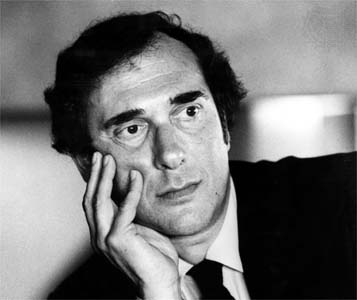
haroldpinterA: Is Harold Pinter dead?

B: He is dead.

A: Are you sure?

B: Yes, I’m sure.

(pause)

A: Well, who will fill his shoes?

B: I will fill his shoes.

A: You will fill his shoes. Are you a playwright?

B: No.

A: No?

B: No. Nobody can fill his shoes. I could fill his shoes if I were a playwright. But I’m not.

A: You know, the thing I suspect you’re getting at here is that Harold Pinter was unlike anybody else. But on a more literal level, I suspect you may have shared his shoe size. Assuming that you pay attention to feet. Specifically, the feet of those who contribute significantly to culture. Does anybody really know what Harold Pinter’s shoe size was?

B: His wife. The Nobel Committee maybe. I’m sorry for suggesting that I could fill his shoes. That was unintentional hubris on my part. I obviously knew that Harold Pinter was dead longer than you, and I’m still grieving.

A: Maybe they’ll offer Harold Pinter’s shoes at an auction.

B: An auction?

A: Yes, an auction. It seems the best place to consider Pinter’s legacy.

B: Will they begin selling off Pinter’s scraps of paper?

A: Maybe they’ll hold the funeral at an auction house. And there can be a little sniveling man crunched down under the bier offering work that hasn’t yet been published.

B: Work that hasn’t been published?

A: Work that hasn’t been published, yes.

B: At an auction house?

A: The publishing industry may not work this way, but maybe.

B: Oh, that’s wonderful.

A: If you’ve got the cash, perhaps.

B: As it so happens, I don’t have the cash. And I’m still a bit sad about Pinter dying.

A: I’m sad about Pinter dying too, although you wouldn’t know it from my morbid sense of humor.

B: Sometimes, a morbid sense of humor is just what it takes to take in the passing of a legend.

(pause)

A: You like the idea?

B: Not really. But we can argue about it over a game of tennis, old chap.

Review: The Spirit

spirit

The critics were not happy during the screening. The critic to my left fell asleep in his chair for an hour. The critic to my right — a jovial man who really wanted to like it — gradually realized that this was a film impossible to come to terms with.

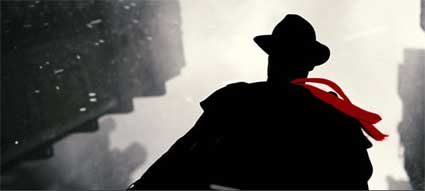
Gone were Eisner’s primary colors, replaced by muddy and amateurish black-and-white visuals with digitally added snow that never seemed to stick. The Spirit was so bad that it made Warren Beatty’s Dick Tracy look like a masterpiece.

Everyone was excited at the beginning, knowing that this was Will Eisner’s classic character finally brought to the screen and that it was Frank Miller who was going to steer it forward. But one of the fascinating aspects of this screening was observing the precise point in which each audience member would give up, knowing that Miller was cheapening a legend. Knowing that the film was wasting its cast and crew. Knowing that Miller was producing something even more odious than The Dark Knight Strikes Again or that crappy Robocop comic. (And let’s be honest. Has Miller truly contributed anything important to comics in the last ten years?) Knowing that it was Mr. Rodriquez who was the great force behind Sin City, and not Miller. (And to think that Rodriquez abandoned the DGA for this hack.) Knowing that just about everybody wanted to lock Miller into a room and punch him repeatedly in the face for about eight hours for producing this travesty. Knowing that something we all had hoped would be good was such a steaming turd.

I counted eight walkouts. There may have been more. But I can’t be sure. I was too busy slumping in my seat, stunned by the film’s relentless determination to sodomize Will Eisner’s corpse, assaulted by the film’s muddled script, which couldn’t even clear up the origin story until two-thirds of the way into the picture, its needless misogyny (women are either whores, nurturers, or kept in the background as laconic sidekicks), its inability to strike a single human note, and its failure to evince one note of fun.

Yes, Frank Miller should be punched in the face for this. It’s the only way to be sure.

There were jokes — one involving an ass on a copy machine — in which not a single person laughed. And again this was a friendly and rowdy crowd. But they all sunk into their chairs, feeling very angry that their time had been greatly wasted.

Oh, Stana Katic, how you tried as Morgenstern! You are as wonderful as Mageina Tovah, who played Ursula in the Spider-Man movies. I can now watch you in just about anything. And I feel so sorry for you for having your talent wasted. How much did you fight to keep the remainder of your quirks in? Bill Pope, I have admired your cinematography for quite a while. But this film was beneath your great talent and you should have known better. Samuel L. Jackson, signing on for a role just because you’re a geek simply isn’t worth it anymore.

Miller directs his cast as if they are statuary and handles his crew as if they are expected to generate magic simply by standing around. He is an ugly and crude man who does not know the human condition, and he is more interested in Eva Mendes’s ass than any innate personality she can use to sex up her role. He has tossed around crude pop culture references — including buildings and trucks named after Eisner’s collaborators — in an effort to win over the fanboys. But the fanboys will not bite. What Miller doesn’t understand is that geeks are too refined to swallow codswallop. What Miller doesn’t understand is that hell hath no greater fury than a fanboy spurned.

If there is any justice, the fanboys will lynch Miller at a future Comic-Con. If there is any justice, this film will fail at the box office and the money men will reconsider handing Miller the Buck Rogers reboot.

But there is rarely justice in Hollywood. The fact that this film was allowed to be made is testament to that.