
NYFF: Waltz with Bashir (2008)

[This is the thirteenth part in an open series of reports from the New York Film Festival.]

About a week ago, fearing that all of the films were turning my mass into flabby mush, I walked two brisk miles in twenty minutes to take in Ari Folman’s Waltz with Bashir, my fourth film of the day. The movie had been described to me by one critic, who purportedly writes for a newspaper, as “a little fiesta” — a qualification that I certainly quibbled with at the time. I’m not sure that a movie depicting the trauma of war and memory can be accurately identified as a “little fiesta.” Certainly, the real-life figures drawn from the Israeli Army do interpret a break between battles as a “little fiesta,” even if they do not precisely use these two specific words. It is true that these soldiers toil in homemade banana leaf huts on the beach and frolic about just before their comrades get shot in their head. But to suggest that these activities represent a “little fiesta” is, I suspect, missing the point just a mite. I’d like to think that the critic in question was having me on, but when I questioned him about specific points in Israel’s history, he had no knowledge of events that went down in 1967.

A professional animator informed me that he had disliked the film because of its gimmick and what he characterized as “amateurish” animation, but this same gentleman had gone bananas over Shuga, a film that I did not care for very much. But it should be observed that the device of a journalist-like protagonist (here, Folman) who questions various people about the meaning of some hazy memory has its roots in Citizen Kane and numerous personal documentaries. I don’t think that Waltz with Bashir is a documentary exactly. It’s more of a recreated narrative with the appearance of an objective pursuit. Something akin to a memoir played out for the camera. Certainly the animation technique, of which more anon, lives up to this notion of reconstruction. If it is not technically successful, then it is certainly viscerally successful.

But I was determined to make up my own mind. My initial reaction after the screening was somewhat ecstatic. But now that it has been a week since I’ve seen Waltz with Bashir, I see the film with slightly different eyes. This is a film that stacks its deck just a bit too heavily. War is bad, and it doesn’t matter what side you’re on. But this predictable rush to condemn war leaves little for the audience to make up their own minds. Paths of Glory is one of the best antiwar films in cinema, but it was Kubrick’s visual genius and his insistence on wiggle room for the audience that made the film work. Waltz with Bashir offers no comparative anthill. It offers more of a sideways glance for a topic that requires thinking in twenty dimensions and more time than you have for rumination. (As Tom Bissell noted in his underrated memoir, The Father of All Things, Vietnam is a subject that one can easily devote a lifetime to.) Waltz is, however, very good about clarifying something just as troubling: more than two decades later, it cannot be stated with any certainty that war memories match up to the reality. (Come to think of it, this is likewise a subject broached by Bissell, and Waltz with Bashir and The Father of All Things might make an intriguing book/movie double bill, or perhaps “two little fiestas” for critics who cloak their ignorance in uninformed mirth.)

The reality itself is the 1982 Lebanon War, and Folman was directly involved. He fought in the Isreali Army and, now in middle age, he retains a memory of naked young men emerging out of the water before a ruined city. Some key friends figure into this fugue: the long-haired Carmi Cna’an, the teenager who everybody figured would succeed in any science, now living in Amsterdam and fiercely protective of his privacy; Shmuel Frenkel, who has taken up vigorous physical exercise and maintains a bald pate; and Israeli war correspondent Ron Ben-Yeshai, who telephoned then-Minister of Defense Ariel Sharon about the massacres at Sabra and Shatila and was given a peremptory answer to back off.

What is quite interesting about Waltz with Bashir is its production method. Folman tracked down the people who haunted his memories, interviewed them, and then styled an animated narrative around these efforts. He even managed to persuade these people to reproduce their voices for the film. (Only a handful of Folman’s subjects declined.)

Each figure appears flat, representing a clear demarcation along a particular focal point. At times, it’s akin to watching a Flash animation or something involving cardboard cutouts from a pre-digital time. Folman’s team has added layers of smoke and reflections atop this basic approach.

Folman also has respect for his subjects’ wishes. When Carmi Cna’an declares that Folman can draw him as he is talking about war, he requests that Folman not include his son. Sure enough, the camera drifts away from the house as Carmi Cna’an engages in this paternal pastime.

But while the testimony that Folman unravels from his subjects certainly inhabits a feel of a bygone time — an atmosphere enhanced by a decent soundtrack and dutiful pop cultural juxtaposition — Folman fumbles a bit on memory’s false starts. Folman’s best friend and shrink, Ori Sivan, brings up a psychological experiment. When subjects were given photographs containing one false element, they believed that the false element was part of the memory. While Folman has exonerated himself somewhat by presenting this caveat to those seeking truth, he nevertheless remains very determined to align his memories to the film’s final moment: a live-action video clip depicting Sabra and Shatila’s aftermath. And while this footage is heartbreaking, with injustices that made me quite angry, I’m not sure if it is entirely fair to corral the film’s theme of ever-shifting memory to this harder reality. If anything, this piecemeal clip presents additional questions about the relationship between documentation and memory that were better pursued in Standard Operating Procedure. This conclusive curveball not only undermines Folman’s thesis and stubs out the strengths of his early emphases, but I suspect that this eleventh-hour departure was why the critic offered me a diabolical conclusion about war being “a little fiesta.”
NYFF: The Headless Woman (2008)

[This is the twelfth part in an open series of reports from the New York Film Festival.]

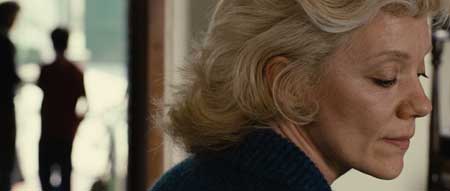
Argentine filmmaker Lucrecia Martel — sadly one of the few women represented among the predominantly male auteurs in the New York Film Festival — doesn’t wish to spell out her entire scheme to the audience. She does have a crackling knack for presenting her muzzled puzzle from a subjective viewpoint. In The Headless Woman, Martel’s characters are often photographed from the passenger seat or the back of a car, suggesting that the audience is sitting right next to protagonist Vero, but helpless to intercede as this wealthy woman slips further down the drainage of her ethical predicament. Cinematographer Barbara Alverez confines the vista to medium shots, often static, with subjects in the background often fuzzing out in soft focus. From car windows, smiling motorcyclists pass and point to turn left while the air conditioning leaves those inside perspiring with a comfy gloom. When the camera opts for a long shot, Martel places her characters at extreme edges of the frame. One of Vero’s house workers discovers the remnants of a swimming pool or an old fountain paved over for Vero’s endlessly renovated garden. But there are no visible apples in this garden, presumably because privileged exoneration has made temptation unnecessary. Vero, you see, has driven over what may be a boy or a calf, reaching for her cell phone as the engine purrs on and rendered catatonic by this bump in the ontological road. Instead of stopping and living up to her moral responsibilities, she drives off, refusing to look back and suffering a severe emotional crisis that has her questioning her own powers of recall. We’re left to believe at film’s end that the incident may not have happened, but, by then, the dye in Vero’s hair has shifted from flaxen to black. Martel’s film represents the transformation; the accident is, quite literally, the calm before the storm.

Martel surrounds Vero with endless children who remind her of the crime. Martel makes Vero a dentist, and there is the suggestion here that Vero’s dutiful drilling upon these children’s teeth represents a full-bore assault on wisdom. After the accident, the tougher cavity jobs have been delegated to others. The mise en scene likewise deracinates the top physical features of characters. Vero is visually headless, framed by her own insularity. Vero is not heartless, for she breaks down in tears while attempting to wash her hands of the affair. The faucet malfunctions. She accepts the kindness of a concerned worker. Her head moves out of frame, revealing nothing more than her craned neck behind the partition separating Vero from the audience. We hear the baptismal rush of bottled water pouring down the top of her head. That the crime takes place on a road near a dry canal, filled by the weekend rainstorm precipitating the crime, suggests a theme of liquid replenishment. Vero is doted upon by help at the house, colleagues at work, and cannot even admire her husband in too-tight trunks. The crime, whether real or illusory, has revealed her true empty nature. “I killed someone on the road,” she states to anyone who will listen. But there is no proof, and this insinuates a deeper question of faith: an ethical stretch that is not quite religious spanning along a sinuous road leading to the annual “Smile Day,” where dentists investigate the porous ivory inside young mouths in the name of public service.

But the journey here is not entirely satisfying. Martel remains so determined to juxtapose Vero in a series of tapestries that match her internal despair that the audience does not have a choice but to go along. There is nobody here who truly scolds Vero for being so callous or unfeeling. There is nobody here who does not dote on her. We are left to witness a woman who, like Bartleby, would prefer not to. When police begin investigating details of the boy/calf’s death, we see Vero and those close to Vero craning their necks near the scene of the accident.

And while Martel injects some interesting subtext into her film, the story of a wealthy person who gets away with a crime has been done too many times before. One thinks quite naturally of The Strange Love of Martha Ivers, and it becomes apparent that Maria Onetto (who plays Vero) lacks Barbara Stanwyck’s eclat. This film could have used a Liz Scott-like side character to shake things up. But we do have an intriguing mother representing Vero’s logical development. This woman watches wedding videos from the past, barks at people to rewind moments because her memories are shot, and rattles off such unthinking “You were so beautiful. Why did you let yourself go?” to the snowy VHS bride, who is standing before her decades later.

Martel showed greater flair for depicting unexpected human behavior with The Holy Girl, which followed a religious teenage girl obsessed with a man who groped her on the street. But I suspect the absence of religion in The Headless Woman is one of the reasons why this film doesn’t quite work. Martel is a filmmaker who, like Pedro Almodovar, cannot make a secular film that packs the same punch. Religion is clearly in her blood. Had it likewise been in Vero’s blood, Martel would have had a hell of a movie.

Similiveritude

The scholar and the world! The endless strife,
The discord in the harmonies of life!
The love of learning, the sequestered nooks,
And all the sweet serenity of books;
The market-place, the eager love of gain,
Whose aim is vanity, and whose end is pain!

— Longfellow, “Morituri Salutamus”

There exists a maximum amount of prearranged information, cultural reconfiguration, and other artistic offerings that one can ingest before it becomes necessary to splash bracing water upon one’s face (or, to take this idea further, to permit dollops of grease to crease one’s cheeks because of a self-administered oil change in one’s figurative vehicle). This is where the frequently overlooked human experience comes into play. By venturing outside one’s domicile or spending time with other humans commonly referred to as “friends” (as they are specified in the parlance of our time), or by participating in intimate activities that involve getting out of the house because the windows have fogged up and nobody wants to talk about the pleasant musky odor known to cause roommates to scurry, one can encounter a new sheath of information or perhaps a sequence of events that is not as neatly contrived or as conveniently cross-referenced as the hallowed narrative construct. The real world is refreshingly anarchic and, depending upon your degree of involvement, can prove to be more interesting than the cultural item that purports to represent it.

It is for these reasons, among many, that books which cannot live up to life must be thrown across the room. It is for these reasons, among many, that one should strive to emerge beyond the house, speak on the phone, meet up for coffee with deranged but amicable individuals, chat up strangers, and otherwise own up to one’s responsibility to live, lest one takes the hypothetical hurling of the book across the room too seriously. (It is a mere parabolic flourish, but a pugilistic passion not to be entirely discounted!)

We speak of verisimilitude, but we don’t speak so often of its dreaded cousin, similiveritude. And if you don’t know what similiveritude is, it is not because I have coined the word. (As it so happens, I am not the originator. At the risk of adopting Googleveritude, another nonsense noun unfound through Googling, one encounters only two search terms for “similiveritude.” Some gentleman named Felix appears to be the first to bandy this about. So I’ll give Felix the proper plaudits — congrats, Felix! you were the one! can I have your baby? — and carry on with this febrile exegesis.)

You could very well be a simiiveritudinist, but you may not know it. And if you still don’t know what this word is, well, then you haven’t been paying attention to all the phonies and the charlatans laboring at “art” who refuse to admit that they have no real understanding of the world they live in, much less an emotional relationship to it. It is quite possible that they may capable practitioners of verisimilitudinous art, but this intuitive connection may very well be dwarfed by academia’s rotten institutional walls.

For the similiveritudinist, life must not only reflect art. Art is the very life itself! The similiveritudinist gravitates to an artistic representation in lieu of a stunning natural moment. He may attend an artistic function, hoping that it will fill in certain ontological vacuities from not thinking about or otherwise ignoring the world. The similiveritudinists talk with others, but the conversational topics are limited mostly to art. My empirical state has revealed that similiveritudinists are found in greater frequency in New York than in San Francisco. Similiveritudinists may be socially maladjusted, apolitical, asexual, or otherwise fond of keeping their noggins lodged inconsolably in the sand. Understand that there is no set formula here aside from highly specialized chatter. They may create callow games like “Name That Author” and they may put up photos on their websites of otherwise pleasant individuals who appear more bored than a silo stacked with accountants on the eve of the apocalypse. They may spend all their time occupying movie theaters — and I have seen more than a few etiolated souls who live for the New York Film Festival’s darkness over the past few weeks — but they cannot confess that they have enjoyed something, nor can they be authentic, stand apart, or otherwise inhabit the variegated identity within. They may indeed be employed primarily as critics, lacking the heart, the soul, the tenacity, or the talent to make a strike for the creative mother lode. The pursuit of art is, in the similiveritudinist’s mind, always a serious business. The worst of the similiveritudinists will thumb their noses at genre, popular art, or anything sufficiently “lower.” (This works, incidentally, both ways.) They believe that art, serving here as a surrogate plasma, must always be high, and that anything that falls beneath these cherished standards should be disregarded. They have perhaps inured themselves to the pleasures of a commonplace flagrance or the joys of a small child laughing as a sun sets over the playground. Joie de vivre? Try joie de livre! The similiveritudinist’s vivre, scant as it may be, is likely to be the hell of other people.

If you’re thinking that my wild ruminations here emerge in response to Horace Engdahl’s remarks concerning the current state of American literature, well, your hunch is partially correct. Michael Orthofer, a gentleman and a scholar, has already exoriated Mr. Engdahl quite nicely (as well as Adam Kirsch’s equally myopic remarks, which are perhaps a tad more pardonable because Mr. Kirsch is now out of a job and must now consort with the rabble, surviving hand-to-mouth like any other cultural freelance writer; which can’t be easy, because I suspect that many of us live more frugally and enthusiastically, and certainly less similiveritudinously, than Mr. Kirsch). So my specific reaction to Mr. Engdahl’s words isn’t quite necessary. Mr. Orthofer has already gone to town here. But I suspect that Mr. Engdahl and I might share a few grave concerns over the similiveritudinists who have invaded American literature. The crux of his criticisms suggest very highly that he may be an asshole, but he is thankfully not a similiveritudinist.

To live for culture is not enough. Culture is no replacement for the real thing. It is a helpful prism with which to find and divine certain meanings, but it is only one great piece of the living puzzle. And Mr. Engdahl is quite right to suggest that certain literary clusters within the United States have become too isolated and too insular. Did Jonathan Franzen read any other emerging author aside from the tepid name he picked from his middlebrow hat when he was asked to name his 5 Under 35 choice? We’ll never know, but his choice, which discounts the dozens of emerging voices who currently write for life and passion, is clearly that of a similiveritudinist. Likewise, David Remnick has been foolish enough to suggest that none of our celebrated writers are “ravaged by the horrors of Coca-Cola.” This is clearly the remark of a tony avocet too terrified to leave his golden perch. A casual saunter through any three city blocks reveals this ruddy symbol of the beast, the hellish mire of advertising that threatens to subsume all human moments. Has Remnick’s annual $1 million salary prevented him perhaps from, say, properly understanding what it is like to live under $30,000 a year? Or to work two jobs? Or to toil in the service sector?

If you do not know why you must tip a waiter in cash, but you can cite pitch-perfect passages from Milton, you are a similiveritudinist. If you do not know the price of a package of hamburger buns, but you’re not keeping track of how much you are blowing at Amazon, you are a similiveritudinist. If you have not skipped a meal so that another mouth can be fed, but you can describe the precise cordial to go along with a slice of pecan fig bourbon cake, you are a similiveritudinist.

Similiveritude represents everything that is wrong with American literature. Not all American literature falls under its terrible influence, and there are many literary advocates who understand its proper secondary place. To cure a similiveritudinist, you must ensure that this reader doesn’t just have a clue, but maintains an open and genuine curiosity about everything. To listen to a stranger because you are interested. To view the book as something that may be real in feeling but unreal in execution. To accept that something crazy, whether it be an elaborate series of footnotes or a moment of magical realism, is meant to happen in a book from time to time because the book is not real. More important than a critical scalpel hoping to be absolute in its appraisal is the idea of whether or not the book is applicable to the human heart, and whether or not this applicability feels intuitively true. From here, reasons and justifications can be loosened, with enough wiggle room to involve the reader.

Last month, Nigel Beale saw fit to tsk-tsk me because I had enjoyed a story involving an unhappy housewife having an affair with a 1,000-year-old woodpecker, and it had provoked an emotional reaction in me. It goes without saying that woodpeckers do not live this long and that most lonely housewives would settle for a Hitachi Magic Wand over a cuckolding canary. But the point here is that Mr. Beale, despite being a good egg, could not get beyond his own personal definitions of literature. And I fear that Mr. Beale might dip into the similiveritudinous deep end of the great literary pool because of his inability to (a) read the story to see what I’m talking about or (b) consider the story on its own terms, despite the unconventional sexuality presented. It is not a matter of Mr. Beale liking or disliking the story. That is his choice. But it is the instant dismissal of the story, and the dismissal of my reaction, that is the issue here. It would be no different if I were to dismiss a reader for, say, enjoying a James Patterson book. Now personally I loathe James Patterson’s work. But a reader has the right to have an informed reaction, even a positive one, and we have the obligation to listen to that reader’s reaction before chiming in with our own. Because there might be some intriguing personal reason for why someone prefers the story with the woodpecker or the James Patterson novel that represents a peculiar commitment to life.

Of course, abandoning similiveritude or listening to the other’s viewpoint doesn’t mean abandoning one’s artistic faculties. It merely means placing a particular way of living first: keeping an open mind and ensuring that the careful intake of culture remains a thorough but secondary occupation. What I am calling for here, quite optimistically, are more Renaissance men to inhabit a society in which there are no limits or barricades to one’s curiosity, a nation that counters charges of insularity with limitless interest, a country that can make Mr. Engdahl’s half-true claims utterly fallacious. It starts with the end of similiveritude. It continues with a series of upturned ears. It ends with an army of pro-active thinkers who value life first.