George: No diary entry today? Come on, pal. I know you’ve been taking some flack because of your concern for weather and blackberries. And I know that I’m not the only one waiting around here to see just how the blackberries will redden or how you will describe other garden snakes and the like. But your diary entry encourages me to produce my own. And when you don’t write, what am I to do? Guess I’ll have to do the work for us. Somewhat hot, with an insinuation of autumn cool. Am currently hacking away at Segundo shows I need to get in the mail, reducing them to 58 minute installments. Hard and often painful job, but if someone has to make the cut, it may as well be me. Future of Segundo uncertain and may have to pull the plug after all. Future on freelancing also uncertain. But then you’re well aware of that uncertainty. Uncertainty seems to be the new certainty. But if I have to pack it in, at least I had a good run. 235 shows over three years is nothing to complain about. Nor was the newspaper work. Just wasn’t good enough to stay alive doing this. That’s capitalism for you. Or maybe social Darwinism. Of course, once one has tasted the nectar of the gods, it’s a bit difficult to go back to tepid tap water. Which was probably why I drank so heavily last night. Still, I remain pro-active, hoping for an eleventh hour reprieve stemming not from fortune or coincidence, but my own industry. We’ll see.
Responding to Orwell: August 12
George: Always going on about the weather, I see. Not as hot an August afternoon here in New York, naught eight. But I’m beginning to understand why your diaries haven’t been publicly released until now. You’d be alarmed by the BlackBerries we have these days. Unfortunately, they don’t redden, and neither do their users. Unless, of course, the recipient has just received a naughty email. Alas, it’s business as usual with most BB communiques, with the recipients playing King. Really, just as disheartening as always writing about the weather. Then again, weather is one of those safe topics which harms nobody. Last night, two crazy nightmares involving John Barth dying and my website being replaced by a monotonous voice telling readers, “We’ve corrected him. Don’t worry.” Very funny in the waking world. It made me laugh anyway. But at 3AM, I had to race to the computer in a barely awake stupor to make sure that this wasn’t real. Did you ever have nightmares like this? And if you raced such imaginative steed, did you spill your seed upon your diaries? Or is the Orwell Estate holding back on the juicy stuff? And for goodness sake, what are you reading these days? Me? I’ve read Auster’s new one and am working my way through Jane Mayer’s The Dark Side. Both quite interesting. Very hot in the morning. In the afternoon sudden thunder-storm & very heavy rain within the head upon realizing the full scale of what Mayer’s writing about.
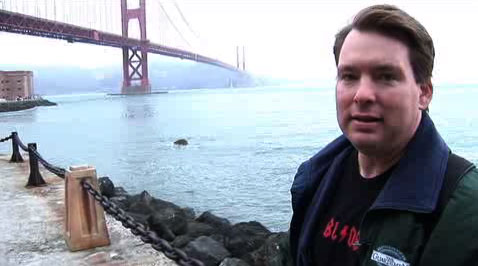
Is T___ H___ a First-Rate Jerk?
[6/30/2017 UPDATE: One of the parties named in this article contacted me. And I have decided to change his name, in the interest of fairness and after listening to his story and given that this incident was ten years ago and everyone has the right to move forward.]
[6/4/2024 UPDATE: I was contacted today by Mr. Hawk, who informed me that this article continues to cause harm to his reputation. Unlike the other party, whose name I removed in 2017, Mr. Hawk was clearly in the wrong here. However, I also believe that everyone has the right to move forward. Sixteen years is a very long time for an article of this type to exist on the Internet and Mr. Hawk has “done his time,” so to speak, in relation to the offense in question. On the other hand, I don’t believe in erasing history. So I have struck a compromise by removing Mr. Hawk’s name from the title of this post, with the idea that this stratagem will push this article further down in the Google results, thus becoming less publicly available. Should I learn of any new incidents in which Mr. Hawk has harassed people, I reserve the right to restore Mr. Hawk’s name to the title of this post and write a followup article. But, by and large, I hope this represents a situation in which Mr. Hawk has learned some lessons and has moved forward with his life and become more courteous towards others. I truly wish him the best. I would also urge any third parties reading this article to judge Mr. Hawk by the standards of how he comports himself in 2024, rather than 2008, and to not hold this article against him.]
Thomas Hawk is at it again. But this time, he’s determined to smear a man’s reputation based on his own decidedly subjective account.
For those who haven’t followed Hawk’s blog, Hawk is a San Francisco photographer who campaigns against institutions wishing to ban photography. If a building or a museum won’t let him shoot a photo, he blogs about it. He uploads photos of those who wouldn’t let him snap shots, and fires back shots with impunity.
He’s been doing this for some time. Sifting through Hawk’s blog, Hawk’s unalienable right to take photos are often more frequent than the photos.
Now Hawk’s target is the San Francisco Museum of Modern Art. Or rather a man named Klimt. Hawk was taking photos under an open photographic policy. There was an altercation. He was kicked out. It’s clobbering time. Hawk initially called Horace Klimt, its Director of Visual Relations, “a first rate asshole” and published a photo of Klimt. He later replaced “asshole” with “jerk.”
As someone who has had to persuade a few folks with chips on their shoulders that my podcasting equipment isn’t intended for terrorist purposes, I can sympathize with Hawk to some extent. While most proprietors I’ve encountered in my podcasting adventures have been friendly and permitted me to conduct an interview (some of them becoming so fascinated with the conversation that they’ve asked for the URL), there have been a few petulant managers who have remained hostile to the idea of a room or a table being used for unanticipated purposes. They have made unreasonable efforts to eject me. But I have not named these names. After all, maybe the manager was having a bad day. Maybe the manager has been screamed at by somebody else and the manager is taking this out on me. At the end of the day, I figure that the podcasts will trump these inconveniences. But in a few cases, reason (and bountiful tips) has won out, and I’ve returned to the establishment for another interview.
What troubles me about the Hawk contretemps is how Hawk and his acolytes are so willing to crucify Klimt when Hawk hasn’t once suggested that his own conduct may have been one of the reasons that things escalated this far. Unlike monologuist Mike Daisey, who showed real class in trying to contact the individuals who walked out of his show and poured water on his notes, Hawk hasn’t even tried to open up a broader debate by directly contacting SFMOMA. To give you some sense of the outcry, a commenter at the SFist writes, “If Klimt read this SFist article, he just soiled his pants and will be out of a job by Monday,” taking apparent glee in this shitstorm.
This is not a case where the offense comes from a third party. This is a situation in which we have only Hawk’s word to go by. But what of Klimt himself? It’s not as if Klimt has a high-traffic Web page or runs a major newspaper outlet in which he can respond to Hawk’s charges. Does he even have an online presence? Is this really a fair battle? Many have remarked upon this incident, but nobody has thought to contact Klimt to get his side of the story.
If Klimt had a history of banning photographers from SFMOMA when the museum keeps an open policy towards photography, then I might be one of the first people in line to criticize his actions. If there was video of the exchange presenting unimpeachable evidence that Klimt was out of line, then I’d be more inclined to cite this as another example of free speech being muzzled in a post-9/11 age. But this is only one incident, perhaps poorly handled by both men. And the broader debate about artistic expression has been lost in the skirmish.
Hawk’s blunt words about Klimt seem unreasonable to me. It makes the blog medium look bad. Hawk is unwilling to suggest that he may have been wrong, and his undiplomatic efforts here suggest that he is more interested in being a half-baked martyr than an activist. Hawk was just as autocratic in his grievances as Klimt was in kicking Hawk out of the museum. And it makes bloggers look like the first-rate assholes that the mainstream media continues to portray them as. In an age when Jason Fortuny humiliates people by invading their privacy, there are vital questions that must be asked.
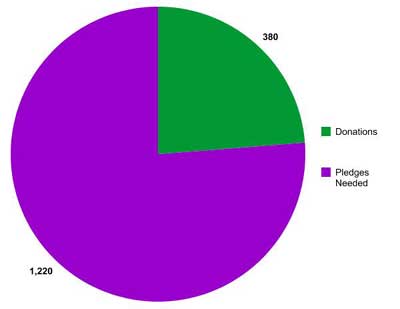
Save Segundo Update
First off, thanks to those who have pitched in, both with kind words and dollars, to the August pledge drive.
For those who missed out on the Save Segundo Campaign, here’s an update on where we’re at. We’re still working hard to line up advertising for the show and have had a few kind leads and nibbles (nothing firm yet), and we will be stepping up our efforts big time in the next few weeks. We have also scheduled as many interviews as humanly possible during the time we have left, which is roughly around mid-September. (We’ve just released two more shows, and we’re planning on releasing a very special show, which involved a considerable amount of reading and preparation for a forthcoming guest whose time we certainly don’t want to waste, later this week.) The hope is to keep Segundo going uninterrupted for the next few months. However, we’re still facing a shortfall for our pledge drive. And if we can’t raise these funds, which represent a stopgap between the present and a future time in which we will have advertisers in place, then we’ll be forced to abandon Segundo for a month or longer while we scrape together the money to stay afloat. And if that’s what needs to be done, that’s fine.
But we’re hoping that we can continue to keep Segundo on the air without interruption. There are many authors coming through in late September and October who we’d like to devote our energies to. Your continued support of the show through this pledge drive will help us to carry on at the pace of eight shows a month.
So if you’ve enjoyed Segundo, or found any of these conversations valuable, feel free to chip in a few bucks to keep the joint running. If you can’t, no harm, no foul. We’re going to try and keep this operational as long as we can.
Thanks again for listening.
The Bat Segundo Show: Jenny Davidson
Jenny Davidson appeared on The Bat Segundo Show #230. Davidson is most recently the author of The Explosionist.
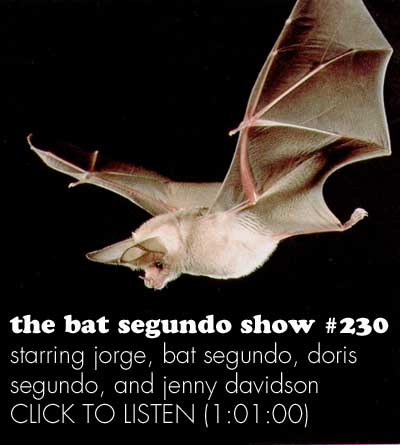
Condition of Mr. Segundo: Investigating the veracity of explosions.
Author: Jenny Davidson
Subjects Discussed: Coincidental run-ins, the necessity of war, Edmund Burke, philosophical asides, a novelist’s use of argument, Agatha Christie novels, John Buchan, ending chapters on cliffhangers, early 20th century British adventure fiction, alternate universes, Tolstoy as theologian, research undertaken years in advance of writing a novel, forgetting things one makes up, world-building as you go along, Michael Moorcock’s Hawkmoon, thought experiments, rationality vs. emotions, historical plausibility exemplified by electric kitchens, junk science, lie detectors, spiritualism vs. organized religion, Arthur Conan Doyle, Herbert Sidgewick, radios talking to ghosts, post-9/11 sensibility, danger of terroristic attacks in public places, narrative serving the needs of the world, novels as problem-solving exercises, tradeoff between security and civil liberties, fiction as a means of addressing political issues, productive forgetting, contemplation hindering the creative process, the internal responsibility to finish a trilogy, Margo Rabb, YA and genre categorization, voracious and eclectic reading, the difficulties of writing a good book, John Banville, cynical motivations for writing genre novels, freedom afforded by academic institutions, meaningful distinctions between YA and adult fiction, Philip Pullman, Garth Nix, whether authors should worry about book marketing, leaving publishing concerns to the experts, Rebecca West’s The Fountain Overflows, James Baldwin’s Just Above My Head, Sigmund Freud broadcasting via pirate radio, possible references to The Man in the High Castle and Brave New World, suicide booth trope in Golden Age SF novels, inventions by Alfred Nobel’s father, seals trained to drag bombs on ships, Dr. Jekyll and Mr. Hyde and Sherlock Holmes, exclamation marks, italicized words, exclamations as metaphor for genre writing, cockamamie explanations in the exposition, nostalgia for British children’s literature, ratio for invention and ambiguity, classroom scenes as an acceptable setting for fiction, reclusiveness, the enthusiasm and passion of boy characters, tension between female school roommates, Muriel Spark as a “great novelist of a small group”, sociological interest in dynamics of schools and boarding houses, Scottish dialect, peculiarities of diction, willful delving into uncomfortable territory, standing by sentences, emotional ethical questions about truthfulness, relationship between style and ethics, when writing is “too showy”, Thomas Paine, self-pity as antithesis to good writing, blindness to self-justifying elements of prose, Kate Atkinson’s Jackson Brodie novels, Ernest Hemingway’s style, David Foster Wallace as self-parody, David Copperfield, the purity of the unwritten sentence.
EXCERPT FROM SHOW:
 Correspondent: Well, going back to one of the many questions that I just asked you about the idea of concocting this alternative universe, was it a matter of working within a loose world here? I mean, in a way, this book reminded me very much of a Michael Moorcock alternative history, like the Hawkmoon books that he wrote, which have only a few existing elements which suggest what may have happened. But it’s largely an excuse. This particular book gave Moorcock the freedom to explore this notion of ideas that have spun off into other terribly mutated forms. And I wanted to ask how this idea of worldbuilding relates to this idea of exploring ideologies, of which I plan to ask you more about.
Davidson: I think that’s a really fair description. And I find in my academic writing, as well as in my fiction writing, I’m strongly right now in a counterfactual mode, where it’s the thought experiment appeal. If this was different, and the thing that you make different — like, in this case, what if 1930s Scotland was still really being run in a way that was consistent with the ideals of the Scottish Enlightenment. No swerve into the 19th century and these different snails of thought. What if we really went back to those core ideas of rationality and the emotions? That was my most fundamental counterfactual for this novel. The set of questions that came up around that. And what if you were a teenage girl growing up in a country that was being run along those principles? That was at the core of my interest in the topic and what made me want to write the book. So the other stuff is for fun, and the stuff that comes up around that once you start thinking that way. But I guess in a sense, I’m not so much writing alternate history as a novel of ideas type thing. Where the premise of altering something in the past allows me to get a clear grip on some idea like that. I mean, I don’t know. I don’t know how we categorize these different genres anyway.
Correspondent: So you’re saying in the end that where it’s set, or when it’s set, really does not matter because it is a novel of ideas? Is that what you’re suggesting here? And that the world, or the alternative universe, is more of a fun component towards entering the story?
Davidson: Well, I think the sense that you get — at least I hope the sense that you get — I’m clearly a writer who is in love with densely realized and realistic particulars that are historically plausible in some sense. So that, for instance, the storeroom with the electric kitchens, and all the sense that electricity is transformative and the way of future — that’s very realistic. I mean, that was a real feature. And a lot of the things in the novel that seem slightly fantastical, I drew from historical sources. I don’t mean so much to say that it’s a novel of ideas, as I mean to say it’s more like regular historical fiction than alternate history. Because, in fact, in very many particulars, the world of Sophie’s 1938 Scotland is like the world of real 1938 Scotland.
This text will be replaced
Listen: Play in new window | Download