Interview with Ralph Bakshi

I recently had the opportunity to talk with underground animator Ralph Bakshi. A portion of our conversation appears this afternoon at Vulture, where you will discover the song that was originally going to play during the finale of American Pop. (For the specific reasons why, you will have to wait for the podcast.) Unfortunately, there were space constraints. So what follows is some of the additional material that didn’t make it into the piece. The entire conversation, which includes even more from Bakshi, will be released as a future installment of The Bat Segundo Show. (Please note that edited elements of the same conversation appear both here and at Vulture.)
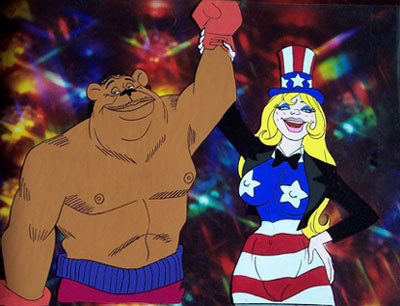
Correspondent: I wanted to ask you about music in your films. It’s certainly important in American Pop. You pilfered from your record collection for that, as well as the “Maybelline” sequence in Heavy Traffic. And there’s “Ah’m a Niggerman” from Coonskin, which you wrote. I’m wondering if you did this because you have an aversion to Carl Stalling-style orchestral music.

Bakshi: First of all, I love music. I’ve always loved music. And I’ve loved various kinds of music. Music is part of our lives. It’s part of the soundtrack that what we all grow up with. Especially in my day. I don’t know today. There’s so many things going on. I’m talking about yesterday and my day, which are the 40s, 50s, 60s, and 70s. Music is so emotionally important to the movie. It’s just as important as anything else. If the song is emotionally correct for a scene, the scene plays better. Or the scene plays better than it would have with a different song. So music is so critical to movies. I chose songs that I knew emotionally worked with these scenes that I wrote. Because whenever I listened to music while either driving in a car or sitting at a bar or listening to Coltrane or Billy Holiday – you daydream. If you don’t daydream to music, then you’re not listening to good music.

I went out and I bought every record that I’ve ever loved that was right for the scene. “Yesterday” by Billie Holiday for Fritz the Cat was perfect for Big Bertha and coming into Harlem. You know, it was a classic song. “Maybelline” and “Twist and Shout.” And all these records. “Scarborough Fair.” All these records I used, I got for fifty to a hundred bucks. They were dirt cheap. I could buy any record I wanted for under two hundred dollars. Why was that? Unbelievable.

Because everybody else was scoring their films. And why were they scoring their films? Because if they had a hit, they’d own the music. They’d make money from the score. They’d own their own records. I can’t release Billie Holiday’s “Yesterday” and make any money out of it. I never considered that. The issue was what was right for the movie. I couldn’t believe the cheap prices I was getting. And I had a low-budget film! So I could afford to get anything I wanted.

Correspondent: But you had Andrew Belling on Wizards. I’m curious if you gave these composers specific instructions.
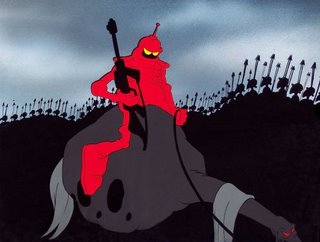
Bakshi: Well, Andrew Belling on Wizards did an absolutely brilliant job. Let’s talk about Wizards. Wizards is very low-budget. One million two. Okay. I’m not going to fall back on my records, because it’s not that kind of movie. I need a score. But I need a score that I love. And I don’t remember how I got to Belling. I’d been to New York with a lot of other guys. But Belling came with a little synthesizer. One little machine which was a very big deal. We didn’t have any orchestra. We had synthesizers. All that music was done with Belling in the room. And he said the right things and he did the right things. And he came back and he played me a piece of music that was beautiful. I think Belling did an incredible job in that song he wrote. And the battle scenes. And the emotion. Belling nailed it. He did it himself and everything. It was all done without an orchestra. It was good.

Correspondent: This is an interesting conundrum. I think one of the reasons why the “Maybelline” sequence in Heavy Traffic is so stirring is largely because of that music. But here you have a scenario in which someone else is composing music that doesn’t originate from another source.

Bakshi: I was terrified what he would do. I was scared. I was nervous. I had nightmares that it wouldn’t work. And he nailed it. I don’t know how he did it. I had nothing to do with it. How do you talk to another composer about music? Now look. Let’s talk about freedom. I demand freedom as a director. I demand the right to fuck up, to do what I want. I am not about to take that freedom away from another artist. If Belling walks in and says that he’s a composer, and I believe what he has to say and I believe that he’s sensitive enough and I believe it, man, prove it. Go do your music. It’s not my job to write the music for him.

(I also discussed with Baskhi why he hired Thomas Kinkade. In addition to the remarks at Vulture, Bakshi also had this to say.)

Bakshi: In the middle of the picture, [Kinkade] stands up and he says, “I’m going away with Gurney for three weeks. We’re traveling cross country.” And I said, “Well, wait a minute. We’re doing a picture.” “All right. We’ll be back on a certain date. We will paint enough before we go. And when we get back, we’ll double paintings.”

He worked with Frank Frazetta. Those kids, Gurney and Kinkade, painted wonderful paintings so fast. And Frank Frazetta would come in — he was a great illustrator – and show Kinkade a lot of tricks. Both of those guys, when they painted other stuff, when Kinkade painted closer to the Ashcan school, which I loved very much, wonderful. He can sell anything. He opened up galleries. He’s building a city now. He’s raised hundreds of millions of dollars. He owns half of California. So I have nothing against Kinkade. He’s funny. He is like Elmer Gantry. He’s ‘s a great painter. But he likes to make money. And he does. He doesn’t like the stuff he’s painting.

Correspondent: But that’s anathema to your position, which is about making it as true and as honest as possible.

Bakshi: By the time I got to Fire and Ice, I was bitter. It’s not my picture. I was burned out. I was through. Though people may like it, I don’t consider that a Bakshi film. That’s a Frazetta film. That’s me not caring. I was burned out. I was tired. At that point, I was gone. And I did. I closed the studio and then I left. I had no emotional interest in Fire and Ice to tell you the truth.
Is Hillary Finished?

Liveblogging the elections.

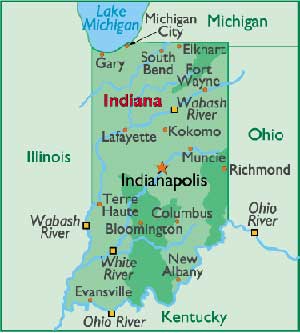
12:18 AM: Listening to WIBC-FM feed. Indiana remains close, with Hillary ahead by only two percentage points. Gary, Indiana remains the big mystery. Hillary has just announced that she will not appear at any public event tomorrow. Does a public event entail a media appearance? Will Hillary concede?

12:22 AM: Gary, Indiana Mayor Rudy Clay’s prediction: “Barack is winning precincts 297 to eight and 153 to two and all that. Gary is going to be a big plurality for Barack Obama, a big plurality.”

12:25 AM: 92% Indiana precincts now reporting, still 51-49. Clinton 588,823 to Obama 568,156. Still waiting on the big bag from Lake County. From WIBC: “The national media is seeing a county that’s just starting to release numbers.” Some playful banter from these guys on the radio, who are marveling over how they’re now the center of attention and how the outside media doesn’t understand Indiana politics. It sure as hell doesn’t involve “hanky-panky.”

12:30 AM: Some additional numbers put Clinton in front. “Gary ain’t come in yet.”

12:33 AM: A report from the Terre Haute Tribune Star, where I am now looking out for a basement. Obama volunteer Casey Chatham began volunteering about a week and a half ago. He spent $57 to FedEx his absentee ballot from Nairobi.

12:35 AM: Also in the Tribune Star: considerable phone mobilization from the Clinton camp.

12:40 AM: Hillary had given a victory speech, but then the numbers began coming in from Lake County. Then there was the mysterious cancellation of public events. 95% of the vote now in, difference now 15,000 votes. Looking for corroboration of this.

12:42 AM: The Oregonian does the math.

12:44 AM: Marc Ambinder offers smart advice. (via Daily Kos)

12:45 AM: It appears that the clock on my computer is a few minutes off. Pardon any chronological confusions as these reports continue. I don’t think I can go to bed until Lake County comes in.

12:47 AM: More info on Hillary’s “declaration of victory.”

12:50 AM: Obama needs to win the remaining precincts by 69% in order to win. But the WIBC guys insist that because these precincts are based in Gary, Indiana, this could happen. Some specific info being blogged here.

12:51 AM: Lake County: 316 out of 561. Obama 46,759 to Clinton 25,100. Wow, this could happen!

12:52 AM: NWI: “We’re updating as fast as we get the results from inside the Lake County Government building.” Keep hitting F5, folks. Keep hitting F5. And thanks to the NWI’s dutiful reporting.

12:54 AM: NWI: Still 7,000 absentee ballots to count. All of Gary’s results in.

12:55 AM: Associated Press: “The northwest Indiana county is the state’s second-most populous with nearly 500,000 people. It had reported no results as of 11 p.m. Eastern Time. A large number of absentee ballots and a record turnout delayed the tallies, and polls there close an hour later than much of the state because Lake is in the Central time zone.”

12:57 AM: I highly recommend the WIBC feed if you’re a political information junkie. These guys are tracking all news updates in real time and providing specific sources. (And there’s some good radio from Indiana!)

12:59 AM: Globe and Mail: “The most unfortunate aspect of the much-maligned Lake County keeping Indiana interesting past midnight is that a completely befuddled Larry King has been forced to take the air while the results are still in question…..Update: After about eight minutes of airtime, Larry King appears to have been sent home in favour of more Anderson Cooper. Although it’s entirely possible Larry is still talking, and they just haven’t told him he’s off the air.”

1:02 AM: Video of Hillary’s “victory.”

1:08 AM: New Jersey Star-Ledger: “The divide feeds the Clinton argument that Obama can’t win in November unless he can convince white voters and those further down the income and education scale — the so-called ‘Reagan Democrats’ — that he understands their needs. It prompted Paul Begala, a longtime Clinton supporter, to complain on a television panel show last night that Democrats ‘can’t win with eggheads and African-Americans.'”

1:10 AM: Slideshow of Indiana voters.

1:12 AM: How Obama Beat the Line.

1:13 AM: WIBC on why we’re in a holding pattern. “We’re up to 98% in Lake County and yet we’re still at 95% in Indiana.” 99%, Clinton 51, Obama 49.

Looks like it’s over. Indiana for Clinton.

Final Thoughts:

Clinton was dealt a major blow tonight. The only way that Clinton was able to win Indiana — and this was a slim victory at best — was through a campaign that involved saying damn near anything and using any slimy tactic in the book to win a vote. These are the actions of a political scum. Nixon is now widely regarded as one of the great American scumbags of all time. But let’s not forget. Nixon’s scummery still nabbed 68.7% of the popular vote in 1972. You could argue that it was George McGovern. But let’s not underestimate the way the casual American voter relates to scums or elects a President based on whether he’s the right guy to have a beer with. I am not certain just what dipsomaniac cachet Clinton has, but let’s not entirely rule it out.

Obama demonstrated that his base is quite strong, that he can maintain momentum based on a more ethical campaign. But was it Hillary hatred or hope that did the trick in North Carolina? It remains to be seen whether Obama’s North Carolina victory will translate into a movement against McCain in November, should he succeed in securing his presidential nomination. The theory of whether Obama has the ability to “close the deal,” however, is beginning to lose credibility. Even with all the superdelegate vagaries, it appears mathematically probable that he will be the Democratic frontrunner.

But it still remains a horror franchise with an endless stream of sequels. Hillary is Jason from Friday the 13th. She’s a candidate who doesn’t understand that she’s dead, but who continues to hack away at any innocuous ideal resembling a few kids fornicating in the forest. Despite skillful attempts at killing her off, she cannot be murdered. Perhaps she’ll succeed in massacring the remaining Democratic ideals before being confined to a space station. Or maybe we’ll all lose interest in the franchise.

The big question mark over Clinton’s head is why she canceled her public appearances today. Whether for health reasons or general fatigue, this is a catastrophic decision on her part. This is no longer a campaign in which you take a day off.

It suggests, by and large, that Clinton herself is the one here who is unable to close the deal, or come anywhere close to offering a fair one. But she’s tried every trick in the book and it’s still not working. If she doesn’t win this, and it looks increasingly likely that she won’t, there will be long memories and many pissed off people remembering what she did to split the Democrats. She could be as much of a political pariah as George Bush is likely to be, come January 2009.

Free Comic Book Day

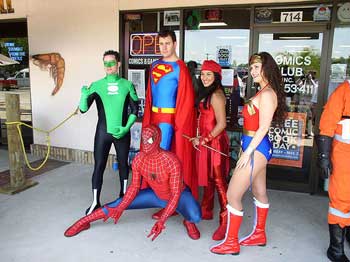
I walked into my local comic shop and saw few unfamiliar faces looking over a few freebies. I walked out with a thick stack of comic books, headed home, and consumed them in the best way: in one mad tear, one mad comic book binge.

It was Free Comic Book Day, the comics industry’s to Halloween. But candy’s handed out in May. Comic publishers supply plentiful issues that are then handed out in comic shops around the world. It isn’t the pounds of sugar that will make your head spin, but the smell of fresh ink.

Four or five hours passed before I put down my last free comic book. A thought balloon hung over my head. What a complete waste of time. The seventh annual FCBD was a bad haul with the effort cut to accommodate the price. I must be insolent to complain about getting forty-one free comic books, but when a company gives you a sample, the idea is to make you a paying customer. But most publishers forewent storytelling and went straight for the sales pitch. These were comic brochures.

The majority of the Free 41 were either excerpts or pages of preview art. And the problem with the multiple previews could be seen in Viz’s Shonen Jump sampler. It had three stories — all close to incomprehensible.

(On the topic of the free manga offered, Jump was one of only three that fit the category. The others were a full-length graphic novel from Antarctic Press and a preview of the manga adaptation of James Patterson’s Maximum Ride novel series. Reading it left-to-right or the traditional manga way did not make the preview any less dumbfounding.)

Perhaps I could forgive the majority of comic book publishers had they offered new material instead of reprints. Gemstone Publishing brilliantly reprinted a 48-year-old story featuring Gyro Gearloose, successfully ensnaring today’s youth with colorful caption boxes: “How does Gyro happen to be in this awesome place? It is necessary to flash back to a recent day in Duckburg!”

DC Comics and Maerkle Press were the only publishers to offer a regular issue of a series for free. Unfortunately, issues were of the how-dumb-do-you-think-kids-are quality of Tiny Titans #1 and Love and Capes #7, the latter being a series flapping wildly in the world of superhero cliché.

DC’s other offering was a reprint of Grant Morrison and Frank Quitely’s All Star Superman #1 — an entertaining book, but one originally published three years ago and since reprinted numerous times. Dark Horse offered new Hellboy stories from Mike Mignola — one of the few FCBD comics worth the trip.

Marvel, during a major movie weekend, made some questionable choices. It published a brand new story by the strong creative team of Mike Carey and Greg Land. But it was an X-Men story, not Iron Man or even the Hulk. Those two characters, who appear in movies this summer, were relegated to a new Marvel Adventures book.

The Free 41 could have been worse. There was variety, from kids’ books to comic book journalism to books where the protagonist doesn’t wear a mask. Indie publishers provided the bulk of the books but only one publisher, Oni Press, offered a full-length story that was outside the superhero genre. Unsurprisingly, superheroes, rather than regular Joes, had the highest representation.

If I were to offer a sappy speech about FCBD, the first thing I would say is that the event is supposed to be about more than just the free comics. It’s supposed to be a celebration of the medium, its power to tell a story, its rich history. But how can I believe that when most books bothered only to make a pitch to buy the next one, the real one?

If FCBD was about seriously good comics, the titles offered would have been worth reading. But where was the free issue of DMZ? Of Fables? Of Thunderbolts? Of The Fantastic Four? Of Ex Machina? Of The Killer? Of Uncanny X-Men? Of 100 Bullets? Of anything happening now? Of the book that will transform someone into a Marvel Zombie? Of the book that will make someone an addict of any comic book genre?

A free book along those lines wasn’t in my thick stack. And I doubt that many people who were in a comic shop for the first time will visit again and leave with an altogether different stack that contains a receipt. Reading an FCBD comic is like talking to the friend who tells you that he has an amazing story, but he doesn’t have the time to tell it to you right now. There were people in the stores, and FCBD deserves credit for this. But all these people ever got was a tease.
The smart shop owners built events into the day — artist signings, contests, etc. Some owners, however, can’t afford to do that. The villain of FCBD becomes the low quality comics that are not truly indicative of today’s comics — whether mainstream or indie. And if comic publishers want new readers, than they need to give the newbies the same comics that the old readers will pay for. The best sales pitch is a cliffhanger, not another six-page preview.

PEN: The Three Musketeers Reunited

[EDITOR’S NOTE: Sadly, this website’s proprietor could not attend PEN World Voices due to contracting a particularly nasty bug. Thankfully, the more robust Eric Rosenfield was able to pick up the slack. What follows is his report from the Umberto Eco, Salman Rushdie, and Mario Vargas Llosa panel.]

The theatre at the 92nd Street Y was packed. It was a sold out house for three prominent international authors. Umberto Eco read in Italian from his well-known novel Foucault’s Pendulum in Italian, while its English counterpart scrolled across a screen behind him. (This surprised me. I expected him to read from his more recent novel The Mysterious Flame of Queen Loana. Foucault’s Pendulum had come out twenty years ago.) I liked the idea of the author reading his work in the language it was originally written (as Rushdie later said, we should hear the words the author actually wrote). But the text scrolled far too fast and the last lines didn’t move for a long time as Eco finished his reading. Next, Rushdie emerged. In a major blunder, ushers paced down the aisle asking for question cards. You see, the Y decided that the best way it would conduct its audience Q&A was by having the audience write down their questions on little cards provided in their programs, then giving these to the ushers, who would then pass these cards up to the moderator. However, it wasn’t right to collect the question cards as one author stopped reading and another author started. We were too busy listening to think about the questions we might want to ask.

Rushdie read from The Enchantress of Florence, a book that will be released in the States next month about Akbar the Great of the Mughal Empire, a sultan who apparently set up a kind of debating house where people could freely discuss philosophy and religion. Akbar’s relationship with his Muslim religion was best summed up during a funny moment where he proclaims “Allāhu Akbar” — the words meaning either “God is Great” or “Akbar is God.”

Lastly, Mario Vargas Llosa read from his latest novel, The Bad Girl. Again, the English text scrolled too quickly and ushers asked for comment cards. The excerpt itself was the touching story of an adolecent boy’s first crush and the cultural clash between him and that crush’s Chilean origins.

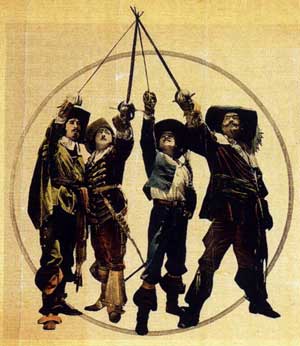
Finally the three sat with the moderator, Leonard Lopate. Lopate himself didn’t have to do very much; with the slightest prodding the three would go off on tangents about writing, language, politics or anything else. They were called “The Three Musketeers” because Eco had dubbed them that twenty years before just after a similar event in London. Other names were discussed, such as the Three Tenors — “you don’t want to hear us sing,” Rushdie dryly commented — or the Three Stooges. (For my money, bombastic, energetic Eco is Curly; dry, even-toned Rushdie is Moe; and Llosa, who waited his turn to speak and tried not to interrupt anyone, is clearly Larry.) The Musketeers theme gave Eco a platform to start talking about Alexandre Dumas. Eco explained that, while the Three Musketeers was a well written book, the later Count of Monte Cristo was awfully written. Eco said that he had once tried to rewrite Monte Cristo and cut it down by improving the style, but doing so made it somehow lose its magic. This led to a discussion about whether a book could create a myth without being a great work of literature. Rushdie said this was true of The Last of the Mohicans, which was also a terribly written book. Llosa disagreed about Monte Cristo. He said that he had cried when he’d read it and that’s what made it great literature: It had touched him. Sentence-by-sentence reading wasn’t as important.

The role of politics in literature and among literary figures was also discussed. Llosa had, after all, run for president of Peru. Rushdie said it was a great thing he’d lost, since he could now write more novels, and Llosa agreed, quipping, “The people of Peru loved my novels so much that they didn’t vote for me.”

Moderator Leonard Lopate asked why authors in America tended not to get as involved in politics, as opposed to other countries where this was more the norm. Rushdie said that Americans had been involved in politics as recently as Norman Mailer, who had “waded in completely” and made himself a figure of cultural consequence. Eco said that the problem with America, and England as well, was geographic. In other countries the universities were in the cities, while, in America and England, the universities tended to be outside of them, leading to the intellectuals being less involved with the general cultural and political scene.

Lopate suggested that in America, writers are seen more as entertainers. Rushdie said that “you can tell the importance of literature by the apparatus in place to repress it.” Llosa agreed, saying that you need a dictatorship: if a society and a government is functioning properly, literature is entertainment. Rushdie said that another part of the problem is the “professionalization of the commentariat.” In England, when there’s a major political event, the media goes to well-known intellectuals and asks their opinions. In America, the people who have opinions on political events are professional opinion-havers, and they’re the only ones who are allowed to have one. Eco pointed out that the exception was Noam Chomsky, but nobody in America knew how to take him.

Llosa also said that a lot of intellectuals weren’t trusted in other parts of the world. Think of all the intellectuals with terrible politics, elaborated Llosa. The greatest philosopher of the twentieth century, Heidegger, was a Nazi and never repented for it. Ezra Pound was a fascist. Sartre was a Maoist. This has, as a result, made people very suspicious of intellectuals.

Eco still thought it was strange that in America we have some of the most important writers in the world, that these writers are read all over, but they have no political power in their own country.

When the time came for the audience questions, there were predictably very few of them. Lopate commented that there were all these people and only five questions were passed up. The Y really dropped the ball on that one.

Despite this setback, the event was amazing. The three authors offered fascinating outsider takes on America and literature, and I think we need more of this type of event. Other mass-media events where authors are interviewed, such as The Charlie Rose Show or NPR, are always more structured and hindered by time constraints. Having three people like this capable of conversing with each other and talking freely about a range of topics was both refreshing and fascinating.

Concerning Poshlost

From John P. Marquand’s Wickford Point:

No one could teach anyone else to write. You could be as industrious as you pleased; you could steep yourself in the technique of all the Flauberts and Maupassants and Dickenses who had gone before, and out of it would come exactly nothing. That was the problem with Allen Southby.

There is something revealing about amateur fiction which is particularly ghastly, for in this type of effort you see all the machinery behind the scene. I could tell exactly what Allen had been reading before he had set to work. He had made a study of Hardy — it must have been a dreary task — and then he had touched on Sherwood Anderson and Glenway Westcott and O’Neill. He had been reading a lot of those earth-earthy books, where the smell of dung and the scent of the virgin sod turned by the plow runs through long paragraphs of primitive through slightly perverted human passion; but those others could write, and Allen Southby never would if he lived as long as Moses. Nevertheless I was finding the thing stimulating again. I was thinking of ways in which I might have changed it.

Allen was back at his desk, fiddling with his folio volume. He saw me right away when I paused and reached for the whisky glass.

“There’s nothing the matter with it, is there, Jim?” he asked.

“No,” I said. “It’s very provocative, Allen.”

“That’s wonderful,” said Allen. “Thank you, Jim, but we mustn’t disturb Joe.”

The delicate feeling of liking that I was experiencing for him, born possibly from a sense of remorse, vanished with this remark. He was an intellectual snob and an intellectual climber. He had intimated without much tact that any admiration of mine was inconsequential now that Joe was there. He would never know that my remark had been completely truthful. Southby had been provocative because he was writing about something which I could understand far better than he could ever understand it. It was not the plot, which was horrible, that arrested my attention so much as his manner of writing. His pages resembled the efforts of visiting writers, who had spent their summers in Maine and on Cape Cod, to depict the New England scene. The effort was the same as when some Northern writer attempted an epic of the South, and could see nothing but nigger mammies and old plantations and colonels drinking juleps. These others,when they faced New England, saw only white houses, church spires, lilacs and picket hedges, gingham hypocrisy and psychoses and intolerance. Not even Kipling, the keenest observer who had touched our coast, could do it. There was something which they did not see, an inexorable sort of gentleness, a vanity of effort, a sadness of predestined failure.