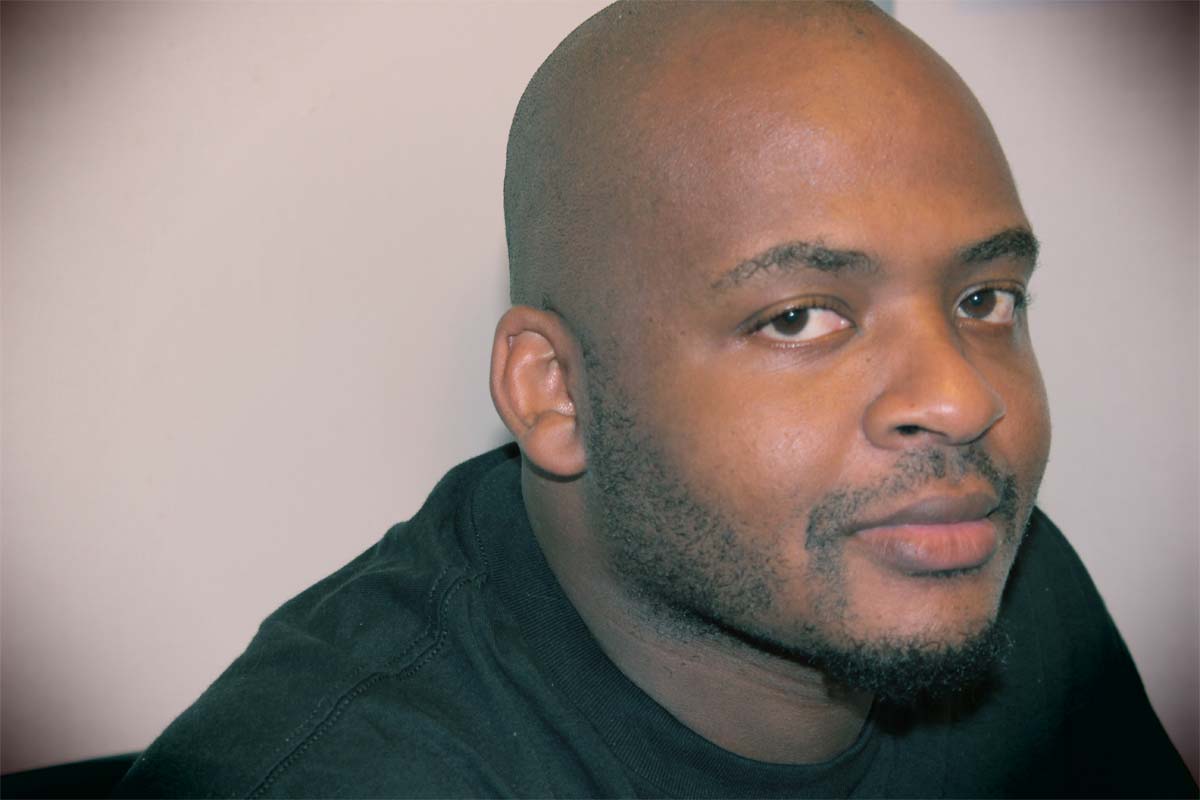
Kiese Laymon (The Bat Segundo Show #513)

Kiese Laymon is most recently the author of the novel Long Division and the essay collection How to Slowly Kill Yourself and Others in America. This show is the first of two related programs devoted to the American epidemic of gravitating to mainstream culture in an age of limitless choice. (You can also listen to the second part: Show #514 with Alissa Quart.)

Author: Kiese Laymon

Subjects Discussed: Meeting people under bridges, Percival Everett’s Erasure, Mississippi teens who run away from narratives, throwaway culture, the importance of stories carrying you through the day, critiquing storytelling skills as a way of understanding the truth, alternative narrative identities as methods of accounting for unspoken national problems, how New York rappers spoke to Mississippi black boys, black Southerners as the generators and architects of American culture, active listening vs. culture as background noise, lyrics and storytelling, native Mississippians who aren’t familiar with the blues, the acceptable level of American cultural engagement, sorrow songs vs. the Ku Klux Klan, standing up for Mississippian culture, people who don’t care about the origin to the soundtracks of their lives, national cultural awareness through regional cultural awareness, tourist notions of regions through culture, New Jersey’s history of serial killers and crime, blind engagement with the South, the refusal to hear what people are literally saying to us, dying as a backbone for Mississippi music, interrogating death, Bessie Smith and the 1927 flood, Big K.R.I.T., running away from the gospel tradition, Octavia Butler’s Kindred, whether time travel stories require a moral equilibrium, America as a crazy-making narration that doesn’t want to accept how crazy it really is, grandmother roles, “How to Kill Yourself and Others in America,” being kicked out of college for not checking out Stephen Crane, how the act of committing everything to memory guides you through life, the desire to hold on to innocence, how Laymon’s early writing was denied and disapproved and disparaged, why all 19-year-olds are lunatics to some degree, satire and observation, the important of implicating yourself, Teju Cole, frat culture, sexism and classism, living with druggie roommates, when certain college kids aren’t incriminated and imprisoned (while others are), how bravery helps you make better decisions, individual guilt and societal guilt, the 50th Anniversary of the March on Washington, sanitizing the truth about racial inequality, the capitalist-commercial nexus and its impact upon airbrushing culture and narrative, why Obama cannot tell the truth, getting the President we deserve, “The Lost Presidential Debate of 2012,” “The Worst of White Folks,” how the state is trying to convince that we are good people (while the community tells the truth), Black Power and nostalgia, Stokely Carmichael, egomaniacal misogynists and ideological commitment, Martin Luther King and token Google Doodles, white folks who don’t share power, why we aren’t able to look at the sentences, interrogating mythology, superficial dissections of pop culture from white people (e.g., Slate Culture Gabfest), Miley Cyrus and the politics of twerking, white appropriation at the MTV Video Music Awards, Brooklyn gentrification, Robin Thicke, Justin Timberlake taking the Michael Jackson Award, society’s failure to implicate itself, how Bernie Mac, Michael Jackson, and Tupac were eaten alive by American culture, recklessness as spectacle, how Michael Jackson projected what we didn’t want to talk about, Tupac’s hologram at Coachella, living in a world surrounded by digital ghosts of sanitized cultural figures, Tupac’s music before Death Row and the downside of selling tickets, the label “Black Twitter,” white people on Twitter, #solidarityisforwhitewomen, important work that goes on without white people, the slipshod involvement of mainstream feminists, how race changes the moral focus, slavery and the Holocaust, and making deals with evil terms.

EXCERPT FROM SHOW:

Correspondent: So let’s start with Long Division, which is truly a tale of two Cities. You have this kid named City. He’s in 1985. He’s in 2013. There’s a book called Long Division within Long Division. And this reminded me very much of Stagg R. Leigh’s My Pafology in Percival Everett’s Erasure. I’m wondering — just because we have to ask you how this book got started — to what degree were you responding, like Percival Everett, to limited literary representation of the African American experience? And how was this a way for you to explore versions of City in 1985 that you couldn’t pursue in the present day?

Laymon: That’s a great question. I think I had to make it a metafictive book, particularly because I wanted the characters to consciously and unconsciously be exploring not just the lit that came before them, but the literature that they read that came before them. So there’s a literary mechanism in place that I’m critiquing as an author. But I wanted to create two different Cities who are also dudes who are 14 and very aware of the lit that they read. And they’re really aware of canonical lit. So there are important scenes. There’s a scene in a principal’s office. There’s a scene in the library where I think that, with these two Cities, we can see them actually trying to become runaway characters. But if they’re going to be runaway characters, I had to position them as characters in some way fully aware of the lit that they’ve read, but not fully aware of the narratives that they’re running away from. So the narratives that they’re running away from are different from the books that they’ve read. And part of the book is that they’re trying to figure out what constitutes this narrative that they’re running away from. And as a writer, obviously, I’m thinking about a lot of African American/black Southern lit. Black Boy particularly. But I wanted them to be running away from literature that they read. Which is really important for me.

Correspondent: Well, I’m glad you mentioned that. Because at one point, City has to stay with his grandmother in Melahatchie, Mississippi. His reading library there is largely this kind of throwaway culture.

Laymon: Right.

Correspondent: Centered around classical books with a capital C and the Bible. And as you write, “I didn’t hate on spinach, fake sunsets, or white dudes named Spencer, but you could just tell whoever wrote the sentences in those books never imagined that they’d be read by Grandma, Uncle Relle, LaVander Peeler…” — his frenemy — “…my cousins, or anyone I’d ever met.” So this leads me to ask. I mean, why do you think that in the South, for these characters especially, that their notion of what it is to be alive is so rooted around books? To what extent were you limited in these areas? You and City? Why is that such an important definition?

Laymon: Well, you know, a lot of people have called Mississippi and particularly the South generally the home of American storytelling going way back to Twain and what not. And so story telling and story listening are part and parcel of our culture. Particularly if you grew up in a really religious gospel kind of household. I grew up in stories, but they were stories that were carried through music or language or stories you had to read in the Bible, and stories that my grandmother told me when she came home from work. Stories just carried the day. So I wanted to create two characters that were hyperaware of stories, of storytelling, and really critical of storytelling. The book starts with City critiquing LaVander’s storytelling ability. And LaVander is critiquing City’s storytelling ability. But by the time City gets to that library, what he’s trying to say is “I’m not being completely reactionary. I get that there’s some great cynicism in these books. But I don’t know what to do with the fact that these people never imagined anybody like me reading these texts.” And so for him, at this point, he really believes that audiences are the bedrock of sentence creation. Like to whom are you writing a sentence to? And so when he gets in that library — and it is throwaway culture in a way. So much happens in there. He sees himself for the first time on the Internet, right? He sees the way that he’s presented to other people. And I just wanted to create characters who were not too precocious, too smart, too witty, but in some way wholly aware that stories carry everything.

Correspondent: So what they read is almost an alternative identity that the United States as a whole can’t actually accommodate because of the many interesting questions of race that are in this book.

Laymon: Absolutely. And this is where literature is particularly important. Because with the references to hip-hop early on, hip-hop has been critiqued. I’ve critiqued it. Will continue to critique it. One of the things that hip-hop did, I think, early on for young black boys is that it was an art form that was made popular, that was talking directly to you as a fourteen, fifteen, sixteen, seventeen year old. At least you thought that. When you get geographically specific, you start to see that a lot of these rappers from New York weren’t talking to Mississippi black boys. But you felt that you were being talked to anyway. So one of the things that these characters are really trying to deal with is what happens to the characterization of a real person and a character who is so often not written to people who look just like them. And as we see early on in the book, we get this narrative imposed on them. And they’re trying to break out. And LaVander sort of does break out. But there’s a price to pay for that breakage. But it’s all about narrative creation.

Correspondent: Yes. I’m glad you brought up hip-hop. Because I wanted to talk about “Hip Hop Stole My Southern Black Boy” — one of the essays. You point to how black Southerners are “the generators and architects of American music, narrative, language, capital, and morality.” You point out that the South not only has something to say to New York, but it has something to say to the world. And I’m wondering why you think the world is so unwilling to listen. How much of this resistance to Southern innovation has to do with people who remain too caught up in some of these B-boy routines?

Laymon: I think the world is listening. But I don’t think the world knows what it’s listening to. You know what I mean? There’s no doubt the world is listening to really rock, R&B, and I would even argue funk that has its root in the Deep South. The world is listening to gospel music. The world is listening to blues right now that has its roots not just in Mississippi, but that Deep Southern, South Central culture. They’re listening. They’re dancing to it. They’re making love to it. They’re talking to it. It’s the music that scores our movies. But I don’t really think we know or, I should say, I don’t know if I fully know. I don’t think we’ve taken enough time to think about where that music actually comes. Like what people created, originated, innovated that music and why. Do you know what I mean? So I think to me that they’re listening. They have to listen. Because it’s everywhere. There’s no question.

Correspondent: But are they actively listening? I think that what you’re suggesting is that it’s music that plays in the background without people actually comprehending that there’s a lot of years and blood and tears that’s put into that music.

Laymon: No question.

Correspondent: And people are just not really curious enough to investigate that. I mean, I’m wondering if that’s a larger societal problem.

Laymon: Yeah, I think it is. I mean, this is what I’m saying. I don’t think we take the time to question the ingredients in art generally.

Correspondent: Sure.

Laymon: I haven’t been in many parts of the world. But as an American, I know that we don’t really take the time to consider what we’re consuming. And we definitely don’t take the time to consider the lives of the people who created the music. So even if we think about hip-hop, people who think they love hip-hop have no idea who Kool Herc is. People who think they love hip-hop have no idea who the people who helped create the culture actually were, what they did, and why they did it. So in some ways, it’s not specific to black American/Mississippi culture. But I do think that these particular stories that come out of Mississippi culture — it’s just ironic that the blues, rock, and gospel all come out of this really small part of our country.

Correspondent: I agree. But I’m wondering who to impugn here. (laughs)

Laymon: Well, I think we impugn everyone.

Correspondent: Yeah.

Laymon: And that’s a loose answer. But I was just in Mississippi for nine or ten days giving readings and stuff. There are people in Greenwood, Mississippi and Greenville, Mississippi — black people — who have no clue what the blues is. You know what I’m saying? And what I’m trying to say is that I don’t know what it is. But it is expiration that, because of my parents and because of my grandparents, we’ve had to go on. I’m saying that we don’t even want to go that road. Because when you go down that road, you don’t just find sound. But as you said, you find the experience. And you find complicity.

Correspondent: And if you listen very closely to the lyrics, you have all these amazing stories. Listen multiple times. There’s some cadence that you didn’t get.

Laymon: And also what’s important about the lyrics is that I think it’s really important to transcribe, to see the lyrics on the page. But what’s important about those lyrics are being spat or sung or, in some instances even before hip-hop, rapped. This kind of rhythmic hip-hopesque way of approaching music, I think, predates what we call hip-hop. I know New York people hate for me to say it. But what I’m saying is that it’s not just the lyrics. It’s how the lyrics are said and what irony has to do with the way those lyrics are being spat And I think it has so much to do with community. And these books, particularly Long Division, are, among other things, about community storytelling. And so what I’m trying to say is that I really think we need to think about the communities. The people, the stories, and the communities that are at the heart of all the music we listen to.

Correspondent: Well, I agree with you Kiese. But I’m wondering what is the acceptable level of cultural engagement that would actually allow the South to be understood and to be properly respected versus the reality of people wanting to have something in the background. I mean, is it reasonable to expect people to have that level of engagement? Much as I would also love to see that!

Laymon: I mean, it’s not reasonable to expect. It’s reasonable to encourage. And it’s reasonable to ask people to think more about from whence the music they listen to comes.

(Loops for this program provided by Kristijann, 40A, kristijann, Reed1415, and ShortBusMusic.)

The Bat Segundo Show #513: Kiese Laymon (Download MP3)

This text will be replaced

Some Thoughts on Candy Crush Saga

Candy Crush Saga is a terribly addictive game designed to prey on the uncertainties of obsessive and compulsive people. If you possess little willpower or a stubborn determination to win, I urge you in the strongest possible terms never to download this monstrous app. You would be better off spending your time taking up chess or impossible bottle building, which both offer the solace of handling tangible objects.

The game involves manipulating candy on a screen to form rows, where the objects obliterate in a deceptively pleasing manner. The first ten levels are preposterously easy, feeling like a derivative form of Tetris or Bejeweled. But this is enough time for Candy Crush Saga to sink its cold steely talons into your sense of confidence. Because the levels after this become progressively more difficult. Sometimes you must ensure that objects from the top of the screen (“ingredients”) fall into their proper niches. Sometimes you need to make blocks of jelly dissolve by forming rows within these viscid masses. It’s a fairly stupid premise for a game, and yet the game ensnares you within its netting.

Soon you are using lives quite rapidly. Because each level has a limited number of moves. The game’s brilliantly treacherous way of making money is for a new life to replenish every thirty minutes. What this means is that you must wait once you’ve used up all of your lives. The other option is a Faustian bargain with your impatience: pay the ignoble ransom of 99 cents per life to get back in the game. Like many effective freemium applications designed to ensnare the closet addict, it requires tremendous willpower not to hand over your cash, your passport, or even your firstborn child.

This has proved quite profitable for the diabolical assholes who run this racket. It is estimated that they are raking in $850,016 each day. Gizmodo’s Ashley Feinberg was brave enough to write a confessional essay, pointing out that she has spent $236 on this game. That figure rivals a mildly out-of-control bar tab or a pleasant day at an affrodable bed and breakfast. I am sure that there are people in America right now excavating coins from the deep crevices of couches just to keep their Candy Crush Saga game going a little faster.

I wasted two hours of my life on Candy Crush Saga and I am still not quite sure why. The derivative music, badly looped, clanged inside my ears with all the subtlety of an army of percussion experts terrorizing me with a six gong battery. There are a few cut scenes involving an obnoxious girl who you are apparently collecting bits of candy for. I did not like this girl and did not understand why she required so much candy. Did she not have concerned parents? Perhaps some dentist who could steer her away from her dentine-destroying fixation? And yet I kept on going despite this poorly conceived narrative. You see, there’s this train that pulls you along from level to level. And I have always been very fond of trains. I hated the way the game preyed upon this affection.

Some outfit called King appears to be the software company responsible for this goddam game. I resent the cocky imperialism contained within the appellation. The company should have had the decency to call itself Scarface or Big Meech Flenory or Nixon. Because King has clearly adopted the business style of a smack dealer operating without honor.

There seems to be some consummate AI at work ensuring that the user will not win. Because if you are too slow or methodical, the game actually shimmers the wrong candy from time to time, suggesting that you move it. And because the game puts you into a narcotic state where you feel compelled to please it, you are constantly at war between the game’s slot machine-like aesthetic and your own rational thinking. There are psychedelic experiences that offer a more consistent state of being.

In the end, I was forced to uninstall the dreaded game. I began to imagine a future in which I was selling my body to feed my Candy Crush Saga addiction. Well, if one must become a puck bunny, then the stakes should be higher than shifting around animated candy.

Teddy Wayne, Miley Cyrus, and Jezebel: White Culture, Free Speech Entitlement, and the Fear of Engagement

“I don’t pay attention to the negative. Because I…I’ve seen this play out so many…how many times have we seen this play out in pop music? You know now. You know what’s happening. Madonna’s done it. Britney’s done it. Every VMA performance, anyone who perform — you know, anyone who performs. That’s what you’re looking for. You’re wanting to make history. Me and Robin [Thicke] the whole time said, ‘You know we’re out to make history right now.'” — Miley Cyrus, her first post-Video Music Awards interview on MTV News.

mlkgoogledoodle

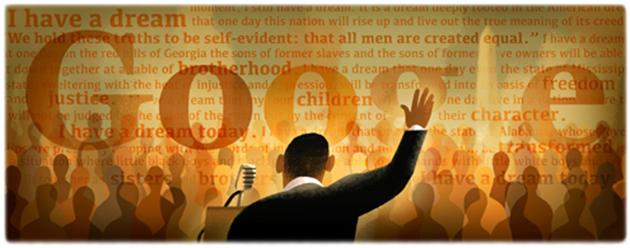
On August 28, 2013, I fired up my browser on the 50th anniversary of Martin Luther King delivering his “I Have a Dream” speech. I was appalled. I was glad to see King recognized in a Google Doodle, but why were King’s words reduced to mere text? On January 16th, Google had celebrated Frank Zamboni’s 112th birthday with a game that allowed you to maneuver through an ice rink. On Valentine’s Day, you could click on a heart to rotate two Ferris Wheels. On February 19th, Copernicus’s 540th birthday was recognized with a slowly animated solar system. On June 10th, there had been an elaborate Maurice Sendak Doodle. Even Debussy’s 151st birthday ushered in an impressive animation set to “Clair de Lune.”

If the mainstream baseline of online culture could not be bothered to offer more than a perfunctory nod to King, what was the point in celebrating?

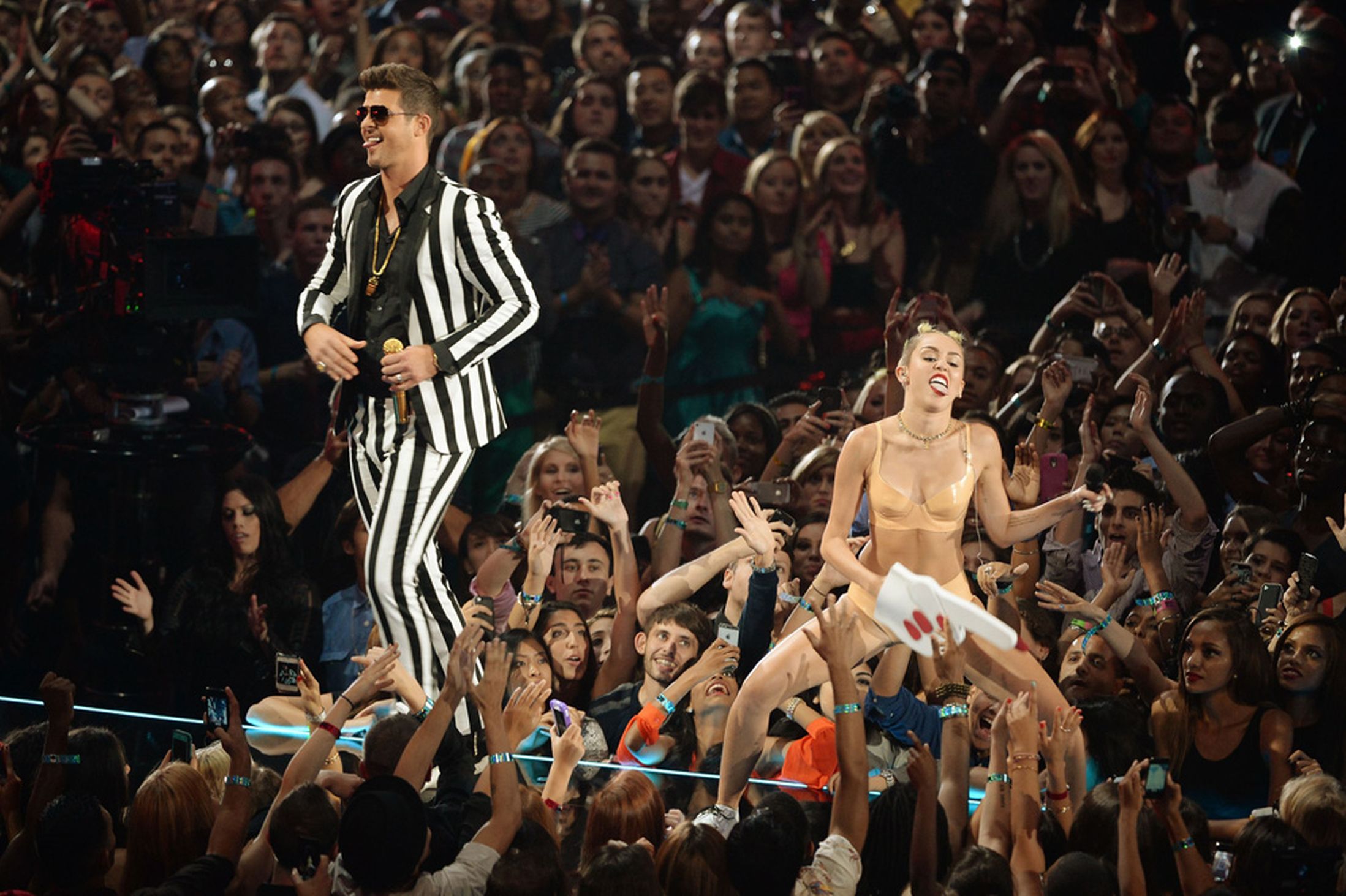
Days before, the Internet had been aflame with Miley Cyrus’s disastrous twerking at the MTV Video Music Awards. Beyond the trashy bombast, people were bothered by the cultural appropriation, with some commentators comparing the performance to a minstrel show. One of the smartest and most heartbreaking responses came from Tressie McMillan Cottom, who described one summer in which she and her then partner had been the only black couple during happy hour. White men and women approached Cottom with racist suggestions. She wrote about how the dancers behind Miley Cyrus fit into a wretched history of black female bodies as “production units.” She pointed out how “Cyrus might be the most visible to our cultural denigration of bodies like mine as inferior, non-threatening spaces where white women can play at being ‘dirty’ without risking her sexual appeal.”

I had thought that white culture’s worst impulses could be curbed for a day with a dignified celebration of a man who, unlike Miley Cyrus, made history for the right reasons. Wasn’t King worth more than a static image or a token acknowledgment? Even with the expensive rights attached to the speech, couldn’t Google, estimated to be worth more than $200 billion, have kicked in a few clams to use the audio in its Doodle? Why had white culture silenced one of black culture’s most indelible icons fifty years after the fact? Wasn’t King worth more than a Zamboni?

* * *

Lindy West has spent the past few years establishing herself as an outspoken pundit on rape jokes and comedy with Jezebel posts such as “Hey, Men, I’m Funnier Than You” and “How to Make a Rape Joke.” She was invited to appear on the May 30, 2013 episode of Totally Biased with W. Kamau Bell to discuss her views further with Jim Norton. She suffered abusive fallout.

But white culture overlooked one vital element of this regrettable chapter. West did not appear on The View or The Colbert Report, but a television show hosted by an African-American, a show that also happened to be a smart and entertaining corrective to The Daily Show‘s predominantly Caucasian concerns. The show often discussed issues pertaining to race. What’s striking about West’s exchange with Bell is how she adopted a pugnacious tone towards the amicable host from the beginning:

Bell: And so I’ll ask the same question to you, Lindy. Do you think comics should say anything they want without consequences?
West: Uh, well, first of all, I think that question is dumb.
Bell: Thank you. Thank you very much.
[STUDIO AUDIENCE LAUGHTER]
West: Because…
Bell: (nodding his head up and down) Good start for me. This is feminist versus comic, not this comic [pointing to self]. Over there. [pointing to Jim Norton]
West: So sorry. Um, no, because, uh, everything has repercussions. So if you’re talking about legal repercussions, uh, yeah, I do not think that comedy should be censored. And we’re not here to talk about censorship. And I’m pretty sure we agree. Uh, what I’m talking about is the kind of repercussion where you choose to say something that, like, traumatizes a person who’s already been victimized and then I choose to call you a dick. And that’s the repercussion.

Bell asked a perfectly reasonable question for his television audience, many composed of African-Americans who may not have been acquainted with Jezebel, so that everyone could understand West’s position. What was West’s response? “I think that question is dumb.” She then asserted her privilege by stating that she had the right to call anyone a dick as a free speech repercussion.

On June 4, 2013, Lindy West posted a video and a blog post, in which West read a series of terrible threats that she received in response to her Totally Biased appearance. (The only reason the video hasn’t been embedded in this essay is because Jezebel hasn’t allowed it to be embedded at any other site, cheapening West’s response into pageviews and linkbait.)

The abuse directed West’s way was absolutely unacceptable. It revealed awful misogyny that will take a long time to shake from the American fabric. But this shouldn’t disavow West of her free speech position, which involves another person offering “repercussions” in response to a disagreeable position. Clearly, the people who fired off bilious invective took West up on her offer. The difference here is that West has painted herself, with considerable justification, as the victim. Nevertheless, in her post, West informed her readers who the “correct” people were to abuse. Of Jim Norton, West wrote that he had been “kind and thoughtful throughout this whole thing, so don’t be mean to him.” When comedians, who were understandably ired by West’s politically correct position, expressed umbrage, they too were implicated:

Local comics — whom I know and work with — have told me to shut the fuck up. One hopes I’ll fall down a flight of stairs. (He later apologized—to my boyfriend, not me.)

In other words, West was unwilling to hold herself responsible for her own remarks — which includes telling one of the classiest African-American hosts on television that his question was “dumb” — while simultaneously placing herself in an entitled position in which she was shielded from criticism. She could condemn standup comics who fired off rape jokes, but refused to consider the consequences of her own remarks or biases. (This behavior is quite similar to what Richard H. Cooper observed of Twitter celebrities in 2012, pointing to hierarchies in which the top tier “[dispenses] admonishments to proles who get impudent” while simultaneously avoiding introspection.)

On June 6, 2013, Bell aired a followup segment about the discussion (and its aftermath):

Bell: Thousands of men protested Lindy’s claim that rape jokes encourage a culture of violence against women. And how did they do that? By flooding her inbox with threats of violence against women. Yay! Men! We’re the worst! Come on, men, what are we doing? I feel gross being a part of a group this terrible. Is this what it’s like to be white?…Now people are saying that Lindy is against free speech. She’s not. She wasn’t even arguing against rape jokes. She was arguing against what many of you asshats are doing right now to her. Attempting to silence a woman by using threats and intimidation. Now maybe that point got lost somewhere in the debate. Personally I blame the moderator….All I’m really saying is that this Internet harassment has got to stop. And that’s why I’ve developed the new technology that will put an end to hate speech on the Internet. You guys have heard of CAPTCHA? You know, when you fill in stuff on the Internet? Yeah. Well, I’ve developed SHUTCHA. As in Shutcha Damn Mouth! Exactly. Yes. Basically, before you can send me any tweets, you have to fill out this SHUTCHA to prove that you have basic awareness of black people and black culture. For example, is this word spelled correctly? [“NIGER” flashed on screen.] If your answer is “no,” then I won’t be hearing from you and you’ll have to harass a local black in your area.

Bell’s SHUTCHA joke brilliantly pinpointed the problem with white culture: namely, its willful ignorance of black people and black culture. (This is also seen with such needless concomitant terms as “Black Twitter,” a catchall designate used by clueless white people to casually position African-American voices as some Other to be deprioritized and/or ignored). But because Bell had been put on the spot and was forced to stand up for Lindy West, he was unable to remark on the more severe problem of white culture’s appropriation of other cultures — what Kiese Laymon has referred to as “the worst of white folks”:

The worst of white folks, I understood, wasn’t some gang of rabid white people in crisp pillowcases and shaved heads. The worst of white folks was a pathetic, powerful “it.” It conveniently forgot that it came to this country on a boat, then reacted violently when anything or anyone suggested it share. The worst of white folks wanted our mamas and grandmas to work themselves sick for a tiny sliver of an American pie it needed to believe it had made from scratch. It was all at once crazy-making and quick to violently discipline us for acting crazy. It had an insatiable appetite for virtuoso black performance and routine black suffering. The worst of white folks really believed that the height of black and brown aspiration should be emulation of its mediocre self. The worst of white folks inherited disproportionate access to quality health care, food, wealth, fair trials, fair sentencing, college admittance, college graduations, promotions and second chances, yet still terrorized and shamed other Americans who lacked adequate access to healthy choices at all. White Americans were wholly responsible for the worst of white folks, though they would do all they could to make sure it never wholly defined them.

In other words, white culture believes that black people should emulate the very mediocrity that now forms its nostalgia-soaked identity. W. Kamau Bell is not permitted to push back at Lindy West without “repercussions,” but he is allowed to emulate her unexceptional intellectual position (“She wasn’t even arguing against rape jokes. She was arguing against what many of you asshats are doing right now to her. Attempting to silence a woman by using threats and intimidation.”) instead of expanding his shrewder and more sophisticated observations on male abuse and the racial dynamics of expression. Robin Thicke is free to rip off Marvin Gaye’s “Got to Give It Up” and turn it into one of this summer’s greatest hits (“Blurred Lines”) and, because he too represents the worst of white culture, he audaciously files a preemptive lawsuit against Gaye’s family to prevent them from seeking damages against Thicke’s pellucid appropriation, claiming, “Plaintiffs, who have the utmost respect for and admiration of Marvin Gaye, Funkadelic and their musical legacies, reluctantly file this action in the face of multiple adverse claims from alleged successors in interest to those artists.”

In August, white feminist culture was challenged by Mikki Kendall with the Twitter hashtag #SolidarityIsForWhiteWomen, largely in response to the now disgraced Hugo Schwyzer:

It appeared that these feminists were, once again, dismissing women of color (WOC) in favor of a brand of solidarity that centers on the safety and comfort of white women. For it to be at the expense of people who were doing the same work was exceptionally aggravating.

The sole Jezebel blog post on the hashtag is a collection of the best tweets rather than bona-fide intellectual jostling with this very serious grievance. There is also this condescending note at the bottom of the post:

Update: The originator of the hashtag page, Mikki Kendall, has been incredibly influential to this conversation and should have been at the top of this list. See her speak more on the hashtag here. To have not included her in the original post was an oversight. Apologies to Ms. Kendall.

This apology isn’t enough. Because without real commitment to thinking and true acknowledgment of one’s blind spots, there can be neither influence nor meaningful conversation. There can be only white culture, inured from disagreement, that monopolizes the dais and remarks upon black culture with a flip elitist tone that would be offensively facile if it weren’t so damn risible:

White culture doesn’t just want to plunder the best of black folks for callow entertainment. It wants to ensure that black culture is never explicitly identified as black. It wishes to soften any sharp edges. It wishes to promulgate endless articles that, as the podcast The Black Guy Who Tips recently put it, fuck with black people. The disgraceful imbalance of free expression identified by Stokely Carmichael in 1966 is still essentially the same: “the only acts that white people can do is to stop denying black people their freedom; that is, they must stop denying freedom. They never give it to anyone.”

This is far more insidious than white culture’s mere copycat relationship with black culture, observed by Norman Mailer in the Fall 1957 issue of Dissent. White culture has moved beyond the willful scavenging and sanding of black culture’s best bits because it feels that it must hog the spotlight. White culture is terrified of engagement. In a complicated world of turmoil, white culture continues to cleave to a new political privilege, in which there can be no room for hyperbole, extremist rhetoric, and what Jon Stewart has wrongly identified as “insanity.” There is no space within white culture to cultivate independent, original, provocative, and non-ideological inquiry. But there is relentless racial assumption, limitless listicles, time-eating timidity through hate-favoriting and subtweets on Twitter, and dull depositories for white culture fantasies such as NPR, The Awl, Slate, McSweeney’s, and Jezebel.

White culture is never about taking a step back and allowing another culture to express itself. It is driven by an intuitive imperialism, one that it can scarcely recognize, that involves blaring its own cultural standards through a megaphone manufactured in another century. Indeed, white culture’s most prolific literary spokesperson, Joyce Carol Oates, is not immune from such xenophobic disgrace. Earlier this year, when she remarked upon the complicated political situation in Egypt:

Ironically, many of these sentiments led Jezebel‘s Katie J.M. Baker to urge Oates to stop tweeting. Was a 75-year-old writer revealing the worst of white folks? How long would this be tolerated from the Establishment?

Not long, as it turned out. On Sunday, The New York Times published a satirical essay by Teddy Wayne upholding the the same white culture stereotypes that Miley Cyrus had sought to “make history” with:

Explain that twerking is a dance move typically associated with lower-income African-American women that involves the rapid gyration of the hips in a fashion that prominently exhibits the elasticity of the gluteal musculature.

Some of white culture swallowed this up without batting an eye:

But a new and hilarious hashtag, #askteddywayne, started making the rounds on Twitter, fighting back against Wayne’s McSweeney’s-style essay with humorous qualities that had eluded the ostensibly professional writer:

Teddy Wayne sent apologies to some of his detractors in private. But as of Wednesday afternoon, he has not offered a public apology. He has switched his Twitter account from public to private.

White culture has been slow to recognize and atone for Teddy Wayne’s essay. The only outlets that have covered this scrape at length are The Root, The Inquisitor, Galleycat, and The Nation. Even more astonishing, New York Times public editor Margaret Sullivan expressed her enthusiasm that Wayne’s piece was #2 on the New York Times‘s most emailed list, without appearing to comprehend why (other than that it was “funny”):

Perhaps Miley Cyrus, Robin Thicke, Teddy Wayne, some of the people who write for Jezebel, the editor at The New York Times who allowed Wayne’s piece to run, and the people behind the Google Doodles really don’t comprehend how their responses and appropriation of black culture represent Laymon’s “worst of white folks.” They have seen the battles play out. They are familiar with some unspecified pattern, much as those who listen to a radio program in the background without really listening to it are dimly aware that there is something important being communicated. But they cannot engage with black culture. Like Cyrus, they won’t “pay attention to the negative.” Because to do so would be to confess to their own mediocrity. To do so with grace and candor would be to share the stage. To find true humility and humanity. To learn something.

White culture has had a very long run. But the time has come for those who make it and comment on it to understand that there is more to appropriating culture than the great white lie of “respect and admiration.”

Norman Rush (The Bat Segundo Show #512)

Norman Rush is most recently the author of Subtle Bodies.

Author: Norman Rush

Subjects Discussed: Keeping a personal existential view of the world on one paper, utopian democracy, allusions to Ulysses in Rush’s work, Vico Cycles, the importance of the 2003 Iraq War protests (and why they have been forgotten), whether forms of liberalism have any legitimate application in the 21st century, the importance of physical space in Rush’s fiction, people who preserve language vs. people who are terrified of originality, how people express themselves, the origins of “in your wheelhouse” and “traveling fight,” comparing various drafts of a “plaid underpants” section in Subtle Bodies, carrying something in your head vs. writing it down, unsuccessful attempts to outperform geniuses, the specific cocktail chatter that led Elsa and Norman Rush to become Peace Fund co-directors in Botswana, draft resistance, amnesty, how an anti-establishment stance can you lead you into an establishment job, the virtues of insouciance, working with editor Ann Close at Knopf, invaluable oddities, personal aversions to semicolons, dialogue and punctuation, singing prose out aloud, Rush’s bygone ukelele skills, resisting the essayist and journalistic in fiction, Sherlock Holmes pastiches, being an anti-minmialist, the carefully designed reading pace of Mortals, limited word use in Botswana cable transmissions, why America is now crazier than Botswana, the three cartons of notes that Rush brought back to America, spending 15 years in the antiquarian book business, exquisitely unknown incidents in the history of the Western Left, the failure of the Socialists to come together on an antiwar platform in 1914, Rush’s stubborn focus on being an experimental writer and a poet in his early days, the anxiety of influence, measuring yourself against the impossible, the origins of Karen in “Bruns,” Patrick van Rensburg, having an indomitable vocabulary, how much Mating‘s Karen was influenced by Denoon, how Rush got to know his great literary friend Thomas Disch, being a genuine man of letters, Manhattan’s financial hostility to writers, finding creative ways to live in Brooklyn, parenthood in Subtle Bodies, connections between Nina in Subtle Bodies and Nan in “Near Pala,” ancillary subjects that propagate during writing, tales of masculine sadness throughout literature, David Foster Wallace, the limited makeup of today’s literary audience, Lena Dunham’s appreciation for Mating, comparisons between Mating and Adelle Waldman’s The Love Affairs of Nathaniel P, characters defined by reading allegiances, the manuscript as a bomb, writing down what people have on their bookshelves, the sangoma in “Official Americans,” Morel in Mortals, why Rush’s characters are seduced by or drawn to charlatans, Rush’s father, religion and theosophy, the foundational aspects of what you are, spiritualism as an unavoidable part of being American, Rush’s “Americanity,” motives for burning a passport, why optimism is essential, parallels between Subtle Bodies and the great Edgar Wright-Simon Pegg film The World’s End, ideologues and the absence of identity, nostalgia as a panacea of anxiety, turning tropes into foundations for serious art, Rex from Mortals, flailing aspirants who write for The Awl, middling educated types, fiction as a place for failed forms of the self, dummy experimentalism, sections from Mortals that were dropped, cave art, the differences between expatriates and Americans who stay home, James Wood’s observations about Ray Finch’s interpretation of Joyce’s “The Dead,” the courage to inhabit an unseemly perspective, the reading Rush did while working as an antiquarian bookseller, fiction with numbered paragraphs, Hume’s influence upon Subtle Bodies, writing a book without a sustained perspective, the Kalahari Desert, the advantages of being overwhelmed with life you are not acquainted with, describing the landscape with waning movie metaphors, young people forced into scavenging from culture, the messianic qualities of 20th century Hollywood stars, the future of narrative, balancing the personal and the political, the importance of recognizing the evils of the world and not to be a fool, people who are increasingly duped in the digital age, facing an unreadable future, the Internet and political activism, and the future of social democracy.

EXCERPT FROM SHOW:

Correspondent: I was curious about this. You were showing me these series of Venn diagrams that represents your existential view. I’m amazed that you could fit this all on one paper.

Rush: Well, actually, I’d need a much larger piece of paper to get the whole thing on. This is about current feelings about the way the world is going.

Correspondent: Are they negative or positive?

Rush: I’d say they could be described as apocalyptic, but in a piecemeal way. I’m not looking for a big bang, but I think serious trouble is coming. And I’ll explain what I mean by that in describing a lack of fit between what the evolved political institutions of our advanced capitalist world, capitalist republic, can deal with and the scale of the problems that are presenting themselves autonomously, outside of anybody’s control.

Correspondent: Well, maybe one way to kickstart this is to tie in a sentiment in Mating with what is going on in Subtle Bodies. In the early Circe-like part of Mating, you have Nelson Denoon’s speech for his solar democracy, Tsau. “Everything we want in a society is what we find brought out in people and the moment of insurrection. Spontaneity! Spontaneous hierarchy!” There are exclamation marks after all of this. “Self-sacrifice! Staying awake all night! Working until we drop! Audacity! Camaraderie! The carnival behind the barricades.” Well, in Subtle Bodies, you have this compound called The Vale. It’s a sprawling place. It’s just outside Kingston. It’s the home to activists. It’s reminiscent in some ways of the Martello Tower at the very beginning of Ulysses. And, in fact, you actually compare it to the Winchester Mystery House. As a South Bay guy, I got that little reference.

Rush: Oh, you’re South Bay.

Correspondent: Yeah. So my question to you is, well, based on what you were expressing earlier, to what degree was this your way of exploring a Vico Cycle in which America is caught within a perpetual moment of insurrection?

Rush: Well, that’s very acute. This is about one of the last flashes of the revolutionary impulse to make a significant change. In this case, stopping the impending invasion of Iraq. So it’s not about making a New Society in the old sense. In the way that Denoon was talking about. But it’s about a much more reduced yet still large objective. And that is basically a negative one. But stopping something from happening.

iraq2003

Correspondent: Well, it’s interesting. Because that Iraq War protest in 2003 is often forgotten by many of the people, like the Occupy crowd. I mean, there were regular people who attended these series of protests. And it’s kind of been swept under the dustbin of history. Is this one of the motivations to explore this in fiction?

Rush: Absolutely. And in fact, it was in its time the largest international demonstration in history. All countries, all over the West. Not only here. And it represented a high watermark of emotion left over from the Vietnam War, which had, in the minds of oppositionists, been stopped by exactly this kind of direct action and mass protest. And, of course, well, I don’t want to give away the end of the book or remind people too much about the history of it. But yes. And that’s another thing. I think the book is working with a kind of fading historical appreciation of what the last twenty or twenty-five years have really meant.

Correspondent: Well, let me ask you something. I mean, if societal ideals — as are represented in that Nelson Denoon speech — if they are constantly replenishing themselves in this new musk of want, what is the present state of revolution? How can fiction provide an answer or encourage or empower people to commit revolution?

Rush: Well, don’t hold back from the big questions. I mean, that is the question. Every serious writer is implicitly or explicitly asking that question. What is it that I’m writing about? What does it have to do with the seemingly autonomous evolution of increasingly less propitious circumstances to make change? And the answer to that is the central and most compelling question, it seems to me, for people who write novels which incorporate serious politics and political thinking into them. The answer keeps revealing itself as you write and as things change. I mean, one of the things that seems to be happening — one reason that this is such a fascinating and, in a way, dumbfounding moment — is that the three great propositions about how we should organize the world and life — that is to say, socialism, followed by its variants, social democracy, followed by neoliberalism — have all in their own ways collapsed and don’t exist as real options anymore. They carry on their shells. There’s a shell of socialism existing in pockets and enclaves around the world. There’s a kind of zombie social democracy operating mostly in Western Europe. And there’s neoliberalism, which is in a state of what you have to call a dispensational crisis. Because basic problems like inequality have not been solved. And in the meantime, coming from the outside is this continual costs in the environment of the systems we built.

Correspondent: But at the same time, Marxism has a lowercase m in Mating. So has there ever really been credence to any of these political systems? Why do we continue to gnaw at them if they are unimplementable in everyday society?

Rush: Oh sure. Actually with the ongoing collapse of socialism, the Socialist Project, one of the standard responses to that — and it’s happened in the past many times — is to take the socialist idea and incorporate it in tiny pieces. Tiny little enclaves. Make it work. Make a pilot model. Make it tiny. Make it small. That’s sort of what Denoon is up to.

Correspondent: I wanted to also talk with you about how space functions in your book. In Mating, you have this wonderful passage where Karen describes love as moving from one room or apartment to another, and each subsequent room or apartment is bigger and better. Also, we learn in Subtle Bodies that the Vale’s large space has become unwieldy, especially when you’re trying to snag some yogurt for breakfast. But what you just said about how America is compartmentalizing itself and how social democracy is doing that reminds me very much of the episode where Nina enters this closet and she hears these two men and you write, “She had gained nothing by putting herself in this predicament.” And I’m wondering if this is your wry way of suggesting that figurative space is the only space that we can trust in fiction, in life, or in politics.

Rush: That’s an interesting way to look at it. Actually, this is a case of her burning desire to know everything taking over her good judgment. And as a character, she is determined to know everything she can to relieve the unmerited suffering she sees of her husband’s milieu. So she puts her nose into everything in the place that they live.

Correspondent: In Mortals, Ray complains that “affray was one of those words that was vanishing from the language.” But in Subtle Bodies, you have Ned almost terrified with the imperfection of a pickup line such as “I stand here lonely as a turnstile.” Nina also says, “A pleasant despair of the region of the loins.” And she claims to be quoting something. But actually you can’t place the quote. So one must assume that it’s original in some sense. If your books represent in some way a history of the way that Americans express themselves, and I think we can say that they do, why do you think your characters have moved from preserving word choice — and, of course, we have the word games as well in the early days of these characters. Why have they moved from preserving language to being terrified of the original expression? I mean, why is this of interest to you? I’m curious.

Rush: I’m interested in knowing the way that people express themselves. What lasts and what doesn’t. It’s kind of a Darwinian process that has always seemed interesting to me. For example, why do we now say that something that is within your competence is “within your wheelhouse”? “In your wheelhouse.” Now the odd thing about that is, first of all, I don’t know where it started.* But it certainly has taken over every conversation. And I was unable, and Elsa too, to recall what preceded it. What did we say when were saying to someone that he was out of his field of competence? Or in it? What did we say? Not “his line of work.” No, that’s not quite right. But there is a kind of occlusion of ways of expressing states of being and possibilities that happens. And it’s happening faster now because the media are so ever present and so tightly connected to everything. It happens fast. But I ask you. What did you say before you said, “It’s not in my wheelhouse”?

Correspondent: “Not in my purview,” I guess. I don’t know. “Not in my bailiwick.”

Rush: “Purview” is not quite right. Because this has to do with competence. “Bailiwick” is closer. But anyway, ponder it. I don’t have an answer myself.

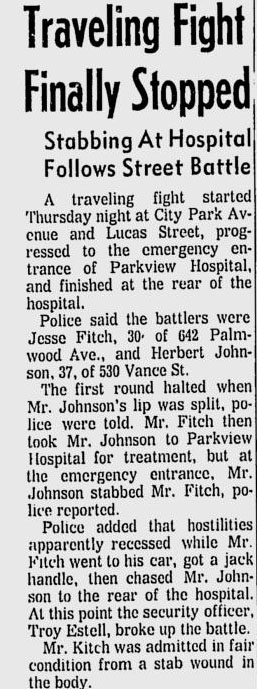
travelingfightCorrespondent: I mean, this leads me to wonder. There is one point in this book where you have a “traveling fight” occur. And I had never actually heard the expression “traveling fight.” And I became so obsessed with that notion of a fight moving from one place to another. And the only place I could really find it online was from a 1970s article in the Toledo Blade.

Rush: Oh my gosh. (laughs)

Correspondent: So this is interesting. They are so determined to use that term “traveling fight,” which comes from a place that they’re okay with. And yet when they’re actually trying to riff on their own phrases, they don’t want to relive the pleasure of those word games in their early lives. Also, I’m just curious about where you first heard “traveling fight.”

Rush: I can’t tell you. I know that it came up in some place along the way in my life and I’ve carried it around as a description. And then suddenly, when I needed it, there it was.

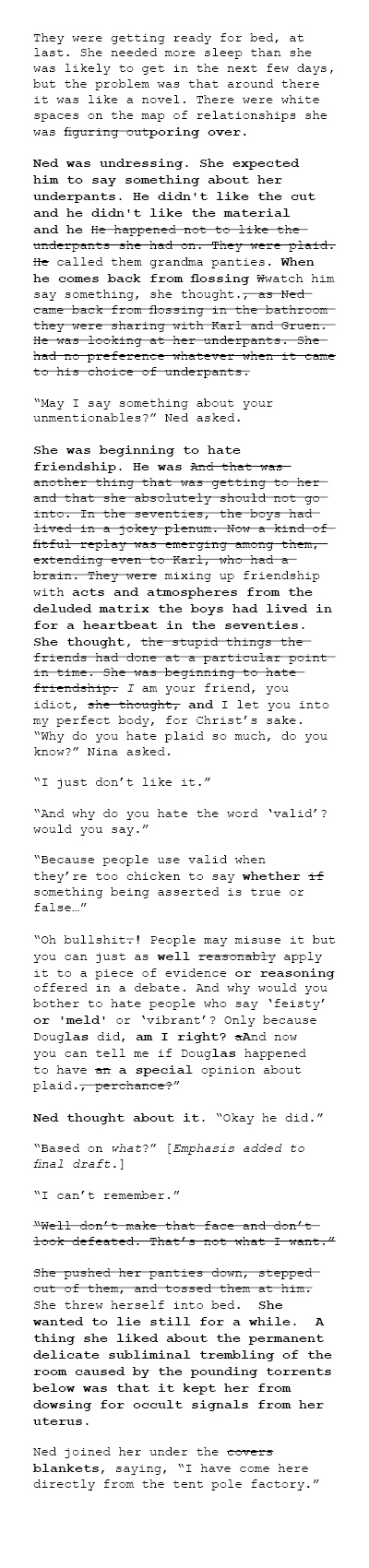
Correspondent: I found an early draft of the “plaid underpants” moment in Subtle Bodies between Ned and Nina that was published in the Los Angeles Review of Books. [NOTE: We have reconstructed Rush’s compositional revisions in the graphic at the end of this capsule.] What was curious about this is that the dialogue you have is almost the same, but there’s some interesting description in this early draft where Nina is a little more willing to judge Ned. The sentences here are “In the seventies, the boys had lived in a jokey plenum. Now a kind of fitful replay was emerging among them, extending even to Karl, who had a brain.” And in the book, you’ve added this passage where Nina describes how she likes “the permanent delicate subliminal trembling of the room.” And this leads me to ask you. To what degree are you discovering these characters in the early drafts? Has it been your practice to severely cut the degree to which your characters dwell on the past and concentrate on the present moment you are bringing to life as you’re writing it?

Rush: Yeah, that’s part of my struggle against saying everything. And you may know that the way I’ve proceeded in the past with books was to write a dossier for each individual character, so that I knew the life of the character up till that point and sometimes beyond. Just for my own reference. And that was a helpful way to proceed. But I do more of that in my head now than I used to feel I had to do on paper. But yes. I have cut down in favor of moving the action so that I can get to the next big thing.

Correspondent: Well, in terms of carrying something in your head versus writing it down, why do you think you’ve always had that packrat tendency to say everything? I mean, I’m looking here and, on the table, you have this massive and quite intriguing collection of files. So why do you think you need to say everything and you need to get it all down?

Rush: I could tell you part of the answer to the extent that I think is true, but there’s more to it. At the very heart of it, of course, there’s got to be something like fear of not having, knowing what you need when you need it. But on top of that is laid another impulse that I have when I write. And that is — it’s a kind of crazed Platonism. Because once you start a book and you set up your characters and you set up the situation and you discern the argument that is going to lie at the base of the structure, you — at least I’m speaking for myself — you have a sense that this is a copy of a perfect realization. There is a perfect working out of the plot. A perfect resolution. A perfect rhythm. Everything. There is a perfect embodiment. End point. Embodiment of the things that you set out to say. And that’s what I want to do when I set out. And this is all kind of philosophical more than I like to admit. But I’m looking for something that is like a realization like, oh say, Kurosawa gets in The Seven Samurai. When you get to the end of the uncut version, when you get to the end of that, you have fully and absolutely experienced what was intended from the very first scenes of the book to the end. Or the opera. Tosca. Or Ravel’s Boléro. At the end of it, you have had everything. It has completed itself. And I think it’s probably a self-destructive kind of impulse to be subject to. But that’s me.

Correspondent: Is it something you grabbed from Joyce?

Rush: Joyce is another example. Ulysses is. And that’s why there’s so much extra stuff in Ulysses. Because in his own not completely formed way, I see him as aiming for the same thing and achieving it in thunder.

Correspondent: But you’ve never really sought out to have Botswana reconstructed from the bricks you laid down in Mortals or Mating.

Rush: No. I thought I would never know enough really as a five year resident and student of an extremely complicated and interesting culture. I would never know enough to do that. That will be the work of some writer from that country in some time. But yeah, I was always very conscious that Botswana was a set in which I was privileged to place my people and my problems.

* — A Way With Words, a casual call-in radio program devoted to word origins and language (I have been a regular listener of this agreeable low-key show for more than a year and recommend it), proved instructive in answering this question on its March 5, 2011 installment. The term “wheelhouse” comes from baseball. According to the Dickson Baseball Dictionary, it involves swinging a bat when the ball is in your crush zone. A 2010 Daily Finance article reveals nautical origins. Its popularity in the last three years (which is on the downslide) can be traced to an episode of Glee, in which Darius Rucker told another singer that a song was not “in his wheelhouse.”

* * *

An earlier draft of the “plaid underpants” episode in Subtle Bodies was published on October 23, 2011 at the Los Angeles Review of Books. This has allowed an unanticipated glimpse into Norman Rush’s compositional approach, when we compare this earlier draft against the published version. Note how Rush’s dialogue remains mostly unmodified. But his description has undergone significant revision. Rush was kind enough to discuss this at length on the program. (Please note that Rush’s additions are in boldface. His deletions are in strikethrough.):

rush-revision8

(Photo: Wyatt Mason, permission through Random House. Music: Kevin MacLeod, “As I Figure.”)

The Bat Segundo Show #512: Norman Rush (Download MP3)

This text will be replaced

Caleb Crain: The Pompous Nitwit Novelist Who Did Not Understand Libel Law (But Who Threatened Me Anyway)

Caleb Crain’s ego was swelling. He had spent three weeks basking his head in a rare rave from acclaimed author Norman Rush in the New York Review of Books. The New Yorker‘s James Wood had also declared Necessary Errors “a very good novel, an enviably good one.” But this grand and substantive praise from high literary places was not enough for this privileged and priggish 46-year-old Columbia Ph.D., who was spending his Wednesday night acting like an upstart two decades younger, threatening me with a libel suit as I was on a long walk without my phone. The following email arrived in my inbox at 7:01 PM. The subject line was “libel”:

Dear Edward Champion,

It has been brought to my attention that a comment has been falsely posted in my name on your blog, at this address:

http://www.edrants.com/boris-kachka-the-inspector-clouseau-of-cultural-journalism/

I would like you to remove it promptly, and I would like you as the manager of the blog to state clearly that the removed content was a forgery and that you have removed it accordingly.

all best,
Caleb Crain

It has long been the editorial policy of this website to allow comments, even belligerent ones, from pseudonyms. Strangers have left anonymous remarks under the names Billy Joel, Danny DeVito, Joyce Carol Oates, James Wood, and others. Not only do I support the right of commenters to use celebrity names as new forms of Publius, but so does the law. Section 230 of the Communications Decency Act grants immunity to online service providers (including website proprietors) when others take action to “restrict access to or availability of material that the provider or user considers to be obscene, lewd, lascivious, filthy, exceedingly violent, harassing, or otherwise objectionable.” This is one of the reasons why so many odious trolls are able to get away with what they do. But the positive side of this is that it allows free expression of unpopular or dangerous ideas: a tenet that I remain fully committed to, especially in an age in which journalists are being increasingly harassed by governments for telling the truth.

The comment in question, attributed to a false “Caleb Crain” and posted here yesterday at 4:01 PM, reads as follows:

Ed Champion, I will hate you till the day I die and wish you nothing but ill way in every career move you make. I will be watching with interest and schadenfreude.

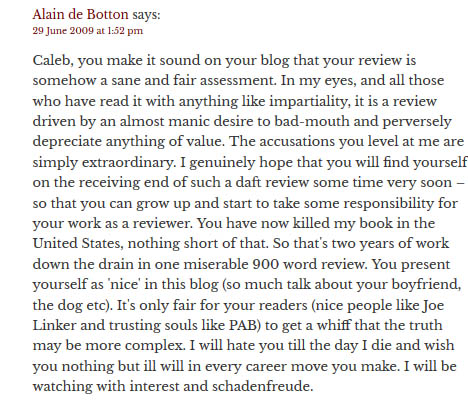
When this comment came in, I instantly recognized this as a riff on Alain de Botton’s infamous comment to Caleb Crain on June 29, 2009:

adbcomment

Alain de Botton had been exceedingly gracious when I asked him about his response to Caleb Crain in July 2009. Not only did he answer my questions, but he contributed an essay on responding to critics. This was the kind of caritas and above-and-beyond munificence that always replenishes my faith in the human race. I had figured that the mysterious comment, originating from an IP address somewhere in New York, had come from an especially devoted reader who was very familiar with my website. I chuckled at the joke and went for my aforementioned long walk.

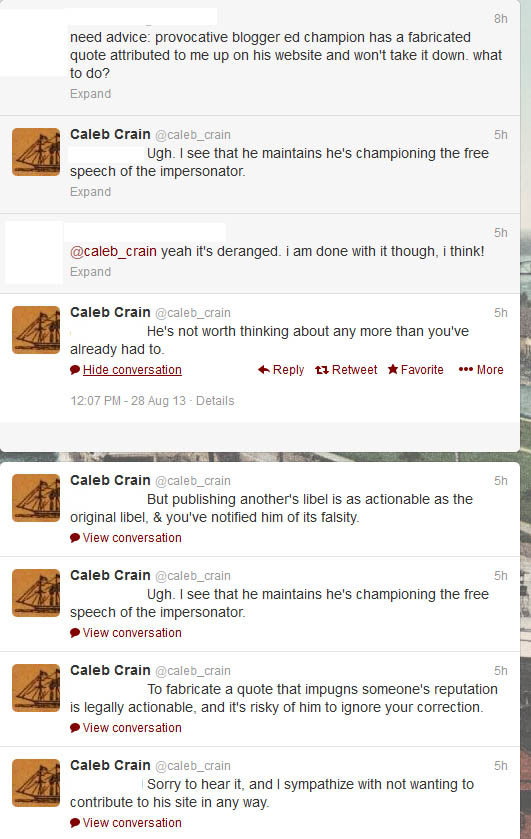
It turned out that Crain had been busy on Twitter that afternoon, corresponding with a Boston Globe employee who had spent the last three weeks harassing my girlfriend and me. (I have blanked out his name because I do not want to give this very angry and embittered young eunuch any further attention. But let’s call him Lee Siegel — no relation to the cultural critic.)

calebtwitter

Lee Siegel had sent me several rude, belligerent, and unprofessional emails over the past six months — some from his Boston Globe account, in direct contravention of Section A1 of the Globe‘s Journalism Ethics Policy. He had called my writing “psychotic” and declared on February 26, 2013 (after I offered to answer a question in his capacity as reporter), “Man. Literally every single thing you say is embarrassing.” Siegel emailed me on May 9th on another matter he wanted to know about. By then, I had tired of his flaccid pugnacity. I would not answer any further questions from him. I replied:

Lee:

As far as I’m concerned, you’ve burned me as a source for life. Given our last exchange, you’ll never get answers from me on any subject ever again. And given what I have going, it’s your loss, not mine. Let this be a professional lesson.

Sincerely,

Ed

Siegel replied:

Haha, OK — this wasn’t about sourcing. It’s just that I got an email about a piece from another total monster with the last name Champion, and wanted to know if you two were part of the same family. Would have been hilarious to me if you were.

Good luck with what you have going!
Lee

Given such churlish behavior, I wondered if Siegel had ever bothered to read the Globe‘s very sensible ethical code:

We treat audience members no less fairly in private than in public. Anyone who deals with our public is expected to honor that principle, knowing that ultimately our readers are our employers. Civility applies whether an exchange takes place in person, by telephone, by letter or by e-mail.

On August 3, 2013, I published a lengthy essay pointing to misogyny, unsubstantiated rumors presented as fact, and incompetent journalism in Boris Kachka’s Hothouse. I learned later that the piece was disseminated in certain circles populated by both Siegel and Caleb Crain. And because many of these pathetic creatures never seem to leave the house, do not appear to have lives beyond the digital, have capitulated all that remains of their curiosity and wonder for snark and solipsism, demonize people they have never met, never ruminate on vital subjects such as Syria or income inequality or surveillance or anything substantial, and spend most of their free time on Twitter “hate-favoriting” tweets, they have always been very easy to ignore. Because they have little more than passive-aggressive ire, a paucity of conviction, and limitless free time to offer a complicated and turmoiled world

However, someone from an IP address in Massachusetts, left the following comment under Lee Siegel’s name:

A woman kissed you? Is that, like, the first time that has ever happened to you? Did you jizz?

As we have established, as website owner, I am not the one fabricating the quote and I am also immune from liability thanks to the CDA. I am thus under no obligation to remove the quote, any more than The Onion (a far more powerful outlet than mine) should be prevented from publishing pieces “written” by Joyce Carol Oates or CNN’s Meredith Artley. Indeed, unlike Crain or Siegel, Artley responded to the parody with characteristic grace:

Lee sent me two emails in less than 24 hours. The second email read:

Ed — did you receive the below? The comment attributed to me still appears at the bottom of your psychotic rant about Boris Kachka, and you ought to remove it.

Lee

Here’s a modest diplomatic tip for young whipper-snappers: if you want to work with someone, it is probably not in your best interest to call the other person “psychotic,” especially after you have already sent several vituperative emails.

Lee then sent the following email to my girlfriend:

Hey there. I am hoping you can help me with a problem I’m having with Ed. A vulgar comment was posted underneath this post on his website by someone pretending to be me, and I need it to be taken down. Lord knows I would not hesitate to ridicule Ed in public, but in this particular case, it so happens that someone is impersonating me.

I have contacted Ed about this, but he has not responded, presumably because we despise each other. Can you please talk to him?

Here’s another modest diplomatic tip: if you want to reach someone through their loved one, it is probably not in your best interest to pledge public ridicule towards the mind you’re trying to change, much less adopt a haughty tone rarely seen outside of Frances Hodgson Burnett novels.

In the spirit of fairness, I decided to contact Lee’s girlfriend, who I’ll call Becky Sharp. We had a civil and polite email colloquy. As I had long suspected, she was clearly the more fair-minded and smarter of the pair. I suggested that Lee should leave a followup comment to clear up the matter. This is precisely what James Wood did in a thread at The Millions. This is indeed what adults do.

Lee did not take up this advice and continued to email me. Because Lee was too stupid to comprehend how content management systems worked, he contacted WordPress, who told him rightly that there was nothing they could do. And even as he angrily flailed with endless ignorance, Lee adamantly refused to leave another comment on the thread (“But I don’t think that would solve my problem — or yours, since right now you have what amounts to a fabricated quote from me on your site.”).

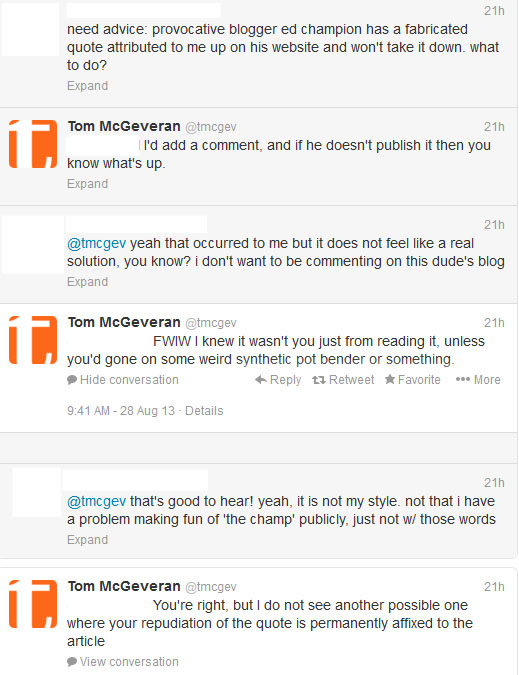
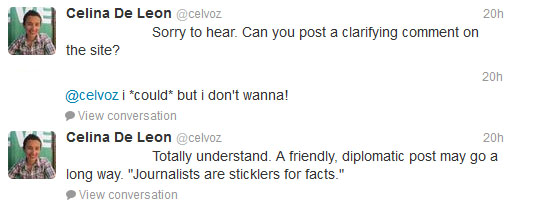
Like many attention-starved megalomaniacs, Lee took to Twitter, soliciting advice. Most of the people who responded to Lee on Twitter, including Capital New York co-editor Tom McGeveran and social media coordinator Celina De Leon, sensibly informed him that leaving another comment would settle the matter. But like a petulant and coddled child, Lee replied, “i *could* but i don’t wanna!”

tommcgev

celinatweets

Aside from the civilized exchange I had with Becky Sharp, the one guy who was a class act during this mess was London Review of Books editor Christian Lorentzen, a friend of Siegel who stepped in as a diplomat. I informed Lorentzen by direct message and in the thread about what was going on and why I could not remove the comment, but thanked him for his gesture.

It was at this point that Caleb Crain stepped into the Twitter conversation with Siegel. This was followed by the fake “Caleb Crain” comment that was left here on Thursday afternoon.

When I returned home from my saunter, I responded to Caleb as follows:

Dear Caleb:

I have just returned from a very long walk and have just received your email. I have also witnessed your behavior on Twitter. You are absolutely out of line, both here and on Twitter. You have NOT been libeled. And I am ccing your publicist on this so that she knows how you are spending your free time. So that Lindsay has some sense of how you are behaving, I have attached a screenshot of your Twitter antics this afternoon.

My girlfriend and I have been severely harassed by Lee Siegel. I had a perfectly civil exchange with Lee’s girlfriend, Becky Sharp, suggesting that Lee leave a followup comment, which I would happily approve. My commenting policy is to allow anyone to post under any pseudonym. Lee chose not to exercise that option. Christian Lorentzen also civilly stepped in. And I explained the situation to him.

You, of course, decided to spread misinformation about this. Without contacting me. You were grossly irresponsible. Then some individual, who I presume observed what was happening on Twitter, left a jokey comment under your name. It’s absolutely clear with the phrasing that he’s referencing Alain de Botton’s reaction to your hostile review, published on this page on June 29, 2009 at 1:52 PM.

http://www.steamthing.com/2009/06/review-of-alain-de-bottons-pleasures-and-sorrows-of-work.html

It’s clear to me that this comment is a joke, a defensible parody. Your reputation is clearly not at stake here: an absolute blip at best, compared to Joyce Carol Oates or Meredith Artley, who were the targets of more mean-spirited parodies in a more powerful venue (the Onion). Over the years, people have left comments at my site as James Wood, Joyce Carol Oates, Billy Joel, Danny DeVito, and numerous others. I have never had anyone complain until now. If you would like to clarify that it’s not you in the thread, as James Wood once did at the Millions, feel free and I will approve it. That’s a perfectly reasonable response. (Indeed, this is what was suggested to Lee by several journalists.)

However, I will not remove the initial “Caleb Crain” comment. That you and Lee cannot leave a followup comment clearing this up, something that takes all of 15 seconds, says to me that you and he are more interested in perpetuating a phony conflict with me.

Understand that I am very committed to free speech. I am also very familiar with libel law and have beaten SEVERAL very high-profile legal challenges to my website over the years. You do not have a case. But if you want to try, be my guest. You would have to prove that the comment falls under the four elements of libel. Honestly, it would be much easier for you to be an adult and leave a followup comment or laugh the whole thing off. The latter option is often what people who have a sense of humor do. I am sorry to learn of your humorlessness.

You’ve got raves from James Wood and Norman Rush and THIS is how you’re spending your time? Seriously?

I demand a public apology for your misleading tweets. If you do not do so by 11:00 AM EST tomorrow, I will go public with your baseless threats. But obviously I would prefer not to.

Sincerely,

Edward Champion

As I composed the above email, Crain sent me a more threatening one, ccing his literary agents Jacqueline Ko and Sarah Chalfant. I did not see this email until after I had sent my reply.

Dear Mr. Champion,

Two different people have contacted me in the past few hours in the belief that the comment falsely posted in my name on your blog was in fact by me. In other words, the comment is not being perceived as parody. There is no free speech defense for libel. Please understand that I take this with the utmost seriousness.

I must also ask you to retain a record of internet protocol addresses and any other metadata associated with the comment falsely posted in my name, as well as associated with the comment posted under your name above it, because information about these two comments may be required by me in a future lawsuit. This information is ordinarily visible to you, as the manager of the blog, in the management panes of your blog software. I am not asking you to disclose it publicly but merely to retain it for discovery.

Sincerely,
Caleb Crain

First off, Crain is not a lawyer. He has not cited any cases or statutes, much less established a case for libel. His colossal hubris in demanding privileged information and claiming discovery, especially since he clearly does not understand legal procedure, is that of a pampered parvenu who has perhaps watched a few too many episodes of Law and Order. Crain has always had the option to leave a followup comment to resolve any confusion he claims from “two different people.” But much like his braying compadre Lee Siegel, Crain could but he don’t wanna.

I’d like to point out that, until all this, nobody had ever written to me — in a little under a decade of online existence — to complain about a fabricated comment.

But Caleb Crain and Lee Siegel both believe they are above the law, that they are above parody and free expression. And they are so wild-eyed and consumed with arrogance that they cannot deign to either laugh off the joke or leave a followup comment in the thread.

On Thursday morning, Crain’s agent, Sarah Chalfant, sent the following email to me just before my 11AM deadline:

Dear Mr. Champion,

I am writing on behalf of Caleb Crain, further to his and your emails of yesterday evening. We are hoping that we can all move beyond this discussion, and wanted to reach out to suggest the following: Caleb will delete his tweets about his interaction with Lee, if he could, in turn, publish a comment on your blog stating that “As will be obvious to anyone who knows me, I did not write the comment above, which has been falsely posted in my name,” for which we’d be grateful.

Caleb would certainly agree not to make any further public statements in blog posts, interviews, and elsewhere about this interaction, if you would be willing to agree to the same; I hope this sounds right to you.

I look forward to hearing from you.

My best,

Sarah Chalfant

This was a fair and professional response. I replied minutes later:

Sarah:

Thank you very much for your email. This is exactly what I requested and is eminently reasonable. As I have declared all along, Caleb has always been free to leave whatever comment he wishes, no matter the tenor. I would also appreciate if he could publicly apologize for his behavior on Twitter. I will, in turn, publicly commend Caleb for his good grace and we will never speak of the matter again.

I’m glad that we could resolve this in an amicable fashion. Please let me know if there’s anything else that you or Caleb would need of me.

All best,

Ed

I also informed all parties that I would extend the 11AM deadline to 2:00 PM to give Crain ample time to meet the terms of this resolution.

But Crain has done nothing. He has not left a comment in the thread. He has not apologized. He has not removed the tweets.

So Crain has forced my hand. It has become necessary to expose him as a pompous and privileged prick. I invite Caleb Crain to sue me for libel, but I’d much rather see him apologize. As Alain de Botton noted of Crain four years ago, Crain is clearly driven by an almost manic desire to badmouth and deprecate and accuse rather than resolve an issue. Maybe Crain’s ire should be directed at the gormless tot who I’ve named Lee Siegel, the sad young literary man and washed up reporter who was so consumed with bile that he was prepared to waste the time of friends, girlfriends, literary agents, literary publicists, and readers — all because he could not find one small scrap of humility. It’s also too bad that Crain has revealed himself to be a solitary man weeping on a bench, his mouth as helpless and ugly as an embryo chicken. Perhaps he should read Auden closer.