BEA 2013: Neil Gaiman

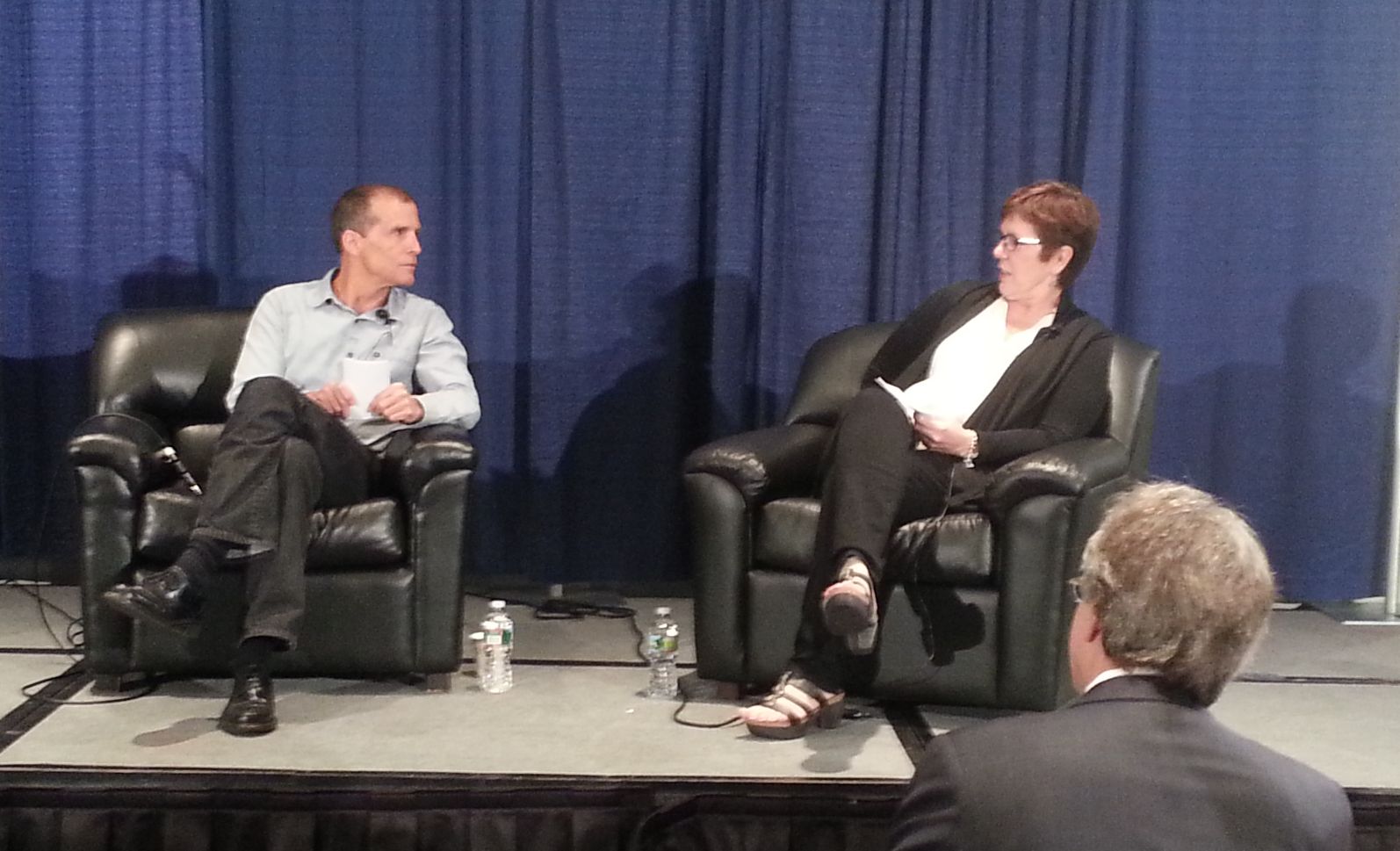
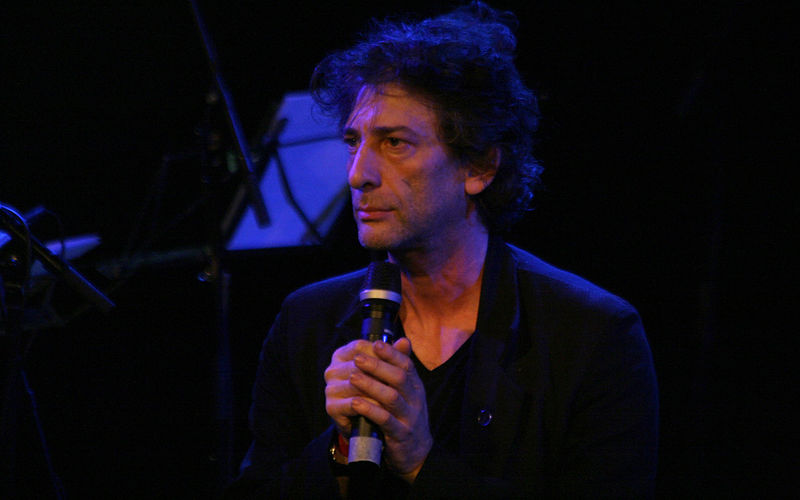
There aren’t many authors who can make a largely female crowd gasp and swoon with every dulcet word, but Neil Gaiman is definitely one of them. Ostensibly at BEA to deliver an address on why storytelling is dangerous, Gaiman’s Saturday morning talk was more about toeing the line and promoting the Gaiman brand. He tossed off e-cards into the crowd like a guitar god cheerfully throwing picks. And he did manage to win over a few skeptics (including this reporter).

“So this morning I got here and I signed 1000 books,” said Gaiman at the start, which was followed by ribald applause. “Each of you gets two books.” One of the books was Make Good Art, which will be published in December.

He was dressed all in black and settled into his chair with a confident and carefully rehearsed ease.

“There isn’t really a Writing Author Lessons 101,” said Gaiman. “But if there was, there would be a list of dos and don’ts. I know that in the don’t column, ‘Don’t have a major novel for adults coming out in June followed by a book for kids in December’ would be high on the list.”

The YA book, which tells the tale of what happened to a father who leaves the house to get milk for the family cereal (among his adventures: being kidnapped by aliens who want to replace the Earth’s mountains with throw cushions and turn Australia into a huge decorative plate), is Fortunately, the Milk, which is illustrated by Skottie Young. Gaiman revealed that the connection came through Twitter, when Young had expressed interest in working with him. “If you need a time-traveling stegosaurus in a hot air balloon,” said Gaiman, “Skottie Young is your man.”

The adult book is The Ocean at the End of the Lane, which was partially inspired by a friend down on his luck who stole Gaiman’s famiily Mini, drove it down to the end of the lane, and committed suicide. It involves the Hempstocks, who have figured in Stardust and The Graveyard Book, but was a long time in coming.

“The problem with writing a story about the Hempstocks is that they lived at the end of my lane.”

Ocean started off as a short story, which Gaiman wrote because he missed his wife, who was in Melbourne for four months recording an album. “I wanted to write a story that’s not about my family,” said Gaiman, “but that’s very much about what it was to see the world through my eyes when I was seven.”

“I’ve heard people point to writing and say that it can be like driving by night. Writing this for me was like driving by night with one headlight out in the thick fog. You can just see far enough ahead not to drive off the road.”

Halfway through the appearance, Gaiman copped, “This has nothing to do with why fiction is dangerous.” He carried on by describing how he got into trouble as a boy by reading books and learning from them. He learned how to dye his father’s white shirts a deep purply red using a common beet root and got into trouble. He learned how to make toffee and became aware of its natural properties. “It will shatter like glass and completely cover the floor of the classroom.”

After offering these biographical exemplars, Gaiman shifted to his views about fiction.

“Fiction is dangerous, of course, because it lets you into other people’s heads. Fiction is dangerous because it gives you empathy. Fiction is dangerous because it shows you that the world doesn’t have to be like the one you live in.”

Gaiman described going to various companies (Google, where one of his sons works, Apple, and Microsoft) and asking the people who invented what they read as children. “They all said, we read science fiction. We read fantasy.”

“Getting into other people’s heads is dangerous,” continued Gaiman, “incredibly dangerous.”

At this point, the floor was open to questions and the talk about “dangerous fiction” was regrettably tabled. Gaiman was asked about the worst sentences he has ever written. He pointed to the story “Night of the Crabs.” One of the offending sentences: “He wasn’t going to leave Pat Benson alone that night, crabs or no crabs.”

He harbored fantasies as a young writer that he would be rewarded for his stories by a limo showing up at his house. “People would get out of it and say this is yours. We love your stories so much.”

As Gaiman described his early writing development, there was a curious pecuniary fixation. He had taped an inspirational Muddy Waters quote next to his typewriter: “Don’t let your mouth write no checks that your tail can’t cash.” He talked of an early teacher who had offered him ten shillings to read the entirety of Gone with the Wind.

He said that he was proudest of his kids, which caused the crowd to loosen an “Ahhhhhh!” that could have found a home on an episode of Community. When one audience member’s phone went off, followed by a cry of “Shit,” Gaiman responded, “Isn’t it embarrassing when that happens? If it’s any consolation, it’s usually up here.”

In other words, Gaiman is well-practiced at working the room.

Gaiman mentioned that the Ameican Gods TV show is still in development at HBO. He has finished a script and he’s waiting to hear back for notes. He compared the relationship to “a game of tennis,” leading this reporter to wonder if there was a dependable racket that didn’t involve thrones. Gaiman talked about introducing material that had never appeared in the book.

“The process has been more HBO going, ‘Can you make it more like the book?'”

Gaiman said he still feels doubt. “I’m a weird mixture of appalling arrogance and absolute self-doubt and humility. Like a nightmarish layer cake.”

He doesn’t write for any specific age. “There’s no such thing as a book just for kids. Because every book is going to have to be read aloud by someone your age.” Every novel is different for Gaiman. After writing American Gods, Gaiman told Gene Wolfe that he had figured out how to write a novel. “He looked at me with infinite pity and said, ‘Neil, you never learn how to write a novel. You just learn how to write the novel you’re on.'”

He did talk about his affinity for Jack Benny’s old radio program. “They get good around 1942,” after Benny had gone through three sets of writers. He mentioned starting a story about Jack Benny, but, tellingly, he did not mention Fred Allen.

There wasn’t much elaboration on Gaiman’s “Make Good Art” speech. This was an appearance to please the crowds. But the very minute that his hour expired, he was led out the door by his handlers, walking with the pace of a rock star with a hectic schedule.

BEA 2013: All’s Fair? Book Reviews & The Missing Code of Ethics

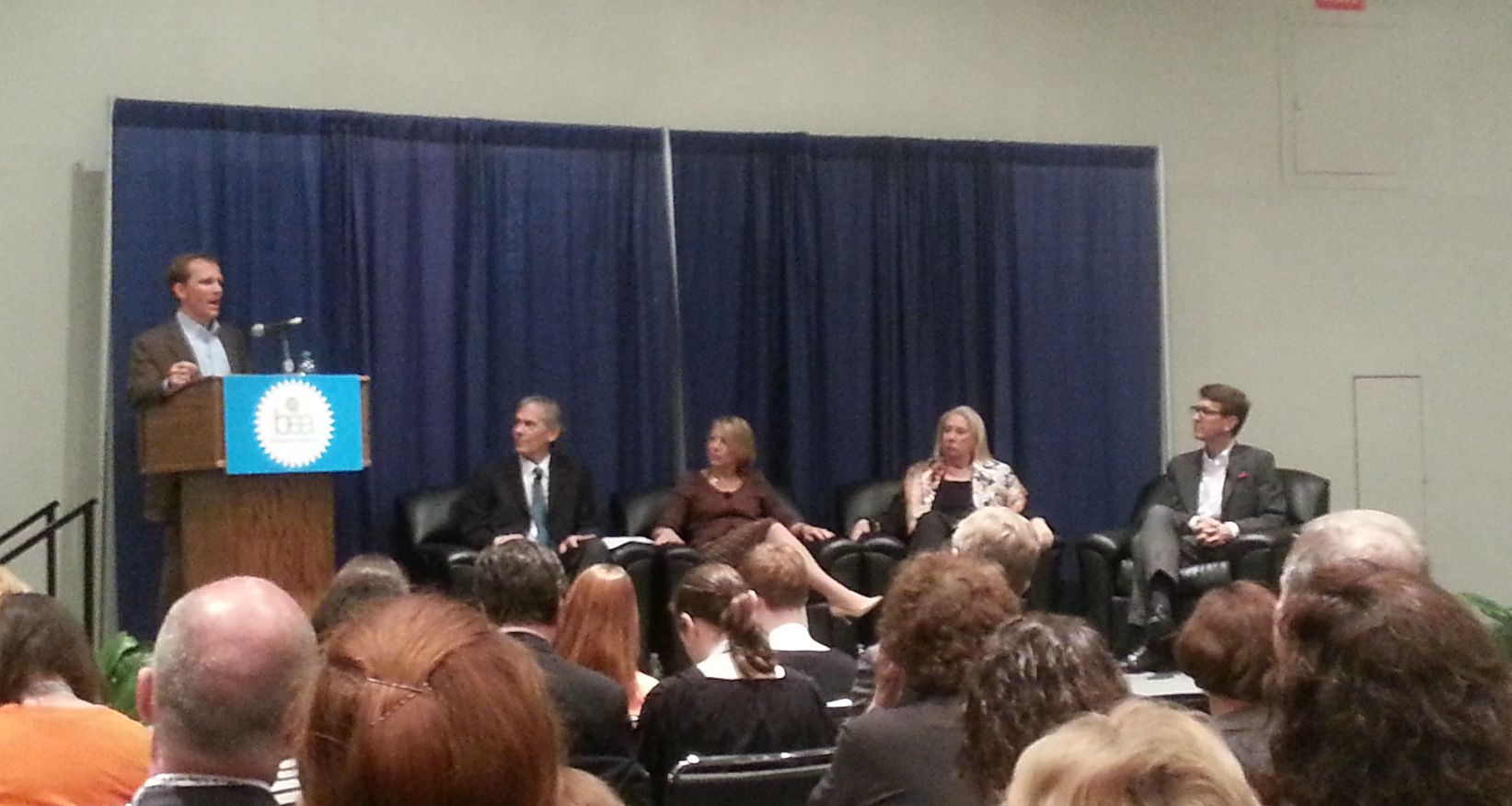
I was fully prepared to ignore the National Book Critic Circle’s latest effort to organize a confab parroting prefab guidelines for how to review books, influence the few, and otherwise eat your own tail. But when I espied a Great Publishing Professional sitting on the floor in a secret access area that I am not at liberty to reveal, I abdicated my seat to this valiant soldier and proudly cried out to the Great Publishing Professional (and others), “You, sir, have decided my fate. I shall cover this panel so that you, good sir, have a physical seat to do your work!” It’s possible that I left the room with a spin on my heel, my arms gliding with the desire to hold an umbrella and leap into the air. But I must confess that the opportunity to ridicule that mendacious puffball Carlin Romano was also too ripe to decline.

But here’s the big surprise. While the panel got off to a lumbering start — ten minutes of introductions (Romano’s, of course, being the longest), reiteration of NBCC wonkery, business serving in lieu of sleeping pills — I was surprised by how smooth it ran. Indeed, it would have been drastically improved had Carlin Romano, a man so in love with himself that he seemed to think the panel was entirely about him, been rolled into the Hudson River, attempting to deliver his gant-inducing gasbag banter with his nose just above water. America the Philosophical indeed!

The panel sprang from the froth of an uncooked souffle concerning whether a universal code of reviewing ethics should be adopted to combat the “Wild West” feel of outlets that were online and offline, print and digital, short form or long form, missionary or doggy style, coffee or tea, and any other dichotomy that comes to mind when overthinking an insoluble problem in needlessly complicated terms. NPR’s Maureen Corrigan seemed to flail against this right out of the gate.

“Why would you want to read a review that was so flensed of bias that it was almost written by an automaton?” she said. She pointed out that the late, great critic John Leonard accompanied Toni Morrison to the Nobel Awards and that seeing how an interesting mind reacted to a book outweighed issues of partiality. “I certainly wouldn’t want to sign on to any kind of contract that required me to leave my biases at the door. My biases have made me worthwhile as a critic.”

After Carlin Romano rattled off points he had delivered in 2007 (and, as a source informed me, reportedly identical to a recent Romano appearance at a biographer’s conference and thus not particularly reportable here), New York Times Book Review editor Parul Sehgal stepped in to rescue the discussion from these unnecessary displays of narcissism. Citing Virginia Woolf’s reviews, Sehgal pointed to the idea of a critic creating a shared space for newer writers. Sehgal was not only the sharpest panelist, but she also valued criticism as a passionate place for expressive possibilities.

But The Paris Review editor Lorin Stein looked to criticism as a place for bright iconoclastic writing. He bemoaned “when a book review editor assigns a novel to a young novelist. I think that creates an impossible conflict of interest.” He stood against what he deemed “tepid, polite reviews.”

I am not entirely sure why agent Eric Simonoff was on the panel, but he did feel that readers of book reviews and blurbs were “pretty smart.” And he agreed with Stein that the “logrolling in our time” that has crept into a few recent publications needed to be avoided. Because this was precisely what a smart reader would detect. “When you feel the tepid poetry of someone who doesn’t want to give offense, you’re reading between the lines.”

Sehgal seemed surprised by much of this. She saw criticism as its own pleasure. “To miss the chance to write an interesting piece of writing for its own sake is what’s done.”

I have neglected to note the contributions of moderator Marcela Valdes, who I really wanted to hear more from. But she was obliged to read back recent responses from an NBCC survey on ethics. Two starkly different responses provided a conversational starting point. The first: “I think that even a very casual acquaintance can inspire undue generosity or vitriol.” The second: “I think the idea that there can be a permanent hermetic seal between author and reviewer is an ideal.” (To be clear, an impossible ideal.)

Addressing these points, Sehgal saw no problem with biases or connections, provided they were explicitly stated in the review.

Romano then raised his impatient finger, beckoning for attention like an impatient five-year-old talent show contestant who wanted to play his violin first.

“There’s one feeling I have after years of thinking,” said Romano. “Literary ethics don’t take place in a vacuum.” He pointed to “the very short memoir about the Sri Lanka woman who lost her family.”

“Sonali Deraniyagala’s The Wave,” cried out the more informed majority in the audience.

“How do you review a book like that if it’s bad?” asked Romano, who clearly had not considered the plentiful finesse established by countless critics over the last few decades. But Romano wanted to matter. He had played his violin. Now he hoped to inveigle the crowd with a few bluntly thrown Molotovs. This was BEA! This was Romano’s Moment!

“Any biases can be overcome by ruthless honesty,” said Romano. “A best friend could write a devastating review of a friend and lose that friend.” Thus, in Romano’s view, objectivity was not possible.

This led Maureen Corrigan, bless her heart, to push back against this hogwash.

“You’re not reviewing the Holocaust,” replied Corrigan. “You’re not reviewing the tsunami. We’re reviewing the book.”

Romano, clearly not listening to Corrigan, then tried to pull himself out of the choppy waters he had created for himself by suggesting that a reviewer might write that the author of a tsunami memoir “should have gone under the waves also.” It was telling how swiftly such blunt asininity sprang from the Great Carlin’s lips.

Lorin Stein had more interesting things to say about being provocative: in large part because his finger appeared more firmly on the pulse of recent newspaper developments. He and Simonoff both noted how outlets had declined in recent years. But Stein saw an equivalency between a blurb and a tepid review. “There are bad books that need to be shut down and that seems to me a very important service to do,” said Stein.

But I think Seghal best comprehended why a review’s identity was so important. “There are some reviewers I read,” said Seghal, “because I want to know how your mind works. I want to be in a space with you.”

Valdes then asked the panelists if there were any hard and fast rules. “You really have to read the whole book,” said Romano. Stein disagreed with this, suggesting that better reviews might be honed if the reviewer wrote about why she didn’t read the whole book. He wanted to avoid writing performed by people who clearly weren’t critics. Seghal was committed to getting the facts right. Corrigan wanted a review to consider a book on its own terms.

“Actually,” added Stein, “a black author said to me, ‘Goddammit, you have to stop reviewing bald white guys. If you keep doing that, you’re going to drive away readers.'”

“In some ways,” said Corrigan, “writing the short review is writing poetry.”

With that sentiment in mind, here is a haiku devoted to Carlin Romano:

Vested man falling
Ground below, boiler plate, ouch
Can’t repeat the past

BEA 2013: Shaping the Future of the Book

On Wednesday afternoon, Open Road Media CEO and co-founder Jane Friedman demonstrated her commendable skills in repeating the same talking points that she delivered at IDPF last year: (1) don’t ignore the elephant in the room (that is, the e-book), (2) we have to think of books in terms of p and e, and (3) Open Road is not a self-publisher. One wonders how many times she has enacted the part of a tottering robot. At least she had the honesty to tell the audience, “All of what you’ve heard so far, I’ve been hearing for 40 years.” But this year, Friedman was speaking before booksellers instead of wild-eyed evangelists who would erect a small nation of geodesic domes if it meant a universe where people read nothing but digital.

Two booksellers attempted to tell Friedman very politely that she was a misguided fool on the subject of e-book implementation in independent bookstores. The first bookseller was a respectful man with long gray hair who informed Friedman that customers would happily download e-books from their computers rather than patronize a physical bookstore. “it’s too easy to get somewhere else,” he said.

“You’re dealing with a universe that’s telling you what they want,” replied Friedman.

This was a sharp contrast to John Sargent’s strepatements this morning, in which he declared with confidence that “the growth of e-books is pretty much pegged.” But then Friedman keeps the Open Road portfolio tied up in digital only and has a natural interest in ignoring any stagnation realities if it means squeezing a few more dollars. (Hachette Book Group CEO Michael Pietsch was careful to point out, “Our job is to be nondenominational.”)

When the first bookseller respectfully shambled away from the microphone, Word Brooklyn manager Emily Pullen stepped up to point to the problem more lucently: “If I were to sell an e-book to every consumer coming through, I would go out of business in a week.” Friedman replied, “Not all e-books are 99 cents,” which severely misses one of the chief reasons why consumers are attracted to e-books.

If that condescending remark wasn’t bad enough, Friedman continued by telling Pullen, “if you sell one e-book to a customer in your store, that person comes back to your store and downloads ten books.” But there’s a fundamental problem with this thesis. When the consumer can simply press a button and have a new book turn up, why would she want to spend the time and gas to hit an independent bookstore? And why should the independent bookseller have any reason to shack up with a snake oil saleswoman — indeed, one who referenced “back to the future” three times during the interminable hour — who undercuts her business.

For the bookseller who was concerned, Friedman took a cue from the 1990s informercial king Tommy Vu. She couldn’t explain to the booksellers in person why her strategy would work, but insisted that they come to her seminar…er…BEA party.

This was the high point in a fairly dull panel moderated by a gentleman who was dull in his relentless agreement with various points and whose questions revealed the regrettable patina of inexperience. I wanted to scream. So did several other booksellers, many of whom offered audible sighs at the people entrusted to “shape the future of the book.” Well, I’ve seen the future. It involves smug people making enemies out of booksellers with hubris (“Maureen Dowd, who is a columnist at the New York Times” — yeah, I think most literate people know this), left in the cold when the bubbles have long fizzled out in their champagne.

BEA 2013: Publishing, Bookselling, and the Whole Damn Thing: A Conversation with John Sargent

John Sargent is a lean man who could be north of fifty, yet dresses and moves like a dude just south of that tetchy line of demarcation sealing a nervous breakdown. He has closely cropped hair with the soft beginnings of gray gently cloaking around a neat skull. He looks a bit like the Christopher Eccleston incarnation of the Doctor. He doesn’t wear leather but he dons muted jeans and a trim light blue dress shirt. He is the CEO of Macmillan and he is something of a maverick, simply for having the gumption to stand up to the Department of Justice. He is here on Wednesday morning to inspire booksellers gathered in a basement room of Jacob Javits Convention Center.

“It is dangerous for us as an industry if everyone lives under a pall of the Department of Justice,” says Sargent. And he means it. This is the man who famously stood up for the agency model as publishers were under fire by that august authority for alleged collusion and price fixing. Sargent was forced to settle for $26 million and the agreement with the DOJ expires on December 2014. (When asked by ABA President Becky Anderson if he would move back for the agency model in 2015, he did not wish to discuss future strategy.) But he’s willing to speak his mind at a trade show if it means firing up a few uncertain souls. And if that means calling the DOJ “extraordinarily myopic” to win some applause, he’ll do it. Even though he’s due to testify next week in the ongoing trial.

He tells the audience that he doesn’t do interviews and that quietude is his natural inclination. Elaborating on this, he says, “I put myself in other people’s shoes who aren’t in the middle of it each day.” But if you look at his feet, you won’t find sneakers.

“I have a great fear of what I think of as the victim effect,” says Sergant when he talks about what he owes the community of booksellers. Under the terms of the settlement, he is not allowed to discuss price. But he can discuss piracy, which makes him feel “pretty bad,” but that he sees as a mild scourge as best. He famously made digital editions of Tor Books DRM-free and it hasn’t hurt his business. He’s quick to point out on Wednesday morning that despite “an explosion of screens,” “the growth of e-books is pretty much pegged.” Macmillan sees 33% of its business goes to e-books; the remaining 66% holds with print. He compliments booksellers on being superb at reacting to “cataclysmic change.” “You guys adjust to that,” he says. “What you need is some time to adjust.”

But the booksellers are watching Sargent for something more than knowledge. They see Sargent, a man who likes to splay his fingers and slice his hands through the air to articulate points, as something of a cowboy. And Sargent lives up to this image with the big square buckle, which looks as if it’s been plundered from the closest thing Manhattan has to a dude ranch. Sargent’s regaling his points from a pad that’s not quite as big as a yellow legal pad but not as small as a memo pad, a clean metaphor for the tone you need to hit when you’re playing a slightly recalcitrant libretto.

But make no mistake: Sargent will follow the consumer’s desires. For all his charisma and his refreshing candor (rare in an industry that is spearheaded by introverts who can sometimes be dry and inarticulate before a large crowd), if the industry were to shift entirely to digital, then Macmillan would veer that very direction. What’s holding Sargent back from extreme digital adoption (rather than highly competent adaption) are sensibilities that he defines as “old-fashioned.” Sargent has been hesitant to release YA books in digital format. As he puts it, “There is something pretty magical about a kid sitting on your lap and reading a book.” He is not a guy who returns home and looks at a screen. And it could be these emblematic 20th century qualities that make him a draw.

Sargent points out that he answers every question he gets on a card, no matter how tough. And he is unafraid to point out certain prejudicial observations, such as the fact that the only people in Congress who want to talk with him are representatives from New York. Publishing is, after all, based here.

But even though Sargent’s talk purports to cover “the whole damn thing,” it’s really more about the innocuous modifier than the noun enchilada. Much as Richard Russo revved up the booksellers last year, Sargent is the confident patriarch encouraging booksellers to shout “damn” in a crowded bookstore.

Elliott Holt (The Bat Segundo Show #500)

Elliott Holt is most recently the author of You Are One of Them.

Author: Elliott Holt

Subjects Discussed: Confusion on what word to emphasize in the book’s title, Elizabeth Bishop, Holt’s stint at ACT in San Francisco, the comparisons and differences between acting and writing, being a failed playwright, reading aloud your work for revision, Philip Roth’s The Ghost Writer, Zuckerman, Billy Wilder’s One, Two, Three, Samantha Smith, writing an introvert based almost exclusively on what she sees and avoiding the interior monologue, smugglers who deliver KFC to Gaza through tunnels, hooking Russians on Coca-Cola, having to answer to the Coca-Cola Company in Dr. Strangelove, the weak perception of Boris Yeltsin, Yeltsin’s 1994 “Truth Decree” in advertising, creating an enemy to define yourself, Cold War cola wars, memorizing slogans to survive, Holt’s experience working as an ad agency in Moscow, the dreadful term “creatives,” Russian cigarettes, trading one form of propaganda for another, characters who are defined by advertising, child ambassadors who become branded, the joys of decrepit Moscow, why Russia is hooked on dichotomies, when mapping personal identity is obstructed by societal forces, how people spill their stories to friends and therapists and what the novel offers in return, Alice Munro, hating the Eagles, why Moscovites love “Hotel California,” Russian accents, Boris and Natasha, church vs. George, the adventures of Holt’s mother in Russia, The Moscow Rules, The International Spy Museum, conveying international calls through brackets and ellipses, having no real designs on journalism, Hollywood cliches in Russia, what people associate with Russia, taking author photographs of Reif Larsen, hanging out at the Propaganda nightclub in Moscow, nude men swimming in fish tanks, Russians on American cleanliness, menacing babushkas who enforce cleanliness in the shower, getting use to being reprimanded by Russians, cultures driven by superstition, the Russian notion of “????” (i.e., soul), being deemed a “star of tomorrow” by New York, being paralyzed by pronouncement, people who feel resentful towards those who are successful, and whether it’s okay to hate other writers.

EXCERPT FROM SHOW:

Correspondent: I did some research and found that you had gone to ACT in San Francisco.

Holt: How did you find that out?

Correspondent: Oh, I have my ways.

Holt: Oh god.

Correspondent: And this is interesting. So you had an acting career at some point.

Holt: I did.

Correspondent: Roughly at the time that I was there. And I was making these short films and plays. And I’m wondering why we didn’t actually run into each other.

Holt: That’s so funny. I did go to ACT in San Francisco. I was a drama major in college.

Correspondent: Oh!

Holt: I went to Kenyon. I was in lots and lots of plays.

Correspondent: That explains why all your answers are in iambic pentameter.

Holt: I was in a lot of plays in college. And I wrote some plays in college. They were terrible. But I think because I took playwriting and read a lot of — I read Aristotle’s Poetics and I read a lot of plays by Pinter and Beckett and Mamet. And I think I was a terrible playwright. I thought I would like playwriting because I had been writing fiction since I was a little kid and one of the things I always liked about fiction writing was dialogue. And so I thought that because I liked to write dialogue, it would be fun to write plays.

Correspondent: Were any of your plays performed?

Holt: Well, my two best friends from college and I — they actually are playwrights. They’re really good playwrights. They’re working playwrights. But when we were in college, we had a student theater group. And we sort of staged our own short plays in those kinds of black box theater. I never staged any full-length thing. There were some scenes I wrote. But anyway, the point is that I was actually a terrible playwright. But I think reading all those plays helped my fiction writing. Because I think I have a really strong sense of subtext and of the importance of scenes as opposed to just interiority. So I think it helped me as a fiction writer, but I was a really bad playwright.

Correspondent: Do you still have any kind of performance quality when you are conjuring up a scene or getting in the head, in this case, of Sarah Zuckerman? I mean, did you feel..

Holt: You mean when I’m writing?

Correspondent: When you’re writing. Do you have to perform sometimes to pinpoint her voice?

Holt: No. I don’t perform. I do think that, when I’m writing, it’s not so different from when I was acting in the sense that I’m really imagining my way into the head of someone. But it’s not like I read things aloud. I think I have a good ear as a reader. And I am very sensitive to modulations in tone when I’m reading fiction. So I think I do hear the language while I’m writing. But I’m not reading it out loud. I mean, later, when I have a full draft, I’ll read it out loud to sort of hear the spots that I think would work. But…

Correspondent: Do you read the whole book? Because Laura Lippman, I know, does that too.

Holt: Yeah. And it helps. You really hear the weak sentences. But, no, not while I’m writing. I’m not performing anything. But yes, I do think in terms of scenes. And I’m sure that’s because I’ve read a lot of plays.

Correspondent: Well, since you have very kindly stepped into the fray of this revived Bat Segundo, I’m going to have to give you one of these massive Bat Segundo questions on your book, which I very much enjoyed.

Holt: Okay.

Correspondent: So this book reminded me of two specific masterpieces. Philip Roth’s The Ghost Writer, of course. Because we have Nathan Zuckerman and Sarah Zuckerman. But not just that. Also the whole thing with Jennifer Jones reminded me of that Anne Frank situation in The Ghost Writer.

Holt: Oh, that’s so funny. I didn’t even…

Correspondent: And then of course, I have to ask you about Billy Wilder’s masterpiece One, Two, Three. Especially since Coca-Cola is here. You’ve got the whole Russia thing. And I’m wondering. Do you need to have partial narrative frameworks — like, in this case, The Ghost Writer or One Two Three, possibly — in order to pinpoint Sarah’s life in this case? Because there’s a good chunk of the mid-section where it’s pretty much Sarah just kind of thinking. And we’re in her head. And then we go back to the plot. So it’s almost like sometimes you adopt narrative frameworks with which to provide Sarah some momentum and with which to provide the reader a good sense of steering the life along a kind of track. And then it kind of dissembles. And then it kind of reattaches again. And I’m really curious about that.

Holt: Dissembles.

Correspondent: Yes. Absolutely. So I’m curious, first of all, were these two masterpieces inspiration for you?

Holt: No.

Correspondent: No? Not at all?

Holt: I’ve never seen One, Two, Three.

Correspondent: You have not seen One, Two, Three!*

Holt: No.

Correspondent: It’s Jimmy Cagney!

Holt: I’ve never seen it. And I love Billy Wilder.

Correspondent: Oh my god.

Holt: I’ve never seen One, Two, Three.

Correspondent: This moves at a machine gun pace. And it has Coca-Cola and Soviet relations at the hub. And paternal stuff. There’s a lot of paternal stuff in [your book].

Holt: No, I’ve never seen it. And actually I think I read The Ghost Writer in college. I love Philip Roth, but I haven’t read The Ghost Writer in a long time. My favorite Roth books that I love the most are American Pastoral and The Human Stain. And I love Portnoy’s. It’s like such a great first book. No, I wasn’t conscious. I think on some intuitive level, I knew I was playing games by naming her Zuckerman in a Roth thing. But I wasn’t thinking about The Ghost Writer. What I was thinking about in terms of — no, I didn’t have the conscious narrative frame. I was inspired by Samantha Smith. So I had a historical — I had history to play with. So I had some history as a frame. And I think, otherwise, no, it wasn’t like there was a conscious frame that I was working towards. I mean, I don’t want to give too much away. But, to me, this is a book about history, personal and cultural. And the obsessive nature of grief. And I think this is a narrator who has a kind of fantasy about doing her past over or getting to see this person that she hasn’t seen in a long time. And she’s really susceptible to a lot of things when she gets to the former Soviet Union. Because there are things she wants to believe. And she gets kind of caught up in her own little spy story in her mind for a while. Because that’s her association with Russia and she wants to.

Correspondent: Sure. On that subject, I was really keen to talk with you about the way you capture Sarah’s introverted nature. Which is a little different from other books. Because it’s almost as if we can get inside her social reservations by way of what she observes in Moscow and the very specific details. It’s almost as if that exists as a way for you to not necessarily inhabit the full nature of her head. She’s taking things in. She’s trying to actually figure out how this relates to her own identity and how this relates to Jennifer Jones, this girlhood friend who has disappeared. She’s trying to make complete sense of this. But she’s doing so by merely bouncing off of the sights that she observes in the regular world. And I’m wondering. Did you feel that you wanted to avoid this almost interior monologue or descent into someone’s head? Because, most of the time, when we read an introvert in fiction — especially in, say, A.L. Kennedy novels — we’re totally inside that head. Which is fine. But in your case, you don’t always go there. And in fact, we don’t actually see what becomes of her until very late in the game when we see some more present day memories. Aspects of her life that are later. And I wanted to ask you about that.

Holt: Well, I don’t think it’s a conscious decision. This is probably just — I probably write the way I do because of the kind of writers I love to read. I mean, Chekhov did exactly that. You have a sense of the character more from what the character is observing than from anything else. And I think the other thing about this book is that Sarah is a character who has spent her life thinking of herself as a footnote in someone else’s story. Kind of playing martyr. And in this book, this is finally when she tells the story herself. But she’s not the most reliable narrator. I mean, she is still evasive in some ways. And I don’t know. But I guess what I’m saying is that it’s, for me, a pretty intuitive process. So it’s not like I thought, “Okay, this is a character whose introvertedness is only going to be revealed by what she observes.” I mean, I think it’s just the way I write. And I think it’s more to do with the kind of books that I love most.

* — Warning to Listener: This moment, featured at the 9:22 mark of the show, has the Correspondent responding to Ms. Holt in a very high-pitched and enthusiastic timbre. The Correspondent apologizes, but he cannot fathom going through life without watching One, Two, Three, a delightful film that you should watch immediately.

The Bat Segundo Show #500: Elliott Holt (Download MP3)

This text will be replaced