The Bat Segundo Show: Shauna Reid

Shauna Reid recently appeared on The Bat Segundo Show #262.

Shauna Reid is most recently the author of The Amazing Adventures of Dietgirl.
segundo262

Condition of Mr. Segundo: Still stinging from his measly memoir efforts.

Author: Shauna Reid

Subjects Discussed: Whether the pursuit of truth is more natural through an anonymous journal, writing as “burdening people,” compartmentalizing online identities, self-esteem, contending with the permanent nature of personal stories contained within a book, how the weight loss journey never ends, remaining fallible with the success story label, connective possibilities that exceed expectations, negotiating the Weight Watchers points system, applying group rules to an individual struggle, differences between the American and the UK versions of the book, being branded “Dietgirl,” the vampire method of exercise, amazing fitness instructors, battling against body image, “perfect” people, societal guides for individual struggles, using spreadsheets to keep track of health statistics, substituting one obsession with another, reprogramming a life, the relationship between physical distance from home and moving ahead with one’s life, placing fabricated news stories within the book, being the largest size in the shop at 23, the false connections between happiness and weight, how not talking about problems put strains on friendships, finding an auctorial voice, adjustments to early journal entries, chronicling friends and marriage, Vegemite parties, immigration, marriage, and entrapment, deportation, not living life because of weight issues, “wasting” one’s twenties, and balancing anarchy and being grounded.

EXCERPT FROM SHOW:

shaunareidReid: You don’t want to burden people with this depressing stuff. So the blog is just my little haven to finally be honest with myself about how I felt.

Correspondent: But “burdening” people. This is an interesting word that you use. I mean, do you feel that all of your writing in general involves “burdening” people? Certainly, I’ve read your stuff for quite a long time and I have never felt any sense of burden. And I’m wondering how this interior sense of burdening people — do you still feel this way?

Reid: No, I don’t feel that way anymore. I think it just goes to show just how crap my self-esteem was back when I started it. Because What’s New, Pussycat? was my original blog. It was where I kind of separated my physical self from everything that was happening in my head. It was where I could be funny. And it didn’t matter what I weighed. I felt so free to be my true self there. Whereas I felt the need to keep outside to do something about my weight. I didn’t feel comfortable letting that audience know that this was the real me. This was this problem I was dealing with. So I just had this ridiculous two separate online lives. It was very hard keeping them up, to be honest.

Correspondent: Yeah, you had to compartmentalize these identities.

Reid: Yeah, I was totally compartmentalizing my life. Because my offline friends and family didn’t know anything about this diet blog. The diet blog didn’t know about the non-diet blog. And vice versa. So it was just keeping all these ridiculous secrets. But that’s just the way I felt at the time. Even though it seems quite strange to me now that I felt that way.

Correspondent: Interesting. I want to actually talk about this notion of self-esteem. I mean, you were fighting, I think, esteem issues on multiple fronts. You had the weight loss and the job scenario and the unemployment. How much do you feel that, for example, your employment history and your employment scenarios tied into the obstacle of losing weight? You point out that staying busy at work “didn’t give you time to think about Kit-Kats and hamburgers and your general state of fatness.” And I’m curious. When did you detect these particular connections? Or by compartmentalizing them, as you indicate in your last answer, this was a way for you to tie all the various threads together.

Reid: Yeah, I think the more I tried to compartmentalize everything, the more I realized they were all connected. And it was pointless for me to try and separate everything. Because one issue rolled into another. Staying busy at work, like I said. Not thinking about Kit-Kats. And then when things got really stressful at work, I would find myself reaching for the Kit-Kats. So it’s all quite a big mess, I think, in the end. It’s not possible. I think I kept it up for about five years — these two separate identities and everything. But in the end, I think when I finally came out of the closet and stopped trying to hide parts of my personality from other people, that’s when I did tackle all of the problems and come out of the other side.

Correspondent: But coming out of the closet now, you’re also dealing with a scenario in which, well, how much do I keep privately to myself? How many of my identities do I compartmentalize? I mean, for all I know, you could have a secret blog somewhere about some other pressing issue that I don’t know about and nobody else knows about. So what is this relationship between the private and the public? Are you done compartmentalizing things at the present time?

Reid: Oh yeah. I’m totally over that now. I don’t feel the need to do that anymore.

Correspondent: Just a phase.

Reid:: Yeah, a very lengthy phase. But the book’s out now. It’s been out for over a year. The most raw, down, dark moments of my life are captured forever in that book. But I do feel a certain detachment from that time in my life now. Because writing about it is a good way of tying up all those loose ends in my own head.

BSS #262: Shauna Reid (Download MP3)

This text will be replaced

The Bat Segundo Show: David Denby

David Denby recently appeared on The Bat Segundo Show #261.

David Denby is most recently the author of Snark.

Please also see our lengthy essay, in response to Adam Sternbergh’s review. This conversation represents an effort to get Denby to answer questions raised by both pieces.

segundo261

Condition of Mr. Segundo: Ordered against using a snarky tone.

Author: David Denby

Subjects Discussed: Whether or not Denby feels battered, unsuccessful attempts to pinpoint the definition of snark, the club of the clued-in, newspapers and narratives, Denby’s reservations about the Web and decentralization, snark’s relationship to voice, Sturgeon’s law, panic in mainstream journalism, satire and a corresponding set of virtues by implication, prototypical voice, the Sarah Palin prank, Spy, contempt for New York celebrities vs. contempt for money and power, investigative reporting and the Web, peer-to-peer journalism, Josh Marshall and the attorney scandal, Private Eye, Sgt. Pepper’s Lonely Hearts Club Band, the need to take sacred cows to task, Pitchfork, “Ugandan discussions,” endearing jargon vs. in-the-know references, why Denby doesn’t find Gawker and Wonkette funny, fickle public memory and disappearing websites, Perez Hilton at 40, fighting slander, accounting for corrective impulses on the Web, privacy as a bourgeois triumph, whether or not Denby can truly have an informed opinion on Twitter if he’s never used it, quibbling with Denby’s uniform assessments of mediums, accounting for the visual innovations of Spy Magazine, the visual notion of snark, Kurt Andersen and Graydon Carter, circumstances in which being ruthless towards someone is okay, Mike Barnacle, nastiness and self-deprecation, Penn Jilette, snark practitioners as flip-floppers, Maureen Dowd, superfluous anger vs. righteous indignation, constructing a narrative in which you can locate yourself, Alcanter de Brahm’s irony symbol, Perez Hilton’s lack of anonymity, defending Tom Cruise, why photographers haven’t fought Perez Hilton, legal remedies, being dragged into the celebrity culture, and raising an army of thoughtful writers.

EXCERPT FROM SHOW:

denbyCorrespondent: Let’s talk about this idea of trash talk vs. snark. You indicate in this book that it’s okay to have a vituperative remark or a savage wit, if there is a corresponding set of virtues. And, in fact, you say “a corresponding set of virtues by implication.” Now “implication,” I think, is the important word here. Because to go back to the Sternbergh review, I would argue, to defend him briefly, that he is attempting to point out that Television Without Pity and the snark tone that he champions — I mean, is there not a corresponding set of virtues perhaps that is in the initial stages? In the prototypical stages perhaps? I mean, don’t people have to start from somewhere before they reach this level of thought that you are advocating in this particular book?
Denby: Well, we don’t know, do we? But I don’t see much of that in Television Without Pity. Mostly, it seems to me, whenever I look, it’s enormously long plot summaries with a lot of snarky adjectives. And it’s fun. Because it’s like friends who gather at a house to watch a TV show, and you compete with one another to see who can be funnier. But I would forgive them everything if they jumped up and down with joy when something original and difficult came out. Like in their movie stuff, I don’t notice them celebrating There Will Be Blood or The Diving Bell and the Butterfly. What gets their jets going is trash like Bride Wars. In other words, they’re invested in trash. And that’s why I say that these people are really thugs of the conglomerate in a way. In other words, they’re part of the commercial system. They’re not really interested in anything adversary. For all of their nasty tone, they’re part of the commercial system. They’re not adversarial at all. They don’t push the little guy — you know, the protest against the system or the artistic revolutionary. That’s not what they’re into. They’re into fandom. Now let me come back to Sternbergh.

Correspondent: But also to point out the initial thrust of this question. As a prototypical model, for some people, snark is the way to get to this more virtuous plane that you’re advocating here.

Denby: Well, I hope you’re right. And maybe they’ll just…

Correspondent: I can say this from experience. Because I was a little snarky when I started writing.

Denby: But people get older and they realize that I’m not pushing my weight. That this is too easy.

Correspondent: Yeah. Jessica Coen, who ended up going from Gawker to New York Magazine. She wrote an essay. I’m sure you’re familiar with this. You don’t quote it in the book. But I’m sure in the course of your research, you found it out. She pointed to the negative feelings that she had, and she wanted to go to this more thoughtful plane.

Denby: Right.

Correspondent: So I’m saying that perhaps, maybe, instead of essentially fanning the flames of discontent against this type, it’s steering them in the right direction. Which you do do in this book. Maybe this is just a growing stage before they blossom into some writer of virtue.

Denby: Well, that would be nice. Also, I think they’re naive if they think that they can make a whole professional career out of this. Because you cannot underestimate the ruthlessness of editors. In other words, this is something that Adam Sternbergh doesn’t know. That his kind of wise guy stuff pales very quickly. And when styles of humor change, editors get rid of you if you don’t keep up. So there can be something naive. It’s a way of gaining a professional foothold. But you’ve got to move beyond it pretty fast. But just to return to Sternbergh, as I remember, the main thrust of his critique was that snark is an appropriate response to a corrupt and dishonorable world. Well, I’m not going to argue with his characterization. I think it is a corrupt and dishonorable world. But the appropriate response to it is not snark. The appropriate response to it is criticism, analysis, and, best of all, satire. Which is what I praise over and over again. The kind of stuff that Stewart and Colbert do. Most of snark is weak. It’s mostly impotent. It’s more a confession of defeat than an appropriate response to anything. I mean, he’s way off on that.

Correspondent: Okay, well, to look at this question of prototypical voice from a different vantage point, you suggest that Philip Weiss’s infamous Spy article, in which he infiltrated Bohemian Grove “discovered only where power hung out and what its vulgar habits are.”

Denby: Yeah, who took a pee where?

Correspondent: Yeah. But if we are to discount this article as nothing more than an amusing prank, I point to the Quebec comedy duo who revealed Sarah Palin’s lack of qualifications with this wonderful prank. And while their particular tone may not have been thoughtful or political, it did lead to people rethinking Sarah Palin’s qualifications.

Denby: Absolutely.

Correspondent: Isn’t there something to be said about how people react to a particular prank or an act? Or how people run with the ball of, say, the Bohemian Grove scenario? And try to investigate it further? I mean, that’s what thought is.

Denby: Yeah, but that’s what Spy never did. I mean, it kept promising more than it delivered. The Sarah Palin prank was brilliant. And that she didn’t catch on for, what was it? Ten minutes? They had her going. It’s just astounding. But the trouble with Spy was that it never did investigative reporting. It did a kind of junior league infiltration of the powerful, rather than the hard work of going to the library and looking up records, and so on and so forth. That true investigative reporting requires before you can nail someone in dishonest behavior or corrupt behavior or collusive behavior. So it never actually delivered. And since it was written basically for people who wanted to join the money….

Random Stranger Shouting Into Mike (Presumably Disenfanchised): Wha…what?

Denby: (to Stranger) Thank you. That was good.

Stranger: You’re welcome.

(Photo credit: Casey Kelbaugh)

BSS #261: David Denby (Download MP3)

This text will be replaced

The Bat Segundo Show: Allison Amend

Allison Amend most recently appeared on The Bat Segundo Show #256.

Allison Amend is the author of Things That Pass for Love.

segundo256

Condition of Mr. Segundo: Pondering the troubling things that pass for love.

Author: Allison Amend

Subjects Discussed: Dealings with the Atlantic Monthly, what constitutes a proper golf story, miniature golf, how Jewishness and faith relates to sustaining a narrative, speaking multiple languages, Pig Latin, the connotations of “molested,” small animals in short stories, whether an author should be concerned about manipulating the reader, grabbing the interviewer by the beard, discovering stories through subconscious intent, stories that “need more gerbil,” writing stories that run counter to an innate perspective, verisimilitude, magical realism, whether multifarious themes and motifs disguise the primary premise of a story, the narrative complexities of romantic intimacy, avoiding the “chick lit” label, Curtis Sittenfeld, the Glimmer Train essay, Amend’s two unpublished novels, dealing with potential editors who issue demands to include a love story, how much one should compromise for art, authenticity vs. marketability, frequent appearances of Zima within Amend’s stories, authors who include brand names in fiction, experimenting with lists and found documents, planning the endings of stories, selecting stories for the collection, and thematic unity.

EXCERPT FROM SHOW:

Correspondent: Golf figures prominently into a number of these stories. In “How Much Greater the Miracle,” you write, “The soul and golf are interrelated. I try not to wax too philosophical, but the soul is like a golf ball.” Now is this particular statement one of the reasons you frequently return to golf in your writing? Do you feel that golf gets a bad rap? Is this your way of essentially taking it, or absconding it, from the upper-class country club associations? Are you trying to counter the John Updike/Richard Ford/Kevin Costner kind of approach to golf? I think this is a very important question!


Amend: Sure, sure. I think that your answer is much better than the one I’m going to give you.

Correspondent: No, I’m sure your answer is going to be fantastic.

Amend: Which is that back when I was in grad school, Michael Curtis, who edits the fiction for the Atlantic Monthly, requested some golf stories. He was editing the fiction section of Golf Digest.

Correspondent: Oh wow.

Amend: And he needed some golf stories. So I was like, “I can write a golf story.” And he said, “Oh, it’s very good. I don’t want it. But it’s a good story.” And I said, “Thank you. I’ll write another one.” So I wrote another golf story.

Correspondent: Aha!

Amend: He said, “I don’t want this either. But I like your writing.” So I wrote one more just to see. But actually I do really like golf as a literary theme. Because, first of all, it’s something for your characters to do without really having to have them do a lot of business. So everyone knows how you play. I mean, everyone sort of knows the theory of golf. You hit a ball towards a hole. And so your characters can talk a lot and can think about things without — it’s not like it’s basketball, where you have to describe the reaction all the time. So I really like golf that way. But also it’s this really absurd game. I played a lot when I was younger and don’t play so much now. But if you told me that you can’t see there’s a hole about the size of your palm and you can’t see it from here. But if you hit the ball three times, you will hit it in the hole. I would never have believed it.

Correspondent: Now you say that you had had golf experience before when you had been asked to do these stories. Or did you have to go into golf again and do a refresher course so to speak? Or a refresher run?

Amend: Well, I was at Iowa. We had a lot of free time.

Correspondent: Okay. They have golf in Iowa.

Amend: They do have golf in Iowa. And it’s actually pretty accessible. There’s a great municipal golf course. A nine hole golf course. And so I actually played a decent round of golf. But mostly I just asked my parents. They are very into golf. And so when I needed some golf details to make the story seem more authentic, I just asked them. I said, “What do you do if the ball’s on the side of a hill?” And my dad’s like, “Well, you hit down on it obviously.” I’m like, “Oh, of course.” And I’m taking notes as I’m talking to them. So that was my golf experience.

Correspondent: But this is an interesting notion of what a golf story is.

Amend: Right.

Correspondent: Because if one plays golf, it’s automatically a golf story? Or golf happens to be a motif? I mean, how golf-intensive does a golf story have to be?

Amend: You know, I don’t know. I don’t think that the golf story is going to be the next hot genre. Although there is the golf novel that does pretty well — apparently every year. But for me, it’s just a story where I have to ask my parents a lot of questions about golf to write it. So to me, that’s a golf story.

Correspondent: I’m just wondering if there’s any golf criteria for a golf story. I’ve never been asked to write a golf story. And I’ve never actually considered, until we just talked about this subject, about what a golf story entails. And so I’m wondering. Maybe it’s like a Christmas story.

Amend: It just has to be some Christmas.

Correspondent: Yeah, I don’t know.

Amend: Yeah, I think so. I’m not sure that I’m the best person to ask, since none of my stories were accepted for Golf Digest.

Correspondent: But they’re in here! There’s like three golf stories in here.

Amend: But they’re in there. In which case, golf is sort of a theme.

Correspondent: Yeah! So you are a golf story person.

Amend: Apparently, I’m a golf story person.

Correspondent: Among many other things. Well, okay.

Amend: Well, I could be. I’ve been called worse.

BSS #256: Allison Amend (Download MP3)

This text will be replaced

The Bat Segundo Show: Nacho Vigalondo

Nacho Vigalondo appeared on The Bat Segundo Show #254. Vigalondo is a filmmaker who is most recently the writer and director of Timecrimes, a film that opens in New York and Los Angeles on December 12.

segundo254

Condition of Mr. Segundo: Searching for future Bats.

Guest: Nacho Vigalondo

Subjects Discussed: What to expect when attending one’s first press day in New York, being isolated from the Hollywood scene by making films in Spain, unexpected attention, Darren Aronofsky’s The Wrestler, the current speed in adapting comic books, Mark Millar, the Timecrimes remake, the pink bandaged head as an old Universal Horror motif, finding the monster within the movie, writing a script out of sequence, Steven Zaillian, trying not to bore the audience, showing the ridiculous side of the situation, using the best bits of Karra Elejalde’s cinematic career for the different Hectors, the influence of fashion choices upon performance, making a movie work in a natural way, the criticism of “improvisation,” criticizing the reasons behind Chica’s nudity, not explaining everything within a movie, the tendency for music to blare throughout every environment, learning from Hitchcock, practical locations vs. planned sets, and making a timeless movie.

EXCERPT FROM SHOW:

nacho-vigalondoVigalondo: When you’re writing a script, sometimes the script is put into a nightmare. Sometimes, it’s giving you some gift. And in this case, when I was writing Timecrimes, I found a monster inside the story. But the story itself gave me the monster. I needed someone with a hidden face, with a scissors on the hand. So I found out that the story was building a monster. A monster that had these classical resonances, as you are telling. So I feel so fortunate. Because when you have a monster in your movie, the movie gets better most of the time. Every movie with a monster is better than the same story without the monster. You can apply this to all the other — to every example. I don’t know. If Million Dollar Baby had a monster, it would be a better film.
Once you find a monster inside your film, well, in my case, it’s something you have to celebrate. For two reasons. It’s a monster that sounds like a Universal classic film monster. And at the same time, it’s a pretty cheap Halloween costume. If the people like your film, they can disguise as the big mummy with little money on the bandages and the scissors. So if you want to dress like Freddy Krueger, it’s more expensive than my monster in my film. So it’s like giving something to the people. In depression times, giving cheap monsters to the people is something I really appreciate. (laughs)

BSS #254: Nacho Vigalondo (Download MP3)

This text will be replaced

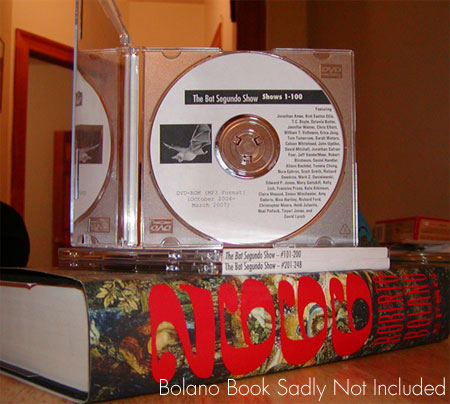
Bat Segundo DVDs Now On Sale!


We’ve received a few requests from listeners asking us how they can get DVD-ROMs of the show. And since Christmas shopping has started, and some of you out there may be on the lookout for a literary stocking stuffer, we’ve decided to begin offering DVD-ROMs of the first 250 shows of The Bat Segundo Show at the very affordable price of $50. (Shows #249 and #250 will be coming online very soon.) For just 20 cents per episode, you’ll be able to experience more than 200 hours of the oddest cultural conversations that can be found on the Internet.

This three DVD set features all programs produced from October 2004 to the present day.

Disc One: Includes interviews with Jonathan Ames, Bret Easton Ellis, T.C. Boyle, Octavia Butler, Jennifer Weiner, Chris Elliott, William T. Vollmann, Erica Jong, Tom Tomorrow, Sarah Waters, Colson Whitehead, John Updike, David Mitchell, Jonathan Safran Foer, Jeff VanderMeer, Robert Birnbaum, Daniel Handler, Alison Bechdel, Tommy Chong, Nora Ephron, Scott Smith, Richard Dawkins, Mark Z. Danielewski, Edward P. Jones, Mary Gaitskill, Kelly Link, Francine Prose, Kate Atkinson, Claire Messud, Simon Winchester, Amy Sedaris, Nina Hartley, Richard Ford, Christopher Moore, Heidi Julavits, Neal Pollack, Tayari Jones, and David Lynch.

Disc Two: Includes interviews with Martin Amis, Ron Jeremy, China Mieville, Tao Lin, Lionel Shriver, A.M. Homes, Scarlett Thomas, Berkeley Breathed, Gary Shteyngart, Richard Flanagan, Katie Roiphe, William Gibson, Marianne Wiggins, Gabe Kaplan, Rupert Thomson, George Saunders, Naomi Klein, Chimamanda Adichie, Steven Pinker, Naomi Wolf, James Lipton, Oliver Sacks, Richard Russo, Tom McCarthy, Andrea Barrett, Will Self, Stewart O’Nan, David Rakoff, Sue Miller, Charles Burns, Steve Erickson, Chip Kidd, Bill Plympton, Michio Kaku, Jennifer Weiner, Richard Price, and Nicholson Baker.

Disc Three: Includes interviews with Mark Sarvas, Errol Morris, Sarah Hall, David Hajdu, Tobias Wolff, Sloane Crosley, Cynthia Ozick, Ed Park, Fiona Maazel, Steven Greenhouse, Ralph Bakshi, Mort Walker, Rachel Shukert, Andre Dubus III, Thomas Disch, Grandmaster Flash, Nam Le, Sen. Mike Gravel, Ethan Canin, Jenny Davidson, Paul Auster, Brent Spiner, Bonnie Tyler, Mike Leigh, Marilynne Robinson, Charlie Kaufman, Neal Stephenson, and David Rees.

Episodes will still be available for free download. But with the purchase of this three DVD set, you’ll be helping us tremendously to continue producing the show, and you’ll save yourself a considerable amount of time downloading them all at home. Particularly if you have dial-up.

The price includes shipping. Please note that all shipments are being sent by FedEx Express Saver to ensure a reasonable delivery time that we can track, and, due to costs, we are currently limiting delivery to the United States. If, however, you’re based outside the States, email me and we’ll work something out.

If there’s enough interest, then we’ll be unloading some additional merchandise, including iPods that have the shows already loaded. But for now, we wanted to offer an affordable way for you to get the shows all in one burst. And if you act swiftly, and you foresee a good deal of commuting time for your Thanksgiving holiday, then we can get the DVDs to you before the turkey is carved.