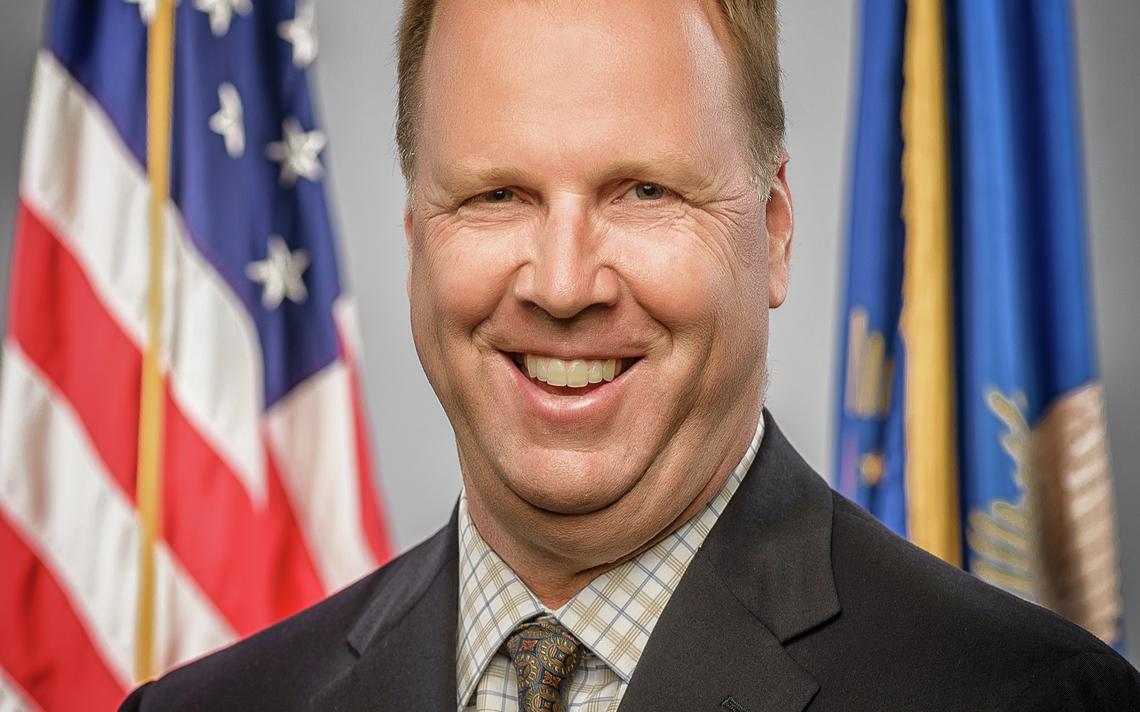
Dave Piepkorn isn’t just stupid. He’s racist and mean and anti-science and officious. The good people of Fargo, North Dakota must remove this dunderhead from office for the greater good.
It goes without saying that Ken Doll dumb white males are part of a significant epidemic now plaguing America. We can usually tolerate such privileged dunces because they can be laughed out of a boardroom or deservedly ridiculed in a local bar. But what happens when such a hideously arrogant and hopelessly stupid lowlife with an inflated sense of importance presides over vital city affairs? You get a guy like Dave Piepkorn.
The Fargo City Commission discussion about a possible mask mandate was bonkers pic.twitter.com/5CljDuyGDA
The good people of Fargo, North Dakota have apparently decided that Dave Piepkorn, arguably the stupidest man to hold local office in the United States, should continue to serve as their Deputy Mayor and City Commissioner. Dave Piepkorn first came to my attentions on Sunday morning, when a video shared by journalist Aaron Rupar went viral on Twitter.
The video documents an October 5, 2020 meeting of the Fargo City Commission, whereby the dutiful leaders of a city populated by 125,000 people discussed a mask mandate. But the maskless Piepkorn embarrassingly states, in full defiance of the science, that masks are no defense against COVID-19.
“And the facts are I’m just as protected as you are wearing that mask of COVID-19,” said Piepkorn. “COVID-19 passes right through that mask. Isn’t that correct?”
There is then a pause, almost as if the collected attendees are collecting their jaws from the floor, understanding with shock and shame just how much of a putz they have in the number two slot. One of Piepkorn’s fellow commissioners, along with the audience, shout numerous noes.
Piepkorn responds with the haughty smirk of a six-year-old sociopath who has gleefully stomped on a helpless salamander with his sneaker. The meeting is closed for public comment. And then Piepkorn continues, “But basically a virus, it doesn’t — it goes, it goes right through the mask. And so for us to start mandating something that doesn’t work, that doesn’t make sense. And as far as the people…”
There are additional stunned reactions from the crowd that one hears off-mike.
And Piepkorn, who clearly doesn’t understand that the hill he has chosen to die on stands in the face of rudimentary rationale that even a preschooler can understand, then grows imperious. His voice takes on the raised autocratic tone of a twisted Karen using her privilege to ruin a Black man by making a phony 911 call for a purely manufactured offense:
“Okay, here’s how it goes. Once again, if you behave yourselves, you can stay in the room. You’re welcome to. But if you don’t, you’re going to be asked to leave. And if you don’t leave, then the police will escort you out. Is that clear?”
The meeting continues.
“The masks are not effective with the virus. Period. That’s proven. The coronavirus passes through. And so it’s false to tell people that they’re going to be safe by wearing that. And as far as sitting six feet apart, it’s liberty. If you don’t want to sit next to each other, then you don’t have to. You can go someplace else or watch it on TV. Or on the Internet. So thank you very much.”
A few weeks after this meeting, North Dakota has now seen its biggest upswing in COVID infections and deaths in some time. Cass County — home to Piepkorn’s Fargo — is now the second most infected vicinity in North Dakota. And it’s all thanks to feebleminded fuckwits like Piepkorn, who scatter falsehoods into the wind like poisonous seeds permanently sullying a promising orchard.
In short, Dave Piepkorn is the living embodiment of Idiocracy, though with more of an ego-driven tinge than Mike Judge’s characters. He refuses to consider other viewpoints. He refuses to grasp science. He is dense when it comes to comprehending basic facts. He is, in short, a contemptible clod who is better suited to work as an assistant plumber rather than as assistant to the highest local office in the land. And that’s only because no respectable building contractor in North Dakota would ever trust this incompetent buffoon to fix the pipes by himself. It also doesn’t help that Piepkorn’s face is so ugly that he looks as if he’s the secret love child of Charles Manson follower Lynette “Squeaky” Fromme and Boris Karloff. Honestly, with a visage so hideous, you’d think that Piepkorn would be on the side of wearing a mask, if only to disguise his aesthetic limitations.
This isn’t the first time that Piepkorn has been a clueless contrarian. He has partaken in comparatively more innocent acts of idiocy, such as being the only no vote in a measure back in May that allowed vegetable and flower gardens to be grown on local boulevards. (The measure passed anyway.) And this certainly isn’t the first time that Piepkorn has demonstrated that he has slightly more brain cells than a gerbil. In a September 9, 2019 Fargo City Commission meeting, Piepkorn condemned fellow Commissioner Tony Gehring for not being present during a special assessment task force meeting. Gehring swiftly pointed out that he was then being deployed by the military. “Sorry, Dave,” snapped Gehring in disbelief. But this didn’t stop dimwitted Piepkorn from actually attempting to follow through on this failed gotcha moment after being publicly embarrassed by Gehring. “It’s just ironic that you seem to be, um, very upset about it, but then your not at the meetings.” It’s certainly no surprise that Piepkorn is too dense to comprehend that irony usually happens when the subject is unaware of his actions and does the opposite of what he says he will. And I suppose it’s ironic that a poltroon like Piepkorn doesn’t see the irony in his own failed attempts to point out irony. (Although, if Piepkorn is reading this, that concept may be a little tricky for his bradykinetic brain to understand.)
It’s easy to simply dismiss Dave Piepkorn as some jaunty jackass who is embarrassing the most populous city in North Dakota. But when you place such an unqualified pillock in power, just as if we have seen nationally, there are often dangerous ramifications.
Piepkorn is also a racist whose atavistic words and actions have ignited racially charged violence in the region. One little known fact is that 8% of the Fargo population was born in another country. These people fled to North Dakota from war and devastation in an attempt to build a new life and contribute to the promise of America. But for repugnant xenophobes like Piepkorn, refugees are clearly a scourge. In September 2016, Piepkorn stood in the way of a refugee resettlement program operated by Lutheran Social Services. When not condemning the money going to a nonprofit devoted to helping people who had fled violence, Piepkorn made unsubstantiated racist remarks claiming that Somali refugees were more inclined to commit crime. Less than a year after Piepkorn expressed his bigotry, Somali-American Shuib Ali was assaulted in a hate crime. Moreover, Piepkorn’s opposition to benevolent organizations helping out anyone who isn’t white has resulted in local racists turning into Piepkorn fans, showing their true colors and loudly ranting against Somalis.
Dave Piepkorn is living proof that fatuous and flatulent imbeciles must not be allowed to hold power. Given how much of a local embarrassment Piepkorn is, perhaps the good people of Fargo can restore their city back to good grace by initiating a new recall campaign, ensuring that Piepkorn never holds any form of political office ever again.
In his 1966 essay “The White Man’s Guilt,” James Baldwin — never a man to mince words or to refrain from expressing searing clarity — declared that white Americans were incapable of facing the deep wounds suppurating in the national fabric because of their refusal to acknowledge their complicity in abusive history. Pointing to the repugnant privilege that, even today, hinders many white people from altering their lives, their attitudes, and the baleful bigotry summoned by their nascent advantages, much less their relationships to people of color, Baldwin noted:
For history, as nearly no one seems to know, is not merely something to be read. And it does not refer merely, or even principally, to the past. On the contrary, the great force of history comes from the fact that we carry it within us, are unconsciously controlled by it in many ways, and history is literally present in all that we do. It could scarcely be otherwise, since it is to history that we owe our frames of reference, our identities, and our aspirations.
Fifty-four years after Baldwin, America now finds itself enmired within its most seminal (and long delayed) civil rights movement in decades, awakened from its somnambulistic malaise through the neck-stomping snap of systemic racism casually and ignobly practiced by crooked cops who are afforded impunity rather than significant consequences. The institution of slavery has been replaced by the indignities of racial profiling, income disparity, wanton brutality, constant belittlement, and a crass cabal of Karens who are more than eager to rat out people of color so that they can scarf down their soy milk lattes and avocado toast, rarely deviating from the hideous cues that a culture — one that prioritizes discrimination first and equality last — rewards with all the perfunctory mechanics of a slot machine jackpot.
Thus, one must approach James McPherson’s mighty and incredibly impressive Civil War volume with mindfulness and assiduity. It is not, as Baldwin says, a book that can merely be read — even though it is something of a miracle that McPherson has packed as much detail and as many considerations as he has within more than 900 pages. McPherson’s volume is an invaluable start for anyone hoping to move beyond mere reading, to significantly considering the palpable legacy of how the hideous shadow of white supremacy and belittlement still plagues us in the present. Why does the Confederate flag still fly? Why do imperialist statues — especially monuments that celebrate a failed and racist breakaway coalition of upstart states rightly starved and humiliated and destroyed by Grant and Sherman — still stand? Battle Cry of Freedom beckons us to pay careful attention to the unjust and bestial influences that erupted before the war and that flickered afterwards. It is thankfully not just a compilation of battle summaries — although it does do much to mark the moments in which the North was on the run and geography and weather and lack of supplies often stood in its way. The book pays welcome scrutiny to the underlying environment that inspired the South to secede and required a newly inaugurated Lincoln to call for 75,000 volunteers a little more than a month after he had been sworn in as President and just after the South Carolina militia had attacked Fort Sumter.
* * *
It was technological innovation in the 1840s and the 1850s — the new machines putting out watches and furniture and bolts and damn near anything into the market at a rapid clip previously unseen — that helped sow the seeds of labor unrest. To use the new tools, a worker had to go to a factory rather than operating out of his home. To turn the most profit possible and sustain his venal wealth, the aspiring robber baron had to exploit the worker at subhuman wages. The South was more willing to enslave people. A barbaric racist of that era ranting in a saloon could, much like one of Trump’s acolytes today, point to the dip in the agricultural labor force from 1800 to 1860. In the North, 70% of labor was in agriculture, but this fell to 40%. But in the South, the rate remained steady at 80%. But this, of course, was an artificial win built on the backs of Black lives.
You had increasing territory in the West annexed to the United States and, with this, vivacious crusaders who were feeling bolder about their causes. David Wilmot, a freshman Congressional Representative, saw the Mexican War as an opportunity to lay down a proviso on August 8, 1846. “[N]either slavery nor involuntary servitude shall ever exist in any part of said territory” were the words that Wilmot added to an appropriations bill amendment. Like any politician, Wilmot was interested in settling scores. The Wilmot Proviso was as much the result of long pent-up frustration among a cluster of Northern Democrats who cared more about holding onto power than pushing forward abolition. The proviso kept being reintroduced and the Democratic Party of the time — much of it composed of racists from the South — began to splinter.
Northern Democrats shifted their support from the Wilmot Proviso to an idea known as popular sovereignity, which placed the decision on whether to sustain or abolish slavery into the hands of settlers moving into the new territories. But Wilmot’s more universal abolition approach still had the enthusiastic support of northern Whigs. The Whigs, for those who may not recall, were essentially middle-class conservatives living it large. They represented the alternative to Democrats before the Republican Party was created in 1854. The Whigs emerged from the ashes of the Nullification Crisis of 1832 — which you may recall me getting into when I was tackling Herbert Croly a few years ago. Yes, Andrew Jackson was responsible for (a) destroying the national bank, thus creating an economically volatile environment and (b) creating enough fury for Henry Clay and company to form an anti-Jackson opposition party. What’s most interesting here is that opposing Jackson also meant opposing one of his pet causes: slavery. And, mind you, these were pro-business conservatives who wanted to live the good life. This is a bit like day trading bros dolled up in Brooks Brothers suits suddenly announcing that they want universal healthcare. Politics may make strange bedfellows, but sometimes a searing laser directed at an enemy who has jilted you in the boudoir creates an entirely unexpected bloc.
Many of the “liberals” of that era, especially in the South, were very much in favor of keeping slavery going. (This historical fact has regrettably caused many Republicans to chirp “Party of Lincoln!” in an attempt to excuse the more fascistic and racist overtures that these same smug burghers wallow in today.) Much like Black Lives Matter today and the Occupy Wall Street movement nine years ago, a significant plurality of the Whigs, who resented the fact that their slave-owning presidential candidate Zachary Taylor refused to take a position on the Wilmot Proviso, were able to create a broad coalition at the Free Soil convention of 1848. Slavery then became one of the 1848 presidential election’s major issues.
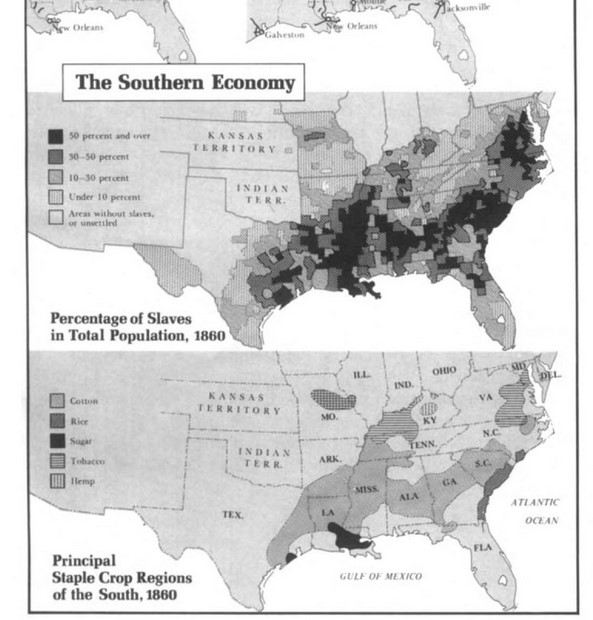
In Battle Cry, McPherson nimbly points to how all of these developments led to a great deal of political unrest that made the Civil War inevitable. Prominent Republican William H. Seward (later Lincoln’s Secretary of State) came out swinging against slavery, claiming that compromise on the issue was impossible. “You cannot roll back the tide of social progress,” he said. The 1854 Kansas-Nebraska Act (authored by Stephen Douglas) repealed the Missouri Compromise, which in turn led to “Bleeding Kansas” — a series of armed and violent struggles over the legality of slavery that carried on for the next seven years. (Curiously, McPheron downplays Daniel Webster’s 1850 turncoat “Seventh of March” speech, which signaled Webster’s willingness to enforce the Fugitive Slave Act and forever altered his base and political career.) And while all this was happening, cotton prices in the South were rising and a dying faction of Southern unionists led the Southern states to increasingly consider secession. The maps of 1860 reveal the inescapable problem:
* * *
The Whigs were crumbling. Enter Lincoln, speaking eloquently on a Peroria stage on October 16, 1854, and representing the future of the newly minted Republican Party:
When the white man governs himself that is self-government; but when he governs himself, and also governs another man, that is more than self-government — that is despotism. If the negro is a man, why then my ancient faith teaches me that “all men are created equal;” and that there can be no moral right in connection with one man’s making a slave of another.
Enter the Know Nothings, a third party filling a niche left by the eroding Whigs and the increasingly splintered Democratic Party. The Know Nothings were arguably the Proud Boys of their time. They ushered in a wave of nationalism and xenophobia that was thoughtfully considered by the Smithsonian‘s Lorraine Boissoneault. What killed the Know Nothings was their failure to take a stand on slavery. You couldn’t afford to stay silent on the issue when the likes of Dred Scott and John Brown were in the newspapers. The Know Nothings further scattered political difference to the winds, giving Lincoln the opportunity to unite numerous strands under the new Republican Party and win the Presidency during the 1860 election, despite not being on the ballot in ten Southern states.
With Lincoln’s win, seven slave states seceded from the union. And the beginnings of the Confederacy began. Historians have been arguing for years over the precise reasons for this disunion. If you’re a bit of a wonk like me, I highly recommend this 2011 panel in which three historians offer entirely different takeaways. McPherson, to his credit, allows the events to unfold and refrains from too much editorializing. Although throughout the book, McPherson does speak from the perspective of the Union.
* * *
As I noted when I tackled John Keegan’s The Face of Battle, one of my failings as an all-encompassing dilettante resides with military history, which I find about as pleasurable to read as sprawling myself naked, sans hat or suntan lotion, upon some burning metal bed on a Brooklyn rooftop during a hot August afternoon — watching tar congeal over my epidermis until I transform into some ugly onyx crust while various spectators, saddled with boredom and the need to make a quick buck, film me with their phones and later email me demands to pay up in Bitcoin, lest my mindless frolicking be publicly uploaded to the Internet and distributed to every pornographic website from here to Helsinki.
That’s definitely laying it on thicker than you need to hear. But it is essential that you understand just how much military history rankles me.
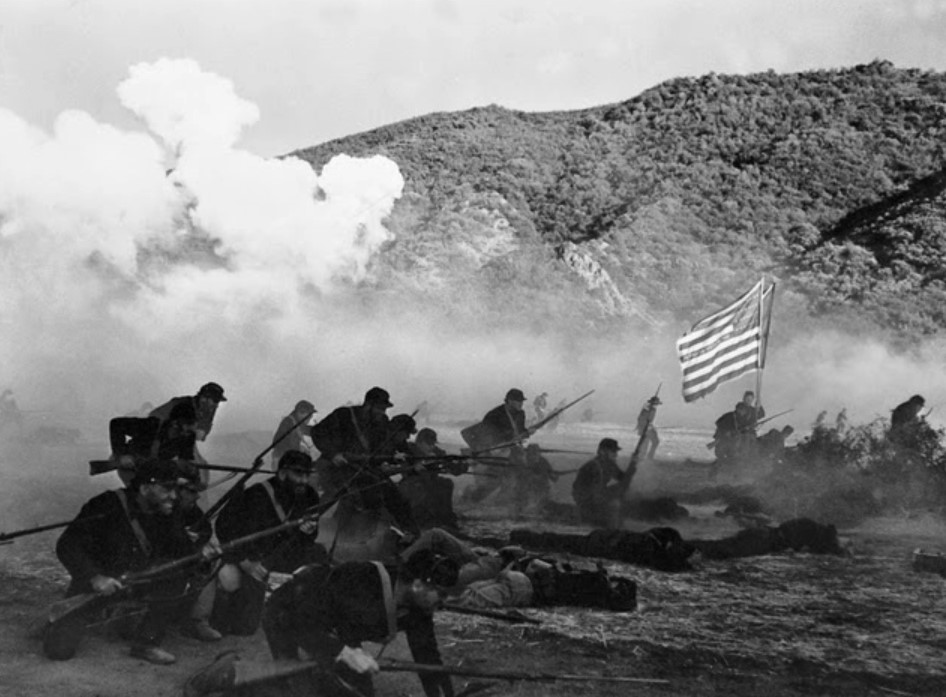
Anyway, despite my great reluctance to don a tricorne of any sort, McPherson’s descriptions of battles (along with the accompanying illustrations) did somehow jolt me out of my aversion and make me care. Little details — such as P.G.T. Beauregard designing a new Confederate battle flag after troops could not distinguish between the Confederate “stars and bars” banner from the Union flag in the fog of battle — helped to clarify the specific innovations brought about by the Civil War. It also had never occurred to me how much the history of ironclad vessels began with the Civil War, thanks in part to the eccentric marine engineer John Ericsson, who designed the famed USS Monitor, designed as a counterpoint to the formidable Confederate vessel Virginia, which had been created to hit the Union blockade at Ronoake Island. What was especially amazing about Ericsson’s ship was that it was built and launched rapidly — without testing. After two hours of fighting, the Monitor finally breached the Virginia‘s hull with a 175-pound shot, operating with barely functioning engines. For whatever reason, McPherson’s vivid description of this sea battle reminded me of the Mutara Nebula battle at the end of Star Trek II: The Wrath of Khan.
But even for all of McPherson’s synthesizing legerdemain, the one serious thing I have to ding him on is his failure to describe the horrors of slavery in any form. Even William L. Shirer in The Rise and Fall of the Third Reich devoted significant passages to depicting what was happening in the Holocaust death camps. Despite my high regard for McPherson’s ability to find just the right events to highlight in the Civil War timeline, and his brilliantly subtle way of depicting the shifting fortunes of the North and the South, can one really accept a volume about the Civil War without a description of slavery? McPherson devotes more time to covering Andersonville’s brutal statistics (prisoner mortality was 29% and so forth) before closing his paragraph with this sentence:
The treatment of prisoners during the Civil War was something that neither side could be proud of.
But what of the treatment of Black people? Why does this not merit so much as a paragraph? McPherson is so good at details — such as emphasizing the fact that Grant’s pleas to have all prisoners exchanged — white and Black — in the cartel actually came a year after negotiations had stopped. He’s good enough to show us how southern historians have perceived events (often questionably). Why then would he shy away from the conditions of slavery?
The other major flaw: Why would McPherson skim over the Battle of Gettysburg in just under twenty pages? This was, after all, the decisive battle of the war. McPherson seems to devote more time, for example, on the Confederate raids in 1862. And while all this is useful to understanding the War, it’s still inexplicable to me.
But these are significant nitpicks for a book that was published in 1988 and that is otherwise a masterpiece. Still, I’m not the only one out here kvetching about this problem. The time has come for a new historian — ideally someone who isn’t a white male — to step up to the challenge and outdo both Ken Burns and James McPherson (and Shelby Foote, who I’ll be getting to when we hit MLNF #15 in perhaps a decade or so) and fully convey the evils and brutality of slavery and why this war both altered American life and exacerbated the problems we are still facing today.
Karlos Dillard was a struggling Postmates worker who longed for fame and attention. But when a white woman cut him off accidentally during a delivery run, he found the opportunity to bend the truth and create an invented narrative in which he was a victim and she was a racist.
Karlos Dillard — a 27-year-old Postmates driver and self-published author in Seattle — was cut off by a 1996 Geo Metro during a routine food delivery. The car was driven by a white woman. Dillard is black. Dillard said that he was on his way to a restaurant he refers to as “Dick’s Dine-In” to pick up a food delivery for a Postmates gig. (There are five franchises of Dick’s Drive-In operating in Seattle. I have confirmed that all five restaurants do indeed offer Postmates delivery.)
Dillard claimed — in a series of Instagram stories — that he had the right of way to merge onto a street from Melrose Avenue in “Capitol Hill. Fucking Capitol Hill.” Dillard says that he was in the right lane. As the two lanes of the unspecified street were about to merge, Dillard says that the woman “freaked out and swung around me and got in front of me and slammed on her brakes and did a brake check.” He further claims that he nearly collided into the back of her car.
At this point, we can confine the details of this incident to, at worst, an act of minor road rage — a common act that anyone, irrespective of race or background, engages in when they are facing significant anxiety — an anxiety that the present pandemic and economic uncertainty has instilled in anyone. But Dillard wished to escalate this — without a shred of video evidence — into a flimsy claim that the unidentified Geo Woman had instigated an act of racism. He decided to take advantage of the present moment, in which the Karen meme of white women using their privilege to engage in repugnant acts of racism has proven to be quite popular.
Dillard, a Trump supporter whose online record shows a clear angling for attention and online fame, saw an opportunity to go viral. So he chased the Geo Woman down in his car and confronted her, releasing the below video excerpt onto Twitter, which, as I write this, has been seen more than four million times.
UPDATE: In an attempt to hide his evidence, Dillard removed the above Instagram post. The full video can be found below:
Karlos Dillard acted with great cruelty in his video.
The woman is clearly terrified. Her hands are shaking. She desperately covers her face and her license plate. Anyone who drives a Geo Metro built in another century is clearly not rolling in riches. So why go after her like this?
The Geo Woman feels attacked by the camera. We have no idea if she’s suffered any kind of past trauma or abuse. What a normal person with any shred of empathy would do here is put the camera down and give her the opportunity to apologize. But that’s not what Dillard does. He continues to call her a Karen, sticking his knife into the woman’s vulnerability and inflating his claim. He pans his phone to the woman’s car and gleefully announces, “Guys, this is her license plate number. She lives here. This is her address.” The woman shrieks at the top of her lungs, “No! No! Please! This is not true.”
“You cut me off!” bellows Dillard.
“No, I didn’t!” says the Geo Woman.
The woman begs for Dillard to leave her alone and to let her offer an apology for whatever happened. But what does Dillard do? He backs away from the woman and shouts into the Seattle streets for attention, “Guys! She flipped me off and then she tried to come home.” It’s vital to note that Dillard does not mention any act of racism in the early period of this unsettling video. Then he shrieks, “She did apologize for calling me a n**** and flipping me off” to anyone who will listen. And yet we don’t actually hear the woman acknowledging that she did any of this. Dillard is the person in the position of power here. And he knows it.
“Ma’am, what have I done to you?” barks Dillard.
“You’re going to ruin my life and you don’t even know me.”
Throughout the video, the Geo Woman repeatedly denies flipping Dillard off. “No, I didn’t! I swear to God!” she shrieks as she cowers with fear, desperately hiding the license plate and wailing with unbearable pain. She claims repeatedly, “I didn’t even see you!” in the full video.
Various onlookers look terribly confused as she cries, “He won’t listen to me!” An unspecified white man claims that he “saw her do it.” But what precisely did this man see?
Dillard eventually drives off and pulls across the street as various people try to comfort the Geo Woman. Then he returns to the scene, his camera off, and there is this exchange:
DILLARD: You literally cut me off. You flipped me off, correct? GEO WOMAN: I did. But it wasn’t the way.. DILLARD: Okay. GEO WOMAN: …you won’t let me finish.
[Is the Geo Woman confessing to accidentally cutting Dillard off? Or flipping him off? Or is she overwhelmed by the rapid fire nature of Dillard’s relentless questions?]
GEO WOMAN: I didn’t mean to. ‘Cause I was trying to… DILLARD: Then what did I do illegally? GEO WOMAN: Can I — can I… DILLARD: I had to merge. GEO WOMAN: I — Can I talk? DILLARD: Yeah. Go ahead. GEO WOMAN: I feel sorry… DILLARD: I have to… GEO WOMAN: (crying) My arm! My heart. DILLARD: Ma’am, you can’t just be going down flipping people off. GEO WOMAN: I didn’t know you were — I wanted to touch you because I wanted you to — I know. I understand. You are a stranger. We — look me in the eyes. DILLARD: You’re not going to be on Instagram. That’s not my deal here.
But going viral is most certainly Dillard’s “deal.”
The Geo Woman never once confesses specifically to flipping Dillard off. If anything, she extends empathy to him for accidentally cutting him off. Moreover, Dillard explicitly tells the Geo Woman — who is now a subject of ridicule — that she will not be on Instagram, betraying his pledge to clear up the misunderstanding privately.
In other words, Dillard’s video is not an act of social justice or even a noble fight for justice. It is an act of pure and unadulterated sadism, conducted by Dillard without a shred of compassion.
The other aspect of Dillard’s video that went viral was the Geo Woman announcing that she has a black husband. Here is the transcript:
DILLARD: You flipped me off! You flipped me off! GEO WOMAN: Sir? DILLARD: Don’t touch me! Do not touch me. GEO WOMAN: I’m trying to… DILLARD: You flipped me off! GEO WOMAN: I have a black husband! DILLARD: I don’t care. Why did you flip me off? GEO WOMAN: You were totally calling me something that I’m not.
There are several important aspects to note here that reveal both the truth of what happened and Dillard’s questionable motivations.
1. At no point does the Geo Woman say that she flipped Dillard off or committed racism.
2. The Geo Woman is still processing some shouting guy with a camera confronting her. And instead of giving the Geo Woman the opportunity to process what’s going on, he instead bullies her with the question, “Why did you flip me off?”
* * *
What is the basis for Dillard’s claims of racism from this woman? In an effort to understand why, I have downloaded and reviewed the eighty photos and videos that Dillard uploaded to his Instagram stories feed on June 22, 2020 for this story. You can download the collected files here. After careful study, it’s pretty clear that there are too many contradictions and constant additions to Dillard’s story for it to be accepted in any court of law. Of the professed brake check and racism, Dillard doesn’t possess any evidence other than his own word, which constantly shifts over the course of his Instagram feed. He also takes many opportunities throughout these Instagram stories to promote his book and his merchandise.
There is a short video of the woman’s Geo facing Dillard, the Geo pulling back with its driver’s side open, and the woman’s Geo then driving off. Dillard has not posted any video demonstrating that the Geo Woman acted with any form of racism. In fact, when he shouts at the Geo Woman, he doesn’t make any mention of her professed racism, which would seem to be the underlying source of his beef. He merely bemoans that she was “driving crazy in Seattle.” He merely shouts, “Karen, learn how to drive!”
As Dillard revisits the incident, the details of his story keep changing. He initially says that the woman “sticks her fingers out of the window and starts flipping me off and saying all of this fucking racial shit.” Dillard also claims that the woman followed him for three blocks. And yet he has no video to back up any of this.
In another bit of testimony from Instagram Stories, Dillard then says that the Geo Woman “purposely brake checked me” and then adds the new detail of the Geo Woman smiling — “the smile and the words that came out of her mouth and her flicking me off.” But the source video of the Geo doesn’t show the woman doing any of these things. Has Dillard conveniently omitted the details?
Dillard takes the opportunity to mock the Geo Woman for having a black husband, stating with hyperbole:
“I have a black husband” will forever be the defense of racist people….and clearly your husband can’t really be about the movement. Because he would have had a conversation with you. Like, if you really had a black husband, you would know what you did was inappropriate. You would also what you’re doing now is inappropriate. If you had a black husband, you would have been apologetic.
But wait a minute. Dillard claimed at the scene of the incident that the Geo Woman did apologize “for calling me a n*****,” even going to the trouble of shouting this at the top of his lungs to anyone who would listen. Moreover, what could the Geo Woman be doing “right now” given that Dillard is removed from her?
To add additional credibility and framing to his claim, Dillard also includes a video on his Instagram Stories feed having a conversation with his husband, completely discounting the road rage as the motivating factor behind the incident. Karlos’s husband Kristopher (who, it is worth noting, was attacked on a bus in 2016) claims that, if Dillard had hit the Geo Woman, then he would “owe her a new car.” And this leap in logic is used to further suggest that the Geo Woman acted with unmitigated racism. Dillard responds:
So issue isn’t the road rage. It’s the…the “Why it happened?” And that’s why I wanted — that’s really — I didn’t give a fuck about her calling me out on my name or flipping me off. I really got pissed off.
Despite remaining cool as a cucumber throughout all of his Instagram Stories, Dillard also paints himself as a suffering victim, suggesting that he will suffer from “hypertension, blood pressure, insomnia, back problems, [and] chiropractic problems.” It is worth pointing out that none of the many legitimate victims of Karens have ever felt compelled to list a series of physical ailments after being subjected to unacceptable racism.
Dillard, a Detroit native, has his own troubled past. He was abandoned at the age of fifteen and worked three jobs while homeless to survive through high school and college. [UPDATE: TrueAnonPod has uncovered a post by Dillard’s adopted mother that disputes his claims. It is worth noting that Karlos Dillard’s original name was Carlos Gum.]
Dillard had gained some Internet attention in the early days of the Seattle protest when he was videotaped blowing bubbles in front of the police. And this is indeed a pleasant and peaceful counterpoint to the relentless police abuse in that area.
But the lion’s share of his online activities appear to have involved harassing people and leveling spurious claims of racism.
I just had a racist Asian lady demand to see my ID and my phone to prove that I was a postmates driver while I was picking up the food. After I refuse to show her my ID. I told her she was being racist and she said whatever Nigger. #blm#postmates@Postmatespic.twitter.com/l2eJQx0u6t
The incident with the Geo isn’t the first time that Dillard has claimed that others were racist during the course of a Postmates delivery. On May 28, 2020, Dillard claimed that the proprietors of A Burger Place demanded to see his ID when picking up an order and that this was an act of racism. Much like the Geo incident, Dillard doesn’t have any video evidence of the alleged remarks that the “racist Asian lady” said to him. Much like the Geo incident, Dillard’s subjects are clearly uncomfortable with his accusations. Additionally — and this is another troubling aspect to Dillard’s approach — his confrontational antics appear to target women. In one of his Instagram stories, he calls the Geo Woman “that bitch.” If Dillard claims to be fighting systemic racism, then can he look inward and confront what appears to be a strain of systemic misogyny?
There’s also the question of whether Dillard’s political motivations are entirely sound. He voiced support for Trump as recently as last month. In a July 11, 2017 episode of The Black Guy Conservative Athesist, Dillard states, “I did vote for Donald Trump.” He later says of Trump: “He might help me with my business taxes. I might get a business loan, which I can’t seem to do.” In a followup interview in May, Dillard claimed that Trump “hasn’t done anything directly to black people, but his antics over the last three years have ignited so much ignorance.” He later said in the followup podcast, “I still think with my thing. I don’t think he has hurt small business and I don’t think he has directly affected black folks.”
In examining Dillard’s Instagram stories, there is an undeniably cruel, attention-seeking, and truth-bending thrust to his grievances — such as the way in which he spliced together the audio from a video depicting a legitimate act of racism from an unquestionable Karen onto his own video. Dillard also leaves in the “You’re an asshole” comment from the original Karen video to suggest that the Geo Woman said these remarks to him.
The epidemic of Karens is certainly one that needs to be exposed and addressed. Racism in any form absolutely needs to be called out and denounced — especially at this pivotal moment in American affairs when so many white people are having difficulty coming to terms with their privilege and truly must do so in order for this nation to come closer to racial equality. But when there is no video evidence of racism — as is the case with the Geo Woman — and the alleged victim — in this case, Karlos Dillard — appears more motivated by cruelty and vengeance and malice and ridicule, to say nothing of an overwhelmingly narcissistic need for attention, one does need to ask whether the cold and compassionless act of revealing the personal details and doxxing a terrified woman for a minor road rage offense is the act of a bona-fide Karen. One must also ask of Dillard why he felt the need to be so cruel and why he wished to gain fame and profit from the suffering of an innocent woman.
Moreover, Dillard’s wanton cruelty is a setback to the impressive progress of the courageous Black Lives Matter movement. When the evidential details are manufactured or outright erroneous, as they clearly are here with Dillard, then it dissuades someone who is on the fence about joining a vital and necessary struggle that will lead to a better tomorrow.
And then there’s the Geo Woman. At this point, the video has now spread so far and wide that it can no longer be pulled. What repercussions and trauma will she face? Are we to offer her no empathy because one opportunistic huckster says that it must be so?
6/23/2020 7:30 PM UPDATE: The TrueAnn Pod Twitter account has excavated a restraining order filed against Dillard for harassing a woman, further buttressing Dillard’s misogyny. Additionally, this Pastebin file links to numerous criminal charges, including driving without a license, numerous offers to commit prostitution, use of a weapon, and harassment.
6/23/2020 9:45 PM UPDATE: There’s another inconsistency to Dillard’s story. In the “brake incident” video posted above, Dillard is clearly blocks away from the Melrose Avenue area where he says that the Geo Woman cut him off. As I point out in the below tweet, there are a number of fishy details: (1) Why is the Geo Woman’s door open? (2) Why is there no mention of either flipping the bird or the smile or the racist language that was to come later in Dillard’s claims? (3) Is it possible that Dillard singled out the Geo Woman and pursued her?
One modest addition to the Karlos Dillard story. His first confrontation with her is on Summit Avenue (see screenshot). A Google Maps search (and StreetView glimpse) shows this is blocks away from Melrose Avenue (where the "cutoff" happened). Did he stalk her from this point? pic.twitter.com/BwO6XuYSLY
6/24/2020 3:15 PM UPDATE: Karlos Dillard has broken his silence and spoken with Insider‘s Rachel E. Greenspan. Dillard’s very own testimony, when corroborated against Google Maps, suggests that he completely invented the merging/cutoff incident. Because, as I documented in the two tweets below, much of the geography of that neighborhood doesn’t allow for two lane streets. We know from the brake chase video that he started pursuing the Geo Woman on Summit Street. He has claimed in another video that Melrose Avenue was where the two lanes merged into one. But I’ve run Google Street View along that sector and it’s one lane in both directions across every stretch of the way. Additionally, the only place he could have merged from when he alleges that he and the Geo Woman circled was along East Olive Street or East Pine Street. And I don’t see a place where there were two lanes. It now occurs to me that the fact that Dillard has been sketchy and nebulous about the location where the cutoff happened leads further credence that it was completely invented.
Karlos Dillard was interviewed by Insider His new deets don't add up. The video shows that they ended with him facing N (facing Howell) on Summit Avenue. He claims they circled after being in a two lane street. Area screenshots show only one lane each way.https://t.co/Wm8W7JPgO7pic.twitter.com/C02SlKf0OL
Karlos Dillard suggested that Melrose Ave was where the lane merging occurred. StreetView screenshots show it's all one lane in each direction. I've gone along the entire strip where he could have driven. Nothing. I'm beginning to wonder if there was ever even a cutoff incident. pic.twitter.com/ggrxvaqqTD
6/2/2020 1:00 PM UPDATE: I am very much indebted to two readers for pointing me to a number of new developments. First off, the original version of the article slightly mangled the precise transcript wording in the longer video. I have corrected it. Additionally, in an attempt to avoid scrutiny, Dillard has also removed the longer version of his video on Instagram from public view. But it is still accessible if you have the link — as it is through this article.
Second, a video that Dillard uploaded on June 15, 2020 has Dillard and his husband confessing to a con in which they harass people with false charges, suggesting further that Dillard have made it a habit to target people with charges of racism to get what they want. The pertinent conversation is at the 35:00 mark in the above video:
KARLOS: We wouldn’t go to another store. But this other store doesn’t have wood tip wine. And that’s what I smoke. And, and I don’t smoke plastic. I don’t smoke Jazz. I smoke wood tip wine. If it’s not wood tip wine, I’m very unhappy. So this place has both. So we went back and we also — okay, to be fair, we went back to start problems. But… KRISTOPHER: I went back to start a problem. I don’t give a fuck. I went back to get my… KARLOS: I went back to see if you’ve learned anything! KRISTOPHER: And… KARLOS: From our last encounter. KRISTOPHER: Let’s find out.
Then Kristopher plays a video of the two men in a store, suggesting that the owners were racist because a person had walked out with a six pack of beer and the store didn’t have beer and they felt entitled to it.
KRISTOPHER: You were lying. KARLOS: That was a true lie. KRISTOPHER: (laughs) That was a complete lie. We ain’t seen nobody. KARLOS: That was…when I tell you, when I tell you… KRISTOPHER: That was a lie. KARLOS: That was a lie I made up on the spot. Because when I…I was caused for this. So what you do is: It’s called Lay a Trap. You lay a trap of racism. KRISTOPHER: Right. KARLOS: Because really, really, if you really did do that, he would have been like, “I haven’t served anyone alcohol.” KRISTOPHER: Right. KARLOS: And then I would shut my mouth! KRISTOPHER: Uh huh. KARLOS: And went to another store. KRISTOPHER: But.. KARLOS: What did he say?
They then play an additional part of the clip in which the “lay a trap” game is played down. Karlos is then very enthusiastic about his lie.
KARLOS: I just made up an imaginary person who I…. [he falls on the couch, laughing] KRISTOPHER: An imaginary person who is white.
What we have with this video is Dillard completely incriminating himself and pointing to his systemic lies less than two weeks before the Geo Woman video. His “Lay a Trap” game, applied both to the woman at A Burger Place and to the Geo Woman, is a game that Dillard and his husband delight in playing.
I have downloaded a local copy of the video. Should Dillard make any efforts to remove this evidence, I will upload it and ensure that this is available for public scrutiny.
The National Book Critics Circle has become a den of privilege and systemic racism, thanks in large part to its unquestioning fealty to the racist Carlin Romano.
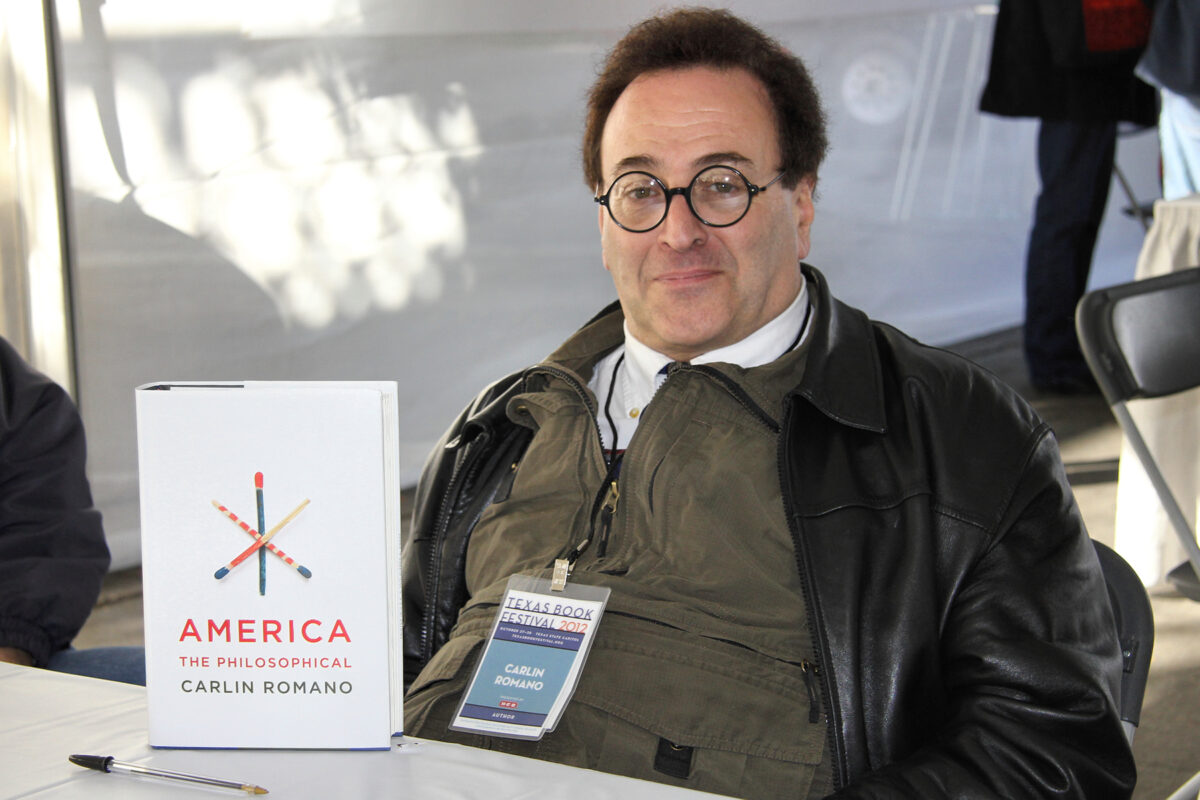
On June 11, 2020, Hope Wabuke — a distinguished Ugandan American poet who was on the National Book Critics Circle board — published screenshots from a disturbing internal conversation that involved how the NBCC would respond to Black Lives Matter. At issue here was how a seemingly august body of professional book critics would answer to recent events. One board member — a man by the name of Carlin Romano, who once opened a review expressing his fantasy of raping a woman author — was determined to “speak up” and claimed that he wasn’t the only board member who felt that racism and police brutality didn’t particularly concern him.
Romano took umbrage with the idea that white gatekeeping “stifles black voices at every level of our industry,” declaring this to be “absolute nonsense.” Never mind that The New York Times recently reported that the esteemed author Jesmyn Ward had to fight for a six-figure advance even after winning a National Book Award. Never mind Malorie Blackman sharing details about how a publisher had rejected a novel because a story featuring two black magical siblings wasn’t “believable.” (Meanwhile, Knopf publishes white author John Stephens’s The Emerald Atlas, which features three white siblings engaging in magic, to say nothing of the family-oriented magic contained in white author Alice Hoffman’s Practical Magic books.) Never mind that Dorothy Koomson tweeted on June 2, 2020 that her books were rejected because they “weren’t about ‘the black experience'” and how she was asked to make characters racist. No, as far as Romano was concerned, the struggles that African-American writers face to tell their stories was “ridiculous,” despite numerous examples.
Romano got even uglier, claiming that black writers would “never have been published if not for ecumenical, good-willed white editors and publishers who fought for the publication of black writers.” Amber Books? Black Classics Press? Third World Press? Triple Crown Publications? Life Changing Books? Any of the far too few African-American publishers who have stepped up to redress the systemic racism that the largely white-owned publishing industry has failed to remedy? That Romano applies “ecumenical” to his atavistic statement says much about his condescending views of writers of color. Apparently, in his view, any publisher who puts out a worthy novel that happens to be written by an African-American is an act of charity rather than an act of merit. James Baldwin? Toni Morrison? Octavia Butler? Ta-Nehisi Coates? Well, you’re lucky that your ass got through the door because Whitey decided to let one or two of you through the gates. Does Romano’s repugnantly racist sentiment here not reinforce the problems of white gatekeeping and not buttress the need for any and all literary organizations to be more inclusive? As far as Romano was concerned, the fact that countless people of color had to fight to be published — despite the fact that African-American novels have continued to be financially successful (Samuel R. Delany’s Dhalgren sold one million copies, Alice Walker’s The Color Purple sold five million copies, even Ann Petry’s The Street selling one million copies in 1946, the list goes on) — did not get in the way of his sentiment that black people needed to be fawning and grateful, much in the manner of slaves, to white publishers. Romano doubled down on this racism by writing, “In my 40 years in literary and publishing life, I’ve seen far more of [sic] white people helping black writers than of people black people helping white writers.” In other words, Romano believes that black people should devote their already disadvantaged positions to spending all their time promoting white writers.
In short, Romano articulated in very clear terms just what he wants the system to be. And his deplorable viewpoint here is no different from an antebellum slaveholder. Romano’s despicable vision is this: White editors serving as gatekeepers. Black authors dancing with joy at the honor of having their neutered visions “represented.” Romano’s statement is, in short, a racist screed against literary merit and inclusiveness. That Romano cannot acknowledge any white bias that has prevented great literature from being published, even as he demands that African-American writers jump up and down over concessions that their white counterparts would never have to face, is nothing less than a pompous white xenophobe revealing his true colors.
But Romano didn’t stop at mere racism. It is a common truth that atavistic barnacles like Romano often feel the need to tout their own superiority, irrespective of its shaky foundations. In perhaps the most risible part of his vulgar message, Romano claimed, “I myself have probably written more articles and reviews about Philadelphia’s black literature and traditions in my 25 years at the Inquirer than anyone living, black or white.” Do you hear that, Black Writers Museum? Do you hear that, African American Children’s Fair? Do you hear that, Hakim’s (the oldest Philly black bookstore, since 1959)? Even though all of you have done far more for black Philadelphia than Romano, Romano wants you to bow down at his professed magnanimity! It’s Romano who’s doing the heavy lifting here, not you!
One would think that the NBCC Board of Directors would instantly denounce such atavistic viewpoints. But President Laurie Hertzel, a white woman who would appear to be the NBCC’s answer to Amy Cooper, was nothing less than fulsome about these backwards views. She claimed, “Your objections are all valid, of course.” She also claimed that Romano’s views “shine unlike anyone else’s.”
I emailed Hertzel about her unquestioning support of Romano’s racism. She replied, “Rest assured that I do not and have not endorsed anyone’s racist comments.”
In other words, Hertzel and nearly the entire NBCC board are not so much interested in looking inward as they are gaslighting the narrative entirely. Nor can the NBCC actually name and hold Romano accountable — as was seen in this self-serving and half-hearted announcement posted on Thursday night.
I attempted to contact many of the NBCC Board of Directors — in large part because the only board members to acknowledge the exchange and take something of a stand against this racism were Carolyn Kellogg and Richard Z. Santos.
The NBCC Board has a duty to denounce Romano’s racist remarks. With their silence, one can only conclude that the following National Book Critics Circle board members are more than happy to uphold systemic racism. Systemic racism butters their bread. It ensures that they can continue to get gigs. That these people fail to call out racism and that refuse to do so even as Party City has done a better job firing racists speaks to their willful and open advocacy of white supremacy in the National Book Critics Circle.
Here is a list of the NBCC Board Members who presently advocate racism and white supremacy with their silence:
Laurie Hertzel, NBCC President
Kerri Arsenault, VP Awards
Jane Ciabattari, VP Events
Connie Ogle, VP Communications
Carlin Romano, VP Grants
Michael Schaub, VP Online
David Varno, VP Tech
Marion Winik, VP Treasurer
Jacob Appel
Colette Bancroft, The Tampa Bay Times
Gregg Barrios
Lori Feathers
Charles Finch
Megan Labrise
Jessica Loudis
John McWhorter
Katherine A. Powers
Madeline Schwartz
Elizabeth Taylor
Should any of the above individuals make a public statement against Carlin Romano and the NBCC’s systemic racism, I will remove them from the list. But I doubt that any of them will.
[6/12/2020 10:15 PM UPDATE:The NBCC Board page has dropped the following names: Laurie Hertzel, Connie Ogle, John McWhorter, and Katherine A. Powers. Presumably, these are the other four Board members who have resigned. Hertzel has also deleted her Twitter account.]
[6/15/2020 12:00 PM UPDATE: This morning, Carolyn Kellogg announced on Twitter that she had resigned from the Board. She cited “microaggressions and delays” in advance of drafting the Black Lives Matter statement. She also noted that the Board, instead of focusing on Romano’s racist sentiments, “focused on Hope’s breach of confidentiality in sharing a damning account of a poetry prize discussion.” Additionally, Kellogg noted that Hertzel called for the board to be dissolved following Wabuke’s leak. Following this call to dissolve the board (and efforts on other members’ part to facilitate discussion), Hertzel and two other members resigned in protest — not because of Wabuke’s concerns about racism, but because of the breach in confidentiality. Three more people — including Kellogg — have now resigned, including David Varno.
The instigator for this imbroglio was Romano. Romano has threatened to sue the NBCC and, according to Kellogg, even “shouted down a new board member on a Zoom call.”
Romano remains on the Board because the current NBCC bylaws, which can be found at this link, prevent the board from removing a member. The only way to do so is through a special meeting, which the bylaws declare can be called upon at the request of the president (for which the NBCC does not presently have one), any vice president (who would presently include Kerri Arsenault, Jane Ciabattari, Carlin Romano, Richard Z. Santos, Michael Schaub, and Marion Winik), or any five directors. As of early Monday afternoon, there has been no movement to call a special meeting. (UPDATE: Santos also noted that genera members can also call for a Board Member’s removal.)
As such, until there is a special meeting, Romano will remain on the board until 2022.
Kellogg concluded her message by stating, “I want to go on to point out that as the sole Black woman on the board, Hope should have been given extra support and liberty in leading our effort to craft an anti-racism statement. She was not.”
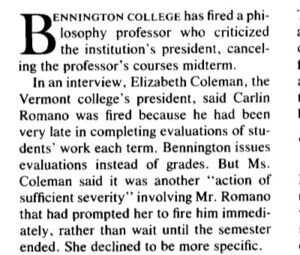
Further investigations into Romano have revealed a troubled history of abusive behavior. According to Ellen Akins, a friend of Hertzel’s, Romano went out of his way to target Hertzel, who is not a confrontational person. According to The Chronicle of Higher Education, in 2000, Romano was fired from his professorship at Bennington due to an “action of sufficient severity” directed at the president, Elizabeth Coleman. An insider at Ursinus College has also reported that there are numerous stories about Romano’s misconduct there.
Should anyone wish to share any stories about further Romano incidents, feel free to email me at ed@edrants.com and I will offer an update. Unless you specifically give me your consent, any and all communications with me will be kept in confidence.]
[6/15/2020 12:45 UPDATE: Ismail Muhammad, one of the board members who was actively working for diversity within the NBCC, announced his resignation from the board shortly after Kellogg’s announcement. He offered further details about what happened: “We were on the verge of winning a vote to release that statement by a solid majority, when Carlin Romano, at the last minute, derailed the process.”]
[6/15/2020 1:30 PM UPDATE:In an article filed by PW‘s John Maher, some new information has come to light. Anonymous board members noted that of the five members who resigned from the board (Hertzel, Victoria Chang, John McWhorter, Connie Ogle, and Katherine A. Powers), only one did so in support of Wabuke. The remaining four did so because of the breach in confidentiality. We know that this was Hertzel’s reason. So that leaves three inside Chang, McWhorter, Ogle, and Powers who resigned in opposition to Wabuke.
Amazingly, Romano himself is quoted in the article. In relation to the lawsuit threat, Romano said that he “alerted the Board I might sue it if I’m voted off the Board in violation of our bylaws and commitment to free discussion.” He denied shouting down the new board member, merely claiming, “We talked over each other at one point.”
Despite the racist tenor of Romano’s email, Romano claimed, “I’m not racist and I’m not anti-black. Quite the contrary. I just don’t check my mind at the door when people used to operating in echo chambers make false claims. A few Board members in recent years have sought to turn the Board, for decades committed to fair-minded judging of books from every political stripe, into a ‘No Free Thought’ zone, an ideologically biased tool for their own politics. In my opinion, they oppose true critical discussion. Good riddance to any of them who resign—the NBCC will be healthier without them. I’ll attempt to stay on the Board, despite concerted opposition, in the hope that I can help NBCC return to its earlier, better self.”]
[6/18/2020 UPDATE: Michael Riley, President and Editor-in-Chief of The Chronicle of Higher Education, was good enough to confirm with me that Romano is not involved with his august publication: “Carlin Romano has not written for The Chronicle of Higher Education since 2018, and, while he was a critic-at-large for The Chronicle a long time ago, he has not been in that role for many years. He holds no official title or standing with The Chronicle.”]
Now that Andrew Yang has dropped out of the presidential race, I’m forced to conclude that he was an underrated candidate who was very good for the Democrats.
On Tuesday, Andrew Yang dropped out of the 2020 presidential race. He was only able to crack 2.8% of the vote during the New Hampshire primary and a mere 1% of the Iowa Caucus votes. But Yang’s presence represented an outlier sincerity that was sui generis, a welcome reminder that the Democratic frontrunner this year can possess a genuine empathy for the American people that can be worn on one’s sleeve without apology. Yang filled the void left by Beto O’Rourke’s exit with his off-kilter sincerity. He was an inspiring force for the “Yang Gang,” a group of supporters who were just as passionate as “Bernie bros” and justifiably excited to see an Asian American represented in a vital election race. He was the lone non-white regular on the debate stage after Kamala Harris, Julian Castro, and Cory Booker dropped out of the race. And after Bong Joon-ho swept the Oscars on Sunday with Parasite, it seems a great letdown to take in the dawning reality that Yang won’t be participating in future debates. In an age in which Jack Dorsey and his crew of idiots upholds racism and hateful xenophobia on Twitter through ineffectual algorithms incapable of parsing nuance and intent, we truly needed more voices like Andrew Yang to set the record straight on a very real disease that ails us.
Yes, Yang, with his lack of necktie and his MATH pin always clipped to his lapel, was socially awkward at times. During the third democratic debate, when Yang introduced a raffle where ten families would receive a “freedom dividend” of $1,000 each month for a year (he later expanded this to thirteen families), he was received with bafflement and modest ridicule. But this seems to me unfair. Unlike other millionaires who entered the race for ignoble and narcissistic reasons (**clearing throat** Bloomberg **spastic and theatrical coughing**), Yang really wanted to solve our national ills with wildly original ideas. He believed that he could cure systemic racism with his universal basic income concept, providing purchasing power to minorities. While this was a batty idea and while his tax policy was more concerned with implementing a value-added tax rather than addressing income inequality, there was nevertheless something appealingly immediate about his position. Was it really any less crazy than finding the essential money for Medicare for All or Elizabeth Warren’s plan to forgive $1.6 trillion of student debt? Yang smartly recognized that one of our long-standing national ills requires a swift remedy and that mere lip service — the empty and cluelessly myopic white privilege that one sees prominently with Pete Buttigieg — won’t cut it.
Yang also had a refreshing sense of humor about his campaign. He sang “Don’t You Forget About Me” at a campaign rally. He crowd surfed at another rally. He even skateboarded before an appearance. Andrew Yang brought an instinctive sense of fun that seemed beyond most of the other candidates, but his heart seemed to be in the right place. He never came across as wingnut as Marianne Williamson or as stiff as Tom Steyer or as cavalierly hostile to voters on the fence as Joe Biden. Even if you couldn’t see him as President, it was almost impossible not to like the guy.
Yang’s willingness to commit to positions of empathy and understanding in provocatively inclusive ways was one of his great strengths. Last September, when comedian Shane Gillis was hired by Saturday Night Live as a regular and fired after repugnantly racist remarks about Chinese Americans were discovered on YouTube, it was Yang who called for a dialogue and a second chance for Gillis. Yang remarked, “I thought that if I could set an example that we could forgive people, particularly in an instance where, in my mind, it was in comedic context or gray area, that I thought it would be positive.”
Yang didn’t really have the opportunity to display the full range of these subtleties. But we did get one moment during his final debate when he calmly responded to Buttigieg shallowly grandstanding about the collective exhaustion of people outside Washington: “Pete, fundamentally, you are missing the question of Donald Trump’s victory. Donald Trump is not the cause of all of our problems. And we’re making a mistake when we act like he is. He is the symptom of a disease that has been building up in our communities for years and decades. And it is our job to get to the harder work of curing the disease. Most Americans feel like the political parties have been playing ‘You lose, I lose, You lose, I lose’ for years. And do you know who’s been losing this entire time? We have. Our communities have. Our communities’ way of life has been disintegrating beneath our feet.”
While there’s certainly a very strong argument that present frontrunner Bernie Sanders has united variegated people by highlighting their stories, Yang had a way, unlike the other candidates, of going directly to the underlying heart of aggravated Americans in the heartland who altered their votes in the 2016 election after being fed up after years of condescending vacuity. It is them who the Democratic candidate must speak to. Yang’s inclusive approach to empathy seems well beyond Buttigieg’s platitudes, but it appears to be increasingly adopted by Amy Klobuchar (which partially accounts for her third place win in New Hampshire).
Andrew Yang opened up a promising road for people of color to speak to voters who are still knowingly or unknowingly practicing systemic racism. And for this not insignificant contribution, he’ll have a place in my heart. America may not have been ready in 2020 for Yang’s approach to empathy, forgiveness, understanding, and inclusiveness. But this nation will almost certainly be prepared for this in future presidential elections. It will take some time, but I think history will see that Yang was ahead of the curve.


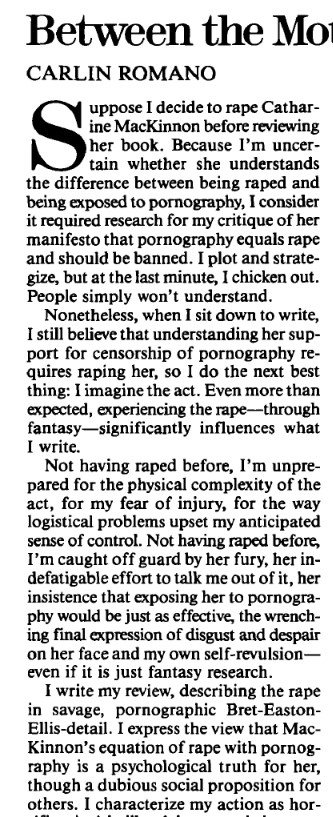 Romano took umbrage with the idea that white gatekeeping “stifles black voices at every level of our industry,” declaring this to be “absolute nonsense.” Never mind that
 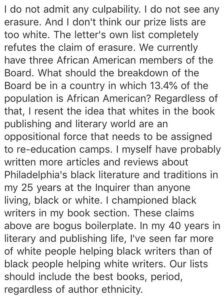 Romano got even uglier, claiming that black writers would “never have been published if not for ecumenical, good-willed white editors and publishers who fought for the publication of black writers.” Amber Books? Black Classics Press? Third World Press? Triple Crown Publications? Life Changing Books? Any of the far too few African-American publishers who have stepped up to redress the systemic racism that the largely white-owned publishing industry has failed to remedy? That Romano applies “ecumenical” to his atavistic statement says much about his condescending views of writers of color. Apparently, in his view, any publisher who puts out a worthy novel that happens to be written by an African-American is an act of charity rather than an act of merit. James Baldwin? Toni Morrison? Octavia Butler? Ta-Nehisi Coates? Well, you’re lucky that your ass got through the door because Whitey decided to let one or two of you through the gates. Does Romano’s repugnantly racist sentiment here not reinforce the problems of white gatekeeping and not buttress the need for any and all literary organizations to be more inclusive? As far as Romano was concerned, the fact that countless people of color had to fight to be published — despite the fact that African-American novels have continued to be financially successful (Samuel R. Delany’s Dhalgren sold one million copies, Alice Walker’s The Color Purple sold five million copies, even Ann Petry’s The Street selling one million copies in 1946, the list goes on) — did not get in the way of his sentiment that black people needed to be fawning and grateful, much in the manner of slaves, to white publishers. Romano doubled down on this racism by writing, “In my 40 years in literary and publishing life, I’ve seen far more of [sic] white people helping black writers than of people black people helping white writers.” In other words, Romano believes that black people should devote their already disadvantaged positions to spending all their time promoting white writers.
 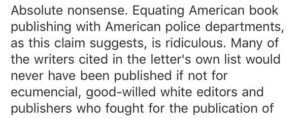 In short, Romano articulated in very clear terms just what he wants the system to be. And his deplorable viewpoint here is no different from an antebellum slaveholder. Romano’s despicable vision is this: White editors serving as gatekeepers. Black authors dancing with joy at the honor of having their neutered visions “represented.” Romano’s statement is, in short, a racist screed against literary merit and inclusiveness. That Romano cannot acknowledge any white bias that has prevented great literature from being published, even as he demands that African-American writers jump up and down over concessions that their white counterparts would never have to face, is nothing less than a pompous white xenophobe revealing his true colors.