Twitter has banned me for speaking out against a conservative racist. This sends a clear message that Jack Dorsey is in the business of upholding fascism and promoting hate and racism.
This morning, I learned that my Twitter account was permanently suspended and that I was banned from the social media platform because I had the temerity to express anger and outrage towards a racist.
A man with a blue checkmark by the name of Jon Miller, a conservative “White House correspondent for BlazeTV,” tweeted an insulting, cruelly disparaging, and racist message mocking the great filmmaker Bong Joon-ho after he delivered one of his Oscar speeches in Korean. Miller’s disturbingly xenophobic words, which are still published on Twitter as of Monday morning, proceeded to claim that “these people are the destruction of America.” This is language that echoes anti-Semitism in 1930s Germany and any number of hate groups singled out by the Southern Poverty Law Center. Words that need to be strongly protested. Even conservative Piers Morgan protested it. Miller’s tweet was rightly ratioed, but thousands of people still retweeted and favorited this vile expression. Miller, in other words, willfully promulgated hate.
As someone who is a big proponent of democracy and multiculturalism and as someone who has a number of Korean friends, some who greatly helped me during a time of crisis in my life, it was my moral duty as a citizen to lodge my protest against this in the strongest possible terms. Bong Joon-ho’s Oscar win for Parasite is not only a historical and artistic triumph. It also rightly sends a message to Korean Americans that their dreams are possible. By any objective standard, this is a good thing and a beautiful advancement of humanity. For someone to shit on this — as Miller did — is to besmirch the very purpose of why and how we evolve as a species.
So I got angry on Twitter. One cannot stay silent when anyone is demeaned and stripped of his dignity like this. But as far as Twitter is concerned, calling someone “a xenophobic, anti-tolerance, anti-art fuckface” — as I did — for expressing such hateful language is “abuse and harassment.” Moreover, there is no appeal for Twitter’s decision. The appeal link that I received by email did not work.
On Twitter, I also challenged Miller to a ten round boxing match to see if he wanted to settle this matter like a man. I did this for a number of reasons. First, I’ve been on a fitness kick and it seemed like a playful way of opposing a racist. Second, my challenge offered a corporeal method of resolving a national cancer that needs to see more resolution in the real world. Racism has long been buried underneath the surface of this nation. And if Miller wants to claim that an entire race is “destroying America,” then let us see if he has the stones to say this in public and in the ring. If Miller still wants to take me up on my challenge, then I will be more than happy to sign up for boxing lessons immediately and get in the best shape of my life. That’s how much I care about fighting racism and intolerance. I’m willing to put my body on the line. It is my position that, when you are confronted with racism, you must not stay silent about it and you have an obligation to fight it.
My playful boxing challenge also falls into a great tradition of writers boxing other writers — seen with Craig Davidson challenging Jonathan Ames to a boxing match, a match, incidentally, that I happened to announce. I’m sure that this probably factored into Twitter’s decision. Still, challenging someone to a boxing match does not involve “wishing or hoping that someone experiences physical pain” — the codex behind Twitter’s rules. The decision to engage in a fight is on Miller. I have challenged him. He is free to take me up on the challenge. I’m willing to put myself on the line and in the ring, but my ultimate wish or hope would be to see Miller acknowledging and confronting and sincerely apologizing for his flagrant racism and unacceptable xenophobia. That’s the goal here. Since Miller proved intransigent on Twitter, I was forced to take him up with my boxing challenge. Even if Miller decides not to box me, then the point has been made. Unable to walk back his hateful remarks, he is revealed for the coward that he is.
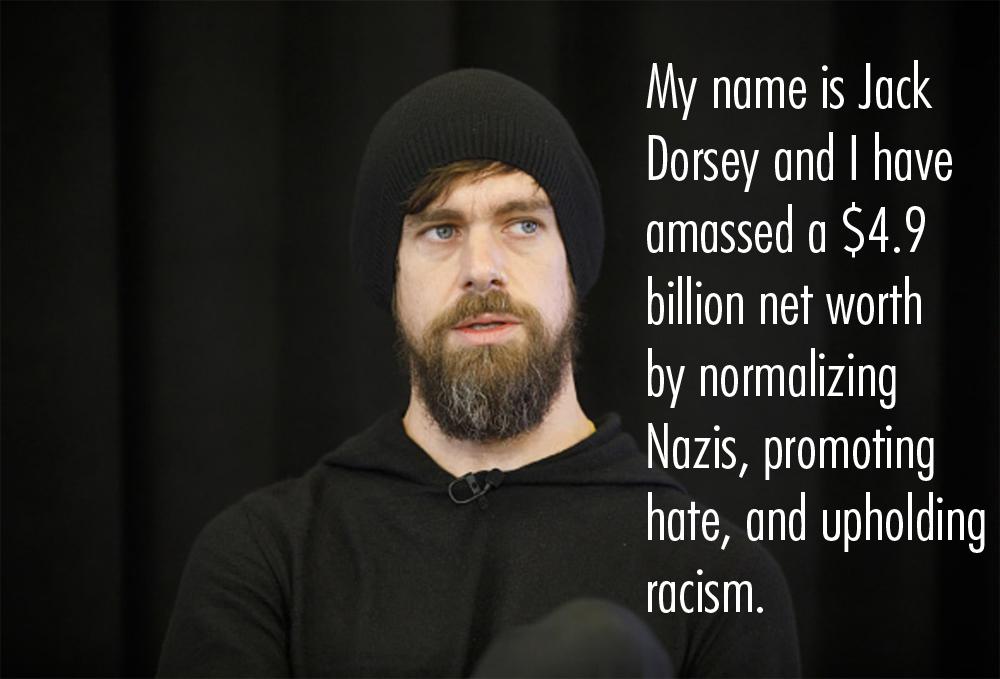
What all this does tell us is that Twitter is firmly on the side of the fascists and the racists and the doxxers and the misogynists and the Nazis and the authoritarians. Jack Dorsey’s business model is to promote hate and to block anyone who pushes strongly against it. Because hate and sustaining the status quo of hate and racism is very good for Dorsey’s business model. It’s lining his pockets right now. My words to Miller were no different than the words that got the great David Simon (temporarily) banned in 2018. As Simon put it in a blog post shortly after his suspension:
The correct response to racism, to white supremacy, to anti-Semitism, to slander and libel is to:
1. Tell the fucker he’s a piece of shit and should die of throat clap.
2. Block him. And in doing 1. and 2. you have marked the spot for the sane and sentient on Twitter, much as any good infantryman who wanders into a minefield marks the Claymores for the rest of the platoon. It’s just good soldiering, Jack.
My Twitter ban may very well be a blessing in disguise and should give me more time to practice my guitar and the new set of harmonicas I just purchased. But it is still part of a national disease that is silencing and squelching voices who speak out against hate, racism, and fascism. A few friends texted me this morning about what happened and claimed my ban to be “a badge of honor.” But I don’t see this as honorable at all. I see this as a deep stain against social justice and a blow against fighting for what’s objectively right. I see this as Jack Dorsey willfully prioritizing hate before justice and profit before human decency. But then we all know that Jack Dorsey has no soul. We know that this shallow profiteer met with Trump last year. If he possessed any qualities of actual decency and if he was truly invested in true discourse, then he would understand precisely what’s at stake here. If we cannot speak out against racism and human indignity, then how will we be able to speak out against any other significant human ills that crop up in the next few years? Especially if Trump manages to win a second presidential term and the Senate remains under control by the Republicans. You don’t win battles by keeping silent or by staying neutral against a gleeful hate merchant like Jon Miller. You call them out for the repugnant atavists and venal promoters of bigotry and intolerance that they are. You challenge them to boxing matches if you have to.
UPDATE: This morning, Jon Miller celebrated the fact that Twitter ruled his racist tweet as something that did “not identify any violations of the Twitter Rules.” Twitter, in other words, is clearly in the practice of upholding racism.
Martin Luther King’s deeply inspiring book provides as much hope in combating social ills in 2019 as it did when it was published in 1964. It reminds us of the beauty of nonviolent direct action, as well as our essential duty to stand up for moral justice and to not accept compromise or delay in fighting for what’s right.
It was a warm day in April when Dr. Martin Luther King was arrested. It was the thirteenth and the most important arrest of his life. King, wearing denim work pants and a gray fatigue shirt, was manacled along with fifty others that afternoon, joining close to a thousand more who had bravely submitted their bodies over many weeks to make a vital point about racial inequality and the unquestionable inhumanity of segregation.
The brave people of Birmingham had tried so many times before. They had attempted peaceful negotiation with a city that had closed sixty public parks rather than uphold the federal desegregation law. They had talked with businesses that had debased black people by denying them restaurant service and asking them to walk through doors labeled COLORED. Some of these atavistic signs had been removed, only for the placards to be returned to the windows once the businesses believed that their hollow gestures had been fulfilled. And so it became necessary to push harder — peacefully, but harder. The Birmingham police unleashed attack dogs on children and doused peaceful protesters with high-pressure water hoses and seemed hell-bent on debasing and arresting the growing throngs who stood up and said, without raising a fist and always believing in hope and often singing songs, “Enough. No more.”
There were many local leaders who claimed that they stood for the righteous, but who turned against King. White leaders in Birmingham believed — not unlike pro-segregation Governor George Wallace just three months earlier — that King’s nonviolent protests against segregation would incite a torrent of violence. But the violence never came from King’s well-trained camp and had actually emerged from the savage police force upholding an unjust law. King had been very careful with his activists, asking them to sign a ten-point Commitment Card that included these two vital points:
6. OBSERVE with both friend and foe the ordinary rules of courtesy.
8. REFRAIN from the violence of fist, tongue, or heart.
Two days before King’s arrest, Bull Connor, the racist Birmingham Commissioner of Public Safety and a man so vile and heartless that he’d once egged on Klansmen to beat Freedom Riders to a pulp for fifteen minutes as the police stood adjacent and did not intervene, had issued an injunction against the protests. He raised the bail bond from $200 to $1,500 for those who were arrested. (That’s $10,000 in 2019 dollars. When you consider the lower pay and the denied economic opportunities for Birmingham blacks, you can very well imagine what a cruel and needless punishment this was for many protesters who lived paycheck to paycheck.)
And so on Good Friday, it became necessary for King, along with his invaluable fellow leaders Ralph Abernathy and Fred Shuttlesworth, to walk directly to Birmingham Jail and sing “We Shall Overcome.” King took a very big risk in doing so. But he needed to set an example for civil disobedience. He needed to show that he was not immune to the sacrifices of this very important fight. The bondsman who provided the bail for the demonstrators told King that he was out as King pondered the nearly diminished funds for the campaign. In jail, King would not be able to use his contacts and raise the money that would keep his campaign going. Despite all this, and this is probably one of the key takeaways from this remarkable episode in political history, King was dedicated to practicing what he preached. As he put it:
How could my failure now to submit to arrest be explained to the local community? What would be the verdict of the country about a man who had encouraged hundreds of people to make a stunning and then excused himself?
Many who watched this noble march, the details of which are documented in S. Jonathan Bass’s excellent book Blessed Are the Peacemakers, dressed in their Sunday best out of respect for King’s efforts. Police crept along with the marchers before Connor gave the final order. Shuttlesworth had left earlier. King, Abernathy, and their fellow protestors were soon surrounded by paddy wagons and motorcycles and a three-wheel motorcart. They dropped to their knees in peaceful prayer. The head of the patrol squeezed the back of King’s belt and escorted him into a police car. The police gripped the back of Abernathy’s shirt and steered him into a van.
King was placed in an isolation cell. Thankfully, he did not suffer physical brutality, but the atmosphere was dank enough to diminish a weaker man’s hope. As he wrote, “You will never know the meaning of utter darkness until you have lain in such a dungeon, knowing that sunlight is streaming overhead and still seeing only darkness below.” Jail officials refused a private meeting between King and his attorney. Wyatt Tee Walker, King’s chief of staff, sent a telegram to President Kennedy. The police did not permit King to speak to anyone for at least twenty-four hours.
As his confidantes gradually gained permission to speak to King, King became aware of a statement published by eight white clergy members in Birmingham — available here. This octet not only urged the black community to withdraw support for these demonstrations, but risibly suggested that King’s campaign was “unwise and untimely” and could be settled by the courts. They completely missed the point of what King was determined to accomplish.
King began drafting a response, scribbling around the margins of a newspaper. Abernathy asked King if the police had given him anything to write on. “No,” King replied, “I’m using toilet paper.” Within a week, he had paper and a notepad. King’s “Letter from Birmingham Jail,” contained in his incredibly inspiring book Why We Can’t Wait, is one of the most powerful statements ever written about civil rights. It nimbly argues for the need to take direct action rather than wait for injustice to be rectified. It remains an essential text for anyone who professes to champion humanity and dignity.
* * *
King’s “Letter” against the eight clergymen could just as easily apply to many “well-meaning” liberals today. He expertly fillets the white clergy for their lack of concern, pointing out that “the superficial kind of social analysis that deal with effects and does not grapple with underlying causes.” He points out that direct action is, in and of itself, a form of negotiation. The only way that an issue becomes lodged in the national conversation is when it becomes dramatized. King advocates a “constructive, nonviolent tension that is necessary for growth” — something that seems increasingly difficult for people on social media to understand as they block viewpoints that they vaguely disagree with and cower behind filter bubbles. He is also adamantly, and rightly, committed to not allowing anyone’s timetable to get in the way of fighting a national cancer that had then ignobly endured for 340 years. He distinguishes between the just and the unjust law, pointing out that “one has a moral responsibility to disobey unjust laws.” But he is very careful and very clear about his definitions:
An unjust law is a code that a numerical or power majority group compels a minority group to obey but does not make binding on itself. This is difference made legal. By the same token, a just law is a code that a majority compels a minority to follow and that it is willing to follow itself. This is sameness made legal.
This is a cogent philosophy applicable to many ills beyond racism. This is radicalism in all of its beauty. This is precisely what made Martin Luther King one of the greatest Americans who ever lived. For me, Martin Luther King remains a true hero, a model for justice, humility, peace, moral responsibility, organizational acumen, progress, and doing what’s right. But it also made King dangerous enough for James Earl Ray, a staunch Wallace supporter, to assassinate him on April 4, 1968. (Incidentally, King’s family have supported Ray’s efforts to prove his innocence.)
* * *
Why We Can’t Wait‘s scope isn’t just limited to Birmingham. The book doesn’t hesitate to cover a vast historical trajectory that somehow stumps for action in 1963 and in 2019. It reminds us that much of what King was fighting for must remain at the forefront of today’s progressive politics, but also must involve a government that acts on behalf of the people: “There is a right and a wrong side in this conflict and the government does not belong the middle.” Unfortunately, the government has doggedly sided against human rights and against the majestic democracy of voting. While Jim Crow has thankfully been abolished, the recent battle to restore the Voting Rights Act of 1965, gutted by the Supreme Court in 2013, shows that systemic racism remains very much alive and that the courts for which the eight white Birmingham clergy professed such faith and fealty are stacked against African-Americans. (A 2018 Harvard study discovered that counties freed from federal oversight saw a dramatic drop in minority voter turnout.)
Much as the end of physical slavery inspired racists to conjure up segregation as a new method of diminishing African-Americans, so too do we see such cavalier and dehumanizing “innovations” in present day racism. Police shootings and hate crimes are all driven by the same repugnant violence that King devoted his life to defeating.
The economic parallels between 1963 and 2019 are also distressingly acute. In Why We Can’t Wait, King noted that there were “two and one-half times as many jobless Negros as whites in 1963, and their median income was half that of the white man.” Fifty-six years later, the Bureau of Labor Statistics informs us that African Americans are nearly twice as unemployed as whites in a flush economic time with a low unemployment rate, with the U.S. Census Bureau reporting that the median household income for African-Americans in 2017 was $40,258 compared to $68,145 for whites. In other words, a black family now only makes 59% of the median income earned by a white family.
If these statistics are supposed to represent “progress,” then it’s clear that we’re still making the mistake of waiting. These are appalling and unacceptable baby steps towards the very necessary racial equality that King called for. White Americans continue to ignore these statistics and the putatively liberal politicians who profess to stand for fairness continue to demonstrate how tone-deaf they are to feral wrongs that affect real lives. As Ashley Williams learned in February 2016, white Democrats continue to dismiss anyone who challenges them on their disgraceful legacy of incarcerating people of color. The protester is “rude,” “not appropriate,” or is, in a particularly loaded gerund, “trespassing.” “Maybe you can listen to what I have to say” was Hillary Clinton’s response to Williams, to which one rightfully replies in the name of moral justice, “Hillary, maybe you’re the one here who needs to listen.”
Even Kamala Harris, now running for President, has tried to paint herself as a “progressive prosecutor,” when her record reveals clear support for measures that actively harm the lives of black people. In 2015, Harris opposed a bill that demanded greater probing into police officer shootings. That same year, she refused to support body cams, only to volte-face with egregious opportunism just ten days before announcing her candidacy. In the case of George Gage, Harris held back key exculpatory evidence that might have freed a man who did not have criminal record. Gage was forced to represent himself in court and is now serving a 70-year sentence. In upholding these savage inequities, I don’t think it’s a stretch to out Kamala Harris as a disingenuous fraud. Like many Democrats who pay mere lip service to policies that uproot lives, she is not a true friend to African Americans, much less humanity. It was a hardly a surprise when Black Lives Matter’s Johnetta Elzie declared that she was “not excited” about Harris’s candidacy back in January. After rereading King and being reminded of the evils of casual complicity, I can honestly say that, as someone who lives in a neighborhood where the police dole out regular injustices to African-Americans, I’m not incredibly thrilled about Harris either.
But what we do have in this present age is the ability to mobilize and fight, to march in the streets until our nation’s gravest ills become ubiquitously publicized, something that can no longer be ignored. What we have today is the power to vote and to not settle for any candidate who refuses to heed the realities that are presently eating our nation away from the inside. If such efforts fail or the futility of protesting makes one despondent, one can still turn to King for inspiration. King sees the upside in a failure, galvanizing the reader without ever sounding like a Pollyanna. Pointing to the 1962 sit-ins in Albany, Georgia, King observes that, while restaurants remained segregated after months of protest, the activism did result in more African-Americans voting and Georgia at long last electing “the first governor [who] pledged to respect and enforce the law equally.”
It’s sometimes difficult to summon hope when the political clime presently seems so intransigent, but I was surprised to find myself incredibly optimistic and fired up after rereading Why We Can’t Wait for the first time in more than two decades. This remarkable book from a rightfully towering figure seems to have answered every argument that milquetoasts produce against radicalism. No, we can’t wait. We shouldn’t wait. We must act today.
How do you reckon with a writer who was simultaneously a virtuosic stylist and a repugnant human being? We try to answer this difficult question in the most equitable way we can in our next thrilling installment of the Modern Library Reading Challenge!
When I last dived into Evelyn Waugh’s exquisite comic fiction for this crazy project nearly six years ago, I wrote a sour essay in which I permitted my hostility towards Waugh’s pugnacious life and his reactionary politics to overshadow my appreciation for his art. Perhaps the way I read fiction has changed or the idea of completely discounting a writer’s achievements with the histrionic tone of an upbraiding Pollyanna who doesn’t possess a scintilla of self-awareness fills me with a dread I usually associate with wincing at a tax bill or standing in a needlessly long line for a pizza slice. Whatever the case, I allowed myself to zero in on Brideshead Revisited‘s weaker elements (namely, the deplorable gay stereotype Anthony Blanche) without possessing the decency to praise that novel’s excellent prose in any way. This was decidedly uncharitable of me. For Waugh was, for all of his faults, a master stylist. That I was also bold enough to rank Wodehouse over Waugh was likewise problematic (although I would still rather read Pip and I have never been able to get into the Sword of Honour trilogy and I still feel that Waugh was more or less finished as an author after The Loved One; incidentally, Waugh himself called Wodehouse “the Master”). At the time, the eminently reasonable Cynthia Haven offered what I now deem to be appropriate pushback, observing that I brought a lot of “post-modern baggage” into my reading. My “take” on that novel’s Catholic dialogue was, I now realize after diving into Waugh again, driven by a cocky yahooism that is perhaps better deployed while knocking back pints in a sports bar and claiming that you’re a big fan of the team everybody else is cheering for. Never mind that the names of the players are only lodged in your memory by the blinding Chryon reminders and the bellowing cries of histrionic announcers that work together to perfect a sense-deadening television experience.
Anyway, I’ll leave cloud cuckoos like Dave Eggers to remain dishonest and pretend they never despised great novels. I’d rather be candid about where I may have strayed in my literary judgement and how I have tried to reckon with it. In a literary climate of “No haters” (and thus no chances), we are apparently no longer allowed to (a) voice dissenting opinions or (b) take the time to reassess our youthful follies and better appreciate a novel that rubbed us the wrong way on the first read. Wrestling with fiction should involve expressing our hesitations and confessing our evolving sensibilities and perceiving what a problematic author did right. And so here we are. It has taken many months to get here, but it does take time to articulate a personal contradiction.
So here goes: As much as I appreciate Scoop‘s considerable merits (particularly the fine and often hilarious satire when the book takes place on Waugh’s home turf), I cannot find it within me to endorse this novel’s abysmally tone-deaf observations on a fictitious Abyssinia — here, Ishmaelia. There are unsophisticated thoughts cloaked beneath the light fluidity of Waugh’s exacting pen that many of his acolytes — including The Observer‘s Robert McCrum and NPR’s Alexander Nazaryan — refuse to acknowledge. There’s no other way to say this, but Waugh is more nimble with his gifts when he bakes his pies with an anglophonic upper crust. And that ugly truth should give any reader or admirer great pause. (Even Selina Hastings, one of his biographers, was forced to concede this. And McCrum, to his credit, does at least write that “Scoop derives less inspiration from Ethiopia,” although this is a bit like stating that Paul Manafort merely muttered a little white lie.) Waugh’s limitations in Scoop are not as scabrous as Black Mischief — a novel so packed with racism that it’s almost the literary equivalent to Louis C.K.’s recent attempts at a comeback. But his “insights” into Africa are still very bad, despite all the other rich wit contained within the book. Waugh cannot see anyone who does not share his lily-white complexion as human. His creatively bankrupt view of Africans as bloodthirsty cannibals or “crapulous black servants” or “a natty young Negro smoking from a long cigarette holder” carries over from Black Mischief. “A pious old darky named Mr. Samuel Smiles Jackson” is installed President. I was rankled by the constant cries of “Boy!” from the assorted journos, late risers who complain about not getting swift servitude with a smile. (“Six bloody black servants and no breakfast,” sneers the entitled Corker at one point.) Even the potentially interesting politics behind Ishmaelia’s upheaval are coarse and general, with the arrival of Dr. Benito at a press conference described in one paragraph with a contrast of “blacks” and “whites” that show the force and timing of a man determined to be vituperative, but without substantive subtlety. One of the book’s jokes involves a nonexistent city on the nation’s map identified as “Laku,” which is Ishmaelite for “I don’t know.” And while it does allow for a decent setup in which numerous journalists expend lavish resources to find Laku for their stories, I suspect that this is really Waugh confessing he doesn’t know and can’t know because he doesn’t want to.
Still, in approaching Scoop, I was determined to give this book more care than what I doled out to Brideshead. Not only did I spend a few months rereading all of Waugh’s novels up through Brideshead, finding them considerably richer than I did on my first two canon reads, but I also dived into the Selina Hastings and Martin Stannard biographies, along with numerous other texts pertaining to Scoop. And one cannot completely invalidate Waugh’s talent:
“Why, once Jakes went out to cover a revolution in one of the Balkan capitals. He overslept in a carriage, woke up at the wrong station, didn’t know any different, got out, went straight to a hotel, and cabled off a thousand-word story about barricades in the streets, flaming churches, machine guns answering the rattle of his typewriter as he wrote, a dead child, like a broken doll, spreadeagled in the deserted roadway below his window — you know. Well, they were pretty surprised at his office, getting a story like that from the wrong country, but they trusted Jakes and splashed it in six national newspapers. That day every special in Europe got orders to rush to the new revolution.”
So Scoop does deserve our attention in an age devoted to “alternative facts” and a vulgar leader who routinely squeezes savage whoppers through his soulless teeth. Waugh uses a familiar but extremely effective series of misunderstandings to kickstart his often razor-sharp sendup, whereby a hot writer by the name of John Courtney Boot is considered to be the ideal candidate to cover a war in Ishamelia for The Daily Beast (not to be confused with the present Daily Beast founded by Tina Brown, who took the name from Waugh — and, while we’re on the subject of contemporary parallels, Scoop also features a character by the name of Nannie Bloggs, quite fitting in an epoch populated with dozens of nanny blogs). John Boot is confused with William Boot, a bucolic man who writes a nature column known as Lush Places and believes himself to be in trouble with the top brass for substituting “beaver” with “great crested grebe” in a recent installment. He is sent to cover a war that nobody understands.
The novel is funny and thrilling in its first one hundred pages, with Waugh deftly balancing his keen eye for decor (he did study architecture) with these goofy mixups. Rather tellingly, however, Waugh does spend a lot of time with William Boot in transit to Ishamelia, almost as if Waugh is reluctant to get to the country and write about the adventure. And it is within the regions of East Africa that Waugh is on less firm footing, especially when he strays from the journalists. Stannard has helpfully observed that, of all Waugh’s pre-war novels, Scoop was the most heavily edited and that it was the “political” sections with which Waugh had “structural problems.” But Scoop‘s problems really amount to tonal ones. Where Erskine Caldwell’s Tobacco Road (ML #91) brilliantly holds up a mirror to expose the audience’s assumptions about people (with the novel’s Broadway adaptation inspiring a tremendously interesting Ralph Ellison essay called “An Extravagance of Laughter,” which many of today’s self-righteous vigilantes should read), Scoop seems more content to revel in its atavistic prejudices.
In 2003, Christopher Hitchens gently bemoaned the “rank crudity” of Waugh’s childish names for side characters. And I think he was right to pinpoint Waugh’s declining powers of invention. For all of Scoop‘s blazing panoramas and descriptive sheen (the prose committed to the Megalopilitan offices is brilliant), the ultimate weakness of the book is that Waugh seems incapable of imbuing Ishamelia with the same inventive life with which he devotes to England. When one looks at the travel writing that came before this, even the high points of Waugh in Abyssinia are the sections where he bitches about his boredom.
Waugh’s writing was often fueled by a vicious need for revenge and an inability to let things go. Take the case of Charles Crutwell, the Hertford dean who praised Waugh on his writing and awarded him an Oxford scholarship as a young man. Waugh proceeded to be incredibly lazy about his studies, deciding that he had earned this financial reward, that he no longer needed to exert himself in any way, and that he would spend his time boozing it up and getting tight with his mates. Crutwell told Waugh that he needed to take his research more seriously. He could have had Waugh expelled, but he didn’t. And for this, Crutwell became the target of Waugh’s savage barbs throughout much of his early writing and many of his novels. In Decline and Fall, you’ll find Toby Crutwell as an insane burglar turned MP. In Vile Bodies, a “Captain Crutwell” is the snobby member of the Committee of the Ladies’ Conservative Association at Chesham Bois. There’s a Crutwell in Black Mischief and A Handful of Dust. Waugh’s story “Mr. Loveday’s Little Outing” was originally titled “Mr. Crutwell’s Little Outing.” And in one of Scoop‘s supererogatory chapters, William Boot meets a General Crutwell who has had numerous landmarks named after him. Keep in mind that this is sixteen years after the events in Hertford. You want to take Waugh aside, buy him a beer, and say, “Bro, walk away.”
Now I have to confess that this type of brutal targeted satire was catnip for me at a certain impressionable age that lingered embarrassingly long into my late thirties. The very kind George Saunders tried to get me to understand this twelve years ago during an episode of my old literary podcast, The Bat Segundo Show, in which we were discussing the way Sacha Baron Cohen singled out people with total malice. Cohen’s recent television series Who is America certainly upheld Saunders’s point. Of course, I stubbornly pushed back. Because ridicule is a hell of a drug. Just ask anyone with a Twitter account. But I now understand, especially after contending with Waugh again, that effective satire needs to be more concerned with exposing and virulently denouncing those in actual power, railing against the tyrannical institutions that diminish individual lives, and, of course, exposing the follies of human behavior. Waugh does this to a large extent in Scoop and his observations about newspapermen running up large tabs on their expense accounts and manipulating the competition are both funny and beautiful, but he also appears to have been operating from an inferiority complex, an intense need for victory against his perceived oppressors and something that, truth be told, represents a minor but nevertheless troubling trait I recognize in myself and that has caused much of my own writing and communications with people to be vehemently misunderstood, if not outright distorted into libelous and untrue allegations. When your motivation to write involves the expression of childish snubs and pedantic rage without a corresponding set of virtues, it is, from my standpoint, failed satire. And I don’t know about you, but my feeling is that, if you’re still holding a grudge against someone after five or six years, then the issue is no longer about the person who wronged you, but about a petty and enduring narcissism on behalf of the grudgeholder. What precisely do these many Crutwells add to Waugh’s writing? Not much, to tell you the truth.
We do know that, when Waugh covered Abyssinia, he wrote in a letter to Penelope Betjeman, “I am a very bad journalist, well only a shit could be good on this particular job.” So perhaps there was a part of Waugh that needed to construct a biting novel from his own toxic combination of arrogance and self-loathing.
But Waugh’s biggest flaw as a writer, however great his talent, was his inability to summon empathy or a humanistic vision throughout his work, even if it is there in spurts in Brideshead and perhaps best realized in his finest novel, A Handful of Dust. When William Boot foot falls in love with Kätchen, a poorly realized character at best, Waugh has no interest in portraying Boot’s feelings as anything more than that of a dopey cipher who deserves our contempt: “For twenty-three years he had remained celibate and and heart-whole; landbound. Now for the first time he was far from sure, submerged among deep waters, below wind and tide, where huge trees raised their spongy flowers and monstrous things without fur or feather, wing or foot, passed silently in submarine twilight. A lush place.” It is one thing to present Boot clumsily setting up an unnecessary canoe or showing the way he gets hoodwinked over a heavy package of stones or not understanding basic journalism jargon and to let Boot’s bumbling behavior (or, for that matter, the apposite metaphor of a three-legged dog barking in a barrel just outside Kätchen’s home) speak for itself. It is quite another thing to stack the deck against your protagonist with a passage like this, however eloquently condemned. What Waugh had not learned from Wodehouse was that there was a way of both recognizing the ineptitude of a dunderhead while also humanizing his feelings. You can lay down as many barbs as you like in art, but, at a certain point, if you’re any good, the artistic expression itself has to evolve beyond mere virtuosic style. This, in my view, is the main reason why Waugh crumbled and why I think his standing should be reassessed. The vindictiveness in Black Mischief, however crucially transgressive at the time, still represented a failure of creative powers. All Waugh had left at the end was a bitter nostalgia for a lost Britannia and a fear of modernity, which amounted to little more than an old man pining for the good old days by the time Waugh got to his wildly overrated Sword of Honour trilogy (and by the time Louis C.K. returned on stage with his first full set littered with racism, transphobia, and scorn for the young generation). If Waugh had learned to see the marvel of a changing world and if he had embraced human progress rather than fleeing from it, he might have produced more substantive work. But, hey, here I am talking about the guy nearly a century later, largely because he’s on a list. Still, even today, young conservative men have adopted the tweedy analog look of a “better time.” So maybe the joke’s on me. Thankfully the next Waugh novel book I have to write about, A Handful of Dust (ML #34), is a legitimate masterpiece. So I will try to give Waugh a more generous hearing when we get there in a few years. For now, I’m trying to shake off his seductive spite as well as the few remaining dregs of my own.
The end of Roseanne proved that, for now at least, there are limits to American xenophobia expressed through mass entertainment. But the troubling question is whether this is the beginning or the end of network-sanctioned white supremacy.
Roseanne Barr is finished. And it’s about goddam time.
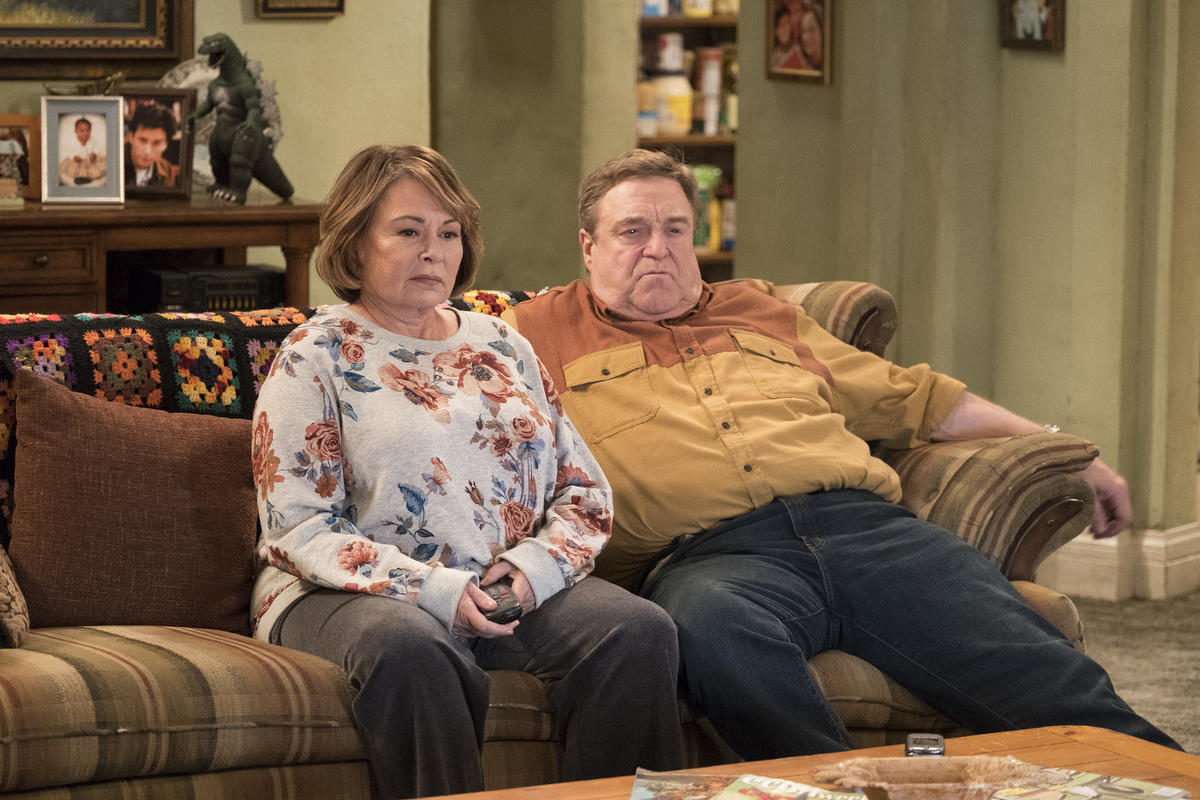
I watched the first few episodes of the Roseanne reboot with an open mind, but the show’s racism and intolerance, well on display within the show and bluntly expressed in Roseanne’s off-air demeanor, demonstrated very conclusively that this was not a contemporary answer to All in the Family, but something more akin to a sitcom version of Jean Raspail’s The Camp of the Saints. An early scene showing the Conners swapping an insufficient supply of medication due to inadequate American healthcare created the illusion that this was a show like its previous iteration, one aligned with the working class roots that had made the original such a success. But then we saw the Conners casually belittling “all the shows about black and Asian families” and it became very clear that this was a program committed to white supremacy. As The New Yorker‘s Emily Nussbaum pointed out, the show relied on coded language, unrealistic dialogue, and sideways jabs to disguise its bigotry-drenched narrative.
I was not the only viewer to flee. It took only weeks for the reboot to drop from 18.44 million viewers to a mere 10.42 million. This was the show that Trump had said “was about us,” but that “us” shed 44% of its purported unity within months. The cast and crew quickly became unsettled by the Faustian bargain they had bought into. Co-showrunner Whitney Cummings left. Then writer Wanda Sykes left. And as actress Emma Kenney was about to bolt, she was informed by her manager that the show was cancelled. The linchpin was a startlingly racist tweet in which Roseanne declared that former Obama aide Valerie Jarrett was the product of “Muslim brotherhood & planet of the apes [sic]” having a baby.
Barring a pickup from an online streaming giant — an unlikely event, given Amazon’s recent woes with Transparent and the Roy Price scandal, Netflix cutting ties with Louis CK, and Hulu likely not wanting to risk its progressive-minded programming slate given the success of The Handmaid’s Tale — there is little chance that Roseanne will return, unless she decides to produce it on her own dime. And even then, she would probably not have enough clout to convince all the cast members and crew to return. Such a hypothetical reboot, untethered from the manacles of network Standards and Practices, would only amp up the atavism further in the interest of “truth-telling,” perhaps inspiring the Southern Poverty Law Center to include Roseanne Barr amidst its distressingly voluminous list of offenders.
This was the first television show cancelled by a single tweet. And I don’t think it will be the last. What Roseanne’s self-immolation demonstrates, quite rightfully and righteously I think, is that America does have limits to what it will tolerate. There will undoubtedly be Daily Caller-reading banshees writing thinkpieces proclaiming this cancellation as a calumny upon the First Amendment. But the decision to write and produce a show, much less watch one, has not been quelled and the audience hungry for this casual xenophobia has regrettably not been deracinated. There are still ten million loyal Roseanne viewers. And I can easily imagine Roseanne being propped up as an underground comic, recast as an alt-right faux Lenny Bruce or perhaps the American answer to Dieudonné, and making a fortune through a monthly Patreon account.
In an age in which a self-help transphobic huckster like Jordan Peterson is framed by the “Paper of Record” as a “dark web intellectual,” Roseanne will probably not be the last repugnant show airing on American television. I fear that we are only at the beginning of hatred and intolerance marketed as “wholesome entertainment.” And while mainstream media rejects Roseanne, one must now be on the lookout for independently produced offerings cut from the same Klan cloth that are snatched up by television executives in the interest of corporate profit. This is, after all, how Roseanne was rebooted in the first place. The question now is who has the chutzpah to push the envelope further into a fetid swamp of ugliness and whether some network desperate for a hit is willing to pick up such a bilious offering, counting upon the American public to forget how these same gatekeepers helped make Roseanne happen in the first place.
On Thursday, November 10, 2016, I attended the protests that had unfolded across the street from Trump Tower after Donald Trump had been elected the 45th President of the United States. I talked with anti-Trump activists, people who voted for Gary Johnson, people who voted for Trump, and people who didn’t vote at all in an attempt to understand how these unfathomable election results happened. (Running time: 32 minutes, 9 seconds)
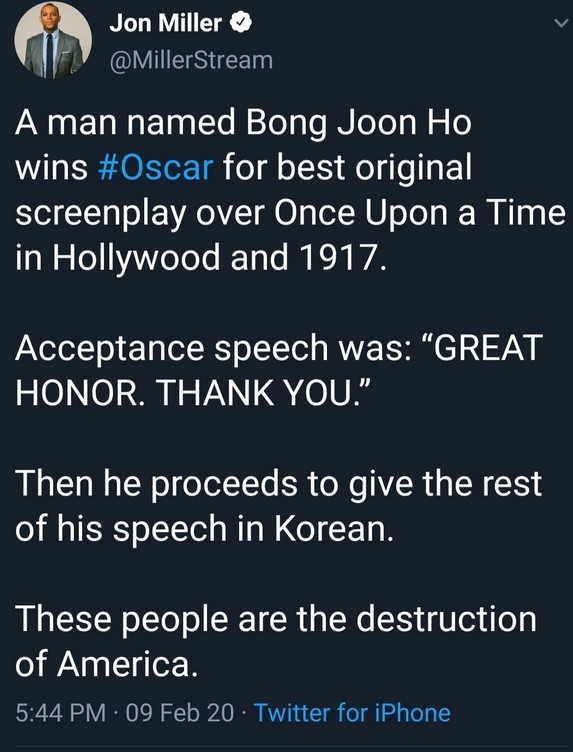 A man with a blue checkmark by the name of Jon Miller, a conservative “White House correspondent for BlazeTV,” tweeted an insulting, cruelly disparaging, and racist message mocking the great filmmaker Bong Joon-ho after he delivered one of his Oscar speeches in Korean. Miller’s disturbingly xenophobic words, which are still published on Twitter as of Monday morning, proceeded to claim that “these people are the destruction of America.” This is language that echoes anti-Semitism in 1930s Germany and any number of hate groups singled out by the Southern Poverty Law Center. Words that need to be strongly protested. Even conservative Piers Morgan protested it. Miller’s tweet was rightly ratioed, but thousands of people still retweeted and favorited this vile expression. Miller, in other words, willfully promulgated hate.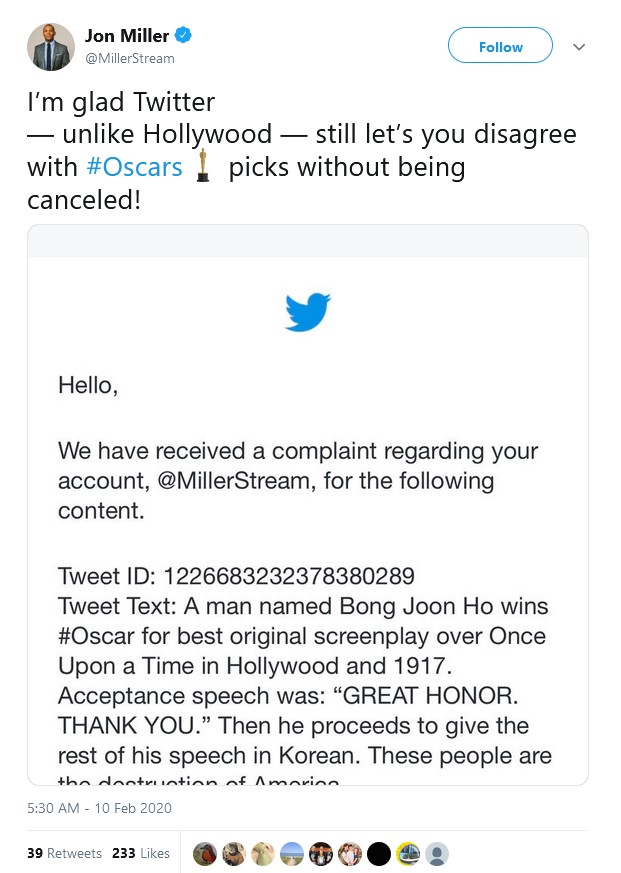
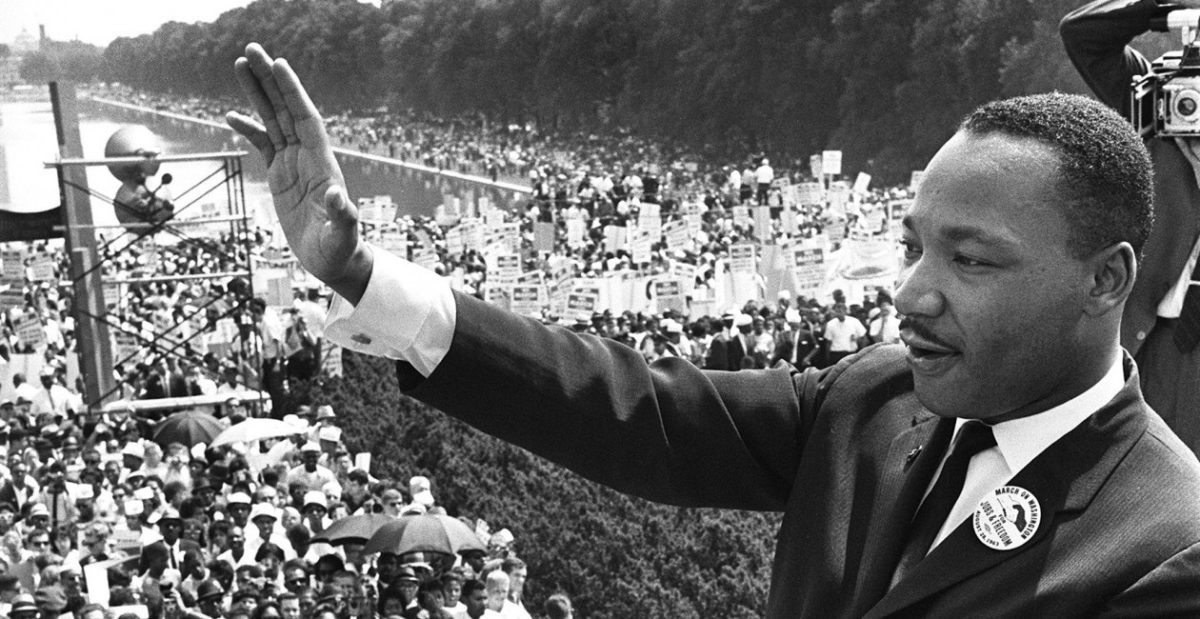
 It was a warm day in April when Dr. Martin Luther King was arrested. It was the thirteenth and the most important arrest of his life. King, wearing denim work pants and a gray fatigue shirt, was manacled along with fifty others that afternoon, joining close to a thousand more who had bravely submitted their bodies over many weeks to make a vital point about racial inequality and the unquestionable inhumanity of segregation.