New Review: George Friedman’s THE NEXT 100 YEARS

Well, the Gerald Celente post continues to draw plenty of haters to this site. And that’s fine. Because everybody needs a hobby. But I’m pleased to report that I’ve taken on another dubious futurist in the fine pages of the San Francisco Chronicle. I had truly hoped for more from the book. I have a soft spot for futurists and I always start reading a book hoping for the best. But, alas, it proved to be grand bunk.

Today, if you’re in the San Francisco Bay Area, you can pick up the paper and read my review of George Friedman’s The Next 100 Years: A Forecast for the 21st Century. Unless, of course, you want to read it now. I can’t possibly predict the future of your own decision, but I’m all too happy to embrace the uncertainty of the present.

Review: Friday the 13th (2009)

friday13th

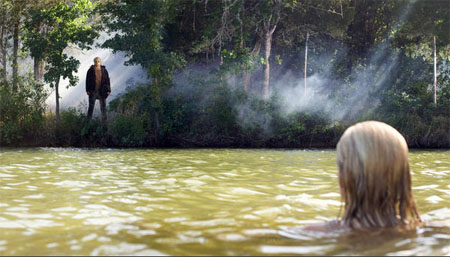
Why in the hell would anyone want to see a reboot of Friday the 13th? Well, the killings, of course. Jason has such a physics-defying command of the machete that he can stab the top of a woman’s skull through the floorboards of a dock, pull the woman up with the machete so that the camera can conveniently film her tits, and then plunge her back into Crystal Lake. I’m surprised that Jason never made an appearance on Letterman’s Stupid Human Tricks or Playboy After Dark.

Over nearly three decades, the people who have made the Friday the 13th movies have transplanted Jason into Manhattan, shot the undead psychotic into space, and pitted him against Freddy Krueger. But the silent and murderous hockey-mask-wearing killer is such a bore that even these “high-concept” storylines have revealed just how utterly hopeless this horror series is. Jason has spent too many years lumbering like a dopey hulk with a chip on his shoulder. He’s the kind of mindless zombie who could probably use some therapy, but he never seems to talk back. Although he does stop sometimes if you’re a woman who looks like his mother with the talent to shout “Jason!” in an obvious and peremptory tone. Which is too bad, because even Michael Myers — the character who Sean S. Cunningham ripped off — had Sam Loomis. And unlike Freddy Krueger, you don’t even get the benefit of the wisecrack when the blood gurgles from your throat. Which seems impolite at best and a missed opportunity for full-scale vengeance at worst.

It doesn’t help that the people killed are just as vapid as our intrepid murderer. Jason’s victims, by and large, are dopey teens who like to fuck each other’s brains out. Jason — that great American Puritanical impulse — is always there to redefine the terms of afterglow. His victims have included Crispin Glover and Erin Gray. But Corey Feldman was recast between films before he could be eviscerated for popular audiences. At least there’s some more explicit sensuality in this film. Characters jack off to Hustler (and a winter catalog, of which more anon) and, put their noses close to bottles of alcohol and marijuana crop. Presumably, this permits them a last fix of living in lieu of the Krueger bon mot. Oddly enough, nobody in this film smokes cigarettes. I can really see Jason making a mortal statement on behalf of the Surgeon General.

So what do director Marcus Nispel (who also remade The Texas Chainsaw Massacre) and writers Damian Shannon and Mark Swift bring to the formula? One of the most deafening sound mixes I’ve ever had the misfortune of being subjected to. Nispel is so incompetent at executing a proper shock that he’s had the sound designer on this show crank up the volume at the highest fucking decibel level. And this is perhaps a worse crime than the feds blasting heavy metal to ferret out Manuel Noriega. He’s even added in inexplicable whooshes of the flashlight. So be sure to bring your earplugs. That is, if you haven’t lost your hearing already. (And perhaps that’s the demographic this film has been designed for.) There’s also been an effort to incorporate present technology into this movie. You’ve got your GPS systems, iPods, and the cell phones that malfunction at convenient moments. Jason now has a mine beneath the dilapidated camp, where a victim has been held for six weeks and still manages to have impeccable hair and makeup. I presume that Jason has offered full continental breakfast service between murders. Or maybe she was fed and kept hydrated by the random rats running around.

We also meet some of the people who live around Crystal Lake, which include a redneck stereotype fond of smoking and dealing weed and permitted to live until Jason feels the need to kill him to obtain his hockey mask. (That great Puritanical impulse again. The redneck stole the weed from Camp Crystal Lake.) And I’d hate to be employed as the poor cop, who doesn’t seem to be fully aware that there’s been a major spike in disappearances and murders. There’s product placement for Pabst Blue Ribbon and Aquafina, explicit in the dialogue, which I believe may be a first for the Friday the 13th series. The murky photography is perhaps the grainiest of any of the Friday the 13th films. The dunces who shot this movie don’t seem to understand that low light, high speed stock, and silver halides aren’t the best combo.

Perhaps the film’s greatest innovation is the introduction of racism to the Friday the 13th series. We’ve come to expect sexism. But here, we get a token Black Guy and a token Asian Guy (and I hope that Angry Asian Man will be on the case with the latter). There’s initially some promise with the former, as he confronts a white woman who assumes that his music career involves rap. “Because I’m black, I can’t listen to Green Day,” says the Black Guy. And there was a brief moment in which I thought to myself that the filmmakers might actually subvert the formula. Alas, Caucasians are the only ones who get down to business in this movie. Our Black Guy, hearing all the white people getting lucky upstairs, is forced to sift through a winter catalog so that he can masturbate to a rich-looking white woman. And he doesn’t even get the consolation of ejaculating. For the door is opened, the Black Guy zips up his pants, he rushes out to look after his friend, and is then axed (asked?) in the back by Jason, wailing at the top of his lungs for his friends to save them. Well, they never do. He’s bait, you see. And Jason turns him around and punctures the axe through the front of his chest. The brother always gets it.

The Asian Guy appears inspired from the Long Duk Dong stereotype in Sixteen Candles. He drinks from a shoe and is mocked for purchasing condoms at a store. He knows how to fix things. And even the Black Guy persuades all that he knows how to fix things. (Presumably, the Asian Guy operates a rickshaw business too.) He expresses sexual interest in one of the white girls and, as he’s about to down a flaming shot, he’s too clumsy and falls over. He is mocked further. And then he goes out, drinking directly from a bottle of scotch, and is found chopped up in a meat locker.

So if you’re white, you’ll get laid. In the view of Nispel and company, you are the bacchanalian master race. And you have to hand it to Nispel and his collaborators for making Crystal Lake a world where the whites win. Where douchebags named Trent may whimper like a coward when faced with death, but inevitably get cowgirls bouncing up and down on their cocks.

I wouldn’t be surprised if Friday the 13th becomes a big hit among Ku Klux Klan members. It does succeed at upping the stakes in the Friday the 13th series, but then the stakes were atavistic in the first place.

Review: Fanboys (2009)

fanboys

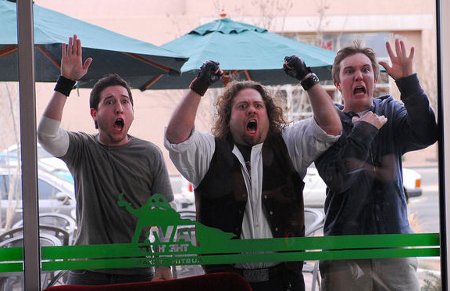
There have been nearly eighteen months of production problems for Fanboys, the comedy film made by geeks for geeks involving a 1998 pilgrimage to Skywalker Ranch to steal a rough cut of The Phantom Menace. A rough cut of Fanboys made the rounds in 2007, earning plaudits from George Lucas and Kevin Smith, with the former granting permission to use Star Wars sound effects and the latter asking for and receiving a cameo. More money was allocated to director Kyle Newman to shoot additional scenes that were prohibited by the original version’s five million dollar budget. Months passed, as Newman attempted to extricate the actors from their respective obligations. Additional scenes were shot. Then there were reports that the film was being saturated with more crude jokes with the cancer plot removed. (Having seen the film, I can report that the cancer plot has metastasized.) Fanboys was scheduled to come out last year, but it remained in the vault. There were delays and a few inquiries from online circles, and an Internet campaign eventually emerged demanding that Newman’s original vision be restored. But this week, Fanboys is finally being unfurled into theaters, perhaps with a few “Greedo shoots first” compromises. And I’m pretty certain that additional speculation will spiral into more online melees.

But I have only the version I screened to go by. If there are better versions of the film to be made, this will likely have to be settled by Phantom Edit man Mike J. Nichols. As cheap thrills go, Fanboys isn’t bad. The film won me over. It plays like an Animal House for geeks, and, if Jeffrey Lyons snoring through half the movie is any indication to go by, it will likely not appeal to entitled snobs who remain incurious about this subculture. But I think it has a pretty good shot of finding an audience in the heartland.

Ernest Cline’s screenplay has reportedly been bouncing around since 1998, but his collaborators (Dan Pulick credited on the story and Adam F. Golberg credited on the screenplay) have transformed the film into a celebration of geek culture just before the dawn of a new millennium. After a scrolling yellow prologue with a “Sent from my iPhone” postscript, we’re then taken to Ohio 199 days before the Phantom Menace release date. Chumbawumba’s “Tubthumping” blasts at a house party, where stormtrooper and Super Mario costumes are copious, with a “Picasso’s blue period” thrown in for good measure. This is still the time of dialup, and a bespectacled geek named Windows (Jay Baruchel) has secured an online girlfriend. Windows is so consumed by his perfervid IMing that he cannot even notice a geek girl flashing her breasts in his direction. Hutch (Dan Fogler) lives in a garage, paying rent to his parents. He insists that he lives in a “carriage house.” Then there’s Eric (Sam Huntington), the “responsible” character you typically find in these teen comedies who works at his father’s car lot and is primed to take over the business. This trio learn that their pal Linus (Christopher Marquette) is dying of cancer. A trip to California is agreed upon.

As you may have already guessed, this setup follows any number of cinematic formulas. But much like the original Star Wars trilogy, Fanboys is more about the journey, rather than the destination (or even the beginning). It does find a few funny moments that prevent this film from entirely succumbing to stereotyping. An R2D2 Pez dispenser is confused with a prominent member. Hutch, who drives a van adorned with Star Wars detailing, sets a few ground rules: “All Rush, all the time” is the only music to be played during the cross-country journey. There’s a side quest to Riverside, Iowa — the birthplace of James T. Kirk — in large part because Hutch says, “I’ll drive all night for the chance to pimp dog some Trekkies.” And this pugilistic vow is carried out over the preposterous question of whether Han Solo’s a bitch. A Star Wars fan has unthinkingly burned in a Jar Jar Binks tattoo without knowledge of the character.

A sequence involving peyote and stripping, suggesting that geeks are as marginalized as gays, doesn’t quite live up to its potential, nor does a running gag about Hutch having one testicle. But the film does poke some insinuative fun at all the forthcoming junk that those associated with Star Wars will soon be involved in. When the group discusses whether or not Harrison Ford is the greatest actor of all time, the van passes by a Six Days Seven Nights billboard. I also enjoyed the idea of Harry Knowles portrayed as an ass-kicker in the know, where trust is established by the number of esoteric film facts at your immediate disposal.

Many of the film’s cameos — which include William Shatner, Carrie Fisher, and Billy Dee Williams (as Judge Reinhold) — are funny. Some, like Kevin Smith and Jason Mewes, are just pointless. The film quotes lines from the original Star Wars trilogy liberally, but not obnoxiously.

The film also delves a bit into geek double standards pertaining to gender. During a moment in Vegas, the aforementioned geeky girl Zoe (played by Kirsten Bell) flirts wildly with Windows, but he and Hutch see only the airbrushed professionals. And while Windows and Hutch do receive a collective comeuppance for their oversight, I wondered whether there may have been something more here lost in all the reshoots and the rewrites.

Fanboys isn’t as good as 1998’s Free Enterprise, largely because Mark A. Altman and Robert Meyer Burnett went to the trouble of portraying geeks as real people. It doesn’t quite have the guts to plunge completely into the complexities of geekdom. And my main gripe with Fanboys is that the “real” moments here were terribly treacly. Perhaps there was some reasonable justification for attempts to rework the cancer plot. But I did laugh, and the film that emerged from the fracas does entertain.

Review: New in Town (2009)

newintown2

I am not necessarily opposed to romantic comedies. In fact, I even confessed to my moviegoing companion on the subway ride back that I enjoyed Notting Hill. I’m pretty certain that, given the choice between rewatching a Lucio Fulci film or Notting Hill, I would opt for the former. But the truth is the truth. Notting Hill more or less works and has some good dialogue, even if Julia Roberts plays Julia Roberts and the narrative is more obvious than the need to apply suntan lotion in 120 degree weather.

Richard Curtis would go on to make one of the most unpardonably atrocious films of all time. New in Town thankfully isn’t as bad as Love Actually. But that’s hardly a consolation, for it isn’t nearly as good as Notting Hill, and Notting Hill isn’t nearly as good as at least a hundred wonderful romantic comedies. By the time you get to New in Town‘s schmaltzy tapioca spraying scene (which reminded me of Zoolander‘s satirical gasoline montage), you know that any sliver of faith you’ve placed in the film can’t possibly be redeemed.

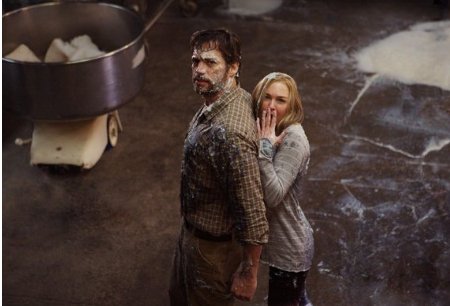
You see, New in Town is a romantic comedy that has a modicum of charm and better acting than a derivative movie of this type has any right to possess. Here is a movie that has pilfered elements from other rom-coms: the corporate crusader vs. the working man advocate at the heart of You’ve Got Mail, the city slicker humbled by the charms of small town life from Doc Hollywood (complete with a David Odgen Stiers-like character played by J.K. Simmons), and the romantic protagonist as a business exec who busts up companies in Pretty Woman (Renee Zellweger has replaced Richard Gere). It’s a movie so quaint and anachronistic that it even has the opening credits at the beginning. The way they used to. The way that audiences conditioned themselves to accept condescending junk without question.

I felt a strange emotional conflict sitting through this movie. I was appalled by the Minnesotan stereotypes, the obvious music cues (“Walking on Sunshine” when Zellweger attempts to escape to Miami), the reliance upon coincidence (a snowstorm), the pat happy ending, the union rep who doesn’t object to unpaid overtime, and the terrible Jesus jokes (redeemed by a better populist joke about belief later in the movie). I wanted the people of New Ulm, Minnesota to hail their conquering hero or make more intriguing efforts to welcome the woman who came to dinner. If only the filmmakers could understand that small towns are laden with life and a lot of fun, that the people who live there aren’t caricatures, that having a good ear for regional dialogue is a must, and that this movie’s potential audience would have augmented tenfold if the New Ulmites hadn’t been treated like one-dimensional rubes. Unfortunately, screenwriters Ken Rance and C. Jay Cox seem to think that phony parochialisms like “Ain’t that a kick in the keister,” “Oh for crying in the bean cheese soup,” and “We don’t give a goose fart on a muggy day” represent verisimilitude. It’s abundantly clear that these two Hollywood hacks whipped this shit up in a room and genuinely thought they were being clever. If only they were real writers who headed to Minnesota on Hollywood money to get their dialogue right. There’s also the token guy living in his ex-wife’s basement, the unbelievable idea of a woman as capable as Zellweger’s character not heading to Minnesota without winter wear, and a ruthless company not cutting Zellweger loose after she’s defied orders for tapioca pursuits and tapioca storytelling.

But just as I was about to give up, something slightly interesting would happen. Frances Conroy would evade bad direction to speak like the Fargo people by speeding up her line delivery, and it was a marvel to watch her improvise under the circumstances and bring something to lackluster material. A New Ulm resident would momentarily evade the stereotypical trappings with a small irony on how only city slicker idiots froze to death while walking down the highway in subzero temperatures. The camera would linger on Zellweger’s hair for more than a minute as she was emerging from a hangover. (No, you’re not exactly going to get Eric Rohmer takes in a movie like this, but, really, how often do you see a long take like that in a mainstream comedy?)

Such moments were too few. When Harry Connick Jr. told Zellweger, “You know you’re not so bad when you’re unconscious,” I had the strange feeling that he was talking directly to me. Maybe he might take me home and try to molest me. Perhaps he might show me his package. (Does he have a decent package at 42? I certainly hope so.) Or maybe he wanted me to be unconscious so that I might forgive the movie a little more. Maybe if I “wouldn’t be so bad,” I might wake up in a snug bed and pretend to watch wrestling on TV after we lip locked. Because that’s what Minnesotans do apparently: watch and elect wrestlers. Maybe I could take Connick’s daughter to the big city for shoes and I could walk around airports in high heels to show that I was just as assertive as Zellweger. This was, after all, what womanhood was to director Jonas Elmer. For all I knew, this definition extended to manhood. Walking around in high heels and having a man like Connick unzip a suit while I was trying to pee. Romantic escapades like that.

You get the picture. I honestly didn’t hate this movie as much as I probably should have. But I didn’t like it all that much either. Ain’t that a kick in the keister?

Review: Donkey Punch (2008)

donkeypunch

In 2006, the critic David Edelstein confirmed his cinematic cowardice by asking this of the infamous nine-minute anal rape scene in Gaspar Noé’s Irreversible, “Noé means to rub your nose in the violence and make you loathe it, but my nose had been pretty well rubbed after the first two minutes. For a while I stared at the EXIT sign, then closed my eyes, plugged my ears, and chanted an old mantra. I didn’t understand why I had to be tortured, too. I didn’t want to identify with the victim or the victimizer.”

I don’t believe that the torture porn issue should especially concern itself with the filmgoer’s rights. In the case of Irreversible, Noé draws our attention to the horrible reality of rape through his unique structure — ten-minute installments arranged backwards, with the “later” events happening first — and by demonstrating how these “later” actions reveal primal motivations that occurred “earlier.” Much as Almodovar had the courage to play a twelve-minute rape scene in Kika for laughs, Noé is interested in suggesting to the filmgoer that our quotidian gestures may very well be laced with savagery. And if the filmgoer feels uncomfortable with this ethical question, he has the option to walk out of a theater if he cannot handle what’s presented before him.

If cinema is to endure as an art form, then it must permit opportunities for the filmgoer to enter into uncomfortable territory. Perhaps Edelstein would have been better off writing about the latest audience-pandering “art-house film” that refused to take chances. His viewing concerns fail to consider the film on its own terms. It is, instead, all about Edelstein, and such attitudes are damaging to films that play fast and loose with comfortable sensibilities.

The torture porn question hinges less on the content and more on whether a film can offer a convincing portrayal of dirty human realities. Let us consider Eli Roth’s oeuvre. This horror auteur displayed some primitive satirical promise with Cabin Fever and Hostel, only to betray this talent in Hostel: Part II with one of the most misogynistic scenes seen in a horror film in years.

In Hostel: Part II, Heather Matarazzo is punished for being eager, geeky, and curious about the Slovakian village which contains the factory in which affluents pay to torture and kill victims. Roth has children spit in Matarazzo’s face when she offers a mint. Her friends lie about the alcoholic content of the cider she drinks. (Matarazzo’s character does not drink.) Whereas even the asthmatic in the first film got some action, in the second film, Matarazzo isn’t even given a chance to get laid — even when she goes on a boat ride with a schlumpy guy. She’s abducted to the torture factory, and doesn’t even get so much as a kiss. The kiss comes later, when she is dangling upside down — naked, chained, humiliated for the camera, essentially raped by the schlumpy guy. Indeed, the schlumpy guy fires up a cigarette just before the torture factory staff bags her head. His breath, polluted by the phallic cigarettes, won’t even partake in an embrace.

And that’s just the beginning. Roth doesn’t even give Matarazzo a moment in which she can upbraid her two companions or display any strengths. She’s a character who exists to be mocked and tortured. She dangles from the ceiling, her breasts bobbing at the top edge of the frame like some cheap chandelier, and another woman — the client who has requested her — proceeds to scrape her skin with a blade, with the camera lingering on Matarazzo’s flesh in full closeup. Torture soon follows, with Matarazzo cut open, screaming, and the blood dripping down onto the nude client’s body. There is nothing remotely ethical or particularly probing about this scene, even if one accepts that it’s “just a movie.” It is cheap, exploitative, incurious about the human condition, and not particularly interested in exploring the relationship between the tortured and the torturer. Matarazzo’s body is presented, but it’s all in the interest of misogyny. And while Roth has another woman cut a client’s dick off near the end of the film, as if to suggest that emasculation represents a kind of female empowerment, the brutal cheekiness (a dog chows down on the cock just after it is thrown across the room) adds nothing particularly substantial to the revolutionary possibilities of the horror genre, much less the talent that Roth displays in other scenes (such as the DePalma-like torture bidding, split-screen montage seen early in Hostel: Part 2).

* * *

Which brings us to Oliver Blackburn’s film, Donkey Punch, part of the Magnet “Six Shooter” series, which has clearly taken Eli Roth’s two Hostel films as its inspiration. Here again is a film presenting spoiled young people going on vacation, taking everything without giving back, and getting lost in gruesome violence. “Check it out,” says one character of the boat in which the action takes place, “It’s, like, the TARDIS.” Like the Matarazzo dilemma in Hostel: Part 2, geekdom resides just under the surface, but it is actively discouraged. Dare to be thoughtful, curious, intelligent, or abstain from drugs, and you will be punished. For it is the vacationer’s duty to be dumb and irresponsible in these films.

Here again is a film that replaces even the crudest concern about the human condition with boorishness and misogyny. Three young women join four young men on board a boat. And what is the allure exactly? This film is too idiotic to pin it on anything more complicated than a vacationer’s crude pursuits of debauchery. These Bacchanalian impulses don’t stop Blackburn from giving his women the Matarazzo treatment. The three women wander about the boat and note that it “smells of boy.” The titular “donkey punch” is a sexual position that involves punching the woman on the back of the head during orgasm. It’s brought up by the marble-mouthed thug Bluey — the stupidest and cruelest character in the movie, and the big “experienced” man who the other three look to for guidance. “What’s in it for the girl?” asks one of the women. The reply? “I don’t understand the question,” followed by selfish laughter.

The donkey punch is carried out. A woman dies. The action is caught on a video camera: a vacation snapshot that transforms into a lucrative Internet possibility (just like Elite Hunting in the Hostel films, which offered a business card with merely an email address). And, of course, the man who caused the death can’t take responsibility. Nor do these characters make any attempt to calm each other down. “Why don’t you fix us a meal?” orders one of the young men later in the film. The object is to evade the police and to carry on with the partying, and to make sure that these “bitches” stay down. After all, they had it coming.

More forgiving critics are likely to defend Donkey Punch as “a cautionary tale.” But this too easily exculpates both the filmmaker and the filmgoer from the failure to find a purpose, or a common territory, for the violence. This is most certainly an exploitation film, but it lacks the chops to get us interested in these characters on a rudimentary level. The film’s setting suicidally, and rather stupidly, begs comparisons to Knife on the Water and Dead Calm, which are both considerably better.

Neither Donkey Punch nor Hostel: Part 2 offers anything half as interesting as Abel Ferrara’s 1979 Driller Killer (which is available online for free; the film is in the public domain). Ferrara’s feature debut is a structural mess, and he hasn’t quite found his voice. (That would come later with his first masterpiece, Ms. 45.) But he does depict madness and violence in a way that draws us into the madman’s psychology. The film’s later scenes of the madman drilling people around New York works both as exploitation, and as a very unusual examination of class and art vs. consumerism. We can observe the violence as horrifying, fun, pleasant, and unpleasant. And that is because Ferrara is genuinely curious and passionate about his warped madman (so much so that he played the part). The violence caused the film to be labeled a “video nasty” when it hit the UK.

Now the new label is “torture porn.” But filmmakers such as Blackburn and Roth aren’t really interested in tinkering with the stigma. Instead of using their freedom and their notoriety to advance cinematic form and mess with heads — as Noé and Takashi Miike’s films often do — they prefer to wallow in misogyny for misogyny’s sake. Their “daring” choices become childish and predictable, and it becomes evident that a flapping penis (and there are many in Donkey Punch) is less about flaunting conventions and more about crass commercialism. This kind of filmmaking stance isn’t courageous. It’s riddled with cowardice and contempt. It performs a great injustice to the horror genre, which, in the best of hands, can be fun, thoughtful, and dangerous.