Parade’s End (Modern Library #57)

(This is the forty-fourth entry in The Modern Library Reading Challenge, an ambitious project to read the entire Modern Library from #100 to #1. Previous entry: The Age of Innocence.)
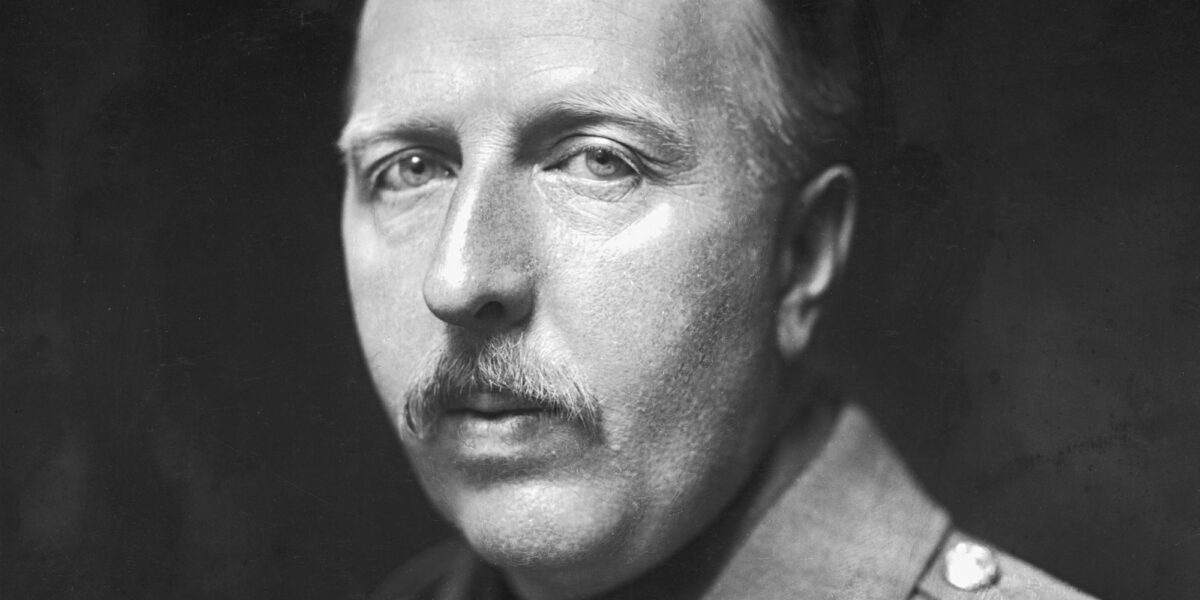
Very few people read Ford Madox Ford (née Ford Madox Hueffer) these days and there are salubrious and soul-preserving reasons why this is so. He’s the rare “great writer” who has as much relevance in the twenty-first century as some huckster trying to sell you an anti-garroting cravat. Parade’s End is ostensibly about the psychological effects of World War I, but, even on my second read of this plodding tetralogy, I found myself revisiting Ernst Jünger’s Storm of Steel, Richard Aldington’s Death of a Hero, Paul Fussell’s The Great War and Modern Memory, and even Rebecca West’s underrated The Return of the Soldier — all far more poignant and perspicacious volumes into how the Great War shaped human history. If anything, Parade’s End is an unwelcome reminder that the crusty white dudes who concocted the Modern Library canon were more motivated by what certain insiders deemed “great literature” rather than bona-fide literary standards.

Of course, I am merely one man on a literary journey — perhaps, more accurately, an asshole on the Internet with an opinion. Even so, when I posted a photo on my Instagram story of me wincing while holding up the Ford omnibus (complete with the unanticipated aesthetic touch of a bandage taped to my forehead, the result of a shaving accident rather than a sustained session in which I repeatedly banged my noggin against a stop sign pole, although my head often felt more like the latter while reading Parade’s End), a friend pointed out that she had indeed suffered with me when she had taken a stab with Ford. Her surprise revelation, delivered in a dramatic “Luke, I am your father” timbre, helped me to feel less alone. Yes, Ford Madox Ford had been dead for a good eighty-seven years and was thus an easy target for a cranky middle-aged bald dude like me who really wanted to write about Kerouac or Faulkner rather than this guy. But our bond of friendship became tighter, cemented in some shared reading agony that we had not hitherto known about. We shook our fists into the air and condemned the dreaded surname “Tietjens.”

You see, only the stodgiest tastemakers imaginable would have the stonecold cruelty to recommend this dull and insufferable perorater to some starry-eyed young reader hoping to secure a foothold in the daunting Modern Library canon. It’s especially aggravating that I have to deal with Ford not once, but twice, on this infernal list. Yes, I am fated to suffer through The Good Soldier when we get to ML 30.  I am not happy about this. But I did take a ridiculous literary oath fifteen years ago and I am a man of my word. This slimmer and more potent novel is admittedly a bit better than Parade’s End — “better” in the way that getting swiftly kicked in the balls is preferable to having a limb sawed off.

But as a graying though exuberant Gen Xer, I am duty-bound to tell any enthusiastic Zoomer or tap-dancing millennial that they would be better off watching Sam Levinson’s exploitative television series Euphoria than reading Ford Madox Ford. It can be sufficiently argued that the only reason that the 2012 BBC television adaptation of Parade’s End was memorable at all is because the brilliant Tom Stoppard (may he rest in peace) rearranged the events and added new scenes and dialogue — most tellingly taking on an “unfaithfully faithful” approach.

Who reads this man today? Perhaps a few superannuated Ford stans can be found whispering “Tietjens” as they slap their fading chits onto lonely numbers in moribund bingo hall parlors swarming with smoke. But I cannot in good conscience join this gloomy coterie of literary losers. These Ford boosters have so deluded themselves into blinkered advocacy that even Julian Barnes had the startling temerity to declare that Ford made Graham Greene, who rightly called out Last Post as “an afterthought,” look old-fashioned. Seriously bro?

Gentlemen don’t earn money. Gentlemen, as a matter of fact, don’t do anything. They exist. Perfuming the air like Madonna lilies. Money comes into them as air through petals and foliage. Thus the world is made better and brighter.

Compare this with Greene in The Quiet American and you see a significant difference between dowdy bloviating and taut observational precision:

A man open to bribes was to be relied upon below a certain figure, but sentiment might uncoil in the heart at a name, a photograph, even a smell remembered.

Christopher Tietjens — intended to reflect the dying gasps of an Edwardian age only now appreciated by husky buzzards pinching tobacco in glum dens boxed by dowdy leatherbound walls — is surely among the least interesting protagonists in 20th century literature. He is the “last Tory” — a clumsy, blunt, physically gargantuan, and very rude statistician incapable of a jocular remark or a jolly jolt in his gait. Ford banged out pages and pages of leaden dialogue from this insufferable mansplainer. And his observations possess all the pleasure of a two hundred pound steel weight being thrown repeatedly into your solar plexus, presumably with some automated Peloton instructor shrieking into your eardrums with the unsettling tenor of an ICE agent preparing to murder someone in broad daylight. “You betray your non-Anglo-Saxon origin by being so vocal…And by your illuminative exaggerations!” “Little nippers like you don’t stop things….Besides, feel the wind!” The ellipses falsely suggest a free associative genius, but only succeeded in reducing me to unintended laughter. (How else was I supposed to soldier through this book? With a stern and self-immolating chin?) Ford actually presages many of these hokey lines with a breezy “Tietjens said:” in the paragraph before just so he can pad out his pages with the unpersuasive momentum of an undergrad trying to hit the 1,000 word minimum on the essay due the next morning.

Tietjens is often outlined as brilliant, but Ford’s descriptive approach is all tell and no show:

The fly that took them back went with the slow pomp of a procession over the winding marsh road in front of the absurdly picturesque red pyramid of the very old town.

Now even someone with a particularly acute case of ADHD will look to such a sentence and see that it is trying way too hard to sound “literary” when it doesn’t say much of anything at all. What are we supposed to dwell on here? The putter of the prewar Smith Flyer? Well, we don’t actually feel its spurts or its undulations in this sentence. But we do have the sense that the fly here is in “slow pomp,” or on display. Which doesn’t really conjure up a distinct image. Okay. Fine, Ford. You do you. But how does the “winding marsh road” contribute to the imagery? Does it serve in some juxtaposition to the fly? Of course not. The road image is used to get us to “an absurdly picturesque red pyramid” that stands in apparent counterpoint to “the very old town.” But what kind of red pyramid? How is it picturesque? Again, we don’t know. And it’s utterly maddening. Ford never describes this “pyramid” again. This isn’t poetic at all. It’s word salad. Ford delivers elegant variations that aren’t even interesting in the manner by which they fail — such as “an extraordinary Falstaff’s battalion of muddy odd-come shorts.” Ford stitches together random phrases, but he only succeeds in giving us disorienting incongruities that read more like some well-read guy tagging along with you on a drunken night in Vegas, though without the pleasure of slot machine clinks or a comely stranger you accidentally hook up with. (Hey, what happens in Vegas stays in Vegas!)

And there’s more hapless syntax where that came from, folks! Should I mention the shadow “falling across the bar of light that the sunlight threw in at his open door” or how a fellow named McKechnie “swallowed as men are said to swallow who suffer from hydrophobia”?

By contrast, here is P.G. Wodehouse describing a golf course at the beginning of “A Woman is Only a Woman”:

It is a vantage-point peculiarly fitted to the man of philosophic mind: for from it may be seen that varied, never-ending pageant, which men call Golf, in a number of its aspects. To your right, on the first tee, stand the cheery optimists who are about to make their opening drive, happily conscious that even a topped shot will trickle a measurable distance down the steep hill. Away in the valley, directly in front of you, is the lake hole, where these same optimists will be converted to pessimism by the wet splash of a new ball. At your side is the ninth green, with its sinuous undulations which have so often wrecked the returning traveler in sight of home. And at various points within your line of vision are the third tee, the sixth tee, and the sinister bunkers about the eighth green⁠—none of them lacking in food for the reflective mind.

This is infinitely more enjoyable than Ford — and not just because Wodehouse is almost always a delight to read. Wodehouse maps out the territory and the types to be found in his setting and he somehow turns golfing — which I myself have never enjoyed outside of the brilliantly designed miniature courses that you find all throughout Ocean City, Maryland — into a joyfully absurd reverie for optimistic philosophy. Where Ford is muddled and confused, Wodehouse is clear and specific, complete with phrases like “wet splash of a new ball.” It is the difference between being stuck at a party with a bitter and rambling old man who gave up on finding felicity at least two decades earlier and a giddy eccentric who plans to cut the rug well into old age — or, at least, as long as his legs will two-step.

Ford Madox Ford was all influence and overhyped “talent.” It’s certainly no accident that the great Jean Rhys devoted her ferocious (and far more gifted) energies to savaging this bombastic tyrant in Quartet — revenge from Rhys after a protracted carnal entanglement. You see, there’s an undeniably skeeze quality to Ford both on the page and in his life. While serving as editor of The Transatlantic Review, Ford used his outsize literary influence to serve as a “literary mentor” to young writers (ahem, young women) decades younger than him. He would publish their early stories and exact a boudoir form of remuneration. This was a less enlightened time in which literary men in positions of power could not be held accountable. And these poor women had to endure Ford’s selfish clit-ignorant thrusts while lying back and thinking of publication. After Ford was rightfully spurned by Violet Hunt (she spent eight ghastly years with Ford; Ford, meanwhile, was cheating on his wife), Ford ruthlessly caricatured her not once, but twice — as Florence Dowell in The Good Soldier and, with evermore preposterous misogyny, as the philandering Sylvia Tietjens (Christopher’s wife) in Parade’s End. Sadly, this was what passed for eminence grise among writers in the early 20th century.

It’s safe to say that, like many clueless male authors who preceded him, Ford could not write women especially well. And this extends to Valentine Wannop, the young suffragette who Tietjens falls for. At the beginning of A Man Could Stand Up–, the third book of Parade’s End, Ford not only has Valentine confused about how to use the telephone, but portrays her dreaming of doing nothing more than eating “pomegranates beside an infinite washtub of Recklitt’s blue.” Recklitt’s Blue, for those of you who aren’t familiar with 19th century household items, was a laundry whitener that helped brighten the hues of your clothes. Despite the fact that we are introduced to Valentine as a free-spirited suffragette in the first volume (unsurprisingly, her best moments in the tetralogy), she not only longs to perform domestic duties, but she complains that she is so alone and lives a “nunlike” existence (“And no one had ever wanted to marry her….No one even had ever tried to seduce her.”).

Now anybody even remotely familiar with the suffragettes knows that they were hardly reticent when it came to passion and sex, either with the men who dated them, with each other, or, quite frequently, as they learned to “control their passions” through the power of theoretical abstinence. (You’d honestly be better off hearing about the suffragettes from Diane Atkinson’s Rise Up, Women than from Ford Madox Ford the chronic mansplainer.) But in reading Parade’s End, we don’t get any real sense of the richer life that Ford was perhaps too incurious or incompetent to draw from. James Longenbach has observed that Ford “took pleasure in feeling more qualified to diagnose the problems with women than women themselves.” (And for anyone who wants to do a deep dive, Reconstructionary Tales, a blog run by Paul Skinner, has a great overview of Ford’s conflicted feelings about the suffragettes.)

My eyes winced with incredulity as Tietjens berated Valentine Wannop for being slightly inaccurate quoting a passage. My soul plummeted into a protective crouch as I realized that Tietjens’s knowledge of the world was largely gleaned from memorizing passages in books with lifeless exactitude and even by reading the encyclopedia in alphabetical order. Almost every time a man showed up in a scene dominated by women, he would flap his lips and I felt very much like Fiona Apple trapped in a bar with the coked out and garrulous egotist Quentin Tarantino.

And here’s the thing. Valentine sees very clearly what a fool Tietjens is:

She knew that his poor mind was empty of facts and of names; but her mother said she was of great help to her. Once provided with facts his mind worked out sound Tory conclusions — of quite startling and attractive theories — with extreme rapidity. This Mrs. Wannop found of the greatest use to her whenever — though it wasn’t now very often — she had an article to write for an excitable newspaper. She still, however, contributed to her failing organ of opinion, though it paid her nothing.

Since I’ve been lambasting the man at length, I’ll give Ford a few modest props for this more clear-eyed passage, but this still circles back to one of my primary gripes about Parade’s End. Obviously, Ford possessed enough cognizance to understand how “modern” women of that era were juggling love and career. But Ford, like many mediocre men before him, is largely incurious about the latter and vitiates what talent he possessed by saturating himself in the former. Hell, even Samuel Richardson’s Clarissa — a massive masterpiece that happily occupied weeks of my reading time last year — showed far more curiosity about the inner life of a young woman than Ford did in Parade’s End. And that’s also accounting for the 18th century’s comparatively more atavistic genuflection to the patriarchy.

Furthermore, activists are fiercely loyal to their causes, particularly if they protest (as Valentine does) on a daily basis. Near the end of Some Do Not…, there is a lengthy section in which Valentine agrees to become Tietjens’s “mistress” — although nothing is consummated — and we are beholden to what is arguably the most pathetic male fantasy on the Modern Library list: namely, Valentine’s fawning admiration for the “poor mind” of this hopeless dullard.

* * *

The first of the Parade’s End books was published two years after Ulysses and T.S. Eliot’s The Waste Land, a year before Virginia Woolf’s Mrs. Dalloway, and while Proust was five books into In Search of Lost Time. These modernist geniuses served up poetic passages about consciousness. They used abstract prose in thrilling and experimental ways to unpack the crags and nuances of human existence. Ford, by contrast, has merely given us clunky prose in which the reader is randomly deposited into a new time and location. Upon solving any “riddle” that Ford presents us, the answer itself proves to be disappointingly pedestrian. It really doesn’t help that Ford is fond of having his characters repeat the title of his novel. “No more parades” obviously means that the pomp and circumstance of established social routines derived from the old social order aren’t exactly going to be practiced after machine guns, mustard gas, and trench warfare demonstrated the truly monstrous possibilities of humankind. And the Groby Great Tree cut down at Tietjens’s estate is more of a blunt and obvious metaphor of the old order collapsing rather than anything especially profound. Ford then commits the grave sin of not only believing himself to be much more clever than he really is, but in giving us a clunky journey in which we increasingly do not care about the destination.

Those who have praised Ford have done so on the basis of what I would deem “consciousness presented through continuous partial attention.” Yet they hold their tongues at the extremely contrived setups throughout the work. Mr. Duchemin, for example, goes insane without any specific reason. There is one particularly awful scene in Some Do Not… in which the “brilliant” Tietjens dukes it out with a banker over a series of overdraft charges.

Oh, but all the confusion and contradiction! The stuff of true literature! It’s why Parade’s End is on this list! Well, I see these more as significant liabilities rather than virtues. I simply cannot believe that Parade’s End was carefully designed as an invaluable modernist contribution — in large part because Ford, at times, doesn’t seem to know Tietjens. We learn, for example, that Christopher has two brothers (one that appears on page) in Some Do Not…. By the time we get to No More Parades, Christopher conveniently has a sister, who has previously been unmentioned. If this is the “inner life” meant to hammer home the conflict between the old and the new social orders, then I’d rather soak in a season of Bridgerton. But, hey, at least I’m now free of this dreadful opus. Don’t worry. I’m quite fond of the next few titles and I’ll behave myself slightly better in future installments!

Next Up! Dashiell Hammett’s The Maltese Falcon!
The Great War and Modern Memory (Modern Library Nonfiction #75)

(This is the twenty-sixth entry in The Modern Library Nonfiction Challenge, an ambitious project to read and write about the Modern Library Nonfiction books from #100 to #1. There is also The Modern Library Reading Challenge, a fiction-based counterpart to this list. Previous entry: The City in History.)

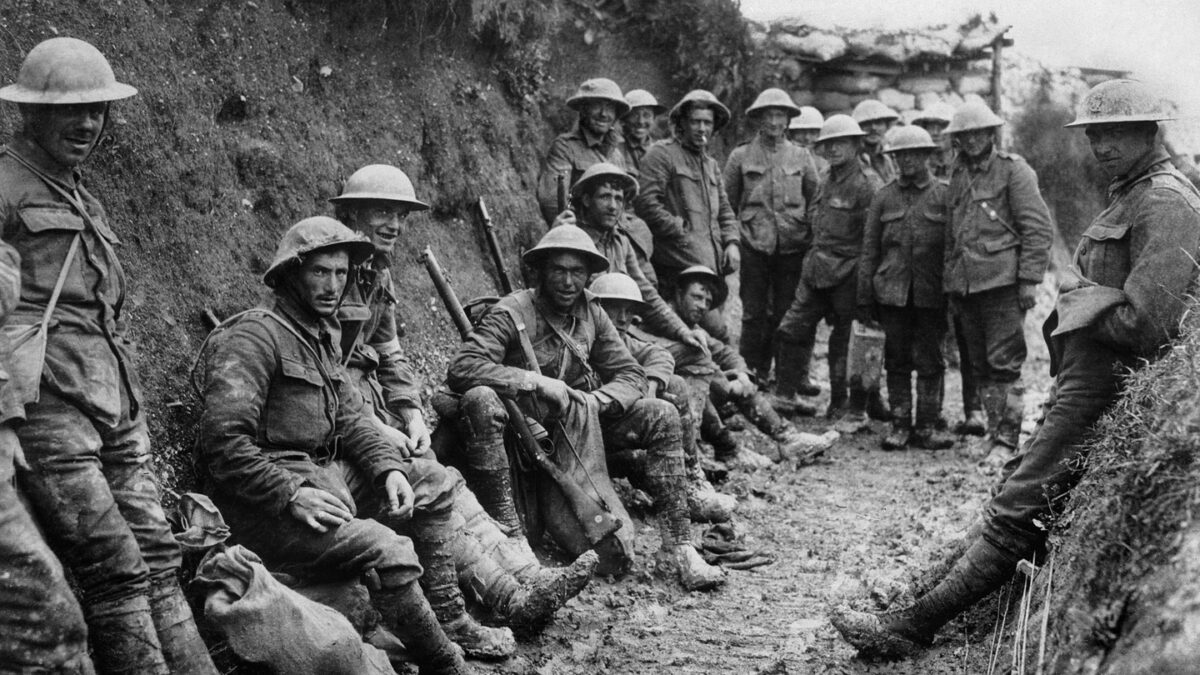
The men went to war. Their psyches were scarred and sotted by the sights and sounds of death and dreary dissolution — all doled out at a hellish and unprecedented new normal. Machine guns, mustard gas, the ear-piercing shrieks of shrapnel and shells, rats gnawing on nearby corpses. The lush fields of France anfracted into a dark flat wasteland.

The war was only supposed to last a few months, but it went on for more than four years. Twenty-two million lost their lives in the First World War. Many millions more — the ones who were lucky to live — were shattered by the experience. Their bodies were bent and their souls were broken. As Richard Aldington observed in his bleak comic novel, Death of a Hero, the trauma that the soldiers carried home became all too common, unworthy of commiseration and often received with scorn.

But, despite the scars and notwithstanding the cruel homeland rebuke, these men somehow sustained a culture during hard-won moments when they weren’t fighting in the trenches and when they weren’t watching their close friends mowed down by the newer and deadlier weapons. Their noble commitment, their fervent faith in some lambent hope plucked from the maws of a mottled landscape, forever changed the way we saw, heard, and expressed ourselves. As Paul Fussell nimbly argues in The Great War and Modern Memory, we are indebted to these soldiers in ways that most people today cannot appreciate.

* * *

While The Great War and Modern Memory doesn’t contain the intoxicating sweep and ambition of Frazer’s The Golden Bough in identifying the underlying rituals that have come to define the manner in which we reckon with disruptive and often inexplicable quagmires, it is nevertheless a remarkable volume, one quite essential in charting the trajectory of how humans expressed themselves through poetry, letters, fiction, and even postwar mediums. I first read this book in my early twenties — many years before I would stumble onto sound design as a method of communicating feelings often untranslatable through words — and, even then, I was startled by how Fussell identified early phonographic recordings as a liminal theatre sprinkled with sounds of attack. This was evidenced not only in the hit novelty records scooped up by supercilious aristocrats comfortably ensconced in cushy sacrosanct parlors without a care in the world, but further immortalized in such unlikely texts as Anthony Burgess’s underrated dystopian novel, The Wanting Seed.

There are so many bones baked into the silt of the Somme that human remains were still being exhumed in Fussell’s day. Forensic experts have continued to make efforts to identify skulls in more recent years. But beyond all these history-shattering casualties, there were also significantly influential linguistic precedents derived from these disfiguring events. The “us vs. them” vernacular that was to become a regular feature of all subsequent wars began with the Great War’s “we” and the xenophobia that was swiftly ascribed to the other side through epithets like “Boche,” as well as the cartoonish pastiches that no soldier in history has been immune from assigning to a mortal enemy. Germans were depicted as giants, memorialized in Robert Graves’s “David and Goliath.” Blunden’s Undertones of War described German barbed wire with “more barbs in it and foreign-looking.” Whether John Crowe Ransom explicitly derived his notion of the other from Blunden, as Fussell imputes, is anyone’s guess. But Fussell’s confidence and deep dive into phrases and terms of art is strangely persuasive. He has, unlike any other scholar since, made a vigorous and spellbinding examination of how language pertaining to division and the unshakeable sense that the war would go on forever influenced the Modernists (and even the postmodernists) as they rolled out their comparatively more peaceful masterpieces to the literary front lines in the 1920s.

Contrary to the cliches, life on the front wasn’t just about poetry and gardening. There was the unappetizing perdition of stale biscuits and Maconochie stew, a hideous tinned concoction (which at least one YouTuber has attempted to recreate!) involving bully beef that reminded the men of meals tendered to dogs. There were startlingly brave figures like Siegfried Sassoon, who not only took a bold stance against the war, but evoked the sordid memories of the trenches and a forgotten England in his Sherston trilogy (which dropped just as autofiction practiced by the likes of Dorothy Richardson and Proust was being quietly celebrated and, in turn, inspired Pat Barker to write her terrific Regeneration trilogy). The stertorous gunfire on the front was so loud that, as Fussell helpfully notes, even Pynchon was compelled to memorialize the idea of shells being heard hundreds of miles away in Gravity’s Rainbow. There was even a series of Illustrated Michelin Guides to the Battlefields that made the rounds after the Treaty of Versailles. Fussell repeatedly points to maps as shaky palimpsests staggered with thick wavy lines and often wry notations, but the lack of tangible geography had to spill over somewhere. Poetry was fated to account for the ambiguity.

Fussell makes a strong case for a tectonic shift in expression being practiced even before the war began. Indeed, the war gave E.M. Forster’s famous “Only connect” sentiment some completely unanticipated momentum as the landed gentry attempted to reckon with the period between the two world wars. If the Great War had not happened, what would be the trajectory of literature? Fussell doesn’t mention Rebecca West’s 1918 novel, The Return of the Soldier, but this was one of the first Great War novels to explicitly deal with shellshock and one can read this book today as a fascinating glimpse into a period between frivolous prewar innocence and the stark and gravid sentences that were to come with Eliot, Hemingway, Woolf, and Fitzgerald. Fussell suggests that the young Evelyn Waugh was emboldened in his poetic and often brutal satire by much of the lingering language that the war had extracted from the patina of once regular summer comforts. The charred scenery on the front lines caused soldiers and servicemen to look upward into the possibilities contained within the sky — itself a predominant fixation within Ruskin’s Modern Painters — and not only did Waugh mimic this in the opening pages of his later novel, Officers and Gentlemen, but one cannot read John McCrae’s “In Flanders Fields” without being acutely aware of the “sunset glow” or the sky serving as an anchor for the poppies blowing beneath the crosses or the singing larks still “bravely singing” amidst the destruction.

It’s possible that Fussell may not have arrived at his perspicacious observations had he not gone through wartime and its preceding ablutions himself. In his memoir Doing Battle, Fussell notes that he could not have unpacked Wilfred Owen’s veiled sensuality had he not been smitten himself with the looks of boys in his adolescent years. He also writes of identifying strongly with Robert Graves’s sentiment that one could not easily be alone in the thronged throes of battle. In The Great War and Modern Memory, Fussell sought to unpack irony and poetic elegy as it became increasingly expressed during the First World War. He claimed his study to be “an act of implicit autobiography” and “a refraction of current events.” In Fussell’s case, he had sickened of the Vietnam War’s overuse of “body count” and perceived perspicacious parallels between Owen’s “Insensibility,” a poem which suggests that expressing “sufferings” is simply not enough to understand real loss. One must have palpable experience of warfare’s devastation in order to reckon properly with it.

And perhaps The Great War and Modern Memory is more serious than Fussell’s “stunt books” (Class, which The Atlantic‘s Sandra Tsing Loh rightfully described as a “snide, martini-dry American classic,” and Bad) because Fussell could not find it within himself to betray his own personal connection to war.

Even so, Jay Winter, Daniel Swift, and Dan Todman have rightfully censured Fussell for leaving out or even demeaning the contributions of working stiffs. Make no mistake: Paul Fussell is an elitist snob and more than a bit of a sneering egomaniac. To cite but one of countless examples, Fussell overreaches and reveals his true colors when he suggests that all letters home from the soldiers adhered to what he calls “British Phelgm” (“The trick here is to affect to be entirely unflappable; one speaks as if the war were entirely normal and matter-of-fact.”). War censors certainly created a creative smorgasbord of workaround phrases, but, as someone who has reviewed World War I letters for research, this is an unequivocal load of bollocks — as a cursory plunge into the National Archives swiftly reveals. Fussell is much better tracking idioms like “in the pink” and using his mighty forensic chops to expose undeniable lexical influence.

As our present world moves ever closer to a potential third world war — with Ukraine standing in for a “trouble in the Balkans” — The Great War and Modern Memory reminds us that all the trauma on our shoulders — whether endured by soldiers or civilians — is destined to spill somewhere. We may not have five centuries of democracy and peace to give us the cuckoo clock that Orson Welles famously snarked up in The Third Man, but there are certainly plenty of unknown Michelangelos and da Vincis waiting in the wings to make sense of the ordeals of 2022 life. History, to paraphrase Stephen Dedalus’s famous sentiment, is a nightmare from which all of us are trying to awake.

Next Up: Cecil Woodham-Smith’s Florence Nightingale!

Audio Drama: “Shadows Have Offended”

We just released “Shadows Have Offended.” This is the seventh and final chapter of our massive epic, “Paths Not Taken,” which takes place from 1994 through 2023 in two parallel universes. This seven part story is part of the second season of The Gray Area. You can follow the overarching story through this episode guide.

This is the most ambitious story we have ever told. It takes place in two parallel universes and follows numerous characters between 1994 and 2023. “Shadows Have Offended” is the seventh chapter of an exciting seven part epic that involves parallel universes, lost love, identity, forgiveness, compassion, fate, fortune tellers, mysterious Englishmen, strange interdimensional creatures named Chester, a wildly exuberant alien fond of hot dogs and Tony Danza, and life choices.

You can listen to the first chapter here, the second chapter here, the third chapter here, the fourth chapter here, the fifth chapter here, and the sixth chapter here.

Here are a number of useful links: (The Gray Area website) (the iTunes feed) (the Libsyn RSS feed) (the Podchaser feed)

For listeners who want to support our show, we have a great deal of behind-the-scenes material available for Season 2 subscribers at grayareapod.podbean.com.

Here’s the synopsis for Chapter Seven:

In the final part of the “Paths” saga, Chelsea and Maya struggle in their forties to keep their relationship alive as they initiate a fateful but necessary Thanksgiving meeting with Maya’s grandfather — a stubborn and “old-fashioned” World War I historian. Meanwhile, the disastrous political trajectory of the parallel universe encroaches upon deeply personal and deeply fatal territory. (Running time: 84 minutes, 55 seconds)

Written, produced, and directed by Edward Champion

CAST:

Chelsea: Katrina Clairvoyant
Maya: Tanja Milojevic
Grandpa: J.K. McCauley
Grandma: Julie Chapin
The DJ: Peter Coleman
Emma: Colette Thomas
Alicia: Elizabeth Rimar
Scarlett: Jessica Cuesta
GPS: Carol Jacobanis
Thomas: Phillip O’Gorman
The Guard: Graham Rowat
Rick: Michael Hisry
The Detective: Phillip Merritt
News Leeches: Pete Lutz, David Nagel, Morgan Corcoran, and Edward Champion
and Zack Glassman as The Receptionist

Additional Voices: Dylan Reed and Christian Caminiti

German Consultant: Vincent Fallow

Sound design, editing, engineering, and mastering by a bald man in Brooklyn who will instantly sing numerous Paul Williams songs if you mention The Phantom of the Paradise to him in person.

The “Paths Not Taken” songs were written and performed by Edward Chmpion

Incidental music licensed through Neosounds and MusicFox.

Thank you for listening!

Behind the Scenes:

View this post on Instagram

Today I recorded one of the most emotionally intense scenes of the second season with J.K. McCauley, a subtly savvy talent who instantly understood that this character was both very real and hyper real. The man had loads of dialogue — dialogue that is among some of the most hardcore I've ever written. And he soldiered on to my great gratitude. (I didn't want to exhaust him!) But his instincts allowed me to see that what I was really doing with this character is renouncing some part of me I don't live with anymore. The hell of it is that J.K. recently returned to acting after a long absence and offered the most eccentric read out of all who auditioned. He was excellent and different and I am so glad I took a chance here. However, I was a bit alarmed by the recognition and, as grueling as it was to unknowingly hold up a mirror to some dark part of me I didn't know I had to contend with, we still had a lot of laughs. Thank you! #acting #audiodrama #darkhalf #character #truth #art

A post shared by Edward Champion (@grayareapod) on

View this post on Instagram

This afternoon, the marvelous Peter Coleman, a really good guy who I had the great pleasure of meeting in an improv class, returned to record new material for The Gray Area. You may recall him as the DJ in "Brand Awareness." I will not divulge how he factors into Season 2. But I will say this: when we recorded last time, I got the sense that Peter, who largely plays comedic roles, had A LOT more range as an actor and that there was a serious part of him that I hoped to gently draw out. So I wrote a scene specifically with this in mind, knowing that Peter could pull it off, in part because he is highly specific about context and line meaning. (And in fact, knowing this, I urged him during our session today to push back against my own view of the story, because I also knew that he would have some interesting interpretation ideas. Sure enough, he did!) The result was an instinctively smart and a very moving performance. I did my best to inject more empathy into Peter's performance and Peter, in turn, graciously called me out on my own motivations. These are the types of collaborations I really, really dig. Because being surprised is how we get closer to making something new and different. I'm thrilled and very honored that Peter has been a part of The Gray Area. Thank you so much, Peter, for fitting me into your busy schedule! #audiodrama #acting #motivation #character #recording #instinct #collaboration

A post shared by Edward Champion (@grayareapod) on

View this post on Instagram

We did it! The incredible @katrinaclairvoyant and I wrapped months of recording this afternoon, finishing up her final scenes in this incredibly epic tale in which she stars. It was, of course, quite necessary to pop open the champagne. There was great joy, a bit of sadness, and, above all, the sense that we had gone through an incredible journey together. I wrote this character with every emotion I had in my heart and Katrina always surprised me every day she came in, finding new angles on this character and always using her instincts to flesh her out further. I cannot conceive of any other actor for this role. My considerable gratitude to Katrina for knocking this out of the park and for her great commitment to this role. This was one of the most incredible and fortuitous artistic collaborations I have had the honor and the pleasure to experience. And I can't wait to see how this comes together. Thank you so much, Katrina! #audiodrama #acting #champagne #character #fun #commitment #real #drama

A post shared by Edward Champion (@grayareapod) on

View this post on Instagram

I just finished a very quick evening session with @mikey_hizy, who squares off against @ogorman.pp in the final scene of the epic Season 2 story! I met Michael through @lit_karaoke (who ALSO said he wanted to be in this, but DIDN'T return my message when I offered him a role — what's the deal, sir? Are you all talk? 🙂 ) and I was immediately impressed with his fine speaking and singing voice. You can learn a lot about an actor by singing karaoke and improvising with him! I had one quick role that I forgot to cast, but then I thought, "Michael! Of course!" Well, Michael was great. He was the first actor to memorize the lines (totally unnecessary for audio drama!). But I steered him towards his instincts and this was very fun. Thanks again, Michael! #audiodrama #acting #audiodrama #character #barbeque #karaoke #voiceover #recording #session #audio

A post shared by Edward Champion (@grayareapod) on

A Farewell to Arms (Modern Library #74)

(This is the twenty-seventh entry in the The Modern Library Reading Challenge, an ambitious project to read the entire Modern Library from #100 to #1. Previous entry: Scoop.)

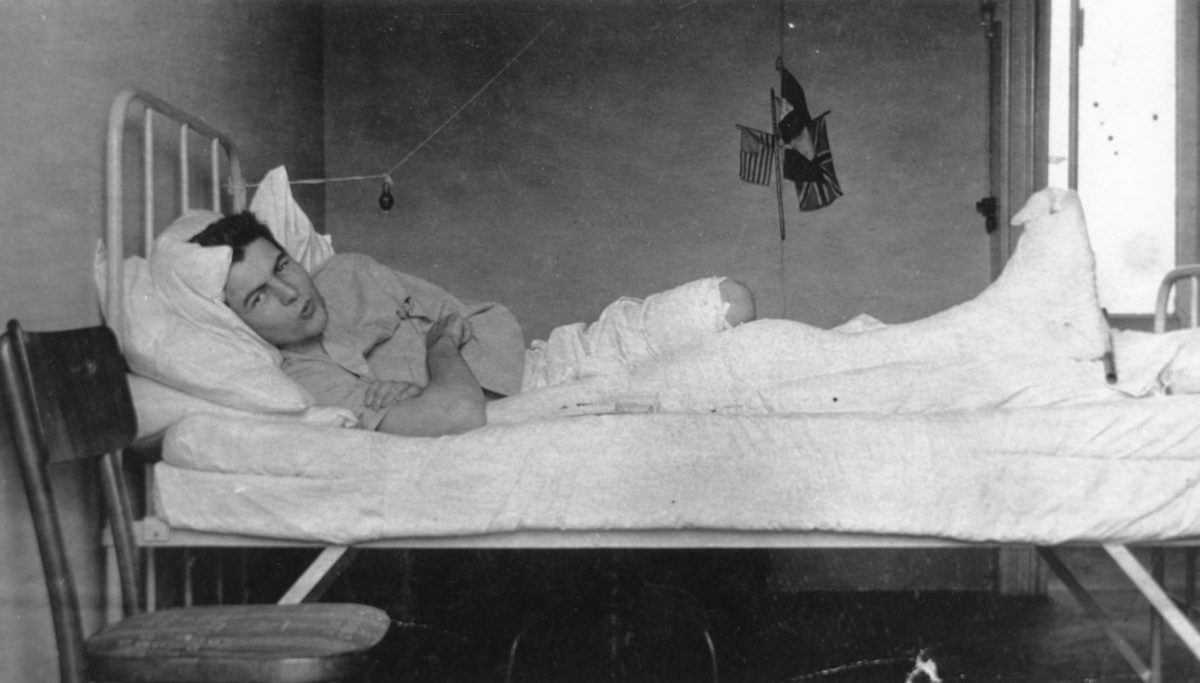
You likely know the basics: An American goes to Italy and enlists as a “tenente.” He drives a battlefield ambulance just before his nation enters World War I. He gets wounded. He meets a nurse at a hospital. He falls in love. He feels free as he recovers. He feels trapped as he returns to the front. He gets disillusioned. He flees. He finds her again. Bad things happen. But A Farewell to Arms is so much more than this. It is a heartbreaking love story. It is a remarkably subtle indictment of war. It shows how people bury their romantic longings behind duty and how there’s a greater bravery in fulfilling what you owe to your heart. It argues for life and love. Its final paragraph is devastating. It zooms along with masterly prose that is buried with treasure. It is one of the greatest novels of the early 20th century. This statement is not hyperbole.
It is now quite fashionable to bash Hemingway rather than praise him, as the flip Paul Levy recently did in his oh so hip and not very bright “hot take”: “The Hemingway corpus is full of artistic failure.” Well, sure it is. I’ve read it all three times at different periods in my life and I don’t think any honest reader would deny that. When I was an obnoxious punk in my twenties, I resisted Hem big time, feeling that he could not teach me to be a man in the way that James Baldwin and F. Scott Fitzgerald had, yet I somehow held onto his books, sensing that I could be colossally wrong. (I was.) Even today, I have to acknowledge that To Have and Have Not is an embarrassment. The Garden of Eden is an interesting but unconsummated train wreck. For Whom the Bell Tolls has its moments, but the Old English verbs and the lack of subtlety can be risible. I’ve never quite been able to leap into The Old Man and the Sea, but that says more about me than Hem. The upshot is that there are quite a few clunkers in Hem’s collected works and some of the Nick Adams tales ain’t all that, but one could make this claim about any author. In the end, when you have a masterpiece like A Farewell to Arms that never grows tedious no matter how many times you reread it, who in the hell cares about the misses? There’s no profit in calculating a shallow statement when the crown jewels shine bright in your face.

The other way that people ding Hem these days is by singling out his macho posturing or peering at his pages through the prism of unbridled masculine hubris. The naysayers dismiss Lady Brett Astley in The Sun Also Rises as an archetype without recognizing her enigma or the way she aptly epitomized the Lost Generation. They don’t acknowledge how Hem had to prostrate himself before Beryl Markham in a letter to Maxwell Perkins and that he did get on (for a time) with Martha Gellhorn, who neither suffered fools nor caved to condescension.

Yet there is certainly something to Hemingway’s women problem, especially as seen in the correspondence between Fitzgerald and Hemingway. In June 1929, F. Scott Fitzgerald sent Hem a letter and observed how, in his early work, “you were really listening to women — here you’re only listening to yourself, to your own mind beating out facily a sort of sense that isn’t really interesting.” (Hemingway’s reply: “Kiss my ass.”)

Scott’s warning remains a very shrewd assessment on what’s so fascinating and frustrating about Hemingway. I’d argue that one of the best ways to ken Hem is to recognize that he was a wildly accomplished giant when he placed his own ego last and that any transgressions that today’s readers detect only emerged when Hem became overly absorbed in his own self. And on this point, one can find a strange sympathy for the man, thanks in part to Andrew Farah’s recent biography, Hemingway’s Brain, which points to Ernest’s many head injuries (which included nine concussions) and concludes that he suffered from CTE, the brain disease seen in professional football players after too many years of violent tackles. This theory, which takes into account the decline of Hemingway’s handwriting in his latter years, would also offer an explanation for the wildly disparate writing quality and thus invalidates Mr. Levy’s foolish pronouncement.

* * *

The world breaks every one and afterward many are strong at the broken places. But those that will not break it kills. It kills the very good and the very gentle and the very brave impartially. If you are none of these you can be sure it will kill you too but there will be no special hurry.

A Farewell to Arms thankfully places us shortly after the rising sun of Hem’s career and, like its predecessor, the book contains razor-sharp prose, keen observations (ranging from Umberto Notani’s infamous The Black Pig, trains packed with soldiers, and the repugnant wartime indignity of a hopped up tyrant fiercely questioning a man who is fated to be shot), and a beautiful epitomization of the famous “iceberg theory” that Hemingway posited in Death in the Afternoon:

If a writer of prose knows enough of what he is writing about he may omit things that he knows and the reader, if the writer is writing truly enough, will have a feeling of those things as strongly as though the writer had stated them. The dignity of movement of an ice-berg is due to only one-eighth of it being above water. A writer who omits things because he does not know them only makes hollow places in his writing.

Much has been spilled over Hemingway’s declarative sentences, which are beautifully honed in this masterpiece. (Hem wrote 47 versions of the ending.) But I’d like to single out “was,” the most frequently used word in this novel. On a surface level, “was” is the most expedient way to hurl us into Frederic’s world: a simple verb of action and hard deets, but one that likewise deflects interior thought. It’s easy to dis Hem as a man’s man summing up life and the earth and the grit and all else that makes us want to ape him even though there can be only one, but the key to seeing the beauty of “was” is knowing that this book is all about pursuing a lost and deeply moving romantic vision, one kept carefully hidden from the beginning. Style advances the perspective and keeps us curious and lets us in and “was” is the way Hem gets us there.

Hemingway uses language with extraordinary command to clue us in on the distinct possibility that this story is in some sense a dream — indeed, a dream involving death based on what Hem was never able to make with the nurse Agnes von Kurowsky while holed up in a ward. There’s the makeshift hospital office, with its “many marble busts on painted wooden pillars,” which is further compared to a cemetery. In the novel’s first part, there are very few adverbs — save “winefully” early on and “evidently” and “directly” in the same sentence as guns rupture Frederic’s existence. The first rare simile (“seeing it all ahead like moves in a chess game”) occurs when Frederic first tries to kiss Catherine and is greeted with a slap (which Catherine apologizes for). This is a far cry indeed from what The Daily Beast‘s Allen Barra recently claimed, without citing a single example, as “flowery and overwritten.” A Farewell to Arms basks in the same beautiful realm between the real and the ethereal that The Great Gatsby does, albeit in a different landscape altogether, but it offers enough ambiguity to speculate about the characters while encouraging numerous rereads.

Language also carries the deep resonances of what people mean to each other. Catherine cannot stand a triple-wounded vet named Ettore and repeats “dreadful” twice and “bore” four times when she vents to Frederic. The words “She won’t die” are also repeated in one harrowing paragraph near the end. (Indeed, if you see a word or a phrase repeated in Hemingway’s fiction, there’s a good chance that something bad will happen.) Shortly after Frederic is moved to the freshly built hospital in Milan (itself a marvelous metaphor for the fresh start of Frederic’s blossoming love for Catherine), he takes to Dr. Valentini, who speaks in a series of short sentences over the course of a paragraph (a small sample: “A fine blonde like she is. That’s fine. That’s all right. What a lovely girl.”) and who Frederic later calls “grand.” The syntax, chopped and sheared and housed within manageable units, represents a telegraph from the human heart like no other.

Frederic acknowledges that he lies to Catherine when he tells her that she’s the first woman he’s loved. Now it’s tempting to roll your eyes over the “I’ll be a good girl” business that often comes from Catherine, but it’s also a safe bet to speculate that Frederic is likewise lying about what Catherine has actually told him, much as Hem himself has fudged the full extent of his “affair” with Agnes von Kurowsky through fiction. (“Now, Ernest Hemingway has a case on me, or thinks he has,” wrote von Kurowsky in her diary on August 25, 1918. “He is a dear boy & so cute about it.”)

An enduring romance is often built on a pack of lies. We often fail to recognize the full totality of who a lover was until we are well outside of the relationship. As for friendship, I’d like to argue that Miss Gage is a fascinating side character who stands up for this. She’s someone who ribs Frederic about not fully understanding what friendship is. Later, when Frederic returns to the front lines, Rinaldi tells him, “I don’t want to be your friend. I am your friend.” And if Frederic can’t recognize friendship, does he really know how to read the room when Cupid shows up with a puckish smile? Hem’s subtle acknowledgment of these basic truths allows us to trust and become invested in Frederic’s voice. And I’d like to think that even Hem’s opponents could get behind such idyllic imagery as Frederic and Catherine “putting thoughts in the other one’s head while we were in different rooms” or agreeing to sneak off to Switzerland together or even the funny “winter sport” business with customs. These are endearing and beautiful romantic moments that certainly show that Hem is far more than a repugnant hulk.

Love is a high stakes game, but it’s always a game worth playing. If you beat the odds, the payout is incalculable. Small wonder that the happy couple ends up throwing their lire into a rigged horse race. Indeed, Frederic’s early days with Catherine are a game like bridge where “you had to pretend you were playing for money or playing for some stakes.” For all of Frederic’s apparent confidence in not knowing the stakes, he does not reveal his name for a while — on its first mention, Frederic only partially spills his name as he is drinking. He is also more taken with the allure of being alone — as seen later in a Donnean nod when he says that “[w]hat made [Ireland] pretty was that it sounded like Island.” His loneliness is further cemented when Miss Ferguson says that Catherine cannot see him.

Is this the loneliness of war? We learn later that Frederic came to Rome to be an architect, although this is likely a lie, given that it is repeated a second time to a customs officer. But it does suggest that Frederic cannot build his own life without another. Perhaps this is the solitude that comes from the relentless pursuit of manly vigor (boxing, bullfighting, hunting) that Hemingway was to explore throughout his life? There is one clue late in the book when Hemingway writes, “The war seemed as far away as the football game of someone else’s college,” and another midway through when Frederic wonders if major league baseball will be shut down if America entered the war. (Fun fact: There was indeed a World War I deadline put into place, but the two leagues squeezed in numerous doubleheaders to ensure that the season could play out.) If the First World War arose in part because humanity was involved in a vicious game, then Hemingway seems to be suggesting that further games rooted in play and peace must be promulgated to restore the human condition. Frederic cynically quips to the 94-year-old Count Greffi, “No, that is the great fallacy; the wisdom of old men. They do not grow wise. They grow careful.” But if being careful is the true measure of existence, why then do we celebrate valor that often emerges from reckless circumstances? Indeed, Hemingway sends up the very nature of heroism up when Frederic wakes up in the hospital and is greeted by Rinaldi, who presses him to confess the specific act he committed to earn his medal. “No,” replies Frederic. “I was blown up while we were eating cheese.”

In an age where razor blade ads are urging us to question what manhood should represent, there’s something to be said about studying what’s contained within masculinity’s ostensible ur-texts and with how careful men are in saying nothing but everything. A Farewell to Arms is a far more sophisticated and deeply beautiful novel when you start examining its sentences and questioning its motivations. Caught in a mire between love and war, Frederic opts for the laconic rather than the prolix. And in doing so, he tells us far more about what it means to love and lose than most authors can convey in a lifetime.

Next Up: Nathanael West’s Day of the Locust!

The Face of Battle (Modern Library Nonfiction #81)

(This is the twentieth entry in The Modern Library Nonfiction Challenge, an ambitious project to read and write about the Modern Library Nonfiction books from #100 to #1. There is also The Modern Library Reading Challenge, a fiction-based counterpart to this list. Previous entry: The Strange Death of Liberal England.)

Thy fanes, thy temples to the surface bow,
Commingling slowly with heroic earth,
Broke by the share of every rustic plough:
So perish monuments of mortal birth,
So perish all in turn, save well-recorded worth;

— Lord Byron, Child Harolde’s Pilgrimage

I must confess from the outset that the study of armed human conflict, with its near Spartan fixation on tactics and statistics, has long filled me with malaise. It is among the least sexiest subjects that a polymath of any type can devote her attentions to, akin to cracking open a thick, limb-crushing tax code volume written in a way that obliterates all joy and finding a deranged pleasure within this mind-numbingly dull amalgam of numbers and turgid prose. As Margaret Atwood once quipped in a poem, the military historian says, “I don’t ask why, because it is mostly the same.” And when the song remains the same, why would anyone other than a ketamine fiend dance to it?

I’ve long pictured the military historian as some aging jingoistic white male whose idea of a good time involves blasting John Philip Sousa from a set of speakers that should be devoted to happening hip-hop: a lonely and humorless parasite who moves cast-iron figures across a threadbare map in some dusty basement, possibly talking to himself in a gruff tone that uncannily mimics Rod Steiger’s inebriated cadences. He seems overly enamored of the dry details of ordnance, mirthless arrows, and terrain circles. Perhaps he fritters away his time in some homebuilt shack far off the main artery of Interstate 76, ready to reproduce well-studied holes with his Smith & Wesson should any nagging progressive come to take away his tattered Confederate flag or any other paleolithic memorabilia that rattles his martial disposition. But let’s say that such a man is committed to peace. Then you’re left with his soporific drone as he dodders on about some long dead general’s left flank attack in the most unpalatable ramble imaginable. He prioritizes a detached tabulative breakdown over the more palpable and poignant truths that motivates men. He doesn’t seem to care about how a soldier experiences trauma or summons bravery in impossible conditions, or how these battles permanently alter nations and lives. The military historian is, in Napoleonic short, a buzz killer despite his buzz cut. Indeed, military history is so embarrassing to read and advocate that, only a few weeks ago, I was forced to hide what I was reading when a woman started flirting with me at a bar. (I sheepishly avoided revealing the title to her for fifteen minutes. Nevertheless, she persisted. And upon seeing The Face of Battle, the woman in question rightfully headed for the hills, even after I offered to buy her a drink.)

There are quite a few military history books on the Modern Library list. So I’m more or less fucked. It is not that war itself does not interest me. Human beings have been fighting each other since the beginning of time and only a soulless anti-intellectual fool resolutely committed to the vulgar act of amusing himself to death would fail to feel anything pertaining to this flaw in the human makeup. The podcaster Dan Carlin, who specializes in military history, is one of the few people who I can listen to in this medium for many hours and remain completely enthralled. But that is only because Carlin is incredibly skilled at showing how the paradigm shifts of war influence our everyday lives. Christopher Nolan’s Dunkirk was a remarkable film that hurled its audience into the dizzying depths of war, but this is merely a vicarious sensory experience. I can get behind Paul Fussell’s The Great War and Modern Memory (ML NF #75) because of that book’s cogent observations on how war influenced literary culture. Neil Sheehan’s A Bright Shining Lie (ML NF #84) remains a journalistic masterpiece that I very much admire — in large part because of its razor-sharp commitment to human psychology, which in turn allows us to understand the miasmic madness of making tactical decisions (see that book’s incredible “Battle of Ap Bac” chapter). But I’d hesitate to categorize either of these two brilliant volumes within the exacting genre of unadulterated military history. I’ve always had the sense that there’s an underlying bellicosity, if not an outright advocacy of warfare, with books that are exclusively dolled up in camo.

So upon reading The Face of Battle, it was something of a relief to see that John Keegan was up front from the get-go about what military history fails to do, and why accounts of battles are so problematic. He begins the book saying that he has never seen or been in a battle. And this is a hell of a way to open up a book that professes to give us the lowdown on what war is all about. It is a genuinely humble statement from someone who has made a career out of being an expert. He openly points to military history’s major weakness: “the failure to demonstrate connection between thought and action.” “What of feeling?” I thought as I read this sentence. According to Keegan, historians need to keep their emotions on a leash. And the technical example he cites — the British Official History of the First World War — is an uninspiring passage indeed. So what is the historian to do? Quote from the letters of soldiers. But then Keegan writes, “The almost universal illiteracy, however, of the common soldier of any country before the nineteenth makes it a technique difficult to employ.” Ugh. Keegan!

From Ilya Berkovich’s Motivation in War: The Experience of Common Soldiers in Old-Regime Europe:

Considering the social origins of most eighteenth-century soldiers, one might think that literate soldiers were uncommon. However, literacy among the lower classes in old-regime Europe was becoming less exceptional. It is estimated that up to 40 per cent of the labouring poor in Britain were literate. Between 1600 and 1790, the portion of French bridegrooms singing their parish records doubled to about half of the total male population. Interestingly, the corresponding figures in northern and eastern frontier regions, which provided most French recruits, were much higher, with some areas coming close to universal literacy. Literacy rates in the Holy Roman Empire fluctuated widely, yet it is telling that over 40 per cent of the day labourers in mid-century Coblenz were able to sign their names. In rural East Prussia, one of the poorest regions in Germany, comparable figures were reached in 1800, although this was still a fourfold increase compared to only half-a-century before….

And so on. Fascinating possibilities for scholarship! It seems to me that someone here did not want to roll up his sleeves and get his hands dirty.

You see the problems I was having with this book. On one hand, Keegan wants to rail against the limitations of military history (and he should! you go, girl!). On the other hand, he upholds the very rigid ideas that stand against the execution of military history in a satisfying, fact-based, and reasonably emotional way that allows voluble chowderheads like me an entry point.

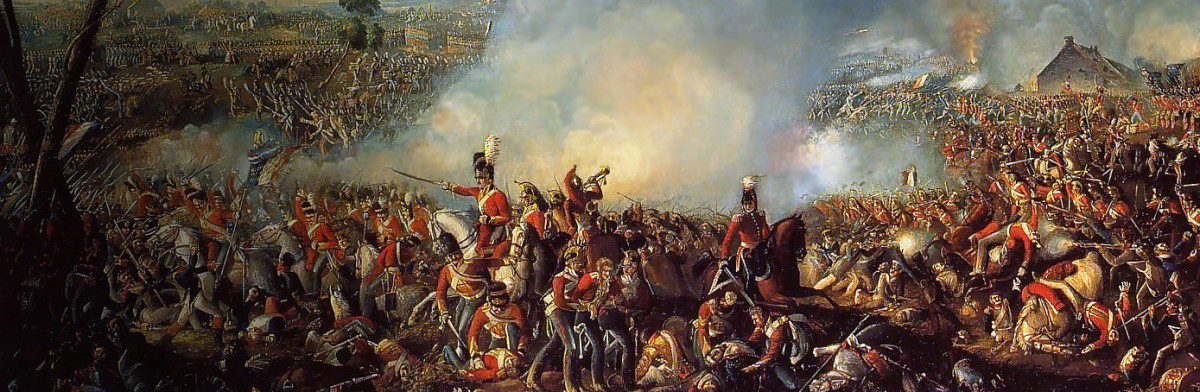
But that’s not the main focus of this book. Keegan settles upon three separate events — the Battle of Agincourt on October 25, 1415, the Battle of Waterloo on June 18, 1815, and the first day of battle on the Somme (July 1, 1916) — to seek comparisons, commonalities, and various parallels that we might use to understand military mechanics. He is duly reportorial in each instance, but overly fond of taxonomy rather than tangibility. Still, there are moments when Keegan’s bureaucratic obsessiveness are actually interesting — such as his examination of British archers and infantry running up against French cavalry during Agincourt. After all, if a horse is charging its way into a man, either the horse is going to run away, men are going to be knocked down, or there’s going to be a “ripple effect” causing open pockets on each side of the horse. So it’s actually quite extraordinary to consider how the French got their asses kicked with such a clear advantage. Well, the British did this with stakes, which impaled the horses. And the threat of this obstacle caused the French to retreat with their backs to the British, resulting in archers lobbing arrows into their vertebrae.

Keegan informs us that “the force of unavoidable circumstances” sealed the fate of the French and allowed Henry V to win at Agincourt. When Keegan gets to Waterloo, we see a similar approach adopted by Napoleon near the end. Large crowds of French infantry rushed towards the British line, landing within mere yards. The two armies exchanged fire and the French, at a loss of what to do, turned around and fled. This was not an altogether smart strategy, given the depleting reserves that Napoleon had at his disposal. But it does eloquently demonstrate that battles tend to crumble once one side has entered an unavoidable choice. The rush of men on both sides at the Somme in 1916, of course, in the trenches not only escalated this to an unprecedented scale of atrocity, but essentially laid down the flagstones for the 20th century’s practice of mutually assured destruction.

These are vital ideas to understand. Still, I’m not going to lie. Keegan was, in many ways, dull and soporific — even for a patient reader like me. I learned more about Henry V’s campaign by reading Juliet Barker’s excellent volume Agincourt, which not only unpacked the incredible logistics of invading northwestern France with engrossing aplomb but also juxtaposed this campaign against history and many vital realities about 15th century life. And a deep dive into various World War I volumes (I especially recommend Richard Aldington’s surprisingly ribald novel, Death of a Hero) unveiled a lot of unanticipated sonic transcriptions that inspired me to draft an audio drama script that I hope to produce in a few years. Keegan is certainly helpful in a dry intellectual manner — the equivalent of being served a dull dish of desiccated biscuits when you haven’t eaten anything for days; I mean, there’s a certain point in which you’ll gorge on anything — but he’s not the man who inspired me about battle. Hell, when one of the most boring and pretentious New Yorker contributors of all time espouses Keegan’s “matchlessly vivid pen,” you know there’s a reason to hide beneath your blanket. Keegan is undoubtedly on this list because nobody before him had quite unpacked war from the bottom-up approach rather than the general’s top-down viewpoint. But like most military historians, he didn’t have enough of a heart for my tastes. There’s a way to present a detailed fact-driven truth without being such a detached fussbucket about it. And we shall explore and exuberantly praise such virtuosic historians in future Modern Library installments!

Next Up: Erwin Panofsky’s Studies in Iconology!