Posts by Edward Champion

Edward Champion is the Managing Editor of Reluctant Habits.

Roundtable Discussion Coming in September

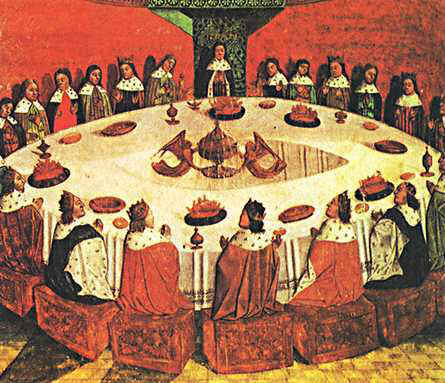
knightsround

As any person keeping tabs on the publishing industry knows, there are so many high-profile books coming out this year that it’s difficult for some of the books that aren’t written by Thomas Pynchon, William T. Vollmann, and Nicholson Baker (as good as these authors are) to get the credit they deserve.

It has therefore become necessary to unleash yet another roundtable discussion for a particularly exciting title sometime during September. For those readers who have enjoyed our previous roundtable discussions of Richard Powers’s The Echo Maker, Nicholson Baker’s Human Smoke, Eric Kraft’s Flying, Ellen Ruppel Shell’s Cheap, and various other books, this September symposium will operate along similar lines.

I cannot reveal the book at this time. But I can tell you that the book is a highly ambitious novel. I can also tell you that there are eight vowels in the book’s title and three counts of one letter in the author’s name.

I should have more details about the book in question when we get closer to pub date. And we’ll reveal the book early enough so that those wishing to follow along can do so.

An End to Permanence?

WordPress informs me that 2,831 posted entries on this blog are presently “Uncategorized.” If I possessed some tremendous treasure trove of expendable income — for time, as we all know, is the only commodity presently tradeable among regular people — I might very well sort through these entries and eventually finish the long duty of corralling these stray textual swine to their taxonomic holding pens. But, even assuming that these entries were feral animals deserving of such virtual domestication, a position that is highly questionable, the journey wouldn’t end there. One sifts through these past posts knowing that the links are, in most cases, invalid and therefore useless to anyone hoping to follow a thread or pursue a path to knowledge. The Wayback Machine only takes us so far. It was fond of taking snippets of websites every six weeks or so in the early noughts. There are, for example, eight snapshots of this website as it existed in 2001. And I don’t know what’s more embarrassing: (1) the needless braying of a young man in his mid-twenties confessing his failings with women and his predictable liberal leanings or (2) the fact that the “archived” site didn’t correctly extract the code, causing one 2001 “snapshot” of this website to crash within Firefox’s most recent iteration.

Such past peregrinations perhaps place an undue importance on what I wrote at a particular time. I read my own thoughts and feelings and wonder who the hell this guy is and why so many people believed in my bullshit at the time. There is a temptation to kill the early entries that are even now still publicly available on this domain. (Indeed, when Return of the Reluctant — as this site was then called — “returned” in December 2003, it did so with the proviso that everything written before that time never happened. The impulse to destroy one’s own work is so casually cavalier!) Some of those entries are locatable on my hard drives, but I wasn’t nearly as precise with my archiving and backups as I might have been. So how many thousands of words have been lost forever? Half a decade later, I’m not sure that I would approve of my extirpating twentysomething self. And there are likewise entries written by me even three years ago which I presently do not approve of. But I now find myself required to preserve everything — the posts, the comments (even the nasty ones), et al. But let’s say that I were to be killed by a car tomorrow. Would anybody even bother to preserve this website? Would any of this website be preserved? Would it even be worth preserving? Maybe I will indeed puff up and die, as The Anthologist‘s Paul Chowder suggests.

Even some of the data recorded on third-party sites and featured on these pages, such as the now-defunct AudBlog, is not recoverable. While I became better at using common data formats and hosting the content on these pages over the years, I have proven, like many people creating things on the Internet, exceptionally optimistic that many websites will stick around. If YouTube were to somehow fold tomorrow, then numerous embedded videos — a number of which reflect my own creative efforts — would be as useless as the few 5 1/4″ diskettes I still have in a file cabinet containing thoughts, essays, and writings from twenty years ago. It’s probably all juvenalia. But maybe there’s some vital thought or feeling in there that I wasn’t quite ready to take on.

William T. Vollmann has amusingly styled websites as “a particularly hated category” in his endnotes for Imperial. I believe his enmity to originate largely from the lack of permanence, our common failure to note a set of thoughts and feelings expressed at a particular point in time. We’re not just talking about preserving words. There’s also a type of moderation that goes over the line. There are at least six websites that I have stopped visiting — a number of them that boast of being “civilized” places — because their immature proprietors saw fit to delete my critical but by no means trollish comments. Some thoughts are better left unspoken or censored. How many uncomfortable truths are lost to tomorrow’s historians because of these knee-jerk impulses?

At the risk of echoing bigoted reactionaries like Andrew Keen, Lee Siegel, and (soon) John Freeman, there remains a double-edged sword. How many of our immediate thoughts should be loosened from our minds? I must again applaud Twitter for ratcheting up the speed and limiting the number of characters, thereby solving several expressive problems. My stupid thoughts and immediate expressive impulses now have a home there, for better or worse. And these ostensible “blog entries” have transmuted from ephemeral roundups into lengthy essays. But who am I to judge the quality? Historically speaking, people have been less interested in what I often spend several hours writing and researching and have been decidedly more intrigued with something I’ve assembled in 20 minutes. (The problem, incidentally, isn’t limited to blogs. John Banville has recently raised his objections to such perceived apartheid.) Perhaps the “rushed” writing is better. (For any stopwatch enthusiasts in the peanut gallery, I have now spent about 75 minutes writing this post.) Or perhaps we can only make distinctions based on the temporal commodity observed at the onset of this essay.

Perhaps this is too much introspection. My own thoughts on these very important issues may not mean anything to you. But at least I have the solace of knowing precisely how I felt on the subject on August 3, 2009. It is very probable that I will feel differently in a few hours. The text here may not be permanent, but I am doing my best to pretend that I am throwing a packed bottle into a sea. Should I change my mind later in the week, I will certainly do my best to note it. Such “journalism” may be the only way to mimic textual permanence. But no matter what the form, it remains our duty to preserve. Human minds and hearts change, but if we hope to witness these magical developments, then we must do better.

Are Bookstores Being Too Censorious With Author Events?

Jennifer Weiner is a best-selling author. And while her latest novel, Best Friends Forever, proved popular enough to hit #1 on the New York Times bestseller list, this didn’t stop a Barnes & Noble bookstore in Framingham, Massachusetts from raising a censorious eyebrow.

Some bookstores have begun instituting informal policies which preclude authors from using four-letter words during a public reading. And even dependable draws like Weiner are being asked to hold their tongues. These developments — reflected most recently in the Weiner case — raise new questions about just how much an author is allowed to get away with in the 21st century and whether bookstore policies that are understandably intended to protect children are going too far.

The trouble for Weiner began when she playfully announced the “potty-mouthed” nature of her Best Friends Forever book tour on Twitter. Shortly after her Philadelphia reading, Weiner later tweeted that she had received a warning:
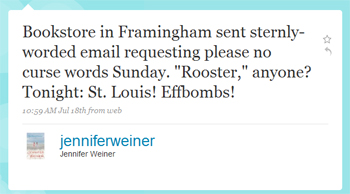
weinertweet

Weiner carried on with the Framingham gig without setting off any F-bombs, and applied her saucy language instead to the inscriptions. (After tweeting about the Framingham event, the organizer of a subsequent off-site event in St. Louis encouraged Weiner to be extra raunchy.)

“I can’t imagine it’s a blanket B&N policy,” said Weiner. “I kicked off the Best Friends Forever tour at the Barnes & Noble in Lincoln Triangle in New York City, and I said ‘cock’ like nine times and told a story about a Hitachi Magic Wand, and the manager seemed perfectly okay with it (my poor editor, who brought her parents to the reading, not so much). As much as I’d like to turn this into a ‘corporate stiffs censor freewheeling lady writer because the world hates it when a lady succeeds’ story, I honestly think it was just this one bookstore, that one afternoon, making a not-unreasonable request.”

A list of questions was sent to Mary Ellen Keating, Barnes and Noble’s senior vice president of corporate communication and public affairs. But there was no response. I was able to reach Margaret Moore, the community relations manager of the Framingham store, by phone. But she was extremely nervous, even when I assured her that I was merely determining questions of policy. I did receive a return phone call from Maddie Hjulstrom, a regional community relations manager at Barnes and Noble, who was gracious enough to talk with me.

Hjulstrom informed me that the email had been sent by Moore when Moore had “learned that Ms. Weiner’s language was colorful at her discussions.”

According to Weiner, the Framingham controversy arose out of concerns that the reading area was adjacent to the children’s section and that Weiner’s scheduled reading time — 3:00 PM — would be too early to account for the hallowed ears of tots.

“Because the event was on a Sunday afternoon,” said Weiner, “I think the bookstore managers reasonably expected that there would be kids there, and felt that they could reasonably ask me to tone down the cussing.”

This was confirmed by Hjulstrom, who told me that the objections had to do with the microphone’s close placement to the children’s department and the possibility that Weiner’s amplified words might drift like cigarette smoke into a 1980s restaurant’s nonsmoking section.

“We want to be respectful of young families and children,” said Hjulstrom. “We don’t regulate where children are in our store. At 3:00 PM, it might be a problem.”

Had Barnes & Noble ever received any customer complaints because of an author or a poet using salty language during a reading? Hjulstrom told me that she couldn’t give me an example of the Framingham store having received a single customer complaint, but that the region, as a whole, had received a few complaints.

The Barnes & Noble “no salty language” policy is, according to Hjulstrom, “not a written policy, just common courtesy.” It is something that is determined on a case-by-case basis.

“All we can do is ask,” said Hjulstrom. “We don’t enforce. We don’t kick them out of their store. We just ask them to respect the children who are in the stores.”

I asked Hjulstrom what might happen if an author used salty language, but did not receive a single customer complaint.

“I’m not comfortable going into what ifs,” replied Hjulstrom. “I just want to deal with the facts.”

But the prohibition causes one to wonder why bookstores — even with the possibility of a child lurking around a bookstore late at night — would be so offended by a monosyllabic exclamation that anyone who has ever stubbed a toe is quite familiar with. Were there efforts by Weiner and Barnes and Noble to broker a last-minute deal?

“We didn’t try to broker a compromise mostly because there wasn’t time,” explained Weiner. “The best solution would have been either to hold the event somewhere else, or after dark, and with just over twenty-four hours, on a weekend, to either reschedule or relocate, that just didn’t seem feasible. And again, once I got over my reflexive ‘the MAN is trying to SHUT ME UP’ paranoia, it didn’t seem like a crazy thing to ask. I’ve got little kids, and if I took them into a bookstore on a Sunday afternoon to pick up the latest Sandra Boynton or ‘Junie B. Jones,’ I probably wouldn’t be thrilled to find some lady standing behind a microphone talking, as I tend to, about ‘wall-to-wall cock.'”

Still, independent bookstores such as San Francisco’s The Booksmith have conducted numerous author events in its children’s section, closing the section off to make room for the audience to sit down. Booksmith co-owner Praveen Madan informed me that, while there are generally no kids around at the time of the event, his bookstore doesn’t make any concessions if an event takes place in the middle of the day.

“We take freedom of speech very seriously and even the suggestion of us laying down any kind of censoring guidelines for authors makes me cringe,” said Madan. “And the issue here is more than freedom of speech. We believe it’s important for authors to be authentic and credible, and sometimes being authentic requires saying things that might end up offending some people. I would rather shut down the bookstore and sell falafels than try to engineer an author’s talk to make the author more palatable for a certain audience. You should be clear about what business you are in. We are in the business of intellectual discourse and opening people’s minds to new ideas and possibilities. If you want to be in the business of reinforcing people’s existing belief systems, than you should run a religious institution or radio talk show, not a bookstore.”

It’s also worth observing that prohibitions on what an author can say at a reading can sometimes have unexpected side effects. As Tayari Jones observed on her blog recently, the author can feel oddly shamed when contending with a complaint.

Jessica Stockton Bagnulo, formerly of McNally Jackson and now working hard to open the Greenlight Bookstore in Fort Greene this autumn, says that there was never a policy prohibiting language or controversial topics at an author event when she worked at McNally. But she did mention that she hoped to be more sensitive to such matters at Greenlight.

“We don’t intend to set any blanket policy,” said Bagnulo. “I think for the most part we will trust our customers to know whether an author is going to be inappropriate for their children or potentially offensive to their own sensibilities. As long as we make clear from the outset what the event is likely to contain, we won’t try to restrict or prohibit authors from anything they’d like to say.”

Even if the event is scheduled in the middle of the day?

“Not unless it’s an event specifically geared toward kids,” replied Bagnulo. “For example, at McNally we held a Halloween event that had kids programming earlier in the day, and some adult authors reading later that had lots of graphic blood and gore.”

Before the Framingham incident, Weiner had never received any complaints from a bookstore for her act. But censorship issues aren’t limited to the big box stores. Weiner alluded to an incident that came from an ostensible independent:

“In 2001, when Good in Bed came out, I did hear from one independent bookstore somewhere in the Midwest that an older gentleman had objected to a cover featuring the book’s poster (naked legs and cheesecake) in the window. But that’s as close to censorship as I’ve come.”

For what it’s worth, Weiner did say that she would do an event at the Framingham bookstore again: “I’d just make sure it was an evening event, or that it was held somewhere far, far away from the innocent ears of children.”

“In general, we feel that authors these days have become rather conservative and risk averse because they are trying to become bestsellers and are afraid of stirring controversy,” said Madan. “I wish more authors would pick topics that might be controversial and not worry about offending people. There are important topics being ignored and we all tend to surround ourselves with people we agree with and we like.”

“I think that indie bookstores work to create an environment of mutual respect between authors and audiences,” said Bagnulo, “where what is controversial is taken in context as part of the conversation, and there’s enough transparency of intention that people are unlikely to be offended.

“It’s not a bad idea to mention ahead of time, ‘Hey, I work blue,'” said Weiner, “but it’s never been a problem in the past, and I don’t really expect it to be a problem going forward.”

The Bat Segundo Show: J. Robert Lennon

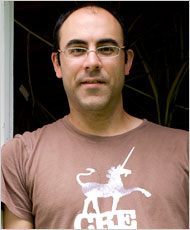
J. Robert Lennon appeared on The Bat Segundo Show #300.

J. Robert Lennon is most recently the author of Castle and Pieces for the Left Hand.

segundo300

Condition of Mr. Segundo: Contemplating his surprising longevity after 300 shows.

Author: J. Robert Lennon

Subjects Discussed: Ending sentences with nouns, how location affects character description, objects and places as the territory of a story, how the land in upstate New York inspires narrative, objects that regular readers can relate to, lost childhood, lost parents, more isolated characters in Lennon’s later novels, meals in fiction, antipodean metaphors within Castle, working with a narrative juxtaposed against a cultural-historical symmetry, Stanley Milgram, Vietnam and Iraq, whether Loesch’s actions are exonerated by historical injustice, the white symbols and black redaction throughout Castle, cutting down on pre-planning novels and trusting the subconscious, whether we’ll ever see the full version of Happyland, restarting a writing career multiple times, dealing with marketing forces, accessibility, Stewart O’Nan, New York publishing biases against small towns, the unexpected American publication of Pieces for the Left Hand, how naps permitted Lennon to finish Pieces for the Left Hand, relying on anecdotal culture for narrative, long thin environments within Lennon’s novels, survivalist novels written in dark, evil writing labs, the “gray”/”grey” controversy, and batty character surnames close to specific words.

EXCERPT FROM SHOW:

jrlCorrespondent: You seem to veer between these really lonely tales and these outright satirical tales. After the whole incident where your novel got serialized at Harper’s, I’m curious if there’s some hesitancy on your part to pursue satire. Is that why Castle‘s so dark?

Lennon: No, no, no.

Correspondent: Why bounce around tonally?

Lennon: I had written Mailman and Happyland in sequence. I was in that antic black comic mode for a while. Which I think is kind of my default mode. I like to think that I go away from it for a few books. I do something very different. And then, whatever I learn there, I bring it into default mode. I mean, right now, I’m writing a book that has a large cast of characters with some manic satirical elements. And, in fact, it’s a family book. Except it’s the opposite of the other family books. It’s not that family members are missing. It’s that there are too many of them. It’s a big ad hoc family that has come together in spite of the unlikelihood of that happening.

Correspondent: It’s interesting. Because I thought you were going to give me the James Ellroy line for this book.

Lennon: Oh?

Correspondent: You know how he says, “It’s fun for the whole family…if you’re the Manson family.” He does this every time he sells a book.

Lennon: (laughs)

Correspondent: But I mean, that’s interesting. I should also point out with Eric, there is nevertheless a strange absurdism to his need for having things in place. And, in fact, and I’m sorry to just throw a bunch of things at you at once, I wanted to ask about the two meals he eats, which are essentially bipolar. You have this really greasy cheeseburger. And then he goes and he eats this vegetarian meal. So it’s almost as if his choices are reflective of not being able to fit into the middle of these two antipodean ends. And I’m curious how much this was a part of devising the character. Having specific locative places like this that he couldn’t inhabit. The middle ground.

Lennon: Well, I think the problem with him is that he can’t inhabit the world. And I wanted to have a scene with him twice, where he had to go and eat something, and he would take that opportunity to sit and think about things for a few minutes. And it occurs to me, “Where does this guy eat?” He’s so abstract. He’s so detached from human life — or this is how he presents himself anyway — that the notion of him eating a cheeseburger is just ridiculous. And it was only later I realized, there’s nothing I could have him eat that would seem right. Because he’s not the kind of person that goes to a restaurant. He’s the kind of person that exists in this sort of dark, violent abstraction as a dark, violent abstraction. I mean, this isn’t an explicitly comic book by any stretch, but I found these scenes to be kind of funny to write. I mean, he’s at the Vegan place!

Correspondent: Well, there’s also this notion too of him fixing the renovations on his house under time, which is interesting in light of the fact that you do mention Iraq in this book. And, of course, Iraq has no timetable. So I’m curious again about these points of disparity throughout the book. How many of these were designed along these lines? There’s also the symmetry, of course, of his very predicament. Here he is. Something terrible has happened to him. And he, in turn, has become someone who has done something terrible as well. So I’m curious. At what point during the conception or the writing of this novel were you aware? Or did you design such symmetry?

Lennon: The Iraq thing came first. And it was only after my wife was reading an article in Weird NJ — the magazine — about a guy who finds a castle in the woods while walking through the woods that it occurred to me that this should be the setting for this book that I had in mind. Like she was the one who told me that that was the setting for the book I had in mind.

Correspondent: Really?

Lennon: Yeah, and when I started thinking about this guy, I was reading a lot of Kazuo Ishiguro. You know, how his narrators are — they’re liars really. Nothing dishonest, but they’re creating a reality for themselves that’s appealing to them. They’re justifying their actions. They’re justifying the things that are happening around them in a very self-serving way. I’m just going to write a first-person narrative like that. Not unreliable, per se. But it’s the sound of a guy who’s done something wrong convincing himself that there isn’t any ambiguity about it.

BSS #300: J. Robert Lennon (Download MP3)

This text will be replaced

The Bat Segundo Show: Douglas Rushkoff

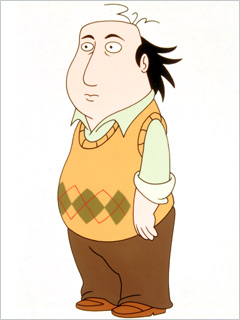
Douglas Rushkoff appeared on The Bat Segundo Show #299.

Douglas Rushkoff is the author of Life, Inc.

segundo299

Condition of Mr. Segundo: Surprised to discover someone more contentious than he is.

Author: Douglas Rushkoff

Subjects Discussed: The wage labor system established in Portugal in 1253, Daily Life in Portugal in the Late Middle Ages, whether the day laborer can stand up, children and branding, people who attend Wealth Expo, the real estate market, pyramid schemes, The Secret, Maslow’s hierarchy of needs, the relationship between self-actualization and helping other people, social interaction, Rushkoff publicly announcing his “anonymous” good deeds, Rushkoff’s anger and crazed speculations on whether or not the Correspondent is a journalist or a Colbert-like persona, why Rushkoff couldn’t just walk into a Westchester school and drop off some comics, the WTO and Ricardo’s theory of comparative advantage, whether Ricardo (and Paul Samuelson) is applicable to individuals and small businesses, the applicability Nash equilibrium, game theory and behavior, the meaningful life metric, cultural values of the 19th century and the home as a fiefdom, most of the world population now living within cities, New York City’s development, whether or not regular people can afford to live in the city, Birkdale Village, NC and New Urbanism gone awry, Rushkoff’s judgment on places for community, tangents about whether a Mickey Mouse watch purchased at Disneyland is real, what “real” is now about, whether brands represent a legitimate common connection, the consequences of viral marketing and Rushkoff not striking it rich, why Rushkoff opted to publish with a corporation, whether or not the Correspondent is “mean,” and whether or not this is the worst interview Rushkoff has done.

EXCERPT FROM SHOW:

Correspondent: You write, “A kid’s selection of sneaker brand says more about him than his creative writing assignments do and is approached with greater care.” Let me ask you something, Douglas. Do you remember the brand name of the high school sneaker that you wore?

Rushkoff: I do.

Correspondent: Really. What was it?

Rushkoff: I wore Keds. And then I wore this JC Penney brand. But by high school, I was in Scarsdale. And everybody else wore Pumas and Adidas. And we just wouldn’t spend the money We couldn’t spend the money on it. Because my parents had spent everything they had to get us into that neighborhood. And I was teased actively and relentlessly. Because I had a fox on my shirt instead of a little alligator.

rushkoff2Correspondent: But the writing that you did. The times that you had. Surely now, decades later, you remember those times. They matter more to you than the brand name on that sneaker. And not only that. But it seems to me that you had a situation. I had a similar situation in terms of having hand-me-downs and that kind of thing.

Rushkoff: But I went to high school before MTV. I went to high school before this hyper-branded universe even happened.

Correspondent: But such a statement is a bit of a generalization. Do you think that this applies to everybody? Every high schooler?

Rushkoff: No.

Correspondent: Okay, well then why….

Rushkoff: Why do you pull out a single sentence from a book and try to say that my entire argument is based….

Correspondent: I’m trying to figure out where you’re coming from in terms of how this branding….

Rushkoff: I’m saying that if you talk to most high school kids about the amount of effort that they put into a paper and how much they thought about it — try and have a deep conversation with them about a paper — and then have a deep conversation about which brand of tennis shoe they bought and why. It doesn’t mean they’re stupid. It means that they have more depth of knowledge and experience and thought into who is Nike, what does Nike mean, what is the brand image mean than what did Abraham Lincoln do with the railroads in that paper I just wrote.

Correspondent: Even inner-city kids, you would say? Or kids who have parents — like your situation growing up — that don’t have the option of putting hundreds of dollars out for a high-brand sneaker.

Rushkoff: I don’t think. I think in many cases the poor have more relationships with those brands than the wealthy.

Correspondent: I ask this question in light of other examples that you use in this book. You attend a Wealth Expo at Jacob Javits.

Rushkoff: Right.

Correspondent: And you conclude that a lot of the people who attend this expo were there to essentially improve their circumstances. They were almost rube-like.

Rushkoff: Right. I don’t think that the people going to Wealth Expo are spending the two or five hundred dollars to have a cynical entertainment experience, or to laugh at Trump. I don’t think they really are getting it as, “Look at this funny bizarre cultish situation.” I think they are there in earnest. I think they want to make money by going.

Correspondent: But I’m wondering. Wouldn’t your scope have been broadened if you had followed, say, Charles and Sandra two or three years later to see if someone actually got money out of these DVDs that were thrown into the audience? I mean, I didn’t see in the book any positive results from Wealth Expo and I’m wondering if you were able to determine any over the course of your peregrinations and your inquiries.

Rushkoff: I was more interested in the Wealth Expo as a phenomenon. I was more interested – I mean, it’s true. We should follow The Secret. It is possible that the people who are using The Secret are developing a spiritual path through which humanity is going to be saved. It is possible. You know, and it’s not — I think that the probability of it is so low that I don’t want to dedicate my life to pursuing that. I think that it is such a blatant scam that it doesn’t even deserve that long-term sociological study. But anyone who wants to go do that, I welcome them to do that. I was more interested in the fact that even after the real estate crisis — now it is my belief and you don’t have to buy this either — it is my belief that it has been revealed that many banks and many Americans made some mistakes in the real estate industry and in mortgage banking. And you can argue this one. But I think that it has been almost proven that there’s a crisis of foreclosures and mortgage-backed loans. And those kind of things have turned out not to work the way they were planned to. And I think that’s almost accepted.

The Wealth Expo that I went to, which was happening after the mortgage crisis, was trying to teach people how to take advantage of other people going into foreclosure. Most of the people I spoke to at the Wealth Expo were people who were in foreclosure. So they were looking at how to try to make money off of people who were about to go through the same thing that they did. And at an event that had fairly accepted charlatans with Jack Canfield and Donald Trump and, you know, get-rich-quick real estate DVD schemes that you see on TV at night. You know. Flip that house. That they shared the stage with Alan Greenspan was fascinating to me. Because I feel that he understands that this really is the real estate market. And maybe it will work. Maybe you’re right. Maybe the way to get through it is to scam. Let’s join Amway. Let’s join Mary Kay. Let’s create pyramid schemes and MLMs. Let’s flip this house. Let’s build something out of nothing. And maybe there’s another few laps in that horse yet. Okay. Go for it. If you believe it.

Correspondent: Well, it seems to me…it seems…

Rushkoff: I think the opportunity rather is to consider whether there are Americans who might choose to create value with their work. To make something. To provide a good or service to someone. And that there’s still time to build an economy on the exchange of value between people rather than pyramid schemes.

Correspondent: But this pyramid scheme. The Secret. The Wealth Expo. Whatever. Amway. People are still going to these things. They’re flocking to these things. This may, in fact, stand against your people-based economic solution that you’re suggesting here and at the end of your book. But…

Rushkoff: Why is that? I don’t understand. So you’re saying — so that lots of people in a country end up killing other people. So that stands against the logic that people might have fun not killing each other.

Correspondent: Maybe you could…

Rushkoff: Well, what are you saying?

Correspondent: Well, what I’m asking here. Perhaps you could explain why people continue to flock to things like The Secret while the 600 years that you document in this book demonstrate that corporations are essentially in control and exploiting….

Rushkoff: The Secret is corporate! What do you think The Secret is? You think that The Secret is a bottom-up, home-spun, let’s hold hands and reclaim America movement? No. What The Secret is is a set of instructions for people to assume the same posture as corporations. To create wealth by thinking it. I think the reason. The very reason why people do flock to a pyramid scheme supporting philosophy like The Secret is because they have internalized the logic of corporatism. Because they think that the idea of actually doing something for someone, of actually lifting, is obsolete.

Correspondent: You go after Maslow in this. Do you think Maslow’s a pyramid scheme?

(Image: WNYC)

BSS #299: Douglas Rushkoff (Download MP3)

This text will be replaced