Posts by Edward Champion

Edward Champion is the Managing Editor of Reluctant Habits.

The Bat Segundo Show: Kathleen Collins

Kathleen Collins appeared on The Bat Segundo Show #290.

Kathleen Collins is most recently the author of Watching What We Eat.

segundo2901

Condition of Mr. Segundo: Contending with traumatic cooking show associations.

Author: Kathleen Collins

Subjects Discussed: TK

EXCERPT FROM SHOW:

kathleencollinsCorrespondent: I should probably start this conversation off by confessing something to you. I think that Rachael Ray is a bit on the crazy side. She’s not someone who really makes me comfortable. I’m actually quite frightened by her. You know, I don’t find her down-to-earth at all. And I think maybe we can start off by describing how we went from this relatively benign cooking show setup, in which you had a quieter, less frenetic impulse, to this more exhibitionistic cooking show that involves a Jerry Springer-like audience shouting for the EVOO and all that. How did we get from one extreme to the other? Do you have any fundamental observation throughout the course of your meticulous observations?

Collins: I do. Although first I have to address your fear of Rachael Ray. Of which I don’t think you’re alone. I can’t remember where I read it. But I heard somebody liken her to Shrek. I don’t know if it was physicality. Or the monsterness. But you’re not alone. I mean, there are people who absolutely adore her. And they’re usually moms. Somebody’s mom who loves her. But otherwise I think, yeah, she can be pretty scary. How we got to that from, let’s say, the home economists of the 1940s and ’50s?

Correspondent: Yeah.

Collins: Long story. I mean, that’s basically what I tried to cover. And it was just a gradual process from the early days of cooking shows where it was all about selling the sponsor’s products. And let’s just use this kitchen space that we have in our studio. Let’s sell this refrigerator. How are we going to fill the time? Well, this is a cheap thing to do. Let’s have some home economists in here and whip something up. Very dry. And then gradually though, they would add some spiciness. There were some shows in the ’50s that had a little entertainment in them. There was Chef Milani out of Los Angeles. And his show was almost slapstick. There was a lot of comedy in it. So for the most part, it was the home ec ladies in the early days. Very, very gradual. Adding entertainment elements. But things didn’t really change until the entertainment aspect really came on with Graham Kerr. The Galloping Gourmet in 1969. At least 1969 in the U.S. Julia Child, everyone will tell you they were in love with her. They were completely entertained by her. But that was not her sole purpose. That was not her purpose at all. She just happened to be extremely charming and lovable. And there’s been no one like her since. So, you know, as soon as the Galloping Gourmet came on the scene and people saw what you could do with the cooking show, it was sort of a light bulb going off. And then other people tried to do it. But none of them for a while. You know, there was a dry spell.

Correspondent: Yeah. But there’s a fundamental difference between Graham Kerr leaping over the divide.

Collins: And leaping over the chair.

Correspondent: Yeah. Leaping over the chair. That is something I can kind of accept. Because I can imagine a friend of mine cooking penne alfredo doing just that.

Collins: (laughs)

Correspondent: I cannot imagine, for example, Rachael Ray, who is bulging her eyes at the camera, holding the utensils in a manner that is completely unnatural — just from the start — and having this thirty-minute, almost exhibitionistic quality to what we’re doing. We move from something that is plausible. Something that is — okay, we’ve got this fourth wall between the television and us. And it’s just plausible for us to have a realistic connection. We can imagine Graham Kerr possibly coming into the kitchen with us.

Collins; That’s true.

Correspondent: But we can’t quite imagine Rachael Ray demanding that we conform to this thirty-minute rigid time. I mean, she’s almost like an HR manager controlling the exact conditions of your employment.

Collins: Yeah, that’s true. I mean, I think a lot of it has to do with the highly produced nature of the show. They have these sets that are just glistening with stainless steel and granite and all the perfect elements that we don’t — many of us don’t have in our homes. Most of us probably don’t have such nice stuff in our kitchens. So we can’t relate to that. And, you know, she doesn’t really cook a meal in front of us. She puts ingredients together in front of us. So it doesn’t look like a real activity. And as for the exhibitionism, I mean, it’s all about personality. I mean, that’s when the Food Network came into being. That’s what they quickly realized was the focal point of every show.

BSS #290: Kathleen Collins (Download MP3)

This text will be replaced

The Bat Segundo Show: Javier Calvo and Mara Faye Lethem

Javier Calvo and Mara Faye Lethem both appeared on The Bat Segundo Show #289.

Javier Calvo is the author of Wonderful World. Mara Faye Lethem is the translator.

segundo289

Condition of Mr. Segundo: Considering the unseen cantaloupe.

Guests: Javier Calvo and Mara Faye Lethem

Subjects Discussed: TK

EXCERPT FROM SHOW:

javiercalvoCorrespondent: I must ask then, Mara Faye, if you had read any other books to get the idiom right in English for this. Because both your translation of this book [Wonderful World] and your translation of Pandora in the Congo strike me as far more specific. It’s almost as if the translation itself can be placed within a neat, genre-specific feel in the prose. And I’m curious if you do it more intuitively or if you actually do, in fact, try and read books surrounding a particular genre or a particular place it might end up. So that it might be more palatable to the English ear.


Lethem: No, I don’t do that. I don’t think that that would be fair to the author. I work with the text. And much more so than the author. Even if he’s in the room next door. Because there are two very separate things. The voice I try to pull from the text itself, not from any other text. Obviously, if the author is working with references — as in Pandora in the Congo, with adventure stories and things like that — it should come through in the original. And so I really try to be as faithful to that as I can. I think a mistake in translation can involve feeling that you know more than the author. It’s like a trap. You think, “Oh, I know what he’s trying to say here.” But you sometimes have to be able to say, “Okay, I can make this choice for him.” Because there’s choices to be made. Definitely. Sometimes, there’s the perfect word. And sometimes there isn’t. You know, there’s no one word that means that in English. But I try to avoid anticipating the author.

Correspondent: But in this case, what did you do to insulate yourself? Because the author here is in the next room. Did you essentially communicate as minimally or as little as possible with Javier? Or what happened here?

Lethem: Oh well, we communicate a lot.

(A noisy siren momentarily interrupts the conversation.)

Lethem: Often about what we’re going to have for lunch. Or who’s going to pick up our daughter from school.

Calvo: I think that the situation where your wife is your translator and you’re living under the same roof — or your husband is the author you’re translating — is a potential nightmare. So it was good that she didn’t really come to me that much or I wasn’t bothering her. And we had some space between us. It’s very easy too to create a professional distance in a question like that. But yeah, it was very good that we didn’t try and work together. And she only came to me when she had an important question or something like that. Because imagine. I think translating your husband’s work might be a pretty good cause for divorce. Potentially.

BSS #289: Javier Calvo and Mara Faye Lethem (Download MP3)

This text will be replaced

Review: Drag Me to Hell (2009)

dragmetohell

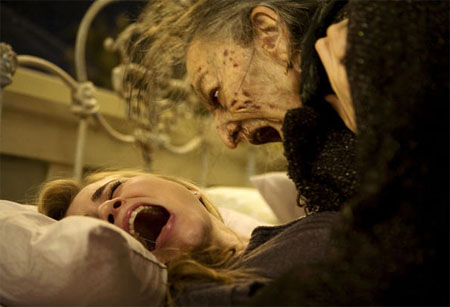
It cannot be an accident that one of Drag Me to Hell‘s central images involves loan officer Christine Brown eating a whole tub of ice cream without apology. And let’s be honest here. We’ve all been in that spot at some point. Christine, however, is lactose intolerant and she has a weight problem buried in her past. She does not care. She spoons down the ice cream anyway. It’s the ice cream that matters now. And while I don’t know how many uptight critics will declare this film some giant tub of ice cream, I’m here to tell you that Drag Me to Hell is one marvelous movie. It’s a grand and enjoyable gift from Sam Raimi — certainly more generous than his 2000 offering — and far more fun than I could have possibly anticipated. If you’re one of those types who’s forgotten the mad and anarchic joys of eating a whole tub of ice cream, then stick to the condescending remakes or reboots or revivals that are made solely to take away your dollars without granting you that cathartic liberation. (It’s worth noting that this movie does feature quite a lot of characters cavalierly asking for money. Perhaps it’s self-aware.) This movie, on the other hand, made me laugh and grin and holler and chortle like an undisciplined eight-year-old. Not many movies can do that. But this one did.

And it’s because Sam Raimi is clearly a man who loves movies. Not the junk shuttling out of the soulless factories supervised by Michael Bay and McG, but the silly stuff and the thrilling stuff. The loud sounds and spastic images that keep us returning to the movies. Raimi has a sense of humor that might be cruel if it weren’t so innocuously bizarre. The filmmaker who dared to insert a highly amusing and utterly gratuitous cabaret scene in Spider-Man 3 has gone even further here. And trust me: it’s all for the best. Here is a movie that introduces its protagonist stuck in traffic and listening to an elocution tape spouting forth such maxims as “There is no friction with the proper diction.” Here is a movie that features a nosebleed gone awry and gives David Paymer a line that is too goofy to be true. Raimi’s even slapped the old Universal logo from the 1980s at the head of his film. This is how movies used to be and could be again if only we wouldn’t settle for less.

Drag Me to Hell is not so much a return to Raimi’s roots, as some have suggested. It is a movie that successfully combines the eyeball-popping humor of the Evil Dead movies (don’t worry: eyeballs do pop here, despite the PG-13 rating), the fey dissolves of Darkman, the classy visuals of A Simple Plan (the deliberately framed crows are replaced momentarily by a cat’s coy positioning at bottom frame), Raimi’s more naturalistic experiments with actors in The Gift (here anchored by Alison Lohman’s earnest performance), and the empathy of the Spider-Man trilogy (thankfully not so sappy). Raimi, as it turns out, has been itching to give into his id all along. And we’re all the better for it.

If being a wild imp means having a vegetarian consulting a book titled Animal Sacrifices in the Services of Deities, then Raimi will go there. What I love so much about this movie is Raimi’s casual audacity. He’s balanced an earnest romance, some ridiculous and often side-splitting comedy, and some genuine jolts. A movie that dares to throw in so many disparate elements should not work this well. But it works because Raimi very much believes that it can work. And since he’s kept the budget fairly low, he doesn’t have to worry too much about studio interference. He’s given himself a safe place to experiment. But who knew the prototype would roll out like a top-of-the-line model?

“I know this is going to sound weird,” says Christine, “but I want to get my fortune read.” When was the last time you saw a movie in which characters were so straightforward about their oddball dealings with the supernatural? When was the last time in which you saw a filmmaker hold his camera on a staircase for suspense? When was the last time you saw a filmmaker commit himself to Val Lewton’s understanding of shadow over the crass CGI effects that are now de rigueur?

Raimi even subverts the usual gender roles, perhaps to atone for the infamous tree-raping scenes in The Evil Dead. The ledger is now corrected. The men in this movie are often hilariously inept — one whimpers at a diner; another boasts of his coin collection — and the women often kick ass. Raimi even explores cringe domestic comedy during one utterly disastrous dinner scene with the prospective in-laws. A psychic and a professor argue about Jung. The camera whooshes as feverishly as Evil Dead II. And the movie even evokes Tolstoy with its lively ending.

Let me be clear on this. If you do not enjoy this movie, then you simply do not have a soul. Drag Me to Hell is a wild masterpiece. And I don’t think I’ll see another movie this year that’s anywhere near as enjoyable. Sam Raimi has restored my faith in Hollywood movies.

The Bat Segundo Show: Arthur Phillips

Arthur Phillips appeared on The Bat Segundo Show #288.

Arthur Phillips is most recently the author of The Song is You.

segundo288

Condition of Mr. Segundo: Reconsidering the playlists and those who play him.

Author: Arthur Phillips

Subjects Discussed: Characters who are enslaved to culture, partisan positions in relation to hoarding facts, being in denial about larger arguments within novels, Nabokov’s Lectures on Literature, aesthetic concerns, muses and playing against reader expectations, the myth of an author’s personal connection, listening to headphones, ghosts and Jeopardy experiences gone awry, personal experience and lies within fiction, speculating on the specific conditions in which a man can be a muse, being a male model and a musician, the myth of writing what you know, getting excited about emotion, the distance required to contend with a fictive location, the wall between the personal and the artistic, the magic souffle, predicting 2009 weather in New York, reading time, the danger of boredom, William Gaddis’s The Recognitions, outlines and improvisation, reinventing the wheel, the little changes within a manuscript vs. changing as a writer, the value of urgency, being a metaphorical roofer and upholsterer, Re-Flex’s “The Politics of Dancing,” and the crazy amounts of money one must pay to republish lyrics.

EXCERPT FROM SHOW:

arthurphillipsCorrespondent: If we’re talking about time, there’s also the notion of reader’s time. And as a stylist, you have some control over how frequently or how long or how short the reader’s going to turn the page. When I read your book, I found numerous passages when I would slow down. And then when dialogue would bump up, particularly with the scenes with the cop, it then sped up.

Phillips: Right.

Correspondent: And so I’m curious. If time on a structural level was important, I’m curious if there was any importance you placed in terms of thinking of the reader and thinking of this notion of how fast the reader’s going to turn the page?

Phillips: That’s such a great question. And on one hand, I want to say, “Jeez, I wish I had more conscious — and I will vow in the future to have more conscious — understanding of those technical matters.” On the other hand, it seems a little impossible to control. Well, not just a little. It’s entirely impossible. I think any time you start getting into what does the reader or what does a reader expect, react to, experience, you’re doomed. I mean, you’re just — it can’t be. If you have one or ten or a hundred or ten thousand or a hundred million readers, they’re just different. And this is just so obvious that it’s just not saying anything. But it says everything. Because if everybody’s going to have a slightly different reaction, even taking a smaller subset of the people who “like” it, they’re going to all have a different reaction. You can’t plan for them. So the only reader that you can really have much planning for is yourself. At which point, I don’t really have to think very consciously about “I need to speed it up here, I need to slow it down here.” All I have is the feeling of “I’m bored.” And so when I’m writing and I go back and I read the draft, I say, “Oh this is just — I’m just bored.” Something has to happen here that is different from what’s happening. Because I don’t like it. And then at the end of it, when I’ve gone and I’ve done that twenty-five times, and I say, “I like the whole thing,” then it’s done.

Correspondent: Well, to deflate my own interlocutory souffle…

Phillips: (laughs)

Correspondent: I should point out that this may very well be the difference between having lots of dialogue and having lots of imagery. I guess the question here is how intuitive is it really. I mean, when you’re getting lost in a long sentence, whether as a writer or even as a reader, you’re going to be aware of the slowness. Or maybe you’re lost in such a fugue state that there really is no sense of time.

Phillips: Right. I’m reading The Recognitions right now and…

Correspondent: First time?

Phillips: First time.

Correspondent: Oh wow.

Phillips: And I’m having all kinds of temporal feelings about that book as I work with it. There are times when I am lost in a fugue state, although not often enough for my taste. And often I’m feeling, “I think Gaddis was lost in a fugue state. And I just can’t join him for some reason.” I don’t know that it’s just images and dialogue. I think that you can have some very impenetrable, hard-to-wrestle-with dialogue. And actually that’s what brings The Recognitions to mind. Because there are passages. Long passages.

Correspondent: The party scenes, I know.

Phillips: You know, there’s a forty page party scene with almost nothing but dialogue. And you have to go, “Oh wait a minute. Is this the same person who four pages earlier was talking? And where is that in relation to the little girl asking for sleeping pills?” And all the rest of it. So it goes on and on. So you can have some very slow-moving dialogue. And actually I was thinking about Gaddis writing that in ’55, and Nabokov in some period around the same time doing one of his customary unappealing little digs at novels that are all dialogue, and thinking, “I wonder if he read this, looked at it, had any feeling about this, would have included or excluded it from that grouping.” Generally speaking, light dialogue goes faster than description or internal thought. But not necessarily, I guess is the short answer. I could have said “Not necessarily” about fifteen minutes ago.

Correspondent: (laughs) That’s all right.

Phillips: There you go. Just cut it down to the dialogue.

BSS #288: Arthur Phillips (Download MP3)

This text will be replaced