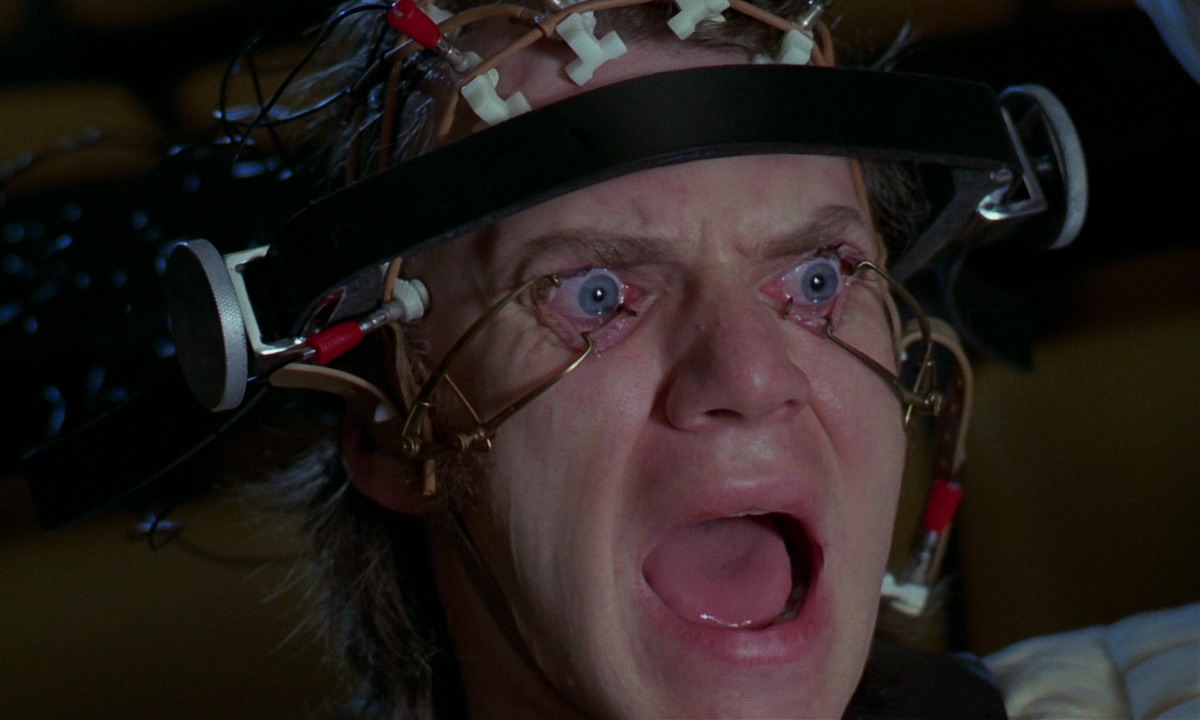
Posts by Edward Champion

Edward Champion is the Managing Editor of Reluctant Habits.

Why Trigger Warnings Threaten Free Speech, Original Voices, and Thoughtful Discourse

“Don’t be so gloomy. After all, it’s not that awful. You know what the fellow said. In Italy, for thirty years under the Borgias, they had warfare, terror, murder and bloodshed. But they produced Michelangelo, Leonardo da Vinci and the Renaissance. In Switzerland, they had brotherly love. They had five hundred years of democracy and peace. And what did that produce? The cuckoo clock.” — The Third Man

On February 26, 2014, a UC Santa Barbara student named Bailey Loverin pushed “A Resolution to Mandate Warnings for Triggering Content in Academic Settings” through the Associated Students Senate. The resolution called on professors to issue “trigger warnings” for students on “materials with mature content” taught in the classroom — whether it be a difficult film shown for context, material assigned for reading, or even a casual conversation on a tough issue. Loverin cited her own discomfort sitting through a film, one which she has refused to identify, depicting sexual assault. The class’s unnamed professor, according to Loverin, provided no warning before the film. Loverin claimed that it was harder for her to walk out of the movie, because doing so in the dark would apparently draw attention. (I have consulted other interviews with Loverin to establish the facts. Loverin did not return my emails for comment.)

Loverin has stated that she’s a survivor of sexual abuse, but she has not suffered from PTSD — the chief reason proffered for the “trigger warning” resolution. In an interview with Reason TV, Loverin said, “We were watching a film. And there were several scenes of sexual assault and, finally, a very drawn out rape scene. It did not trigger me. I recognized the potential for it to be very triggering.”

Loverin is not a psychologist, a sociologist, or a medical authority of any kind. She is a second-year literature major who has become an unlikely figure in a debate that threatens to diminish the future of free speech. Yet Loverin isn’t nearly as extreme in her views as the trigger warning acolytes at other universities.

Rutgers’s Philip Wythe has claimed that trigger warnings are needed for Virginia Woolf’s Mrs. Dalloway (for students suffering from self-harm) and for F. Scott Fitzgerald’s The Great Gatsby (apparently a literary gorefest on the level of an episode of The Walking Dead). Oberlin threatened to issue trigger warnings over such traumatic issues as “heterosexism, cissexism, ableism, and other issues of oppression,” before the policy was sensibly pulled for further reconsideration.

Loverin claimed in an opinion roundtable for the New York Times that the UCSB resolution “only applies to in-class content like screenings or planned lectures and doesn’t ban the content or excuse students from learning it.” The resolution offers a suggested list of “rape, sexual assault, abuse, self-injurious behavior, suicide, graphic violence, pornography, kidnapping, and graphic depictions of gore” as trigger warning options. Students who feel that they “have a negative emotional response” (note that it is any “negative emotional response,” not necessarily PTSD) “to such content, including distressing flashbacks or memories, should be allowed to leave the classroom or skip class altogether without being penalized.” And while there certainly isn’t any direct prohibition, there is still the unsettling possibility of professors forced to soften their materials, which leads one to wonder how they can adequately teach war, genocide, slavery, or imperial conquest in the classroom. Another question, one that has remained unconsidered by trigger warning boosters, is whether or not skipping class over material that easily offends will be used as a catch-all excuse for students to shirk their scholarly duties.

In the Reason TV interview, Loverin said, “Being uncomfortable, being upset, being even a little offended is different than having a panic attack, blacking out, hyperventillating, screaming in a classroom, feeling like you’re under such physical threat, whether its real or perceived, that you act out violently in front of other people.” It certainly is. Yet there is no evidence to support Loverin’s claim that there is a widespread epidemic of students acting out violently in class over a movie. The PTSD Foundation of America observes that 7.8% of Americans will experience PTSD at some point in their lives. But most people who experience PTSD are children under the age of 10 or war veterans. Furthermore, an NCBI publication reveals that intimate group support among fellow trauma victims (CISD) and rigorous pre-trauma training (CISM) are effective methods for helping the PTSD victim to move forward in her life.

There are some connections between media and PTSD, such as a study published last December which observed that some Americans who watched more than six hours of media coverage about the Boston Marathon bombings experienced more powerful stress reactions than those who refrained from watching the news or who were directly there. Another UC Irvine study found that 38% of Boston-area veterans who suffer from PTSD and other mental disorders experienced some emotional distress one week after the bombing. But these studies point to (a) people who already suffer from PTSD, (b) PTSD victims being exposed to media for a lengthy duration, and (c) PTSD victims in close proximity to a recent attack.

astronautfeldstein

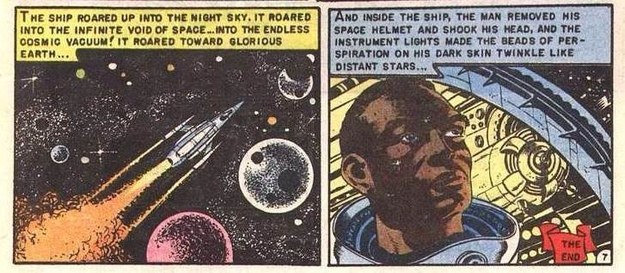
It is certainly reasonable for a professor to ask her class if any student suffers from PTSD, but the trigger warning approach is uncomfortably similar to the Comics Magazine Association of America’s crackdown on comic books over gory content in 1954, which led Charles F. Murphy to wrongfully conclude that reading violent comics leads to juvenile delinquency. As Saladin Ahmed recently pointed out at BuzzFeed, Murphy’s Puritanical Comics Code — a kind of self-regulated and equally self-righteous “trigger warning” system of the time — forced a black astronaut to be made white in order for Al Feldstein and Joe Orlando’s “Judgment Day” to run. (Before the Comics Code, the story would have appeared without a problem.) The pro-trigger warning crowd also refuses to consider the benefits of confronting trauma. If Steve Kandell hadn’t possessed the courage to visit the 9/11 Memorial Museum 13 years after his sister was killed in the attacks, then we would not have learned more about that tourist attraction’s crass spectacle and its deeply visceral effect on victims. There was no trigger warning at the head of his essay.

Discouraging students from confronting challenging topics because of “a negative emotional response” may also result in missed opportunities for humanism. In her thoughtful volume A Paradise Built in Hell, Rebecca Solnit examines numerous instances of people reacting to disasters. Contrary to the reports of doom and gloom presumed to follow a disaster, people more often react with joy and a desire to reforge social community. Those distanced from disaster tend to become more paralyzed with fright. No less a literary personage than Henry James, who read sensationalistic accounts of the 1906 San Francisco earthquake, imagined that his brother William underwent some perdition: “I feel that I have collapsed, simply, with the tension of all these dismal days,” he wrote in a letter. “I should have told you that I have shared every pulse of your nightmare with you if I didn’t hold you quite capable of telling me that it hasn’t been a nightmare.” But William. who was impressed with the rapid manner in which San Francisco came together, replied, “We never reckoned on this extremity of anxiety on your part.”

Only a week after Loverin’s resolution was passed, a group of anti-abortion activists had one of its banners, which featured a bloody picture of an aborted fetus, plucked by professor Mireille Miller-Young. A YouTube video capturing this incident features the professor pushing Joan Short, one of the Christian activists and the person operating the camera, after she attempts to retrieve her sign from an elevator. At the 2:46 mark, Miiller-Young can be seen kicking Short’s shoe out of the elevator bank.

triggerreport

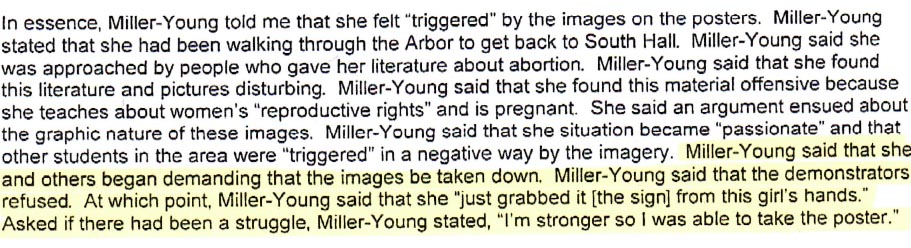
The police report, which I obtained from the Santa Barbara Independent‘s Tyler Hayden (the PDF can be viewed here), cites “triggering” as one motivations for Miller-Young’s actions. Miller-Young asked the Christian activists to remove the sign. They refused. Miller-Young grabbed the sign and destroyed it in her “safe space” with scissors. “I’m stronger,” said Miller-Young, “so I was able to take the poster.”

As a hard progressive and free speech advocate who is strongly pro-choice and as someone who finds gory pictures of aborted fetuses to be a repugnant response to civility, I am nevertheless appalled that a supposedly enlightened figure of authority like Miller-Young would use “trigger warnings” as an excuse to not only shut down another person’s perspective, but to completely destroy the sign used to present it. These activists were not harassing young women outside of an abortion clinic, yet Miller-Young claims in the police report that “she felt that the activists did not have the right to be there.”

Many ostensible liberals have attempted to paint “trigger warnings” as something harmless, yet they refuse to see how appending a precautionary warning can lead to a chilling curb of free speech. And like Miller-Young, in their rush to condemn, it becomes clear that they are less interested in comforting those who are sensitive and more concerned with painting anyone who disagrees with them as either “a jerk” or someone who delights in the suffering from others. On Twitter, two privileged white male writers with high follower counts revealed their commitment to petty despotism when opining on the trigger warning issue:

We have seen recent literary debates about unlikable characters, an essential part of truthfully depicting an experience. But if an artist or a professor has to consider the way her audience feels at all times, how can she be expected to pursue the truths of being alive? How can a student understand World War I without feeling the then unprecedented horror of trench warfare and poison gas and burying bodies (a daily existence that caused some of the bravest soldiers to crack and get shot for cowardice if they displayed anything close to the PTSD that they felt every minute)? How can one understand rape’s full hurt and humiliation if one does not wish to become familiar with its baleful emotions? How can any student comprehend climate change if the default response is to ignore the news and play a distracting cat video that will amuse her for two minutes?

I realize that the trigger warning police mean well, but human beings are made of more resilience and intelligence than these unlived undergraduates understand. Hashtag activism may work in a virtual world of impulsive 140 character dispatches, but it cannot ever convey the imbricated complexities of the human spirit, which are too important to be stifled and diminished by a censorious menagerie of self-righteous kids, including middle-aged genre writers who can’t push their worldview past adolescent posturing that’s as preposterous as Jerry Falwell claiming emotional distress over a parody.

Will the Cecily McMillan Sentence Dampen Occupy’s Future?

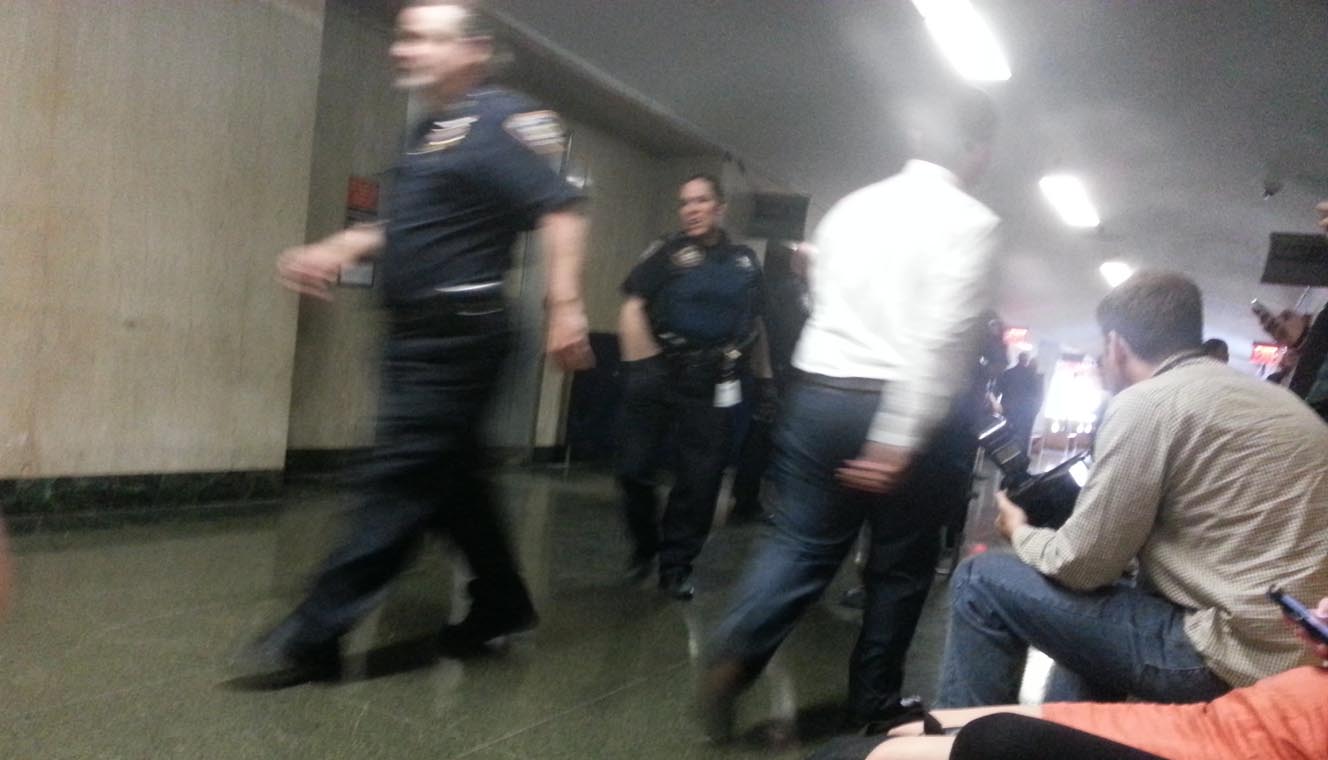
It took six working stiffs to assemble the magnetometer in front of Judge Ronald Zweibel’s chamber: one held the long left unassembled side, a second knelt down trying to figure out how this white plastic dolmen attached at the top corner, a third held the flashlight, three more police officers stood behind them to the right. It was a tableau that could have been stage-managed by the late filmmaker Theo Angelopoulos: deliberately slow, long, a good deal of fuss over something extraneous.

On Monday morning, the eleventh floor of the New York City Criminal Court building filled up with a time-honored mix of optimistic activists who believed in justice and cynical reporters who boasted over who had been the first to cover Occupy. Most had to wait in the hall outside the courtroom, tapping their feet on green marble stepped on by countless innocents.

Then the two metal doors opened and an activist, not calling for a mike check, quietly informed all surrounding parties that Cecily McMillan, a young woman who had been found guilty of assaulting a police officer on the most draconian and iniquitous of pretexts, was sentenced to 90 days in jail, with five years probation. This was a far cry from the maximum sentence of seven years, but just long enough to annoy anyone with a social conscience. Just short enough for any random party to wonder what the fuss was about. Just perfect enough to trivialize a movement.

McMillan’s attorney Martin Stolar attempted to persuade Judge Zweibel to commute the sentence further. The judge would not budge from 90 days. McMillan read a statement. The judge would not budge from 90 days.

It was impossible to attend the sentencing and not feel as if you were inhabiting some preordained role as awkwardly rigged as the magnetometer. Once the courtroom had filled to capacity, it was pushed unceremoniously to the side of the door in minutes, as quickly as McMillan’s sentence.

Cecily McMillan will do her modest time and spend the rest of her young adulthood checking in with the authorities, released from their tendrils only after the last remaining flames of idealism have been doused from her spirit. She is, after all, on a leash. Can she still be a revolutionary? Or even the moderate that some Occupy activists have presented her as? Those who remain part of Occupy will preach to the choir, calling for more appeals and more petitions.

But Occupy succeeded not because of political stridency. It was amorphous enough to enliven the variegated strains in our national conscience. The movement still carries a formidable strength in finding quick organizational remedies to inflexible bureaucracy, seen with Occupy Sandy and still very much in place on Monday morning when several activists rapidly collected the phones that weren’t allowed in the courtroom with improvised identifying slips handed to owners. But I am not so sure what it can do beyond this. After the sentence, the crowd gathered across the street from the courthouse and sang songs and attempted to conjure a responsive plan to the McMillan sentence (they are also rallying tonight at Zuccotti Park), yet the strategies now feel flat and old hat. All because of a sentence that will be interpreted by most as no big deal. We certainly have the New York Police Department and Judge Zweibel to blame for this. But there may be a deeper problem.

As I stood in line, hoping to get into Zweibel’s courtroom this morning, I chatted with an African-American woman who identified herself as Aanis. She was waiting for another case in another chamber. She wondered if this seemingly indomitable group would stand up for her the next time she was arrested. But most ignored her. And as the Occupy protesters disseminated literature, passing me up because I’m the kind of man who tends to go to the courthouse wearing a suit and tie and they presumed I’d be uninterested, I had some idea of what she was talking about.

Porochista Khakpour (The Bat Segundo Show #545)

Porochista Khakpour is most recently the author of The Last Illusion. She previously appeared on The Bat Segundo Show #249.

Author: Porochista Khakpour

Subjects Discussed: Lyme disease, the thrill of not knowing yourself, messy house syndrome, bird mythologies attached to various nations, Marco Polo and the roc, drawing from the Shahnameh, the inspirational value in Googling feral children, what artists talk about on smoke breaks, when readers hold an author morally responsible for fictitious animal abuse, BASE jumping, the Freedom Tower video, going blonde for Elle, making lunch with caviar and Wonder bread, being a white demon in a dark world, Toni Morrison’s advice on writing the book inside you (with mangled paraphrasing), being obsessed with Latin American and surrealistic writers, the appeal of the grotesque, being young and adversarial, when novels become unanticipated memoirs, when the “unreal” is more real than real, David Foster Wallace, Infinite Jest, Karl Ove Knausgaard, hard realism vs. surrealism, Stephen Dixon, hyperrealism, when realism becomes too polished or manicured, dry literary modes getting in the way of depicting reality, Carol Shields, harmful MFA diets, James Salter, Richard Yates, John Cheever, academics who misinterpret authenticity, finding the human in the idiosyncratic, the freaks, and the outsiders, why Bret Easton Ellis’s work is dismissed, Glamorama as an underrated novel, Khakpour’s review of Helen Oyeyemi’s Boy, Snow, Bird, the myth of perfect novels, why risks and originality are important to sustaining unique fiction, attempting to track what went wrong with risky American fiction during the last twenty years, the dangers of likable books, Dinaw Mengestu’s All Our Names, Yiyun Li’s Kinder Than Solitude, why young American readers are so conservative, millennials who avoid politics and history, when reading choices are impacted by economic crisis, what happens when the youth experience of bouncing around jobs is taken away from American life, needless obsessions with “being good,” when favoriting and liking intrudes upon the sincerity of genuine compliments, why hierarchies now look stupid, ridiculous formalism vs. overly casual forms of address, speed and anxiety, the threat of phones that entice us with buzzing notifications, contemporary anxieties over art that confronts, the remarkable human capacity for inventing needless popularity contests, being part of an immigrant group and fitting in, being true to yourself, ridiculous calculations set up by publishers, when New York publishing types forget regular readers who crave something different, why women’s magazines have embraced The Last Illusion, doing something daring because the universe is indifferent, blind ideological labels that cause nuance to be overlooked, “TWITTER NEVER FORGETS”, suspicion attached to sincerity, the apology cycle, media training’s assault on the real, healthy anti-authoritarian impulses, illegal methods of making money, the trap of fancy restaurants, the mistaken assumption that all writers live middle-class lifestyles, consumerist impulses that get in the way of the writing life, the appeal of New York City (when one can barely afford it), being exposed to subcultures, finding places where outsiders are accepted, Y2K and 9/11 as efforts to destroy New York, New York’s openness, medical arbiters named after guitar gods, how storytelling can combat injurious forces against the individual, inhabiting your own narrative, adopting a uniform of neon orange socks and a cowboy hat for school, pranks as a form of existence, prank phone calls, dialing up a radio station and pretending to be other people, talking in a baby voice as a professed Playboy Playmate, testing the notions of what people are willing to believe, learning international calling codes as a child and asking people in Nairobi to speak Swahili, physically digging holes to China, being paralyzed by knowing we’re going to die, Elisabeth Kübler-Ross, getting the big death questions out of the way on the first date, the benefits of not caring vs. paralyzing thoughts as a kid, dramatizing how people believe in illusions, betrayal and panic attacks, differing emotions that emerge from PTSD and betrayal, fear and illusion, magical thinking, the Y2K panic in San Francisco, Y2K as a cultural embarrassment, failing to consider American time before 9/11, Asiya perceived as a villain in The Last Illusion, why a 500 pound character is the soul of The Last Illusion, eating insects (and associated ethics), being inspired by paintings, how different generations have viewed women, the absence of parents, family structure as a safeguard against feral children, destructive ways of being to survive a fractious childhood, Kafka’s response to Kierkegaard’s Fear and Trembling, Kafka’s notion of the other Abraham as a solution to the parable’s heroic failings, father figures as impostors, having a checkered employment history, work as an enslavement of faith, saturating a novel with pre-9/11 paraphernalia, celebrating the autodidact, awkward paths to manhood, masturbation, connections between reading fiction and empathy, how online skimming is discouraging people from reading ambitious fiction, how to get more people to read Ulysses, trends in longform, the recent fetishization of Gay Talese, Renata Adler’s resurgence among young people, the double-edged sword of “legitimized” indie presses, marketing savvy entering into alt lit considerations, hostility towards works of ambitious fiction, Rebecca Curtis’s stories, Leslie Jamison, the impact of the VIDA Count, trying to get young men to read, reading around the world to atone for American literary inadequacies, Borges’s Ficciones, and hopes expressed for future punks.

EXCERPT FROM SHOW:

Khakpour: I’ve got gallows humor for miles, but I’ve been having so many difficulties because of a recent relapse of Lyme disease. So I’m finding everything a little extra challenging. But maybe also a little bit thrilling. Because who knows what will come out?

Correspondent: What’s the thrill of this predicament?

Khakpour: The thrill is that I actually don’t entirely know myself. And so…

Correspondent: You’ve found out more things about yourself.

Khakpour: (laughs) Well, sort of. I’ve been teaching and lecturing and sometimes I feel like this disease attacks your softer tissue. Everywhere. Your brain and your organs and everything. At certain times…

Correspondent: I thought that the brain was a harder tissue. All that work. Especially your brain.

Khakpour: In my case…

Correspondent: No.

Khakpour: …it’s pretty dim.

Correspondent: Oh, I don’t know about that.

Khakpour: It’s weird. I remember certain things that I thought I had done away with and then certain things I will completely forget. You know, I have that sort of senile dementia.

Correspondent: But, see, I’m like that without Lyme disease.

Khakpour: (laughs)

Correspondent: So I think actually, if that’s the case, you’re the most formidable intellect who has ever appeared on this show.

Khakpour: (laughs) Thank you. It’s amazing. I looked up this thing called messy house syndrome.

Correspondent: Messy house syndrome!

Khakpour: And I thought that it literally just meant, “Your house is messy.”

Correspondent: Or your house is not in order. In some family dynasty sense.

Khakpour: (laughs) I think it’s this thing. I’m not sure exactly how to pronounce it. There are various names that involve forms of senile dementia that are related to it. And it is an interesting umbrella term for various forms of cognitive dysfunction that I very much relate to. But I don’t think it’s permanent. I hope it’s not permanent. I’m enjoying it a little bit. My emotional range is quite stunted.

Correspondent: It’s kind of a temporary vacation from possibly thinking all the time.

Khakpour: Well, I’ve short circuited a lot with thinking.

Correspondent: Well, you’re associative, I think.

Khakpour: (laughs) Exactly.

Correspondent: Which some people call a short circuit, but actually is really kind of liberating. So you have this little caesura in the usual great Porochista universe.

Khakpour: It’s interesting. I used to be so obsessed with altered states and I would do drugs to achieve them and all that.

Correspondent: Now you’ve got the ultimate altered state. The ultimate natural high.

Khakpour: Exactly. So in some ways, it’s kind of amazing. But it would be nice if I knew it would end soon. I think it will.

Correspondent: And yet you have been nothing less than perspicacious so far.

Khakpour: Okay. Thank you. Phew. (laughs)

Correspondent: Let’s get into the book. So Marco Polo, he popularized the legend of the roc. The Greeks, they have the phoenix. Slavic folklore has the firebird. In short, I don’t think there’s a single culture in the world that does not have some form of a mythological bird. America has the bald ego…the bald eagle. The bald ego as well! (laughs)

Khakpour: (laughs) The bald ego as well! I was going to say.

Correspondent: The bald ego and the bald eagle. And not far from the years of your novel, in 1999 to 2001, which is when yours is set, the bald eagle was actually placed from an endangered species to a threatened species and now is actually off that list altogether. Because the bald eagle made a comeback. So beyond your inspiration from the Shahnameh, I’m curious what drew you to the bird as this malleable mythological symbol. To what extent were you interested in not only transcending culture across nations, but even subcultures, perhaps bird-related, within this nation?

Khakpour: Oh. That’s so interesting. I love that question. Yeah. There’s a lot of avian themes in everything I write. It’s strange. It was in my first novel as well. And then I just naturally gravitated toward it here. I was at a residency where everybody was working very hard. And it was one of my first residencies. And I had no interest in being there almost. I was just tired from the first book. And I just decided I was going to read during my residency time. I brought a copy of the Persian Book of Kings, the Shahnameh, the Dick Davis translation that came out a few years ago. And I was flipping through it and remembering my father reading it to me in Farsi. And there was always just this one story that I always would make him reread. And it was the story of Zal and his friendship with this giant mythological bird, the Simorgh. It’s strange to even say “friendship.” I mean, the Simorgh was this guardian. And so essentially raised him. So anyways, that was in the back of my mind. While I was flipping through it at night in this residency, I would go on smoking breaks and there was this one other lovely artist there who was the only other smoker and she was also kind of pretending to do work. And we would just talk about our lives during these smoking breaks. And one time she said to me, she would just go on these rants and she said, “Whatever you do, never Google ‘feral children.'” And I said, “Wait! Why did you say that? What?” And she said, “Oh no. I’ve just been bored. I’ve been Googling things late at night.”

Correspondent: As one does.

Khakpour: Yeah. And then so I thought, “Okay.” I went there obviously. It was late at night there one night. And it was very horrific. And I’d always been interested in both the “reality,” but also the hoaxes that have been attributed to feral children. So then I found this case, this Russian case, of a bird boy who’d been essentially partially raised in a cage and could only chirp. Maybe it was a hoax. Maybe not. And immediately I combined that with Zal in my brain. And the two just kind of mashed up seamlessly. The next day at our smoking break, I told her. I said, “I think you just helped me come up with my second novel.” I’d had the other thread of the second novel, which really involved the magician and the last illusion. But he was only — I could always tell that he was 50% most of the story. There was a whole other thread. So I don’t know. Then I came to that and it was actually interesting. I came to realize, “Boy, you’re obsessed with birds and flight and all that. What is that about?” And there’s a made up myth in the first novel that involves burning doves actually. It’s sort of the myth behind the narrative of the first novel.

Correspondent: This is what it sounds like when the doves fry.

Khakpour: (laughs) Yeah.

Correspondent: Sorry.

Khakpour: So many people scold me about that scene. It’s funny. People come to the readings. And I only started reading from it late in the game. And I would have these oftentimes older women who would come to me and say…

Correspondent: Older women?

Khakpour: Yes. Who’d say, “Why would you have such scenes of animal abuse?” And they would accuse me of having harmed animals myself. And I was just so horrified. I was, “No, this is fiction.”

Correspondent: People get very sensitive to animals being harmed in fiction, I find.

Khakpour: Totally.

Correspondent: I mean, they are more willing to impugn an author for a fictional animal abuse more so than any real animal abuse.

Khakpour: I know.

Correspondent: It’s really odd.

Khakpour: Incredibly. I know. And people were very disturbed by that. But anyways, you brought up so many good points about the cultures in the U.S. too. I think, I mean, there’s a general awe that comes when you think about flight, right? It’s one thing we definitely can’t do. We can do it in these wonky adorable human ways. Hang glider. Sky diving.

Correspondent: BASE jumping.

Khakpour: Yeah, BASE jumping. Right.

Correspondent: That amazing video from the Freedom Tower.

Khakpour: I know.

Correspondent: I’m not even going to tell you how many times I saw it.

Khakpour: Same here.

Correspondent: It just gave me such a cathartic thrill.

Khakpour: Oh yeah. I started collecting a lot of those ideas, or collecting a lot of those instances and looking at their videos and all that, when I was writing this. And that figures — even the idea of stunts that involve flight or falling — big in this book.

Correspondent: How many times did your dad read you the legend of Zal? I’m curious. Because this seems to me that it was deeply imprinted upon you as a child.

Khakpour: Yeah.

Correspondent: And we always go back to the tales we’re told as children to find meaning and inspiration as adults.

Khakpour: Over and over, I would ask him to read this. He would keep going. There’s many amazing stories in the Shahnameh. There’s so many beautiful and incredible — you know, it has that feeling of The Canterbury Tales and The Old Testament where you can go to it for unlimited inspiration. But I was frozen on Zal. I related to him so much. Because there was also — you know, in my first novel, there’s a whole thing with I Dream of Jeannie. This blonde genie and the weirdness of that to me.

Correspondent: And here you are blonde as well. (laughs)

Khakpour: Yes. For an article.

Correspondent: It was in the prophecy! (laughs)

Khakpour: Yes. Exactly! Now I am one of the fakest blondes ever. So that was a fascination. The other thing that was interesting in the story of Zal was that he was born essentially something like an albino. It’s unclear from the text exactly what they meant. But he had a certain whiteness of skin and a lightness of hair. He basically had white hair. And that was why he was cast out. And I think for an Iranian immigrant new to the U.S. — at that point, we’d only been a few years in the U.S. — I was so fascinated by issues that surrounded race and ethnicity in the U.S. vs. Iran and what that all meant. So Zal to me was just — I didn’t know what to make out of this story. He was somehow what Americans might consider the ideal of beauty. Maybe even some other cultures of course. And yet he was cast aside. Basically left in the wilderness to be raised by a bird.

Correspondent: There were a lot of uncleared mysteries in the original tale.

Khakpour: Yeah.

Correspondent: And maybe this is perhaps what captured your imagination and led you to flesh it out and transplant it here in New York.

Khakpour: Exactly. Yeah. And I had been so anxious about fitting into America at that point. And I knew — I couldn’t even really relate to my own parents. I mean, they were of a different socioeconomic class than my brother and I. So here were two upper-class Iranians in their twenties who were fairly gutted about not being able to do fancy things. You know, my mother would be upset that we couldn’t have a childhood where we went shopping in Europe. And my father was meanwhile making us only Wonder bread sandwiches with butter and caviar on it.

Correspondent: Butter and caviar?

Khakpour: (laughs) Yeah.

Correspondent: Wow. That would make the lunch trade a little bit more convoluted.

Khakpour: (laughs)

Correspondent: “I’ll give you the caviar for the apple.”

Khakpour: (laughs Yeah. Exactly. It was a very confused issue concerning nationality and ethnicity and all that.

Correspondent: And class.

Khakpour: And class. Definitely. So I was constantly thinking about this. And when I would get tired, late at night, when he would read me these stories, I’d have horrible insomnia. I would sit with him and he’d pick up where he left off. I would just ask him, “Could you read this story one more time?” He seemed to give me both a combination of hope for the outsider — because at the end of the Zal story, he’s a great warrior and he’s a great hero of the Persian Empire. And even his whiteness starts to be discussed as silver. It’s very striking. He suddenly becomes the embodiment of strength and power. But there’s a lot of conflict in this story too. And there’s a lot of darkness in that story too. And that really got my wheels turning at a young age. And I feel like I’ve always waited to have an opportunity to do something with that story. And it sort of got me when I didn’t even know that I was looking for it.

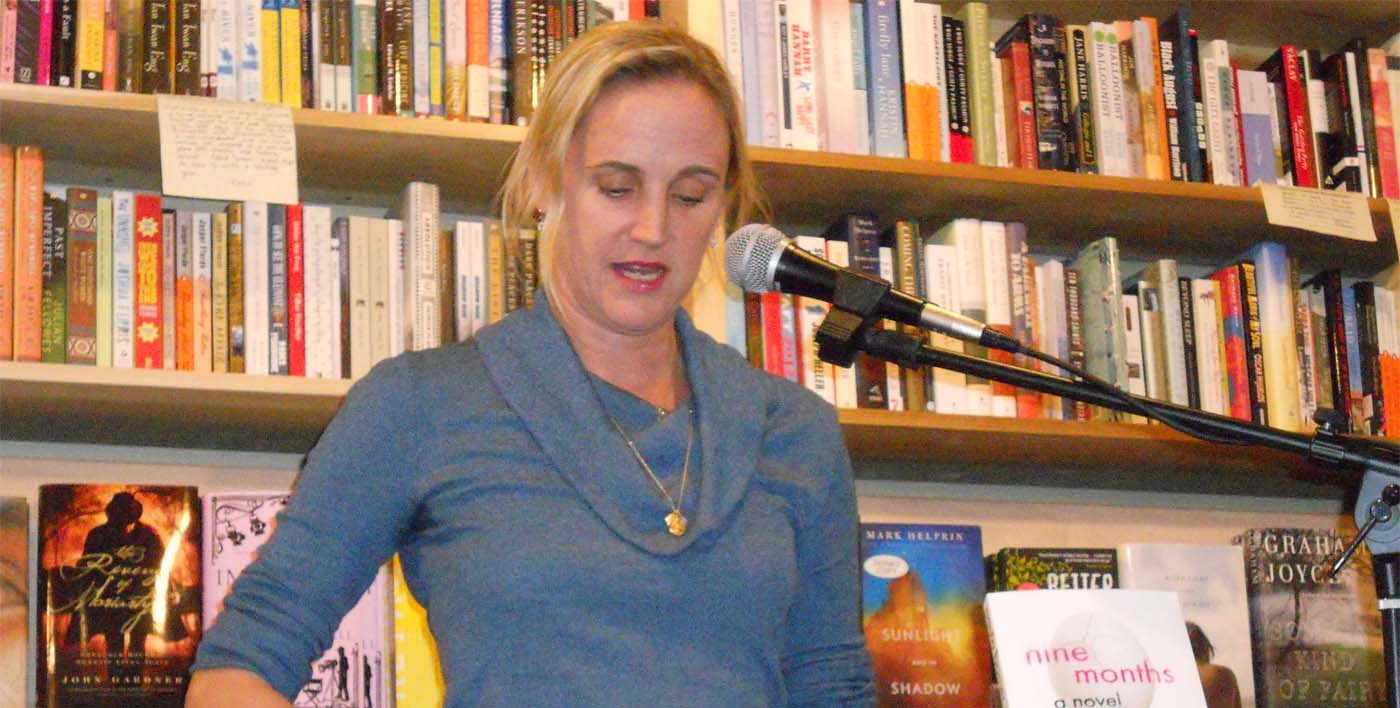
(Photo: Darcy Rogers)

(Music provided through Free Music Archive: Jose Travieso’s “Zombie Nation.”)

The Bat Segundo Show #545: Porochista Khakpour II (Download MP3)

This text will be replaced

Nikil Saval (The Bat Segundo Show #544)

Nikil Saval is the author of Cubed and an editor at n+1.

Author: Nikil Saval

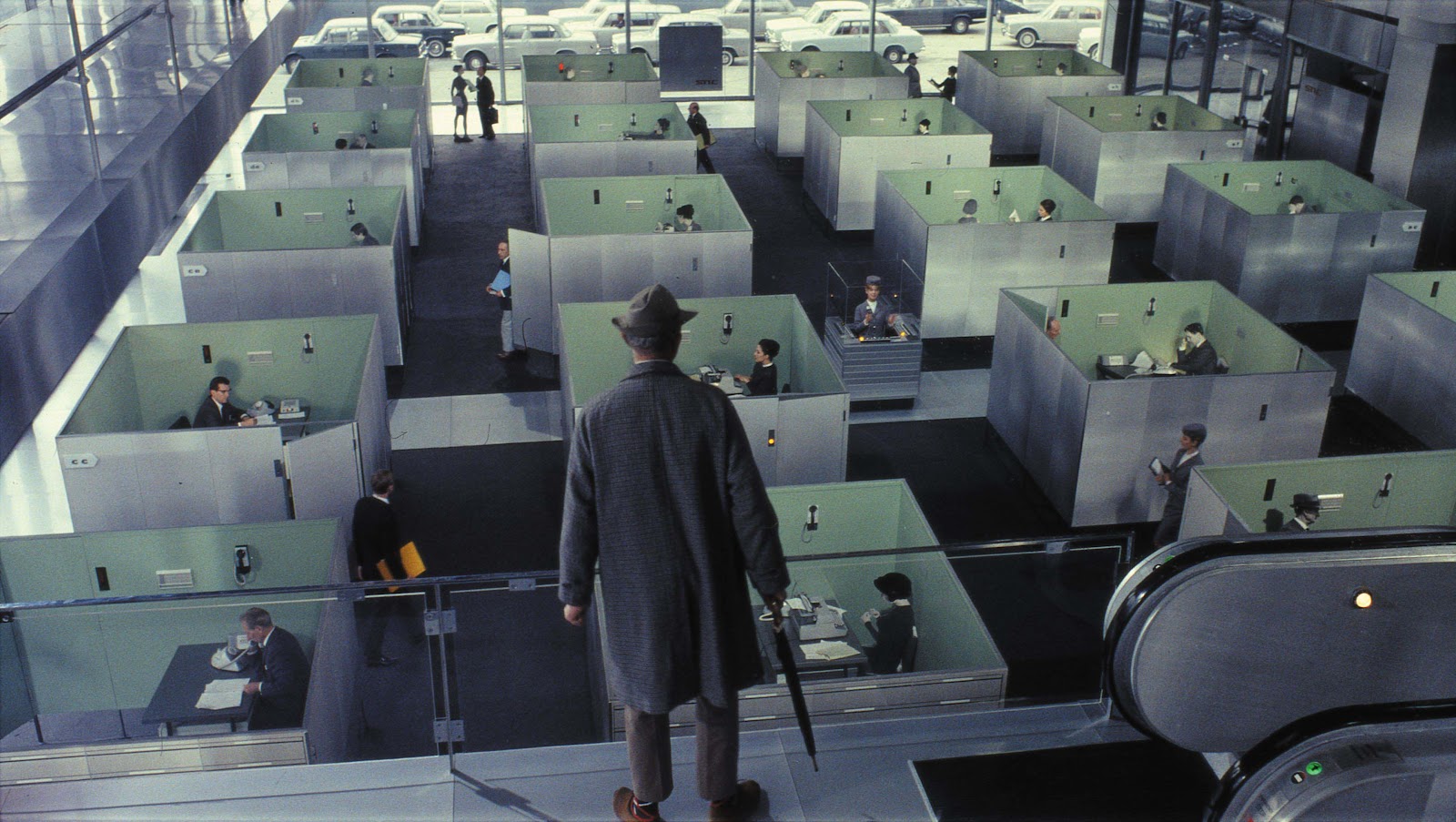
Subjects Discussed: Karen Nussbaum and the Nine to Five movement, 9 to 5 as the template for the office comedy, whether the office workplace is permanently stacked against the worker (and attempts to find hope), the beginnings of human resources, the Hawthorne effect, efforts to control workers through close supervision, attention to light and the beginnings of office architecture, the National Labor Relations Act, attempts to organize office workers in the 1930s, anti-immigrant sentiments and racism among white collar workers, unions and white collar workers, why workers feel empowered when they have nothing, the rise of freelancing culture, Richard Greenwald, how office work creates the illusion of giving the worker mastery over his fate, the Bürolandschaft ideal, Robert Propst, Action Office, the historical beginnings of the cubicle, attempts to track down the guy who first closed partitions into the cubicle, Norbert Wiener and cybernetics, King Vidor’s The Crowd, Jacques Tati’s Play Time, futile attempts to photograph “action” in offices, sitting up and standing down, healthy activities in the workplace, Propst’s failed three wall ideal, Herman Miller propaganda and Action Office possibilities, when George Nelson was jilted from the office furniture plans, how changes in the broader culture influenced changes in office culture, managers pulled from offices and deposited in cubes, Barry Lyndon, the impact of mass layoffs, the recession of the 1980s and its impact on white collar culture, when the cubicle became associated with transience, the lack of privacy in the workplace, why European countries revolted against office layout while Americans stayed silent, Frederick Taylor and Taylorism, Taylorism’s rise and fall and second rise, Louis Brandeis’s popularization of Taylorism through “scientific management” (used in his argument of the Eastern Rate Case of 1910), Taylorized families, Harry Braverman, the beginnings of human resources, Taylorism vs. eugenics, Stephen Jay Gould’s The Mismeasure of Man, Douglas McGregor’s The Human Side of Enterprise as an anti-Taylorist tract, Andy Grove’s Only the Paranoid Survive as a return to Taylorism, Robert Waterman’s In Search of Excellence, perpetuating familial attitudes in the workplace, advertising and irony (and parallels to Taylorism), Taylorism vs. Taylor in Planet of the Apes, Frank Lloyd Wright’s Larkin Building, natural light and the early forms of air conditioning, surveillance by overseers that is perpetuated in workplace architecture, zombie-like accountants, the ethical question of happy workers, the beginnings of glass buildings, Le Corbusier and urban planning, the Lever House, when glass curtains won over Lewis Mumford, Vico cycles, how offices may be returning to their original counting house forms, the Sony Tower’s transformation from work units to residential units in the next few years, the question of workplace architecture becoming an ineluctable and oppressive threat on the way we live, mistaken impressions of Marxism spouted by philosophers, companies spending less on office space, developments in living space and workspace, laptops in cafes, freelancers and co-working facilities, the upward presumptions of clerks, and how once stable labor conditions have become a fantasy.

EXCERPT FROM SHOW:

Correspondent: We are, in fact, talking in an office. So I’m not sure what that does to this conversation. But we’ll, I suppose, make amends.

Saval: I know. Well, at least it’s a private office and not a cubicle. Because that could be a…

Correspondent: Or an open office for that matter.

Saval: Or an open office. God.

Correspondent: Well, let’s get right into it. Back in the late 1970s, Jane Fonda met Karen Nussbaum, a remarkable figure who organized women clerical workers in this Nine to Five movement. And Fonda and a screenwriter spent an entire evening talking with 40 office workers. This became the basis for the wildly popular movie 9 to 5, which arguably set the template, comic wise, for Office Space, The Office, and, of course, most recently Silicon Valley. As you point out in the book, some of the proposed remedies at the end of that film — plants, rearranged desks, flextime, day care at work — they actually reflect what’s know as the Bürolandschaft ideal. And we’ll get to that in a bit. But, you know, this has me wondering if there is something permanently broken about the office. Is it possible that any attempt to remedy it or improve it is almost this kind of neoliberal trap? What hopes do we have for the worker? Or is the deck permanently stacked against her?

Saval: (laughs)

Correspondent: Just to start off here.

Saval: So softball.

Correspondent: It was such a wonderfully bleak book that I had to have a vivaciously bleak opener.

Saval: Gosh. I wish I could just say, “No no no. The story’s happy. It has a happy ending.” You know, I don’t really mean to say that the workplace is permanently broken. I guess I do want to say that the kind of repeated — as you pointed out, there’s a repeated attempt to make work better, usually through design but also through other kind of arrangements in the workplace. Architecturally and what have you. And a lot of these go wrong. And some of them go spectacularly wrong; the most famous being the office cubicle. And I think the point there is not just that the office seems to be broken, but that there is some sense of an idea of how work might be better and there is an idea of somehow you might be able to organize it better, somehow work might be more free, workers might have more control over their work. Things like that. And usually these are sort of fatally disabled by — I mean, it’s not always the case, but usually, roughly, it’s a presumption that these designers or planners know what’s best for an office worker. And there’s usually something imposed on an office worker. Or there’s a plan that starts out really well and then when it’s replicated ad nauseam, it goes wrong or it doesn’t even strike at the heart of what’s wrong at work and they try to design a way things are more fundamental to the issue of the workplace.

Correspondent: But as you also point out in the book, there is this brief moment for the worker — and perhaps it’s an illusional one or a delusional one — where you have a situation when suddenly there is care about what the worker thinks and how the worker can behave, as opposed to how the worker should behave. And I’ll get into Mr. [Frederick] Taylor in a bit. But what accounted for that particular moment, which was roughly around 1929 and up through about the 1950s, before yet another ideologue came in and had ideas about what to do for the worker and for the workplace?

Saval: Well, yeah, that’s, I guess you could call it, the human relations movement. That was the idea that…

Correspondent: That’s the 1960s of the office. (laughs)

Saval: Exactly.

Correspondent: That’s the hippie idealism, I suppose. That period.

Saval: Yeah. And it comes out of a lot of different sources. And one was just the office, but it was also the workplace. It took hold on factory floors as well. And the idea was just that workers needed to be in corporations that somehow ostensibly cared for them. It came out of what was known as the Hawthorne experiments, which are a famous social science experiment where they tried in the Hawthorne Works to experiment with different lighting levels and to see how this affected the way people worked. And what they realized was that actually there wasn’t a direct connection. It wasn’t that the light got better and workers worked better or got worse and workers worked better. It was just that when workers thought they were being watched — at least this was the conclusion — they felt like the company cared about them. And therefore they worked better. And so, especially at a time — this was not so true in the ’20s, but certainly in the ’30s this was true — when there were union movements, when there were the high points of the American labor movement, corporations and companies just felt that things were not going their way and they did not want unions in their workplaces. And so they thought, “Well, we just need to become more familial. We need to care more. We need to manage more lightly. We need to think of our workers’ psychology, not just their efficiency and their productivity.” And I think this results in all kinds of changes in the workplace. I sort of argue that even the architecture of the workplace somehow reflects this desire to make work better, to make workers feel more at home. Maybe with the mid-century corporation, I think I suggest that with things like the Lever House, the Seagram Building, the attention to light and to design and the explosion of design at that time in the workplace — even the idea that a workplace interior should be thoroughly planned and designed — I think reflects this attempt to make workers happy.

Correspondent: Do you think that many of the behavioral psychologists and these people who were looking into lighting were thinking very much about unions? I mean, we often forget from our — well, to get into the decline of labor in the 21st century is another can of worms, but we often forget from our vantage point now how much pull labor had in the early 20th century. And I’m wondering, in the attempt to determine how workers were feeling, how much was that a presence? How much was that a motivation? Or was it simply just innate curiosity? Or the kind of touchy-feely vibe we were implying earlier?

Saval: You know, certainly with industrial workplaces, it was definitely, absolutely a fear. Partly because union organizing, it just spiked, especially after the passage of the Wagner Act, the National Labor Relations Act. With the office, I don’t think there was a huge worry about it. I did some, to me, very fascinating but probably to other people very tedious archival work where I looked into the proceedings of the International Association of Office Managers, or rather I think it’s the National Association, and there’s a point in the ’30s when they really express worries about this and they think, “Well, it’s really taken a hold on factories and even some offices are starting to unionize.” And there actually is, more than there used to be, in certain publishing houses. The New Republic organizes at the time, with something affiliated with the Communist Party. And so you have people talking about how the last redoubt of capitalism, the place where individualism thrives. The office. Even this is under threat. And so we really need it. I mean, once this goes, I think there’s a little bit of a sense that — and again it was not so widespread, but they were definitely afraid, I think.

Correspondent: Well, you do in fact quote the possibly apocryphal Samuel Gompers line, “Show me two white collar workers on a picket line and I’ll organize the entire working class.” Why didn’t office workers latch onto labor? You suggest that there is this assumption that their talents and their skills could in fact give them an independent shot. And I suppose, I guess we see the natural offshoots of this kind of libertarian impulse with some of the tech entrepreneurs that came later. But I’m wondering. Why couldn’t there be some sort of confluence here? Because it seems to me that everybody here had the same interests in mind.

Saval: Yeah. This is sort of the central contradiction of the white collar workplace. I mean, it’s just that there is, on the one hand, you have this ideal of this perfect meritocracy, that certainly the managers talk about this in their association, that you can rise — and this was true in the early antebellum offices especially. And it made more sense then. If you were a clerk, you would become the partner of that firm. And that lasted even past the point that that was true. When some offices became much larger, business became bigger and there were only so many places at the top and many more places at the bottom. So it was just less and less likely.

Correspondent: Toil long enough at the firm and you will ascend to heaven when you’re dead.

Saval: (laughs) Right.

Correspondent: It’s a very familiar promise.

Saval: Right. Exactly. So the way that persists is partly that there’s just a lot of — that it makes sense. It was true for some people. And that had some effect. It made people think that it was true in the office. There’s something about the prestige and status of white collar work that has made it different from blue collar work, especially in the U.S. politically. It just seems like it’s cleaner. The work often required a high command of English. So when there were a lot of high waves of immigration into the United States, there weren’t a lot of immigrants working in white collar workplaces. So there was a kind of homogeneity. And then, of course, also it was very male up to a point. And then when women entered the office, they often entered into the steno pool, a typing pool, to jobs that didn’t have high levels of prestige so that men could feel themselves above in a way, could still feel like they were middle class even when they maybe weren’t. And the other thing — and I talk about this a little bit in a chapter about the skyscrapers — was that there were not a lot of appeals on the part of unions or political parties in the U.S. to white collar workers. It was not clear how to organize them.

Correspondent: It was not clear how to get through to them.

Saval: Yeah. Exactly. The whole model was predicated on industrial organizing. And this doesn’t mean that it didn’t work in a number of cases, a can of worms which I don’t deal with which is the public sector. Because I think it’s a different animal. Can of worms. Animal. Anyway.

Correspondent: Let’s mix as many metaphors as you like. (laughs) But this leads me to wonder. Why couldn’t these very dedicated labor unions get through to the white collar worker? I mean, they had — and again I cannot understate this — they had incredible power at the time.

Saval: Right.

Correspondent: How could they not actually have the communication skills or the fortitude or even the ability to massage their message? Why couldn’t they get through? I mean, they did try. There’s an AFL magazine article you quote, addressed to the white collar workers, where essentially the author says, “Hey. Look after yourselves. You want to think about the future.” But it seems to me that they needed to go further. I mean, what was the disconnect here?

Saval: You know, it just seems like a number of things. One was just the persistence of the idea that upward mobility was a given. And in periods where there are high levels, it’s mainly growth. I think of times like the 1920s, even when inequality widens, union influence starts to dip after a kind of high point in the late 1910s. And then in the ’30s, the union influence in the office increases. Because white collar unemployment becomes a real thing. But then it dips again in the ’50s and then it starts to spike up in the ’70s. And then actually in the ’80s, when things really actually go wrong for a little bit.

Correspondent: With Reagan and the air traffic controllers.

Saval: Yeah. And then it hasn’t really — I mean, you would think that and you would think now in the last four years that it would increase. I feel like I’ve read of isolated cases. But it’s not a trend. There’s a union organizer who I quote, writing in Harper’s in the ’50s — he’s an anonymous organizer — about why white collar workers can’t be organized. And he seems to think that there’s a way in which white collar workers see themselves, even though they are exploited. He says they are the most exploited workers in a certain way. But they see themselves as possessing certain skills, whereas an assembly line worker will talk about the industry that he works in. “I work in the auto industry.” Whereas a white collar worker will refer to his or her profession. “I’m a stenographer” or “I’m a typist.” “I’m a bookkeeper.” And that way of talking indicates that you’re able to move. That you have a skill that other people prize. And I don’t know if that’s a sufficient reason for people not to organize. But it sort of means that you need to talk about different things. And it’s not always the case. People do organize. It has happened. But this was his reason anyway.

Correspondent: In other words, with this particular notion, the suggestion is that one had a kind of linguistic independent identity. One had a label to hold as his own, whereas the organized worker would relate to an industry. This leads me to wonder why that notion of independence was, number one, so appealing to the worker and, number two, why they didn’t see, especially after toiling for many decades and not getting anywhere, that it was all a sham.

Saval: Yeah. It remains a sort of intractable question. But the notion of independence is powerful. And you even see that now in the rise of freelancing or contract work, which I do not want to attribute that too much to people choosing to do that all the time. I mean, there is a lot of it.

Correspondent: The sexiness of having to go ahead and pay for your own health care. Having to look for pennies under the couch. It’s just such a remarkably romantic ideal, isn’t it?

Saval: It’s so freeing. It’s liberating. But on the other hand, there are people who choose to do it. And what they’re seeking is a certain kind of freedom and autonomy over their work.

(Loops for this program provided by Martin Minor, MaxJC, danke, ozzi, 40a, ebaby8119, and Dokfraktal. )

The Bat Segundo Show #544: Nikil Saval (Download MP3)

This text will be replaced

Evie Wyld (The Bat Segundo Show #543)

Evie Wyld is most recently the author of All the Birds, Singing.

Author: Evie Wyld

Subjects Discussed: The Call of the Wild as workplace novel, the stability of work in wild environments, physical labor and working in bookstores, coming from a family with a farming background, the engineering mindset, the virtues of being a messy writer, the interest in what we hold back, having to write moments that aren’t revealed to the reader, the dangers of creative pride, how to organize a messy 60,000 words on a floor using scissors and tape, structure and certainty, hating your book, attempts to write linearly and literally, the virtues of an innate rebellious streak, when flashbacks become integral to structure, the many insects within Wyld’s fiction, how horror films are more willing to dramatize the relationship between humans and animals, Jeffrey Lockwood’s The Infested Mind, entomophobia and Western culture, why sharks are misunderstood, Australian insects, Holiday Cigarettes, the autonomy of smoking, attempts to find control over your environment, kangaroos hit by utility trucks, appreciating life by confronting death, why kangaroos are mutinous, dogs vs. kangaroos, animals and social projection, sheep, when kangaroos stop being cute, pet kangaroos, when giving a character a job is the hardest part of fiction, sheep shearing pubs, farming pubs, sheep integrity, Ernest Hemingway, Robert De Niro and Method writing, imagination vs. process writing, getting bogged down in research, notes and memory, characters with palindromic names, bidirectional retreats to the past, how to get around writing boring scenes, romantic notions of writer’s block, why it’s important to write drivel, thinking on the page, despising the manuscript and knowing the moment when it needs to be plucked away, happy nightmares, families of solitary figures, eccentric exercise regimens, the back as a footstool, sheep killing as an ambiguous mystery, the Pulp Fiction briefcase, the appeal of monsters, the pros and cons of setting up reader expectations with a mystery, Stephen King’s It, disappointing endings, why seeing the monster isn’t relevant in storytelling, narrative entitlement, how novelists contend with increasing reader distractions, Arnold Schwarzenegger, the Venn diagram of genre and literary fiction, the advantages of working as a bookseller, Richard Flanagan’s The Narrow Road to the Deep North, Wyld confronting her dead father’s records in the bookstore database, having a healthy suspicion of lists in a BuzzFeed age, Keith Richards’s Life, and the benefits of accidents and coincidences.

EXCERPT FROM SHOW:

Correspondent: I had a rather strange way of entering this rather raucous novel. About three years ago, another critic Matthew Battles and I, we were having this online conversation about The Call of the Wild. And we were both arguing that Jack London’s great novel was actually a workplace novel. Because Buck, he’s forced to contend with the aggressive cubemate, like Spitz, and essentially he has to find individualism and this independent work ethic over the course of his journey. Your book happens to involve two dogs — one of them actually named Dog — and Jake has to learn sheep shearing and driving skills during her journey. Why do you think work became such a dominant part of this novel’s fixation in your efforts to contend with these rather feral environments, both in Australia and in England?

Wyld: Well, I think work is a way of normalizing yourself. It’s a way of getting yourself away from the stuff that’s actually happening in your life. A way of processing it. So I think for Jake, handling sheep is very much who she is. She expresses herself through wrestling with sheep and trying to keep them alive. And she tries to kind of make amends for some of the things in her life by working really, really hard and working very hard at looking after these sheep, trying to keep them alive, failing a lot of the time.

Correspondent: Why do you think it’s tied so much into the idea of existing in this kind of wild environment? That’s the real question. Why work is the defining quality of a naturalistic environment.

Wyld: I think it keeps you sane in some sense. I mean, I certainly find. that lives in the wilds of Peckham, where I am in London, I work very, very hard in the bookshop and I work very hard at writing novels. And I think it’s something to do with, as long as you’re working hard, you feel you’re existing in a way that is worthwhile, in a way that you feel like — sometimes you can feel like you’re very transient and that you’re slightly floating above the earth and you’re not really experiencing anything. And you find that if you actually do something physical to kind of make your mark on the earth, then it has a calming effect, I find.

Correspondent: Do you feel that there’s any difference between working in the wild of a bookstore and working in the rather saner, urban environment of sheep shearing?

Wyld: I think probably a fair amount of difference. I think I really admire physical work. I would love to…

Correspondent: How much physical work have you done?

Wyld: Well, I’ve done absolutely no sheep shearing. I don’t know how physical bookselling is. I lift the books.

Correspondent: It is pretty physical. I mean…

Wyld: Stacking shelves.

Correspondent: Stacking.

Wyld: Dusting. The whole lot.

Correspondent: Moving shelves for author events.

Wyld: Wrestling the odd shoplifter to the ground. That sort of thing. But, yeah, I think my mother’s family are Australian and they’re farmers. So it’s always been something that I have looked on with envy and amazement, really. This amazing, quite masculine work. Actually growing stuff. Actually keeping something alive.

Correspondent: Why didn’t you decide to enter the farming racket?

Wyld: Not sure I’m that talented, to be honest. My Australian family aren’t big readers or big intellectual kind of thinkers. But somehow they’re some of the most intelligent people. They can look at a broken tractor and they can fix it. And I find that incredible. And I don’t have that skill. I don’t have the maths, I think, mainly.

Correspondent: The sort of engineering brain to look upon some casual thing to fix and then you’ll be able to find a solution through a MacGyver situation by putting it back together.

Wyld: Put some oil on it. (laughs)

Correspondent: Yeah. Exactly. Well, the novel here is built on a series of alternating chapters. It’s almost this two-lane highway. You have this forward motion in the present and you also have these backwards chapters that depict Jake’s past. I’m wondering how this structure emerged, first and foremost. But how much of Jake’s background did you plan out in advance or come to know in the act of writing? Just to start off here.

Wyld: Well, I’m a very messy writer.

Correspondent: You need structure.

Wyld: Yeah. I tend to start in the middle and kind of work outwards.

Correspondent: Okay. So you just write all over the place.

Wyld: I just write all over the place and then I get to a point where I’ve written a certain amount of words. And I try and find what the story is, what the arc of the story is. So mostly for me the writing process involves getting to know the character. And for me, that involves their childhood, their family. It doesn’t always enter into the story in the end. But it’s central to me that I can’t understand who someone is unless I know about them before the sort of now of the book. So I’d written about 60,000 words. About a third of the book. Maybe half the book. And then I just realized that I was enjoying her as a character and I was enjoying her life in Australia and in the UK. But it was lacking tension. And there was just something really to be gained by folding it over on itself. And I’m a big fan of playing around with structure, only in terms of furthering the story, only in terms of not just for fun but because it’s so exciting to me when you have two objects that shouldn’t go next to each other and they create a third feeling.

Correspondent: Yeah. Did you find that your sense of Jake deepened when you had this structure in place? That you knew here even more intimately than you could ever possibly anticipate knowing?

Wyld: Yeah. I think so. I think there’s something about somebody who is trying very hard not to think about something that appeals to me and that makes me feel that they’re much more human.

Correspondent: It allows you to get outside of your own head.

Wyld: Exactly.

Correspondent: Because you’re sort of a cerebral person and you need something who isn’t a cerebral person to escape to.

Wyld: Yeah. I think there’s definitely something to be said for the things we hold back. I think they’re more interesting than the things we say a lot of the time.

(Loops for this program provided by danke, ozzi, and 40a. )

The Bat Segundo Show #543: Evie Wyld (Download MP3)

This text will be replaced