Posts by Edward Champion

Edward Champion is the Managing Editor of Reluctant Habits.

Barack Obama: The West Point Operator

obamawestpoint

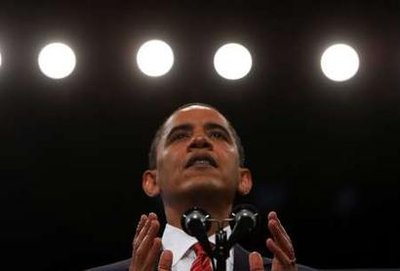
President Barack Obama stood tonight before the seated West Point cadets and revealed himself to be a shallow political opportunist, a man who views mortal sacrifice with all the cold and uncomprehending analysis of a clinical dilettante who is in over his head. Obama stared hard into his twin prompters, as if expecting some illusory plane to crash and conflagrate. One detected the whiff of self-sabotage as this newly christened lame duck spoke without spontaneity, failing to hit any note that even approximated empathy. Yes, he had signed letters of condolence to the families of every American who has given up a life. But there was nothing in his dead eyes to suggest a solace that extended beyond bureaucratic acts or a leader who knew what he was doing. This was shallow and unconsummated political theater, and, for me, a profound feeling of nausea kicked in at the ten minute mark.

Obama preferred to regale the crowd with hollow tough talk, but, judging from the few cutaway shots, the West Point throngs didn’t seem terribly convinced. He reminded us all, including those brave progressives daring to huddle around high-def sets for some benefit of the doubt, that he was the Commander-in-Chief. In a line that will no doubt be fiercely argued by febrile teabaggers, he declared that he had seen “firsthand the terrible wages of war.” It was as if he still needed to prove something just less than a year into his Presidency. But in an age of economic disaster, unseen relief, and international terror, the time for needless reminders and phony platitudes has now passed. Actions that live up to the mandate have become beyond necessary, and Obama demonstrated again that he cannot deliver. This geeky, number-crunching adolescent, who painfully reminded us that he had once stood against the Iraq War, pretended once again to be an adult, and his speech was a firm betrayal of the alleged ethos that secured his November victory. When that dreadful noun “hope” came up thrice, applied to Afghanistan’s untenable wasteland, the linguistic political operator and almost certain one-term President came out of the closet. It was also an unpardonable insult for Obama to suggest that “we must come together to end this war successfully,” a sentiment at odds with the exigencies of healthy democracy and language uncomfortably close to the previous Oval Office hick now laughing his ass off in Dallas. One expects a failure to grasp the realities of human conflict from some desperate corporate leader making an awkward speech at a company retreat, but not the ostensible leader of the free world. Had a cadet yelled, “You lie!” tonight, I would have applauded him as a patriot.

This was a hard spectacle for anyone on the left to endure. The social networks were strangely silent. It was eerily symbolic that YouTube opted to live-stream an Alicia Keys concert over tonight’s cold hard truth. Obama, the man who had fueled his base through the Internet, had been abandoned by his most fervent online boosters. And this sizable cluster was really the canton who needed to hear this speech more than anyone else. Perhaps they will be braver in the morning, when they can stomach some predawn douse of icy and abrasive water. Obama’s speech was a tremendous slur against optimism and possibility, for it invited cynicism rather than respect. This was not a delivery that could galvanize the hardscrabble American heart, for it offered only fungible realities.

Obama failed to sell the brave recruits or the American people on the reasons behind the Afghanistan surge. Lives would be lost, but for what? These unspecified threats and specious connections were the reasons why so many of us opposed Bush. Obama said that he owed us “a mission that is clearly defined, and worthy of your service,” but remained too general on the details. His objectives involved denying al-Qaeda a safe haven, reversing the Taliban’s momentum, and denying them the ability to overthrow the government. But these goals carried distressing echoes of the administrative arrogance depicted in David Halberstam’s The Best and the Brightest, and remained doubly troubling with the assumptive hubris. For Obama was there to tell us that those seeing another Vietnam were relying upon “a false reading of history” and offered no text in return. His inference rested on the principle that Vietnam was the natural parallel, rather than the failed ten-year campaign by Russia, much less the ongoing clusterfuck in Iraq, which, in Obama’s words, was “well-known and need not be repeated here.”

Obama claimed that “this is not just America’s war,” He preferred to mimic the language of our previous President, awkwardly jutting his chin in deference to the eight-year charlatan’s cowboy tic. But it did not seem to occur to him that such arrogance — conveyed through subdued and unconvincing burlesque and a stunning failure to be even remotely real — is not how any nation builds coalitions.

This was a Powerpoint presentation delivered without the slides. Obama sweated, looking like a boxer past his prime, and didn’t seem to comprehend that human lives were in the balance. When Obama stated that “the days of providing a blank check are over,” one was speedily reminded of the no-strings-attached check handled to the rapacious thugs at Goldman Sachs and the $787 billion stimulus package that has allegedly “created or saved” 640,000 jobs (or about $248,000 spent for each job). Obama offered a timeline, but for all of his talk about “addressing these costs openly and honestly,” he was reticent to drop specific pecuniary numbers for his escalation plan. He offered yet another hollow promise to close Guantanamo Bay, but the travesty that continues to sully alleged American virtues must end with a decisive action.

When speaking about Afghanistan, Obama looked directly into the camera, as if expecting a pockmarked population to watch, and said, “We do not seek to occupy other nations. We will not claim another nation’s resources or target other peoples because their faith or ethnicity is different from ours.” But I did not believe him. And there is no reason to expect an Afghanistan civilian to believe him. Before the speech, two of his officials had used the word “surge” in relation to these developments. And Malalai Joya, writing bravely in The Guardian, intimated that an escalation of troops is a war crime against her country. (Both links found helpfully through Glenn Greenwald.)

None of these concerns were considered. There remained the cliched faith in “workers and businesses who will rebuild our economy,” but none of this could atone for the pressing reality that more than a tenth of us are without a livelihood and nearly one fifth of African-American males are far worse off. As Obama heads on to Oslo to collect his Nobel Peace Prize, one is reminded of the 1973 Swedish hypocrisy. One begins to hear Kissinger’s duplicities in Obama’s dulcet voice.

Which leads anyone living in the waking world to conclude justly that Obama’s idealism is gone. His rhetoric is hollow. This is a dead parrot.

Tunnel Vision

holland

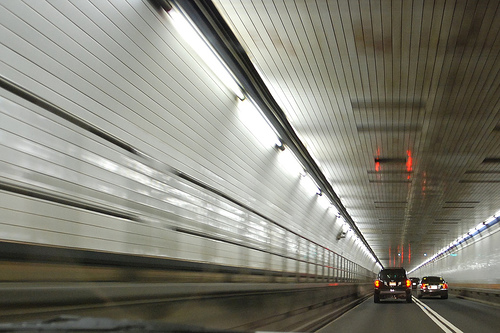
Some months ago, I shot some footage around Holland Tunnel. It was all part of a short movie — one of the so-called anthropological films I’ve been working on — devoted to the bridges and tunnels that surround Manhattan. The creative effort arose from innocuous intent. It had not occurred to me that many of these passages, despite being heavily traversed by thousands at any given hour, would be heavily protected by burly men toting submachine guns, many of their waists protruding from one too many pulls from a certain donut franchise extending its limitless basidospores across the five boroughs.*

I hoped to better understand my surrounding geography, to take in sights that New Yorkers are not supposed to look at, and to tinker with pre-existing notions of what it means to live in a city. Times Square is not just a place where tourists and cubemates shuffle like Romero’s zombies. Impromptu parades need not be limited to one cultural audience. Riverside Park isn’t just a locale for joggers to plug in their iPods. There are rigid designators — traffic signs, expected functions of roads, men shuffling in subways with cups — that we choose to block out and this selective criteria reinforces cliches. We believe we already know all this. And if we don’t, we can always Google it. But in many instances, we maintain only a superficial understanding of how these many infrastructures relate to our lives, much less the unexpected consequences that expound from such willful ignorance.

Obviously, living is an exercise in perceptive selection. It is unreasonable to expect anyone to pay attention to everything. But seeing as how there is a failure to discuss how present economic circumstances are hurting people, I felt that my little experiment might offer an intuitive nudge in the right direction, wherever that may be.

Even so, how can a two-dimensional medium, selectively cutting up particular bits and arranging them into some preordained pattern, accurately capture the totality of life? For that matter, what right did I have to offer a subjective viewpoint on a feeling varying from person to person? To address these problems, I imposed certain limitations for the anthropological films. I would not capture any dialogue or sound from the streets. And unlike Carson Davidson’s excellent short, “3rd Ave. El,” which presents the belated railway in its full elevated glory, I would do my best not to confine my peregrinations into a narrative form. In the editing, I would give into my own subconscious, permitting specific patterns to emerge around a piece of music.

My efforts with the tunnels were impeded by the fuzz. For we are no longer permitted to photograph certain territory we’re consciously ignoring. So we acquiesce to authorities who seem to believe that certain technologies, like Emperor Yuan in Ray Bradbury’s “The Flying Machine,” shouldn’t be permitted within specific territory. But might the balance be restored with a garden-variety saunter? By simply being there? Not at all. In our lust to capture everything, we’ve given up that right.

Setting aside the Port Authority Police Department’s overstated security concerns, this double-edged sword has much to do with living in a seemingly irreversible age in which nearly everything seems to be photographed or reported. On Saturday, while I was hanging out with friends, I was extremely surprised to see that my appearance was reported by two different people on Twitter. It wasn’t that these people didn’t engage with me or that they weren’t nice. They were. But they felt compelled to report where I was.

There’s also the case of Thomas Hawk, an amateur photographer who was ejected last year for photographing inside the San Francisco Museum of Modern Art. Hawk grandstanded his First Amendment right, but he proceeded to harass an employee by posting his photograph online. (In 2006, similar behavior from Hawk resulted in a security guard being fired.)

All this suggests that the need to document everything — indeed, the need to create an alternative and seemingly peerless reality — may outweigh the pleasure of knowing that you or someone else you know lived and had a good time, or that you all managed to do something interesting without anybody reporting it. While I cannot imagine a society that does not capture its highs and lows, I’m wondering if it’s even possible for our most feverish chroniclers to stop. Because if we don’t control these impulses to chronicle every private moment, we could very well be placing needless limitations on reasonable public discourse. And the territory we must explore to maintain “the real unconscious history” that Guy Debord so angrily italicized may beckon a more real and catastrophic social network.

* — With this aside, we reveal the identification of a crass and hermetic pattern. But suppose the donut franchise offers both fourth-rate sustenance and communal meaning to the law enforcement authorities taken to task? Do we stray into elitist territory or adopt the rebellious and frustrated position of not being able to circulate within restrictive geography? Certainly Guy Debord had some sharp feelings on the subject: “Tourism, human circulation considered as consumption, a by-product of the circulation of commodities, is fundamentally nothing more than the leisure of going to see what has become banal. The economic organization of visits to different places is already in itself the guarantee of their equivalence. The same modernization that removed time from the voyage also removed from it the reality of space.”

The Bat Segundo Show: Laurel Snyder

Laurel Snyder recently appeared on The Bat Segundo Show #313. Laurel Snyder is most recently the author of Any Which Wall.

segundo313

Condition of Mr. Segundo: Concerned about walls and their failed sentience throughout the years.

Author: Laurel Snyder

Subjects Discussed: The extraordinary conditions in which Any Which Wall was written, the flexibility that comes from being a small fish, a writing identity tied to poetry and waitressing, the tendency for books to come quicker in the children’s market, financial experiments that involve finishing novels, YA authors and creating a backlist, Norton Juster, Edward Eager’s Half Magic series, being too tied to homage, the virtues of sitting your ass in a chair, sexism in YA vs. patriarchal walls, patriarchy and gods, italicized passages, whether or not discussions with editors can prove violent, the degree of defensiveness within writers, the etymology of “bleckish,” debating the vital issue of whether or not rats actually dance in New York subways, Robert Sullivan’s Rats, old ladies on unicycles, godlike narrators, Don Quixote, sending books out without an agent, being scared of the first person, how rewriting changes books, Roald Dahl, believing in voice, reader reaction, an author’s inevitable pattern of repetition, the dangers of ambition, the element of control, the quest for authenticity, on not being satisfied by books that have been written, the joys of having written vs. the joys of writing, impatience, the unexpected work-related spontaneity that comes from children, J. Robert Lennon, dictating and driving, finding moments of silence, and balancing life and the creative exigencies of anarchy.

EXCERPT FROM SHOW:

laurelsnyderCorrespondent: Henry opines that all meals should be hand-holdable and that forks and spoons should be against the law. You, again as the narrator — and this is interesting. You as the narrator.
Snyder: I’m a little intrusive.

Correspondent: Yeah, you’re a little intrusive and you start to question what your characters are saying. And you object to this line of reasoning, writing, “How could you ever eat spaghetti without a fork? And how could you live without spaghetti?” I must object to your objection.

Snyder: You can live without spaghetti?

Correspondent: No. No, you can still eat spaghetti without a fork.

Snyder: Oh, that’s true.

Correspondent: You can always slurp up the noodles. Now that’s going to make a big deal of a mess and particularly….

Snyder: You don’t have a two-year-old, do you?

Correspondent: No, I don’t.

Snyder: I have a two-year-old, and have seen people eat spaghetti without a fork. And may I say, it’s not pleasant.

Correspondent: But Henry may very well just want to slurp his spaghetti. What’s so wrong about that? He’s going through a sort of slurping stage, as opposed to the more civilized fork and knife.

Snyder: I think that Henry’s mother would object. No, the intrusive narrator thing is an interesting thing. It’s coming out in the next book. The first two books both have this. [Up and Down the] Scratchy Mountains and Any Which Wall both have this intrusive narrator. And it’s a voice that I take from earlier books. And I really like those kinds of books myself. But I’ve begun to realize that there’s a degree to which, if you assert that much as a narrator, the characters never fully detach from me. And so with the next book, I’ve let that go. And in the book that I’m starting on right now — the book that I’m not going to have a deadline for, the book that I’m going to try and do differently — I’m actually going to first person. And it’s scary to me. But I’m letting go of not only of not only my intrusive narrator, but the third person altogether.

Correspondent: But I don’t know if I agree with the idea of a nagging narrator getting in the way of character. If anything, it actually causes certain…

Snyder: But it creates a kind of meta. It creates a kind of frame for the book. As long as the narrator is there. This is something I think about a lot actually. In a lot of children’s books, the kid is telling the story. Like it’s a first person story. But it’s not a diary. And this happens in adult books too. It’s the sort of opening of “This happened last October” kind of voice.

Correspondent: Yeah.

Snyder: It’s like, “Well, who the hell are you talking to?” Who is that person talking to? When the narrator is stepping forward and saying, “You the reader blah blah blah,” it creates a kind of stage, right?

Correspondent: Yeah.

Snyder: It creates a kind of stage for those characters to be performing on. And I think on some level — there’s a sort of theatrical. It’s a voiceover. And it’s like, you know how when you’re watching a movie and there’s a voiceover or like music starts in the background, and kids will joke, “Where’s that music coming from?”

Correspondent: Yeah.

Snyder: It’s that moment of “Where’s that voice coming from?” I actually have an idea for an adult novel that I’ll probably never write where the book begins with a third-person omniscient narrator. And then on page 150, that same voices says “you” or “me.” And you realize that it’s the voice of god. That third-person voice is essentially the voice of god. Letting that god then enter for the second half of the book to be a character. I can’t imagine writing that book, but I like the idea of that existing.

BSS #313: Laurel Snyder (Download MP3)

This text will be replaced

Review: The Road (2009)

theroad

In 2006, an incalculable number of retroussé-nosed snobs — most possessing little understanding or appreciation of speculative fiction — were justly charmed by Cormac McCarthy’s YA novel, The Road. It was a common weakness for such ostensibly erudite essayists as James Wood to not comprehend that McCarthy, like nearly every other speculative fiction author, was extrapolating his own values of fatherhood and manhood onto his fantastical canvas. Functional illiterates, without even an elementary knowledge of the exciting New Weird and steampunk movements then in full bloom, raved that The Road was “unlike any book you’ve read in a long time,” and that sentiment was certainly true if your grasp of speculative fiction extended no further than a Ray Bradbury story read under duress in a high school haze. But McCarthy’s novel — simple yet effective in its execution — went on to earn the Pulitzer Prize and was even selected by the middlebrow television queen, who proudly gushed to McCarthy that he looked just like he did on the back of the cover.

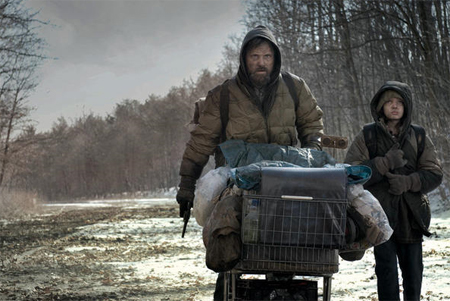
I am happy to report that The Road, in its cinematic version, lives up to this wanton accessibility. It lacks the apocalyptic punch of 1984’s Threads or 1982’s The Day After, and is far from bleak and depressing in its approach. But a liberal parent may very well argue that this family-centric film is fun for the whole family. I couldn’t help but wonder at times whether Viggo would coo, “Good night, John Boy,” under the acid rain of family values. The film does possess a streak of humanity comparable, at times, to 1983’s Testament, particularly since it is securely anchored by Viggo Mortensen, who conceals an effective bundle of husks, rasps, and laconic remnants within his spindly, half-starved frame. (He even delivers McCarthy’s contractions without apostrophes. This is a dedicated lead actor.) Joe Penhall’s adaptation is relatively faithful to the book, reproducing much of the narrative moments and the dialogue (although on film, the mind’s eye begins to see the question marks forming around lines, somewhat sullying McCarthy’s intent). There’s also gruff narration from Mortensen reading much of McCarthy’s prose, which I’m not sure was needed. Flashback moments involving Charlize Theron as the mother come perilously close to needless audience spoonfeeding.

But then McCarthy’s book was, in its own way, altogether too geared for mass consumption. One moment from the book, bearing the telltale indicator of a corporation wheeling over a rusty shopping cart of money, has been lovingly reproduced on screen. But director John Hillcoat and Penhall shouldn’t be held entirely accountable. They have indeed been true to the book, rendering every line of the following exchange:

He withdrew his hand slowly and sat looking at a Coca-Cola.

What is it, Papa?

It’s a treat. For you.

What is it?

Here. Sit down.

He slipped the boy’s knapsack straps loose and set the pack on the floor behind him and he put his thumbnail under the aluminum lip on the top of the can and opened it. He leaned his nose to the slight fizz coming from the can and then handed it to the boy. Go ahead, he said.

The boy took the can. It’s bubbly, he said.

Go ahead.

He looked at his father and then tilted the can and drank. He sat there thinking about it. It’s really good, he said.

Yes. It is.

You have some, Papa.

I want you to drink it.

You have some.

He took the can and sipped it and handed it back. You drink it, he said. Let’s just sit here.

The stuff of literature! A book and a smile! And a film and a smile.

On the big screen, the thinking audience member, troubled not only by this product placement coming at the expense of verisimilitude, notes that warm and unrefrigerated Coca-Cola nestled for so long would surely have gone flat. (Indeed, the subject was argued about on Metafilter.)

The apocalypse’s visual elements involve tilted telephone poles, burned out office parks, skeletal remains, bituminious detritus, and frequent flickers of past civilization (paintings within a gutted out church, portraits in houses) cannily mirroring the father’s desire to “carry on the soul” and stay “one of the good guys” in a landscape populated mostly by cannibals. Alas, the sordid cannibalism doesn’t include the book’s infamous roasted baby, which China Mieville rightly called “a little bit camp.” We do see bloody bathtubs and sinks, a basement populated by living human meat, and chops and screams in the distance. But Delicatessen and Eating Raoul this ain’t. This grisly stuff should jolt or horrify, as it does on the page. But the film’s cannibals are more or less actors daubed up with grease who wear trucker’s caps. The intent is to depict humanity debased by desperate impulses, but it comes off like a cheap shot at red staters.

Still, some of the film’s pulled punches are redeemed by the solid performances (Kodi Smit-McPhee is good as The Boy) and a sound mix that knows the value of silence and knows when to intrude with creepy creaks. Robert Duvall’s presence as the old man is quite welcome and possibly more of a humanizing influence than the character’s appearance in the book. And while David Edelstein has pooh-poohed the film’s seeming “monotonous” quality, I must commend the film for the same reason. (Then again, it’s doubtful that Edelstein paid much attention. He claims that “having Mom lurch off is quite an evolutionary statement,” but failed to note Molly Parker’s presence at the end.) This is a film about process. Surviving in a wasteland when there’s no real reason to survive — other than the nebulous idea of “going south” — is one of the film’s (and the duo’s) reasons for being. It also helps that the father is, as the flashbacks and the incident with the thief reveal, hardly a flawless and glowing patriarch, and that his mistakes don’t necessarily coincide with the conditions.

Make no mistake: This is a feel-good apocalypse movie. And while the film is more entertainment than art, it’s just loose enough to provide any number of comparisons to the present economic shitstorm. Because of this, I suspect it may perform quite well at the box office.

Review: The Missing Person (2009)

THe Missing Person

Noah Buschel’s The Missing Person (opening in New York today) is, as the title intimates, yet another entry from the Hey, I’ve Got a Clever Twist! school of filmmaking. Now several clever twists, nestled within a narrative at unpredictable points, are perfectly wonderful. Some American independent filmmakers, such as Darren Aronofsky and Shane Carruth (the latter regrettably absent from filmmaking since his low-budget breakthrough Primer), have fulfilled this grandiose requisite of complex storytelling, which shares some qualities with the “prodigious fiction” identified by literary critic Tom LeClair in 1996. But an embedded narrative, whether brainy or entertaining, is only as good as the character qualities and developments it pitches at unexpected arcs.

I’m quibbling with the very quality that prevents The Missing Person from fleshing out its seedy and goofy potential, which is more concerned with the singular twist: that one revealing moment on which all action hinges upon. We can probably blame the unitarian “clever” narrative impulse, a clunky can rattling around the halls of cinema for the last two decades or so, on such overrated offerings as The Usual Suspects and The Crying Game — both competently put together, but emotionally hollow and reliant upon strong acting once you know the Big Reveal.

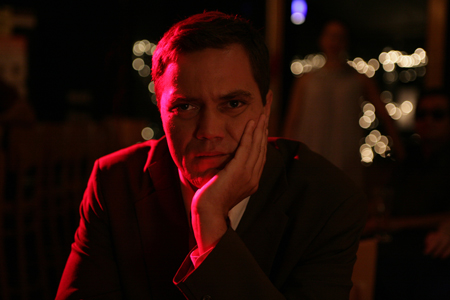
And like all Hey, I’ve Got a Clever Twist! films, The Missing Person is at its most interesting before we know the why. A former NYPD officer with the promisingly idiosyncratic name of John Rosow (played by Michael Shannon) lies in bed in a sparse rundown flat, complete with subway cars rattling noisily behind him and constructed of seemingly nothing more than blue concrete. We learn that he is an alcoholic, that his services now involve primitive forms of private investigation, and that he is not particularly adept at his job. Rosow’s work is ridiculously easy and ridiculous lucrative. $500 a day plus expenses. The missing man he must track on a train sits with his compartment door open. A middle-aged woman later throws herself at Rosow. A Los Angeles cop on a Segway hectors Rosow for smoking a cigarette. There is something of the Old World dying within Rosow. And the burned out quality is strangely augmented by Shannon’s mumbling and shuffling manner. Shannon even adds a tinge of Bogart to his inflections. (He isn’t the only actor mimicking a forgotten cultural figure. Frank Wood, playing the eponymous missing person, oscillates his deep voice so that it sounds eerily like Dick Cavett.)

We are therefore left to wonder why such an incompetent would not only get work — particularly during the present economic climate — but get handsomely paid for it. As one character says to Rosow, “You stick out like a broken nose.” This is an unusual character approach rarely seen in movies today, and Buschel manages to accentuate these incongruities with some understated humor. Rosow confuses the famous search engine with gogolplex. Rosow is more adept chopping up lemons and limes and pouring drinks rather than getting hard information. And while there are needless flashbacks to Rosow’s past interfering with his character qualities in the present, Rosow’s crude no-bullshit quality — seen when he defiantly fires up a cigarette in a cab and when he extracts a camera phone from a smarmy cell phone salesman — bears the funny conceit that even a relatively clueless man committed to single-minded pursuit can get results. This is, after all, an age more concerned with political correctness and passive aggressiveness.

But because The Missing Person is a Hey, I’ve Got a Clever Twist! film, the twist betrays these giddy possibilities. The talented Amy Ryan, who executive produced this film, is wasted as a throwaway Girl Friday. And her fate at film’s end is precisely what we expect. It doesn’t help that the Clever Twist, as is most frequently the case with such movies, isn’t very plausible. I won’t reveal what happens, but I must ask how the Missing Person can get away with his crime without any other government agency or insurance company locating him. He operates in plain sight. There’s a lot of money invested in his fate. Surely, someone would have found him before Rosow.

This major story flaw spoils what should have been a quirky little movie. I can commend Buschel for his blunt and slightly eccentric dialogue. “You’re putting me in a very idiosyncratic spot here,” says one character. A cabdriver states, “I’m not allowed to talk about directions. I’d get into big trouble.” There’s also a pair of FBI agents who offer Rosow an extra pair of sunglasses that they picked up from 7-11.

It’s evident that Buschel has a good knack for quirky moments that don’t feel particularly phony. And I regret that I haven’t seen his other two films. But after seeing The Missing Person, I suspect that Buschel has a movie in him that’s just as good as Wayne Kramer’s best films (The Cooler and Running Scared). He is clearly operating in the same mode. And since giddy filmmakers lifting from life (rather than Diablo Cody’s insipid cultural reference) seem to be in short supply these days, I certainly hope that, with future offerings, Bushel does away with his reliance on Clever Twists and trusts his crazy subconscious to offer us something more spontaneous and special.