The Bat Segundo Show: Misha Angrist

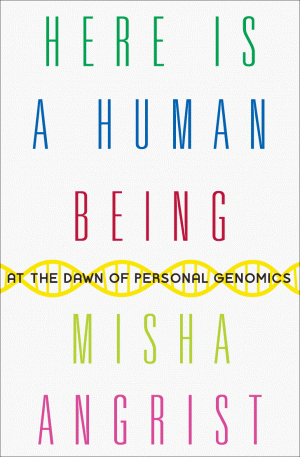
Misha Angrist appeared on The Bat Segundo Show #376. He is the tenth person to participate in the Personal Genome Project and is most recently the author of Here is a Human Being.

Condition of Mr. Segundo: Wondering how sequencing relates to funking people up.

Author: Misha Angrist

Subjects Discussed: [List forthcoming]

EXCERPT FROM SHOW:

Correspondent: What’s most curious about this book is that it seems to be very much about mapping your own neuroses as much as your own genome. It’s almost as if your quest to understand the implications of the PGP has led you to understand the implications of the implications of your own particular attitude. For instance, you write that you and your wife had a rough patch. There’s the point where you declare that Loudon Wainwright’s “Therapy” as your theme song, which was astonishing to me. You attempt to interview James Watson and you have this $83 paperback that you purchase, but you don’t actually get the interview. Which made me feel for you, I must say. And the sly suggestion here, I think, is that self-reflection may very well be just as important as understanding the genome. So what of this? Why did this strategy go into writing this book?

Angrist: Well, I think to call it a strategy is very generous of you. You know, I wanted it to be a first-person personal narrative that was going to be about personal genomics. I started graduate school in 1988. And I finished my postdoc in 1998, and went on to cover the biotech industry and market research in a fairly miserable job. And I should say that Ed’s Rants and Confessions of an Idiosyncratic Mind were great friends to me during those years in the desert.

Correspondent: Wow! You make us seem like we’re palm trees or something.

Angrist: (laughs) You’re a lot more interesting.

Correspondent: Than a palm tree?

Angrist: Yes.

Correspondent: But we’re talking about you.

Angrist: But you gave me succor.

Correspondent: We’re talking about you and your self-reflection. I only just met you now. I just want to be clear on this.

Angrist: Yes. But it doesn’t feel that way. To me, anyway. You may want to pretend that we never met. So then I got a job as a science editor and I continued to watch the field grow and change. And so I had many years of stuff that built up inside me that I felt I needed to say. So I think that’s one thing. Another thing is when I read George Church’s article in Scientific American in 2006, it was a real lightbulb moment. And I felt like here was a guy who was articulating things that I felt for a long time, but didn’t know I felt them. And so that sort of brought me clarity. And then finally — and I alluded to this a moment ago — so many science books that are intended for popular audiences are just awful. So many trees have given their lives so that people with the best intentions wind up writing cheerleading, didactic, anti-cheerleading…

Correspondent: Polemical. Let’s not forget that.

Angrist: I’m sorry?

Correspondent: Polemical books as well.

Angrist: Yes. Right. Screeds.

Correspondent: Rants.

Angrist: Yes, rants. I mean, those are just shameful.

Correspondent: Yeah, absolutely. Expatiations.

Angrist: (laughs) So I wanted a book that had real people in it.

Correspondent: And looking in the mirror, you saw a real person.

Angrist: Well, I saw something.

Correspondent: You saw someone who was worth sacrificing trees?

Angrist: I saw something that I knew something about. I was on a panel with Annie Murphy Paul. And someone asked her, “How did you make the decision to put yourself in your book?” And she said, “Well, I happen to have access to my own thoughts and feelings.”

Correspondent: Not always mapped on a genome.

Angrist: That’s right.

Correspondent: So you’re getting the stuff that isn’t mapped. And mapping that. That was the suggestion with my question.

Angrist: Well, I think people who glance at the book probably look at it or assume that it’s this deterministic thing. And I wanted to be very clear that that’s not where I was coming from. On the other hand, I’m not interested in making the case that it’s useless. I simply wanted to take a picture of where we are now and where we might be headed and what some of the contingencies are.

Correspondent: I’m wondering. To what degree does having access to your genomic data altered your notions of privacy? I mean, this is a very confessional book.

Angrist: Yes.

Correspondent: As I said, that’s kind of why I felt the need to give you a hug right before you sat down. Because I very much worried about you during the course of reading this book. I worried that you would slip further, the more you discovered about yourself through the genome. I’m curious if your neuroses deepened as you accessed more information. Similar to this dilemma of: Well, here we have all this genomic data and we can’t map it all. Because there’s just a shitload of it.

Angrist: Right. I would say that my neuroses had relatively little to do — I’m sorry. Let me rephrase that.

Correspondent: Little to do? I was going to call you on that. (laughs)

Angrist: I would say that my genome had relatively little to do with my psychic ups and downs. And my therapist at one point tried to gently make the case that the whole book was sort of an exercise in acting out and I don’t know.

Correspondent: You required a therapist to complete the book?

Angrist: Expiation. Uh, I required a therapist. Period. (laughs)

Correspondent: Okay. Did your genome require a therapist?

Angrist: Well, probably everyone’s does. But of course, everyone’s doesn’t. I mean, this is one of the things that, being among the first, is. You know, you sit down at a computer and you look at an Excel file full of broken genes. And you think, “You know, I should be dead fifty times over.” But of course that’s a reflection of how little we know and what a redundant system we are.

Correspondent: Well, I’m going to try and make things a little bit more pithy and important with my next question.

The Bat Segundo Show #376: Misha Angrist (Download MP3)

This text will be replaced

The Bat Segundo Show: Elia Suleiman

Elia Suleiman appeared on The Bat Segundo Show #374. He is most recently the writer and director of The Time That Remains.

Condition of Mr. Segundo: Constantly examining his watch.

Guest: Elia Suleiman

Subjects Discussed: [List forthcoming]

EXCERPT FROM SHOW:

Correspondent: I wanted to touch back on a point you were making about the democratization of the audience with a specific ultimate…

Suleiman: The popcorn-less?

Correspondent: Well, the popcorn-less and those with popcorn. In Divine Intervention, there’s a wonderful clip involving your answer to The Matrix. The ultimate democratic video scenario, YouTube, features this clip and a quarter of a million people have seen the clip. A user named Firestarter89 offers this comment: “It’s like some Muslim smoked a bunch of weed and watched Wonder Woman and The Matrix.”

Suleiman: (laughs)

Correspondent: I’m wondering, with a clip like that presented on YouTube, if you’re worried if that gets away from the point of the trilogy. That presented independently without any kind of context, people don’t actually know that it’s really your clip. There’s just a bunch of people who enjoy that clip for what it is. Is that troublesome for you as a filmmaker? On one hand, you’ve got an audience here. But they have taken it and turned it into something completely different, as this user Firestarter89 clearly has.

Suleiman: Well, I mean, it would be too long to now discuss the potence and impotence of the Internet and YouTube. And I don’t look at my own clips, by the way. I never watch what they say. I’m not really interested in this kind of image ghettoization and the very consumerist element of it on the Internet. So I actually protect myself from this pollution. However, yes, to take it out of context is really harmful. Because in the narrative of the film, what we see is his fantasy, his inner fantasy of his lover disappearing. So he wants her to come back as a victorious hero in an almost B-movie like or kitsch-like ambiance. When that episode is finished, he is cutting onions in order to cry. So we see that the result of it is this impotent character who is even unable to cry. So it is an extremity to that violent and that victorious heroism.

I have to tell you a story. A funny story actually. One time, a man stops me. A young man stops me. I was trying to film something on a small camera in Ramallah on the street. For nothing specific. I forgot. Maybe to take a note. I don’t even remember. And he doesn’t know who I am. He just stops me. He stops me and he says, “Are you a filmmaker?” I said, “Well, kind of.” And he said, “You know, you Palestinian filmmakers are all losers. You know, you don’t know how to make a real film. You don’t know how to do anything. You know, make us a film like this guy who made this ninja film.” And I told him, “What guy made the ninja film?” I asked him to describe the action and it turns out to be the segment of Divine Intervention. And I told him, “Well, I’m going to try.”

Correspondent: (laughs)

Suleiman: And he said, “That’s filmmaking for me!” So of course there’s going to be always this level of misinterpreting or taking things out of context. You cannot control that. Look at my biography. I mean, I’m sure that I’ve been presented with at least ten biographies of my life. None of them is true to my biography.

Correspondent: And yet here you are making movies that are rooted in autobiography. As such, there’s the classic saying that we accept fiction for its truth — particularly in this country — more than autobiography or memoir, in which you constantly question the facts.

Suleiman: But, you know, I’m not at all pointing fingers at anyone. But the fact is there’s always a tendency to bring down to earth again what you’re trying to bring to a potential reality. Rather than bring it back to the actual reality. So you’re trying to fight the media distortions. And they bring it back. Eventually you have a TV interview. You’re put in the news. So I don’t know how much we can — on how many fronts you can actually start or stop, deter — I mean, I can barely make my movies. So to start also campaigning against YouTube or distortions of the media, it’s very difficult for me. But I think that one could also say, rather than look at it from a defeatist point of view, if it gave anyone out there some pleasure and some dreamlike potential for a better world, then I think we are — if I feel that I’m doing the best I can, if I feel that I’m trying to dig out the little monster inside of one’s self. Not necessarily the monster only that you project on. You’re trying to evaluate. Re-evaluate your own acts. And trying to become a better person and call it your own moral equation. I think this far I can do. But I can’t go beyond that.

The Bat Segundo Show #374: Elia Suleiman (Download MP3)

This text will be replaced

The Bat Segundo Show: Mike Leigh II

Mike Leigh appeared on The Bat Segundo Show #373. Mike Leigh’s most recent film is Another Year, which is now playing in American theaters and is very much worth your attention.

He previously appeared on The Bat Segundo Show #238. There’s a very lengthy review of Another Year from October that relates to this rather unusual interview, which is part straight journalism and part performance.

Condition of Mr. Segundo: Making sure to keep the conversation under 40 minutes.

Guest: Mike Leigh)

Subjects Discussed: [List forthcoming]

EXCERPT FROM SHOW:

Correspondent: Are your films, would you say, a Rorschach test? The reason I ask is because two reviews I read at Cannes basically said, “Oh well. These are people who I wouldn’t want to meet at a cocktail party.” And that leads me to think to myself, “Well, actually, if that’s the case, then Mike Leigh did his job. Because he presented such vivid characters.”

Leigh: Look, look, here’s the thing about this. I’m concerned in making films that talk to people. Like anybody, I only want to talk to anybody who wants to listen, who wants to know, who wants to share, or have a conversation with me, as it were. I can’t deal with, or I can’t follow, the kind of media-obsessed, decadent position that can’t decode the film for what it actually is. Which is to say an open, honest look at real people and how real people are, with their needs and all their vulnerabilities. Warts and all. If you can’t embrace that, then go away basically. You’re quoting people at Cannes. Journalists, no doubt, who say that these are people I wouldn’t want to meet at a cocktail party. Well, you know, you’re not going to meet these people at a cocktail party. Clear off to the cocktail party and don’t worry about this sort of film. Because you’re not interested basically. And if you’re not interested, I can’t do anything about it. Real people out there. Which is to say: not journalists. People who are going to go to the movies to enjoy, be stimulated by, be moved by, be upset, be amused, whatever it is by this film. And they’re not preoccupied with all sorts of decadent media nonsense.

Correspondent: Yeah. And certainly I’m in agreement with you on that. But I’m wondering though if it’s getting harder to make these movies. Particularly with the austerity stuff that you have going on in Europe and whether this idea of depicting real life on film is becoming a bigger problem for you. I mean, you’re doing another play, I know.

Leigh: No, no. I’m doing another play for other reasons. I’m not doing another play because I can’t make a film. It’s just that the next film I make will take longer. I have plans. The truth of the matter is this film has the lowest budget I’ve had for a long time. Because of the recession. I don’t know. I can’t talk about whether it’s easier or harder. Because I just get on and do what I do basically. I never discuss the subject matter or even the style of anything of my films with anybody. We just get the money and we make the films. I just get on with it really.

Correspondent: Well, considering the actors, I know that in the production notes were very clear to point out how many times each individual cast member and crew member collaborated with you. Which I thought was actually quite funny. But I did notice that, of all the main cast at least, only three people had worked for you for the first time. And I’m wondering if that’s because of this budgetary issue. Is it harder to find actors who you can go through…

Leigh: No, no, no. It’s absolutely not. It’s not hard at all. We are blessed with huge numbers of actors who have all the time in the world. No, it’s not that. I just chose to cast the people in this film that I did. There’s no significance in it whatever really.

Correspondent: I also wanted to ask about the triangular sandwiches really quick.

Leigh: Say it again?

Correspondent: The triangular plastic sandwiches! There’s one that appears with Joe in his office and he’s clutching it. And then we see it later at the funeral. This seemed to me a very specific choice on your part. Is it reflecting, I guess, the class that these respective characters are in or…

Leigh: Well, I mean, it may do that. But that’s not — I’ve never thought of it in those terms. That is what they would get.

Correspondent: Yes.

Leigh: I mean, if you want to get — they take sandwiches.

Correspondent: Yeah.

Leigh: A hundred miles to this funeral.

Correspondent: Yeah.

Leigh: And you can buy them at well-known department stores. Ready packed in these hard plastic containers. That’s what they got. And the other one is the same. There’s no — I mean, I don’t think in terms of I’m making a statement about working-class life.

Correspondent: Oh, I didn’t mean that at all.

Leigh: Sorry, what did you mean?

Correspondent: I meant it as reflective of their particular station.

Leigh: Well, it is! You know, of course, what you get in my films — lots of films, but my films I’m particularly concerned with it — is the accuracy in the details and minutiae of how people live. And that’s what those sandwiches are.

Correspondent: Sure.

Leigh: Nothing more or less. Also, there’s no Pythagorean meaning.

Correspondent: Or even an encased shroud of plastic consumerism.

Leigh: Absolutely.

The Bat Segundo Show #373: Mike Leigh II (Download MP3)

This text will be replaced

The Bat Segundo Show: Andrew O’Hagan

Andrew O’Hagan appeared on The Bat Segundo Show #372. He is most recently the author of The Life and Opinions of Maf the Dog, and of His Friend Marilyn Monroe.

Condition of Mr. Segundo: Feeling sartorially inadequate and unwilling to beg for his dinner from the table.

Author: Andrew O’Hagan

Subjects Discussed: [List forthcoming]

EXCERPT FROM SHOW:

Correspondent: It is interesting. You want to have the dog smarter than everybody else in the book. And this leads me to ask you about the footnotes in this. I mean, from a formalistic standpoint, well, we view dogs at our feet. And the footnotes, of course, reflect that particular —

O’Hagan: And the dog’s always going to love footnotes because they can identify the position.

Correspondent: Exactly. But initially many of these footnotes are there to clarify little cultural tidbits. Almost gossip. Like: What is Douglas Sirk’s real name? But as we read the footnotes more, they then become very concerned with clarifying specific facts. Almost in a hectoring tone towards the reader. I’m curious about how the footnotes came to be from just this tonal shift that goes throughout the book, and also if you were tempted to allow the footnotes to go maybe further than eight lines at some point. What did you do to keep that down?

O’Hagan: Well, it’s interesting that. If I had my own way, if I lived in a world of pure O’Haganism, then the footnotes would have gone on for volumes and have a Shandy-ian or Borgesian nightmare where the footnotes were longer than the book. I like the comic potential with that sort of thing. And I like the idea that this was a work of bricolage, as the French would say. That it was an attempt to build up phenomenon in the reader’s mind. Which could increase their confidence about what consciousness was. Cause after all, this was really a book about inventing the notion of consciousness for an animal. I built it up from the ground up. And he does say early in that process of life for him — quite early in the book when he’s still in England — he says, “Dogs love digression.” So it made it natural to me that at some point he would start to deploy the footnote. Which is nothing if not a little contained digressionette. I liked the idea that he would occasionally stop the narrative in order to point something out to the reader. To wag a finger or a paw and give a notion of other worlds of knowledge which might be available. Maybe while pointing towards. He’s a friendly little scholar as much as anything else. He’s a pedant too. And all these things are exciting character traits of his to me. So I had to make him stay in character. And it would be in his character to offer footnotes. Even ones that were hectoring or were strictly unnecessary. They add to the entertainment value overall, I feel.

Correspondent: But to go back to what we were discussing earlier about the comedy vs. the tragedy, and how this reflects human life, early on in the book Maf says in one of these footnotes, “Unlike humans, we can hear what people are saying from themselves. And we can sniff illusion.” Later you have Maf finding “the real difference between humans is that some care about authenticity and some don’t care at all.” Why must the humans in this book be so tied or interconnected with authenticity and illusion?

O’Hagan: Because I think it’s an utterly 20th century obsession. The mid-20th century obsession particularly. Hollywood having held such a position in cultural life the world over. American moviemaking created a sensibility in the 20th century. It didn’t just reflect sensibilities. It actually created a mind set. A notion of natural human behavior and democracy, which I often think was illusory too. But then it was very attractive to the world. Very viable. And I knew that this dog was going to be having its life at the center of that. So I wanted these questions — illusion and reality, illusion dipping into delusion, our condition of being overwhelmed by fakery almost — to be something that the dog had an inside view on. An inside view for a number of reasons: (1) Which is that he’s a novelist at heart. And novelists really know what illusion is all about. We are a conjuring artist as a novelist. You’re playing god with lives and experiences and parts of history and vocality and patterns of speech. You know, you are a trickster. And I think that I’ve always been interested in that fact. And I wanted this little avatar of mine. This little novelist manqué, of Maf the Dog, to be somebody who could look at not only the world of Hollywood and psychoanalysis and politics and the early 60s from an insider’s view — which Maf certainly had. The real dog was in all of those worlds with Marilyn at the time. She was a real figure who had very deep experience of illusion. And I wanted to manipulate that for the reader to present an opportunity to look at the relationship between reality and imagination in a fresh way.

The Bat Segundo Show #372: Andrew O’Hagan (Download MP3)

This text will be replaced

The Bat Segundo Show: Paul Murray, Part Two

On December 5, 2010, the Irish novelist Paul Murray encountered one of Mr. Segundo’s many agents before a full audience at Word Brooklyn. The two gentlemen proceeded to talk, with smart audience interjection and Mr. Murray reading from the book, for a little under 90 minutes. Just as the tape ran out, the very patient Word Brooklyn staff wisely put an end to this gabfest. The two gentlemen had no idea they had rambled on for so long. From all reports, neither did the crowd.

The first part of this conversation is now available for your listening pleasure as The Bat Segundo Show #370 (also referred to as “Phyllis Presents,” for reasons known only to those possessing the appropriate handbook). It is about 41 minutes long and involves the initial Q&A between Mr. Murray and our most mysterious agent.

The second part of this conversation is now available for your listening pleasure as The Bat Segundo Show #371 (which does not possess any alternate name, we are sorry to report). It is about 38 minutes long and features Mr. Murray reading from his latest novel, Skippy Dies, along with further questions from our agent (and many from the crowd). If you listen carefully to this second part, you may be able to detect a broken haiku.

The producers wish to thank Brian Gittis, Stephanie Anderson, Jenn Northington, Sarah Weinman, and (of course) Paul Murray for their great assistance (much of it at the last minute) in making this special conversation happen. We hope to offer similar “live” conversations in the future.

Condition of Mr. Segundo: Recoiling from the pleasures of being applauded by a recorded audience.

Author: Paul Murray

Subjects Discussed: The origins of Bethani, the original length of Skippy Dies, storylines cut from Skippy Dies, the narrative need for an adult ballast, the importance of the school as a microcosm, Infinite Jest, open-ended narratives, tradeoffs, the impossibility of second-guessing an audience, Roland Barthes, cartoon sex, absurd editorial exchanges concerning the physicality of mermaids, balancing gender perspective, getting Lori’s emotions right, Catholic schoolboys, amoral characters and teenage beauty, authentic teen voices, requests for a “director’s cut” of Skippy Dies, trying to find uses for scrapped material, when descriptive “transplants” don’t work in revision, and the importance of listening to editors.

EXCERPT FROM SHOW:

Murray: I didn’t want it to be an Infinite Jest level narrative. I think that might have had its day, in fact. That sort of completely open-ended narrative structure. Because once you read Infinite Jest and you get to the end of 1,000 pages and realize he’s not going to tie it all up. Sorry to anyone who hasn’t read the book. The butler did it. That in itself is not quite a gimmick. But it’s a device. And it’s a device that people will get bored of. So you need to find new ways. Roland Barthes, who I read a lot unapologetically, he talks a lot about, “If you destroy something. If you try and destroy something, it just comes back.” Like you just sort of preserve the dialectic. So what you need to do is subvert it by making fun of it or just twisting things and tweaking things. I guess that’s what I was trying to do with the book. I really like — I watch tons of — far too many movies and TV programs and stuff. So I wasn’t coming at it with some kind of Puritanical urge to — like an Alain Robbe-Grillet sense of “I puke on the novel.” I wanted it to be a story that some of the people would enjoy. So yeah, it does look like a lot of elements. It’s got characters and it’s got jokes. It’s got plot twists and stuff. I would argue that it doesn’t work in a sort of three-part type of way. Because Skippy dies at the beginning. And then it tracks back. The first two parts are tracking back. What happened to him. And then the last part is just dealing with the effects of his death. So it is kind of chronological. Quite weird.

Correspondent: Well, what do you trade off when you are writing for the audience like this? Are there certain areas that you went into further? Because the book is very candid about the teenage lifestyle. And drugs and sex and things like that. Did you go further in this earlier draft? Were there things that were perhaps just too off-putting for the audience that you were seeking? I’m just curious.

Murray: I genuinely would try and avoid — I mean, if you start thinking of your audience, then it’s impossible to second-guess an audience. Because people react in ways that you can never imagine. So you’re on a losing streak with that. And also you’ll just freeze up if you start worrying about what people will think. So I tried to avoid doing that. That said, I did have more extreme things happening in earlier drafts. And I think it was because it was hard to gauge the right level of shockingness. And it wasn’t that I wanted to shock people. It was more that I was worried about censoring myself. I was worried that the editors won’t like this scene. So I’m going to leave it in there! Which is a very stupid way of writing a book. But that’s what I did.

For instance, the Bethani character, who writes a lot of these strange porno songs. There were more of those than there needed to be initially. And there’s a very disturbed character called Carl. His stuff was initially — there’s a bit where Carl is at home looking at porn on the Internet and he seems to be looking at this toon porn, which is characters from Disney — Pocahantas and the Little Mermaid, Snow White and so forth — having sense with various other toons. Smurfs having sex.

Correspondent: Imagination or research into this?

Murray: Uh, no comment. But there was a humorous exchange with the publishers. With Penguin. Because initially they were saying, “I think Disney may have copyright on these. So we’re going to have to write to them and say is it okay?”

Audience and Correspondent: (laughs)

Murray: Okay, I don’t know if they’ll go for that. But it turns out.

Correspondent: Did you get any yeses? Yes, it’s perfectly okay for a Snow White and a dwarf 69. Or something.

Murray: (laughs) You know that site!

Correspondent: No, I…no comment!

Murray: That’s one frisky dwarf.

Correspondent: (laughs)

Murray: No, but it turned out that it was legal. It was okay. The Penguin legal department checked this out. It was fine. You could use those references. But there was another bit. A Penguin editorial assistant, who is a very nice and lovely girl called Anna Kelly, said, “You have Pocahontas giving a lickout to the Little Mermaid.”

Correspondent: (laughs)

Murray: “Physiologically, that’s not actually possible.”

Audience and Correspondent: (laughs)

Correspondent: Your imagination then!

Murray: “Dear Anna: Thank you so much for that.” So if you know anything about the English publishing industry, then you know it’s run by these very sweet, very polite women. And so there’s this humungously embarrassing email conversation back and forth. “Maybe we should have the Little Mermaid giving a lickout to Pocahantas.”

Audience and Correspondent: (laughs)

Murray: “Oh! That seems like the best solution!”

Audience and Correspondent: (laughs)

Correspondent: Oh boy. Anybody have a question to follow that up with?

The Bat Segundo Show #371: Paul Murray, Part Two (Download MP3)

This text will be replaced