End of the Bat

The last episode of The Bat Segundo Show will air shortly before Election Day. The schedule for the last few shows — and I’m not sure how many there will be — will be intermittent and irregular. The time has come for me to move on. This wasn’t an easy choice, but it was a necessary one.

History has demonstrated that a specialized dirigible of this type can float in the air for only so long. Tom Snyder’s The Tomorrow Show — which aired an especially gutsy interview with Charles Manson and opened its forum to in-depth talk with emerging musicians and cult figures — carried on for eight years, despite constant creative interventions from NBC. Dick Cavett’s ABC incarnation — the version frequently held up as primo — lasted six years. The Mike Wallace Interview, despite the indelible onyx background and the jasper smouldering in the tough interlocutor’s hand, lasted a little more than three years.

Stacked against these models of smart and engaging conversation, nearly 500 installments of The Bat Segundo Show aired over eight years isn’t bad. I’ve put out more episodes than This American Life, although it took Ira Glass and company seventeen years to hit half a grand. My rate of productivity was also slightly better than William Buckley, who pumped out 1,504 episodes of Firing Line over 33 years. These guys had a staff. I didn’t.

I also did not have Wallace’s Parliament Cigarettes to hawk. (I kicked smoking more than two years ago, which may explain why my slight rasp turned somewhat nasal and mildly mellifluous in the last 150 shows.) There was a long period where, despite hundreds of telephone calls and emails, I could not persuade a single advertiser to sponsor the show, although I did have some advertising on this website for a while and, near the end, sponsorship arrived through the good people at Litbreaker. Some income came from turning these programs into newspaper profiles or abridged bits that did not reflect the totality of these in-depth talks. But that’s to be expected. Because the dirty little secret about radio is that many of its finest practitioners can’t even turn a dime. This is a medium designed to be cut into manageable bits, arranged around selling things or hawking selves rather than the other way around.

I fought against these conditions for a long time, but the time has come to move on. If Bat Segundo’s end is how I get somewhere grand or more meaningful, then I would rather risk everything than mope about what I did not attempt or bray about what I did not have the guts to grow into.

* * *

I was told by one radio program director that I was “too intellectual” — even though I don’t consider myself much of one. I just read the books, thought about the ideas, staked out original angles, and did independent research. There were some email volleys with another station manager who inveigled me with the prospect of a weekly unpaid slot, but only if I didn’t talk books and only if I dumbed things down. I was never contacted by a single mainstream outlet during the eight years I ran the show, although a handful were kind enough to mention me.

I certainly never set out to dismiss Michael Silverblatt or Robert Birnbaum, who both still do first-rate erudite work. (I have been fortunate to have wonderful conversations with both gentlemen, on and off air.) I worked damn hard to keep Bat Segundo going, often when I had only a handful of dollars in my checking account. I always insisted on high standards, and maybe that was part of the problem. I read the books in full for every guest who appeared on the program, no matter if the volume was 200 pages or 1,000 pages: sometimes twice, sometimes taking notes, sometimes in tandem with other tomes. Sometimes I photocopied interesting articles and gave them to authors. I felt that anything less than this minimum industry was an insult to the author. But what use is a work ethic in an attention economy?

With rare exceptions, I met each author in person. Because that was the only way to do it. This often allowed for unusual encounters, such as the award-winning novelist who I once telephoned from a hotel lobby as his attentions were diverted by a prostitute (to his credit, he did the interview anyway) or the author who was so needlessly nervous that he showed up stinking of redolent weed (I said nothing, but was happy to see him clean up his act years later) or the guest who was so insecure that he asked me to feel his bicep (I did; why not?). Such human moments allowed me to care more about the authors, even as I maintained a febrile curiosity and did my best to ask honest questions, finessing some of the more challenging and critical queries with this ethos in mind.

Each installment took me a minimum of 20 hours to produce. This ranged from booking the interview (which could be anywhere from 5 minutes to three hours to negotiate; it was always the midlisters who gave me the most trouble, not the big names), reading and research, preparing about two single-spaced pages of questions and bullet points that I often disregarded, and mastering the rattly audio that I recorded in cafes, restaurants, hotel lobbies, mysterious rooms, parks, graveyards, laundromats, and any practical location I could discover in a pinch. There’s the maxim touted by reductionist thinkers that 10,000 hours (20 hours x 500 shows) make one a success at any given field. Well, if that’s the case, then Malcolm Gladwell should see how much I earned out.

* * *

I grew up doing this show. Perhaps the real commodity I’m considering is time and how to invest this precious and fast-flowing measure with greater sagacity.

I do know that a number of authors were greatly helped by these conversations. I do know that a number of listeners were inspired to pick up books. I do know that there are groups in Switzerland and Norway who are huge fans of the show. I have been genuinely surprised and humbled and moved by the numerous kindnesses expressed by many over the last eight years. The opportunity to connect with so many great books and great people behind the books has been truly incredible.

On the other hand, why should I expect anyone to engage with the history of credit or a conversation revealing what one man has spent forty decades to put together when they can have something more soothing and less challenging? Television, +1 culture, distracting smartphones, and the need to zone out are the present villains against American engagement. Only two of these were around when I started out. It wasn’t as if I didn’t try to make the pith I had seductive or entertaining. Loyal listeners reminded me that I cracked jokes throughout, even when the elaborate Bat Segundo intros became less frequent.

It’s possible that I’ve exhausted my thoughts on literature in this form. My passion for books hasn’t waned, but I may have become too polished, with each interview becoming something akin to slipping on a comfy pair of shoes. If you’re getting closer to forty and you’re going through the motions, there’s a good chance you’re erecting a massive obstacle preventing you from blossoming. I don’t want to stagnate. I want to up the ante and stop repeating myself. My general sense is that this nice round number of 500 is telling me to move on.

The final episode of The Bat Segundo Show will be recorded at McNally Jackson on October 3, 2012 with J. Robert Lennon, who is a deeply underappreciated writer who has taken more lumps than a man of his talent has any right to deserve. Lennon, who appeared previously on the 300th episode of The Bat Segundo Show, is one of the most underrated writers working today and I can’t think of a more fitting way to end the program. Please stop by and say hello if you can.

This was a very fun part of my life, but I’ve got to move on. Thanks to friends and loved ones who put up with me. Thanks to the writers and other folks who came on the show, and the publicists who took chances with my format. Thanks to everyone who listened.

Occupy Wall Street: One Year Later

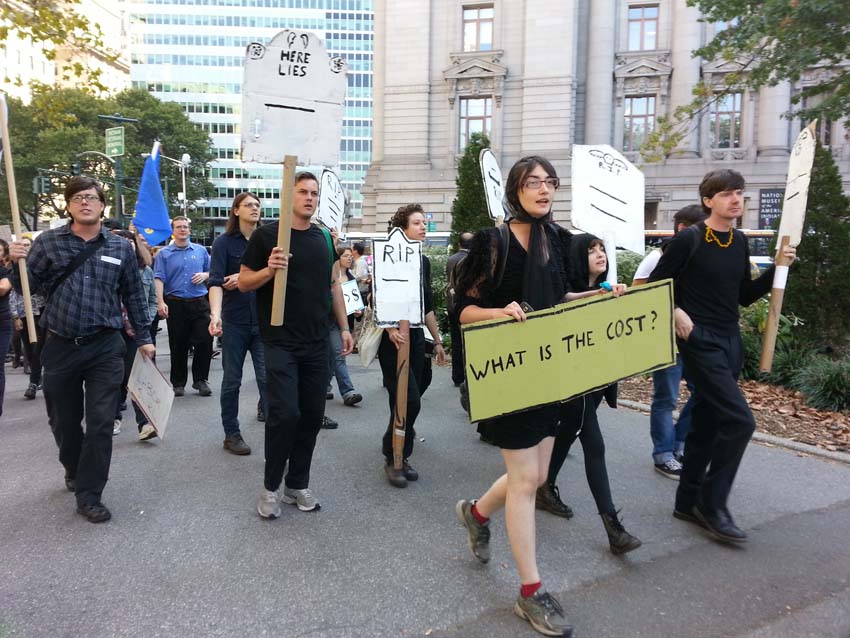
They put up the steel grille barricades around the edge of Zuccotti Park on the first anniversary of the Occupy Wall Street movement, leaving a few hundred protesters looking for a workaround under the bright red cube sculpture across Broadway. But a few hours later on the other side of the park, a smiling group situated on the edge of Trinity Place was busy with brushes and thin placards. They were painting peace signs and placing these signs around the perimeter on a soft bed of newspaper to dry: bright green life and hopeful ovals just under the drab barrier prohibiting the perfect circle of year one.

The protesters were matched in number by cops, many in riot gear. And they swarmed with a hunger for arrest. Numerous whiteshirts had been unrustled from their beds at an early hour and many seemed indignant about the renewed duties. I observed one whiteshirt shove his way through a crowd at Nassau Street, his meaty hand giving a hard singular push at any shoulder that got in his way. The checkpoints around Wall Street felt thicker, more reminiscent of East Berlin. Like last year, there were police mounted on horses beyond these points. But as the morning rolled on, the New York Police Department opted for motorcycles, later parking them neatly and voluminously next to the Charging Bull, guarded so beyond measure that you almost wondered if the cops had received some weird lead about two hundred armed men planning the biggest theft in human history.

It was the absence of visible activism for so long that made the authority feel more formidable. The extra force inspired the cops, with their bright white ties swaying from their belts, to manacle more people and make more arrests. By 3:30 PM on Monday, the official tally was 146 people nabbed for disorderly conduct. This included the artist Molly Crabapple, at least one NYU professor, three handicapped activists, and a few journalists. There were rumors circulating that the figure was close to 200. Some people told me that the cops were dragging people off the sidewalk to arrest them for stepping onto the street, but I didn’t see anything like this. But during one highly charged moment near Nassau Street, I witnessed four people arrested in less than five minutes.

The protesters were peaceful and calm, but this was not the ragtag group that had formed one year ago. It was a seasoned crew familiar with the stakes of income inequality and what they were in for if they got arrested. They felt the rightful need to claim their anniversary, often doing so with messages scribbled into the sidewalk with colored chalk. Three people said happy birthday to me over the course of a few hours, and the tone was so sincere that I wondered for a mite if some authority had changed my birthday to September 17th without bothering to alert me before coming to my senses. There was music and glitter emitted into the air. There was impromptu dancing, often in the middle of intersections. I was especially fond of the “crow technique” that a group of students adopted at the corner of Cedar and Broadway, which involved fluttering their arms into the air and making pleasant squawking sounds.

But when protesters repeatedly shouted “Shame!” for the umpteenth time in response to an arrest, a few protesters next to me remarked on how shame had lost its meaning. The hysterical calls to “Arrest the bankers! They’re the real criminals!” felt more like a dull platitude than a careful considered irony. There was also a bleaker humor this time around, with some protesters dressed as doctors and leaving “blood money” around the area. Their hands were saturated in fake blood, and it was doubtful that Rick Santorum would shake them.

It’s pretty clear that Wall Street has no interest in beginning a meaningful dialogue with the Occupy movement, yet the neighborhood isn’t quite willing to accept the protesters as a regular fixture. I watched one angry white collar man stomp out bright red balloons outside a building with an amazing ire, as if they were newly discovered mice scurrying around the floor of a ritzy apartment. I listened to another man, putting in four orders and wrestling with an allotment of hastily collected twenty dollar bills, complain to a delicatessen worker about how nobody else in the office wanted to leave the office and get breakfast. I saw a scavenger pick up bottles and cans for extra cash. There were still blue-collar workers on the clock and they moved dollies through the thick streets with a great patience. There were more people in the streets, but it was business as usual.

Lynn Povich (The Bat Segundo Show)

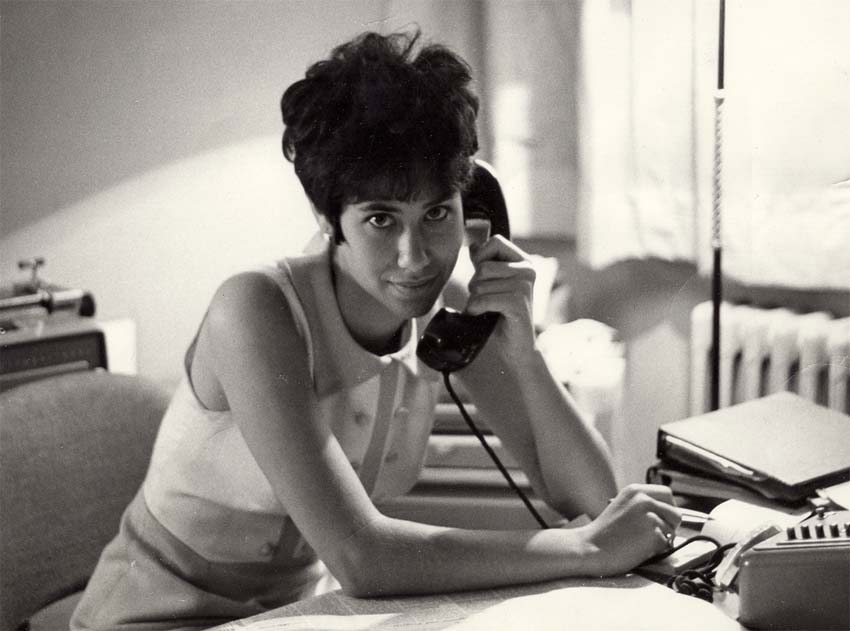
Lynn Povich is most recently the author of The Good Girls Revolt.

Condition of Mr. Segundo: Wondering why mysterious men are packing him off to Paris.

Author: Lynn Povich

Subjects Discussed: The Henry Luce “tradition” of men working as writers and women working as researchers, well-educated women being exploited in a two-tier system, Janet Flanner, the influence of the Civil Rights Act, the old boys’ network, the contrast between Oz Elliott’s civil rights conscience and Newsweek‘s treatment of women, Anna Quindlen, Otto Freidrich’s 1964 ridicule of the fact checker (and Friedrich’s condescending description of women), “office maidens,” the importance and accountability of fact checkers, how people viewed women reporters in the 1960s, Businessweek hiring women straight out of college, Reader’s Digest‘s paternalistic form of “respect” towards women, Flora Lewis in The New York Times, whether Kay Graham and The Washington Post‘s support of the lawsuit was sufficiently commensurate at the time, women reporters not being invited to lunch meetings, the second Newsweek lawsuit, Gloria Steinem vs. Graham, being a feminist vs. being a businesswoman, Eleanor Holmes Norton and the importance of having the right attorney, Harriet Rabb, Margo Jefferson, black reporters who didn’t organize at Newsweek, inquiry into efforts to unite black and women reporters, income disparity, why the journalism industry is a good medium to examine income inequity, women and education, journalism school, Povich’s editorship at Working Woman, women managers, tryout sessions for women and writer training programs, office affairs and rampant recreational sex within newsrooms, Hanna Rosin’s recent claims about hookup culture being empowering, how women didn’t get ahead even when promiscuous, sexist stereotypes in Aaron Sorkin’s The Newsroom, Sorkin’s “silent bearers of sexism,” the 2011 Global Report on the Status of Women in the News Media, the American inability to consider work vs. family balance, why it’s important to worry about men, and men as stay-at-home dads.

EXCERPT FROM SHOW:

Correspondent: When Oz Elliott, the Newsweek editor-in-chief, initially responded to the lawsuit that you filed against Newsweek — and this is sort of my question to get you to talk about that lawsuit, but let’s go ahead and get the background first — he said in his statement that the reason that most of the researchers at Newsweek were women and virtually all of the writers were men was, in his words, “because of a newsmagazine tradition going back almost fifty years.” Now he said this, despite what you describe later in the book as “a WASPY social conscience.” So why was this tradition, which originated from Henry Luce and Brit Hadden, tolerated for so long? Especially when you had some women who had to settle for this second-tier treatment and often give the best years of their lives? Let’s talk about the origins of this problem.

Povich: Well, yes, in fact, when Henry Luce created this system of all of the researchers being women, and all of the writers and reporters being men, Oz, who worked at Time Magazine at the time, said this was great for women because it got them out of the steno category and they could actually do editorial work. So at that point, which was in ’29 I think, it was considered more liberating than being a secretary. And Newsweek copied Time. However, by 1960, it was pretty clear that well-educated women coming out of the same schools as men with perhaps no prior experience, as many men did not have, and some prior experience, as some men had, were hired into this entry level category and couldn’t be promoted out of it. And women who really wanted to be journalists that young and knew it, like Nora Ephron and Jane Bryant Quinn and Ellen Goodman and Susan Brownmiller, they saw the lay of the land pretty quickly and they left. And the rest of us “good girls,” as I call us, were probably, first, happy to get a job. Especially in a place that was so interesting, about the news, working on the matters that really were important and having this special pipeline to the truth. As one of the writers said, we were all blind in many ways. I mean, the women bought into it. The men certainly bought into it. Until one day we didn’t. And I think the fact that the women’s movement happened as many of us in the mid-’60s were coming into the workforce helped us realized, certainly helped me realize. I was reporting and writing at the time. I was a junior writer. And I started covering the women’s movement. And I suddenly realized this isn’t just about those women. Hey, there’s something wrong with this picture for us at Newsweek. And that’s when a bunch of us started organizing.

Correspondent: Were there any other efforts at organization before yours that fizzled out? That you were aware of when you were organizing with your fellow women reporters or women researchers at Newsweek, aspiring of course to be reporters? I mean, were you aware of any other cues or efforts to rebel against this? I mean, I’m really curious as to why such a “tradition” lasted for so long and why good old Oz actually upheld that for a while, who was eventually forced to turn back. What was the impulse to, number one, cause him to change? And, number two, the other question is is: Why weren’t women revolting against this?

Povich: It’s a good question. Well, first of all, during World War II, there were women writers, as there were in many professions, where women took over men’s jobs. But by the early ’60s, they had all left. And there was one women who managed to get out of research and into writing in the early ’60s and was promoted to being a correspondent in Paris. So she was already writing in Paris when we were back in New York.

Correspondent: This is at Newsweek.

Povich: At Newsweek. There were still no women writing.

Correspondent: It’s interesting. They sent the women from New York. Just like Janet Flanner at the New Yorker.

Povich: (laughs) Right. Exactly. Paris.

Correspondent: Somehow women could understand Paris, right?

Povich: And she was a brilliant write and reporter. She was fabulous. She just didn’t happen to be there when most of us were hired. She had left to go to Paris. So we were presented with this situation of all of us being researchers and the guys being our bosses. It’s interesting. Because even though the Civil Rights Act passed in 1964, when the person who actually first started our revolt, Judy Gingold, who was a Marshall Scholar, who came back from England and could not find a job. Except as a fact checker at Newsweek. When she was talking to a lawyer, who told her that our situation was illegal, she couldn’t believe it. And she said, “Well, you know, I don’t think the guys know it’s illegal. I think we should just tell the guys.” And the lawyer said, “Call the Equal Employment Opportunities Commission and you’ll find out.” And so she called them. They said, “Yes, this is illegal.” And she said, “Well, shouldn’t we just tell the men?” And the women at the other end of the line said, “Are you crazy? People in power don’t want to give up power. If you tell them, they will promote two women, co-opt your movement, and it will be finished. You have a clear-cut case and you have to sue.” So my feeling is that they didn’t know it was illegal or realized it was illegal. Because it had been accepted as a woman’s job for so long. It had been a tradition. And, of course, it benefited men. And their circles were men. I mean, they hired guys right off the Harvard Crimson and the Yale Daily. Because that’s where they were from. And their circle, as we know, in corporate America still — if it’s a boy’s club at the top, your sources are guys.

Correspondent: Do you think these men were conscious of the fact that they were playing into this sexism? Or that this was an automatic power structure that they fell into? I mean, we were talking about Oz Elliott changing his mind. How difficult was it to get other men who were in positions of power to change their mind? Even before you filed a lawsuit. Or was it fairly steeped in the culture?

Povich: I mean, I have to say that many of the men at Newsweek were supporters of ours. Certainly the writers we worked with and who knew how smart and talented many of the women were, they supported us from the very beginning. And Oz Elliott, as you said, got it right away. He told me that Monday he realized we were right. Now this is a man who put Newsweek on the map because of his civil rights coverage. And they were very proud of their progressive views on civil rights and Black Americans.

Correspondent: A great irony.

Povich: Yes. And at the same time, they hadn’t realized that in front of their noses, there was this horrible injustice happening to the women who worked for them. Oz Elliott also has three daughters. And my pet theory is that men with daughters are far more open and respectful of what women can do. But like all organizations, or many organizations, the actual discrimination came in middle management. For us, it was the senior editors and the top couple of editors under Oz. That happens a lot in corporate America. And many of those guys were against affirmative action. Anna Quindlen has a wonderful quote she told me. I always say I’m an affirmative action baby and I’m proud of it. I wouldn’t have gotten where I was without it. And she feels the same way. And she says when people look at her strangely about that, she says, “If you think affirmative action is promoting a second-rate talent just because they’re female or black, you’re looking at one.” And so I do think a lot of people were against affirmative action. They thought that this was not a good idea. And they also didn’t look at women, frankly, as capable professionally. Either because of their own backgrounds, because of power. Whatever it was. But I was told that promoting me was one of the worst decisions that the editor ever took at the time. We were told when we filed the suit — one of the top editor said, “Why don’t we just fire them all? We don’t need them.” It’s complicated. I call it our little Rosa Parks moment. Everybody went to the back of the bus until one day you didn’t. And one day, we didn’t.

The Bat Segundo Show #484: Lynn Povich (Download MP3)

This text will be replaced

NYFF: The Savoy King: Chick Webb & The Music That Changed America

[This is the first in a series of dispatches relating to the 50th New York Film Festival. All of Reluctant Habits’s NYFF posts can be located here.]

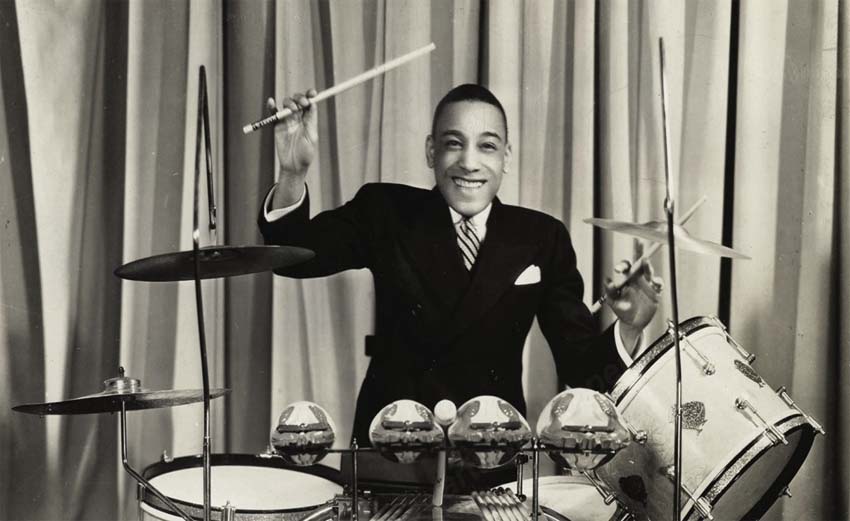
His name came from a tough tumble down Baltimore stairs. They called him “Chicken” because that was the way he walked: wobbly and hunchbacked and sometimes a little alone around the schoolyard. They shortened the name to “Chick” because the single syllable rolled faster off the tongue. But Chick Webb had the grit to hawk newspapers and saved up enough dough for a drum kit. They figured he might build up his upper body strength if they kept him hammering young and long and hard on the drums.

They could not know he would become a big draw at a very big venue: the legendary Savoy Ballroom, immortalized in music with an indelible stomp, the rare place where blacks and whites hopped together on the same hard floor. They could not know how he would woo and shape Ella Fitzgerald’s talent shortly after her fateful appearance at the Apollo. They could not know how Chick would rehearse new arrangements from new composers, the band fueled by mescal and Mary Jane, into the sunrise. They could not know that if you hung around the Savoy long enough, you would have Chick’s respect. Because sticking around was how Chick had made it this far and this good. They could not know he would lead the first black band to host a national radio show. They could not know he would be dead only four months after his 34th birthday. Or maybe it was his 30th? Why not print the legend?

The biggest surprise about Jeff Kaufman’s documentary, The Savoy King: Chick Webb & The Music That Changed America, is how Chick Webb’s mesmerizing life is diminished by the clumsy collection of stray biographical tidbits (Chick liked motorcycles, Chick was a snappy dresser, Chick had a German Shepherd), which don’t quite coalesce into a true narrative trajectory until the film stretches itself across a more expansive canvas. The film serves up many prominent voices (Bill Cosby as Webb, Janet Jackson as Fitzgerald, Jeff Goldbum as Artie Shaw, Andy Garcia as Mario Bauzá, and so forth) as profound movers and shakers in the 1920s and 1930s swing scene. But when we know Chick argued with Jelly Roll Morton, why do we need the former Jello pitchman? This minor dissonance also hinders the film from fully portraying or explicating Chick’s innovative drumming (“He sounded very different from any of the other drummers,” says one subject, to which one must ask, “Care to elaborate?”).

Chick Webb was so legendary that the Harlem streets were congested with more than 10,000 people on the day he died. Gene Krupa said that Webb was the only other drummer who “cut” him. In light of these vital details, it’s surprising that Kaufman races too fast over such details as Chick’s loyalty to his longtime guitarist John Truehart, the only member of Chick’s band who kept with him all the way through, and is sometimes too willing to buy into the Webb myth. (For example, Charles Linton told biographer Stuart Nicholson that Webb only said that he adopted Ella Fitzgerald “for the press people,” yet Kaufman is quite willing to go on with the mythos of Webb as Fitzgerald’s legal guardian.)

When many of the charming survivors (especially the ebullient choreographer Frankie Manning, captured here in his final years and in remarkable shape) are happy to spill Kaufman the story, why have other people get in the way? The Savoy King has greater success with dodgy-looking visual aids (such as the Indiana Jones-like map depicting Chick’s relentless touring schedule across the States in 1937) than the high-profile vocal cast.

But when the film shows the Savoy’s impact on American culture, displaying its contours with a computer simulation of the Savoy’s interior, it becomes a more meaningful exploration of the swing scene. The film obviously worked on some level with me, because I am playing Ella Fitzgerald as I write these words and I have a great desire right now to time travel back to the fateful evening of May 11, 1937, when Chick Webb and Benny Goodman duked it out in a battle of the bands at the Savoy. When the film reminds us that there were clubs in which a racist rope separated the dance floor down the middle and when it tells us that, in other clubs, blacks had to pay the same admission as whites to watch an act from the balcony (and weren’t allowed to dance) and when we recall that even the much vaunted Cotton Club would not admit African Americans, the Savoy’s pioneering efforts, taken with what others remember of Chick’s great generosity and energy, feel like a forgotten historical chapter that can’t be reread often enough.

Katie Roiphe, Cultural Sociopath

In the same year Anita Hill testified before snaky senators about a soon-to-be-confirmed Supreme Court Justice who had sexually harassed her, a twenty-three-year-old from privileged stock desperately sought attention.

Katie Roiphe tapped the sticky tendrils of her inherited web and wrote a New York Times article arguing that date rape was little more than a hysterical fantasy. “More than just a polemic against rape,” wrote Roiphe of this form of sexual assault, “it reveals a desire for dates.” Claiming that date rape pamphlets share common qualities with mid-19th century etiquette guides, Roiphe declared, without citing any specific sources, that the feminist movement then in bloom “peddle[d] an image of gender relations that denies female desire and infantilizes women.”

There was no vacancy in Roiphe’s article for feelings of trauma, shame, physical violation, or any emotion approximating empathy. But there was plentiful room for regressive rhetoric about “subject[ing] our male friends to scrutiny,” as if acquaintance rape was some inconvenience comparable to a chiropractor calling in the middle of dinner to schedule a followup appointment.

The piece received enough controversy for Little, Brown to enlist Roiphe to build these half-considered murmurs into a bigger townhouse — an even more ill-considered tome called The Morning After — where the Gray Lady-sanctioned paralogia pushed harder against the drab confines of Roiphe’s dim and unfurnished mind. “The guerrilla feminists were effective in their purpose,” read one of Roiphe’s typically subtle magnifications, “they successfully planted the fear of rape in the minds of prospective students before they even reached the Wesleyan campus.”

In tracking down some of Roiphe’s sources, Katha Pollitt discovered that Roiphe had used data in a misleading manner. Roiphe misrepresented a court case. Roiphe claimed anti-rape activists had manipulated statistics, yet fudged and ignored the research with a zealot’s predictably mad and sadly delusional touch.

Yet somehow Roiphe’s inexorable knack for inaccuracy and her reliance upon risible self-delusion to articulate a provocative point had escaped the pitchforks that had rightly driven Jennifer Toth out of town. Roiphe continued with her dutiful op-ed claptrap, turning out an essay collection (Last Night in Paradise) dripping with manufactured horror. To cite just one offense, Roiphe was so cruel that she went out of her way to ridicule Alison Gertz, the young woman who contracted HIV during her first sexual encounter and spoke around the country about safe sex before she died. Roiphe called Gertz “sweeter and blander” with each new wave of media attention. Then there was Still She Haunts Me, in which Roiphe expelled violet-tinted doggerel passing as a novel (“She was the oyster, the sun, the walrus,” reads one of the tome’s turgid sentences).

* * *

Who was this cultural Ann Coulter? Was she really serious? In 2007, when the surprisingly more restrained Uncommon Arrangements was published, I made an attempt to answer these two questions. I met Roiphe in-person for an interview, theorizing — wrongly as it turned out — that her viewpoints were part of an act or that she might be misunderstood. But Roiphe proved so belligerent that even the friendly woman at the Cobble Hill cafe asked what the problem had been shortly after Roiphe stormed out like a toddler in want of a pacifier. Not only was Roiphe in denial about a passage that she had written, which I had asked her to clarify, but she proved unwilling to talk about any of her other books. She hung on hard to gender generalizations, such as her idea that all women in their thirties long to be married, which I challenged. Above all, she claimed a devotion to the obstinate and inflexible viewpoint that refused to adjust, even as new evidence and new experience presented itself:

Roiphe: I’m actually interested in talking about this book and not my previous work. But, yes, I stand by everything that I said at the time that I wrote that book.

Correspondent: Okay. I mean, you know, don’t you — doesn’t your ideology change in any manner?

Roiphe: As I say, I stand by everything I wrote in this book and I’m right now interested in talking about Uncommon Arrangements.

* * *

“I often hear people refer to other single mothers I know as ‘crazy,’ and I assume that when I am not standing right there they refer to me that way too.” — Katie Roiphe, “The Alchemy of Quiet Malice”

In 1930, the psychiatrist George Everett Partridge introduced the word “sociopath” to the lexicon. Attempting to address the quotidian dilemma of people who went out of their way to be callous or who were unable to understand the concerns of others, Partridge identified a sociopath as someone motivated by supreme egocentricity, an inability to feel or comprehend remorse or contrition, and an almost total lack of empathy. The term sought to distinguish this troubled breed from a “psychopath,” who is driven by mental illness.

From the very first essay of her latest collection, In Praise of Messy Lives, Roiphe is a veritable Partridge exemplar. When friends extend help and sympathy after Roiphe’s divorce, she sarcastically writes, “I am touched by their concern,” and a page later, “At no other point in my life have so many people tried so hard to convince me of how miserable I am.” She complains that her friends aren’t hearing her, but refuses to consider that what they observe may contain a kernel of truth. It’s a strange early tone to establish, especially when Roiphe proudly notes how she “once wrote an entire book about one shouldn’t reach for easy feminist interpretations of the world.” It also makes one wonder why anybody would ever want to be Roiphe’s friend. Bring a cup of homemade chicken soup to Katie when she’s sick and you may very well be charged with a malefactory motive.

Roiphe believes in “things that can’t be measured and quantified in studies.” But her purported observational acumen, on display in “Unquiet Americans,” doesn’t reveal anything terribly sophisticated while traveling with her husband in Hanoi:

I had begun to see that everywhere we went there were a million minor transactions taking place beneath the surface. At first I was oblivious to these transactions, but slowly I began to recognize them: if a driver takes you to his friend’s hotel, he is getting a cut; if a waiter sells you an expensive dish, he is getting a cut; if a guide takes you to a silk shop, he is getting a cut; and there are bound to be other people getting cuts of his cut.

Beyond the crass suggestion that all in Hanoi are primarily motivated by a financial opportunism indistinguishable from the American middle class, there’s an alarming failure here to comprehend that these so-called “cuts” may be essential to Vietnamese survival or that American wealth, even with recent inflation, permits one to live like a relative king. Two peddlers approach Roiphe and her husband and our hapless heroes eventually give in. But Roiphe’s takeaway has little to do with the peddlers’ souls or any especial concern for their inner lives, which may even be messier than hers. She seeks craven capitalist comforts:

The only thing that is familiar, the only thing that moors us to our regular lives, is the green face of our former president.

Roiphe retreats from the green of money to the Greene of literature and her journey through Southeast Asia becomes as soaked in cliché as a graham cracker softened by milk as she notes the “tiny and immaculate” guide in Cambodia, maintaining a superficial and impenetrable response to what she sees as the “alien.” Unfortunately, this upper-crust white cracker jive becomes more lucid back on home turf.

In the essay “Beautiful Boy, Warm Night,” Roiphe reveals that a concern for others that is clearly alien to her arguably soulless and judgmental nature. “I remember her being from a trailer park,” writes Roiphe about a former college friend named Stella just before revealing that she secretly slept with her confidant’s boyfriend. And if this is a harbinger of the “praise” for messiness, it’s a decidedly cold and self-absorbed defense:

…people didn’t belong as absolutely to other people then. There was a kind of fluidity to our world. The barriers that in adult life seem so solid and fixed, literal walls defining your apartment, your bedroom, did not exist at that age. You listened, for instance, to your roommate having sex; you slept easily and deeply on someone else’s couch; you ate breakfast, lunch, and dinner with everyone you knew. And somehow nothing was quite real unless it was shared, talked about, rehashed with friends, fretted about and analyzed, every single thing that happened, every minute gradation of emotion, more high-level gossip in the process of being told than events in and of themselves.

This passage is about the closest Roiphe gets to confessing about how she relates to other people. Aside from the creepy idea that listening with care to the ways in which your roommate fucks the young man she loves is comparable to talking over a meal (let alone the cowardly act of stealing a lover in secret), the clear distinction here is how Roiphe infers what other people say about life as opposed to learning valuable lessons through living, even living as a mess. It’s telling how Roiphe states that she remembers almost nothing at all about the actual incident. And when Roiphe concludes her essay by imagining Stella, who aborted her friendship with Roiphe, returning years later about how Roiphe has once again failed to consider anyone outside herself, Roiphe writes, “She would be right, of course: I am stealing the boy all over again.”

And with this last sentence in the section devoted to Roiphe’s life, the sociopath clambers up to the surface: the same empty and unchanging monster demanding your scrutiny as she did eighteen years earlier, but without really much to say.

There’s her infamous and ill-informed essay about how today’s male novelists are too timid to write about sex. But Roiphe, who clearly hasn’t read much outside the mainstream literary canon, cherry picks a few convenient examples to uphold her thesis (Dave Eggers, David Foster Wallace, and Benjamin Kunkel), while completely ignoring the considerable volumes of literature (written by men and women; indeed, why should gender matter in a generational argument?) that have tackled daring or even absurd sexual topics.

Roiphe’s failure to mention the Bad Sex Award in an essay that purports to probe into how fictional sex is now received by the public reveals how clearly she has not done her homework. An essay that purports to deal with how “the heirs apparent have repudiated the aggressive virility of their predecessors” should probably consider how readers and critics perceive literature. Jonathan Littell’s The Kindly Ones, which took home a recent Bad Sex Award, featured ridiculous sexual description, but I don’t think Littell’s “jolt that emptied my head like a spoon scraping the inside of a soft-boiled egg” could be called, in all seriousness, a repudiation — given how that little episode went on for pages near the book’s finale.

If your reading tastes don’t steer to the vanilla, as Roiphe’s clearly do (despite her self-satisfied caterwauling about Fifty Shades of Grey), one can find plentiful contemporary novelists who still take chances with sexuality. Three years ago, Brian Evenson’s Last Days included a scene in which a mutilated woman stripped before a self-mutilated clique. And the disturbing and absurd qualities of this tableau, the rare literary moment striking an array of disparate emotions, revealed much about the way we objectify sex, even while hitting a more surrealist Portnoyesque moment. Earlier this year, Samuel R. Delany’s Through the Valley of the Next of Spiders was saturated with sex, which was used as a way to represent aging and being an outsider. Have the unsettling moments in Bret Easton Ellis’s American Psycho become so quickly forgotten? What of the comic sexual embarrassment frequently found within Jonathan Ames’s work? Or the uncomfortable sexuality explored in Rupert Thomson’s The Book of Revelations? Or the disturbing sex often found within Iain Banks’s work? (Or do we disqualify Thomson and Banks because they’re British? I don’t follow Roiphe’s logic. Do we conveniently elide certain nationalities to fit this essay’s sudoku-like approach so that the numbers line up in this predetermined puzzle?)

Roiphe’s hysterical ignorance bristles through this essay like an insensitive investment banker running away from a vagrant, especially when she lumps David Foster Wallace into the “often repelled and uncomfortable when faced with a sexual situation” category. Hardly. You don’t have to scratch Wallace’s oeuvre too hard to find fearless sexual representation. Unless, like Roiphe, the only fucking thing you’ve read of Wallace is Infinite Jest. Consider the title story of The Girl with Curious Hair, which features a young woman who allows a yuppie to set off matches on her skin (incidentally, teaching this story lost Jan Richman her job eight years ago). And what of the unsettling sexual feelings contained within Brief Interviews with Hideous Men?

That all of this uninformed folderol passed without a single editor looking into any of this, and was printed in the ostensible Paper of Record and a book published by The Dial Press, reaffirms the crepuscular state of American cultural journalism, which has not seen vibrant daylight for some time. Katie Roiphe easily fits into this onyx nexus because the medium is populated by vampires who cling to their jobs like passengers on the Titanic and who turn any remotely fresh or original talent into ground chuck. These thugs aren’t interested in thoughtful pieces. They’re interested in names and phony controversy. And the hilarious thing is that Katie Roiphe, a vitiated dunce more noxious and sociopathic and backwards than her fellow XX misogynist Caitlin Flanagan, is still considered a name by some of these people, who haven’t had a handle on things since about 1991.

It’s evident later in the book that this is more about Roiphe holding on to her op-ed perch rather than articulating anything of substance. Roiphe reveals herself as a fabulously scabrous hypocrite who views herself above the angry commenter (“Is it possible, though, that there is just more bitterness out there than we realized before the Internet brought us closer to people’s rawest, quickest, uncensored thoughts.”) and condemns Emily Gould for seeking a blurb after her hostile Gawker post:

If you are pumping out autopilot schadenfreude all day long, maybe there is nothing personal in it. The rage, the dissociated nastiness, floats through the ether and attaches itself fleetingly to a subject, but really, taking it personally is like being annoyed at the wind for messing up your hair.

This from a figure who pines for the days where sixteen-month-old children recognize the smell of Scotch on other people’s breaths and who kvetches about the political predictability of incest scenes in fiction.

To afford Roiphe some credit, she does include a somewhat intelligible essay on how Joan Didion’s style creates the illusion of personal revelation. But when Roiphe writes about Didion “[giving] writers a way to write about their favorite topic (themselves) while seeming to pursue a more noble subject (the culture),” one can’t help but think of Martin Amis’s more cogent critique about Didion’s “reflexive cross-hatching” in an essay contained in The Moronic Inferno — especially because Roiphe cribs the very same passage from The White Album (“does not now seem to me an inappropriate response to the summer of 1968”) that Amis used.

It’s no wonder she would try to pinpoint the value of messy lives, even if the best she can do is remark upon how “the tameness of contemporary sins” is a little disheartening. Maybe what Roiphe longs for are the days when messy essayists could get away with poorly considered arguments in the newspapers.

Like many rotting fountains throughout America, Katie Roiphe rose up the ranks with a cold and ungainly stream of stinging reductionist views, but has since fallen into permanent ratiocinative disrepair. Like a third-rate polemicist tossing poorly mixed Molotovs with a limp-wristed aim, she does not await the ballistics expert to fix her locking mechanism. She would rather rust with pride. So long as the New York clime will tolerate her peculiarly accepted form of trolling, Roiphe will be quite happy to douse you with a sticky brownish taint. This is not something to celebrate. It is something to pity.

(Editor’s Note: This essay contains some reworked material originally published as a Metafilter comment.)