The Bat Segundo Show: Charles Yu

Charles Yu appeared on The Bat Segundo Show #424. He is most recently the author of How to Live Safely in a Science Fictional Universe.

Condition of Mr. Segundo: Saying goodbye before saying hello.

Author: Charles Yu

Subjects Discussed: Accusations of egomania, Abbott and Costello, the real Charles Yu vs. the fictive Charles Yu, writing a novel in a nonlinear fashion, how time travel encourages emotional truth, father-son bonding experiences, viewing your own memory as a bystander, freedom of movement within text, skimming vs. careful reading, intense reading experiences, Finnegans Wake and recursive reading, David Foster Wallace, Faulkner, lack of concentration and the Internet, Dan O’Bannon, Red Dwarf, working stiff protagonists, schlubbiness, inner worlds and inner schlubs, gazes and looks within fiction, non-conflict conflict, drawbacks within time travel novels and extended meditation, diagrams contained within the middle of books, loneliness and sexbots, genre and MacGuffins, sticking with skeletal plot no matter what, gobbledygook and cryogenics, Richard Feynman, legitimate and illegitimate research into quantum mechanical texts, the appeal of language vs. the appeal of ideas, the fun tone of fake science, “Problems for Self-Study” (PDF) as a precursor for How to Live Safely, schematics as the genesis for finished fiction, smudging a list and Silly Putty, not laughing at one’s own comic writing, the funny qualities of email vs. fiction, Twitter, Moisture Man, schlubbiness vs. Asimov’s robotics, Phil the Computer Program, crushing the sentient feelings of computers in the future, reconstructing individual AI personalities from Twitter feeds, personality algorithms generated from books, books as simulacrums of consciousness, fakery injected into fakery, stories that are told in other voices, the use of hypothetical robots within fiction, fakery used to aid the idea of conflict, tangible boxes that have levers and stuff, and projections of machinery.

EXCERPT FROM SHOW:

Yu: I think schlubbiness is my default protagonist, unfortunately.

Correspondent: Oh yeah?

Yu: Yeah. I’ve yet to write — and lots of people have pointed it out, but really now it’s coming into focus. Because I realize how much I kind of schlub it up when I start designing. Not designing. But that’s how they come out. Maybe it’s a reflection of my inner schlub that I don’t know how to create a dashing hero yet.

Correspondent: (laughs)

Yu: I want to.

Correspondent: You’ve made attempts? (laughs)

Yu: I’ve probably made some half-hearted attempts. But I’m going to try harder to make a non-schlub protagonist. Because I want to try something different. I think it’s partly a reflection of just the worlds too that these guys live in — and so far they have been guys. That they’re sort of slightly broken, damaged worlds in the stories I’ve written too, for the most part. So they fit into that, I guess.

Correspondent: Inner worlds create inner schlubs.

Yu: (laughs)

Correspondent: So you’re saying that the schlubbiness is dictated more by the worldbuilding that you’re undergoing in a short story or a novel. Or the fact that you can be more, I suppose, confidently schlubby on paper as opposed to life.

Yu: No, I think the worlds make the schlub. And I think there’s a bit of a change in the Charles Yu character. I think he tries to stop being such a depressed navel gazer and look forward a bit. I mean, I don’t mean to spoil anything for people who haven’t read it and want to read it. But it also seems easier for me to see the change that I want to have in the character. Or to start with somebody who’s really sort of broken. And have them find some measure of some resolution or something.

Correspondent: Well, on that subject of something else being in plain sight — no pun intended for the next question, which is rather elaborate — in describing a sexbot, you write, “Something about the look in her eyes gets me, even though I know they aren’t really eyes.” When an older Charles observes a younger ten-year-old Charles and his father, you write, “And it looks as if they are staring, not through me, but right back at me, and with their minds immersed in the theory of time travel and their eyes fixed on the future.” Late in the book, when Charles Yu faces a serious existential crisis and contemplates several options, he has one choice. “Nor can I change the path of my body, the words from my lips, not even the focus of my eyes.” So it’s interesting to me that Charles Yu — in the book, not you — is just as aware of these fixed looks and staring into these windows of the soul and he can’t quite connect through the space-time continuum and through the act of writing. So I’m curious where this interest in eyes came about. Was this a way of informing the reader on what Charles Yu is missing out on? These recurring stares? This recurring communication with souls and the like?

Yu: Yeah, that was an elaborate question. So I’m going to try and give an appropriately elaborate answer.

Correspondent: Fantastic.

Yu: It only seems right to do justice for that question. Because I think you’ve put your finger on something I was trying to get out. Which is this kind of feeling of missed connection across time. And yet when Father and Mother are gazing toward the future, or Charles is looking at something, can sometimes sense something in the room, it’s this idea that now that future Charles is in that room looking back, maybe the first time around you feel the future there too. And that’s what you’re looking at. But you can’t connect. As you pointed out, you’re not directly looking at it. But there’s a sense in which what’s going to happen is already in the room with you and you can feel it there. You can’t see it yet. And then in the past, you can see it now. But you can’t change anything about it. And that also, in terms of narrative mechanics, there is some squiahiness to my sci-fi here. It’s not hard at all.

Correspondent: Squishy and schlubby. This is great.

Yu: That’s right. Yeah. Not hard sci-fi. Squishy, schlubby, mushy sci-fi.

Correspondent: It was never on the jacket copy though.

Yu: (laughs) But the one constraint I wanted to have in there. And I won’t pretend to know whether or not I ever violated it. But I think I said as a rule that you can’t change the past. And if you do, you shoot off into an alternate reality. But here’s where the sort of paradox comes in. You can’t — like the Charles when he realizes he’s caught in his time loop, if he wants to stay within his chronology, he can’t say or do anything different. And he can’t even look in a different place. But he can think something different. So I’m drawing what I understand is an artificial distinction between thinking and doing. But that was sort of where that comes from. It’s that even if my eyes — you know, everything I do is exactly the same as the first time down to where I’m looking. I have the tiny degree of freedom of changing how I feel about the same experience. Therein sort of lies the difference where he goes through this for the second time, basically.

Correspondent: Any alteration in the time stream causes the protagonist Charles Yu to not be able to see or to interact. Which is a really bummer offshoot of any of his decisions. Even a stray drift from this prevents him from doing anything. That’s quite a high wire act you set for yourself as a writer. How do you generate conflict if you have a protagonist who is incapable of doing what most humans are doing? When his pro-active decisions create this mess?

Yu: Right. That was a problem. It really was. And I’m not sure I surmounted that problem. I think if I were to judge by some of the responses I’ve gotten, some people have said, “Not enough conflict in this book.” And I think that’s a fair statement. And what conflict there is is necessarily pretty internal. One drawback for having a time loop novel and one in which the form of time travel requires you cannot change anything.

Correspondent: Was this form of non-conflict conflict the best way for you to explore these issues of memory and consciousness and choice and loneliness? That that was really the only comfortable or reader-accessible way for you to tackle these issues?

Yu: I think so. It’s the only way I could figure out how. I mean, I wanted it to be sort of an extended meditation on something. And that doesn’t make it sound terribly attractive when you’re thinking of reading and writing a book that’s going to last for a couple hundred pages at least on a meditation. But it was, to me, the only form that — it just kind of grew out of what I was writing about. For better or worse. So I was like, “Well, this is going to be the plot.” And as you know, there’s that diagram in the middle of the book, which sort of gives you the plot points. And there aren’t many of them But that’s what I did pretty early, like very early I drew that. And I said I’m going to stick to this. Because this will keep me from getting lost and violating the rules I’ve set up. And keep me focused on exploring the ideas of consciousness and memory that you pointed out.

The Bat Segundo Show #424: Charles Yu (Download MP3)

This text will be replaced

The Bat Segundo Show: Wayne Koestenbaum

Wayne Koestenbaum appeared on The Bat Segundo Show #423. He is most recently the author of Humiliation.

Condition of Mr. Segundo: Fully considering the witnesses.

Author: Wayne Koestenbaum

Subjects Discussed: Whether a deliberate slander of a surname is a humiliation, the three components of humiliation (victim, abuser, and witness), the differences between recorded humiliation and experiential humiliation, spectacles of martyrdom, preexisting humiliation and statutes of limitation, edicts of instantaneous revocation, Koestenbaum’s use of triangles to uphold book concepts, itemizing shameful personal anecdotes, self-excavation as a writer, the pleasure of sentence making, being eons away from publication, rousing one’s self from stupor through stimulated memories, glimmerings that regurgitate and abreact, Koestenbaum’s obsession with a paddled third-grader, shifting personal anecdotes around to serve the narrative and whether this cheapens it, life as an experience of first times, Freud’s cathexis, cheapening vs. coarsening, what Koestenbaum doesn’t write about, Koestenbaum’s uncertainty in knowing whether or not he humiliates his own parents, growing up in a family where disclosure is normal, observing a large woman who urinates in the middle of a sidewalk, Edith Massey, Female Trouble, parodying Russ Meyer, John Waters as instigator of a cinematic spectacle, being simultaneously atrocious and radiant, Divine, fecal doppelgangers, honesty vs. humiliation, displaying one’s body, David Foster Wallace’s “Big Red Son,” the genuine facial expression of a person in orgasm, Anita Bryant being pied, pornography and humiliation, seeing the malevolent as human, the draw of Liza Minnelli videos, the human duty to understand multiple perspectives, an artificially polarized theater of affect, Freud and children getting beaten, being kind to the humiliated, finding Alec Baldwin sexually attractive, Alec Baldwin as a macho ego ideal, rejecting tabloid culture, the scapegoating culture, the London riots, privileged humiliation, Frantz Fanon’s The Wretched of the Earth, the Jim Crow gaze, Abu Ghraib, Michael Jackson, whether Osama bin Laden was humiliated because America withheld the photo, Annie Leibovitz taking photos of Susan Sontag’s corpse, David Rieff, respecting evil historical figures, whether Shakespeare humiliated language, Basquiat striking out words in his paintings, Finnegans Wake, humiliation vs. a sense of wonder, radical muscularity within language, “Bare ruined choirs, where late the sweet birds sang,” logocide, writing with physical pleasure, humiliation vs. sorting out thoughts, critiquing the sign system of American power, writing on paintings, wrongness as the new gold standard, Gertrude Stein, “maltitude,” well-done violent movies, John Woo, major human dynamics at stake, behavioral options when responding to assholes, Eleanor Roosevelt’s “Nobody can make you feel inferior without your consent” maxim, humiliation and consent, Freud’s anti-Semitic experiences, writerly failure, vengeance, TC Boyle’s “Bury your enemies,” and aggression in writing.

EXCERPT FROM SHOW:

Correspondent: In “Catheter,” you write at the end, “I have a noble aim: to urge you to be kind when you see someone humiliated, even if you think that the shamed person deserves punishment.” When you find someone like Alec Baldwin sexually attractive and, in your own words, “wondering why I agree to occupy this role rather than refuse it by vowing to ignore the tabloid trade of trashing the stars,” I’m wondering if you are being kind to Alec Baldwin. If you don’t know the figure who is being humiliated, if you’ve never met them, can you always be kind? I’m curious about this.

Koestenbaum: You mean, is that like the tree falling in the forest thing? Like if I’m kind to Alec Baldwin by not reading a scandalous story about him, how will he know I’m being kind?

Correspondent: That, and also this compelling allure of participating in that culture. I mean, when that whole thing came out, I heard about it from friends. But I made a conscious choice not to participate in it. Because I just felt that it wasn’t worth my time. I’m only getting one side of the story. I don’t know Alec Baldwin. I like him as an actor, but, you know, what business is it of mine? You know what I mean? So as a result, it seems to me that you’re finding or you’re vacillating with “Should I participate?” To be or not to be.

Koestenbaum: Right. Okay, I will say that I totally get your point. That you’re talking about the kind of conscientious objection to or an abstaining from the gladiatorial carnival of consuming celebrity carrion.

Correspondent: Absolutely.

Koestenbaum: And I understand that. I would say that in my life, I have made a few golden exceptions to that rule because of deep libidinal and imaginative connections that I had. And so for example, having written a whole book about Jackie Onassis, that’s a case where I flagrantly did not abstain from the national profession of consuming images of Jackie. I indulged it. But that’s because I had deep unconscious motives. And I felt that much for me was personally at stake in pursuing that obsession. In the case that you’re mentioning, where you like Alec Baldwin as an actor but you don’t have strong feelings about him, it’s not a difficult thing for you to abstain. For me, like Alec Baldwin, I didn’t consume it as deeply originally as I did when I decided to write about it. But I do have a kind of long-standing crush on Alec Baldwin. I’ve interviewed him. I wrote about him in my book Cleavage a little. “My Evening with Alec Baldwin.” We’re the same age. He is a kind of weird hectoring ego ideal — hectoring isn’t the right word. I mean, he seems like a kind of bossy guy. He’s a kind of macho ego ideal for me. So I have — he’s a — I agreed, agree I have cast him in my drama, but, yeah, I’m using him as a teaching point.

Correspondent: But how can you be kind? I mean, I think you nailed it on the head there by pointing out and being fully candid about the fact that there’s an allure there. There’s a sexual attraction there. He forms an imaginary impulse for all sorts of things in your mind. Which is perfectly fine and that’s completely understandable. But at the same time, can you also be kind when you have that going on as well? It’s almost as if this is another instigation point for humiliation.

Koestenbaum; Right. No, no, no, I will say then that, toward Alec Baldwin, perhaps I have not been supremely kind. But I’m not alone. And I would like to think — maybe I’m dreaming — I would like to think that I’m placing the whole Alec Baldwin crease within a really large cultural context of these kinds of spectacles. And I’m reviewing, I’m saying on the one hand I get a sort of sadistic erotic relish from this. And then on the other hand, I wish to abstain from the process of scapegoating others. I’m never saying he’s a bad father. There’s never a moment where I pass judgment on him. I’m commenting instead on his use of the word “humiliating” in the thing to his daughter. It’s hard for me to really explain this, except to say that I’m not making judgments about Alec Baldwin. I’m making judgment about the star culture and the culture of scapegoating.

Correspondent: It can be argued that the London riots, which occurred a few days ago at the time of this conversation, that they arose because you have the poor, the young, the disenfranchised given no choice. Essentially they are humiliated. Thus, you have revolt from humiliation. You touch upon this very early in the book where you deal with revolt, activism, and uprising as a response to humiliation. You conclude that, “Choosing homicidal martyrdom as a response to historical humiliation, I become a suicide bomber.” What of this space in between which causes riots? Very often you have no progress but more of the same. How do you reconcile? What we’ve been talking about here is essentially privileged humiliation vs. an unprivileged humiliation in which it’s unrest or activism.

Koestenbaum: That’s a really — I mean, I don’t have profound or definitive things to say. That’s a moral conundrum for deeper minds than mine. Honestly. But in a way, it’s the question of a justified violence or of revolution, a violent revolution. And when it’s justified or it’s not. And who is to decide when it’s justified. That’s a big question. And I think it’s — I want to say case by case. I would hesitate to make any generalizations about revolution. I think I talk about what I call the Rosa Parks principle, where humiliation leads to uprising and activism or Frantz Fanon in The Wretched of the Earth. But let’s just call it the suicide bomber or the terrorist question. I don’t want to say pro-terrorist things. Because I don’t really feel very pro-terrorist.

Correspondent: But you are willing to confront what you call the Jim Crow gaze. That look where someone looks at another person as if there is nothing there. Complete invisibility. Entirely because of race and also often because of class or because of sexual orientation or what have you. It seems to me that this willingness on your part to tackle this difficult question doesn’t necessarily make your views on humiliation legitimate or transferable from this place of privilege and this place of media obsession to this really stark territory of “How do I get by when I don’t have any options on the streets?”

Koestenbaum: Right.

Correspondent: No thoughts in terms of the Jim Crow gaze in comparison to the Alec Baldwin stuff we were talking about before?

Koestenbaum: It’s a really — I mean, I talk about both things in the book. Because it seems that with the title and a subject like humiliation, I have a feeling I don’t want to write a book just about the Alec Baldwin things. That’s only one question that interests me. And I was just as much motivated to write this book by the Abu Ghraib things. But as I say, very honestly, there were three catalysts: Clinton, Michael Jackson, and Abu Ghraib. They have very little to do with each other. But there is a kind of spectrum where all three instances involve the United States, power, scandal, and sex. Or the sexualizing of — I don’t know. I don’t want to say glib or wrong things.

Correspondent: Yeah.

Koestenbaum: I try in this book through the use of these numbered fragments to keep as separate as possible some of these kinds of instances for exactly what you’re suggesting. That it’s not possible to map what you’re calling “privileged humiliations” or, as I describe on my own, having had a relatively humiliation-free and lucky life, nonetheless I could go into this litany of my humiliations. I don’t want to say that all suffering is the same.

Correspondent: Life is not a comparison of horrors. That kind of thing.

Koestenbaum: No.

Correspondent: Well, let me try to get on this from another angle. You had mentioned very early on — and I was actually going to bring this up too — the photos that Annie Leibovitz took of Susan Sontag. The Osama bin Laden execution. There was no photo of a dead body. Saddam Hussein’s execution, we do get to see him. Now you write of Leibovitz taking photos of Sontag’s corpse, as we said earlier, quoting David Rieff, who said that she was humiliated posthumously. So the question is, if one doesn’t have the choice of seeing the photos, is it still possible to humiliate the object or the person? Was the decision, for example, to not release the Osama photos a more respectful choice? Or was it possibly something — by not giving Americans the option to humiliate or to not humiliate, maybe it was almost a dishonest choice. What do you think about that?
Koestenbaum: Yeah. I mean, I don’t want to chicken out of a question But I can’t. I don’t know — do I really want to talk about the Osama bin Laden photos? It feels way beyond what I can speak about responsibly in a way.

Correspondent: Even if you were also simultaneously asking us to feel kindness for those who are absolutely terrible as well.

Koestenbaum: Yeah. I mean, the only reason I say I don’t want to — it just seems — just because I wrote this book, it doesn’t mean I feel that I’m an expert on the world’s atrocities or am some extraordinary moral barometer in a way. The question has a lot of responsibility tied into it. As if because I mentioned the Susan Sontag photos in the book, I’m automatically going to have an opinion about the Osama bin Laden photos. Which I don’t. I mean, basically, I don’t have a stand about “Yes, release all photos” or “No, don’t release all photos.” Maybe I don’t understand your question.

Correspondent: Maybe the direct question to ask you is: Is Osama worthy of the same respect if someone is being humiliated as David Rieff suggested of Sontag?

Koestenbaum: Well, is that then the question of, like, “Is it possible to imagine Hitler had a mother and that she loved him?” And that’s again a question way too complicated to know the answer to. Is it possible to include in the human family some of the worst people? And I do say in the book that when I imagine or see a serial killer led to his execution, whimpering, I feel clemency rise within me. Yeah, I have that impulse. I bet you do too, if you’re asking the question. Yeah, I do have that impulse.

The Bat Segundo Show #423: Wayne Koestenbaum (Download MP3)

This text will be replaced

Lord Jim (Modern Library #85)

(This is the sixteenth entry in the The Modern Library Reading Challenge, an ambitious project to read the entire Modern Library from #100 to #1. Previous entry: Ragtime)

Much like today’s tawdry Hollywood movies, Lord Jim was based on a true story — back in the days when it actually meant something. On August 7, 1880, a ship called the Jeddah, on its way from Singapore to Arabia and carrying 950 Muslim pilgrims, had an accident. The British officers abandoned the ship near Cape Gardafui. But the Jeddah did not sink. Captain Clark was on his way out of the British Consulate when another captain reported that the Jeddah had been salvaged and towed. Clark got off lightly. His certificate was stripped for three years. But the Jeddah‘s first mate, Augustine Podmore Williams, received a harsher sentence.

This tale of lost honor and irresponsible officials eluding their duties so captivated Conrad’s imagination that he began drafting a short story in a thick album bound in leather that had belonged to his grandmother. The Jeddah became the Patna. (And the Patna would show at the end of Alien 3, lest you thought that film franchise was solely Nostromo.) Zdzislaw Najder’s very large biography, Joseph Conrad: A Chronicle, informs us that Conrad kept tabs on his word count in the margins. Serializing the yarn in a magazine was the idea, and his labor on the Lord Jim prototype intersected with the completion of “Youth” — a story that also featured the well-known Charles Marlow. Yet at this stage in the Lord Jim writing, Marlow hadn’t yet found his loquacious entry point. What Conrad would not know is that Marlow would become as ubiquitous in his work as the creepy adjusters you see in today’s subdivisions who show up minutes after a fire to stake out a husked out building. While Marlow may not have been driven by the adjuster’s compulsion to itemize and sweep in, he did share the common trait of being a remarkably patient listener to a tragic tale.

After some early starts, there was a six month break. Around this time, Conrad was also at work on Heart of Darkness (yet another deck for Marlow to walk on), which appeared in three parts in Blackwood’s Magazine (and which will be discussed in a future Modern Library installment). Factor in an especially vituperative article from Eliza Orzeskowa (“The Emigration of Talent”) that accused Conrad of deserting the Polish homeland and diminishing his talents and one gets the sense that Conrad wasn’t exactly doing the happy dance around 1899.

Conrad had to go sailing on a boat (La Reine) he had purchased with his pal Stephen Crane to unlock Lord Jim‘s secret: namely, the shift from omniscient narration to Marlow, who is arguably one of the most formidable ramblers in all of literature. (Indeed, there is a strange pleasures reading Lord Jim in the 21st century and contemplating the type of audience who would sit through such a protracted tale without offering a question or an interruption. I’ve done the math here, and Marlow’s tale is probably a lot longer than Christian Marclay’s The Clock. When you factor in our short attention span age, the time investment and patience is tenfold more remarkable. Today, I have no doubt that people would be live-tweeting Marlow or checking their BlackBerries. And we haven’t even discussed bathroom breaks.) Conrad’s “long short story” of 20,000 words eventually expanded to six times the calculated length. This didn’t stop him from additional dips into continuous partial attention. He even collaborated with Ford Madox Ford on The Inheritors in early 1900.

In addition to bracing the pressure of Blackwood’s serializing Lord Jim, Conrad also faced the death of his BFF GFW Hope’s seventeen-year-old son on the high seas (with some evidence of a covered up sexual assault, thus accounting for the book’s dedication), and, like many writers then and since, tremendous financial uncertainty. The plan had been for “Tuan Jim: A Sketch” to be part of a collection, but this idea became spottier as the story mushroomed.

One can offer the theory (and biographer Jeffrey Meyers certainly has*) that Conrad needed to be oblivious to keep up with the time-consuming nature of novel writing, claiming to be just about finished when there was still a good deal of work that needed to be done. Yet Conrad plowed forward, fighting off bronchitis, malaria, and even gout. Indeed, if one isn’t humbled by the fact that Conrad wrote this sweeping masterpiece in his third learned language, there’s the impressive manner in which Conrad doggedly used a paperweight to keep down his sheets while working with an inflamed wrist.

Conrad’s grief over his good friend Crane’s untimely death on June 5, 1900 made its way into Lord Jim‘s last ten chapters. And given how these heavy feelings fueled such a heavy book, there is little doubt that Conrad had reached a point where he wanted to be done with Lord Jim, as he was to remark in a July 20, 1900 letter to John Galsworthy:

The end of L.J. has been pulled off with a steady drag of 21 hours. I sent wife and child out of the house (to London) and sat down at 9 am, with a desperate resolve to be done with it. Now and then I took a walk round the house out at one door in at the other. Ten-minute meals. A great hush. Cigarette ends growing into a mound similar to a cairn over a dead hero. Moon rose over the barn looked in at the window and climbed out of sight. Dawn broke, brightened. I put the lamp out and went on, with the morning breeze blowing the sheets of MS all over the room. Sun rose. I wrote the last word and went to the dining room. Six o’clock. I shared a piece of cold chicken with Escamillo [Conrad’s dog, named after Carmen] (who was very miserable and in want of sympathy having missed the child dreadfully all day). Felt very well only sleepy; had a bath at seven and at 8:30 was on my way to London.

The thing that gets me is how Conrad felt the need to punctuate the end of his industry with a cold piece of chicken. But Conrad would initially dismiss Lord Jim as “a lump of clay.” While Lord Jim was to be favorably received, it wasn’t exactly a blockbuster. The first batch of 2,100 copies sold out in two months. The next printing of 1,050 copies took four years. Some reviewers complained. Many raved. Henry James sent Conrad a letter of congratulations.

* * *

If I am to be truthful here, I must confess that I had to start Lord Jim a second time before I really got into Jim’s woeful adventures from Patna to Patusan. My first reading attempt pushed me to the 200 page mark, but I zoned out, Conrad’s paragraphs washing over my eyes like imposing ebbtides. At first I feared that Conrad, whose Heart of Darkness I had loved so much in high school, did for me what Thomas Pynchon does for other people when they resent not being able to finish Gravity’s Rainbow. But when I put aside some professional obligations and realized that Lord Jim required my total attentions, I found myself stirred and fascinated by Jim’s remarkable obstinacy, his failure to shake off the shame from the bulkhead accident and move on. Here’s a guy who skips town anytime some stranger brings up the Patna incident. You almost want him to go all Dustin Hoffman (as opposed to James Marsden) in Straw Dogs rather than sit there passively while others deface his honor. Jim would never be able to get away with these chicken sprints in the age of Google.

Other characters tolerate this curious strain of romantic heroism. Poor Marlow, who you figure should know better, gets Jim a gig in the most munificent manner possible, pointing out to the troubled young hipster (sorry, but I can’t help but think of emo layabouts when imagining Jim in my mind’s eye) just how much he’s put his ass on the line:

“Look at the letter I want you to take. I am writing to a man of whom I’ve never asked a favour, and I am writing about you in terms that one only ventures to use when speaking of an intimate friend. I make myself unreservedly responsible for you. That’s what I am doing. And really if you will only reflect a little what that means…”

Jim gets the gig, offering a jolly “Jove!” in response to this generosity. (It’s worth noting that Jim is very big on “Jove!” I’m guessing that “Jove!” was the “Fuck yeah!” of its day.** And, on second thought, I don’t blame Marlow too much. If I was in the company of an exuberant lad who liked to yell “Jove!” all the time, I’d probably buy him a few beers with the remaining shekels in my reticule.) But he blows the job (and costs the man his business) when the second engineer of the Patna shows up. “I couldn’t stand the familiarity of the little beast,” writes Jim back to Marlow.

But given how Conrad offers us so many eccentric characters of the sea, is Jim’s bitching really called for? Especially when Jim’s stolid near Bartleby-like temperament causes people he knows to die after Stein appoints Jim as manager of his trading post in Patusan. We see any number of idiosyncratic types throughout Lord Jim: the German skipper who demands liquor by the light of the Patna‘s binnacle, the captain who is part of the Patna investigation and suicidally throws himself overboard as though “he had suddenly perceived the gates of the other world flung open wide for his reception,” Marlow’s brief chief mate Selvin who, upon not receiving a letter from his wife, “would go quite distracted with rage and jealousy, lose all grip on the work, quarrel with all hands, and either weep in his cabin or develop such a ferocity of temper as all but drove the crew to the verge of mutiny,” the butterfly-collecting merchant Stein, and the monstrous buccaneer Gentleman Brown who forces Jim’s hand in Patusan. Given his close proximity to goofballs and mountebanks, one would think that Jim would have something bigger on his mind than his own fragile ego.

If Jim is considered “a solitary man confronted by his fate,” then it interesting how he attempts to reconcile his honor with Cornelius, the “unspeakable” man embezzling and appropriating from Stein whom Jim replaces in Patusan. Cornelius treats his station and his girl quite unwell. But can we commend Jim for trying to be civil with Cornelius when he asks if he is unwell? Perhaps. But doesn’t Cornelius, for all of his odious qualities, carry some slim honor? Sure, the man has bamboozled Stein. He’s clearly stealing more than a few office supplies. But there’s something equally absurd to Jim in the way Cornelius offers to smuggle Jim out through the river for a mere eighty dollars. Cornelius certainly has a point when he declares to Marlow, “What did Mr. Stein mean sending a boy like that to talk big to an old servant? I was ready to save him for eighty dollars. Only eighty dollars. Why didn’t the fool go? Was I to get stabbed myself for the sake of a stranger?”

In light of the “Look at that wretched cur” farcical business at the Patna inquiry, whereby Marlow remarks on a weaving yellow dog and the oversensitive Jim believes that Marlow is talking shit about him, what makes Cornelius’s griping about sacrifice any less ignoble than Jim’s? And in disseminating Jim’s tale of dishonor to unknown listeners in the shadows, isn’t Marlow also sullying Jim’s honor? Certainly not in our eyes, if we look upon the tale from the outside. But Jim would most certainly think so, if he knew the full extent of Marlow’s goodnatured gossiping. We also have no idea how reliable Marlow is — especially since we are getting boatloads of hearsay. In fact, only “one privileged man” gets to hear the final word of the story, which is mostly second-hand from a fairly unreliable source.

Perhaps as Marlow says, the problem resides in the externals:

The conquest of love, honour, men’s confidence — the pride of it, the power of it, are fit materials for a heroic tale; only our minds are struck by the externals of such a success, and to Jim’s success there were no externals.

* — You may have observed that I haven’t really probed into Joseph Conrad’s bad behavior in this Modern Library installment. Given that there are three more Conrad volumes on the list, I’m thinking I’ll probably be addressing Conrad’s boorishness at some future point. However, since we’re on the subject, I feel compelled to point out that, should you check out Jeffrey Meyers’s Joseph Conrad: A Biography from the Mid-Manhattan branch of the New York Public Library, you will find this amusing marginalia on Page 187 suitably illustrating the author vs. work predicament:

Annotator 1: Ingrate! mistreats his wife I am trying to find something beneficial
Annotator 2: His writing!

Annotator 1: Constantly borrowing money
Annotator 2: So what?

** — Aside from “Jove,” “tumult” is another word Conrad is quite fond of — for abundantly clear reasons. I am also highly inclined to devise some Brooklyn answer to “tiffin” that I can work into my life and vernacular.

Next Up: Elizabeth Bowen’s The Death of the Heart!

The Bat Segundo Show: Alan Hollinghurst

Alan Hollinghurst appeared on The Bat Segundo Show #422. He is most recently the author of The Stranger’s Child.

Condition of Mr. Segundo: Pondering a new career that has nothing to do with literary biography.

Author: Alan Hollinghurst

Subjects Discussed: Ivy Compton-Burnett, attention to character panoramas in 21st century literature, the appeal of huge gaps in the narrative, Alice Munro’s Runaway, how Hollinghurst decides which characters get to pop up later, Chekhov’s gun, characters who have affairs with the same man, factoring in the reader’s need to know, The Line of Beauty, Michael Apted’s Up series, unanticipated flourishes that run throughout different historical epochs, the 1967 Sexual Offenses Act, avoiding writing directly about the Great War, the dangers of too much research, the James Wood review, how a single verb choice can alter a sentence, “muddle,” the paucity of laughter verbs in English, our correspondent’s highly pedantic (and unsuccessful) attempt to pinpoint Hollinghurst’s affinity for verbs containing the letter U, Paul Bryant as one of the most compelling cases against literary biography and literary criticism, real world Paul Bryants, how minor biographies are often written by the wrong people, Ronald Firbank, obsessiveness as a character trait, media overexposure, being comfortable with the inevitability of obsolescence, fiction and posterity, Auden and biography, Mick Imlah’s “In Memoriam Alfred Lord Tennyson,” legitimate literary biography, Michael Holroyd’s work on Lytton Strachey, Richard Ellmann’s Joyce bio, the fallibility of human memory, the corruption of poetry, the allure of the second-rate, life vs. art, having a vivid sense of someone over a weekend but not really knowing them, The Man Who Shot Liberty Valance, referential character names, why Hollinghurst couldn’t get through the whole of Anthony Powell’s A Dance to the Music of Time, depicting older people, having a wide range of friends, The Swimming-Pool Library, relationships between young and old people, sticking with “said” in dialogue and appending description, Evelyn Waugh, dealing with idiosyncratic translations, the word “satiric” offered as a cue for later satirical exercises, loose environmental description, jostling characters around, class trappings, TS Eliot and PG Wodehouse’s past experience as bankers, growing up with a father who was a bank manager, and Hollinghurst’s novels increasingly moving further into the past.

EXCERPT FROM SHOW:

Correspondent: In the first section, we are informed that Cecil’s servant cleans his change. Later in the book, you have Paul Bryant, who I want to talk about quite a bit — he works in a bank and he washes the money smell off of his hands in the gent’s room. Then you give Cecil a very firm handshake. And then in the third part, you have Paul with his bandaged hand. So there are these interesting historical parallels, historical contrasts, that I detected. And I’m curious how many of these you calculated in the book.

Hollinghurst: Well, you’re a wonderfully observant reader, I must say. I hadn’t actually been struck by the fact of the bandaged hand and the firm handshake. Yes, a great deal has been made of Cecil’s hands being very large. He’s always climbing up mountains and rowing boats and things. And seducing people with them. I mean, one is always cleverer than one knows, of course.

Correspondent: (laughs)

Hollinghurst: (laughs) One’s unconscious is just happily seeding all sorts of little details of that kind, which I may not have actually calculated. It’s always very gratifying when they’re picked up by reviewers, if they were fully conscious. But truly they’re often not.

Correspondent: Well, I’m curious. The five part structure. To what extent was this motivated by knowing the characters in advance? Or did you just know the historical settings in advance?

Hollinghurst: Did I know when I started what the different periods were going to be?

Correspondent: Well, that, and also did, for example, considering the characters and how they would evolve determine when you set those particular parts?

Hollinghurst: Possibly, yes. I mean, the first and third sections in particular happened on the eve of very significant things for their lives. The first section is on the eve of the summer before the Great War. And the 1967 section happens just before the passing of the Sexual Offenses Bill in England, which decriminalized homosexuality or homosexual acts between two consenting adults in private.

Correspondent: And the course of your book is post-Wilde as well. So there you go.

Hollinghurst: Exactly. So those dates were both significant. Partly these gaps are a way of avoiding writing about things such as the Great War and so on. Which I knew I didn’t want to write about. And I know that what I always wanted to write about really was the more intimate lives of sometimes slightly strange people. Rather than large heavily researched panoramic sorts of things. You know, the Great War has been so wonderfully well written about by people who were in it and by people since. That’s just not the kind of writer I am, I think. But I like the idea of writing scenes that the reader would know what was overshadowed by historically imminent things.

Correspondent: But most importantly, it’s a very skillful way to avoid long years of research to these battles.

Hollinghurst: (laughs) Exactly.

Correspondent: I mean, most of these scenes — most of the settings are inside. And very often, we get these wonderful descriptions of architecture and the like. So I’m wondering if setting much of the novel indoors, in specific area, was a strategy to avoid perhaps this obsessiveness that would in fact go on to researching obscure details.

Hollinghurst: Yes. I think that may be right. There’s something defensively domestic about the whole scale of the book. I mean, it’s a large book in a way. It covers a long period. But I think it is domestic in scale.

Correspondent: This leads me to ask you about how often in your sentences a verb will transform something that is normal into something that becomes beautiful and intoxicating. One example. There’s one sentence where you have a servant pour soup into a bowl. And instead of saying “pour,” you use “swim.” And I became obsessed with this verb. How that one verb choice transforms the entire sentence. And it gives you this completely different look at an ordinary action. And this leads me to ask you. How much do you agonize over a verb choice? Like something like that.

Hollinghurst: I can’t remember that particular one. Well, I do write very, very slowly, as you probably realized. So I wouldn’t generally write more — you know, on a good day, two or three hundred words. It’s not quite agony. Because it’s actually very exciting and gratifying when it goes well. And as you say, when I surprise myself by a choice for a word. Which I think is probably an improvement on the obvious one.

Correspondent: Deliberation. Okay, so there’s this James Wood review in The New Yorker of your book. And I thought that it was a little on the silly side. Because he was going on about how you use the word “muddle” repeatedly. And I asked some friends, “Do you honestly are how often Hollinghurst uses muddle?” But this also leads me to ask you. I mean, when you have the entire book done, do you go through the entire manuscript hoping you don’t use the same word multiple times? Or is there a conscious choice to use a word like muddle? Or how much does this matter to you? I’m curious.

Hollinghurst: “Muddle” I was entirely conscious of. Yes. So it’s rather galling then to have it put back into something.

Correspondent: He had a list of all the sentences. I was like, “What?”

Hollinghurst: Yes. It was ridiculous. The schoolmaster like had a finger wagging. Yes, I think it’s very interesting. I think each stage — because I write things in longhand in the first place. And then I put onto them and print them out. And then they go into the proof. But at each stage, new things rise to the surface. And you’re aware of new patterns.

Correspondent: Such as what?

Hollinghurst: Recurrences of words. I mean, the first time I printed this out and it was read — I mean, I wasn’t aware of it. But a great friend of mine noted the word “chuckle.” “Frown” and “chuckle” appeared and alternated. Sometimes people frowning and chuckling even at the same time. So I had to go through. There’s a terrible paucity of laughter verbs in English. I mean, “chuckle” doesn’t really have an easy equivalent. And I think I perhaps replaced one or two of them with “giggle.” And then I had to do a “giggle” purge as well. I think there are things that one is not quite in control of. But “muddle” was a word I was very consciously using. Because in a way, it’s what the whole book is about. “Muddle” is also consciously Forsterian.

The Bat Segundo Show #422: Alan Hollinghurst (Download MP3)

This text will be replaced

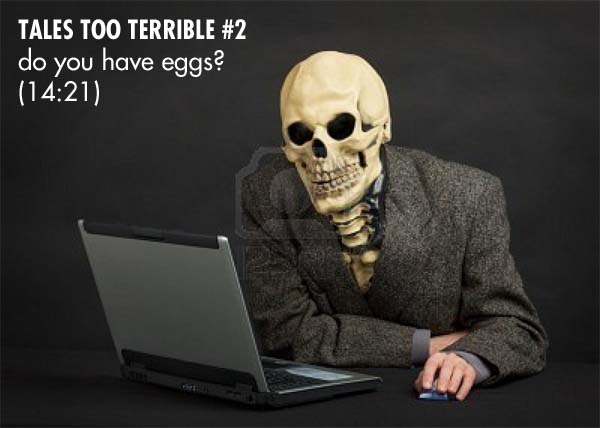
Tales Too Terrible #2: Do You Have Eggs?

“When I last tried to tell you this tale, I began to talk to you about a surly gentleman named Dweezil Ness meeting an operative named Scrambled Sal Spinoza in San Francisco on November 19, 2009. But I reached a point where I could not proceed any further. This may have had something to do with the egg salad sandwich I had for lunch, which was terrible and reminded me of the terrible nature of the story, or my perhaps it was my personal disposition, which if I had to be honest was also terrible at the time. But now that my mood has snaked into the sanguine, I feel that the time has come to continue. As the good Charles Marlow once said, ‘I have as much memory as the average pilgrim in this valley, so you see I am not particularly fit to be a receptacle of confessions.’ But, dear listener, I shall try to be your receptacle. So let us shift back into Dweezil Ness’s headspace.”

This is the second in a new project called Tales Too Terrible. The first installment can be found here. In this project, mysterious fragments that have been lost or abandoned or disowned by various parties (primarily from a looseleaf notebook that I discovered from Gregory Stetson, who has no address, no phone number, and no email) are resuscitated into radio stories running somewhere between ten and fifteen minutes. If you listen very closely, you may discover certain referential clues to other narratives that you may or may not be familiar with. However, for listeners who aren’t interested in such silliness, the Tales are also designed to be heard in sequential format.

There is no set schedule for this project. Whole months may pass by before you get another installment. Or you may get three new installments over the course of the week.

The second installment “Do You Have Eggs?” is fourteen minutes and 21 seconds long and can be listened to below.

Tales Too Terrible #2: Do You Have Eggs? (Download MP3)

This text will be replaced