Occupy Wall Street: Was the NYPD Authorized to Pepper Spray Peaceful Observers?

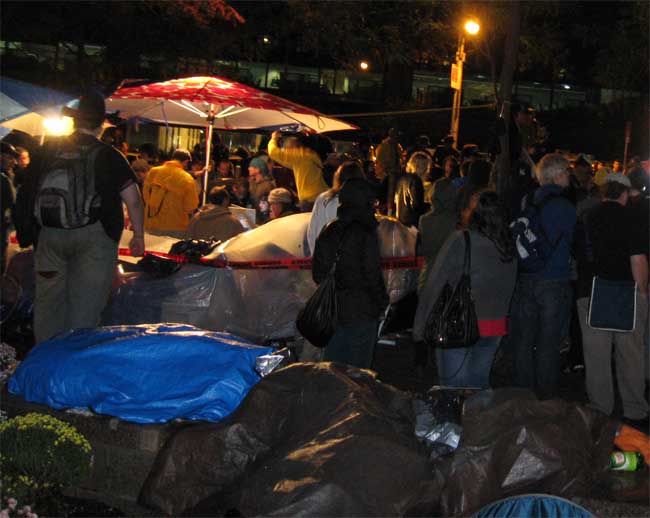
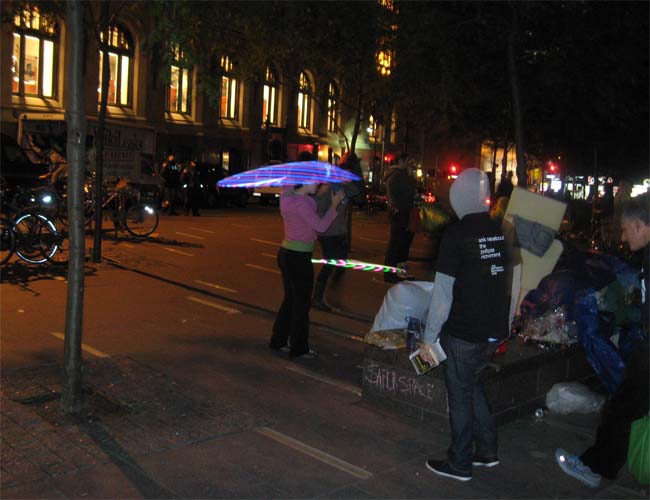
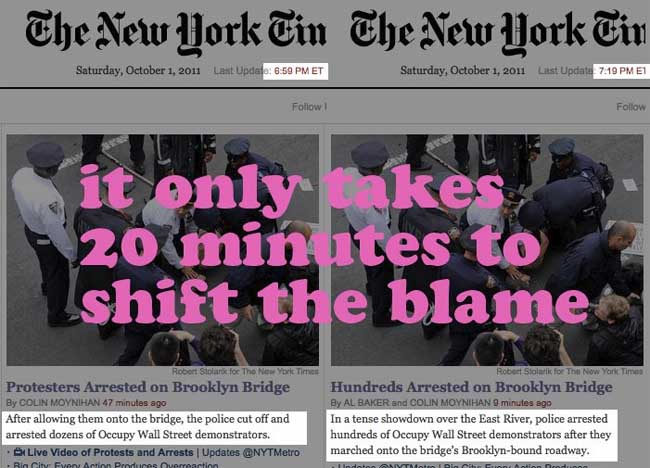
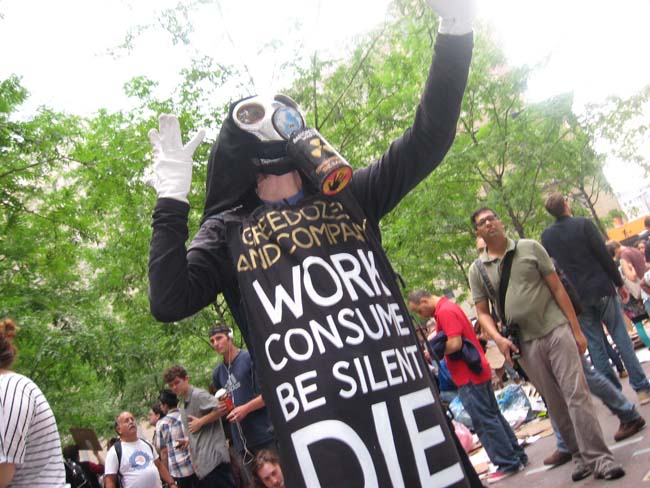
On Saturday, the New York Police Department arrested approximately 80 people — many participating as part of Occupy Wall Street, a peaceful protest against Wall Street and the economy.

But one incident suggests very strongly that the NYPD exceeded its authority and failed to follow appropriate procedure. In videos that have been making the rounds in the past 24 hours, three bystanders — all occupying the street and captured inside orange netting erected by the police — shout “What are you doing?” and “Oh my God!” in response to unseen arrests in the distance. The women, who offer no resistance or violent behavior, are seen and heard shrieking in pain as police officers pepper spray them without any apparent warning. On the main video, the young woman on the right clutches her hand over her mouth in shock, looking around and doing nothing, just standing there. She is clearly unaware that she is about to be maced. (The Daily Kos’s MinistryOfTruth talked with one of the women. She confessed in the report that she had no idea what prompted the attack.)

Two police officers clad in white shirts approach the women. One of them is equipped with pepper spray. He has been busy off-screen. He points fiercely at the three penned women, barking, “You guys are all going to be going” — presumably in response to the legitimate question “What are you doing?” The young woman on the right, still stunned, stretches out her hand. And he responds by spraying her in the face with pepper spray. He moves his arm to the right and sprays the others.

As the three women scream in pain and flail their arms, the netted orange perimeter is broadened. But not a single police officer steps inside to aid the women, much less arrest them. Other people scream for someone to bring water to the three women.

Here is the original video:

Here is the original video slowed down:

Here is the incident from another angle:

The NYPD would not confirm with The Gothamist whether or not it used pepper spray in any of the arrests. Yet the videos clearly indicate that it did. According to CBS News, the NYPD called every arrest justified. But an equally important question is this: Why did these officers consider the use of OC justifiable against these peaceful observers?

These three videos contain enough information about the macing incident to reconstruct a substantial portion of it. Reluctant Habits has also obtained a 2005 edition of the New York Police Department Patrol Guide, which outlines the specific use of pepper spray in Section 212-95. By the 2005 standards and based on the available evidence, it is clear that the NYPD did not follow appropriate measures.

In most cases, pepper spray is used to effect the arrest of a resisting subject. And the Patrol Guide specifies five uses for OC pepper spray:

  • Protect self, or another from unlawful use of force (e.g., assault)
  • Effect an arrest, or establish physical control of a subject resisting arrest
  • Establish physical control of a subject attempting to flee from arrest or custody
  • Establish physical control of an emotionally disturbed person (EDP)
  • Control a dangerous animal, by deterring an attack, to prevent injury to persons
    or animals present.

We see in the above videos that the women were not assaulting the police officers (unless stretching out one’s hand to get one’s bearings is considered “assault”). There was no need to establish physical control. They were not fleeing from arrest. (Indeed, how could they when they were trapped in orange police netting?) They were not emotionally disturbed persons. They were not dangerous animals who were going to injure anybody.

In looking at the Patrol Guide, we learn that the police are obligated to arrest the person who is pepper sprayed and charge them with a crime. Yet we see that the police do not make any moves towards the three women. They are left to scream, kneeled in the streets and in pain. They are not criminals. But they are clearly examples of what befalls “bad” citizens.

The Patrol Guide specifically orders the uniformed officer not to use pepper spray on “subjects who passively resist (e.g., going limp, offering no active physical resistance).” But the white shirted policeman has clearly ignored this procedure. In the same note, the uniformed officer is instructed to “avoid using O.C. spray in small contained areas such as automobiles and closets.” It is hard to determine with all the pandemonium going on in the video, but the orange netting erected by the police may very well fall into the scope of “small contained area.”

Patrol Guide procedures also request Emergency Medical Services “once the situation is under control.” But we see these women screaming and no apparent EMS members in the frame. Did the NYPD fulfill this option? Probably not. Because the women were left in the contaminated area to scream. They were not relocated to fresh air, contrary to another Patrol Guide mandate: “Remove the subject from the contaminated area and expose to fresh air while awaiting the arrival of EMS, or transportation to hospital/stationhouse if tactically feasible.”

Given the distance of the officers from the victims, it’s likely that none of the officers asked the women if they were wearing contact lenses. Nor were the women placed in a sitting position to promote free breathing. They were left to fall to the ground and suffer. The Patrol Guide also specifies that officers should provide a source of water and flush the contaminated skin of those who are pepper-spayed. Even if we give the NYPD the benefit of the doubt, and accept that the situation was an anarchic one and that it was hard to enforce these guidelines, one would think that this flushing proviso would be followed to the letter — if not as an enforced code, then at least as a basic quality of humanism that requires no explanation. But for a good twenty seconds, the women are left to scream and to experience pain, with one woman stretching her arms in an effort to find some relief for her anguish. The women who are not sprayed appear to want to help her, but, trapped inside the orange netting, they cannot offer water.

The NYPD’s conduct does not fall into the five general categories of pepper spray use. It fails to adhere to the NYPD’s own guidelines. And since the NYPD cannot own up to its inhumane behavior, despite repeat inquiries, it suggests very highly that the police are not especially committed to Fidelis ad Mortem — especially that vital faith in innocent bystanders whose only crime was to ask what was happening to fellow human beings.

Here is P.G. 212-95 reproduced in its entirety:

P.G. 212-95 Use Of Pepper Spray Devices

Date Effective: 01-01-00

PURPOSE

To inform uniformed members of the service of circumstances under which pepper spray
may be intentionally discharged and to record instances where pepper spray has been
discharged, intentionally or accidentally.

SCOPE

Use of Oleoresin Capsicum (O.C.) pepper spray constitutes physical force under the New
York State Penal Law. Use of pepper spray is proper when used in accordance with
Article 35 of the Penal Law and Department procedures. O.C. pepper spray may be used
when a member reasonably believes it is necessary to effect an arrest of a resisting
suspect, for self-defense or defense of another from unlawful force, or to take a
resisting emotionally disturbed person into custody. In many cases, pepper spray will
reduce or eliminate the need for substantial physical force to effect an arrest or
gain custody. It will often reduce the potential for injuries to members and suspects
that may result from physical restraint and it should be regarded as a possible
alternative to such force and restraint, where practical. Pepper spray shall not be
used in situations that do not require the use of physical force. O.C. pepper spray
may be used in arrest or custodial restraint situations where physical presence and/or
verbal commands have not been, or would not be, effective in overcoming physical
resistance.

PROCEDURE

When necessary to use pepper spray device:

UNIFORMED MEMBER OF THE SERVICE

1. Hold pepper spray in an upright position, aim and discharge pepper spray into a
subject’s eyes for maximum effectiveness, using two (2) one second bursts, at a
minimum distance of three (3) feet, and only in situations when the uniformed member
of the service reasonably believes that it is necessary to:

a. Protect self, or another from unlawful use of force (e.g., assault)

b. Effect an arrest, or establish physical control of a subject resisting arrest

c. Establish physical control of a subject attempting to flee from arrest or custody

d. Establish physical control of an emotionally disturbed person (EDP)

e. Control a dangerous animal, by deterring an attack, to prevent injury to persons
or animals present.

2. Effect arrest of criminal suspect against who pepper spray was used and charge with
crime which initiated use of the pepper spray.

a. Add resisting arrest charge, when appropriate

b. P.G. 210-13, “Release Of Prisoners – General Procedure” will be complied with if
it is determined that arrested person did not commit the crime or that no crime was
committed.

c. P.G. 216-05, “Mentally Ill Or Emotionally Disturbed Persons,” will be complied
with, when appropriate.

NOTE: Do not use pepper spray on subjects who passively resist (e.g., going limp,
offering no active physical resistance). If possible, avoid using pepper spray on
persons who appear to be in frail health, young children, women believed to be
pregnant, or persons with known respiratory conditions. Avoid discharging pepper
spray indiscriminately over a large area for disorder control. (Members who are
specifically trained in the use of pepper spray for disorder control may use pepper
spray in accordance with their training, and within Department guidelines, and as
authorized by supervisors.). In addition, avoid using O.C. spray in small contained
areas such as automobiles and closets.

3. Request response of Emergency Medical Service (EMS) once the situation is under
control.

a. Advise person sprayed that EMS is responding.

4. Remove the subject from the contaminated area and expose to fresh air while
awaiting the arrival of EMS, or transportation to hospital/stationhouse if tactically
feasible.

a. Determine whether the person sprayed is wearing contact lenses. (It is strongly
recommended that contact lenses be removed as soon as possible after exposure to O.C.
spray.)

5. Position subject on his/her side or in a sitting position to promote free
breathing.

a. The subject should never be maintained or transported in a face down position.

b. Do not sit, stand, or kneel on subject’s chest or back.

6. Provide assistance to subject as follows:

a. When consistent with member’s safety, and provided a source of water is readily
available, the uniformed member should flush the contaminated skin area of a subject
with profuse amounts of water.

b. Repeat flushing at short intervals, if necessary, until symptoms of distress
subside.

c. Continue flushing the contaminated skin of the subject in custody, at the
stationhouse as needed.

d. Commence the flushing of a subject’s contaminated skin upon arrival at the
stationhouse, if this has not already been done.

NOTE: Do not rub or touch skin of contaminated person, as the initial effect of
pepper spray does not dissipate for 15 – 20 minutes. Also, do not use salves, creams,
ointments, commercial eye washes or bandages. The desk officer will ensure that all
prisoners who have been sprayed with pepper spray receive appropriate first aid, if
needed, upon arrival at the stationhouse. Desk officers are also responsible for
ensuring that prisoners who have been sprayed with pepper spray are properly observed
throughout the arrest process, and that they receive prompt medical attention if they
need or request it. A Command Log entry will be made stating whether the prisoner has
had his/her skin flushed with water, been examined by EMS, or been transported to the
hospital.

7. Transport prisoner immediately to the emergency room of the nearest hospital if
he/she is demonstrating difficulty breathing, or exhibiting signs of severe stress,
hyperventilation etc.

a. Windows of transport vehicle should be kept open

b. Members who come in contact with persons who have been exposed to pepper spray
must thoroughly wash their hands afterward and avoid having any contaminated clothing
make contact with their face

c. Advise hospital staff that pepper spray has been used on prisoner.

8. Prepare ON LINE BOOKING SYSTEM ARREST WORKSHEET (PD 244-159) and MEDICAL TREATMENT
OF PRISONER (PD 244-150) in arrest situations.

9. Complete the AIDED REPORT WORKSHEET (PD 304-152b) in non-arrest situations, e.g.
EDP, and:

a. Check box “O.C. Spray Used”

b. Enter rank, name, and tax registry number, of each MOS who discharged spray in
the “Details” caption

c. List the time, doctor’s name, and diagnosis under “Details” caption, when
applicable.

COMMANDING OFFICER, M.I.S.D.

10. Provide a quarterly printout of all arrest and aided incidents where pepper spray
was discharged to the commanding officer, Firearms and Tactics Section.

COMMANDING OFFICER, FIREARMS AND TACTICS SECTION

11. Analyze situations where O.C. spray was employed to evaluate its effectiveness.
a. As appropriate, modify existing training/tactics relative to the use of pepper
spray.

ADDITIONAL DATA

The only pepper spray authorized for use is the type issued to all uniformed members
through the Firearms and Tactics Section.

In order to maintain the effectiveness of the spray, it is recommended that the device
be shaken at the start of each tour. Carrying the pepper spray device during normal
patrol duty should be sufficient to keep the solution thoroughly mixed.

Pepper spray will not automatically stop all subjects, and even when it does
incapacitate, the effects are temporary. Members should therefore be ready to use
other appropriate force options and tactics.

When performing duty in uniform, the pepper spray shall be carried in its holster
attached to the non-shooting side of the gun belt. When performing enforcement duty
in civilian clothes the pepper spray must be carried, in the holster attached either
to a belt or in another appropriate manner. Undercover members may opt not to carry
the pepper spray. Members of the service may carry the pepper spray device during off
duty hours.

UPDATE: The Village Voice talks with Chelsea Elliott, one of the protesters: “We lay on the ground like little worms. One of the other girls was a medic, and was able to pour milk in her eyes. The cops left. They moved the net. All I know from what happened afterward, I watched on YouTube. For like 15 minutes, I couldn’t see; I couldn’t breathe at first. It was so out of the ordinary and unprovoked. Our medical group poured milk into my eyes for like 10 minutes, and apple cider vinegar on my face.”

UPDATE 2: The NYPD officer who pepper sprayed the protesters has been identified as Anthony Bologna. A Downtown Express profile of Bologna reveals that he became a police officer late in life and there is this telling quote: “You read in the papers about cops doing things that you can’t believe because you think everybody’s like you. But a department this large can’t really be completely free of it. If you don’t find anything wrong, you’re in real trouble because you’re not looking.” I am also investigating this article from 2001, which suggests the possibility that Anthony Bolgona attacked another protester at a Mayday NYC protest in 2001.

UPDATE 3: Jeanne Mansfield, “Why I Was Maced at the Wall Street Protests.”

UPDATE 4: The Guardian reports that Anthony Bologna may have committed civil rights abuses during the 2004 demonstrations at the Republican National Convention.

Another Review of Moneyball

This is the second of two Moneyball reviews we’ve published. The first, featuring two fictitious sportscasters, can be read here.

I came to Moneyball not having read Michael Lewis’s book. There wasn’t really a good reason. Because I do read source material for a film whenever possible. Why? Because I like to play comparison games in my head. And because if the film doesn’t match up to the book, then I can figure out why. Or if it does measure up (and then some), I can analyze the differences.

Oddly, I didn’t do so when I saw The Social Network, which Moneyball is clearly trying to ape: from the Sorkin dialogue that managed to survive a zillion rewrites and doctoring to the shots of 21st century retro computing (2001 in Moneyball, 2004ish in TSN) to the meetings where old people need to be convinced of something new and foreign (in TSN‘s case, when the fictional Zuckerberg is being deposed by lawyers or telling the Harvard people why he doesn’t give a fuck about them but does about Facebook; in Moneyball, when beatific Brad Pitt as Billy Beane drops his masks and tells a room full of Fathers Know Best scouts they don’t know what they are doing.) Maybe Moneyball needed full-blown Sorkin, but I don’t think his script could have saved the movie, which was pretty much unsaveable from the get-go.

Here’s why: it opens with footage (real? doctored? who cares?) of the Oakland Athletics’s 2001 wild card playoffs, a strike against my childhood self who cried out for her 1994 Expos, their bound-for-playoff run aborted by the strike that killed the game and ushered in three rounds of post-season. There’s Jason Giambi before we knew he took steroids. There’s Roger Clemens before we knew he took steroids, perjured himself, and generally revealed himself to be a colossal douchebag of the highest order. And I’m distracted, thinking of the Mitchell Report, Itamar Moses’s amazing play about the late 1980s A’s, Canseco introducing McGwire to the magical elixir of what these drugs can do. And oh yeah, the A’s lose, Schott won’t give Beane any money, and everybody’s fucked until the Fat Kid Math Whiz comes along to save the day and make Beane look good with his Sabermetric-based statistical analysis of underappreciated players.

Moneyball did pick up. I admit, when the movie turned to the streak, the grinding gears caused me to get caught up in the manufactured excitement. I mean, truth sometimes does trump fiction, and Hatteberg’s homer really was something else. But we’re only a couple of clicks away from finding out that Jonah Hill’s character is pure fiction (the truth, in the form of Paul DePodesta, Beane’s real-life assistant GM, got edited out because it wasn’t convenient, so DePodesta refused to have his name included), Beane was only following in predecessor Sandy Alderson’s footsteps, and going the quant route only works for the scrappers if the big guns haven’t figured it out. Also, I was kind of hoping for a cameo by some Theo Epstein stand-in, aka the man who ended up with Beane’s promised GM job at the Boston Red Sox. In fact, why hasn’t Ben Mezrich written about him yet?

Anyway, Beane is still with Oakland, though possibly not for long, as this New York Times Magazine piece reveals. He still hasn’t won a playoff. And that’s great, but is this a movie? It’s not that the lack of a Hollywood ending galls. Because it doesn’t. It’s that the lack of a Hollywood ending reinforces the fact that there wasn’t much of a Hollywood beginning or a middle. In other words, I want my damn 1994 Expos. Now there’s a team that might have changed the game further, and their shot wasn’t just ruined then, it was taken away forever.

Review: Moneyball

This is the first of two Moneyball reviews we’ve published. The second, which gets into the baseball nitty-gritty, can be read here.

— Now up to bat. Kenneth Turan, suckered in by the story, believing that the Mickey Mantle epigraph celebrates profuuuuuuuuuuuuuundity but really is more of a marketing gimmick that fools you into believing that It is Important.

— Well, Jack, I’m not sure you’re being fair towards Turan. Every time he gets on the plate, his eyes just widen at middlebrow pitches.

— But, Phil, did you see the way Turan immediately fell for the hook about this being “a famously troubled production.” And that crack about Pitt “who must have had a sense of how good a role this was for him.” Did he just cut and paste the press notes?

— I wouldn’t know, Jack. The movie started late and Sony was confiscating everybody’s cell phones as if they were criminal thugs.

— Sounds like you’re a bit bitter.

— Well, yeah. But I had also seen a rather amazing film that day called Le Havre. And, well, Moneyball paled by comparison. Have you seen it, Jack?

— No, Phil. I don’t do subtitles.

— Your loss, Jack.

— You know, now that you mention it, I’m not sure how much Philip Seymour Hoffman’s Oscar win for Capote has to do with his role in the movie.

— “Letter-perfect,” Turan wrote before the last pitch.

— Looks like the copyediting umpire is throwing signals.

— I still don’t think Turan stands for anything.

— You’re right about that. Four balls, two strikes. Looks like they’re going to walk Turan. And there he is! Throwing the bat, doing his little strut.

— Is he actually trying to job?

— I guess so. He’s got a jolly little roll in his belly. It looks like he’s been eating hot meals, Phil.

— Middlebrow critics often do. Now heading for the plate: Manohla Dargis, whipping out that Tennyson in the lede.

— You know, that’s a very impressive move.

— Baseball is poetry!

— But a hungry heart? And why the hyperlink? Didn’t the New York Times figger its readers would recognize “Ulysses” by the two words alone?

— They probably think sports fans are dumb or something.

— “Liquid physical grace and bright eyes of a predator.” That’s some serious description, but is it poetry?

— You can’t talk about Brad Pitt without considering how he looks soooooooooooooo much like Redford.

— You mean they’re grooming him to take over when Redford croaks?

— Could be.

— Who’s on Sundance?

— What’s at Telluride?

— I don’t know is at Toronto.

— That’s right. You know, like Turan, she’s really paying attention to the titles that are flashing on the screen.

— You mean the numbers?

— I mean the numbers. Did you really think this movie was exuberant?

— Well, after a while, I got bored.

— Why’s that?

— It seems condescending to reduce the complexities of baseball down to two distinct visions.

— Strike for Dargis.

— Yeah, she’s not hitting well this season.

— Cut her some slack. There’s the New York Film Festival too.

— Sure. But two distinct visions. Here’s a movie that suggests it’s either all about hard statistics or all about the love of the game. And, really, was the Michael Lewis book that cut and dry?

— No. Strike!

— Well with Turan on first and the home team down a few runs…

— Can I just stay that I love the way Manohla goes to the trouble of saying that Billy has a great face. After that whole business of “liquid physical grace.”

— Do you think she wants to fuck Brad Pitt?

— Hey, who doesn’t? But does Brad Pitt’s handsomeness have anything to do with the movie?

— Not really.

— Can they really put it up there with The Social Network?

— Same producer. Sorkin wrote some of it.

— You see, that’s just it. The script seems to be a bastard hybrid of Steven Zallian’s heartfelt stuff.

— Brad Pitt’s kid? That song she sings?

— That silly song she sings. And Sorkin’s robust moralizing. It just doesn’t feel right. It should have been either one or the other.

— Oh, come on, have some sympathy for the Hollywood machine.

— It’s difficult. I can’t. These movies can be so much smarter.

— Dargis swings. And…….misses.

— First out for the home team.

— And to think that Sony handpicked the right critics for this. Do you think this stands a chance of winning Best Picture?

— One word. Crash.

— And who doesn’t like baseball?

— There’s that book from Chad Harbach.

— You’re not one of those readers, are you?

— No. Not really.

— Good. We’re supposed to keep the skepticism at a minimum.

— Why is that?

— Well, it’s good form! Because they might not invite us to additional screenings.

— One more thing about Manohla. I loved the way she tried to read significance in the American flags, trying to find a symbol.

— They are a symbol. We do that for every game.

— No, a September 11th symbol. Isn’t that a bit reaching?

— Well, what do you expect from Manohla? Now batting: Richard Corliss!

— He’s swinging wild.

— Well, he’s dealing with a funny pitcher.

— Not funny. Statistically proven to gain the approval of critics too calcified to rock the boat.

— I love how Corliss praised “the star’s administrative strategies.”

— It’s a paean to Big Business!

— “A solid, bustling social comedy at the 130-IQ level?” Were you laughing much?

— No. I mean, I liked Jonah Hill.

— He’s funny.

— Jonah Hill is funny. But in this he’s actually quite good in a dramatic role.

— So does the presence of Jonah Hill turn this into a “bustling social comedy?”

— Not really.

— You gotta give Corliss this. Love the way he commends Bennett Miller for including scenes of Billy driving at night.

— Cutaways.

— Smashing things up.

— A lot of movies have that.

— Working out in the team gym.

— Come on, when you’ve got Pitt’s muscles?

— But do you think he’s overpraising the movie for these shots? I mean, there was a time when all movies had these shots.

— Maybe that’s why he’s so excited.

— 130-IQ level? What does he mean by that?

— It means this film is just short of genius.

— Is Bull Durham or Major League at the 130-IQ level?

— They don’t have number crunching.

— But you’re still rooting for the success of the team? I mean, by Corliss’s standards…

The Bad News Bears is at the 130-IQ level.

— The original or the Linklater remake?

— Let’s not talk about the remake.

— “The central pairing, though, has championship stuff.”

— How so?

— Because it gives Corliss an excuse to make another Social Network comparison.

— Beane and Brand are the Winklevoss twins?

— Hey, if you stare really hard, Brad Pitt and Jonah Hill are kinda identical.

— Do you think “a walk is as good as a hit” is debatable?

— I don’t know. We just announce it.

— He’s out!

— What’s Corliss’s batting average these days?

— Don’t ask.

— Do we have a team?

— We do. And they’ll do anything the manager says.

NYFF: Le Havre

[This is the sixth in a series of dispatches relating to the 2011 New York Film Festival. All of Reluctant Habits’s NYFF posts can be located here.]

The one modest issue I’ve had with Jean-Pierre Jeunet’s more recent films (specifically, the ones he didn’t make with his former partner Marc Caro) is his revisionist aesthetic. Amélie is a well-crafted and moving portrayal of the world’s joys, but it comes at the expense of Jeunet’s team of eager geeks digitally erasing the Métro graffiti and anything remotely insalubrious. Micmacs is a great-looking celebration of misfits, but Jeunet required additional digital cleanup of Paris to meet the film’s ideological promise. Consider Elastic Girl, who performed much of her contortions without trickery, but required computers for her more physics-defying acts. You could argue that Jeunet was making a formalist argument that idealistic hopes come at a cost. If you want to maintain your sunny view of the human race, you’re going to have stop looking at the ugliness, perhaps erasing it from your life. Whether Jeunet will step up this moral argument for truly devastating effect in a future film is anyone’s guess.

But Aki Kaurismäki’s very charming Le Havre approaches this idea in the reverse, tinkering with the idea that our fantasies are more rooted in our heart, existing before we can sculpt them into visual submission. The film uses 20th century aesthetics and values to get at the 21st century French problem of immigration. It is populated by several graying humanists (many working-class), whose collective efforts to help a boy named Idrissa (Blondin Miguel) make it to London before the immigration authorities deport him, cause them to put aside their grievances with a shoeshiner for the greater good. Is this not a fantasy? Kaurismäki certainly suggests that it may be. His style, unlike Jeunet’s, feels more like an analog reconstruction from the guts of reality and other films, rather than one whitewashed by digital effects. When a couple talks out their past problems for a “trendy charity concert,” Kaurismäki raises a Sirkian spotlight as they reunite. The lush orchestral cue that follows sounds like something that might have accompanied Rock Hudson’s gentle gardener looking with longing towards Jane Wyman. Yet somehow this moment doesn’t feel kitschy, because Kaurismäki is careful to measure out his stylistic influences (Bresson, Melville, and more) without stifling the evolving life of his characters.

If humor is the true wisdom which unravels how we interact with each other, then it’s contained amply in Kaurismäki’s protagonist Marcel Marx (André Wilms), a one-time Bohemian who gave up his artistic ambitions to become a shoeshiner. Our early moments with Marcel -– accompanied by his fellow scrubber Chang (Quoc Dung Nguyen) –- see his gaze hitting the ground seeking fresh feet, acerbically remarking on an unexpected death, and contending with the cries of shoe store managers who tell him to get lost when he sets up shop outside, hoping to bag some foot traffic. It becomes clear that Marcel dearly loves his wife Arletty (Kati Outinen), who is suffering from some unknown ailment. Most of his hard-won money is confiscated not long after he walks through the front door. You might almost say that the Marx house is also a fantasy. Even accounting for French social programs, what struggling shoeshiner could afford this marvelous place? The house contains plentiful 20th century appliances, smooth hunter green walls, a welcoming picket fence, and a friendly dog.

But if this is a homespun fantasy, the fantasy also includes the tradeoffs of life. Arletty has to stay in the hospital, begging the doctor not to fess the affliction to her husband (the doctor asks if this means he’s a politician), and Marcel devotes his attentions to helping Idrissa. This becomes a purely altruistic concern: Marcel mines from his hard-earned savings and even visits one of Idrissa’s relatives in Calais. Yet the hysteria surrounding the missing boy is almost phantasmagorical (a newspaper headline shouts that the immigrants may be part of al-Qaeda), leading one to wonder where the reality ends and the fantasy begins. We see the boy always wearing a sweater featuring red diamonds, mimicking the recently adopted Red Crystal adopted by the Red Cross, and we begin to wonder the extent to which this story represents wish fulfillment. Caring for others is certainly part of being a humanist, a duty that any good soul cannot escape. Why then does Kaurismäki portray so many unseen Frenchmen (a prefect, a man who rats out Marcel by phone) so committed to doing the opposite? Are there darker wishes competing with the more noble ones? Undoubtedly.

Many of the colorful side characters suggest that it’s not so much the distinction between reality and fantasy that matters so much as paying attention to others. This is a film where we get to overhear two burly regulars at the cafe discuss the proper way to make scallops. There’s Inspector Monet – a beak-nosed man with a minatory moustache and the kind of sideburns and hat that don’t belong on a man with such a fleshy head – talking about the downside of being a cop, namely that people are likely to hate you for doing your job even when they need you. (I can’t possibly give away what Monet eventually does, but Kaurismäki is a sharp enough director to play against my distinctions.)

Initiative may also be the secret ingredient. There’s one great moment where Marcel shows up at a refugee center and boldly announces that he is the only albino in the clan. He claims to be a journalist and a lawyer, and further remarks that he has recorded the entire conversation.

Yet if Le Havre suggests that pretense may cause one to overlook the scummier qualities of other human beings, it manages to transcend these sprightly concerns and the cinematic homages because of its happy ending, which imputes that the occasional need for a blinkered fantasy carries possible dangers. But Kaurismäki isn’t condescending about this dilemma. In not pursuing the vivacious caricatures favored by Jeunet, Kaurismäki may have discovered greater wisdom in sticking with the more subtle, the more noble, the more human: the very real reasons why good souls stay alive.

NYFF: You Are Not I (1981)

[This is the fifth in a series of dispatches relating to the 2011 New York Film Festival. All of Reluctant Habits’s NYFF posts can be located here.]

In a 1965 interview with Ira Cohen, Bowles revealed that his short story “You Are Not I” came from a dream state: “a second between waking and sleeping, or sleeping and waking.” Sara Driver’s You Are Not I is a spellbinding example of how a scrappy filmmaker can transform words into something that is different from the source yet equally distinct. Unlike Julia Loktev’s weak attempt to play coy (and ultimately hollow and obvious) with Tom Bissell, Driver fully engages with the dream and makes it her own. A commonplace Jesus portrait hanging above a chair isn’t so much a kitsch signifier as it is a marker of one possible faith that might fill in the traumatic gaps. The “She’s dead” uttered within Bowles’s story becomes a hypnotic mantra. The indelible imagery of stones being dropped into the open mouths of the dead transmutes into a surreal effort to express grief.

There are several pleasant and unexpected ties to a Lower East Side culture from decades before. Jim Jarmusch serves as co-writer and cinematographer. Luc Sante, wearing watch cap and glasses, acts as a man who drives the car. Phil Kline offers a synth-sculpted soundtrack. There’s Tom DiCillo on assistant camera. And given the film’s commitment to slow trancelike walking (understandable, given the main character’s recent escape from a mental hospital and her confrontation with the dead), one gets the sense that the young Driver (and Jarmusch) was feeding on a steady diet of German Expressionism. I was quite fond of the especially still manner in which Fletcher sits in a chair, speculating on what others might be saying about her, and the long and lumbering manner in which the actors walk across the room. Because of these qualities, the film, in Driver’s hands, feels more like something from Jane Bowles rather than Paul. When the young woman enters the house (one of those boxy, square-screened hulks in New Jersey), she claims that the layout has been switched around and that this construction must have been committed at great expense. That we have not seen the “original” house is quite helpful. Because we’re then left second-guessing whether what we are seeing is real. I must confess that I found myself suspicious of the cigarette smoke pervading the living room near film’s end for arty effect.

Equally interesting is the way that this 48 minute black-and-white film was rescued from the dead. Driver had unknowingly shipped a print of her film to Bowles in Tangier. The negative was destroyed, courtesy of a leak in a New Jersey warehouse. And as Driver’s remaining digital copy was eaten away by the ravages of degradable tape, with the signal reduced to nothing, Driver had concluded that the film was dead. Until librarian Francis Poole traveled to Tangier to collect Bowles’s papers for the University of Delaware, not knowing that the film he carried in his hands was indeed an adaptation of Bowles’s story. Poole got in touch with Driver. And the film is now thankfully enjoying a second life at the New York Film Festival. (A more elaborate version of this story can be heard on the press conference audio below, which includes both Driver and Poole discussing the film.)

NYFF 2011: You Are Not I Press Conference (Download MP3)

This text will be replaced