Occupy Wall Street: Friday Afternoon

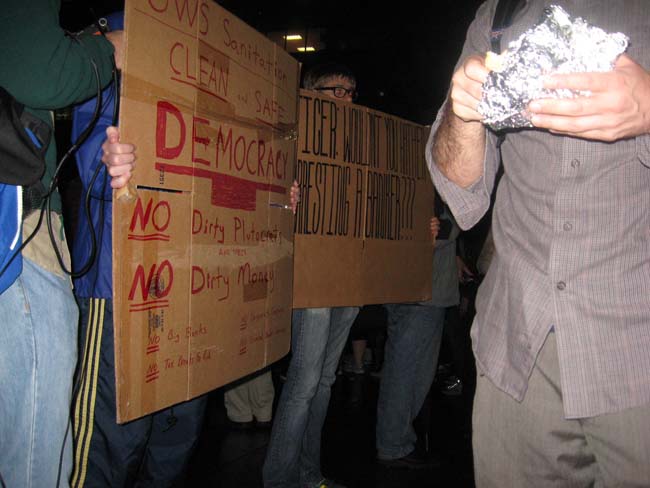
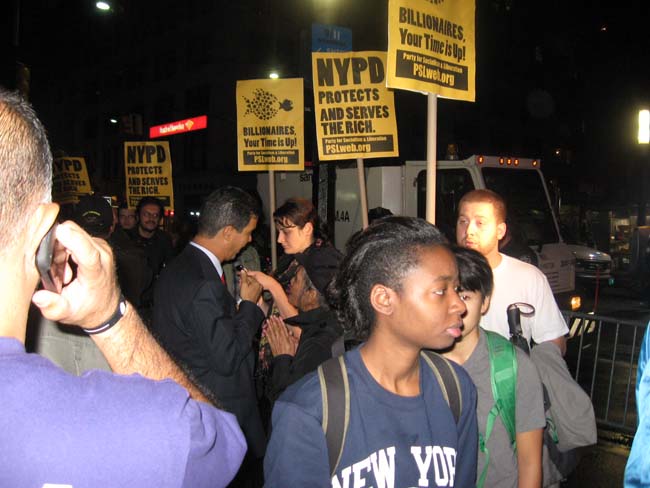
On Friday afternoon, the crowd density at Occupy Wall Street had thickened quite a bit from earlier in the week. Many of the new attendees were journalists. I counted close to thirty media types as I canvassed Zuccotti Park, watching TV vans and cameramen and reporters taking notes on their notebooks and BlackBerries. I saw NY1, CNN, Slate, a concatenation of outlets I had not seen when I hit the park on Tuesday.

“Cough drops!” barked a man with several lozenges in his hand. “Get your cough drops! So when CNN talks with you, you’ll have a clear head for your ideas.”

I hit Zuccotti Park in the late afternoon: just before a march upon NYPD headquarters. I estimated the crowd at a few thousand. More poured into the park, some lured by the prospect of a rumored Radiohead appearance at 4PM.

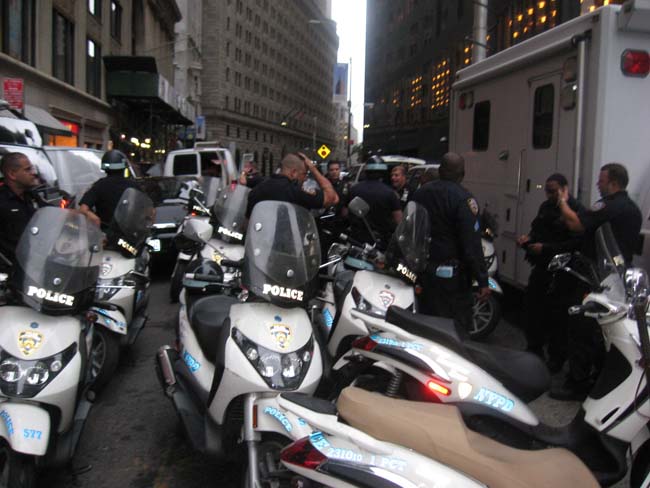
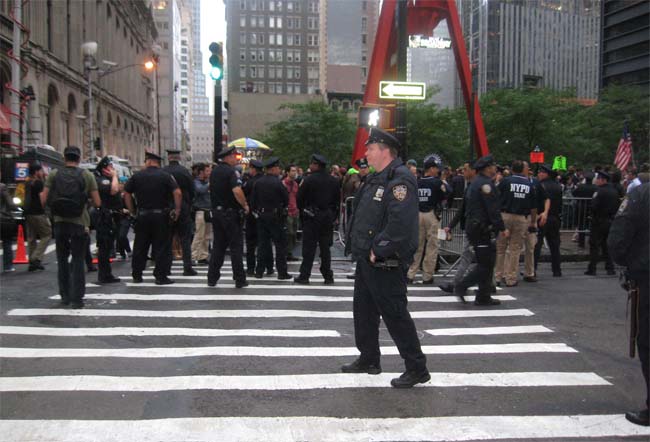
While the park’s perimeter remained open to pedestrian traffic and the cops remained fairly calm (perhaps due to the heightened media), I wondered it the increased media attention would cause more people to come, testing the limits of occupation. I also wondered what plans the NYPD had in store. Cops clad in riot gear? By now, a hackneyed effort to intimidate. Yet across the street from the park, I noticed a badly dressed undercover cop, wearing sunglasses and very much on his own, feebly pretending to be an activist with brand new crutches and a limp that didn’t match the way he was clutching his aluminum.

When attending a large-scale event, it is often my practice to stand in one spot and listen to the surrounding people. The protesters were fully aware that they were putting on a show. Many greenhorns — some considering themselves journalists — had come to gawk. Their intent was to document. They wondered why these people were still sticking after two weeks. Some of the bona-fide journalists appeared to be mystified about why they had been assigned this story.

If these slogans and sentiments on cardboard and posterboard appear flip and cliched, what then is the best method to get a message across? In recent days, there has been a modest debate about whether the protesters should dress up and improve their aesthetic.

But from what I have seen in my visits to the park, it isn’t just scruffy kids wearing tie-dye tees. There are many lingering into the park from their day jobs, wearing dress shirts and backpacks. I suppose your sartorial flair depends on the degree to which you’re participating and how long you stick around. (For my own part, I was wearing a red George Orwell shirt.)

The Bat Segundo Show: Nick Broomfield

Nick Broomfield appeared on The Bat Segundo Show #413. He is most recently the co-director of Sarah Palin: You Betcha.

Condition of Mr. Segundo: Wondering if he has gone rogue or rouge.

Guest: Nick Broomfield

Subjects Discussed: Being attracted to conservative politicians with big hair, Christopher Hitchens’s sexual fantasies about Margaret Thatcher, Frederick Wiseman and Errol Morris, contending with publicists and press agents, Joe McGinniss’s The Rogue, Levi Johnston and Tank Jones, filming Daryl Gates accepting an interview fee on camera, the ethics of paying interview subjects, Broomfield’s amateurist aesthetic, the faux professionalism of film crews, Broomfield filming himself on the phone, Broomfield’s tendency to gravitate towards ad hominem, whether the possibility of Sarah Palin becoming President is a serious question, John Bitney, Steve Schmidt, campaign management of Palin, Broomfield doing less documentaries, the Kickstarter campaign for Sarah Palin: You Betcha, flipping between documentaries and narratives, wearing red flannel in Wasilla, JC McCavitt, the influence of Palin and the evangelical right in Wasilla, whether or not Wasilla reflects America, whether Broomfield is motivated by vengeance or retaliation, the chewing gum photo montage, balancing the visual details and the facts, collaborating with Joan Churchill, why Broomfield put himself in front of the camera after Lily Tomlin, claims of Lily Tomlin’s insecurity, the difficulty of filming Tomlin, why the construction of a documentary creates a more inclusive one, the dangers of moral labels, why people should trust Nick Broomfield, moral paralysis, subjective truth borne from a personal quest, embarrassing public questioning, Broomfield’s view of restraint as a weakness, hedge funds, getting investors to sign on for a Broomfield movie, working with non-actors, and the ever-shifting Broomfield paradigm.

EXCERPT FROM SHOW:

Correspondent: Going back to Margaret Thatcher [Tracking Down Maggie], it seems to me that you have an especial interest in conservative politicians with very interesting hair-dos. What’s up with this particular commonality? I sense also a formalistic commonality as well with the chase for Maggie and the chase for Sarah here. What of this?

Broomfield: Well, in fact, I never thought of the similarity of the hair-dos. But now that you’ve pointed it out, it’s quite extraordinary.

Correspondent: Are you a man who likes big hair? You’re a Clintonian man?

Broomfield: I’m actually not a particularly big hair man. But when I was doing the Margaret Thatcher film, one of the people I interviewed was Christopher Hitchens.

Correspondent: Yes.

Broomfield: Who had a lot of almost sexual fantasies about Margaret Thatcher, which I hasten to add I never shared. But I noticed that a lot of people also have the same feelings about Sarah Palin.

Correspondent: Yes.

Broomfield: And, again, I’ve never succumbed to those kinds of thoughts with her. But I think that both women captured the imagination of a large part of the population. Probably also because they were women and they had a determination and a charm that was unexpected and was refreshing in its own way.

Correspondent: Yeah. Not attracted to Sarah sexually. But I also think to Fetishes and also to Heidi Fleiss; Hollywood Madam.

Broomfield: Right.

Correspondent: It seems that there is also some sexual quality sometimes to some of your subjects. Especially women. Why do you think this is?

Broomfield: Well, I mean, I think as any full-blooded male once interested — I would apply it more to films like, yeah, Fetishes, Heidi Fleiss. I did a film, Chicken Ranch, in a legalized brothel in Nevada. Even someone like Aileen Wuornos was very interesting along those lines. Sexual lines. It’s funny. Just last week, I saw Fred Wiseman in Toronto. He’s just made a film. The Crazy Horse. A strip club. And before that, he did the ballet film. And I said, “Fred, do I get the sense of some kind of Fräulein in your work.” And he said, “I’d like to see what you’re doing when you’re 81 years old.”

Correspondent: Errol Morris’s Tabloid as well. While we’re on the subject.

Broomfield: Oh really?

Correspondent: Yeah, there you go.

Broomfield: What’s he just done?

Correspondent: He did Tabloid on the sex scandal. 1970s. So there we go.

Broomfield: There we go.

Correspondent: All you documentary filmmakers are turning into dirty old men.

Broomfield: Exactly. Exactly. Just give me a few more years and I’ll be completely there.

Correspondent: To get on a serious subject, since you had experienced difficulties in both Tracking Down Maggie and Heidi Fleiss: Hollywood Madam when dealing with press agents and publicists, you had to know going into this one that you were probably not going to get a sitdown interview with Sarah Palin.

Broomfield: Well, I think that I always had the belief that I would get one probably. And it was only after we’d been there for about ten weeks — just before Christmas — that I really realized with that final phone call with Chuck Heath, the father, that I wasn’t going to get one. I don’t know that one would necessarily learn something devastatingly original with a sitdown interview with her. Because she’s done many interviews and nothing very revealing has come out. Generally, she’s revealing by omission. Which is: she doesn’t know something or she mispronounces a word or she is factually inaccurate or she gets things all confused. So she’s very revealing. Generally about lack of knowledge. She’s very unrevealing generally about herself and her upbringing and even her beliefs. I think she’s very guarded. For somebody who studied media at university, she is completely distrusting of the media and has more control probably over what she says and does than anybody. I mean, the only interview she does is with FOX Television, who she’s employed by. And obviously Facebook and Twitter. But I did think that as we were resident in Wasilla that maybe we would get a down moment with her that would at least be revealing of her — thank you (to barista) — of her family and her friends and the way she saw life around her or as part of the evangelical community. Which is really what Wasilla is.

Correspondent: Well, this is interesting because Joe McGinniss also has a book called The Rogue. And he managed to get more childhood friends to talk — anonymously in that book — and you had to go all the way to way to Alexandria to find someone who would talk with you. I’m curious…

Broomfield: Well, my sources were not talking anonymously. They were talking on camera. And I can back up all my various claims in the film. Whereas I think one of the problems in quoting undisclosed sources is that you cannot back up your claims. And you obviously can’t do that in a film.

Correspondent: I was curious. While we’re on the subject of interviews, Heidi Fleiss: Hollywood Madam has the famous moment where you’re showing Daryl Gates accept the cash.

Broomfield: Right.

Correspondent: In this, you have one moment where you’re talking to Levi Johnston’s manager, Tank Jones, and you’re negotiating trying to interview him for $500. And I’m curious about this. Is this kind of thing ethical? I mean, why would it be ethical? And I’m wondering, when you do in fact pay someone for an interview, do you feel an obligation to feature that on screen? Has this always been the case for you? Have you paid other people?

Broomfield: What I think was interesting is that people like Levi Johnston basically live off — I introduce that segment in the film, saying that there’s an industry that’s grown up around Sarah Palin and people live from that industry. So that was an illustration of Levi Johnston basically — I mean, I think they were asking $20,000. So I think my derisory offer of $500 was more of a joke than anything else. But I think it’s very relevant to point out that there is a great deal of money in tabloid journalism and that people are paid to make contributions. I mean, I didn’t pay anyone in this film. But there have been other films, which you quite rightly pointed out. Like, for example, the Heidi Fleiss film, everybody expected to be paid.

Correspondent: Everybody in Heidi Fleiss pretty much got paid? Ms. Sellers and the like?

Broomfield: They all expected to be paid. I don’t know if they all got paid. But yes. And I think I make a big point of that in the film. I comment on how much money various people wanted. Like DarylGates. I think he wanted $2,000. $1,500 to take part.

Correspondent: But when you introduce money into the equation, doesn’t this affect what you’re going to be getting from your documentary subjects?

Broomfield: Well, I’m making a film about what is. And we live in a world that’s very commercial and a world that has to do with money. And as a documentary filmmaker, you’re reporting on that world. So if everyone wants money in that world, you report on that fact. And of course, that makes a difference. Yes.

Correspondent: What about this amateurist aesthetic that is often in your films? I think of the tape running out in Biggie and Tupac.

Broomfield: Right.

Correspondent: And in this [Sarah Palin: You Betcha], your efforts to try and cross an iced lake or to try and negotiate ice in numerous ways. Or the hat trick in, of course, The Leader[, His Driver and the Driver’s Wife]. And all that.

Broomfield: Right.

Correspondent: There’s a certain…

Broomfield: You’ve certainly done your homework here.

Correspondent: Well, I’m curious about why this exists. Are these deliberate moves on your part to either win over your subjects or win over the audience with a more amateurist approach that’s calculated? Or are these just mess ups on your part?

Broomfield: Well, I would argue that there’s sort of a faux professional approach with a lot of film crews. You know, when they climb back in the car and drive on to the next location, I’m sure they’re a whole lot of fun. And they crack a whole lot of jokes that are not in the film. But when they get the cameras out, they get the clipboards out, and they became these serious professionals. Which I think is a load of bullshit. I think it’s much better to reveal what it’s really like to be doing that film or what you really think or what the humor is, you know? Rather than having this — you know. I remember when I was working for television. I was working with a presenter. And the presenter was actually a very funny guy. And I remember we were making a film in a monastery. And he would get into all these arguments with the monks about whether God existed or how many angels he could get on a pin and all those classic debates. And he would always lose the arguments. Because the monks and the abbot and so on, that’s all they did. And they studied all the books. And they were really up on their theology and logic. And when I showed the film to the TV company, they were horrified. Because they said a professional reporter does not lose his way. Does not stumble over words. Doesn’t turn to the camera and say, “I’m stuck.” But of course, they do. And I think by including those kinds of things, you make a much more accurate portrait than if you leave them out. I think there’s a sort of faux professionalism that we’re surrounded by that is completely inaccurate.

Correspondent: But doesn’t your persona, your schtick, sometimes get in the way of the very subjects that you’re photographing. I mean, every time you make a telephone call in your movies, you’re always in a car.

Broomfield: Right.

Correspondent: And I’m wondering why you feel the need to film that as well. It’s almost as if you’re counting on the subject to say no.

Broomfield: Well, what…wha…I mean, I don’t really understand the point. I don’t know whether you’re saying that the phone calls are irrelevant or the fact that I’m in a car is irrelevant.

Correspondent: I’m trying to point out that you’re really trying to show yourself more than anything else.

The Bat Segundo Show #413: Nick Broomfield (Download MP3)

This text will be replaced

The Bat Segundo Show: Sheila McClear

Sheila McClear appeared on The Bat Segundo Show #412. She is most recently the author of The Last of the Live Nude Girls.

Condition of Mr. Segundo: Embracing the diminishing returns of Old New York.

Author: Sheila McClear

Subjects Discussed: Peter Pan Donuts as a point of meaning in one’s life, Hunter S. Thompson and breakfast, Old New York, staying in New York by any means necessary, having unique issues with your parents, having problems with authority, the swift manner in which money disappears in New York, contending with siblings who tap parents for money, personal responsibility vs. economic victimhood, shyness and job interviews, latent rebellion, zoning out during a peep show strip, whether those who work in the nude can be turned on sexually, the many levels of compartmentalization as a stripper, zoning out in relation to performance and being uncomfortable, transactional relationships and comparisons between stripping and psychiatry, writing as a partition between shyness and performance, being charmed by wolves, how long it takes to a Midwesterner to become a true-blue New Yorker, worldliness, not talking with anybody for two weeks, writing about co-workers and allaying concerns, scribbling on the job and maintaining a notebook, memory as a great liar, expanding anecdotes into stories, how patterns inform the narrative, rebelling and dropping out, freedom and reality, being a reg, healthy addictions and obsessions, the advantages of having a focus, McClear’s reluctance to use the words “object” and “objectify,” difficulties with didacticism, the power dynamic between a stripper and a client, dealing with the inevitability of being objectified, losing one’s virginity later in life, working the same peep show stint as a top draw, Fashion Week, the importance of clothes and theatricality in the peep show, the advantages of wearing a schoolgirl skirt, how piercings trick people, guys who read your energy, not being able to hide behind your clothes, dressing like your archetype, subconscious authenticity, making more money when ovulating, the uselessness of wigs, split-second decisions, racism in the peep show industry, racial profiling and men’s sexual preferences, troubling generalizations, race and hiring practices in strip clubs, hygiene at strip clubs, the dangers of mops, sterilizing dollar bills, the necessity of internships to get a foothold in the New York media industry, Ivy League pedigrees, unemployment claims towards Gawker, improving labor conditions for sex workers, exploitation, stage fees, the difficulties of worker organization, what might have happened to McClear without the peep show industry, and the just safe enough nature of peep shows.

EXCERPT FROM SHOW:

McClear: I have problems with all authorities in general. It makes sense.

Correspondent: It makes sense. Your parents were both lawyers. When you were out here trying to survive, did you ever tap them for money? Because that was a question that was never answered in the book.

McClear: My mom gave me two grand when I moved. And every once in a while, she’d send like a hundred dollars in the mail. I never asked them for money. Occasionally, they would send it. No, I would say, other than the two grand — which, God, that disappeared so quickly.

Correspondent: It does in New York. Yeah.

McClear: I already had money too and…well, not a lot. But no. No. I didn’t. It was that and occasional things in the mail. Also my sister was tapping them for a decent amount of money.

Correspondent: Oh, I see. You wanted to be the more respectable sister? (laughs)

McClear: I felt it was unfair to pile on.

Correspondent: Yeah.

McClear: Then there was also the point of, well, at least then I…you know?

Correspondent: Yeah. Yeah. Of other attempts at employment, you write, “It wasn’t as if I didn’t try and do something else.” And I’m curious. To what extent could you be said to be personally responsible for finding work in a peep show? I mean, you were determined to stay in New York by any means necessary. You wanted to prove something to yourself. So obviously you made the decision. So how responsible are you for something like this? Or do you view yourself as a bit of an economic victim?

McClear: Oh, not at all. No one forced me to work there. And it wasn’t my first choice at all. But as I got more and more and more — I mean, everyone has a hard time finding work.

Correspondent: Sure.

McClear; And I probably — I don’t know. I was probably doing something wrong in my job search.

Correspondent: You really think that? I mean, how many resumes did you send? How many job interviews did you go on?

McClear: I don’t know. I think I was so shy back then that I probably came off as bad in an interview. You know, a little awkward. But I was totally — I had this sort of latent thing where I never had rebelled. And I had never been a slacker. I never did drugs really. I never had acted out or been promiscuous. And like there was sort of that going on. And that sort of felt like the first excuse. Especially now that I was by myself and didn’t know anyone to reprimand me or find out what I was doing. It was sort of the first excuse that I found to act out in what was sort of a safe and controlled environment. I took it. And there are other things leading to that decision. Like needing a job and stuff. But I was looking for a way to act out obviously. It had to happen sometime.

Correspondent: Sure.

McClear: Like when people go through their drug phase or their sleeping around phase or their slacker phase. I never did any of it. And I was 25.

Correspondent: You were feeling left out?

McClear: I was feeling left out! And totally uncool. (laughs)

Correspondent: Uncool? I mean, why? I mean, by what metric, if you are so anti-authority, did you feel uncool or not hep or not with it? I mean, who gives a fuck about that?

McClear: I guess I did give a fuck. (laughs)

Correspondent: Many times in the book, you describe zoning out and shutting your brain off during a peep show strip. Of a photography modeling job that steered into an entirely unusual direction…

McClear: (laughs)

Correspondent: …you write, “I had already floated away inside my head, detaching my mind from my body. Nearly three hours had passed before we were done.” But I have to point out even before you arrived in New York, when you performed with the Terranauts in Michigan, you write, “The rush of performing canceled out the noise in my head.” So it seems to me you’re describing here this need to act out. But I should point out that there has been, at least in my reading, this tendency to want to check your brain in or zone out or just not focus. To what degree was it there before you worked in the peep show? And do you think that working at the peep show exacerbated this tendency?

McClear: Yeah. I think it was there. Because my personality type is more of an observer. A little bit of a depressive. And sort of an introverted person. And a tendency to overthink things. Which is probably like…

Correspondent: (laughs) This is going the other way!

McClear: Well, it’s probably describing most writers. So it’s always a vacation if you can find a way — whether it’s meditation or exercise or playing in a band or whatever — to put your mind at ease. But then, of course, being in the peep show was just so — doing the show was much too personal. It was uncomfortable to be present. So I would always check out. And then it did exacerbate that tendency. Just like I described. Of turning a light switch on and off until the breaks. Because you’re like unsure of like “Am I on or off?” Or you can’t toggle between them as much anymore. Which is why I flipped out that one time and went to Bellevue.

Correspondent: Yeah.

McClear: And then I think it just ends up in you withdrawing more. Or just being less present. I actually had a friend who was a nude massage therapist at the time. And she was like, “Um, are you able to be turned on sexually anymore? Because I’m not.”

Correspondent: (laughs)

McClear: And I was like, “Oh. Me neither.” And she was like, “Yeah, I think it’s my job.” “Yeah, probably mine too.”

Correspondent: You couldn’t compartmentalize in any way? That Chelsea [Sheila’s peep show identity] was one type of sex and Sheila was another?

McClear: I could have. But I felt, and I did to an extent, that compartmentalizing too much would almost be like losing some core part of your personality. And I worked with a lot of girls who compartmentalized to the point where they were not the person they used to be before they worked in the business. So I didn’t want to be like that.

The Bat Segundo Show #412: Sheila McClear(Download MP3)

This text will be replaced

Occupy Wall Street: Nine Conversations and a Protest Song

On Tuesday afternoon, I discovered this report from NPR Ombudsman Edward Schumacher-Matos. NPR hadn’t aired a single story in relation to the Occupy Wall Street protests, which I had reported about on Sunday in relation to the pepper spraying incident. I decided to walk across the Brooklyn Bridge and attend the protests myself. What follows are nine conversations I had with various individuals at the protests.

Douglas: “I’m here because I’m American. I was born here in New York. I was born here in Manhattan.”

This text will be replaced

Jeff and Miike came from Colorado.

Miike: “We came on Sunday specifically for this. And we decided we wanted to come down for the week also.”
Jeff: “We had already planned a trip to New York. And then they were talking about it on the radio station that I listen to in Denver. And they were saying there’s a total media blackout on this whole thing. And so I said I’m going to go down there. I called them up and said I’m going to go down there.”

This text will be replaced

Dorjee: “I hope it brings it down completely and we get a completely new system of human respect with viable resources and fair trade, instead of I lend you. You, you need a thousand dollars. Okay, I’ll give you a thousand dollars if you pay me back $1,000 plus $200.”

Me to Dorjee: “Be careful with that fist. Because you’re trying to be peaceful, right?”

This text will be replaced

Marvin was holding a sign that read JESUS IS NOT FOR CORPORATE GREED. What will the protest actually do?

Marvin: “It will make people more aware that we live in a capitalist system where more people are living in poverty than ever. And the most ironic part of it is that it’s a capitalist system, but we live off the Communists. We have to borrow money from Communists to even exist.”

This text will be replaced

Mary was a tourist who had stopped by Liberty Square on the last day of her vacation.

Mary: “I’m surprised it hasn’t happened earlier. Now it has. I started following it on Twitter. And then I thought I’d come down and see what was happening.”

This text will be replaced

Ed and Robin came to the protests all the way from West Virginia.

Robin: “The corporations have done a great job in dividing people, separating people into issues. People are coming together here and realizing that we have much more in common with each other than we do with the people who are trying to sell us on what a good way of life is here.”

This text will be replaced

Ed and Robin were also kind enough to perform their song “Let ‘Em Eat Cake” for me. Here is Uncle Eddie & Robin’s website.

This text will be replaced

Roman carried a sign calling for President Paris Hilton and had some unusual ideas about making sex appeal a more predominant characteristic than others.

Roman: “I’m an aspiring, you know, Paris Hilton. I want to just be able to live and party. I live with my parents right now but we don’t have much money. And I think that if Paris Hilton becomes President, you know, she can help everybody just party.”

This text will be replaced

Brian worked very close to Liberty Square. He was checking out the protests on his lunch break.

Brian: “This is funny anyway. [indicating sign] I mean, who hasn’t tried to go to school looking for a job when they first get out of school. I mean, that’s what we all do. It’s hard to find a job. But, like anything, you continue to look and try until you find one and do what most of us have done.”

This text will be replaced

[EDITORIAL NOTE: Please note that an earlier version of this story misidentified “Steven Levy” as “Wired senior writer Steven Levy.” Reluctant Habits expresses its apologies to Wired‘s Steven Levy and greatly regrets the error.]

As I was circling Liberty Square and talking with many people about what it meant to protest, I observed an older man berating a young man going by the name of Matt. It was the only contentious banter I had observed in what was otherwise a peaceful gathering — complete with donated food, plentiful signs laid along the ground, activists singing protest songs on banjos and guitars, and even a library established in close proximity to the main dais.

I was curious about what had caused this older man to lose his gasket. Because while I had talked with people who did not approve of the protest (including some cops who declined to go on the record, but all NYPD officers I observed were calm and professional), the older man was the only one prepared to go ballistic. This being a public space, I naturally began recording audio and approached the shrieking man, hoping that I might use this moment to generate a civil discussion. But the man, who identified himself as “Steven Levy” (not to be confused with the Wired senior writer) wasn’t especially interested in explaining to me why he was upset at Matt.

“He and I were just talking with another woman,” explained Matt after the exchange. “And I think they’re more on the liberal interventionist side of the economic policies — at least in terms of their opinions. And I was like saying, ‘Look, I’m personally against Keynesianism. Because I think Keynes is all about government spending. And I don’t believe government is a good allocator of spending.'”

This position apparently infuriated Levy. When I approached Levy and Matt, Matt was explaining to Levy that the two of them were on the same side. Levy responded, “You don’t read well.”

I decided to intervene. I merely wanted to know what Matt was misrepresenting. The results can be listened to below:

This text will be replaced

The Call of the Wild (Modern Library #88)

(This is the thirteenth entry in the The Modern Library Reading Challenge, an ambitious project to read the entire Modern Library from #100 to #1. Previous entry: Loving)

In June 1902, Cosmopolitan published “Diable — A Dog” (the original title “Bâtard” had been softened by squeamish editors) by an emerging young writer named Jack London. This gripping tale involves a dog (“illegitimate” like London: his father a timberwolf, his mother a husky) battling his vicious master Leclère as the two wander the Yukon — seemingly with the sole purpose of rending each other at any opportunity. London describes how “hate bound them together as love could never bind,” not unlike Edward Albee’s George and Martha or Eminem and Kimberly Scott. And like the most extreme bonds of blinding enmity, for Diable and Leclère, this leads to a fatal end.

In December of that year and in a lonely place, London began work on a 4,000 word short story — a companion piece to “Bâtard” involving a civilized dog named Buck, who is also a mongrel, and his adventures in the Alaskan wilderness. Two months later, London had a novel. But he he would make a catastrophic business decision: $2,000 in cash from Macmillan for all rights with a further $750 to the Saturday Evening Post. Given the millions of copies that Call would go on to sell, and given London’s constant financial woes, this transaction may very well be American literature’s answer to the Dutch snapping up Manhattan from the Lenape for a mere 60 guilders.

Despite this bad business, Call would cement London’s literary reputation. And I am pleased to report that, a little less than three decades after I first read it, Call holds up remarkably well on a second and third read — so much so that I was compelled to read White Fang, a London biography, numerous critical responses, and countless other texts directly and indirectly related to Call before a kind friend cut me off from this London monomania in the manner of a respectful bartender telling an exuberant customer to go home and sleep it off. Additional friends encouraged me to read sections of White Fang aloud to an especially finicky cat and were surprised when I found that I could not stop. I could go on reading London for days. The man is that good.

My obsession likely emerged from the startling rediscovery that London’s prose remains alive in a way one would not expect from a novel published in 1903, especially since London found his inspiration to write from a somewhat incongruous source: Ouida‘s Signa. Soon after Buck is kidnapped from the “big house in the sun-kissed Santa Clara Valley,” where he lives with Judge Miller and his family, London masterfully establishes the way that the setting is changing by throwing the reader off with subtle syntactic shifts:

Several times during the night he sprang to his feet when the shed door rattled open, expecting to see the Judge, or the boys at least. But each time the joyful bark that trembled in Buck’s throat was twisted into a savage growl.

We believe that Buck springing to his feet will spawn an escape or that the door rattling open will precipitate some further action, but London establishes an uncertain feeling between understated fear and expectation. And he neatly foreshadows Buck’s inevitable transformation with the “joyful bark” twisting “into a savage growl.” This style might be identified as highly refined Alger, but it also allows us to become invested in Buck’s inner life in a manner that feels tough rather than sappy, transcendental rather than fixed. And we become so involved with Buck’s struggles that we forget we are reading an animal tale.

But Call has more going on than a soft Southland mutt growing into a legendary Ghost Dog who “sings a song of the younger world.” London, who spent much of his formative years laboring hard as a “work beast,” is also writing about the honor and integrity that emerge from doing a job well even in the worst of all possible worlds. This wild world of hard labor, in which one must eat faster and push one’s muzzle harder to grab that bit of protein needed to keep pulling the sleds and one must ward off belligerent “co-workers” like Spitz (if you think you’ve got annoying cubemates, wait until you meet this dog), still has its virtues:

Best of all, perhaps, he loved to lie near the fire, hind legs crouched under him, fore legs stretched out in front, head raised, and eyes blinking drearily at the flames. Sometimes he thought of Judge Miller’s big house in the sun-kissed Santa Clara Valley, and of the cement swimming tank, and Ysabel, the Mexican hairless, and Toots, the Japanese pug; but oftener he remembered the man in the red sweater, the death of Curly, the great fight with Spitz and the good things he had eaten or would like to eat. He was not homesick. The Sunland was very dim and distant, and such memories had no power over him. Far more potent were the memories of his heredity that gave things he had never seen before a seeming familiarity; the instincts (which were but the memories of his ancestors become habits) which had lapsed in later days, and still later, in him, quickened and became alive again.

Work, which comes by necessity in the wild, overcomes the distressing prospect of being crippled by memory. It unites disparate souls, even those who are lashing at each other, and even causes experienced men to protest the clueless chekakos. Midway through the novel, three greenhorns show up with canned goods, “blankets for a hotel,” and beat their dogs into submission without lightening the load. Later in the novel, Buck makes his escape from this unthinking and irresponsible trio into John Thornton’s care.

While it’s true that unfastening a lock can require pluck, some critics have made too much hey now over certain autobiographical connections between Jack and Buck. It is true that London was writing The Call of the Wild as his first marriage was disintegrating. Buck does describes his love for John Thornton with lilting romance (“But love that was feverish and burning, that was adoration, that was madness, it had taken John Thornton to arouse”*), but London wrote these words before he had Charmian Kittredge, the woman who could match London’s libido and physical activity (she even boxed with him) and who would become his second wife. (And since I’m dishing out gossip, I should probably point out that London, licentious even as his belly bulged from drink, still cheated on her.)

If work can save you, it doesn’t necessarily eliminate class struggle, which London would explore more fully in his needlessly overlooked novel, Martin Eden. London’s daughter, Joan, would write that Call was “the story of all strong people who use the cunning of their minds and the strength of their bodies to adapt themselves to a difficult environment and win through to live,” but this strikes me as a little pat. It is certainly interesting that The Call of the Wild and The Sea-Wolf both rely on bourgeois protagonists being plucked from their safe environments in order to learn invaluable lessons in individualism and morality. Perhaps you can learn such lessons within middle-class comforts. But London’s romantic view makes a compelling case that it is better for instincts to quicken and become alive when you are thrown outside your comfort zone. In other words, every MFA student and passive-aggressive vacillator needs to read Jack London pronto.

* — This seems as good a time as any to bring up the relationship between The Call of the Wild and London’s companion novel, White Fang, which depicts the transformation in reverse (wild wolf turning into civilized dog, complete with another judge taking care of White Fang near the end, suggesting a symmetry with London’s earlier volume). While I enjoyed White Fang quite a lot, I consider it to be the inferior volume, rehashing many story elements of Call (wolves getting into a squabble over a rabbit, rising to sled leader, and so forth) and not quite possessing the poetry and the tautness and the keen insight and the gripping gusto that’s there in Call. The passage I quote here about Buck’s love for John Thornton doesn’t feel nearly as schmaltzy as its heavy-handed counterpart in White Fang: “Human kindness was like a sun shining upon him, and he flourished like a flower planted in good soil.”

Next Up: Arnold Bennett’s The Old Wives’ Tale!