The Bat Segundo Show: James Gleick

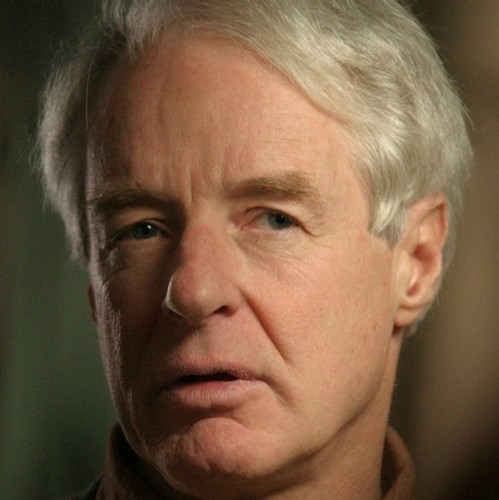
James Gleick recently appeared on The Bat Segundo Show #397. He is most recently the author of The Information.

Condition of Mr. Segundo: Giving little bits of your entropy.

Author: James Gleick

Subjects Discussed: Claude Shannon, the origin of the byte, Charles Babbage and relay switches, measuring information beyond the telegraph, bit storage capacity, being right about data measurement, “A Mathematical Theory of Communication,” information overload, TS Eliot’s The Rock, email warnings in 1982, information compression, George Boole’s symbolic logic, information overload, Ada Lovelace and Babbage, James Waldegrave’s November 13, 1713 letter providing the first minimax solution to the two person game Le Her, game theory, Lovelace’s mathematical aptitude, the difficulties of being too scientifically ambitious, connecting pegs to abstraction, Norbert Wiener and cybernetics, Wiener’s contribution to information theory, Wiener vs. Shannon, mathematical formulas to solve games, Ada Lovelace’s clandestine contributions, Luigi Menabrea, a view of machines beyond number crunching, entropy, the Second Law of Thermodynamics, James Clerk Maxwell’s view of disorder as entropy’s essential quality, dissipated energy within information, Kolmogorov’s algorithms and complexity, links between material information and perceived information, molecular disorder, connections between disorganization and physics in the 19th century, extraneous information, Thomas Kuhn’s paradigm shifts, Richard Dawkins’s defense of dyslexia as a selfish genetic quality, new science replacing the old in information theory, the English language’s redundant characters, codebreaking, Shannon’s scientific measurements of linguistic redundancy, the likelihood of words and letters appearing after previous words and letters, Bertrand Russell’s liar’s paradox and Kurt Gödel’s Incompleteness Theorem, Gregory Chaitin and algorithmic information theory, Alan Turing, uniting Pierre-Simon Laplace and Wikipedia, extreme Newtonianism, and the ideal of perfect knowledge.

EXCERPT FROM SHOW:

Correspondent: I wanted to first of all start with the hero of your book, Claude Shannon, who of course is the inventor of the byte. He built on the work of Charles Babbage. Shannon conducted early experiments in relay switches, creating the Differential Analyzer. He made very unusual connections between electricity and light. He observed that when a relay is open, it may cause the next circuit to become open. The same thing holds, of course, when the relays are closed. Years later, Shannon, as you describe, is able to demonstrate that anything that is nonrandom in a message will allow for compression. I’m curious how Shannon persuaded himself to measure information on the telegraph. In 1949, as you produce in the book, there’s this really fantastic paper where he draws a line and he starts estimating bit storage capacity. As you point out later in the book, he’s actually close with the measurement of the Library of Congress. How can he, or anybody, know that he’s right about data measurement when of course it’s all speculative?

Gleick: Wow. That was a very fast and compressed summary of many of the ideas of Claude Shannon leading into Claude Shannon. Well, as you’re saying, he is the central figure of my book. I’m not sure I would use the word “hero.” But he’s certainly my starting point. My book starts, in a way, in the middle of a long story. And that moment is 1948, when Claude Shannon publishes his world-changing paper, “A Mathematical Theory of Communication.” Which then becomes a book, The Mathematical Theory of Communication. And for the first time, he uses the word “bit” as a unit of measure for this stuff. This somewhat mysterious thing that he’s proposing to speak about scientifically for the first time. He would go around saying to people, “When I talk about information as an engineer and a mathematician, I’m using the word in a scientific way. It’s an old word. And I might not mean what you think I mean.” And that’s true. Cause before scientists took over the word, information was just gossip or news or instructions. Nothing especially interesting. And certainly nothing all-encompassing. I guess the point of my book, to the extent that I have a point, is that information is now all-encompassing. It’s the fuel that powers the world we live in. And that begins, in a way, with Claude Shannon. Although, as I say, that’s the middle of the story.

Correspondent: Got it. Well, as you point out also, information overload or information anxiety — this has been a truism as long as we’ve had information. You bring up both TS Eliot’s The Rock — “Where is the wisdom we have lost in knowledge? / Where is the knowledge we have lost in information?” — and, of course, a prescient 1982 Computerworld article warning that email will cause severe information overload problems. To what degree did Shannon’s data measurement account for the possibility of overload? I didn’t quite get that in your book and I was very curious. There is no end to that line on the paper.

Gleick: No. Shannon didn’t really predict the world that we live in now. And it wasn’t just that he was measuring data. It’s that he was creating an entire mathematical framework for solving a whole lot of problems having to do with the transmission of information and the storage of information and the compression of information, as you mentioned. He was, after all, working for the telephone company. He was working for Bell Labs, which had a lot of money at stake in solving problems of efficiently sending information over analog copper telephone wires. But Shannon, in creating his mathematical framework, did it simultaneously for the analog problem and the digital problem. Because he was looking ahead — as you also mentioned in your very compressed run-up. He thought very early about relays and electrical circuits. And a relay is a binary thing. It’s either open or closed. And he realized that open or closed was not just the same as on or off, but yes or no or true or false. You could apply electrical circuits to logic and particularly to the symbolic logic invented by George Boole in the 19th century. So Shannon created his mathematical theory of communication, which was both analog and digital. And where it was digital, it had — we can see now with the advantage of hindsight — perfect suitability to the world of computers that was then in the process of being born.

Correspondent: It’s fascinating to me though that he could see the possibilities of endless relay loops but not consider that perhaps there is a threshold as to the load of information that one can handle. There was nothing that he did? To say, “Well, wait a minute. Maybe there’s a limit to all this.”

Gleick: I’m not sure that was really his department.

Correspondent: Okay.

Gleick: I don’t think you can particularly fault him for that or give him credit one way or the other.

Correspondent: It just didn’t occur to him?

Gleick: No, it’s not that it didn’t occur to him. It’s that — well, I would say, and I do say in the book, that this issue — I’m hesitating to call it “problem” of information overload, of information glut — is not as new a thing as we like to think. Of course, the words are new. Information glut, information overload, information fatigue.

Correspondent: Information anxiety.

Gleick: Information anxiety. That’s right. These are all expressions of our time.

Correspondent: There’s also information sickness as well. That’s a good one.

Gleick: One of the little fun side paths that I took in the book was to look back through history at previous complaints about what we now call information overload. And they go back as far as you’re willing to look. As soon as the printing press started flooding Europe with printed books, there were lots of people who were complaining. This was going to be the end of human knowledge as we knew it. Leibniz was one. Jonathan Swift was another. Alexander Pope. They all complained about — well, in Leibniz’s words, “the horrible mass of books.” He thought it threatened a return to barbarity. Why? Because it was now no longer possible for any person, no matter how well educated, no matter how philosophical, to keep up with all human knowledge. There were just too many books. There were a thousand. Or ten thousand. In the entire world. Well, now, there are ten thousand books printed every hour in the world. Individual titles. So yes, we were worried about information overload. And yes, you can say that Claude Shannon, in solving these problems, greased the skids. But I don’t know whether it’s true or not that he didn’t foresee the issue. It just was an issue that wasn’t in his bailiwick.

Correspondent: Got it.

The Bat Segundo Show #397: James Gleick (Download MP3)

This text will be replaced

Jennifer Schuessler: “Literary Occupation: Housewife”

On September 21, 1832, Maria W. Stewart became the first African-American woman to lecture on women’s rights. She was jeered at by male crowds, who pelted her with tomatoes. A few years later in Philadelphia, Lucretia Mott received a similar reception when she pointed out that it was “not Christianity, but priestcraft” that had subjected women. Mott’s remarks, along with those of other women, were widely ridiculed by the press. On November 5, 1855, The New York Times would write of Mott:

The evident sincerity of feeling and intensity of thought produce a strong impression on the mind, but the utter absence of imaginative power stripped the impression of those almost higher attractions which beauty of illustration lends. Still, though the absence of this quality may neutralize the effect as far as popularity with a general audience is concerned, the effect on those who came with a preconceived sympathy with the ideas of a preacher, is likely to be more powerful, in proportion as the enunciation is simple and unaided by the poetical assistance of sensuous flights of imagination or classical touches of cultivated intellect.

In other words, Mott was merely some sincere country bumpkin who could only preach to the already converted. As far as The New York Times was concerned, Mott’s rhetorical approach, despite “a large and eager congregation,” could never reach the higher plains of cultivated intellect.

These ugly and prejudicial avenues were revisited on June 4, 2011, when The New York Times published a baffling article by Jennifer Schuessler. Schuessler suggested that, any time a woman author tweets a 140 character message, she is engaging in a literary feud. Was Schuessler longing for a presuffrage America? Or a continuation of the complacent and sexist approach from 150 years before? It certainly felt that way. Despite claiming that feud watchers “question whether Twitter feuds really qualify” (and who is a feud watcher anyway? Jonathan Franzen when he’s not watching birds?), Schuessler condemned numerous women for speaking their minds. By criticizing the establishment, numerous bestselling authors were somehow transformed into a mindless mob. And if Schuessler has possessed the linguistic and argumentative facilities of her 1855 counterpart, she might very well have claimed that these women carried an “utter absence of imaginative power.”

After serving up a laundry list of all-male literary “feuds” (Theroux v. Naipaul, Vargas Llosa v. Garcia Marquez, Moody v. Peck), with the feud defined as “a willingness to throw actual punches along with verbal jabs,” Schuessler writes:

If the literary feud has lost its old-school bluster, it might be tempting to lay the blame with what Nathaniel Hawthorne might have called “the mob of damn Twittering women.” These days, in America at least, it’s women authors who seem to start the splashiest literary fights, and you don’t need a stool at the White Horse Tavern to witness it.

The problem with this logic is that it assumes that those who have tweeted critical comments (the names cited in the article are Jennifer Weiner, Jodi Picoult, Ayelet Waldman, and Roseanne Cash) wish to engage in physically and verbally aggressive behavior, or that they have little more than barbaric contributions to offer to public discourse. In Schuessler’s defense, there is a modest case that Waldman, in defending her husband, was engaging in ongoing ressentiment towards Katie Roiphe. But the other women cited in Schuessler’s piece were not. If Weiner and Picoult “led a Twitter campaign against what they saw as the male-dominated literary establishment’s excessive fawning over Jonathan Franzen,” one must ask whether a campaign constitutes a feud.

The feud, as described by Schuessler, is one predicated upon hatred for another person. When an author receives a black eye or a knockout, this is little more than an ignoble pissing match revolving around egos. When Paul Theroux writes a poison-pen memoir condemning his former friend Naipaul, does this stand for any corresponding set of virtues?

Yet when a group of women is trying to raise serious questions about the manner in which books are covered by the media, can one really call it a feud? The evidence suggests nobler intentions. In an August 30, 2010 NPR article, Jennifer Weiner stated that the establishment is “ignoring a lot of other worthy writers and, in the case of The New York Times, entire genres of books.” On August 26, 2010, both Weiner and Picoult were interviewed at length by The Huffington Post‘s Jason Pinter about their positions. And it becomes clear from Pinter’s piece that the purported “mob of damn Twittering women” isn’t just “a Twitter campaign,” but an attempt to start a discussion.

Schuessler also condemns “a similar crew” who “took aim at Jennifer Egan” after Egan declared chick lit as “very derivative, banal stuff.” But in refusing to identify the “crew” in question (and only getting a quote from Katie Roiphe, who had little to do with the “feud”), Schuessler proved herself to be an irresponsible journalist. The conversation about Egan’s remarks extended well beyond Twitter, with detailed essays appearing for and against in such outlets as The Frisky and The Millions. Does such a debate really constitute a feud?

When Roiphe says, “The nature of Twitter is you don’t need to think about what you’re saying. Most of us need to think more about what we’re saying, not less,” she demonstrates her total ignorance of the way in which Twitter works. As seen by the Egan remarks and the Franzenfreude statements, there was an initial emotional outcry on Twitter that became dwarfed by a more serious discussion. People formulated their thoughts and wrote lengthy online essays. If the comments to those essays were somewhat heated, there remained numerous efforts by thoughtful people to maintain a civil debate.

So when Schuessler gets Waldman on the record to speculate about how Jane Austen might have engaged in a Twitter debate over Naipaul’s recent comments, Waldman (perhaps unwittingly) upholds the status quo: “Only those of us with impulse control issues take our snits into the ether.” But this falsely suggests that Twitter encourages nothing less than our worst impulses and that one’s initial outburst can’t be tamed into a more rational discussion. It also upholds a dangerous double standard: a man is permitted to speak his mind and punch somebody out (presumably for the amusement of “feud watchers”); but if a woman does anything close to this, she’s little more than “a damn Twittering woman.” If the purported paper of record — an outlet that suggested a few months ago that a gang-raped schoolgirl had it coming — is seriously equating today’s talented female authors with Freidan’s “happy housewife heroines,” then it is clear that The New York Times is ill-equipped to operate in the 21st century.

The Bat Segundo Show: Adam Hochschild

Adam Hochschild recently appeared on The Bat Segundo Show #396. He is most recently the author of To End All Wars.

Condition of Mr. Segundo: Conscientiously objecting and objectifying consciousness.

Author: Adam Hochschild

Subjects Discussed: What is considered morally permissible in war, mustard gas, deadly military technology, Ray Bradbury’s “The Flying Machine,” the women’s suffrage movement and World War I, Emmeline Pankhurst and the Women’s Social and Political Union, splits within the Pankhurst Family, Women’s Dreadnaught, James Keir Hardie’s antiwar speeches, attempts to get socialists to agree, the duties of history to remember the losers, parallels between World War I and current wars, Osama bin Laden’s death, Wikileaks and the Czarist Archives, Margaret and Stephen Hobhouse, conscientious objectors, I Appeal Unto Caesar, Edmund Dene Morel’s hard labor sentence, the tendency of wealthy families and connections to carry more weight, Bertrand Russell, jingoistic writers during World War I, John Buchan’s imperialism, Rudyard Kipling, PG Wodehouse’s The Swoop!, the political stances of writers, contributions of famous writers to British propaganda, The 39 Steps, Sir Arthur Conan Doyle, Sherlock Holmes and Germany spy conspiracies, responding William Anthony Hays criticism about “stack[ing] the deck by presenting such particularly unappealing characters as foils to the pacifists and liberals he seeks to praise,” attempting to find positive qualities about Douglas Haig (World War I’s worst general), Winston Churchill, Sir John French’s likable qualities, Haig vs. General Eisenhower, the Lansdowne Letter, attempts to understand why the World War I peace movement failed to catch on, relativistic courage, untrained pilots going up against the Red Baron, and the dangers of speaking out what you believe in.

EXCERPT FROM SHOW:

Correspondent: It’s an unsuccessful story. Should history really be in the business of remembering the losers?

Hochschild: Well, first of all, for me, as a writer, it was a challenge to see if I could write a narratively interesting and emotionally meaningful story about a movement that failed. My last book was about the anti-slavery movement in the British Empire. That was a successful movement. Slavery did come to an end. These people failed to stop the First World War. But I still find them very, very much writing about. Because it takes a special kind of courage and nobility to go against patriotic madness that’s in the air. And very often, a movement like this, it doesn’t succeed the first time. We still haven’t stopped war today. We’re caught up in at least two unnecessary wars, in my view, in the United States right now. I would like to see people who opposed those wars take some inspiration from these earlier folks. Even though they failed.

Correspondent: On the other hand, I wanted to bring up your recent TomDispatch article, in which you draw parallels between our present times and World War I. I’m wondering if it’s an appropriate parallel simply because in World War I, there was considerably more death. Presently, you say, “Well, why aren’t we protesting the war?” Well, we did in 2003. It was the biggest protest in America against the conflict in Iraq.

Hochschild: Yeah.

Correspondent: So I’m wondering if really the parallels should line up or whether we should consider the full scope of any kind of war when considering it. Is there a danger here of parallel relativism? Or what? Maybe you can expand upon this.

Hochschild: Well, I don’t think the parallels to anything are ever exact or anywhere near exact when there’s nearly 100 years in between. But I guess some of the parallels I saw between the First World War and those that we’re in today are several. First, look at how the First World War started. Austria-Hungary was eager to make war on little Serbia next door. They felt the existence of Serbia was a threat. Because there were a lot of restless Serbs within the border of the old Austria-Hungarian Empire. They had actually drawn up invasion plans to invade Serbia and dismember it. Then Archduke Franz Ferdinand gets assassinated by an ethnic Serb, but an Austo-Hungarian citizen. And there’s no evidence that the top officials of Serbia’s government even knew about the assassination plot. But they immediately used this as an excuse to make war on Serbia. I see some resemblance between that and Bush using the September 11th attacks to make war in Iraq, which had nothing to do with those attacks. So when countries are hungering to go to war for one reason or another, they can easily use something as an excuse. That’s one similarity. I think another is that most of the time when a country starts war, they expect it to be over very quickly and easily. Kaiser Wilhelm II, when he sent his troops off to France in 1914, said, “You will be home before the leaves have fallen from the trees.” And the Germans had this masterplan that they’d worked on for years that very systematically and with great exactitude showed how they were going to subdue France, conquer Paris, and force the French surrender in exactly 42 days. Of course, it didn’t happen that way. But countries always expect it to happen that way. Like when Bush landed on the aircraft carrier in 2003 in front of that big sign MISSION ACCOMPLISHED.

Correspondent: Sure.

Hochschild: Well, I’m still not sure what the mission was in Iraq. But whatever it was, it hasn’t been accomplished.

Correspondent: Well, we just recently had another MISSION ACCOMPLISHED allegedly with Osama bin Laden.

Hochschild: Yeah.

Correspondent: And I’m sure you saw some of the New York Post headlines here. They were really, really grisly. On the other hand, I should point out that there is a fundamental difference between al Qaeda, which is networked all around the world, versus the German nation, which is starving, which is machine gunning the soldiers. And the soldiers on the other side are machine gunning them. And there’s this trench warfare and all that. There’s even a sense of gentlemanly accord in World War I that one doesn’t see in the present conflict. Especially when you also factor in communications. I mean, there’s nothing even close, parallel-wise, to Wikileaks, for example, that you could have in World War I. That’s why I’m unclear as to the parallels. Are the parallels more in the way that governments inform the people and governments persuade the people to become involve in a conflict? Or what?

Hochschild: Well, as I say, the parallels from a hundred years are never completely exact. But there was a sort of Wikileaks episode in World War I, which was this. In 1917, there came the two Russian Revolutions: the February Revolution, when they overthrew the czar, and the October Revolution, when the Bolsheviks seized power in a coup. At that point, the Bolsheviks got into the Czarist Archives and they made public all the secret treaties that Russia, France, and the agreements between Russia, France, and Italy had. That showed how the Allies were planning to divide up the possessions of Germany and its allies once the war was over. And it had tremendous reverberations. In the same way that the Wikileaks material did in recent months. Because it showed that even though the Allies liked the Germans — they were saying they were fighting to defend civilization itself — nonetheless, they’d actually drawn lines on the map as to how they were going to divide up spheres of influence in the Middle East, for example.

Correspondent: Okay. I wanted to shift back to conscientious objectors. The case of Margaret Hobhouse. She’s a well-to-do woman. Her son Stephen is imprisoned as a conscientious objector. This suggests to some degree — this whole incident where she writes a book that is, of course, ghostwritten by Bertrand Russell, I Appeal Unto Caesar — that it takes the rich or the privileged in order to shift things. Because she manages to persuade 26 bishops and 200 other clergyman to sign a statement arguing for more lenient treatment of COs. Similarly, in 1916, some COs are sent to France. They’re fed bread and water. They’re forced to the front line. The No Conscription Fellowship is on the case trying to seek them out. But, of course, because they don’t have this Hobhousian connection, it’s a great difficulty to track these folks down. At the beginning of 1918, there were still more than 1,000 COs behind bars. You have Basil Thomson noticing that pacifism was on the rise. Now this comes after I Appeal Unto Caesar was published. Why was there such a delay between 1916 and 1918 in drawing attention to these maltreated COs? Does it take a book? Does it take a privileged person speaking on behalf of COs to ensure humane treatment for all classes? What of this?

Hochschild: Well, obviously, at all times and places, I think that when the people from wealthy families and so on speak out loudly on behalf of something, their voices carry much more loudly. That’s unfortunately the way the world works. One thing that was interesting to me about the war resisters in Britain was that they came from across the class spectrum. You had people in jail like Stephen Hobhouse, who you mentioned, who was from this very ancient wealthy family filled with connections to lords and bishops and so on. And a very close friend of the family was in the Cabinet — Alfred Milner, who was minister without portfolio on charge of coordinating the war effort. At the same time, there were labor unionists in jail, who didn’t have those powerful connections. And these folks all felt a real sense of solidarity with each other across those class lines.

Correspondent: But was the book really the linchpin? I mean, I don’t want to draw any false correlations here, but I’m curious how this connection to Basil Thomson saying, “Oh, pacifism is on the rise.” Is that more the increased awareness of COs? Or is that more people in grief? Because bodies are coming back. Or they’re not coming back. And they’re getting messages that their loved ones are dead.

Hochschild: Well, actually, the book you mentioned by Margaret Hobhouse, because it was allegedly written by Margaret Hobhouse, who was the wife of a prominent churchman and a big landowner and everything, it had considerable effect. Although in fact Bertrand Russell secretly co-authored it. The book helped bring about the release of several hundred conscientious objectors who were in poor health in one way or another. But that’s about all it did. The government still kept locking up conscientious objectors who refused to do alternative service. It still cracked down with increasing harshness on people who spoke out against the war. Bertrand Russell, despite being himself being the son of an earl; he later inherited the earldom from his brother, was sent to jail for six months in 1918. Edmund Dene Morel, really the country’s leading investigative journalist, spent six months in jail for his antiwar writings. Served hard labor. And it broke his health and he died a few years later.

The Bat Segundo Show #396: Adam Hochschild (Download MP3)

This text will be replaced

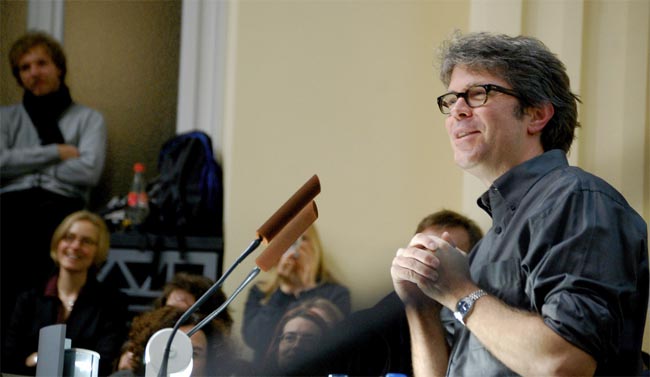
What Jonathan Franzen Didn’t Include in His New York Times Op-Ed

On May 28, 2011, The New York Times published a Jonathan Franzen op-ed “adapted from a commencement speech he delivered on May 21 at Kenyon College. The piece contained a link to an audio version of the piece. Here’s a breakdown of what Franzen didn’t include (I have not included throat clearing or minor linking words):

“Good morning, class of 2011. Good morning, relatives and faculty. It’s a great honor and pleasure to be here with you today. I’m going to go ahead and assume you all knew what you were getting into when you chose a literary writer to deliver this address. I’m going to do what literary writers do, which is talk about themselves in the hope that my experience has some resonance with your own experience. I’d like to work my way around to the subject of love and its relation to my life and to the strange techno-consumerist world that you guys are inheriting.” (Beginning to 00:38)

“…powerful Blackberry Bold with a five megapixel camera and 3G capability.” (Bolded product description dropped, 00:43-00:48)

“…tiny track pad…” (“tiny” dropped, 1:03)

“…impelling them to action by speaking incantations…” (dropped, but this may have been a reading flub, 2:02-2:04)

“Let me toss out the idea that according to the logic of techno-consumerism in which markets discover….” (dropped, 2:26-2:28)

“…the ongoing transformation…” (“ongoing” dropped, 3:48)

“…fallen for your schtick. Those people exist to make you feel good about yourself, but how good can your feeling be when it’s provided by the people you don’t respect? You may find yourself becoming depressed…” (dropped, 5:17-5:23)

“dissed” upgraded to “disrespected” (6:34)

“One of the heartening things about the plague of cell phones in my Manhattan neighborhood is that among all the texting zombies and the party-planning yakkers on the sidewalks, I sometimes get to walk along somebody who’s having an honest to God fight with the person they love. I’m sure they prefer not to be having the fight on a public sidewalk, but here it’s happening to them anyway and they’re behaving in a very, very uncool way. Shouting, accusing, and pleading, abusing. This is the kind of thing that gives me hope for the world.. Which is not to say that love is only about fighting or that radically self-involved people aren’t capable of accusing and abusing.” (dropped, 7:53-8:30)

“When I was a senior in college, I took the first seminar the college had ever offered in literary theory. And I fell in love with the most brilliant student in the seminar. Both of us liked how instantly powerful literary theory made us feel. It’s similar to modern consumer technology in this regard. And we flattered ourselves on how much more sophisticated we were than the kids who were still doing those tedious old close textual readings. For various theoretical reasons, we also thought it would be cool to get married. (uncomfortable laughter from students) A longer story than we have time for here, but my mother, who had spent twenty years making me into a person who craved full commitment love now turned around and advocated that I spend my twenties, as she put it, footloose and fancy free. Naturally, since I thought she was wrong about everything, I assumed she was wrong about this. I had to find out the hard way what a messy business commitment is. The first thing we jettisoned was theory. My soon-to-be wife once memorably remarked after an unhappy scene in bed, ‘You can’t deconstruct and undress at the same time.’ (more uncomfortable laughter) Try it. We spent a year on different continents and very quickly discovered that, although it was fun to fill the pages of our letters to each other with theoretical riffs, it wasn’t so much fun to read those pages. But what really killed theory for me, and began to cure me more generally of my obsession with how I appeared to other people, was my love of fiction. There may be a superficial similarity between revising a piece of fiction and revising your webpage or your Facebook profile. But a page of prose doesn’t have those slick graphics to help bolster your self-image. If you’re moved to try and return the gift that other people’s fiction represents for you, you eventually can’t ignore what’s fraudulent or second-hand in your own pages. These pages are a mirror too. And if you really love fiction, you’ll find that the only pages worth keeping are the ones that reflect you as you really are.” (9:00-11:00)

“unliked” instead of “disliked” (11:08)

“My wife and I, having married too young, eventually surrendered so much of ourselves and caused each other so much pain that we each had reason to regret ever having taken the plunge. And yet I can’t quite make myself regret it. For one thing, our struggle to honor our commitment actively came to constitute who we were as people. We weren’t helium molecules floating inertly through life. We bonded and we changed. For another thing, and this may be my main message to you…..[segues into “pain hurts”]” (11:27-11:55)

“What I said earlier about how engagement with something you love compels you to face up to who you really are may apply particularly to fiction writing. But it’s true of just about any work you undertake and love. I’d like to conclude here by talking about another love of mine.” (12:34-12:49)

“And since I’d been fired up by critical theory and I was looking for things to find wrong with the world and reasons to hate the people who ran it…” (bold parts dropped, 12:59-13:05)

“…the angrier and more people hating I became…” (bold part dropped, 13:20-13:25)

“Finally, around the time my marriage was breaking up, I made a conscious decision to stop worrying about the environment” changed to “Finally, in the mid-1990s, I made a conscious decision to stop worrying…” (13:26-13:29)

“I had no choice but to start worrying about the environment again. Yeah, what a drag.” (bold part dropped, 14:38-14:40)

“Like I said, the bird thing was very unexpected to me. For most of my life, I hadn’t given much thought to animals. And maybe I was unlucky to find my way to the birds so relatively late in life. Or maybe I was lucky to find my way to them at all. Once you’re hit with a love like that, however late or early, it changes your relation to the world. In my case, for example, I’d abandoned doing journalism after a few early experience [sic] because the world of facts didn’t excite me the way the world of fiction did. But after my avian conversion experience, which has taught me to run toward my pain and anger and despair rather than away from them, I started taking on a new kind of journalistic assignment. Whatever I most hated at a particular moment became the thing I wanted to write about. I went to Washington in the summer of 2003 when the Republicans were doing things to the country that enraged me. I went to China a few years later because I was being kept awake at night by my anger about the havoc the Chinese are wreaking on the environment. I went to the Mediterranean to interview the hunters and poachers who were slaughtering migratory songbirds. In each case, when meeting the enemy, I found people who I really liked. In some cases, outright loved. Hilarious, generous, brilliant gay Republican staffers. Fearless, miraculous, young Chinese nature lovers. A gun crazy Italian legislator who had very soft eyes and who quoted the animal rights advocate Peter Singer to me. In each case, the blanket hatred that had come so easily to me wasn’t so easy anymore. (15:59-17:26)

(Photo credit: Daniel Sillman)

Review: Puzzle (2009)

Narratives featuring older women are in short supply these days. But writer-director Natalia Smirnoff’s marvelous debut, Puzzle, arrived this weekend to cure this needless deficit.

Puzzle introduces us to Maria, subtly underplayed by Maria Onetto, a suburban housewife. The film’s first shots are handheld, following Maria as she serves canapés and cooks and cleans up at a party. We learn that this is her own party, and that this is the manner in which she is celebrating her fiftieth birthday. I know that, if you are an Englishman, it is customary to buy everybody drinks. I have no idea if this practice has escalated further in Argentina, whereby not a single soul thinks to help the birthday girl out. But the failure of Maria’s husband and her children to chip in for such a once-in-a-lifetime occasion suggests very highly that there’s a problematic power balance in her marriage. Thanks in large part to Onetto’s incredible performance, which telegraphs Maria’s complexities even in the way she walks, it would be wrong to characterize Maria as completely meek. There is clearly an intelligence within her as she listens to one son attempt to embrace veganism. Yet it’s also clear that she’s chosen a life in response to her husband, an entrepreneur who runs a small business but who expects Maria to remember to replenish his favorite cheese (rather than going to the store and getting the groceries himself). The reason she’s stuck with her husband so long may be temperament. It may be that she simply hasn’t found the right angle in life.

Then Maria opens a present. It’s a jigsaw puzzle. With the family away, she starts putting the puzzle together. And the look in her eyes as she’s doing this (accompanied by musical thumps suggesting, quite deliberately, a quasi-Egyptian tone) suggests that this is one thing she’s very good at and that makes her very happy.

As someone who listens a good deal and observes much and remains frustrated by the failure of film (and books) to capture such quiet and magical moments occurring so very often in life, I can’t possibly tell you how rare and wonderful it was to see a filmmaker like Smirnoff surprise us like this. Like many of the game critics cracking vodka jokes (because, hey, nobody knew who Smirnoff was and the notes were nebulous), I had expected some goofy movie about jigsaw puzzles. But what I discovered was a deeply poignant movie about what it is to stick at some idiosyncratic interest that everybody tells you is wrong.

Maria wants more puzzles. “What’s the point of this?” asks her husband. “I like it,” responds Maria. Shouldn’t this be enough? When Maria’s husband denies her a new puzzle when they are out shopping, the moment is truly heartbreaking — especially because we know that her family doesn’t appreciate the nuances of her cooking. But when Maria finds a store that specializes in nothing but puzzles, the look of bliss on her face just killed me. Especially when she sees a 20,000 piece puzzle. One might argue that Maria is committing a form of adultery with her puzzles (and, as we see very subtly later, there is a sexual charge Maria gets from these puzzles). As she constructs more puzzles, she has to hide the puzzle-in-progress on a board underneath the couch. But surely Maria’s husband (who so upset me that, even in writing this quick essay, I cannot compel myself to name him) can spare a few minutes to encourage her hobby in late bloom.

But Maria is undaunted. She answers an ad reading “Seeking Companion for Puzzle.” But the way she answers it is complicated. For the man on the other end has an email address. And she has never touched a computer. Is it Smirnoff’s suggestion that giving into a quirky passion like puzzles is almost a pre-Internet idea that we can no longer talk about? Or is this a smart dramatic device that communicates just how much Maria has not been allowed to learn during her marriage? Whatever the case, the scene in which Maria is patiently trying to comprehend email as another woman tries to help her is expressed as a valiant struggle to move forward. Maria may be slow and quiet, but her passion will find fruition.

I’ve suggested that this film plays like a low-key version of Madame Bovary, with a sexual tension contained within Maria’s pursuit of the puzzle. What’s admirable about Smirnoff’s direction is the way she broaches this issue without pushing it too fast to the surface. The man that Maria meets, who does indeed want to take Maria to a puzzle championship in Germany, does make more than a few passes at her. But for Maria, it is the puzzle interest first and foremost that she’s lying to her family about. And when they do not entirely respect this singular pursuit, Maria’s decisions become more justifiable. In a late moment in the film, she orders the family to help her clean out a spare room. Again, it does seem the least that they can do. And in this act of cleaning, the family begins to dance in a rather spontaneous way after finding an item. So Smirnoff’s optimistic suggestion is that the fun moments in life often happen when you help those who are closest to you with their interests, however crazy or ordinary they may seem. The incurious counterpoint is a relationship founded on another person’s will.

Like any art investigating a subculture (and there’s certainly one here, complete with specific puzzle building techniques and some modest intensity), Puzzle reveals that there’s more to the ordinary if you know where to look and if you stick it out. As someone who has seen many of his friends and acquaintances sacrifice their voices and their spirits for crass materialistic gain, I’m grateful to this film for demonstrating that it’s never too late for anyone.