Review: Source Code (2011)

If you grew up watching time travel trash like 1994’s Timecop, 1989’s Millennium, or 1991’s Freejack, or you forgave the execrable television series Sliders because you hoped that the show’s incompetent writers could serve up some half-interesting angle on the parallel universe, then chances are you will enjoy Duncan Jones’s little thriller, Source Code. I am pleased to report that there is something more here than VHS nostalgia. The movie doesn’t have the ambition of Shane Carruth’s Primer or Richard Kelly’s Donnie Darko, but it does share in part the anarchistic exuberance seen in Nacho Vigalondo’s Timecrimes – especially when Source Code‘s protagonist starts hitting people.

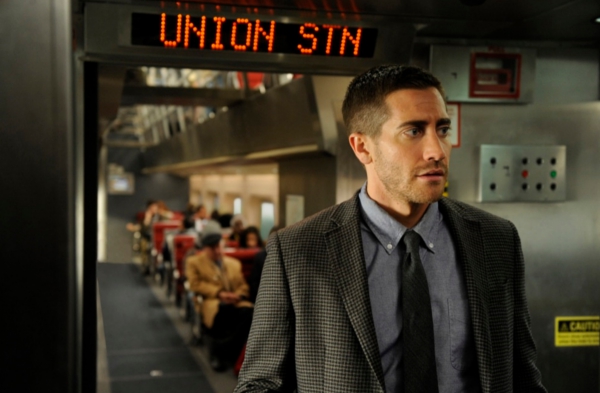
The story involves Captain Colter Stevens (Jake Gyllenhaal), an ostensible soldier who flew helicopters in Afghanistan but who has no hard memories of his last mission. His spirit is beamed into a man on a Chicago commuter train during the last eight minutes of his life. At the end of each existential installment, he is blown to bits by a bomb. Before this, I had thought a shaky theatrical act getting assailed by rotten fruit was the height of humiliation. (And it seems that Jones has anticipated my worldview. One of the train passengers is a television comedian.) Shortly after Stevens is “killed,” he is then pressed for details by a woman (Vera Farmiga) who doesn’t seem to comprehend that being repeatedly subsumed in an explosive fire is likely to cause a touch of disorientation, to say nothing of PTSD.

This is all part of an experiment called Source Code. Later in the film, we are given some adorably dodgy science about the brain’s electromagnetic field, curiously similar to Johnjoe McFadden’s theories. Just before death, the brain has the ability to take an eight minute memory of its final moments. And this is why Stevens can wander about a train. Who knew that the mind was a 7-11 security camera? The vital question of whether Source Code can be used to recall some of humanity’s most inebriated evenings is never pursued.

Stevens’s purpose is to find out who the bomber is so that a much larger explosion, purportedly prepared by the same individuals and threatening to take out the Windy City for good, can be stopped so that Uncle Sam doesn’t have another pretext to strip away more civil liberties. Every entry into this eight minute universe involves Stevens (or, rather, the man he’s leaped into) dodging a woman spilling a cup of coffee, responding to his fetching coworker Christina (Michelle Monaghan) while she’s telling him, “I took your advice. It was good advice. Thank you,” handng his train ticket to the inspector punching holes, and listening to a boorish bourgie man across the aisle complaining about the train being late. Given these limitations, the filmmakers are successful in constructing a universe that generates interest through slight alterations. What happens if you get off the train? Or if you disarm the bomb? Or if you just start hitting people? Or if you frighten a poor woman on her way to work?

If this sounds as if I’m damning the movie with faint praise, I’m not. I enjoyed the flick quite a bit. But in light of a recent publicity fiasco, I feel that some modest corrections are in order. Director Duncan Jones has repeatedly mentioned in interviews that JG Ballard is one of his favorite writers. And it has reached the point where some of my friends – the kind of smart people who have “JG Ballard” set up as a Google News alert – have expressed interest in the movie. These Ballard soundbytes suggest that Jones is either somewhat literate or wishes to cultivate a potential audience who reads. But Ben Ripley’s screenplay has no great philosophical ambition, much less any suggestion that he (or Jones) is even vaguely familiar with Ballard. The movie actually owes more to the supremely underrated television series, Quantum Leap. (Jones, to his credit, has honored his inspirational influence by including Scott Bakula’s voice in a cameo.) Nor can the movie, despite its Linux-friendly name, be said to be very tech-friendly – especially when you start considering the preposterously effortless manner in which the phones inside the movie can access military information.

This is mass entertainment, folks. But it’s old school mass entertainment. Source Code is the type of small concept-driven movie that was fashionable fifteen years ago and that very much needs to be part of the regular crop of releases again. Like a dependable pulp novel kept on the nightstand as dutifully as a gun under the bed, Source Code comes stocked with some unexpected ammunition. Who is the eccentric and handicapped scientist played by the great Jeffrey Wright? Why is our hero trapped in a room that is getting very cold? Why is he not allowed to leave? Why is he asked to recall the Queen of Spades as if he’s a shark counting cards at a Vegas blackjack table?

In our present epoch of hollow CGI spectacle, we’ve taken the art of basic narrative questions very much for granted. So a movie like Source Code, which would probably merit ho-hum reviews if it had been released in the mid-1990s, becomes a rare lily to be plucked from the top of a dunghill. I hope that the film is commercially successful so that the business of telling real stories becomes a higher priority among the amental Hollywood thugs who believe that three reboots of the same comic book franchise over ten years is the way to win audiences.

Review: Circo (2010)

When it came to the circus, even the great Federico Fellini could not resist the personal myth. Fellini’s 1970 quasi-documentary, The Clowns, opened with the young director (portrayed by a child actor) watching workers hoisting a circus tent outside his bedroom window, with each series of grunts producing another incremental rise of the top in the magical night. Ambrose Bierce may have defined circus as the “place where horses, ponies, and elephants are permitted to see men, women, and children acting the fool.” But name another venue where professional fools – especially those who act before more human animals – cause a cinematic genius to reimagine the beginnings of his own allure. The modern circus has endured quite well after Philip Astley. Assuming that you haven’t handed over all four of your ventricles to the great capitalist sham, it remains difficult for any vaguely mischievous soul to countervail the circus’s great charms.

Aaron Schock has largely resisted Fellini’s understandable tendency to reinvent with his striking and quite magical documentary, Circo. The movie depicts a vibrant second-string circus in Mexico – one that has been in some form of existence since the 19th century, but which lacks the resources in the 21st to play the big cities. Nevertheless, you will find motorcycles rolling in the “globe of death” and performers giving it their all as a recording of Alan Silvestri’s Back to the Future theme plays over dim makeshift speakers.

We are told that you never need a house in the circus. And the maxim appears to be largely true. Home is where the heart is. While the family here appears close-knit, despite evidence late in the film revealing interpersonal fissures, those who stay in the circus work very hard, sacrifice vital aspects of their lives for their art, and face increased taxes and costs so that audiences can have a good time. There are some performances where hardly anybody shows at all. But the family still shrink wraps tasty snacks and they give it their all. After all, the show must go on.

Sick days are not an option. Money needs to be produced. When we see one of the trucks containing llamas and tigers break down, we know immediately how unforgiving the economy and the operational expenses will be on the family. It is something we can never truly understand through the film medium, except for those who try to leave the circus and can’t always adopt to the nine-to-five jobs and come back. But coming back is not without its difficulties. The circus life is one where, if you don’t convince a girl to get in the truck when you’re about to leave a stop, romance is a concatenation of ephemeral encounters.

“Without children,” says one man, “there is no circus.” And sure enough, the vehicles carrying the booming announcers roll through the streets of distant domiciles. It draws the enthusiasm of kids who run along the side and beg for tickets and try to schmooze the man at the wheel for a few more.

It’s difficult to walk away from this film without being deeply affected by the iridescent streaks that the circus manages to paint upon the most colorless crannies of Mexico. It remains a mystery how much of this is clever cinematography and how much of this is a bona-fide collision. But I don’t think it matters much. Beyond this rich visual charm, Circo movingly puts human faces upon the families who work long days for a few hours of grand entertainment.

For the Ponce family running the Gran Circo Mexico, being a kid means learning gymanstic tricks at every spare moment, and scarfing down tortillas and beans after a hard day of wrangling animals and performing chores and enduring the educational instructions of an uncle sitting on the steps of a trailer. As one family member says, “You have kids to give them everything. And they work too much.” But what kid wouldn’t want to tame a tiger? What kid wouldn’t want to put on a mask and entertain a crowd? There is also Naydelin, one very adorable five-year-old girl who, when leaving the circus for school, still finds delight in learning grammar – even though we know that she’s giving up the rarest on-the-job training imaginable. She feels genuinely apologetic for the young girls who will never know such a world.

Circo comes about as close as a film can get to knowing such a world. The film’s great sense of wonder comes in knowing that nothing here needed to be reinvented. This could not have been easy for the filmmakers and it’s certainly not easy for the audience. Because the people in this film chose the circus life and, against all odds, remained determined to walk on water. And if you can’t get behind that, it’s very possible that you’re not really living.

The Bat Segundo Show: Michael Crummey

Michael Crummey recently appeared on The Bat Segundo Show #387. He is most recently the author of Galore.

Condition of Mr. Segundo: Wondering if you can rent a motel room in the whale of a belly.

Author: Michael Crummey

Subjects Discussed: Childbearing in poor families, grisly deaths and irresponsible life decisions, infant mortality in the early 20th century, the relationship between historical investigation and magical realism, Crummey’s intense dislike of the term “magical realism,” dominant spectres and other ghosts, how the stench of death encourages the reader to get acquainted with new characters, the complexities in basing novels on historical events, aligning Galore‘s narrative to the Great War, not mentioning dates, the advance of religion before medicine in 19th century Newfoundland, the dissolute nature of Father Phelan, the netherworld beneath the real world, the truck system and fishing unions, whether Yoknapatawpha-like organization is required in building a world, avoiding Gabriel Garcia Marquez’s One Hundred Years of Solitude and learning to love it, alcoholic opera singers, balancing multiple characters into a narrative coherence, being saved by having family characteristics, being influenced by Marquez, another book as a road map, the unavoidable serendipity of reading, “happening” onto books with which to inspire a novel, Moby Dick, riffing on other people’s work, being suspicious of magical realism, magical realism as a cheat, not being able to talk about Newfoundland folklore, the importance of mechanical laws in the telling of the story, what readers are willing to accept, the song “Jack Was Every Inch a Sailor” as an unexpected inspirational force, magical realism as an interpretive notion similar to the Bible, and having faith in characters and fakery.

EXCERPT FROM SHOW:

Correspondent: In terms of character balancing, if you’re running into the jungle and wildly whacking around with a machete, there needs to be something systematic. Particularly if you hope to arrange it in any sort of coherence.

Crummey: (laughs) Right. Well, I definitely had particular themes the book was following that, in a way, matched the trajectories for each of these characters for each of the generations. I was playing with the whole notion. Newfoundland is a tiny place. About a half million people. I mean, it’s big geographically. But it’s a tiny community. Half a million people today. A hundred years ago, I think it was less than half of that. And a hundred years before that, it was miniscule. Maybe twenty, thirty thousand people. So everybody’s related. And the gene lines between those generations. I mean, there are researchers from all over the world in Newfoundland studying because they can map how these genes crossed generations. Because there’s been so little contamination. For lack of a better word. So I wanted to play with that in the book. So when I started off with Judah, for example, I knew that the book was going to end with a direct descendant of Judah — and, of course, some of Judah’s characteristics; the smell, the white skin, and all that sort of stuff was passed on. And I knew that I wanted the book to end with someone who was in some way saved by being the direct descendant and having those characteristics. So all the way along, of course, I have this map to follow where these particular characteristics had to be passed down and then to do something interesting with those characteristics, all the way along, before I got to this end point.

Correspondent: Does this explain in part some of the copious cock imagery throughout the book? I mean, lots of blades and penises.

Crummey: Right.

Correspondent: Lots of propagation I found.

Crummey: Yeah. Well, I mean, partly that was homage to [Gabriel Garcia] Marquez as well.

Correspondent: Yes.

Crummey: Because every penis in Marquez is monstrous.

Correspondent: Yes. No pun intended.

Crummey: It’s huge. And that was just something else again I stole from Marquez. (laughs) But the whole sense of propagation — I mean, this was a place that was incredibly difficult to survive in. And my sense of it is that only people with an incredible life force in them would have made it.

Correspondent: This explains in part the considerable virility of many of these characters.

Crummey: That’s right. And it is rather astonishing when you go to the old graveyards in Newfoundland. The graves seem primarily to be divided into two categories. There are people who died before they were fifteen, often of some disease or drowning or whatever. And then there are people who died when they were ninety-eight. So the people who were strong enough to survive past the fifteenth year seemed to go on forever. So there is a sense of unbelievable stubborn virility in these communities. And often, sometimes there’s not much life-affirming about it even. I wanted to get that sense across and, in some sense, it just seems like a stupid animal stubbornness that keeps these people going.

Correspondent: Well, based off your research, what’s the dip like in terms of the middle aged? In terms of death.

Crummey: Well, I mean, to be fair, I would say that most people didn’t live much past fifty-five. Right? And that fifty was considered to be old. And in every community, there’s this group of people who live to ancient years. But for most people, I think they were broken by the life they were supposed to live. By the time they were fifty, they were probably crippled by the work that they were forced to do and by the fact that women, in particular, probably started having children in their teens and would continue to have them until it killed them almost.

Correspondent: I’m curious. You’ve brought up Marquez a couple of times. And I’m wondering at what point during the writing did you shake off the inevitable yoke of influence?

Crummey: Right. Well, I mean, I was a little concerned when I first started talking about this book with people about even bringing Marquez up.

Correspondent: You brought him up here. Just for the record.

Crummey: I’m much more comfortable with it now over time. Because it’s ridiculous. There’s Marquez and then there’s me. But I think the thing that gave me the courage to try the book was the fact that I felt like Newfoundland and Newfoundland culture was every bit as rich and bizarre and otherworldly and maddening as the world that Marquez was writing about. And I trusted that to create its own uniqueness as I wrote the book. So it made me unafraid to steal what I needed from Marquez and to see that almost as a road map for a way to tell the story. Because I knew that the stories and the places I was writing about were so unique onto themselves that they could create their own. If I let them be, they could create their own world. And I feel like I did that. A lot of people when they read this book, I think, think of Marquez. But I haven’t — at least I haven’t heard anyone yet — heard anyone say it’s just a Marquez knockoff. Because the place itself is so completely different. It stands on its own feet as a culture.

Correspondent: It was more of a narrative canvas. A map on the wall with which to go ahead and put your pushpins in.

Marquez: Sure.

The Bat Segundo Show #387: Michael Crummey (Download MP3)

This text will be replaced

Review: Rubber (2010)

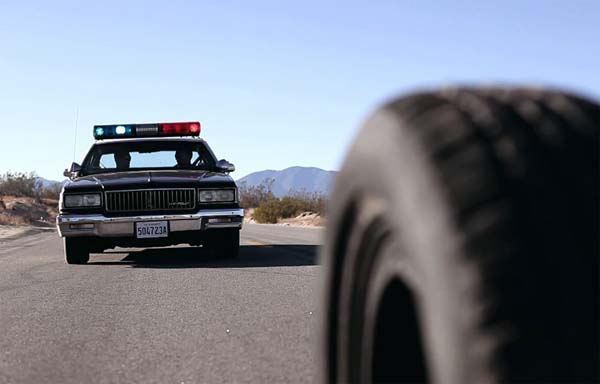
Quentin Dupieux’s latest film, Rubber – not to be confused with a effervescent sex education film – is not for the uptight analytical type who needs to know the precise motivations of a sentient tire (credited here as Robert) emerging from dead detritus in the desert, rolling over spiders and scorpions in the early minutes of his revitalized life, developing telekinetic powers that involve vibrating its body piles violently and causing distant objects to explode, and then using these same powers to go on a murderous rampage. But don’t let these eccentricities fool you. Rubber is a quite pleasant and deceptively pointless picture that did have me wondering why Dupieux – an electro musician turned filmmaker – did not attempt to get Goodyear to bankroll the whole of his meager budget. (Perhaps Dupieux has issues with product placement. I did notice Mountain Gust enjoyed by one character.)

When Robert (actual name for the tire or name for the character?) isn’t enjoying these homicidal activities, the tire watches television, stares at nude women taking showers, plops over sideways every so often for a nap, and rolls into a swimming pool. Discounting Robert’s need to kill people, such behavioral range suggests that Dupieux has closely observed the average American male. Lacking the orifice to enjoy a cerveza in the desert, Robert instead uses his considerable energies to cause human heads to explode. Rather curiously, Robert doesn’t require an air refill at the gas station, presumably because there is enough hot air contained within the film’s story to sustain him.

If the film’s premise recalls the sack awakened by a long pole in Samuel Beckett’s Acts Without Words II, then the presence of spectators within the film, all observing the tire narrative from afar and gradually starved by the folks putting on the show, suggests an homage to Augusto Boal. I don’t believe the Theatre of the Oppressed was especially keen on turning its audience into a bunch of starving animals wolfing down a turkey – a suitably carnivorous image we see midway through the film. After all, if we’re going to be equitable about the artistic experience, shouldn’t we have starving audiences in addition to starving artists?

Forget the theory. Forget the influence. Dupieux would rather have his audience believe that much of this is fun and absurdist bullshit. And it is. Before the tire comes alive, we are introduced to chairs placed meticulously in the road, which are then plowed down by a car. The car’s trunk is then opened, and a sheriff named Lt. Chad (Stephen Spinella) gets out, is handed a glass of water by the driver, and then addresses the camera. Lt. Chad informs us that there is “no reason” that the couple is mad about each other in Love Story. Why doesn’t anybody in The Excellent Chainsaw Massacre [sic] wash their hands or go to the bathroom? “No reason.” Why does Adrien Brody in The Pianist have to live like a bum when he has such remarkable piano skills? “No reason,” says Lt. Chad, conveniently ignoring the Nazis.

“Life itself is filled with no reason,” continues Lt. Chad. And we are informed that the film we are about to see an homage to “no reason.” In other words, this glorious fuck you gives Dupieux liberty to let loose countless what the fuck moments in the next 80 minutes. But we soon see that Lt. Chad is addressing a number of spectators, that binoculars are being disseminated to them so that they can track the tire. Never mind that they never really seem to have a great view or that the range of the binoculars extends for several miles, beyond any and all obstructions. Is Lt. Chad’s prologue directed at us or them? Does a participatory reference point even matter for a film like this? Later in the film, Lt. Chad, locked into one stubborn spectator’s need for the story to continue, dismantles the tire on his own car and announces to everybody, “That’s our suspect!”

To call Rubber postmodern is something of a mistake. You can’t take a film like this seriously. In fact, it’s more fun and more rewarding if you don’t. For my own part, my entertainment value greatly increased as I watched one self-important tool, who had offered a feeble intellectual defense of Sucker Punch just before the movie, fail to appreciate the glorious batshit madness before him.

Yet Rubber works beyond mere free association or curious cult offering. There are scenes in which the spectators remark upon the fact that they can be arrested for piracy, in which they quibble with the T&A moment, and in which they question the logic of the scene (and even question whether they should be offering commentary in the first place). There’s even a moment in which our guide Lt. Chad asks his fellow actors to shoot him with bullets to prove how artificial the environment is.

The film has a healthy contempt for what moviemaking has devolved into in recent years: namely, a process so mechanical and soulless that the latest forgettable $200 million 3D CGI extravaganza may as well be as a spare tire dropped into a pyre. Sure enough, Rubber‘s final moments features an army of derivative tires storming Hollywood. Who knew that it required a bloodthirsty tire to get us to reconsider our relationship to movies?

Review: Potiche (2010)

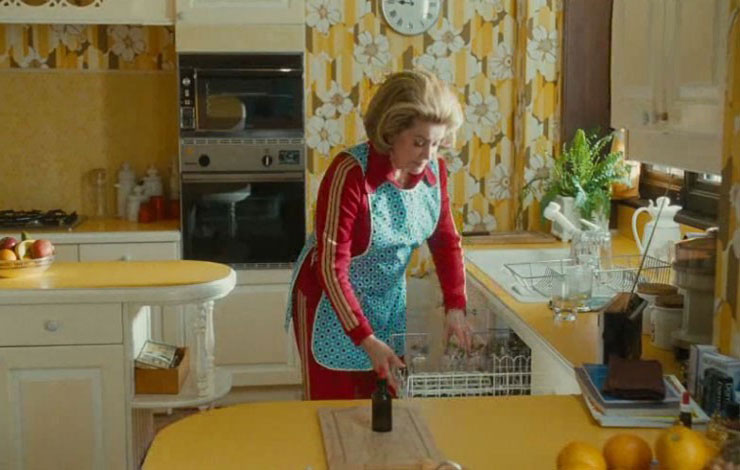
Catherine Deneuve — now 67 — is one of the few actresses in the world who will still stop a man in his tracks in her seventies and eighties. Yet François Ozon, having worked with Deneuve before in the comic murder mystery 8 Women, has rightly comprehended, much like Jacques Demy, the effervescent appeal beneath the sexy sheen.

Potiche, based on a play by Pierre Barillet and Jean-Pierre Grédy, is certainly a pleasant enough vehicle for Deneuve and her costar Gerard Depardieu. The older and middle-class critics at the screening I attended laughed at the right moments, perhaps not entirely aware that Ozon has been kind enough to toss a few goofy Molotovs over the years. For those who enjoy the more provocative side of Ozon, Potiche signals a retreat from the eye-popping fare that established this intriguing director’s career.

Whether the condition is permanent is anyone’s guess. But the gleeful assaults on bourgeois marriage, seen in such films as 5×2 and the glorious Sitcom, that imbued Ozon’s work with such mischievous zest have been replaced by a comparatively stale story involving Suzanne Pujol (Deneuve) as the titular “trophy wife” to Robert Pujol (Fabrice Luchini), an umbrella manufacturer (a nod to Demy’s The Umbrellas of Cherbourg) who enjoys balling his secretary Nadège (Karin Viard) on the fly (when, of course, an altogether different fly is unzipped). Robert is a man who cannot remember his wife’s birthday. Which begs the question of why Suzanne has stuck around for so long. (There’s an answer late in the film, but, alas, it’s something of a contrivance.)

It could be because this is 1977, a year when France is a paradise for labor strikes. Sure enough, the umbrella factory run by Pujol finds itself facing the kind of progressive resistance that seems to elude 2011 America. Leading the strike is Maurice Babin (Depardieu), who happened to have a fling with Suzanne back in the day. He may be a man of the people, but he knows how to respect a lady — a sentiment that the film is careful to heed by featuring needless flashbacks with younger actors. (I felt sorry for the the largely mute thespians playing younger versions of Depardieu and Deneuve in these scenes. With classic French cinema to be compared against, how can they compete?)

You’d think that all this political intrigue would permit Ozon to expand his cheerfully irreverent approach. One promising joke of copulating rabbits suggests that the Ozon we know is here. But he’s hamstrung by the somewhat passe and toothless material he has to work with. What’s odd about Potiche is that the Suzanne/Maurice affair — that vital subplot that’s pretty much the linchpin of good farce — doesn’t have nearly the same narrative traction as the Babin family taking over the factory while dad is occupied. Suzanne’s daughter Joelle (Judith Godrèche) faces a dwindling marriage and an augmented belly, but despite these conflict, she’s quite the reactionary little minx — especially when asked to vote during the board meetings. (Is this a joke relating to France being behind the women’s suffrage curve? Remember that France didn’t give ladies the municipal elections until 1945.) But I was especially fond of Jérémie Renier’s subtly mannered performance as Paul, Suzanne’s son. His artistic background is applied to the factory with humorous effect. And perhaps that’s because Ozon delights in decorating the Pujol house with green drapes with a sofa to match.

Potiche doesn’t quite have the retro pizzazz of an American movie like Down With Love, much less Ozon’s fashion-conscious world in Time to Leave. Watching this latest movie, it’s difficult to fathom that, only a few years before, Ozon made a movie about a baby with a working set of wings.

One sign of an interesting filmmaker is how well he can stay himself when asked to work in the mainstream mode. In Potiche, there’s one moment when a man shoves whole potato chips in his mouth. This may very well mimic what the audience is being asked to enjoy here. Or perhaps it’s a strong indicator that Ozon is better off commenting upon conventional narratives through the unconventional. Why stick with trophies when you can raise hell and get away with it?