The Benefits of Being Conformist

Curtis Brown, one of the most self-important independent literary agencies, has set up its own creative writing school. And frankly I don’t see what all the fuss is about. We’re only gently molesting writers while we take their hard-earned money. We’re not nearly as bad as derivative traders, but give us some time. We differ from vanity press operations only in the scale and technique in which we crush young writing dreams. (Don’t worry. For an additional $500, Curtis Brown will rip off your clothes in the forceful manner of a rapist just after you give us your manuscript.)

Frankly, this was not the debate I anticipated. Will we stub out innovative writing once and for all? Well, we hope so. But this is still a fledgling operation. So it’s hard for us to make sufficient projections until unpublished and destitute writers start blowing their brains out. Had I stumbled onto the idea after reading Ayn Rand’s collected works? Well, yes. But I only skimmed Atlas Shrugged, much as I skim the manuscripts of those silly fools who laughably believe that we’ll get them published. These are the questions I had hoped to debate. In fact, I hadn’t really anticipated debating anything at all. We employ large and threatening men at our office for a reason. It’s important that public discourse be confined to softball inquiry.

First off, let me just say that Curtis Brown Conformist will be of no interest to bloggers who have purchased any recent titles from Word Riot or Two Dollar Radio. For those who believe that reading audiences exist beyond the conventional, CBC is probably not for them. Let brash young idealists, no doubt attending their Marxist rallies, discover the hard way that we live in a cruel capitalist system that needs to be embraced. But for those who are committed to flooding the marketplace with predictable novels capitulating to every petty big box retailer demand, let me clarify a few points.

Curtis Brown Conformist is the first writing course in which a literary agency kills the life out of a neophyte’s manuscript. What’s great about CBC is that we take your money too. You might even say that we’re correcting the marketplace. CBC is an intrusive three-month course for new writers promising access to industry professionals who will fill young heads with cynicism and lies. First prize is the opportunity to be considered by one of our elite agents. Second prize is a set of steak knives.

Paying for access? Not exactly. We like to fleece naifs in other ways. We are still one of the few agencies that pretend to read unsolicited manuscripts. We are committed to leading newly minted MFAs astray, taking as much as we can from our authors, and providing career management similar to the way that Allen Klein once managed the Beatles. We like to think that our authors will come to us, saying, “I think you’re screwing us, but I don’t see how.” We’re hoping to screw at least 200 new writers a week.

Unethical, you say? Well, launching new writers isn’t just hard. It’s fucking impossible. If we can’t find ways to publish new writers, well we may as well screw them. We may as well turn them into a profitable army of James Pattersons. Or turn them into B-list celebrities. The big takeaway from Curtis Brown Conformist is that writing well is the least of your worries.

CBC is run by Benito Pooter, a novelist who published twelve profitable potboilers in the last year alone. Before he was a novelist, Pooter knew how to make the railroads run on time, shooting several conductors who could not comprehend how important it was to adhere to the timetables. He is also an expert in passive-aggressive behavior. Thanks to Pooter’s innovative education techniques, which involve electrodes being glued to gential areas, CBC hopes to reduce the remaining idealism plaguing the market. CBC will not just be making false promises about getting access to the industry, but forcing its young writers to memorize and chant four hundred maxims that will ensure that all distinct writing is stubbed out.

So, the fee. It will cover our tutorial costs. It will cover our valets. It will cover our forty weeks of luxurious holiday each year. It is comparable to a high interest Tranche D loan, which we feel is quite generous.

Will these writers be compelled to be represented by CB? Of course not. We only want their money. But when these schmucks head home with unfulfillable dreams, we will throw all their manuscripts into a bountiful bonfire!

Publishing is often viewed as a closed door. With this course, we hope to keep it this way.

The Bat Segundo Show: Cynthia Ozick II

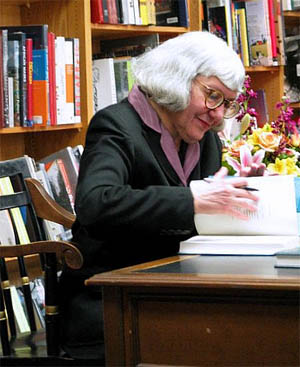
Cynthia Ozick recently appeared on The Bat Segundo Show #368. Ms. Ozick is most recently the author of Foreign Bodies. She previously appeared on The Bat Segundo Show #210.

Condition of Mr. Segundo: Wondering why Henry James forces him to have alarming dreams.

Author: Cynthia Ozick

Subjects Discussed: [List forthcoming]

EXCERPT FROM SHOW:

Ozick: The joy of dialogue. Oh, dialogue! It took me such a long time how to learn how to do dialogue. And I think I learned it from a single book. Which is Graham Greene’s The Heart of the Matter. Which I actually studied to see how he made it concise and dramatic. And I think once you know the character, you have the voice. I suppose you could say that once you have the voice, you have the character. But I don’t think it works like that for me. Once you know the character, you can hear the character speak. And of course, they all speak in their own voices. I don’t know if that’s really related to music. I think that’s more related to seeing. Because you see the character. And if you see visually the character, then if I am looking at you, the voice that comes out of you is naturally yours. Because I see you. Whereas music is this mystery of mathematics. Including Confucius, music and math go together. And that’s a wonder about E.M. Forster. He’s one of the few writers who was very musical. I mean, seriously musical. And that’s in his writing as well. But I think the link with writing is more painting. We see this. It’s so interesting. John Updike had the ability to draw and write. So did Thackeray. Kipling. There are others. I can’t think of them now, but they’re so many linkages in writing and art. In other words, the pen and the eye. Whereas music is abstract math. So that’s where the voices come from. From the eye, I think.

Correspondent: It’s interesting that you mention Greene. Because of course, we know him for the colon. And in terms of looking at your dialogue in this book, what is rather interesting is that sometimes you have almost a Marianne Wiggins-like dash. And sometimes you have the quotes. I’m curious to the methodology behind that. How that developed.

Ozick: Well, that was pretty simple. I needed to have a dialogue in the historic present, so to speak. And dialogue before then. So for the earlier dialogue, I used the dash to distinguish it from the dialogue that’s occurring in the now. Even though the now is in the past tense. Because I have to confess. I have a lot of trouble with our common currency of present tense. Despite those great books of Rabbit [Angstrom]. I was once standing in a group of writers and was so humiliated. Because I mentioned my prejudice against writing in the present tense. And Updike was standing at my right elbow and said, “Well, my Rabbit books are in the present tense.” That was not a good moment. (laughs)

Correspondent: Well, why the aversion specifically to present tense? It’s used a lot more, I think, now than it was thirty years ago.

Ozick: Absolutely. It’s ubiquitous. I don’t know. It just seems that it spoils storytelling. Because it escapes from the magical “Once upon a time.” This happened once. If it’s happening now, then there’s almost no history in it. It destroys the past. And, of course, you see that writers who write in the present tense have to go back and deal with the past. You see that they then have to revert to past tense anyway. And it has a kind of inconsistency. And it’s simply unpleasant to me.

Correspondent: You’re saying that a novel really should present itself almost as a sense of history.

Ozick: Exactly. It’s a story that happened. Not a story that’s happening. And I guess that really needs to be explored. Why should a story that happened be better than a story that’s happening? I don’t know. Help me. Why?

Correspondent: Well, I think when you have a situation like — there was a book by Elliot Perlman called Seven Types of Ambiguity. Named, of course, after the great text. I mean, I like the book. But it has this really absurd situation because it’s written in the present tense. And the narrator’s going, “He’s hitting me.”* When I read this, I thought, “This is just utterly preposterous.” It immediately takes you out of the story.

Ozick: (laughs) Right!

Correspondent: If he “hit” him, right. But “He’s hitting me.” It’s like — wait a minute.

Ozick: Then how can you be writing?

Correspondent: How can I be participating in this? But with the past tense, you can feel a greater sense of participation in the activity.

Ozick: You can believe in it!

Correspondent: Yes!

Ozick: You can believe in it. I mean, it really helps the suspension of disbelief if you present it as a history. And isn’t this the beginning of the modern novel? My Man Friday?

Correspondent: (laughs)

Ozick: We’re supposed to believe that.

Correspondent: Yeah.

Ozick: And we do. Because it’s written like a history. No, I think you hit it when you said it has to do with history. And maybe that is a problem — if there is a problem — with much of American writing today. That it is rather amnesiac.

* — In all fairness to Mr. Perlman, I feel compelled to issue a slight correction. I told Ms. Ozick that I remembered the phrase “He’s hitting me” from Elliot Perlman’s Seven Types of Ambiguity. It has been a good six years since I read Mr. Perlman’s book — sent to me with a handwritten note by Ami Greko, one of the few publicists back in the day to grasp the litblog medium that is now simultaneously ubiquitous and passe. But I can find no indication of the phrase “He’s hitting me” within Perlman’s book. Yet the specific passage I was trying to remember when Ms. Ozick put me on the spot, presented below and written in the present tense, does indeed reveal how the reader can be thrown off when violent gerunds are involved. It still reads as absurd and remains just as applicable to the conversation at hand. This funny little episode also reveals how a fatal expressive error can be misremembered years later, perhaps subject to the same “rather amnesiac” problem with American writing that Ms. Ozick mentions. Authors, take heed when using the present tense!

“I’m going to fucking kill you!” I scream at him. I am punching his face repeatedly, left then right again and again against the smooth stone paving and I am going to kill him. He is squeezing tighter. I am killing him. I am trying to kill him as Anna is pulling me off. She has her arms around my shoulders. She uses all her strength to drag me off him. (80, U.S. hardcover)

(Image: Zugoli Lany)

The Bat Segundo Show #368: Cynthia Ozick II (Download MP3)

This text will be replaced

Edward Docx: A Slug Defending His Gated Community

On December 12, 2010, The Guardian published a pretentious essay by an amental snob named Edward Docx. Docx foolishly suggested that “genre writers cannot claim to have anything.” He accused Lee Child of “ersatz machismo bullshit” even as Docx himself could not see the fecal specks sprouting throughout his own ineptly argued assault on genre. He wasted his first two paragraphs blabbing on about the plebs on the train and, like a petulant infant longing to grow into a long-winded David Cameron, bitched about not having space to provide “a series of extracts…to illustrate the happy, rich and textured difference.”

Yes, it’s class warfare, my friends. But here’s the thing. Docx isn’t on the working man’s side. His essay reads like some corpulent slug defending his gated community with a Magpul PDR and then slithering away because he doesn’t know how to release the safety. It’s the kind of unfit approach that invites ridicule rather than confidence, alienation rather than mobilization. For if you’re going to claim yourself a champion of the people (or, to use Docx’s inept populist metaphor, a half-hearted burger eater), shouldn’t you be paying attention to what they’re reading? If you wish to demonstrate why Stieg Larsson is such a shitty writer, shouldn’t you have the guts to quote him at length? After all, your argument is airtight, isn’t it? The writer is dead and he can’t respond, right? Win win!

Alas, Docx can’t be bothered. He identifies “the most tedious acronym-packed exchange” that he has ever read, but he fails to comprehend that what Docx considers “tedious” might be the kind of wonky info banter that is going to get a journalist like Blomkvist rock hard. He quotes from a very early part of The Girl with the Dragon Tattoo (page 24 in my copy) and gives us no full indication that he has read the whole book. This makes Docx not only an illiterate, but an inept bully foolish enough to support his claim through deductive induction — a logical fallacy that hasn’t worked ever since newspapers had the good sense of opening up their articles to public comment. Because Docx says that genre is lesser, and Docx fancies himself an authority, then it must be true! No need to provide airtight examples of Swedish silliness. Docx also tries to quote a few passages from Dan Brown to make his case. But wait a minute, that’s a logical fallacy! What about Larsson? That guy you just shit talked in your previous paragraphs? Shouldn’t you be taking him down? Oh dear, secundum quid! If only Docx had the space, he’d demolish your genre! He’d *gasp* have an argument!

Well, not really. It becomes abundantly clear that Docx doesn’t know what the fuck he’s talking about when he attempts to quote others. In a feeble attempt at wit, Docx deliberately misquotes Isaac D’Israeli’s Curiosities of Literature (the full quote: “Whatever is felicitously expressed risks being worse expressed: it is a wretched taste to be gratified with mediocrity when the excellent lies before us”). But D’Israeli was writing rather sensibly about how well-read writers are those comprehending the wit of other men. Does Docx comprehend D’Israeli? To employ a populist reference that Docx might frown upon, you make the call. For Docx misses the vital sentence that came before the business about being “gratified with mediocrity”:

It seems, however, agreed, that no one would quote if he could think; and it is not imagined that the well-read may quote from the delicacy of their taste, and the fulness of their knowledge.

And here’s what came after:

We quote, to save proving what has been demonstrated, referring to where the proofs may be found. We quote to screen ourselves from the odium of doubtful opinion, which the world would not willingly accept from ourselves; and we may quote from the curiosity which only a quotation itself can give, when in our own words it would be divested of that tint of ancient phrase, that detail of narrative, and that naivete which we have for ever lost, and which we like to recollect once had an existence.

So if Docx wishes to uphold worthy literature, why is he unable to provide a corresponding set of virtues other than a measly list of literary names? According to my word count feature on OpenOffice, this doddering dunce had 1,770 words to stake his claim. All that space and he couldn’t be bothered to provide a single passage? Talk about long-winded. It’s safe to say that Docx is no D’israeli. I think it’s also safe to say that Docx has utterly mangled D’isreali’s great sentiment.

So why bring the argument up in the first place? Why make such a spectacle of yourself? Why do this when you tacitly admit that “there is also much theatricality to the debate?” Sarah Weinman has a few answers. Certainly I can understand the Guardian‘s need for attention in this vanquished media economy. But I’d like to think that some editor over there was having a good laugh at Docx’s expense.

You see, Docx is the kind of humorless elitist who observes people reading books on a train and actually sees this as a bad thing. Rather alarming that ordinary Joes don’t seem to share Docx’s refined instinct for spending their increasingly valuable leisure time reading a 900 page Russian epic. How dare the rabble sully literature by having a good time! In this essay, Docx vomits so many half-digested meals out of his mouth that one detects an uptight gourmand who showed up to an orgy wearing a chastity belt. The man is incapable of understanding that when people flock to Stieg Larsson, they may very well move on to other authors beyond the missionary position. The very “literary” authors Docx desires them to read. And he’s incapable of finding anything positive in this apparent predicament. Which makes him more of a pinpricked sourpuss than a viper for the people.

Here is a man who berates a blue-collar worker for having to put down a Larsson volume. He writes: “And when, finally, I arrived at the buffet car, I was greeted with a sigh and a how-dare-you raise of the eyebrows. Why? Because in order to effectively conjure my cup of lactescent silt into existence, the barrista in question would have to put down his… Stieg Larsson.” Now if it had been me, I would have viewed this exchange as a rather comic moment. Maybe an opportunity to ask the barista why he liked Larsson and recommend a few names in response that might help him find a way to wider reading pastures. That is, if he didn’t want to go back to his volume. In which case, I would have offered a generous tip for blabbing on for five minutes. But for Docx, the barista represents a foolish opportunity to cling to class assumptions that haven’t been in place since the 1880s. You insolent reader! Fix me my latte now, you unthinking peon! And this makes Docx not unlike Charles Pooter, the hapless protagonist of Diary of a Nobody, who demands some respect from a blue-collar “monkey of seventeen.” The laborer replies: “All right, go on demanding!”

Of course, Docx can go on demanding all he wants. It isn’t even noon Eastern Standard Time, and I can see that the man has already been thoroughly ridiculed on Twitter. But if Docx gets his money quote, I get mine. And if we assume that dictating taste represents a fleeting freedom, I think Nietszsche best sums up why Edward Docx is such a small and pathetic man:

People demand freedom only when they have no power. Once power is obtained, a preponderance thereof is the next thing to be coveted; if this is not achieved (owing to the fact that one is still too weak for it), then “justice,” i.e., “equality of power” become the objects of desire.

[UPDATE: This post has been corrected. An earlier version of this article incorrectly observed that Docx had not cited Larsson. This was not true. Docx did quote a passage, but his argument remains so pisspoor that Docx’s “takedown” still doesn’t hold water. Nevertheless, I apologize for my error and express my gratitude to Nico for pointing this out to me.]

The Bat Segundo Show: Susan Straight

Susan Straight recently appeared on The Bat Segundo Show #367. Ms. Straight is most recently the author of Take One Candle Light a Room.

Condition of Mr. Segundo: Exploding Roman candles overlooked by the elite.

Author: Susan Straight

Subjects Discussed: [List forthcoming]

EXCERPT FROM SHOW:

Straight: I think what I’m trying to say about America is that it’s a series of villages. And everyone has a village. Again, people stay or people leave. But the idea that Americans want to forget that you come from a village — whether it’s the Upper East Side or Clackmannan Parish — that’s your village and you have to honor it. Fantine is the ultimate rootless traveler who goes on the road trip from hell with her father. Her father was really a pivotal character to me. I thought about Gustave and Enrique for months before I wrote this. And I wrote two short stories about them. The way that they became brothers was based to me on a true story told to me by an elderly neighbor. He came to my house for me to write letters to him. Because he couldn’t read or write. And I wrote letters to the VA. He was missing a little finger from the Korean War. And he was still trying to get money for it. And I grew up with his son. So he would come to my house. And I would write letters for him. And one day, we were sitting on the porch. And he told me this story of how he was an orphan. I mean, his dad was killed when his mom was pregnant with him. And he was seven years old. And he was hungry. And he wanted some meat. And nobody would give him any meat. No one would go get any meat. So he took a hammer. He walked three miles. He found a pig on a farm, killed it, dragged it three miles back to his house. Seven years old. And said, “Cook me some meat.” So that to me — the Enrique/Gustave — those are the men that I grew up listening to their stories of immense deprivation. Of walking fifty miles to go find a job. Of not ever having a mother and father, and making themselves into brothers. So that meant a lot to me too. That family at the end of the Clackmannan Parish Delta would say, “We’re still here.” It doesn’t matter what you do to us. We will still be here. Enrique was a big part of that for me.

Correspondent: Related to this desperate hunting, I have to ask you: Where did you get the idea of wrapping bacon around a gunshot wound as a home remedy? I asked a forensic science masters. I asked a medical student. And they had not heard of this. And I had not heard of this.

Straight: (nodding her head)

Correspondent: Aha! You did.

Straight: My mother-in-law told me that. My mother-in-law, I miss her so much. She died the year that that youngest child was born. And the last thing we whispered in her ear was that I was pregnant with her third granddaughter of our family. I mean, she had twenty-five grandchildren. My mother-in-law could have been born in Mississippi. She could have been born in Arkansas. She could have been born in Calexico. Nobody ever knew where she was born. We had to get her a birth certificate when she was fifty. My mother-in-law told me that when they were so poor — probably in Mississippi — that you would wrap bacon around the wound or salt meat. More likely salt meat. And that the salt pulled out the infection. She told me that when my children were really, really young. I mean, I knew her from the time I was sixteen on. And [my daughter] Rosette had this horrible infection on her leg. And we couldn’t figure out what it was. And we had tried everything. Antibiotics. Everything. One night, it was as if my mother-in-law spoke to me. And I had a piece of maple cured bacon. Farmer John. Stupid maple cured bacon. And I took that part. And I put it on Rosette’s wound. And I wrapped a dish towel around it. And the only thing I had to tie it with was Christmas tool. Like wrapping ribbon.

Correspondent: Wow.

Straight: She kept it on all night and all morning. Pulled it off. And the infection came out with the piece of bacon. It was the most disgusting thing you can imagine. And her wound healed over. And I just thought, “Okay, this is Alberta telling me what to do from the beyond.” And that’s exactly where that came from.

Correspondent: I’m shocked that, if this has happened, no mystery novel has picked this up. Or anything like that.

Straight: Exactly!

Correspondent: It sounds like the coolest way to get rid of a wound.

Straight: I took her to the dermatologist, who was Chinese. And she was like, “No, that’s not true. That’s not true at all. It couldn’t have happened.” And she dug a big hole in Rosette’s leg after that. And Rosette has a horrible scar now.

Correspondent: Oh wow.

Straight: So for us, the bacon. We should have just stuck with Grandma Alberta.

Correspondent: Quite literally, you must bring home the bacon.

Straight: Well, the sad thing is that that is one of those folk remedies that was passed down to me from my mother-in-law. Along with the title of the book. Take One Candle, Light a Room is something I’ve heard some older women say at some family reunion. And someone said, “Oh, is that your only child?” And she was like, “Take one candle, light a room.” And I was like, “Wow.” That’s the best phrase I could ever imagine. In a kind of defiant way to say, “Yes, I have one child. And that’s all I ever needed to make my life.” So everything I’ve been given like that is kind of like a gift from listening, I think. I’m the person who listens.

The Bat Segundo Show #367: Susan Straight (Download MP3)

This text will be replaced

Superficial Reading: Cynthia Ozick and Critical Pygmies

When Zadie Smith reworked E.M. Forster’s Howard’s End* into her excellent novel, On Beauty, few reviewers expressed dismay at her creative methodology. Frank Rich, who raved about Smith’s novel in The New York Times, noted “the blunt declaration of Smith’s intention to pay homage” in Smith’s first sentence. The Washington Post‘s Michael Dirda, who was even more effusive than Rich, called Smith’s novel “subtly laced with learned allusions” — which was something of an understatement. Similarly, Jonathan Lethem’s “The Ecstasy of Influence” was also celebrated for appropriating numerous texts — even included in the 2008 edition of The Best American Essays.

In an age where Girl Talk and Creative Commons are as mainstream as Johnny Mathis, remixing and repurposing is clearly the usual, something to be celebrated among our greatest literary practitioners. Yet it is rather extraordinary that a few reviewers — all conspicuously out-of-touch with this present temperament — have seen fit to punish an author, one who has pretty much earned the right to do anything she wants, for reworking a novel considered to be a classic. What is most interesting about these feeble hatchet men is how little they comprehend the text they wish to feed to the dogs.

Cynthia Ozick’s Foreign Bodies has been bitchslapped by The Los Angeles Times‘s David Ulin, The Milwaukee Journal Sentinel‘s Mike Fischer, and The Seattle Times‘s Michael Upchurch for a novel that is, respectively, “more schematic than engaged,” “doesn’t have the texture or plumb the depths that anchor James’ metaphor-rich prose,” and “a great premise — disappointingly handled.”

Upchurch’s indolent 300 word review — indistinguishable from a cranky Goodreads capsule banged out by a drunk in a matter of minutes — can be easily dispensed with. All Upchurch manages is a chickenheaded concatenation of pusillanimous modifiers (“crude,” “thin,” “choppy,” “baffling,” and so forth) for Ozick’s latest. He guzzles down his precious column inches praising James, as if desiring some librarian to pin a gold star to his lapel for dutiful reading, and he writes that Ozick “introduces [a] bracing, brutal twist without really developing it” without bothering to explain why. (This is not dissimilar Ulin’s sloppy pronouncement that Foreign Bodies “remains curiously unsatisfying.” More on Ulin in a mite.)

When one explores the Goodreads page for Ozick’s book, one discovers that even the reviewers who didn’t care for the book have more clarity and plenitude than Upchurch:

She is really a wonderful writer with a unique presentation and style. However I did not rate this higher as I liked none of the characters, not at all or even a little bit. They all had significant flaws and I found the reading experience unpleasant as they were just all so annoying. I did not care really what happened to any of them although I was curious enough to finish the rather short book and had hopes that they would change a little or something other than what they were throughout.

That comes from a Goodreads user named Allyson. Writing in her spare time, Allyson offers a more valuable negative review than Upchurch. She articulates — in fewer words than Upchurch — that she didn’t care for any of the characters, but notes that she was attracted to the style. And she also seems genuinely taken aback — certainly more than the newspaper naysayers. By contrast, Upchurch writes, “We also get prose that too often flails hyperbolically as it paints its grotesques.” Like Allyson, Upchurch doesn’t really expand on his observation. But Allyson is not so quick to condemn. The outside observer, curious about the balance between style and characters, is more interested in Allyson’s review. Therefore, why would any news outlet pay Upchurch money when we can get the same material for free? I understand that Upchurch has had his space cut. But Upchurch, in sticking with the superficial in his review, offers us no reasonable justification for his professional existence. He is as joyful as a starving urchin in Calcutta. One desperately wishes to feed him.

Of Foreign Bodies, David Ulin claims “there are no overt references to the novel, other than a few puns and one-liners.” Yet even in Ozick’s second chapter (the first after a letter), one encounters quite a number of Jamesian references.

In The Ambassadors, James’s Paris is often quite cold. Chad’s house, formed from “the complexion of the stone, a cold fair grey, warmed and polished a little by life,” takes “all the March sun.” Strether is led into “the rather cold and blank little studio.” Madame de Vionnet leads Strether into an antechamber that’s “a little cold and slippery even in summer.” By contrast, Ozick’s postwar Paris is piping hot, the victim of “a ferocious heat wave assault[ing] Europe.” Bea walks “through the roasting miasma of late afternoon” and in search of nonexistent air-conditioners. A superficial reader may view such an inversion to be merely the “mirror image” that Ulin claims it to be. But if Foreign Bodies is simply swapping the twin taps, why then would Bea also encounter a “visionary living robot” at a department store, which also has the “familiar” consolation of “cold air?” Ozick isn’t simply reversing The Ambassadors. She’s studying how French-American cultural relationships have developed over the fifty years since The Ambassadors. Ozick’s ravaged version of postwar Paris is quite different than the cultural mecca that enticed Strether, yet she daringly suggests that the new Paris appeals to Americans who are “vigorous, ambitious, cheerful, and given to drink” — “literary tourists” who are hoping to “summon the past.” From The Ambassadors:

Nothing could have been odder than Strether’s sense of himself as at that moment launched in something of which the sense would be quite disconnected from the sense of his past and which was literally beginning there and then.

Ulin declares Ozick’s novel as merely “a counterpart” and “a mirror image, James’s story turned around.” But this lazy thesis fails to account for the Suite Eyre spa in California, featured near the end of Ozick’s novel, which serves almost as an wry answer to Thomas Mann’s European spas. Where The National Post‘s Philip Marchand rightfully observes that “not every character in Ozick’s novel is based on Henry James,” for Ulin, Foreign Bodies “seems more schematic than engaged.” By contrast, The Barnes and Noble Review‘s Tom LeClair is more daring (and interesting) in his suggestion that Ozick is responding in a way to a particularly callow interviewer who began his conversation by telling Ozick that her work was cut off from contemporary culture (and who then got his ass handed to him). Evidence for LeClair’s theory can be found within the novel, which concerns itself with sexual candor, abortion, and several other subjects that occupy our present time. But LeClair, in attempting to pursue “the physical revulsion and spleen that circulate through the novel,” offers a more curious and less turgid investigation than Ulin. Ulin’s inability to see Lili as little more than a refugee who marries Julian suggests very highly that Ulin skimmed (if that) the book’s last 100 pages, which offer quite a bit more with a figure named Kleinman.

Ulin’s miserly efforts to corral Ozick’s novel against another are matched by Mike Fischer’s impoverished interpretation. Fischer lauds one Ozick passage that “James could have written” and notes that Foreign Bodies “is filled with similarly uncanny echoes of the Master’s voice.” But he is too much of an incurious James fanboy to consider Ozick’s book on its own terms. He is blindsided by how closely Foreign Bodies aligns with The Ambassadors. And like Ulin, he too seems to have skimmed the final 100 pages. Fischer observes “the washed-out watercolors of Marvin’s two maddeningly inconsistent children,” which isn’t so much a cogent observation but an inept attempt at wit. Fischer likewise doesn’t have the acumen to consider Margaret’s vital presence as anything more than a sketch representing “narrative neglect.” (Never mind that Ozick, imbuing Margaret with a pebble in her heel, is exploring the symbolic possibilities of spousal neglect cast against an American backdrop.) Fischer makes no mention of the book’s careful concerns with the corporeal. And there’s one vital clue for Fischer’s doddering take in this “narrative neglect.” Near the end of Fischer’s review, Fischer claims that Ozick’s readers “stumble in the dark,” because “we’re not given an object lesson on the moral ambiguity that is central to understanding James.” This is no doubt a reference to James’s “The Art of Fiction,” in which the Master threw a famous fit over Walter Besant’s “conscious moral purpose.” But “conscious moral purpose” (or even James’s “air of reality”) isn’t the sole reason to read a novel. (Indeed, this is precisely what James was arguing.) Only a precocious child would ascribe such a singular criteria when assessing a book. But Fischer — “a Milwaukee lawyer and writer” and, quite possibly, a moribund Grisham aspirant — wishes to fish with a puny pole that will never hit the sediment.

It’s bad enough that Upchurch, Ulin, and Fischer’s conservative-minded deference for the original text prevents this bubble gum chewing trio from appreciating what Ozick is trying to do. Updike’s first Rule for Reviewing — “Try to understand what the author wished to do, and do not blame him for not achieving what he did not attempt” — has clearly been tossed out the window. But what makes these three reviews especially troubling is the instant drift to the superficial. This is especially dishonorable with a novel embedded with all manner of treasures. Not one of these three men proved capable of observing the canny way that Ozick closes the book at the turn of the year. Not one of these three men proved capable of understanding composer Leo Coopersmith’s role in the narrative, much less paying close attention to the way Ozick describes voices and musical instruments. (An opportunity to explore what Ozick’s novel in music might have been welcomed in a newspaper. But why attempt serious criticism when you’re firing blank bons mot?)

Robert Birnbaum, writing about Ozick in The San Francisco Chronicle, is quite right in suggesting that “the enterprise of book reviewing has become degraded.” When critical pygmies wish to denigrate an author that they lack the time or the curiosity to comprehend, one wonders why such infants aren’t devoting their pens to matters more suited to their collective ken: perhaps snarky synopses of television episodes or vapid profiles of Hollywood celebrities. If these are the hollow considerations we’re getting, then the death of newspapers couldn’t arrive any faster.

* — One fun fact: Forster, rather famously, didn’t care much for Henry James. Of The Ambassadors, Forster wrote:

The James novels are a unique possession and the reader who cannot accept his premises misses some valuable and exquisite sensations. But I do not want more of his novels, especially when they are written by some one else, just as I do not want the art of Akhenathon to extend into the reign of Tutankhamen.