The Bat Segundo Show: Paul Harding

Paul Harding appeared on The Bat Segundo Show #364. He is most recently the author of Tinkers.

Condition of Mr. Segundo: Tinging with Mingus and tinkering with Tinkers.

Author: Paul Harding

Subjects Discussed: [List forthcoming]

EXCERPT FROM SHOW:

Correspondent: We were talking before all this about the idea of novels and whether or not they can actually serve as a handbook for life. Something I don’t necessarily believe in. And I don’t think you do. But I wanted to address that. Because your book, Tinkers, does, in fact, present life. And I’m wondering how you, as a writer or just in general, arrange text as a way to present life rather than dictate life. Was this ever a struggle for you when writing this?

Harding: Not with this. I think I had done my apprenticeship to bad prescriptive moralizing writing and just ended up writing very bad propaganda.

Correspondent: (laughs)

Harding: You know, it was just designed to show people how progressive and enlightened and intelligent I was. And then I’d say the kind of operative word is description. And precision of description. And if you describe things precisely, you end up bearing witness to the truth of your characters — in this case, characters’ lives — in a way that does them the kind of moral justice that’s misplaced when you think you’re going to moralize. For me, it even starts with the writing process. The difference between writing declarative prose and writing interrogative prose. Like I don’t presume that I know something and I’m going to tell you how it is and that afterwards, if you’re lucky, you’ll be as smart as me. What I do is that I try to write interrogatively, discover things, work through revelation. It’s just a type of aesthetic. But then what you leave on the page behind you — when the reader reads what you’ve written, the reader will have the same kind of revelations and moments of recognition. To me, that’s like the greatest experience as a reader. Those moments of recognition. Where you read something and you simultaneously realize, “I’ve always known that’s true. I’ve never thought about it consciously and I’ve never seen anybody put it into language before.” So there’s a kind of morality to that. There’s some sort of confirmation of common humanity or whatever. But it’s not prescriptive, small-minded minor kind of moralizing.

Correspondent: I’m very glad that you brought up description. Because one thing that I really think is interesting about this book is the hyperspecific nature of the description.

Harding: Right.

Correspondent: To offer an example, you have George “reading by the dim light of a small pewter lamp set on the rolltop desk at the far end of the couch.” Now that’s extremely specific. And I’m wondering if that serves as a way for you to get the reader inside George’s head. Or is this a way for you as a novelist to kind of know where everything is situated? The only person I think who writes that hyperspecifically is possibly William Gibson or someone like that. A lot of the 19th century authors do.

Harding: Yeah. And I’ve certainly spent all my reading time trolling around 19th and early 20th century fiction. I mean, I almost think of Thomas Mann’s little preface he has to The Magic Mountain. That we will be long on detail, but when was a book ever short on interest that was long on detail? People would argue against that novel’s glacial — but it’s sort of a bit of both. Which is while I’m writing, I’m blocking the scene out, you know? And since my characters in Tinkers — it’s so interior that I knew from the beginning that I had to keep the world embodied. I had to keep it physically, tangibly present. Because otherwise it would just be feasting on ether. So there’s that. There’s the kind of geography of the room. But then it’s also to make the reader feel like he or she has been put in a real place. Actually put in a place where there’s a chair to your left. There’s a certain physical feeling you get when you feel that there’s a chair to your left and a sofa over here and a painting over there. That sort of thing. I also just believe in the virtue of concrete nouns and verbs. And I think it’s true too that there ends up being something hyperreal, rather than surreal, about it. But there’s really a cool kind of bandwidth of unintended affects that you can’t predict. But you use that process of total precision, almost pointillist precision, that you end up getting into these kind of transcendent or metaphoric realms. But not by lifting up out of the world or evaporating off of it, but by going deeper into what’s imminent. So you’d get so materialistic about it that then it turns into something you don’t recognize and you sort of double back on yourself and it becomes unrecognizable and sort of unsettling and hyperreal. So I love that. I just love that phenomenon.

Correspondent: But it’s not just also in relation to materialism. It’s also in relation to place. Of course, the clock theme that goes throughout with The Reasonable Horologist, which I presume is invented.

Harding: Yeah, that’s all invented.

Correspondent: I’m wondering if that text within the text [The Reasonable Horologist] was included almost as a way to distract the reader from the fact that the text, the prose itself, is almost written in this kind of William James, 19th century mode. And that by having this, you can almost justify the style that you’re doing within the actual prose itself.

Harding: It’s a little bit of — on the most generic level, it’s just to change things up. It’s just to use relief. So much of the book is very somber and funereal and twilit. And this is just a little more verbose and florid, and kind of tongue-in-check. It’s kind of humorous. And so it keeps the textures changing. But, yeah, I think it’s also true. Because the writing is formal and that kind of precision leads to that kind of, “It sounds formal, so it sounds archaic to some extent.” It was also just a fun way to write in that kind of, “Welcome, dear reader, to Reason!” You know, it just worked emotionally with the character, with George the clock repairman. His upbringing was so chaotic and disorderly that the idea of the deterministic, mechanical view of the universe is appealing to him. The idea that you can fix things, that it’s mendable, and that there’s an order to everything.

The Bat Segundo Show #364: Paul Harding (Download MP3)

This text will be replaced

Review: 127 Hours (2010)

I’m relieved to report that 127 Hours, a very pleasant movie about mountain climber Aron Ralston quite literally giving up his right arm, cuts straight to the point. The early moments see director Danny Boyle slashing the screen, De Palma-style, into three partitions. Our introduction to Ralston (played by James Franco) involves a spastic man fumbling about for his Swiss Army knife (with the camera staying inside Ralston’s cabinets, much as it will later inhabit the inside of Ralston’s water bottle, where we will see the inside of James Franco’s throat, which is quite possibly an image that is more disturbing than the bloody hackwork to come), surreal shots of cyclists shooting past Ralston’s car in the dead of night, and James Franco leaping across canyons like some video game character unaware of real world physics.

At the risk of shortening my flourishes, Danny Boyle’s latest movie is a cut above Sean Penn’s Into the Wild – in part because, unlike Penn, Boyle has a rapier wit. He stabs at the regrettable inconvenience of getting one’s arm caught by a boulder from several points, approaching it as a laughably common Gordian knot, a psychotropic experience, and a wounding nightmare. But these methodical slashes into the predicament also inspire astonishing momentum. Like David O. Russell’s Three Kings, Boyle’s camera enter the very body itself. Like the final moments of Darren Aronofsky’s Pi, Boyle blurs out the soundtrack with distorted tones as Ralston has the nerve to feel his nerves as he saws away to the bitter end. I can also report that Boyle even has the balls to quietly broach the subject of how Ralston will jerk off without his dependable right palm. But I don’t want to give Boyle’s hand away here.

It helps that James Franco has the chops for the part, imbuing his Ralston with a crazy edge. This lacerating insanity comes in handy when Ralston slices through the last of his rational equanimity, concocting a radio show (with a laugh track added to the film) to pass the time when he’s not guzzling down his own piss. But it also slays at the truth: Ralston is a solitary man. (“You’re going to be so lonely,” says a prophetic ex-girlfriend as Ralston relives a lost relationship from the comfort of a shitty situation.) Our hero has driven himself to his sticky predicament because he didn’t bother to tell anyone where he was going. That has to hurt. And even though we know that Ralston will be saved in the nick of time, Franco arms his performance with enough ambiguity so that we wonder what torments are stabbing away inside, when we aren’t subjected to intriguing hallucinations of family and friends watching the proceedings unfold from a comfortable couch (much like the audience!).

One never feels strongarmed by this approach, although some audiences have reportedly fainted because they expected a shot of morphine or something. They are wrong. For Boyle has plenty of tricks up his sleeve. A raven always flies over the cliff at the early morning hour. For a brief period, even Scooby-Doo serves as an way to greet the possibilities of living with open arms.

I was almost determined to cut my losses just before the blood spurted, but, thankfully, the moment is almost anticlimactic when it arrives. I appreciated the way in which Boyle had caught me redhanded in my anticipation.

The upshot is that this is a bloody good movie – a handy reminder of the creature comforts we take for granted. Should I ever lose my hand, like Ralston, I’ll stay a betting man in the great game of life.

Review: Due Date (2010)

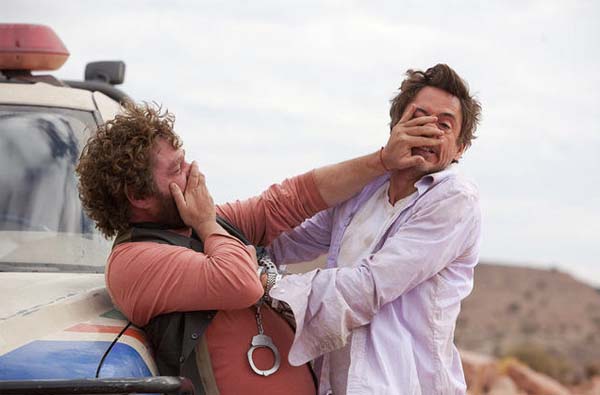
A comedy featuring a masturbating dog certainly hits the right stroke. Thankfully, there are capable hands behind Due Date, a gutsy and often side-splitting movie that further cements Todd Phillips’s rep as a comedy auteur far more interesting than Adam McKay and Nicholas Stoller. Like those two directors, Phillips often relies on stock situations – predominantly featuring men – to propel his unapologetically adolescent anarchy. Men in early middle age start a fraternity in Old School. Four men celebrating a bachelor party in Vegas can’t remember what happened the night before in The Hangover. And in Road Trip, The Hangover, and Due Date, it often takes a long drive to work out these lingering issues of rootlesness.

Despite all this late stage wandering, one detects a grown-up somewhere within Phillips. With his two most recent films, Phillips seems to be working the territory somewhere between Terry Zwigoff’s hilariously bleak assaults on the American climate and Seth MacFarlane’s free association. In The Hangover, Mike Tyson (playing Mike Tyson) factors into the plot. We see Carrot Top and Wayne Newton in the closing credits slideshow. In Due Date, the sitcom Two and a Half Men becomes a part of the story.* RZA turns up as a TSA man. .

Given such attention to the real and the imaginary, Slavoj Zizek could very well host a Lacanian kegger after taking in the Phillips oeuvre. (It’s worth pointing out that Phillips cut his teeth with the controversial documentary, Frat House, in which Phillips and co-director Andrew Gurland faced allegations that they paid fraternity members and staged several scenes.) But if Phillips’s films were only about this (and, more importantly, if his films weren’t flat out funny), they probably wouldn’t be worth considering. Any Family Guy viewer knows damn well that a promising installment often flounders when MacFalane’s writers rely too much on reference.

But Phillips has Zach Galifianakis’s Belushi-like presence to counterbalance all this. I enjoyed Galifianakis’s raucous mania in The Hangover, but felt that he had exhausted his possibilities in the HBO series, Bored to Death. It turns out that I was mistaken. Jonathan Ames’s lazy and ungenerous writing, which fails to view Galifianakis as anything more than a fat guy foil for Jason Schwartzman, was largely to blame. In Due Date, Galifianakis bustles as brightly as he did in The Hangover. The man has the talent to turn a physical gag on a plane with his belly into something that somehow makes us less aware of his physicality and more intrigued by his character. (Chris Farley was one of the few portly comic actors to do this as well: most notably in his famous Chippendale’s sketch with Patrick Swayze on Saturday Night Live.) As aspiring actor Ethan Tremblay, Galifianakis knows how to deliver his lines so that the audience is constantly recalibrating its estimation of Tremblay’s intelligence. (And in light of the film’s observations about underestimating people, and a nation that relies too much on swift judgment, this performance helps steer the film in the right direction.)

There’s a scene in which Galifianakis’s character is asked to perform material within a public restroom, so that he can prove to the disbelieving Downey that he’s a bona-fide actor. Tremblay delivers an unexpectedly poignant performance, using the edge of a bathroom stall as a wall. And this moment works on several interesting levels: (1) Todd Phillips is communicating to his audience that Galifianakis is more than just a funny fat man, (2) Ethan Tremblay is communicating to his snobbish white-collar traveling companion that he has some serious chops, (3) Ethan Tremblay is being asked to give it his all in a public restroom, quite possibly the most ignoble venue to prove himself (and the one you are least likely to see chronicled in the newspapers), and (4) the savvy symmetry between (1) and (2) gives Phillips some leverage to continue his exploration of the real and the fictional.

That all this is going on, while Phillips is presenting his populist audience with a genuine emotional moment, suggests very highly that the director who once gave us Starsky & Hutch has more moves than any half-literate moviegoer could have anticipated six years ago. How’s that for underestimation?

John Hughes’s Planes, Trains, and Automobiles serves as Due Date‘s obvious template. Yes, Phillips and his writers have taken the blue collar/white collar framework of Planes, updating the film to reflect a post-9/11 America. Yes, they have taken an actor known in part for his wackiness (here, Robert Downey, Jr., previously, Steve Martin) and made him grumpy and straitlaced. Yes, they’ve even taken whole lines from Hughes (“I have a winning personality”) and converted them over.

But Phillips has also paid close attention to what Hughes did so well visually in the motel room scenes: the blue colors for John Candy, the white colors for Steve Martin. In one notable moment from Planes, we see Martin grabbing a blue blanket covering Candy and putting it over his frame, a nice visual suggestion of class integration in a motel room bed (like the restroom moment in Due Date, also evocative of the dignity discovered within “low” environments).

Twenty-three years after Planes Trains, and Automobiles, the income disparity between the rich and the poor has worsened. So in Due Date, our white-collar protagonist now wears a purple shirt, as if his white collar had become somehow stained by blue-collar contact. (It is also interesting that, when Downey’s character breaks his arm, his cast is blue.) Meanwhile, the Tremblay character wears blue jeans (2010’s answer to Candy’s blue collar pajamas?) and a red shirt (post-Dubya assumption about red staters). Additionally, the pregnant white-collar wife stuck at home wears a pristine white sweater, bearing faint blue stripes. Is she imprisoned by class? Or is she besmirched by it? And what does it say that Downey’s character suspects a black man of having an affair with her? Might he be just as capable as Tremblay of rallying with an OBAMA = SOCIALIST sign? What does it say that Tremblay lets a “zebra baby” epithet slip from his lips that is entirely accidental? If our language and our actions remain under constant scrutiny, how then can we learn from our mistakes?

It’s a lesson that both sides can profit from. Because class lines are more ruthless than they were in 1987. In Due Date, the the yuppie is much meaner. At one point, Robert Downey’s architect character, Peter Highman, clips a kid in the stomach to get him to stop harassing him. Is this brutal solution a harbinger of fatherhood to come? (Or violent liberals to come?) Meanwhile, Ethan Tremblay commits far more destruction than John Candy’s Del Griffith. Forget Michael McKean’s cop. Phillips ups the stakes and brings in the border patrol. Minutes into the movie, Tremblay manages to get Highman on a no fly list. These skirmishes against authority make Due Date a more political film (think gleeful anarchism) than Planes, Trains, and Automobiles. But like Zwigoff’s movies, Due Date skillfully uses politically incorrect humor to defuse any hypothetical political agenda and thus make these considerations more palatable to the common man, which is very much where Due Date‘s heart is. And rightfully so. The reason why this movie works so well is because our fragmentation is more common than most of us are willing to accept.

* The use of Two and a Half Men is suspiciously well-timed, leading one to imagine an iniquitous PR flack, happily trading in misfortune for money, encouraging Charlie Sheen to engage in more headline-grabbing behavior right before the film’s release.

The Cooks Source Scandal: How a Magazine Profits on Theft

On the last Thursday of October, Jeff Berry sent an email to his friend, Monica Gaudio. Berry informed Gaudio that an article called “As American as Apple Pie — Isn’t!” had been published in Cooks Source Magazine.

“Is this you?” asked Berry. “Is this your article? And how did you get it published? Because I’m trying to break into any market that I can.”

Gaudio, who identified herself to me over the phone as “an amateur medieval enthusiast,” went home last Thursday and discovered that an article she had written on Gode Cookery, which contained a clear copyright notice at the bottom of the webpage, had been reprinted on Page 10 in Cooks Source‘s October 2010 issue.

“They used the website that I had,” said Gaudio. “I own the domain name. Jim Matterer owns most of the content. However, that article is mine.”

The first thing Gaudio did was call the number listed at the Cooks Source website. An hour or two later, Judith Griggs — editor of Cooks Source — called Gaudio back. Gaudio missed the call. Griggs told Gaudio to contact her by email. This was the best way to get in touch with her. Gaudio emailed Griggs, pointing out that Griggs had published her article.

“Well, it was on the Internet,” replied Griggs by email. “Didn’t you want it published?”

Gaudio wondered how to respond to the email. Initially, she thought that Griggs was a new copy editor who was perhaps a bit nervous on the job. But she began to wonder if Griggs was something more sinister. Perhaps a database collecting her private information. When it became apparent that Griggs was actually running the show, Gaudio grew dismayed.

“I couldn’t believe I was explaining copyright to a magazine editor,” said Gaudio. “This is not fair use.”

In that first email, Griggs asked Gaudio what she wanted to do about this. Gaudio replied that she wanted three things: an apology on Facebook, an apology in the magazine, and a $130 donation (ten cents a word for the 1,300 words that Griggs had published without Gaudio’s permission) to the Columbia School of Journalism. She decided upon CSJ because the famed New York school was considered to be an excellent one for journalism and because it was easy to make an online donation.

Griggs replied by email to Gaudio’s request last Thursday, pointing out that the Cooks Source staff was very busy and was trying to publish an issue.

Gaudio sent additional emails to Griggs. She figured Griggs and her staff were leaving for the Halloween weekend.

Then, on Election Day, Gaudio received Griggs’s response. Gaudio’s Livejournal entry, chronicling her story, kickstarted a massive Internet awareness campaign that, as of Thursday afternoon, had counted writers Neil Gaiman and John Scalzi among the supporters. When I spoke with Gaudio early Thursday afternoon, she told me that she was afraid to look at her email.

My phone calls to Judith Griggs were not returned. But in Griggs’s email to Gaudio, partially excerpted on Gaudio’s Livejournal, Griggs suggested that Gaudio should compensate her for the time she put into rewrites.

“It was ‘my bad’ indeed,” wrote Griggs in her email, “and, as the magazine is put together in long sessions, tired eyes and minds somethings forget to do these things.” Griggs also insisted that Gaudio’s article was “in bad need of editing.”

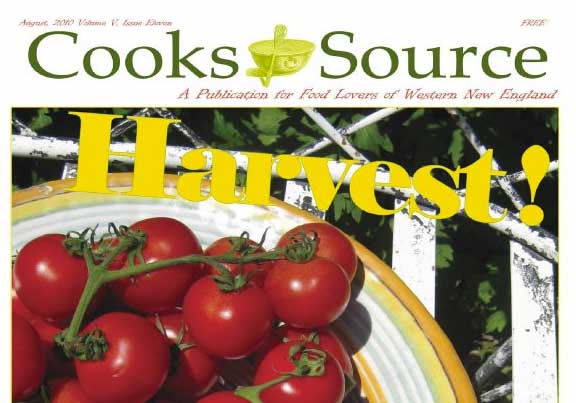
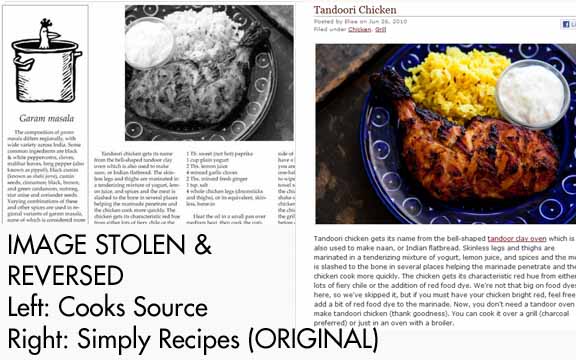
But a Thursday investigation revealed that not only is Cooks Source in the practice of stealing articles and publishing material without permission, but the magazine often pilfers the images which accompany the content. Such was the case with two entries stolen from the website, Simply Recipes. In Cooks Source‘s July 2010 issue, the Simply Recipes entry on tandoori chicken was taken wholesale from the website, with the photo merely flipped over in print. (On the same page, a sidebar item on garam masala recycles text from the Wikipedia entry.)

I spoke with one publisher by telephone, who asked to remain unnamed for this piece, about a book excerpt that had run in a recent Cooks Source issue. The publisher later informed me that it hadn’t worked with Cooks Source before and that the magazine had never sought permission to use the excerpt.

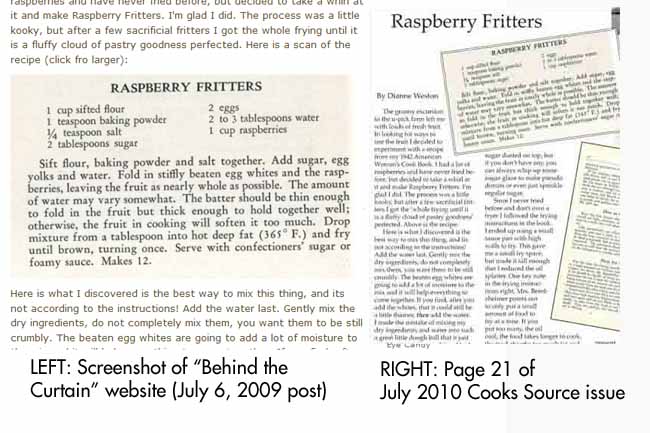
On July 6, 2009, the website Behind The Curtain published an essay on a raspberry fritters recipe that she found in a 1942 cookbook. Not only did Cooks Source print the majority of the essay on Page 21 of its July 2010 issue, but three photos taken by Kathy Zadrozny had also been reproduced. This occurred despite the fact that Zadrozny’s About page contained an explicit copyright notice in relation to her images.

“I haven’t seen any reproduction of my articles anywhere nor have I heard of Cooks Source,” said Zadrozny by email.

The July 2010 issue also reproduced at least seven recipes from The Food Network. Shawn White of The Food Network’s Licensing Department did not return my calls, but I alerted him to the recipes in my voicemails to him. The Cooks Source issue contained the following Food Network recipes: Chicken Chopped Mediterranean Salad with Feta Vinaigrette (page 10), Blackberry Lemonade (page 10), Mixed Berry Soup with Gelato (renamed Mixed Berry Soup) (page 11), Fresh Mozzarella BLT with Pesto (page 11), the Best Burger Ever (reprinted as “Alton Brown’s Best Burger”) (pages 12-13), Napa Valley Basil-Smoked Burgers (page 13), and the Feta Sun-Dried Tomato Stuffed Prosciutto Burger (republished as “Jairs Burger”) (page 13).

On Thursday afternoon, I was informed by nutrition consultant Dana Angelo White that the legal department was looking into a Cooks Source article on page 24 taken from two of White’s pieces written for The Food Network’s Healthy Eats blog: “What Does ‘Natural’ Mean?” and “9 ‘Healthy’ Foods to Skip.”

On page 12 of the July issue, Cooks Source also reproduced this hamburger history article. The original website has a clear copyright notice from Linda Stradley at the top, but Stradley hadn’t returned my email to confirm that the article had been used without her permission.

For every reproduction that I found, I made efforts to contact the original copyright holder. And the above examples demonstrate unequivocally that nearly the entirety of Cooks Source‘s material has been taken from other sources and that, in at least four instances, Cooks Source did not obtain the necessary permission to reproduce the material. The onus is now on Cooks Source to produce the appropriate paperwork to demonstrate that it secured the release. But since Judith Griggs is uninterested in returning telephone calls, since she has demonstrated a lack of concern for copyright, and not a single writer, publisher, or organization has come forward with proof positive that Griggs has played by the rules, one can conclude from the presented evidence that Cooks Source is a magazine that profits on theft.

While big companies like Scripps (which owns The Food Network) have generous coffers with which to resolve legal matters, enthusiastic amateurs like Monica Gaudio don’t have that luxury.

“My understanding — and again I am a lay person — is that a copyright has to be litigated in federal court,” said Gaudio. “Federal court costs a lot of money. Hundreds, if not thousands of dollars. So will I litigate? Possibly. It’s so small.”

Gaudio told me that it’s “unfair” for her to spend so much money to defend her copyrighted material. Yet despite all the Internet attention and Griggs’s recalcitrance, she hasn’t adjusted her demands. She simply wants Cooks Source to make two apologies (in print and on Facebook) and donate the $130 to the Columbia School of Journalism. She’s played by the rules. She’s filled out the form on Facebook. All this would just be over if Cooks Source would own up and apologize. But according to Cooks Source‘s message machine, last contacted at 4:00 PM on Thursday, the staff is just too busy to talk.

11/4/10 LATE PM UPDATE: First of all, thanks to Neil Gaiman and many others for the overwhelming traffic that this story has received (and with great apologies for the bumpy server). In the interest of tying up some loose ends, I’ve heard back from Elise Bauer, of Simply Recipes. She had this to say by email:

For the record, Cooks Source has used my copyright protected content without my permission. The copyright notice has been on every page of my site for 7 years.

I’m astonished by the flagrant plagiarism and copyright infringement. I’m also dumbfounded by the Cooks Source publisher’s response to complaints that have been made about the use of other bloggers works without permission. This person honestly believes that everything on the Internet is public domain.

So that gives us five definitive cases instead of four.

I have also heard back from the head of a publishing imprint who was very interested in speaking with me on the phone. I’m going to touch base with this individual tomorrow morning and report back any additional news pertinent to this story, if warranted.

11/5/10 LATE PM UPDATE: In the comments, Linda Stradley left this message:

I’ve just read your article, The Cooks Source Scandal: How a Magazine Profits on Theft, and was very surprised at reading my name.

I also was never contacted to ask permission to use my copyrighted article on the “Hamburgers – History and Legends of Hamburgers.”

That brings the tally up to six.

Jon Stewart and the New Political Privilege

“Think for yourselves, and let others enjoy the privilege to do so, too. It is the sole consolation of weak minds in this short and transitory life of ours.” — Voltaire, “Toleration”

I did not attend Saturday’s rally because, like many Americans, I could not afford to. I did not have the cash for the $60 Boltbus round trip, the $100 or so to spring for a night in a motel room, and the $40 (very conservative estimate) for food and water. $200.

Now imagine the tab if you have a kid. Factor in childcare and you’re easily getting into the $400 range if you were a parent hoping to participate in a rally that was being compared in some corners to Martin Luther King. Sure, you could blow a few hundred bucks to make a purported difference or you could put that money into your kid’s Halloween costume. Or maybe that’s a few weeks of much needed groceries. Or maybe that’s what you need at the end of the month to make mortgage or rent.

The upshot is that, in this economy, $200 is a lot of money for many people. If you are among the 10% of Americans who remain unemployed, the ones who are being told that economic recovery is just around the corner, then those two Ben Franklins are worth a good deal more. And these are the people we’re not talking about. These are the people we can’t talk about. Because unless it’s a message from the Rent is Too Damn High Party, talking about poverty and class division isn’t nearly as entertaining as an episode of Jersey Shore.

If you could afford to go to Washington last weekend, you practiced your new political privilege. This privilege was reflected in the mostly white demographic that turned up in Washington. It was reflected in Jon Stewart and Stephen Colbert’s performance of “The Greatest Strongest Country in the World”:

Stewart: They don’t care about the gays
Colbert: That’s mostly true
Stewart: They’re terrified of Muslims!
Colbert: Well, they scare you too!
Stewart: But I would never talk about it / Folks would get annoyed
Colbert: You’re a coward
Stewart: Yes, but I’m still employed (going into a falsetto yodel)

The satirical song’s message, a sentiment also reflected in Stewart’s closing speech, is that there is no longer any room for hyperbole, extremist rhetoric, and “insanity.” If you’re lucky enough to remain gainfully employed, maintaining a Spock-like commitment to cold “logic” while others face the savage brunt of rising costs and diminishing prospects, keeping your job is more important than speaking your mind or commiserating with the hard realities of a family who has to skip a few hot meals. The message is this: It could have been you, but, hey, you’re still employed. Don’t take a chance. People might get annoyed.

And how exactly does this represent togetherness? Togetherness doesn’t mean shunning people, but listening to the viewpoints you despise. And while you may be bathing in a Stewart-Colbert afterglow, the “insane” people will be there in the voting booths on Tuesday. There will be hard and possibly irreversible developments because a bright red cluster was just told that its feelings didn’t matter. That the manner, however inappropriate, in which people responded to justifiable concerns about unemployment and foreclosure wasn’t valid. Yes, they amplified their messages until their posters turned into increasingly stranger exemplars for Godwin’s Law. But if the corporations had given them jobs as Wall Street enjoyed its best September since 1939 or someone had listed to justifiable concerns about being forced to pay exorbitant costs thanks to one of the biggest giveaways to private industry in American history, would we even have Christine O’Donnell as a candidate? Would we even be diminishing political discourse by considering the gentlemanly angles on muff diving?

While keeping atavistic sentiments out of evenhanded analysis is a worthwhile goal, there are several problems with Stewart’s overgeneralized view of the way the media and the political conversation operates — hardly limited to what David Carr has courageously and reasonably offered. As Glenn Greenwald wrote in September, where’s the space for someone engaged in genuinely independent and non-ideological inquiry? The fact that the audience applauded strongest when Stewart yodeled about keeping his job suggests that public discourse is not necessarily about the politics, but about keeping one’s privileged position. The new privilege is, irrespective of Rick Sanchez, being able to hold onto your job and being able to spend money to go to a rally. What of those who aren’t part of this illusory middle class? The ones who were left behind like the poor saps missing the rally, stuck in traffic on the “free” Huffington Post buses? Was Saturday, as Mark Ames suggested, more of “an anti-rally, a kind of mass concession speech without the speech–some kind of sick funeral party for Liberalism, in which Liberals are led, at last, by a clown?”

I don’t want to pin the blame on the 215,000 people who attended the rally, particularly since many conservatives are attempting to undermine this number with dubious metrics. These goodhearted people attended this exercise in good faith, seeking confirmation that there was a safer way to express their political commitment. As someone who witnessed firsthand in San Francisco the manner in which suburban people were squeezed out of the Iraq opposition rallies on February 15, 2003 (the largest global anti-war rally in history) after the protest turned bad, discouraged by the loud and loutish voices who caused their swift surrender, it was a great relief to witness a new political unity.

But if the cost of this unity involves slicing the edges off the political spectrum, if it involves ignoring the obvious facts that Goldman Sachs created an orphan month to puff up its earnings and good people had their lives changed by subprime loans and the derivatives casino rewarded the rich at the expense of the poor, then there is something seriously wrong with our priorities. It involves embracing a myth that is just as dangerous as the fabricated Reagan prosperity narrative promulgated by the Tea Party crowd.

The people who attended this rally may very well be without this Wall Street greed. But the ones who have caused our national problems have been anything but civil. The Glenn Becks and the Keith Olbermanns who fulminate hysteria are not, it is important to be reminded, selling our grandchildren into slavery.

In his speech, Stewart talked about the “selfish jerk who zips up the shoulder and cuts in at the last minute. But that individual is rare and he is scorned, and he is not hired as an analyst.” Not at all. These selfish jerks are hired in droves on Wall Street. Reason won’t deter the very insane avarice and the unremitting selfishness of the economic elite. You can’t always bring a book and a calm demeanor to a knife fight.

In fact, few have remarked upon the selfish qualities contained within Stewart’s speech. The first sentence: “I can’t control what people think this was.” Near the end: “If you want to know why I’m here and what I want from you I can only assure you this: you have already given it to me. Your presence here was what I wanted.” You will not find the verbs “want” or “control” in Martin Luther King’s “I Have a Dream” speech. In Obama’s much longer and more nuanced “A More Perfect Union” speech, you will find our future President using the phrase “we want” (not “I want”) numerous times, but never “control.” King and Obama brought people together during these moments not because they dictated to their audiences what they wanted (and thus, as Stewart has done, dictated how they should respond), but because they invited their listeners to become part of their journey.

The difference is that Stewart can rescue himself from any criticisms because he can always play the “I’m a comedian” card. Yet it isn’t too much of a stretch to see that Stewart’s “I want” has now eclipsed Kennedy’s “Ask not what your country can do for you, ask what you can do for your country.” Stewart suggested to his audience that “because we know instinctively as a people that if we are to get through this darkness and back into the light we have to work together,” but he has, rather brilliantly, sandwiched this facile notion of working together within the troubling crust of “I can’t control” and “I want.” And “I want” is a more dangerous beast than the fleeting optimism contained within “Yes we can.”

“I want” is the mantra of entitlement. “I can’t control” is the sentiment of someone whose view of the “opposition” is relegated to a quick glimpse of someone in a car, where judgments as superficial as Beck and Olbermann reduce a complex individual to a neat demographic label. The mom with two kids who can’t think about anything else. The Oprah lover. What about the people who don’t have the money for gas?

Stewart is on firmer ground when he suggests that racists and Stalinists are “titles that must be earned” and that labels should be granted to those “who have put forth the exhausting effort it takes to hate.” But what about more subtle disgraces? Systemic issues? By these standards, the cab driver who does not stop for a black man, the gay couple that is not permitted the same benefits as a married couple, or the ongoing wage gap between men and women should be given less amplification.

As John Scalzi recently noted in a list, you don’t have to worry about any of this. You can attend a rally and feel good about yourself. What you may not realize is that clowns much bigger than Stewart and Colbert — the ones who took your tax dollars during the bailouts and the ones who speculate on commodities and raise your daily prices — are laughing at you.