
On Her Wedding Day, My Fantasies Come to an End

The great love of my life marries today, the woman who bobbed her head up and down on my large and throbbing cock anytime I commanded her (both in reality and in my fantasies), and I am not the groom. I, Andrew Cohen, have at long last seen my egotism, my narcissism, and my rampaging douchery, vaster than the greatest expanse of human possibilities, crushed in a single go. Please mourn for me, for I may not fully recover. The sweetness of my life has demonstrated a capacity to make decisions, something I thought exterminated from the female species. I had thought the uppity bitch best confined to popping out babies from her uterus (my children, not hers!), cooking multicourse meals in the kitchen, massaging my feet when I was tired, and cleaning up my castabout black socks in the bedroom. I had thought that such variables were the basis of a lifelong relationship. But I, Andrew Cohen, finally now understand that my casual misogyny, even sweet casual misogyny, is not enough. Sometimes, as the romance novelists know, living in the wrong century is everything.

But today is not a day for remorse. It is not a day for lost causes. For I might still find some throwback minx to cater to my every whim. Today is a day for celebration! While my great love is getting hitched, this is merely one minor tilt in the Andrew Cohen Masterplan. The woman I once promised to keep oppressed is oppressed. For she has once again encountered the institution of marriage! She tells me she is marrying a wonderful man, a man more wonderful than me. A man who has actually read Gloria Steinem and bell hooks. A man who recognizes the equality of gender. I do not understand such strange concepts. For I only exist within my own universe, which is filled with nothing more than little versions of me jumping up and down screaming my name. It’s a bit like a Beatles concert, except the four bandmates are Andrew Cohen (vocals, guitar), Andrew Cohen (vocals, bass), Andrew Cohen (the quiet one, guitar), and Andrew Cohen (the drummer). Every one who has paid a ticket to this show is named Andrew Cohen. All that’s left for me to do is consider a potential universe (is there one?) in which there is someone not named Andrew Cohen. I presume that my love, my true love, the woman who has filed a restraining order against me, the woman who told me that sixteen voicemails a day was too much and twenty text messages every hour was a tad excessive, is happy. I must wish her well and find another old hag — perhaps one who dares to question my specialness — to suck my cock without question.

The present I humbly send my sweetheart today is this column: this public note, which comes with a photocopy of my penis, which came courtesy of the AOL photocopy machine, along with a series of measurements from professional surveyors (upheld by several affidavits) indicating that my penis, much like my ego, extends well beyond nine inches. No one ought to have dealt with a cock that was bigger than nine inches for so long. But my love, my glorious ex-wife, certainly did. I demonstrated my great affection by performing one-man bukkake upon her fresh lily white face whenever I wanted to. And I hope that my affections, rendered here by the magic of the keyboard, will elicit the same response.

I want to thank her, mostly, from knocking upon the doors of my neighborhood and informing the kind men and women — but mostly the men — that I was not, in fact, a creepy sex offender. When we met, back in the spring of 2005, I was nearly 40 and my days revolved around masturbating to photographs of myself. I had lost faith in relationships. Other people had grown noxious and smelly. I had given up on love. She arrived, with a sympathetic heart, and showed me what was possible. Eleven years younger than me, I figured that she would be young enough to fall for my commanding tone. Young enough to forget that Naomi Wolf had ever happened. Young enough to be fooled into thinking that Katie Roiphe and Caitlin Flanagan represented the way women felt and thought.

It wasn’t too long after we met that I began imagining what our wedding day would be like. She would have her feet bound together like some maltreated Chinese courtesan. I nonetheless pictured her not taking it too seriously, for surely she would see the situation as I did — through the singular prism of my almighty hubris. I pictured me slipping her a mickey if she got, pardon the pun, cold feet. There, at the altar, she would capitulate to my male empowerment and say “Yes” even within the dewy-eyed emptiness of unconsciousness. My sweetest love would be my own personal Girl Gone Wild.

Well, dear reader, I was wrong. She has married some other man. So at last my wedding toast today is backhanded yet sincere: I wish the deepest and most profound love of my life. I will confess that there is little else to my life than creepy Politics Daily columns and casual misogyny. But it is my happiness to give. Even if, as some of our friends have opined, she is much happier than I am. Even if I have not quite understood why she didn’t invite me to her wedding.

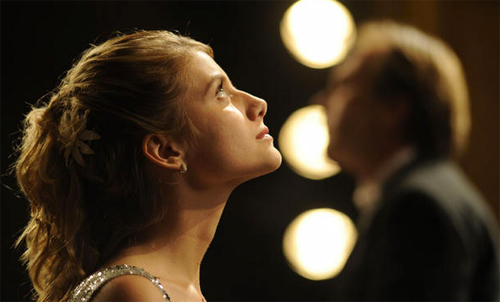
The Bat Segundo Show: Sally Potter

Sally Potter appeared on The Bat Segundo Show #347. Ms. Potter is the writer and director of the 1992 film Orlando, adapted from the Virginia Woolf novel, which opens in re-release on July 23, 2010.

Condition of Mr. Segundo: Hoping to live forever or die trying.

Guest: Sally Potter

Subjects Discussed: [List forthcoming]

EXCERPT FROM SHOW:

Correspondent: One interesting aspect about Orlando, from my standpoint, is that it’s almost a textual collage. You don’t really use a lot of the prose that’s in Virginia Woolf’s book. And if you do use it, you often modify one word or two words. There’s Spenser’s The Faerie Queene. There’s Joseph Addison’s The Tattler. There’s Shelley’s “I Arise From Dreams of Thee.” If you’re a literate person, there’s a smorgasbord of collage and possibilities. And I’m curious why you made this particular decision. Was the idea here to reinforce some of the sexism of the literary world? That Virginia Woolf’s true prose would not be represented in the film version of her work? What happened here?

Potter: Well, I think the essence of her prose is the skeleton of the film. I tried to make a distillation of what she’d done to further distill her own project of distillation. She writes in her diaries about wanting to exteriorize consciousness, writing in images rather than language. And where usually she was working with a kind of inner monologue — the stream-of-consciousness project through the word — in this case, she was working through the description of images that were like watching the inner mind unfold, but not as one individual’s mind. A kind of collective mind. Now she was also working with a tapestry of references. So the book is littered with one reference after another. When you go back to her diaries, and look at her essays — which I did — and go back to her sources, you see that she was doing a kind of postmodern collage herself.

Correspondent: Yes.

Potter: So all I tried to do was stay true to that principle, but make it work in cinematic terms. Anything else would have been a disservice to her as a writer.

Correspondent: But in terms of using the other — mostly; in fact, all male — writers, instead of specific quotes — with the exception of, for example, the trial and the poetry scene with Greene, I’m curious how you made that selective process. Did some reference in the book cause you to grab for the Norton Anthology? What happened there? And also, I was curious in terms of changing one specific word from a passage. Did you encourage the actors to paraphrase from the script? Or did you actually have the…

Potter: Oh no no.

Correspondent: Okay.

Potter: No. But I did so many drafts. My first draft — in fact, when I took it to my script editor at Faber & Faber. He picked it up, weighed it, and said, “Go and take out a hundred pages.” It was really long. The first adaptation. So it was clear that it had to be cut. And some words work spoken. And some words work written. And so through the very long development process — I mean, multiple redrafts and redrafts and redrafts. And Tilda [Swinton] reading aloud to me. And so on. First of all, I learned about the importance of things actually working, rather than working in theory, as you intended them, and to try to be very open to listening and observing what worked, and make things fit so that they had, in a sense, a natural feeling for voice and body of that particular actor who’s manifesting the idea. So that entails changing things from time to time. But, for example, Nick Greene’s satiric poem about Orlando and Orlando’s bad poetry are not in the book. I had to write them.

Correspondent: I figured as much.

Potter: From clues. So I had to fill in, in a way, certain gaps that, had she written them on the page, they would have had a different status. And also, from her, she does a sort of sketch of 18th century authors. And you know who she’s referring to. And again, I had to fill them with actual quotations. So my guiding principle always was: Stay true to the spirit and the intention, but not to the letter of the book.

The Bat Segundo Show #347: Sally Potter (Download MP3)

This text will be replaced

Review: The Concert (2009)

Here are some of the reasons why The Concert does not work:

1. Eran Kolirin’s The Band’s Visit — a highly charming movie in which an Egyptian police band accidentally goes to the wrong town and learns quite a bit about existing along the way — hangs in recent memory. There is little doubt in my mind that The Concert was acquired by The Weinstein Company or set into motion by its motley group of multinational financiers with this association. But its premise — a ragtag Russian group of musicians impersonates the Bolshoi Orchestra to play in Paris — is problematic.

2. The premise is problematic because it asks us to suspend our disbelief again, and again, and again. This causes us to resist the movie. We’re expected to believe that, because one fax has been intercepted, a fax that wouldn’t be followed up with an email, a phone call, or any other attempt to verify provenance, the ersatz Bolshoi commanded by our hero would happen. We’re expected to believe that the Théâtre du Châtelet, a long-standing house that premiered Stravinsky’s Petrouchka and is home to the Kirov Opera, would throw around a good deal of money without, say, consulting the Bolshoi’s website to ensure that these people are who they say they are. We’re expected to believe that these impostors can get away with their scheme when a Russian TV crew is chronicling them, and it is quite likely that friends and loved ones of the true Bolshoi would proffer hysteria and consternation when seeing the con unfold. We’re expected to believe that an entire symphony, nearly all of them out of practice, will somehow get its act together. And we’re expected to believe that, in a post-9/11 age, not a single fabricated passport, nearly all obtained at the eleventh hour, would be scrutinized by a single authority. And obviously, since a world-class orchestra is attending press, there are likely to be journalists or bloggers who are going to be checking into the Bolshoi performers. (Then again, what if nobody cared about the Bolshoi Orchestra in Paris? What if the reason why this phony orchestra passed for the real thing was because classical music had become less valued? Even in a metropolis priding itself on culture! Suddenly, there’s a more legitimate tension here over whether or not the impostors will be discovered or even appreciated!)

3. In short, scenarist and director Radu Mihaileanu hasn’t thought these basic questions through. Strangely, Matthew Robbins, the screenwriter who wrote such campy movies as Corvette Summer, Warning Sign, and The Legend of Billie Jean, is credited as one of the collaborators. “Collaborator,” in this case, is rightly associated with the connotation I derived from Isser Woloch’s Napoleon and his Collaborators: The Making of a Dictatorship. What we have here is an illogical mess that will frustrate any thinking audience member. Never mind that Aleksei Guskow is actually quite good as the disgraced former conductor of the Bolshoi Orchestra toiling decades later in the Bolshoi as a janitor and who sees the ruse as a way of restoring his reputation. The points I’ve raised in the previous paragraph work against story logic. Furthermore, the secret daughter plot introduced deep in the film’s second act disastrously detracts from the redemption narrative.

4. Look, I get that the movie wants to be the 21st century answer to Ernst Lubitsch through a Russian prism. (The Concert immediately reminded me of the much superior Ninotchka, and I grew antsier as the film progressed.) But Lubitsch (and Billy Wilder, one of Ninotchka‘s co-writers) understood that when you’re creating fantastical elegance of a somewhat implausible ilk, it needs to be buttressed by such ideas as a champagne pop being confused with a gunshot or funny lines like “The last mass trials were a great success. There are going to be fewer but better Russians.” And while there’s a certain amusement in seeing the fates of several symphony members (a few elderly musicians are now providing the orgasmic soundtrack of a porn movie), as well as a gypsy musician prove himself before edified musicians, The Concert doesn’t have what it takes to invite us into its deception. Furthermore, in explaining the plot, it relies upon an obnoxious strobe effect for belabored flashbacks. And in these flashbacks, the film hasn’t even bothered to make its fifty-year-old composer look or feel like a man in his early twenties.

5. I forgot to mention one of the film’s subplots involving a man attempting to revitalize the Communist Party with a speech delivered on the night of the Bolshoi performance. This story angle is neither funny nor interesting. A long-winded speech, check. A reduced audience, check. Flags and uniforms rescued from the mothballs, check. What’s lost within all these cliches is the true cost of attempting to recapture a past identity. The film’s ultimate failure comes with its diffidence to confront genuine human emotions, save through a work camp flashback that comes near the end, which feels appended by some slick marketing type wanting to ensure that “all the elements are in place” for mass consumption. A film coming from France and Russia shouldn’t feel like some thoughtless bibelot churned from a Hollywood machine.

The Bat Segundo Show: Jennifer Weiner III

Jennifer Weiner appeared on The Bat Segundo Show #346. She is most recently the author of Fly Away Home. Ms. Weiner previously appeared on The Bat Segundo Show #198 and The Bat Segundo Show #14.

Condition of Mr. Segundo: Hoping to be frightened by The Motherland sometime soon.

Author: Jennifer Weiner

Subjects Discussed: [List forthcoming]

EXCERPT FROM SHOW:

Correspondent: It seems to me that you are really gravitating more towards this extremely dark expanse of human behavior. At least from my vantage point. And it seems that you really want to push further in this direction. And yet, to some degree, you almost stop short of really pushing yourself fully into something so dark. And I know you’ve got it in you. So I’m wondering: why ride the comic tone? Out of obligation to your readers? Or what here?

Weiner: Well, I think, for me, it always feels natural to have both. To have the darkness and the comedy. That’s just how I am as a person. And I think that my own family history has made me that way. There’s been horrible things that have happened, but me and my sister and my brothers always wind up laughing about it. Because what else can you do? But it’s interesting. That darkness. Because it’s a tough tension to maintain. And I don’t want… (pause) See, here’s the thing. I don’t think writers choose the books they’re trying to write. I don’t think writers choose the tone they’re going to take. I think that it’s a blood type. Like it’s what you’re born with. Stephen King gave the example. He and Louis L’Amour could be sitting at a pond. And Louis L’Amour would come up with this Western about water rights in a town that was having a drought, and what would happen? And Stephen King would write about something that comes slithering onto the banks, and first takes the dogs, and then takes the cattle, and then takes the kids. It’s just the way you’re wired. And I think that I’m wired, for good or for ill. I mean, there was a lot of sad stuff in Good in Bed too.

Correspondent: That’s true. But we’re talking about rape.

Weiner: Rape.

Correspondent: We’re talking about neglected children.

Weiner: Yes.

Correspondent: And during those sections in both of these last two books, it gets really, really serious.

Weiner: Right.

Correspondent: And then we go back to the laughs. But I’m wondering why not go ahead and spread this further? It’s not to say that you can’t explore light and dark. You can do a double plot thing. Like Crimes and Misdemeanors or something. I don’t know.

Weiner: (laughs) And then when you turn the book over…

Correspondent: (laughs) Yes.

Weiner: …they go shoe shopping!

Correspondent: Yeah, exactly.

Weiner: Well, who’s doing that well? Zoe Heller obviously.

Correspondent: Yes.

Weiner: Who else? Who do you like? Because Zoe Heller’s funny too.

Correspondent: I’ll bring up Richard Russo. Richard Russo does that very well too. And in fact, I….

Weiner: Mmmmm. My mother loves him.

Correspondent: I’m trying to go ahead — you and Russo are actually on the same team here. You know, that whole description of the development of the grocery store?

Weiner: Yes. Yes.

Correspondent: I could find that in a Richard Russo book, as I could in a Jennifer Weiner book. He writes about this kind of stuff too.

Weiner: Right.

Correspondent: You write about this too. And I’m telling you. What do we do to get some kind of diplomacy here?

Weiner: But I…

Correspondent: It’s not Russo’s fault that your mother was blabbing about him!

Weiner: Oh my god.

Correspondent: It wasn’t his fault.

Weiner: Okay, let me set the scene for you. The year is 2001.

Correspondent: (laughs)

Weiner: And my first book is out. And I’m in a bookstore with my mother. And I’m signing stock, as you do. And my mother, who is very friendly and chatty. This woman comes up to her and says, “Oh, I need a great book for the summer. Have you read anything?” And my mother says, “I just read the best book. It was funny and it was sad. And the characters felt so real.” And I’m like, “Wait for it. Wait for it.” And my mom’s like, “It’s called Empire Falls by Richard Russo.” And I’m like, “Mom!” Because do you think that Richard Russo’s mom is up in Maine pimping my books?

Correspondent: But your mother was probably pimping your book too!

Weiner: Uh uh.

Correspondent: No?

Weiner: Mmm mmm.

Correspondent: Not at all?

Weiner: Well, maybe a little bit.

Correspondent: Oh okay. Well, there you go.

Weiner: But I think the woman asked what she read that she loved. And I think that [my mother] read Good in Bed in galley months ago. But, no, I love Richard Russo. But I don’t know.

Correspondent: So wait. You have read him.

Weiner: Of course!

Correspondent: Okay. Okay. So this is…

Weiner: I’m not a philistine here!

Correspondent: (laughs) So what’s the issue here? It can’t just be your mom. There’s something else going on here.

Weiner: I like Richard Russo. Have I talked smack about him?

Correspondent: Yeah. You’ve been suggesting, “Oh. Richard Russo. I don’t talk about him because of this whole mother thing.”

Weiner: It’s a joke! It’s a joke!

Correspondent: Okay.

Weiner: I like him. I don’t like Jonathan Franzen.

Correspondent: Yeah.

Weiner: But I don’t think Jonathan Franzen likes anybody. So I think it’s all good. Like I don’t think he wants me — I don’t know? Does he want to be liked? Did you read the essay that his girlfriend wrote?

Correspondent: Yes.

Weiner: Where was it? The Paris Review?

Correspondent: Kathy Chetkovich. It was in Granta. [EDITORIAL NOTE: Issue 82, to be precise. Now behind a paywall, but an excerpt appeared in The Observer. See above link.]

Weiner: Granta.

Correspondent: Yes. Exactly.

Weiner: Weird guy. About birding.

Correspondent: Yeah, I know. But actually, since we’re talking about the literary world…

Weiner: Yes!

Correspondent: I should also bring this up. Why give so much credit to The New York Times Book Review? I mean, this whole thing with the full-page advertisement.

Weiner: I know.

Correspondent: And I read your Twitter feed. And I know that you’re there on a Friday afternoon. At 5:00. When they put up the new articles. And you are looking through those articles.

Weiner: Right.

Correspondent: Why? Why give these folks credence?

Weiner: Well, you know what it is? They’re kind of the only game left in town. The Philadelphia Inquirer, where I used to work, once had a free-standing books section. And there used to be — I think the Hartford Courant, where I grew up, had a books section once upon a time. But honest to god, the truth is that my dad read The New Yorker and read The New York Times Book Review, and would get all of his reading suggestions from those two places. So if you weren’t in there, you didn’t really matter. And I think that I internalized that to a very great extent. But honestly, I think that the die was cast when I went with Atria instead of Simon & Schuster. Like way back in the day. When I was choosing who was going to publish my first book. And it’s like, well, Atria is much more commercial. And I knew that I loved my editor. I love my editor still. I love my publisher. They got the book. Like on a really visceral level. They were going to a great job of promoting it. Do a great job with me. But I wasn’t going to get reviewed by the Times. But then again, if you call your book Good in Bed, are you ever going to get reviewed by the Times? I don’t think so.

Correspondent: Unless you name it The Surrender.

The Bat Segundo Show #346: Jennifer Weiner III (Download MP3)

This text will be replaced

(Image: pplflickr)

The Bat Segundo Show: Dan Chaon

Dan Chaon appeared on The Bat Segundo Show #345. Mr. Chaon is most recently the author of Await Your Reply.

[PROGRAM NOTES: This conversation, conducted in May, was almost lost when a Seagate drive bit the dust. Considerable gratitude to data recovery specialist Wayman Ng, who managed to resuscitate this conversation from the grave. My apologies also to the very kind and patient Dan Chaon for the unanticipated two month delay, which came after an aborted attempt to talk with the man during the book’s hardcover release. Additionally, during a moment in which the conversation shifts to Lost, narrative momentum, and concision, the Correspondent misidentifies Charles Beaumont’s “The Howling Man” as “The Wolf Man.” The short story, not to be confused with the Twilight Zone adaptation, can be found in Beaumont’s Night Ride and Other Journeys, along with several collections and is well worth reading (along with Dan’s books, for that matter).]

Condition of Mr. Segundo: Tired of waiting on dying hard drives.

Author: Dan Chaon

Subjects Discussed: [List forthcoming]

EXCERPT FROM SHOW:

Correspondent: I have to remark upon the frequency of auto accidents in your work. In Await Your Reply, Lucy Lattimore’s parents die in an automobile accident. There’s the car accident excuse offered by Jonah in You Remind Me of Me. The car accident identity similarly appropriated by George Orson. And all this reminded me of Charlotte Haze’s death in Lolita. Similarly, in You Remind Me of Me, Jonah kidnaps Loomis in a car. And this reminds me very much of Humbert Humbert taking away Lolita. And, of course, the epigraph for the second part in Await Your Reply is from The Real Life of Sebastian Knight: “Whatever his secret was, I have learnt one secret too, and namely: that the soul is a manner of being – not a constant state…” So I must ask you, first and foremost, about the Nabokov influence in these books and whether this preoccupation with cars is sort of a Lolita thing. I’m curious.

Chaon: The car thing is not a Lolita thing. It’s just that I spend a lot of time in cars. And when I was in my twenties, a psychic told me that I would die in a car accident.

Correspondent: (laughs) Really?

Chaon: I haven’t yet. But I have a fear of car accidents. Partially because I do a lot of driving, but I’m not known as the best driver. I’m a spacey driver. My sister has me listed as one of her top five worst drivers that she’s ever driven with. I’m only at five though.

Correspondent: This psychic premonition — were there any other premonitions? Did they have any effect on your stature as a writer? “Go write, young man?”

Chaon: No. It was one of those things where it was like this weird friend of my wife who fancied herself a medium type person and was always making pronouncements and things like that. But it did stick with me. So I guess car accidents are one of my fears, along with being in a house that’s burning down. Which is also something that I tend to write about a lot. Burning houses. The Nabokov stuff though — I mean, I do feel like it’s a big influence on me. I mean, both Lolita and Sebastian Knight. Despair as well. Which is also about identity theft. I don’t know if you’ve — have you read Despair?

Correspondent: I haven’t.

Chaon: It’s about someone who switches identities with a hobo. So, yeah, I definitely think about the big in quite a bit. In terms of people that I’ve read over and over, he’s one of the main ones.

Correspondent: Was Despair one of the guides for this particular book? Or the plot?

Chaon: I guess I had it in mind to some extent. I mean, I don’t feel like I have the same kind of intellectual or verbal chops that Nabokov does, of course. But I certainly admire his work and I think about him a lot as a writer.

Correspondent: I wanted to also ask, since we were on the topic of mediums and the like — I mean, there are a lot of aphorisms contained in this book. The Eleanor Roosevelt maxim “Nobody can make you feel inferior without your consent.” And these aphorisms are almost out there — little driftwood that the characters can clutch upon. But they don’t actually take heed or comprehend the aphorisms. And I’m curious how that came about.

Chaon: Well, I wanted the book to be full of a kind of webbing of different references and a level of gamesmanship that was thinking about the ways we put together ideas about the self and ideas about our lives through various quotations and mediums, and the way that that’s actually encouraged in our education, right? We’re being presented with various models about how to behave and how to think about ourselves, and so on and so forth. So I had a lot of these things that I was playing with. I mean, there’s self-help stuff. There’s the kind of quotes that you see in high schools to encourage kids to be good citizens or whatever. And there’s the kind of things that people try to pull out when they’re trying to make intellectual pronouncements — some of which are real and some of which are made up. And some of them — I found some interesting quotes that are misattributed. There’s a [Anais] Nin quote in there that is often attributed to her. But she never really said it. And that’s another fun thing. There are all these quotes out there that people get attached to, but they don’t really belong to those people.

Correspondent: This may be an obvious observation, but I wanted to compare You Remind Me of Me with Await Your Reply. You Remind Me of Me reveals, to my mind, how characters cannot fit into the world before them. And then in Await Your Reply, you have a situation in which, well, let’s go further. Now you have to invent an identity to fit within the world. And I’m wondering if the idea here with Await Your Reply was to approach the same idea of You Remind Me of Me in a manner that was (a) more representative of 21st century life and (b) represented a greater pigeonholing of possibility through this invention of identity.

Chaon: Yeah, I think to some extent. You Remind Me of Me is very much a regionalist novel in some ways. I mean, I think I was still thinking about myself in terms of the Midwest and in terms of what the possibilities of the Midwest are. And Await Your Reply, I think, comes out of having, for the first time in my life, traveled a lot. I mean, in some ways, it comes out of book touring.

Correspondent: (laughs) Free research. I know David Mitchell, he keeps meticulous notebooks when he is on tour.

Chaon: Yeah. But I guess I started to think about the way the characters — even in Await Your Reply — would, by this point, be in larger touch with the world. Whether they wanted to or not. In Await Your Reply, people are affected by the globalization of media and by all that stuff in a way that probably the people in You Remind Me of Me weren’t — only because of the time period that they were living in.

Correspondent: I’m curious about this Midwestern jumping point. I’m not sure if that was really a straitjacket for you. But I’m curious if it was difficult, when you’re starting to envelop a larger world with this book, to really keep those limitations which you set up in You Remind Me of Me — the bar and so forth. I’m curious to what degree this was a challenge with Await Your Reply.

Chaon: Well, I wouldn’t say that it’s a challenge. A lot of the energy that I get from the landscape of the Midwest is fed into my inspiration for writing. A lot of times I’ll start out with landscape. And a lot of times, I’ll start out with these isolated places that, for whatever reason, are emotional touchstones for me. That’s the place where I’m usually starting. It was fun to start to branch out and start writing about places that I never tried to write about before. Like the Arctic. Or like Ecuador. Or like Las Vegas. And it was also fun realizing that I didn’t necessarily have to have lived in those places to write about them. I think there was a part of me that always felt that you had to have this deep instinctive sense of a place before you could write about it. And I guess I feel, after writing this, less constrained by that sense.

The Bat Segundo Show #345: Dan Chaon (Download MP3)

This text will be replaced

(Image: ALA)