Review: Inception (2010)

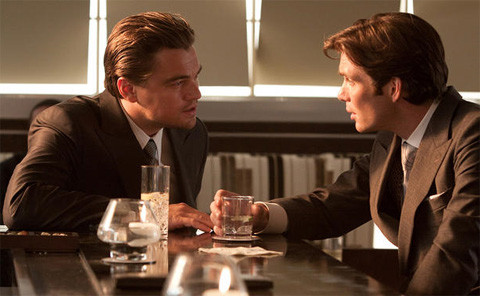
A good filmmaker doesn’t need to be invitational, but it certainly doesn’t hurt. But if an auteur can’t inveigle an audience, if he doesn’t have a basic understanding of showmanship, then the least he can offer is a distinctive voice. Alas, Christopher Nolan offers neither quality with Inception — a hopelessly unimaginative film that has been overly esteemed by many. Inception is reliant on perfunctory globetrotting, lights dangling atop ceilings, and repetitive amber hues for its “look.” It does contain an admittedly intricate plot structure, which cannot be immediately discounted. But when a film feels as dead as a greedy investment banker’s onyx soul, one isn’t exactly enlivened to clap. In fact, nearly all of the characters resemble Goldman Sachs employees hungrily hording your tax dollars: slicked back hair, lifeless eyes, and needlessly expensive suits. It can’t be an accident that the dollar amount of an expensive wallet is mentioned several times, or that the reason this group is invading a man’s head concerns some cartoonish explanation of the global energy market. In other words, this is a film with a childish understanding of our world; a Tinkertoy assemblage you’d gladly celebrate if it were handed to you by a five-year-old, but not from the 39-year-old man who has made Insomnia, Memento, Following, The Prestige, and two passable Batman movies.

It is truly a sad sign of American cultural decline that the rich now exist to be worshiped rather than depicted with anything approaching dimension. Inception‘s emphasis hardly inspires an everyman identification point, much less audience sympathy. Here is a cinematic opportunity to explore the dream state — to plunge into the depths explored by David Lynch, Guy Maddin, Terry Gilliam, Ken Russell, Jean-Pierre Jeunet, and countless other cinematic fantasists still alive and working today. Nolan has been given a $160 million budget to get a mass audience to confront its deepest visceral fantasies, but, with Inception, the collected reveries resemble a pedestrian heist movie. It would be one thing if Nolan possessed the theatricality of someone like Arch Orboler, the wackiness of Dan O’Bannon, or the outrĂ© singularity of Italo Calvino, but his derivative vision of snowbound fortresses invaded by machine-gunning skiers or decaying seaside cities is divested of such punch or possibilities.

Consciousness should resemble something more than a bad pulp novel. In Inception, you won’t find phantasmagorical creatures or perverse sexual encounters. You won’t find a dream that is truly dangerous. For this is a movie that has been rated PG-13 — a rating explicitly designed to prohibit human truth from the multiplexes. But you will find plenty of mindless gunfights and tedious slow-motion images of a van falling off a bridge, along with the fine comic actor Joseph Gordon-Levitt underused as a guy floating around zero gravity collecting twined bodies into an elevator. (Why the repeat images? Well, the film’s final few reels take place in three, later four, separate levels of the dreamworld, with each level operating on a different unit of time. What passes during seconds in the top level will be weeks on the second level and months on the third level. This permits dreams within dreams within dreams. It’s a clever hook, but Nolan overplays his hand by treating his audience like a bunch of unthinking baboons who can’t remember the club sandwich atmosphere even after the fifteenth series of cutaway shots.)

It’s never a wise idea to name a protagonist after a salad, but our man Cobb (Leonardo DiCaprio) is a flinty expert at invading people’s consciousnesses. He carries the mental detritus of his dead wife, storehousing these memories in various levels of his mind and unable to control these stray elements from invading a dreamscape. And while there’s a certain appeal in seeing an old school elevator traveling between internal cerebral levels, there’s simply no emotional impact with a foot-crunched wineglass or a totemic top. Nolan introduces numerous projections of the subconscious — figures who detect when the mind is being invaded and start attacking intruders like white blood cells. But Nolan is crass and careless with his semiotics. The symbols serve merely to demonstrate that Nolan is the guy driving the car, rather than presenting us with any real insight into trauma.

Recruited by a rich man named Saito (Ken Watanabe) to plant a motivation inside a corporate heir’s mind, Cobb assembles a predominantly male group of operatives, with the token female played by Ellen Page — a precocious student who seems capable of grand conceptual innovation, but who spends most of the film staring doelike at DiCaprio or offering banal responses to “surprise” twists.

The film fills every spare moment with so much expository chatter that we never get a chance to marvel at the world Nolan’s setting up. Cobb and his cronies are never permitted a moment to breathe. Nolan doesn’t seem to understand that film is a visual form, not a chatty medium. He’s taken the same minimalist approach that he offered with his two Batman movies — neuter the images with austerity so that they feel “real,” but don’t bother to layer the mise en scène with elements that capture our imagination. And even then, the dialogue is so crummy, so indicative of a man who read a slim Baudelaire volume over the weekend and thought himself a philosophical giant, that it’s hardly worth dredging up. We get bad pulp ultimatums (“Do you want to take a leap of faith or become an old man living with regret willing to die alone?”), laughably specific training lessons (“You have two minutes to design a maze that it takes one minute to solve”), and vapid declarations of life experience (“Do you know what it is to be a lover?”). Even poor DiCaprio, who delivers a fairly lively performance under the circumstances, is directed to talk like a two-packs-a-day Batman near the end, barking “I feel guilt” in one of the film’s many phony emotional revelations.

Taken with the film’s limited worldview, a place where people exist solely to betray each other, there is little excitement here in relation to the human spirit. Indeed, the “cognitively dissonant milkshake of rage, fear, and, finally, absolving confusion” that Jonathan Lethem identified within The Dark Knight is more applicable to Inception. The film feels like some feral holdover from the Bush Administration. It’s a love letter to conservatism, a chapbook steeped in cruelty and duplicity, where the only real evolution comes with how well you can screw over your partner.

One feels needlessly bullied by this movie. Nolan is so keen to show off how clever he is that the film’s internal workings are more adorned than felt. It’s as if Nolan is some obnoxious conversationalist at a cocktail party who can’t take the hint that he’s hardly the smart charmer he thinks he is. Unfortunately, because cinema is a passive experience, you can’t pour the punch bowl over the smug man’s head.

While I suspect the film’s numerous defenders will point to the fact that the dreamworld here is flat because most of Inception takes place inside a privileged man’s head, I must point to Mary Harron’s American Psycho, Kubrick’s needlessly condemned Eyes Wide Shut, and even Cameron Crowe’s flawed Vanilla Sky as examples of dormant and often dangerous desires explored in contemporary cinema. These filmmakers understood that even the most comfortable members of society can be driven to, respectively, homicidal rage, restricted perversion, and self-evisceration in their dreams. No such luck with Inception. We’re promised Limbo, a mental sublevel so intense that the dreamer eventually returns to the real world as a mental vegetable. One imagines Bosch landscapes or truly terrifying images. But what do we get? Some tame universe that looks like it was whipped up in UDK over a few days by some bored kid.

So this film will dazzle any dummy unfamiliar with Bergman or Bunuel. It will entice any viewer who has set the fantasy bar quite low. It will make a good deal of money. And there’s little that anyone can say to dissuade the inevitable march of capitalist progress. But the hyperbolic comparisons of Nolan with Kubrick are foolhardy. There used to be a time in which we didn’t compare a common pickpocket dressed in a flashy suit with a criminal mastermind who had the decency to respect the mark. But in a post-BP, post-bailout age, it comes as no surprise that our affluent cultural thugs would be declared the new Jesii by lifeless critics who are too diffident and too easily seduced by a shiny bauble. Ain’t that a kick?

Harvey Pekar (1939-2010)

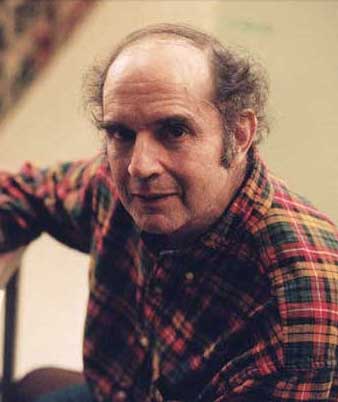
Harvey Pekar, the comic book writer best known for the long-running American Splendor, died this morning in his Cleveland home. He was 70 years old.

Pekar was devoted, more than many of today’s lifeless literary practitioners, to depicting the truth behind everyday moments. And it is especially painful to know that Pekar’s passing comes a little more than a month after David Markson’s. Like Markson, Pekar knew that life didn’t offer any tidy resolutions and that art, even at its best, served as an intermediary. “Ordinary life is pretty complex stuff,” he would write most famously. It was one of the key lines that made it into the 2003 American Splendor film adaptation. But the film, as great as it was, couldn’t compete with the work on the page.

Pekar was not the type to pull punches or avoid the harsh truth. He wrote fearlessly about his testicular cancer scare, his failings with women, his anger, and his inadequacies. But his work was never solely about a lifelong exploration of the self. He wanted those who read his work to understand the world. For Pekar, that universe was Cleveland. And Pekar demonstrated that it was hardly just some flyover state to be overlooked by the bicoastal snobs. He described the hopeless art of trying to pick the right checkout line when standing behind an old Jewish lady. He wrote about Emil, the Ukranian laborer who lived next door to him in the mid-1960s, moved into a rough Cleveland neighborhood, and saw his idealism dissolve into racism. Of his jury duty experience, he would point to the hypocrisies of “rich people like Nixon and Agnew” staying out of prison while poor people were thrown into the slammer for less serious crimes. These anonymous lives presented stories that were just as important, but more recklessly forgotten.

Pekar’s later volumes became more ambitious than these Cleveland chronicles. There were graphic histories featuring Students for a Democratic Society and the Beats. With Michael Malice and Macedonia much like Emil, Pekar investigated the hypocrisies behind idealistic commitment. But regular people remained very much a priority with an adaptation of Studs Turkel’s Working.

Righteous indignation was an essential part of Pekar’s work. (Indeed, one story from 1986, “Hysteria,” depicts Pekar getting so worked up that he lost his voice.) But he did have a good deal to be angry about. Here was a very sharp autodidact toiling as a file clerk, who was often needlessly ridiculed. The most infamous scorn came from David Letterman, who booked Pekar on his show so that he could lob potshots at the weirdo he never bothered to read or appreciate. These regular appearances ended when Pekar got sick and tired of being the butt of the joke, shortly after he rightly condemned Letterman for his ties to General Electric. He would write about this experience in 1988’s “My Struggle with Corporate Corruption and Network Philistinism.”

But even Pekar’s most vocal mainstream supporters didn’t seem to ken him. I know this, because Pekar contacted me by telephone to talk about it. With Dean Haspiel’s help, he sought me out shortly after I had written a blog post in his defense. The Los Angeles Times‘s David Ulin claimed that Pekar was writing too much in his later years. But Ulin had failed to note 2005’s The Quitter, which I declared “an inarguably raw and mature portrait of a younger Pekar developing some of his anger while being tormented on the Cleveland streets.” And he had failed to cite anything specific in his criticisms.

“This David Ulin guy doesn’t know what he’s talking about,” barked Harvey over the earpiece. “Look, man, I’m trying to stay alive.”

He was. He took any gig he could and he did his best to offer something worthwhile. And should a man be condemned for his work ethic? Not when he’s constantly contriving new ways of staying fresh. Pekar employed eclectic artists to keep his stories new. There was Rebecca Huntington’s photorealist approach in the 1988 story, “I Don’t Wanna Seem Judg-Mental, But…,” the dependable boxiness of longtime collaborator Gary Dumm, Val Mayerik’s free-form frameless approach in 1985’s “A Marriage Album,” and, of course, those early innovations with R. Crumb. He was often quite generous in soliciting other artists to collaborate with. And the artists were very often supportive in return. In later years, he would refer to Dean Haspiel as “my agent.” Haspiel helped Pekar to book gigs as the post-retirement medical costs accumulated.

I was lucky enough to talk with Pekar very early into The Bat Segundo Show. I was new at this interviewing business at the time, but I did ask the man why he continued to use the “STRAIGHT OUT OF CLEVELAND!” line for so long during the American Splendor run. And he told me that he had always intended this declaration as an alternative to superheroes. And indeed, why bask in nothing more than spandex-soaked chronicles when the real world has never had to retcon its glaring realities? A comics world without a new Harvey Pekar volume every year will be a much sadder place. For Pekar wasn’t just some gloomy guy. He was a committed cultural chronicler.

RELATED: The Bat Segundo Show #40: My 2006 radio interviews with Harvey Pekar and Dean Haspiel.

Review: The Girl Who Played with Fire (2009)

When I read Stieg Larsson’s The Girl Who Played with Fire, I learned that it was possible to subsist on little more than Billy’s Pan Pizza when taking down a shadowy human trafficking organization. I learned that Billy’s Pan Pizza could get you through the day when your name was slandered in various Swedish broadsheets, and when your family’s malicious nature was revealed, and when you needed to hack into computers using tactics that the 2600 crowd would surely find dubious. Eat enough Billy’s Pan Pizza and you too would be able to access a powered down laptop! Perhaps it was a surrogate for a wild weekend involving a bag of shrooms and a fifth of scotch. Or merely the workaholic’s answer to intense labor. But it was certainly enough to alter reality and make it persuasive. If you had two breaks for Billy’s Pan Pizza, you could spend most of the day at your computer “with only a big bottle of Coca-Cola for company.” This was a Donnean existence to be sure, but then Billy’s Pan Pizza could take you quite far. If you walked into a 7-11, it was absolutely impossible not to walk out with several boxes of Billy’s Pan Pizza, along with an obsessive need to announce your shopping list to the reader. Because of this, I felt very sorry when Salander had exhausted her Billy’s Pan Pizza supply. Without the pizza, there was no way for her to win.

So I was considerably disappointed when the film adaptation failed to understand the true power of Billy’s Pan Pizza. Yes, it pimped Vaio and Mac and IKEA and other non-food products. The Swedish television industry (for this cinematic release is actually the first half of a TV miniseries) has learned a thing or two about product placement. But the problem here was that the filmmakers haven’t considered the right item to pimp. Aside from an unidentified pizza box tossed against a kitchen wall, there was no indication of Billy’s Pan Pizza maintaining its essential role. For this reason alone, I must condemn writers Soren Staermose and Jon Mankell and director Daniel Alfredson for this lackluster offering. The Millennium trilogy has been a remarkable commercial bonanza. Is it not fitting to maintain the commercialism in these cinematic counterparts? If these filmmakers cannot comprehend the importance of such a vital frozen food product, then they are as morally dissolute as tax cheats.

But maybe this criticism isn’t entirely fair. While I could complain about my failure to read the Swedish subtitles due to the crowded house and the screening room’s highly acute grade, I won’t. I’ll only say that I was seated behind The Girl Who Didn’t Understand That Her Fat Head Prevented Others from Reading the Subtitles. This extenuating circumstance may have had some bearing on my ability to review the film properly. Nevertheless, I was able to make out 95% of the missing words by listening. And I was delighted to encounter more overlap between Swedish and English word roots than I anticipated.

While I could point out that Staermose and Mankell don’t quite have the knack of synthesizing a mammoth novel that the previous writers (Nikolaj Arcel and Rasmus Heisterberg) had with The Girl with the Dragon Tattoo, I should point out that they are good enough to make the book’s “giant” relatively laconic. Director Alfredson has cast a rather silly blonde man named Micke Spreitz as Ronald Niedermann. He isn’t quite Richard Kiel. He resembles what might have happened if some Tiger Beat model from twenty years ago grew up and replaced his morning Wheaties with steroid shakes. Menace isn’t exactly his strong suit. He’s preposterous and not nearly as intense as he should be. But he’ll do.

There is semi-hot lesbian sex, which I’m sure will please a certain redblooded demographic too diffident to walk past the beads into a video store’s adult section. Not exactly Deneuve and Sarandon from The Hunger, but it will also do. Salander’s surprise breast implants didn’t find their way into the film, suggesting some mammary diffidence. The hospital flashbacks are shot in black-and-white, suggesting a chiaroscuro commitment to spelling out the bleeding obvious. But Michael Nyquist (Blomkvist) and Noomi Rapace (Salander) aren’t too bad in this. Yes, Nyquist and Rapace don’t really get many moments to confirm their onscreen chemistry this time around. And Nyquist, who was quite the studly lothario in the last one, doesn’t quite have the “talent” that Larsoon was keen to delineate in the book. My hope here is that Nyquist will be getting his rocks off in the next film to demonstrate how old school journalists are the new stallions.

Thanks to budgetary constraints, the Millennium‘s office (this time around) looks more like some fly-by-night startup rather than a major muckraking magazine. I was also disappointed that the juicy line “Your mother was a whore!” was uttered so calmly. For goodness sake, this is Swedish melodrama! We need such lines to be uttered with scenery-chewing integrity!

Nevertheless, I had fun with the film. Even if I did notice that other critics were baffled by the plot. I am not certain that they had read the book. And I’m still not sure if the Millennium film trilogy quite captures Larsson’s lurid feel. These films are certainly not the Red Riding Trilogy. But they’ll do.

The Bat Segundo Show: Dan Ariely

Dan Ariely appeared on The Bat Segundo Show #344. Mr. Ariely is most recently the author of The Upside of Irrationality.

Condition of Mr. Segundo: Looking about for Dichter’s egg.

Author: Dan Ariely

Subjects Discussed: [List forthcoming]

EXCERPT FROM SHOW:

Correspondent: The question is whether or not there is some kind of maximum threshold. An escalation of that one item that makes something unique before we realize that it’s really a ruse.

Ariely: I don’t think so. I think that we’re actually going the other way in terms of society. A long time ago, we had to hunt and spend time finding food and cooking and so on. And right now, you can do it in thirty seconds. So what do you do with the rest of the time? I think we get conceptual conception. I mean, we’re still occupied with consumption. But it becomes much more about the idea behind it right now rather than the thing itself. You know, we can get enough food. That’s no problem. It’s about: what does the food mean and what do the clothes mean and the vacation that we get. And so on. As we strive more for meaning and ideas and stories, I think that actually we get more and more involved in this aspect of loving what we create. By the way, I also think this has a lot to do with how things turn out in the housing recession. As the housing market was going down and down and down, Zillow — the website — they did a survey that asked people, “Have houses in your community lost value?” People said yes. “Has your house fallen in value?” And people said absolutely no. And I think that the reason is that we have our own house and we’ve tailored it just to ourselves. So we put much of ourselves into it. And we expect other people to value it. Maybe not as much as we do, but to a much larger extent. So people become immune from thinking that other people don’t see things in the way that they do.

Correspondent: We’re talking about that interval between social norms and market norms. Obviously, you’re dealing largely with behavioral economics. But in this case — like, say, a home — we almost have a social and a market norm. And so, as a result, it becomes a dicey proposition when we’re trying to analyze why people place this extraordinary value on their own particular possessions. Because it may not necessarily be interpreted — at least from their perception — as a possession.

Ariely: Yeah. So housing is complex. Again, it’s one of those things that, when you try to get people to think about the house from the perspective of the market, they have a hard time. First of all, they are connected to the price they bought the house at. It’s irrelevant, right? It’s irrelevant how much you bought the house versus how much you can sell it for. But people get attached to it. But on top of that, I talked with many real estate agents. And they say that when they get a seller to express a price, if they get an offer that is way too low, they take it as a personal offense.

Correspondent: Yeah.

Ariely: It’s not a personal offense! But, no, people really get upset.

Correspondent: Well, you were upset when they did the same to your house. When you had taken out the walls and they asked you to put them back in so you could sell the home.

Ariely: That’s right. So assuming that I did lots of changes to a house and made it just so — so we loved it — lots of other people loved it as well, but didn’t want to live in it. And eventually what we did was we put some walls back. We changed some of the beautiful things we’ve done for our purposes. And actually so many people wanted to see it afterwards then. All these changes. It was really heartbreaking.

Correspondent: But there’s also an interesting irony there. About something that you’d customized.

Ariely: Yes.

Correspondent: It becomes off market.

Ariely: That’s right.

Correspondent: So I guess we need to start off with a baseline item for market value. And then we get into a tricky situation where our own personal — the unique qualities we place…

Ariely: The unique taste that you have might also make the house less valuable.

Correspondent: Yeah.

Ariely: But it’s very hard to see it. Because if you like blue, it’s very hard for you to understand that people might not like blue windows. Or blue something. Especially if you spend lots of time and energy on it. And you do it just so. It’s really hard to imagine. I mean, I can tell you as somebody — so I wrote a couple of books. It’s the same thing. I invested a tremendous amount of effort and energy into those things. And if somebody doesn’t like them as much as I do, I don’t understand how can that be. Right? I expect everybody to love these books. In fact, in my view, they’re better than any other book in the world almost.

Correspondent: (laughs)

Ariely: But once you invest so much effort, you get blinded to the projection of other people.

Correspondent: But how does humility factor into something like this? Just from a scientific standpoint. I mean, I don’t think you really believe these two books are the best books in the world.

Ariely: No, I don’t. (laughs)

Correspondent: I’m going to have to break it to you. You know, if I had a choice between your book — which is great!

Ariely: (laughs)

Correspondent: I would choose Ulysses over that. No offense.

Ariely: Well, talk to my mother.

Correspondent: (laughs)

The Bat Segundo Show #344: Dan Ariely (Download MP3)

This text will be replaced

The Blank is Dead

Once upon a time, an elephant-sized ego wrote a vapid article about the blank being irrelevant. The article inspired other articles and other blog posts and other comments and other tweets. Never mind that the blank wasn’t dead. Never mind that you could walk into any blankstore and encounter so many blanks that even the most impotent customer couldn’t ignore them. Never mind that you could look upward at the beautiful cerulean sky and see a bountiful blank filled in by the swirling clouds, annotated at ground level by human interpretation. The blank couldn’t be dead. It was like saying that life was dead. And anyone who believed that all human possibilities had halted overnight probably didn’t have much of an existence in the first place.

But for this unnamed and very sad man, the blank was dead. All forms had been filled out. The government had stopped issuing tax forms. There was no more money to collect and no more cash to spend. All calendars had been confiscated. All paper had been taken and filled up with words and scribbles. All pens were removed from homes and offices to prevent any potential blanks from being filled in.

The blank was dead and there was nowhere more for the human race to go. It had ended on June 22, 2010, at 4:53 PM — the very moment that the article had been published. On June 22nd, there was no further need for the human race to feel or think. The human limit had maxed out. It was time for the blankless world to become the new reality.

Humans could no longer feel giddy when they filled in a conversational caesura with a catty quip. They could no longer fill in a crossword puzzle or jot down a liaison with a scandalous lover into a blank square. But weren’t all those feelings trivial? Wasn’t life more comforting when you knew what was happening every damn minute?

Because the blank was dead, every possibility had been prefigured. Every social occasion had been predetermined, down to the guest list and the specific manner in which you dipped a carrot stick into ranch dressing. Every meal had been prepared. If you wanted to order sushi on a whim, well, then you’d have to consult the fatalist texts to see if the decision had already been made. Because the blank was now dead.

Life went on like this for a while. Until people started to understand that the blank had only disappeared because the man had said so. And those who had easily placed their faith in the foolish pachyderm began to wonder why they couldn’t ignore the wrongheaded article that had caused all the fuss. Somehow, the man had willed the blank into dying. Or perhaps he permitted the unimaginative types who couldn’t believe in the blank to come out of the closet — much in the manner that Proposition 8’s passage had revealed dormant homophobia. Fortunately, there were a few doubting Thomases. When those who believed in the elephant felt ashamed by their unthinking leaps forward, it became necessary for some of the more stubborn acolytes to take cold showers. It became necessary for them to find a blank, any blank, with which to funnel their hopes and galvanize their passions. The truly hopeless committed suicide. If the blank wasn’t dead, these sad sacks could demonstrate their commitment to the end in another form.

Of course, for those of us who never believed in the false prophet, there was no such perceptive problem. We were quite happy living our lives, filling in blanks and finding new ones. And for those writers who insist that the blank is dead, one must naturally ask why you’re talking about blanks in the first place if your mind is so blank and your soul is so dead.

(Image: Jo Naylor)