The Bat Segundo Show: Marcy Dermansky

Marcy Dermansky appeared on The Bat Segundo Show #343. Ms. Dermansky is most recently the author of Bad Marie.

Condition of Mr. Segundo: Misidentifying French landmarks and attempting to make peace with copy editors in sketchy motel rooms.

Author: Marcy Dermansky

Subjects Discussed: [List forthcoming]

EXCERPT FROM SHOW:

Correspondent: I want to touch upon coincidence. Because it does create possibly a problem for a reader who is looking for a plausible reality.

Dermansky: Yes.

Correspondent: And I’m wondering if you can justify the use of coincidences or convenient run-ins because this is a work of fiction.

Dermansky: Right.

Correspondent: Because anything goes in fiction. Because you should be aware that it’s an artifice. Do you think that verisimilitude was just not required for this particular work?

Dermansky: Well, I think to some extent. There are crazy coincidences in life. And why not? I mean, there goes a motorcycle.

(A motorcycle passes.)

Dermansky: You never know who you’re going to run into or what’s going to happen. When I was signing books at BEA, someone came up to my table and said, “I want you to sign this for Alexa.” And I said, “Okay!”

Correspondent: Who was Alexa?

Dermansky: I have no idea. It was like her cousin or her niece. But at the table next to me, somebody walked up and said — and I just overheard; we were right next to each other — she said, “Could you sign this book to Alexa?” And it was just a different person next to me. And I just thought, “How many Alexas are there in the world that other people want?” And so that happened. And that’s not as dramatic as reading a book in prison and then coming out and finding out that your best friend is married to that author. But there are coincidences.

Correspondent: Did you make any efforts to track a third Alexa?

Dermansky: No. (laughs) I should have done that.

Correspondent: I mean, maybe there was a run-in of Alexas. Maybe there are a lot of Alexas in the publishing industry!

Dermansky: I stopped signing the book and said, “Isn’t it strange that there’s another Alexa?” And the woman whose book I was signing thought I was odd. And she’s just like, “Sign my book.” And I kept going on about how I thought that was interesting.

Correspondent: Did you find out what her name was?

Dermansky: No. I didn’t find out her name.

Correspondent: Oh.

Dermansky: Yeah.

Correspondent: Maybe she was Alexa. Maybe she liked to refer to herself in the third person. We don’t know.

Dermansky: Possible. Yeah, you don’t know. The normal people are often that. That’s what I was saying.

Correspondent: But on the other hand, we are dealing with narrative vs. reality.

Dermansky: I know. It’s true.

Correspondent: And while we can accept numerous coincidences, numerous associations, numerous situations, numerous parallels — that’s not necessarily going to line up neatly in a book. And in this, it seems to me, reading it, that you just didn’t care.

Dermansky: I think I didn’t care. I mean, I could put it back on you and I could ask you that. And you could be truthful. If that bothered you as a reader. Did you say, “Oh my god! She’s gone too far!”?

Correspondent: Well…

Dermansky: (laughs)

Correspondent: It did and it didn’t.

Dermansky: Okay.

Correspondent: I mean, I would say that it is rather curious that your book has a lot of outsider characters who are observing the situation. And then they mostly get involved with the narrative. And I wanted to actually ask you about that. There isn’t a single real stranger who’s looking upon all these weird characters — or unusual characters — or characters who came from a normal author.

Dermansky: Okay. (laughs)

Correspondent: They don’t just sit back and express disgust, save for that waiter. And I’m curious why you felt the need to pull in all these side characters into the narrative like this. As opposed to just letting them look at the situation and offer some expression of disgust, some expression of dismay, or what not.

Dermansky: Right. I was trying to remember who’s the waiter. He’s the waiter at the French restaurant.

Correspondent: Yes.

Dermansky: And he’s very disgusted because they put all the food on the table. And the cat on the table.

Correspondent: Yeah.

Dermansky: Well, I mean, don’t you, when you introduce a character to the story, they have to become part of the story?

Correspondent: Not necessarily. I mean, if you’re in a crowd, and these characters are often running into crowded situations when they’re not in rooms, you’re going to have people give them glances or expressions and the like.

Dermansky: Yeah, that’s true.

Correspondent: So to me, it was interesting that you decided any remote run-in with someone, I mean, immediately they become a supporting character or even a minor walk-on character.

Dermansky: Yeah. I guess that’s true. Like there’s that scene in the bathroom in Paris.

Correspondent: Yeah.

Dermansky: Where the woman walks into the bathroom. And she doesn’t just walk in and out. Well, they’re two teenage girls. They walk in and out. And they give Marie a dirty look. But then a woman in a hijab comes in. And she actually helps Marie change Caitlin’s diaper. So she becomes a character just for that scene. I don’t know. I think, if you put somebody into a room, you want to use them. Or why do that? You can’t just have a book with four characters either. It gets very claustrophobic. And so I do that a lot. I feel that as a writer — I’ve taught writing. So I’ve told students that you don’t introduce a major character in the third act of your book. You don’t. You have to have all of the players in there. But at the same point, it gets so flat and stale. Like new people come in. It’s a little bit like life. So a movie star walks in at the very end of the book.

Correspondent: That’s right.

Dermansky: And that seemed okay to me.

Correspondent: Is this, I suppose, the mark of a very socially inclusive personality?

Dermansky: I don’t think of myself as a very socially inclusive person.

Correspondent: (laughs) Just like you like to introduce people at parties, you like to introduce characters in novels? In your writing?

Dermansky: (laughs) No, I’m the person at the party who stands back and just gets introduced to other people.

Correspondent: You’re just defying all the expectations here. This is great.

Dermansky: I think I defy the expectations without thinking! (laughs)

(Image: Rachel Kramer Bussel)

The Bat Segundo Show #343: Marcy Dermansky (Download MP3)

This text will be replaced

Non-Intimidating

The San Francisco government had gone out of its way to declare the police station “non-intimidating,” It all started when a young innovator had suggested sending brochures to nearby residents by mail. The City, which was still in the early stages of embracing all things digital, thought that this was a pretty good idea. To save a bit of money, it commissioned this conceptual whipper-snapper to write all the copy. When an administrative official two weeks away from a prestigious (read: more lucrative) post in Pennsylvania caught wind of the young man’s purported background in graphic design, the official, hoping to create a mess for the obnoxious new guy to clean up, replied, “Fire up Quark and knock yourself out.” With “public awareness” still a recurring and not easily identified priority, the plan was ridiculously easy to authorize. But when the brochures came in, accompanied by a dubious $2,000 invoice for “special services” from some guy named Randy, the young man was boxed around the ears and let go. The gaudy brochures had come back with the catastrophic header DON’T WORRY! WE WON’T INTIMIDATE YOU! printed in a large and unfriendly font against a sickly yellow and vaguely green background.

Meetings were held. Protocols and terms were fiercely argued. The City, still bracing from Randy’s invoice, contemplated bringing in George Lakoff from across the Bay, before understanding that there was a certain humiliation in relying on Berkeley to solve a San Francisco problem. Remarkably, this wasteful public spending had somehow escaped Matier and Ross’s prying investigative attentions. Randy had been paid promptly to keep things quiet. Yet despite these setbacks, it was agreed that the “non-intimidating” concept had to be conveyed to the public. Bus shelter ads might scare the living bejesus out of the elderly. So the City agreed to a low-key campaign. Use the word “non-intimidating” at press conferences. Mention it in intimidating situations. Have all the earthquake preparedness professionals use it in relation to unanticipated seismic rumbles. But most importantly, describe Park Station as “non-intimidating” on the sfgov website.

Few people remembered that Park Station, once strenuously opposed by the mindful planner John McLaren during its construction, had spent a good century defying public perception. The building, originally flanked by two wings stabling 32 horses, had maintained its stucco facades over the years, but its interior had been replaced by clinical functionalism.

This transformation may have had something to do with Park Station’s successful bombing by bloodthirsty activists, believed to be the Weather Underground. It was thought at the time that the window ledge blasting was related to the Chicago Trial protests. The bombing had killed a police sergeant. Developing technology would later pin part of the crime on members of the Black Liberation Army, but Bill Ayers’s guilt hadn’t been entirely pegged after four decades of investigation. The station had closed, reopened, remodeled, and reinforced itself. Its look decayed and its fortification strengthened with every fresh generation of cops grousing its halls.

Some of the residents living near Golden Gate Park’s southwestern perimeter had traded in their ideals for relentless equity management during boom times, but they came around to believing that Park Station was non-intimidating. It helped that many of these young starving pups had no sense of history. The station was non-intimidating only if you believed that the police would always do their duty. It was non-intimidating only if you believed that the authoritarians wouldn’t confuse the rights of nonviolent protesters with their more intense, pyro-happy counterparts. It was non-intimidating only if you kept your head down and avoided the hassles, the harassment, and the harried interventions of hotheaded cops too eager to crack a few heads.

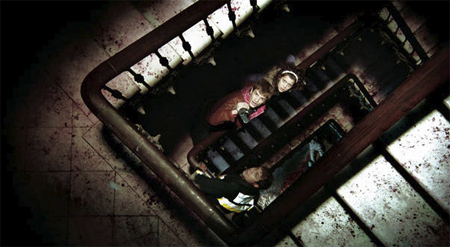
Review: [REC] 2 (2009)

Nobody seems to agree on the precise pronunciation of [REC]. And I haven’t even brought up the potentially controversial notion of pronouncing the brackets. (A throat-clearing sound?) I had been saying it wrek — in large part because I spent some of my childhood living in a sketchy apartment complex with a dubious “rec room,” and enjoy a little symmetry in my horror nomenclature. I talked with a friendly horror aficionado before the screening who insisted on spelling it out ar-ee-see, as if the title were an acronym. Another film critic pronounced it with a long e. I must presume that the film’s title, much like the film itself, is what you make of it.

But just how do you name a sequel in a franchise based around a camera button? [REC] Again has little zip, suggesting to the audience that they’ve made some mistake, perhaps missing the taping of some vital House installment. [REC] with a Vengeance insinuates that the button has become sentient, transforming into some mechanical Charles Bronson-style vigilante. (This wouldn’t be entirely out of line for the [REC] films, seeing as how the camera is just as much of a character in as the reg folks gone aggro.) In the end, writer-directors Jaume Balagueró and Paco Plaza have opted for numerical superscript for their sequel — much like the Aliens films. I am pleased to report that the camera perspectives do indeed live up to this squared sensibility.

For those of you who have no idea what the hell I’m talking about, you should probably check out the original [REC]. Unlike many mindless horror franchises, the [REC] movies feel as if the filmmakers have given serious thought to the environment. (Or perhaps they know how to improvise better. The Saw series’s endless “twists” — in which the Jigsaw Killer’s plan becomes increasingly more baroque and laughably improbable with each installment — have readily revealed the creative bankruptcy in milking a cash cow.)

But with [REC] 2, you may be just as lost as the survivors if you haven’t experienced the previous film. Made in 2007, the first [REC] is a pretty terrific little horror film that presents a zombie plague entirely from a single camera perspective. Like The China Syndrome, there isn’t any music. But the results aren’t obnoxious like Mike Figgis’s disastrous (and dated) Timecode — surely the last decade’s answer to Woodstock or More American Graffiti.

A cameraman and a television presenter named Angela Vidal — both filming a disposable reality TV series called While You’re Asleep — visit a firehouse to find out just what firemen do. Angela awkwardly asks the fire chief, “You’re the boss, right?” She puts on a firehat and a uniform, jumping about for camera-friendly frivolity. She suggests to another fireman she’s interviewing that the alarm should go off for full dramatic effect. There is a basketball game that is interrupted by an alarm, which takes yawning firemen and bored camera crew to an apartment building, where a zombie infection is underway.

Life, in other words, needs to be shaped into a juicy narrative by the camera crew. But the viewer is part of a different narrative, thanks to the unedited tape that comes with the epidemic. While this may seem to echo the setup of George A. Romero’s Diary of the Dead (more satirical), The Blair Witch Project (a narrative designed out of a savvy marketing strategy), and Cloverfield (the handheld gimmick used to present a pedestrian Hollywood narrative in a “different” way), [REC] works so well because the camera is instrumental in portraying the panic. When the camera is hit, the audio gets bumped right along with it. Near the end of the film, the camera must rely on night vision.

The camera crew makes desperate efforts to maintain some journalistic facade when sealed in the building by mysterious government forces, continuing to conduct interviews with the survivors. But these efforts soon dwindle as the need to survive becomes more pressing. As the environment becomes more unruly, the cuts between the camera being on and off tell additional stories. Where Diary of the Dead placed its faith in the idea that young people would continue to seek fame when there wasn’t much of an audience left, and where Cloverfield‘s camerawork often proved ridiculously stable near cantilevered edifices, [REC] considered how people would act to apocalyptic events and how the camera would be instrumental in conveying this behavior. And this approach, thanks to Manuela Velasco’s fish-out-of-water performance as Angela and the more naturalistic acting (for horror, anyway), strongly suggested that Balagueró and Plaza had carefully studied The Battle of Algiers (certainly a good deal more than the Blair Witch bunch, who should be commended for bamboozling the American public).

[REC] 2 doesn’t quite match the first film’s gripping suspense, but it comes extremely close. Like the first film, the behavior, dictated by the camera, changes through the movie. We’re introduced to soldiers who are rather by-the-book and not particularly insubordinate. The ostensible commander insists on recording everything. But as the film progresses, a more human element of fear and frustration creeps in, and, with this, a very pleasing sense of revolt that is perhaps best signified by the liberal use of firearms.

[REC] 2‘s narrative feels more like a Valve video game or the Sunday New York Times crossword puzzle — a journey to be filled in once you’ve explored the unknown space.

OBJECTIVES: 1. Get blood vial. 2. Go downstairs. 3. Find Patient Zero.

You get the idea. And if you can’t get behind this crass fun, then I sentence you to a lifetime of soporific Merchant-Ivory movies.

One POV shot, in which a soldier blows away zombies with a machine gun, comes across like a Left 4 Dead installment five years from now, with a better engine and more heat-sensitive hardware. There is a moment in which snipers shoot at the building that had me wondering if I was re-experiencing Half-Life 2. There is even a secret door leading to a bonus world, further cementing the gaming comparisons. Should cinema resemble a first-person shooter? In most cases, I would advise against it. But because the [REC] films are very much about playing with our narrative expectations with the camera-audience relationship, this cross-media mimesis somehow works. It wouldn’t work without the camera. And while sometimes this feels like a cheat, we are given enough unexpected developments to keep feeding in our quarters.

There are more cameras here than the first film — including several lipstick cams placed upon soldier helmets, reminiscent of the second Aliens film, that are occasionally patched into. There’s a second perspective emerging midway through the film. There are more characters — including a group of foolish teenagers. But there are also more opportunities for zombie destruction. Aside from some head explosions, there is also a very satisfying moment in which a zombie flails about with a bottlerocket in its mouth. At one point, when a zombie runs towards the camera, the image freezes on its quite open and terrifying mouth. The filmmakers also offer a greater attention to accumulating scrapes and bruises as our intrepid heroes are attacked.

If you can accept that [REC] 2 is a carnival ride, then you’ll probably like this flick as much as I did. I certainly enjoyed [REC] 2, despite all of its supernatural contrivances, considerably more than the boring art house film I’d seen earlier that day. And maybe that’s because Jaume Balagueró and Paco Plaza really love making movies — in a way that seems to have eluded the pretentious and the avaricious.

What Characters Read Books on Television?

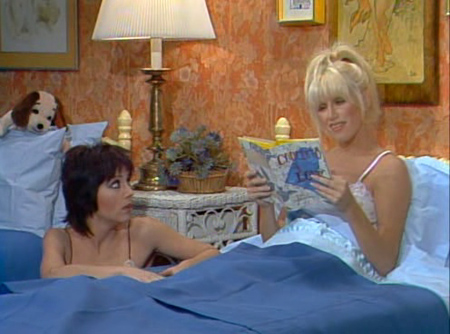
The above screenshot is from a Three’s Company episode called “The Lifesaver,” in which even the dimwitted Chrissy Snow could be seen reading a book. The novel is Concerto of Love (fictional, of course) and Chrissy had only reached Page 4. But it does have me wondering. In 1979, even sitcom characters who were more than a few cards short of a full deck were still committed to reading in some form. Can we say the same thing in 2010? What television reading moments have you seen lately?

UPDATE: Here are some observations from Twitter.

Ron Charles: “Isn’t that odd. There are rarely any books in their homes…”
eBookNewser: “There is an episode of the Rockford Files where Jim is reading some kind of detective novel. Tom Select is in the episode.”
Mark Athitakis: “Best-read character on a show currently on the air: Brian Griffin” and “‘Mad About You’ may be the exception that proves the rule.”
James Othmer: “Draper: Meditations in an Emergency; other Mad Men selecs: Lady Chatterly, The Best of Everything, The Sound & the Fury.”
John Williams: “I imagine Lisa Simpson is pretty well read for her age.”
Mike Cane: “Well, duh, CASTLE. But he also writes them.”
Colleen Mondor: “Has anyone mentioned Rory on THE GILMORE GIRLS yet? It was a hallmark of her character.”
Levi Asher: “hmmm … the youngest kid in “Good Times” was often seen carrying or quoting from a book … Dale Cooper … Lucy Ricardo.”

Content Slows Momentarily to a Crawl

Due to my present participation in a rather mammoth undertaking, I don’t anticipate much in this space over the next few weeks — aside from the weekly podcast (several conversations already conducted!) and a few essays on movies. I’m also pushing back today’s podcast to sometime early next week in the interests of balancing content release. Probably curtailing my Twitter activities to a few tweets a day. All is very well. This ain’t exactly a hiatus. But I’m finding myself increasingly committed to offline activities.