The Bat Segundo Show: Arthur Phillips

Arthur Phillips appeared on The Bat Segundo Show #288.

Arthur Phillips is most recently the author of The Song is You.
segundo288

Condition of Mr. Segundo: Reconsidering the playlists and those who play him.

Author: Arthur Phillips

Subjects Discussed: Characters who are enslaved to culture, partisan positions in relation to hoarding facts, being in denial about larger arguments within novels, Nabokov’s Lectures on Literature, aesthetic concerns, muses and playing against reader expectations, the myth of an author’s personal connection, listening to headphones, ghosts and Jeopardy experiences gone awry, personal experience and lies within fiction, speculating on the specific conditions in which a man can be a muse, being a male model and a musician, the myth of writing what you know, getting excited about emotion, the distance required to contend with a fictive location, the wall between the personal and the artistic, the magic souffle, predicting 2009 weather in New York, reading time, the danger of boredom, William Gaddis’s The Recognitions, outlines and improvisation, reinventing the wheel, the little changes within a manuscript vs. changing as a writer, the value of urgency, being a metaphorical roofer and upholsterer, Re-Flex’s “The Politics of Dancing,” and the crazy amounts of money one must pay to republish lyrics.

EXCERPT FROM SHOW:
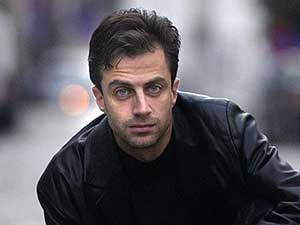
arthurphillipsCorrespondent: If we’re talking about time, there’s also the notion of reader’s time. And as a stylist, you have some control over how frequently or how long or how short the reader’s going to turn the page. When I read your book, I found numerous passages when I would slow down. And then when dialogue would bump up, particularly with the scenes with the cop, it then sped up.

Phillips: Right.

Correspondent: And so I’m curious. If time on a structural level was important, I’m curious if there was any importance you placed in terms of thinking of the reader and thinking of this notion of how fast the reader’s going to turn the page?

Phillips: That’s such a great question. And on one hand, I want to say, “Jeez, I wish I had more conscious — and I will vow in the future to have more conscious — understanding of those technical matters.” On the other hand, it seems a little impossible to control. Well, not just a little. It’s entirely impossible. I think any time you start getting into what does the reader or what does a reader expect, react to, experience, you’re doomed. I mean, you’re just — it can’t be. If you have one or ten or a hundred or ten thousand or a hundred million readers, they’re just different. And this is just so obvious that it’s just not saying anything. But it says everything. Because if everybody’s going to have a slightly different reaction, even taking a smaller subset of the people who “like” it, they’re going to all have a different reaction. You can’t plan for them. So the only reader that you can really have much planning for is yourself. At which point, I don’t really have to think very consciously about “I need to speed it up here, I need to slow it down here.” All I have is the feeling of “I’m bored.” And so when I’m writing and I go back and I read the draft, I say, “Oh this is just — I’m just bored.” Something has to happen here that is different from what’s happening. Because I don’t like it. And then at the end of it, when I’ve gone and I’ve done that twenty-five times, and I say, “I like the whole thing,” then it’s done.

Correspondent: Well, to deflate my own interlocutory souffle…

Phillips: (laughs)

Correspondent: I should point out that this may very well be the difference between having lots of dialogue and having lots of imagery. I guess the question here is how intuitive is it really. I mean, when you’re getting lost in a long sentence, whether as a writer or even as a reader, you’re going to be aware of the slowness. Or maybe you’re lost in such a fugue state that there really is no sense of time.

Phillips: Right. I’m reading The Recognitions right now and…

Correspondent: First time?

Phillips: First time.

Correspondent: Oh wow.

Phillips: And I’m having all kinds of temporal feelings about that book as I work with it. There are times when I am lost in a fugue state, although not often enough for my taste. And often I’m feeling, “I think Gaddis was lost in a fugue state. And I just can’t join him for some reason.” I don’t know that it’s just images and dialogue. I think that you can have some very impenetrable, hard-to-wrestle-with dialogue. And actually that’s what brings The Recognitions to mind. Because there are passages. Long passages.

Correspondent: The party scenes, I know.

Phillips: You know, there’s a forty page party scene with almost nothing but dialogue. And you have to go, “Oh wait a minute. Is this the same person who four pages earlier was talking? And where is that in relation to the little girl asking for sleeping pills?” And all the rest of it. So it goes on and on. So you can have some very slow-moving dialogue. And actually I was thinking about Gaddis writing that in ’55, and Nabokov in some period around the same time doing one of his customary unappealing little digs at novels that are all dialogue, and thinking, “I wonder if he read this, looked at it, had any feeling about this, would have included or excluded it from that grouping.” Generally speaking, light dialogue goes faster than description or internal thought. But not necessarily, I guess is the short answer. I could have said “Not necessarily” about fifteen minutes ago.

Correspondent: (laughs) That’s all right.

Phillips: There you go. Just cut it down to the dialogue.

BSS #288: Arthur Phillips (Download MP3)

This text will be replaced

The Bat Segundo Show: Sarah Waters II

Sarah Waters appeared on The Bat Segundo Show #287. To listen to our previous interview with Sarah Waters, check out The Bat Segundo Show #37.

Sarah Waters is most recently the author of The Little Stranger.

segundo287

Condition of Mr. Segundo: Creeping into the dark shadows of fabricated identities.

Author: Sarah Waters

Subjects Discussed: Research involving poltergeists, country doctors, and other topics, lingering interests from The Night Watch, Susan Hill’s The Woman in Black, similar story elements across multiple novels, the limited elements of a haunted house story, dashed out four letter words, male consciousness in the postwar age, M.R. James, class relations and entitlement, job security, giant manses as characters, noun-heavy descriptions, science vs. faith, the eleventh-hour patriarchy in The Little Stranger, the value of empathy in relation to uncomfortable character qualities, character names, unintentional symbolism, Gyp the dog as a potential symbol of an Old World attitude, when a friend’s dog becomes menacing, writing about characters who could potentially live in the present time, the burdens of living memory and authenticity, on not drawing from real life, the KEEP CALM AND CARRY ON poster, tackling new genres, the paucity of contemporary ghost stories, and sustaining a cringe-worthy romance.

EXCERPT FROM SHOW:

sarahwatersWaters: He’s about to turn forty.

Correspondent: He’s about to turn forty. But he’s very coy about this particular age. He’s constantly saying, “Oh, I can’t go up in there. Because I’m too old.” It’s nonsense! You’re forty years old. You could still — today, you could go to the gym.

Waters: Today, you could go to the gym. But of course, in the 1940s, I think being forty was being middle-aged. People were older in their style and, even physically, kind of older. So I was very mindful that he’s of a different generation than Caroline — the daughter. He develops a bit of a romance with Caroline. But he’s definitely on the way into old age. I think that’s part of his problem. He feels that he’s been this boy. This young boy of enormous promise. The working-class boy who really clever people have picked him out, singled him out. He’s actually had all the advantages. But all they’ve done really is to alienate him from his own class. And he’s never really lived up to that promise. And here he is at forty about to enter into the second half of his life, not really having achieved very much. Which is why, I think, his exposure to the Hall is so crucial for him. Because it does open up something for him.

Correspondent: But Seely is older than him. And he doesn’t concern himself with his age.

Waters: Well, everybody’s different. It’s not like — for me, I was very interested in the doctor’s individual take on things. So he is a man who’s slightly apart from his colleagues. He has these quite pleasant colleagues. But they are family men. He’s not. He’s a bachelor. He’s quite a lonely figure really. Which again is why he fastens on to the Hall. Which actually was a problem for bachelor doctors. That people would often leave the family doctor alone. Because they knew that he had his own children, his own wife to take care of, and they’d go to the bachelor doctor. And I think the problem for doctors was that they were at risk for giving too much to their patients. That they had to guard against that. And I think that, to a certain extent, that’s what happens to Dr. Faraday. He gets sucked into this extraordinary Hall with these things going on in it.

BSS #287: Sarah Waters II (Download MP3)

This text will be replaced

New Review: Chuck Palahniuk

Chuck Palahniuk is regularly dismissed by the snobs. Despite his sales, you will not see a New York Review of Books or a Bookforum essay on the man anytime soon. The atmosphere is too retrousse. Here is an author who seems to be uncritically admired by his fans and just as unilaterally (and unfairly) condemned by the literary elite. But people do read the man and the man is not without talent. It is a foolish person indeed who does not submerge himself with some frequency into the common lake of the average Joe. You really don’t need a nez relevĂ© to appreciate the bas-reliefs of any structure.

Much as Jeff Vandermeer did earlier this week in the Washington Post, I approached Palahniuk’s latest novel, Pygymy, with this demarcated dichotomy in mind over at the Chicago Sun-Times. And yet the book’s voice proved so unusual for a popular book that I felt compelled to turn in an initial review mimicking its style. The editor wisely suggested that I rewrite it, permitting me to keep a paragraph. The review is much stronger as a result. One can indeed write a whole review or a whole book in a particular style, but the human heart must remain in conflict with itself. That makes this business worth the agony and the sweat.

Great Fiction Not Written by White People

As Darby Dixon III has suggested, with the exception of Toni Morrison’s Beloved, Dick Meyer’s list of great books written after 1900 has all the literary sensibilities of a grand wizard. To counter Meyer’s vanilla extract sensibilities, here’s a very hastily assembled list of great American fiction written after 1900 not written by white people. This is by no means an authoritative list. It pretty much came together in one mad mnemonic rush. I have also limited the list to one book per author. But all of these books have moved me or wowed me or otherwise floated my boat in some manner and are certainly worth your time. Please feel free to add more to the list in the comments.

Chimamanda Adichie, Half of a Yellow Sun
Chinua Achebe, Things Fall Apart
Sherman Alexie, The Absolutely True Diary of a Part-Time Indian
James Baldwin, Giovanni’s Room
Octavia Butler, Kindred
Ana Castillo, The Mixquiahuala Letters
J. California Cooper, A Piece of Mine
Samuel R. Delany, Dhalgren
Junot Diaz, The Brief Wondrous Life of Oscar Wao
Ralph Ellison, Invisible Man
Louise Erdrich, Love Medicine
Percival Everett, Glyph
Ernest J. Gaines, A Lesson Before Dying
Aleksandar Hemon, The Question of Bruno
Chester Himes, If He Hollers Let Him Go
Zora Neale Hurston, Their Eyes Were Watching God
Ha Jin, Waiting
Edward P. Jones, The Known World
Nam Le, The Boat
Chang-Rae Lee, Aloft
Toni Morrison, Song of Solomon
Walter Mosley, Devil in a Blue Dress
John Okada, No-No Boy
Z.Z. Packer, Drinking Coffee Elsewhere
Susan Power, The Grass Dancer
Ishmael Reed, Mumbo Jumbo
Leslie Marmon Silko, Ceremony
Zadie Smith, On Beauty
Colson Whitehead, John Henry Days
Richard Wright, Native Son

BEA Blogger Signing

Since today is apparently self-promotion day, I should point out that I have been signed up for a blogger signing at BEA. On Sunday, May 31, at 1:00 PM, at BookExpo America, I will be at Booth #4077 with bloggers Carey Anderson and Sarah Weinman to sign things. I am not sure what things will need to be signed, but I draw the line at credit card receipts to fund your child’s private education. If you don’t have anything for me to sign, I can sing to you. And if you want to avoid my terrible singing voice, I’ll be happy to just say hello. There may even be some baked goods, but I have been informed by the people organizing this that Jacob Javits Security is arresting anybody who dares to disseminate homemade cookies. You may want to stop on by anyway to see what this is all about.