
Forgotten Statue, Forgotten Spirit

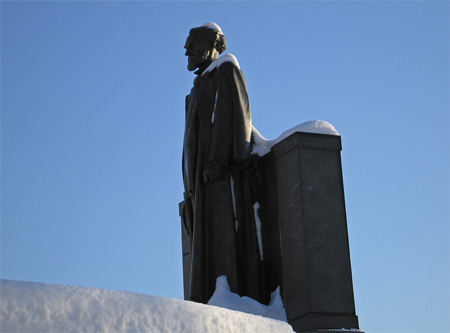
schurz.jpgLike many statues nestled along the rectangular trestles of Manhattan’s parks, Karl Bitter’s bronze depiction of Carl Schurz — situated at the corner of Morningside Drive and 116th Street — is regularly overlooked by many New Yorkers. They walk their dogs. They chat on their cell phones. They rush to important appointments or set out to beat a jogging record. But they rarely stop to observe this rather tall and intriguing figure who remains memorialized.

That’s saying something, considering that Schurz is quite vertical in design (he stands nine feet tall), his left foot juts a mite forward, and his portly girth, disguised by a thick and definitive bronze coat and cape, demands attention. To look over the promontory where Schurz is propped, you must walk up three stone steps to get an unoccluded view. But no matter what building your eyes settle upon, Schurz will remain in dogged peripheral vision. Maybe pedestrians are vexed by Schurz’s hatless and Germanic form — for what it’s worth, he does politely hold his hat in his right hand — invading Harlem’s horizontal vista, which, like every Manhattan neighborhood, is now undergoing terminal gentrification. Perhaps to live in New York, the New Yorker cannot look upon the past, but must continue contending with the swift-paced momentum of the present. And if that means accepting glass monstrosities in lieu of charming brick buildings without remonstrance, so be it. But this willful acceptance also extends to figures like Schurz, who reminds us that there was indeed a New York before the present one.

The Schurz statue is unsullied by the verdigris now eating away at another of Bitter’s sculptures — that of Franz Sigel residing on West 106th Street and Riverside, currently earmarked for renovation. Schurz and Sigel both have parks named after them. (Karl Bitter, alas, does not. New York reserves its laurels for its heros, not the artists who render the legacy.)

We know that Schurz was a military man, a political reformer, and a journalist. He spent the majority of his life outside of New York, served as Secretary of the Interior for President Rutherford Hayes, moving to the city in 1881, ostensibly to retire. But a man of his insurmountable energies could not settle down. He had twenty-five years left in his life to make a name. And he did. Starting with his immediate rise to editor-in-chief of the New York Evening Post in 1883 and followed by becoming one of the Mugwumps supporting Grover Cleveland the following year. He spoke out against Tammany Hall, drawing enthusiasm for his remarks even as a fife and drum corps passed by.

The first fact that, in our efforts for good government, stares us in the face is the existence of an organization — Tammany Hall — whose very purpose it is to give the city the worst government it dares, to the end of making money out of it. And this organization has been for years, and is now, in full possession of the municipal power.
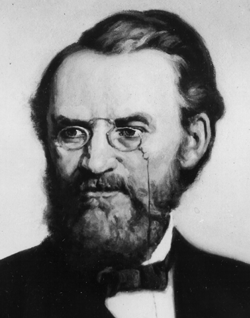
schurzreal.gifSchurz spoke these words as two friends of his were the top mayoral candidates. He would not let friendships get in the way of principle. Likewise, he did not think much of William Jennings Bryan and also campaigned against him.

As the New York City Department of Parks & Recreation is proud to announce, he was an adopted New Yorker and was often unpredictable with his political choices. Schurz was gleefully antagonistic, and on September 22, 1900, he resigned his Presidencies of the National Civil Service Reform League and the Civil Service Reform Association of New York, observing, “I frankly confess that on account of my position of antagonism to other policies of the Administration, the performance of my part of that duty is especially unwelcome to me.” But he could not quite give this ghost up and was elected the following year as President of the Civil Service Reform Association.

When Schurz was buried in Sleepy Hollow in May 1906, he had an audience both rich and poor. Andrew Carnegie and Joseph H. Choate stood beneath one umbrella. The Times described Schurz as “a publicist and patriot.” The funeral was attended only by relatives and close friends, but policemen had to stop many who hoped to get a view of Schurz’s coffin. It was Choate who ensured that the statue now standing in Morningside Park was completed.

Schurz had a reformist ebullience scarcely seen in the present political age. We now seem to settle for charisma and monoglot messages about hope. Those who do stand out are censored or declared too lunatic for the political arena. This stands in sharp contrast to the words Choate unfurled during the statue’s unveiling, “As a leader he did what is so seldom seen and yet so necessary in the upholding of the best in public life. He put expediency above personal and party advantage. He never allowed party to lead him in the wrong direction, and for years he stood alone, an independent figure in party and public life.”

At the pedestal before Schurz’s form are the words: CARL SCHURZ Defender of Liberty and Friend of Human Right.
schurz2.jpg

Today, who knows Schurz’s name outside of hard-core history buffs, fans of The Who, and curiosity seekers? Not long ago, when I visited Schurz’s statue, I observed a broken bottle of Gilbey’s upon the faded ornamental brick. The bottle had apparently been thrown at Schurz, and the glass shards glistened more resolutely than the brick. While the bottle, in all likelihood, had been hurled by a cavalier youth, I couldn’t help but contemplate whether there was a rejection of Schurz’s spirit in the air. History was apparently the work of others. But it seemed to me that it was the other way around.

Weekend Sightings: “People in Order”

The question of whether life represents a parabolic arc is taken up by Lenka Clayton and James Price‘s short film “People in Order” — in which 100 people are edited together and proceed to beat on the same drum over the course of three minutes. It’s an inventive spin on the Michael Apted formula. The people here have been arranged by age, starting from the age of 1 and ending at 100. What’s particularly striking is the varying levels of enthusiasm, both in the people expressing their age and in their need to bang the drum. Some of the figures are happy at any age. Some are sad. Some seem to wonder what all the fuss is about.

Rosebud 2.0

undress.jpgI lean into my computer screen chin on fist, eyes leveled. Before me, a woman lies face down on an unremarkable bed. A man moves the woman’s hands behind her back. The woman waits patiently as he ties her hands together securely but comfortably with a simple rope. His wedding ring gleams as he pushes up her cotton frock and takes his time easing her panties down over her thighs. For the next several minutes, he fondles her. His caresses move from the swells of her buttocks to the folds of her genitals. She undulates and rears up against his hands. His fingers disappear inside her. She exhales pure desire in this otherwise quiet scene. At one point the man clutches the woman’s hand in a silent, tender communication. Then he reaches for something off screen. Shuffling noises ensue. A twisted tube of lubricant and vibrator appear. The play becomes more aggressive, as do the woman’s reactions. She strains to open her legs against the binding panties around her knees and another rope around her ankles.
I swallow hard.

Three quarters of the way through Amateur Bondage Video, I abort my research efforts. A few minutes after that, my jeans are a jumble on the floor and I am smoky-eyed on my own bed, basking in the aftermath.

The perfect pornographic experience? Not entirely. Sure, the end result was enthusiastic enough, but I had to swim through a dangerous ocean of flesh to get here, proving that nothing is easy.

egyptfellatio.jpgPeople often assume that women dislike pornography or that they don’t like it as much as men. That’s an oversimplification. I want to like porn. But professional videos are less concerned with what feels good for a woman and more hard pressed on what is visually arousing for men — fellatio for instance. I’m not knocking it. It’s a wonderful erotic act that men love to watch, but that only gets me so far. On the flip side, pro porn constantly depicts cunnilingus as if it were a lollipop-licking contest with a misplaced emphasis on the visual. I always roll my eyes at that and think: Too bad. If he were doing it right most of the pink stuff wouldn’t be viewable.

And the subtleties: barely audible breathing escalating to a wide-eyed moan, finger strokes that tighten into a desperate clutch, the widening eyes of climax. Ideal porn would show all of this without the ridiculous staging, faux boobs and silly plots involving pool boys and “nurses.” But the professional efforts are all about those things, which is why I gave up on them years ago. One could argue that the actors love the work and the camera, but I doubt Jenna Jameson ever works for free. Pro porn stems from the exchange of money. Successful sex is about the exchange of desire.

So when XTube.com went live nearly two years ago with the option of user-generated adult content, it was a revelation–a naked YouTube, without the snarky comments. The idea seemed flawless: finally, a free-of-charge amateur alternative to the Internet’s bogus claims of 100 percent free XXX! The parade of copycat sites followed — PornoTube, YouPorn, Megarotic. The list gets longer every day. There’s a healthy dose of desire splattered on these sites. The Web 2.0 actors and directors are doing this because they want to and they want me to watch. I’m not paying to attend this soiree. I’ve been invited.

leek.jpgThe initial orgy was a blast. The woman sashaying nude down a busy street with a cigarette in one hand and a swinging purse in the other was so funny that I posted the clip on my blog and titled the entry “Confidence.” I assigned pithy quips to my discoveries and emailed the links. I asked, “Got vichyssoise?” of a huge leek being used as a dildo. “Her lips are sealed” was my commentary on the woman matter-of-factly tying her labia into a knot. These weren’t about arousal, but fun. If the people posting them were doing it to bolster their self-esteems, judging by the hit counts, they had to puff up like peacocks. I might have watched on with bewilderment, but why shouldn’t Super KnotGirl be proud of herself?

Things got cagier when I searched for something to arouse me. I passed over the male-concentric thumbnails that dominate these sites and clicked on images or titles that might have something for 42-year-old housewife and mother in Cleveland, Ohio. My five foot one stature earned Petite Amateur Keeps Fucking a click. It featured the reverse cowgirl position, which showcased the woman’s body beautifully, but her clitoris was a mile away from the action. Even 38 seconds of that was too long — I was out in 10. The thumbnail for Mature Wife And Her Special Friend looked promising with a lush sex toy and lacy stockings, but it went south when a loud radio jock’s voice suddenly plugged an event “sponsored by new Heineken Premium Light, the first light beer worth the name Heineken!”

Ugh.

I hated it when that deer-in-the-headlights thing overcame me during mediocre or bad footage. I’d push the fast forward bar along and think: will he ever take that thing out of her mouth? If he did, but only in order to ejaculate all over her face, it was an emotional pinch for me. Amateur porn is real sex, not someone’s job. I don’t want to be treated that way. How did the woman on the screen feel? I’m not judging her sexual experience, but when it comes to watching sex, I’m selfish. I can’t help but project what I see on the screen onto my own paradigm. Someone else might be doing it, but it’s still all about me. Hence, I quickly found that no matter how graphic and banal the footage, it was almost always complex.

A click here, another over there. My eyes frenetically scanned screen after screen of thumbnails. The search, with all its primal stimuli, became tiresome, even annoying. There was very little that was sexy to me. The endless surfing was the zenith of frustration particularly when I was unsuccessful. Who wants to waste an hour looking at porn that doesn’t turn them on?

I admit there are gems and high-riding waves among the online porn like Amateur Bondage Video. And I love it that 47-year-old Doris from accounting, brought up on the mantra Good Girls Don’t Do Certain Things, can slip into the den and furiously rub off while watching Lonely Housewife Fucking Her Vacuum after a lifetime of guilty curiosity. One big surprise was the relief I felt at finally seeing what other women’s genitals look like and how women touch themselves. Men have been comparison checking ever since the locker room. Board members often have nowhere to hide. Vaginas are different. Unless you’re a gynecologist or a gay woman, you don’t see them. The pink panther stays under wraps until we open it up. Even to view my own, I have to fold up like a pretzel on the bathroom floor with all the lights on and get tricky with a mirror. Playboy is no help. Hefner’s minions either Photoshop out any indication of an orifice or leave a tiny hairless line that peeps, “I’m a very well-behaved little muff.”

Double ugh.

But the online amateurs are fleshy beauties, lush with folds and colors from pink to brown to dusky rose. These are the childbearing workhorses of human sexuality, unapologetic and closed five days a month, thank you very much. They roar, “I am pussy!” and get my unconditional support.

Then there was this: the image of a man buried between a woman’s thighs moved me to click through to Female POV 3. The man was handsome and muscled. The woman was filming the action. “It’s taking too long,” he said as he looked up and revealed his flaccid penis. Next was a failed attempt at intercourse. Then the woman bent over and fingered herself to provide a visual. The man stared into her, his face vulnerable and desperate, his right hand furiously stroking. “The camera and stuff just makes me a little bit nervous,” he said. She urged him to ignore it. Nothing worked. The man collected his clothes from the floor and left. “Hey,” said the woman, whose face remained hidden, “Close the door, please.”

I blinked back tears. I was furious over the woman’s indifference. But at the same time, I waxed protective — even feeling maternal — for the man. Women complain about sexual objectivity all the time. This was the same sort of sexual abuse made worse by the unavoidable evidence, all of which was recorded by that obnoxious little broad’s camera. I wanted to reach into the screen and grab her by the neck, plop her down and say, “Think you’re such hot shit? Don’t forget that all your shaved sweetness did nothing for that man. Everything here failed, including you.”

And that is how XTube, self-billed as “the greatest thing since the orgasm,” managed a total eclipse of my arousal for the rest of the day.

I later realized that the clip was not a failure, but the most evocative footage I’d seen, hands down. It had every right to be online and then some. So it goes when you sail the sea of free online sex. Every adjective applies. It’s funny and sad and sexy and messy and arousing and painful and infuriating and, well, a lot like real sex.

But we’ve been recording real sex forever. What’s different about Porn 2.0? This new porn frontier is thriving because the logistics that heretofore governed adult content are stripped away. To procure the new sex, all I have to do is step into my home office and fire up the Mac, which is miles away from the seedy “Adult” stores on the other side of town. Once online, I’ll find all the amateur footage I want compliments of high-speed Internet and inexpensive digital cameras. The broadcasts come from across the globe.

It can be overwhelming.

The sheer volume and range of content makes me feel as though I am standing with my nose one inch away from a fifty-foot billboard that is glaring and blaring a million different sexual messages. Thus far, Web 2.0’s John Q. Public editor might be dealing aces over at Wikipedia, but not here. In fact, the more he gets his paws into online sex, the more raucous it becomes. After all, honest sex doesn’t come with six-pack abs and good lighting. Perhaps it’s no surprise that the public editors of Wiki have spent the past two years making that world look like a real reference site and making XTube look like real sex.

But do I really want Editor 2.0 to clean this sex up?

I don’t think so. Despite my quibbles, I’m rooting for all this diverse new unbridled sex with all of its imperfect beauty. And even though I don’t drop in that often, I’ll be checking in once in a while to see how things are (ahem) coming along.

Visit the 1/11/08 entry of O’Brien’s blog for pertinent links.

Interview with Jami Attenberg

(Note: The full interview excerpted here can now be listened to as the 172nd installment of The Bat Segundo Show)

For my first 2008 interview, I met up with writer Jami Attenberg at her Williamsburg apartment. During our conversation, Attenberg’s very friendly and intelligent cat, Cracker, proceeded to climb upon my leg and claw at the wires. He then deposited his slinky corporeal mass upon my lap and, later, climbed atop the table and deliberately occluded my notes. I was then forced to wing a portion of the interview. But the cat’s daring locative intervention proved pertinent to the conversation at hand.

Attenberg’s second novel, The Kept Man, is as much about a woman’s relationship with topographical territory as it is about a passive thirtysomething drifting on the dregs of her husband’s legacy. To my mind, the two themes were linked. And during the course of the interview, I asked Attenberg about the connections between her protagonist, Jarvis Miller, and the neighborhood she inhabited. (The full interview will appear in a future installment of The Bat Segundo Show.)

attenberg.jpgCorrespondent: I’m wondering also about the Terri Schiavo narrative, because it does play in more later in the book than in the beginning of the book. Did you know immediately that there was this almost quasi-allegorical feel to that? Or did it start with the fact that you had Martin Miller in this coma?

Attenberg: It started with Martin being in a coma. I knew that. Actually, the first chapter that I wrote in the book was about the donut girls at one point.

Correspondent: Oh, interesting.

Attenberg: That was the first thing. Because I wanted to write a little bit about the art world. I knew that. And then I knew that there was this man who was in a coma. I wanted to do that. But I didn’t know how it was going to end. I’ve said this before, but when you have a guy in a coma, you set the stakes really high like that. There’s only three ways that it can possibly end, which is that he dies, or he wakes up, or somebody kills him. Or he just keeps floating along, I suppose. But that wouldn’t be a very good ending to a book now, would it? So I didn’t know about the more political stuff until I got to the end of the book. I don’t want to give away the ending though.

Correspondent: No, no, no. We’re not.

Attenberg: But I really have no idea when I start writing a book how it’s going to end at all.

Correspondent: So you actually had sort of a mish-mash here. You jumped from Point A to Point 6 to Point Z, etcetera, throughout the course of writing these novels? And that’s how you sort of stumble upon the narrative?

Attenberg: I mean, the first two books I wrote — this is the second book — I wrote in about a year. So everything, like I said, it’s very organic. I just sort of making up things around me and putting them into a book. Eventually, when you get to the end, you filter out what worked and what didn’t work.

donuts.jpgCorrespondent: Okay, well, if Davis and the donut girls was one of the key starting points, was this an imagined experience? Or was this drawn from anything specific that you observed? Because I am certainly not familiar with this phenomenon. (laughs)
Attenberg: With donut girls?

Correspondent: Yeah, yeah.

Attenberg: Well, you have to live in this neighborhood. It’s more north side. We’re on the south side right now. And we’re doing this interview in my apartment. And on the south side, it’s very Hassidic and Puerto Rican and Dominican, and then when you head towards more of the north side, it’s Greenpoint. And then it’s really Polish over there. So you notice the Polish girls that are out there. And some people are really fascinated and obsessed with beautiful young woman.

Correspondent: Yeah.

Attenberg: And they’re recent immigrants. And they’re definitely a force in the population.

Correspondent: Well, I’m wondering though. Donut shops in particular. It seemed…

Attenberg: There is a donut shop! In Greenpoint. On Manhattan Avenue. And it just stuck in my brain. I think I went there after seeing a rock show. So it’s sort of like that donut shop. And it just sort of stuck in my head. And I wanted to write about it.

Correspondent: Did you observe any specific pickup artists there?

Attenberg: No. I don’t even know if people really do pick them up. It was just in my imagination that they did.

Correspondent: Interesting. Or even someone constantly buying clothes and this whole modeling thing.

Attenberg: Right.

Correspondent: The whole thing escalating into something else. This was the imagined part.

Attenberg: But that’s no different from Jarvis wanting to be taken care of. Or these men wanting to be taken care of. That there are these people in the world who look to other people to sponsor them or meet their needs. But they provide something in return. I think I missed the point that I wanted to make, which was that, after I had all these ideas about these characters and plot points, I came across the idea of being kept or held back. Once I realized that that was going to be the title of the book and that was a major theme, then it was really to go back to move forward and make sure that every character has something that’s holding them back or keeping them into their life. That’s where it comes from.

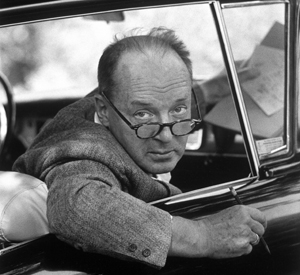
nabokov.jpgCorrespondent: Going back to this issue of topography as a launching point, it’s reminiscent to me of Nabokov’s rule, where he basically said that he could not write a novel until he actually had a particular location. Likewise, in addition to this inspirational momentum, I wanted to first of all find out if this was a factor for you in terms of writing this. And it also leads into another question about Jarvis’s perspective, where she’s generally taking a small item and putting it into a larger neighborhood. For example, there’s a pack of cigarettes she observes. And she’s very clear in the way that she describes it as coming from a particular deli and how it was actually purchased and the like. So I wanted to ask you about this phenomenon. Was this a way for you to generate momentum in your book? You needed to get the lay of the land before the lay of the characters?

Attenberg: I’ve lived here for five years. And I’ve lived in New York for ten years. So, for me, it’s not conscious in any sort of way. I wanted to write about the neighborhood that I lived in. And I take a lot of pictures. I go out a lot to document. And I have a blog. So I have been writing about the neighborhood a lot. So, for me, it’s just a natural — I don’t know. It’s not like — it’s not a conscious thing. I would love to take credit for it being some sort of conscious, deliberate act on my part. I just write about the world around me. But I did feel like, at that moment I was writing the book, that there was so much going on in Williamsburg. I mean, this is a rapidly gentrifying neighborhood. Thematically, it did feel perfect for Jarvis. Because Jarvis needs to break out of something in Williamsburg. And Williamsburg was very quietly becoming something. Then all of a sudden, it burst out and there was all this development. And people were really concerned with its development. And I think people in this book suddenly become very concerned with Martin Miller’s life as well.

Correspondent: Well, concerning this gentrification, you have Jarvis fleeing — almost like the Trail of Tears — across the river. And yet, she is very taken with, for example, bagel shops. The laundromat as a kind of social nexus. As well as finding comforts in the very locations that she often despises. So I’m wondering when did you know that this was coming up. Did this come about from knowing the neighborhood or as an extension of Jarvis’s consciousness?

Attenberg: I think that, if you’re going to write a true New York story, you have to write about all of these little shops and stores. We don’t know our neighbors a lot of the time. Our friends tend to live really far away from us. Or it’s not like you can walk down the street and knock on someone’s door and see them. So it becomes really crucial where you have these relationships with a person at your bodega, with a laundromat. It’s just an interesting community. And in Williamsburg, where there’s so many different kinds of people here, and there’s this big influx of young people who really like to engage, it just seems really natural. I don’t know. That’s just my version.

Correspondent: So it sounds like it very much is a topographical concentration.

Attenberg: But she’s not me. But it’s just how someone like her would. You know, I certainly identify with her. I don’t think that I’ve ever done anything that she’s done before. And I’ve certainly never had anyone support me.

* * *

For related conversations, see Jami Attenberg in conversation with Kate Christensen and Ryan Walsh interviewing Attenberg at Largehearted Boy.

Rep. Randy Forbes: Revisionist Historian

House Resolution 888 (presumably 666 was unavailable) aims to celebrate and glorify a little bit of that ol’ time religion in a very big way. The resolution, introduced by Rep. Randy Forbes of Virginia and signed on and unquestioned by 31 co-sponsors, wishes to “rejec[t], in the strongest possible terms, any effort to remove, obscure or purposely omit such history from our Nation’s public buildings and educational resources.” It also wishes to set up an “American Religious History Week” each year “for the appreciation of and education on America’s history of religious faith,” although the resolution’s litanies are curiously Judeo-Christian in priority. (Where other civilized nations remain capable of walking and chewing bubble gum on this topic, it appears that, when it comes to religion, the United States can only concentrate on one religion at a time. There was no greater example of this deficiency in national character than last Sunday’s “Islam Issue” of the New York Times Book Review.)

bushreligion.jpgI’m fine with the appreciation and education of American history. I’m not so fine on politicians seeing deities and religious influence in every corner and demanding that the country be “educated” about it. In examining Forbes’s endless “Whereases,” I’ve found more than a few historical humdingers and at least one egregious prevarication.
Whereas the Supreme Court of the United States affirmed this self-evident fact in a unanimous ruling declaring `This is a religious people … From the discovery of this continent to the present hour, there is a single voice making this affirmation’;

The specific case being quoted here is the 1892 case, Church of the Holy Trinity v. United States (143 U.S. 457). But it was Justice David Josiah Brewer who stated this in the opinion, which was not based upon upholding religion, but concerned whether an Act “to prohibit the importation and migration of foreigners and aliens under contract or agreement to perform labor in the United States” applied between an alien and a religious society. And while Brewer’s words do regrettably speak for the Supreme Court, it is highly disingenuous to suggest that the ruling, which dwelt upon an entirely separate decision, had to do explicitly with religion.

Whereas political scientists have documented that the most frequently-cited source in the political period known as The Founding Era was the Bible;

Since the bill fails to cite any specific political scientists, I must conclude that they are referring to the claims made by two University of Houston researchers, where it was demonstrated that of the purported 94% of all Founding Father Biblical citations (or conclusions based on the Bible), 60% of these citations were from the latter and the sources were unclear. Much, it would seem, as Forbes prefers to conjure up the ghosts of “political scientists” as he goes along.

Whereas the first act of America’s first Congress in 1774 was to ask a minister to open with prayer and to lead Congress in the reading of 4 chapters of the Bible;

If we are presumably talking about the First Continental Congress who met at Carpenter’s Hall starting on September 5, 1774, is this truly “America’s first Congress?” The First Continental Congress met up two years before the Declaration of Independence was agreed upon, thus technically making it more of a British colonial congress (or a response to oppressive conditions) rather than a United States congress proper.

Whereas Congress regularly attended church and Divine service together en masse;

How do outside religious activities pertain to what Congress does within its halls? If Congress attends a stag party en masse, we don’t ask for a “Scotch and Hookers History Week?” (Or since we’re talking about Rep. Forbes, why not an “Abramoff Corruption History Week?”)

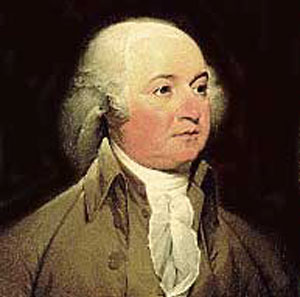
Whereas upon approving the Declaration of Independence, John Adams declared that the Fourth of July `ought to be commemorated as the day of deliverance by solemn acts of devotion to God Almighty’;

johnadams.JPGWell now, let’s take a look at that letter Adams wrote to his wife Abigail on July 2, 1776. First off, Adams was tickled pink that the Continental Congress had that very day unanimously approved the Declaration of Independence. Which is no different from yelling “Holy shit!” when some particularly great news has poured into one’s ears. The fecal matter in question is not necessarily holy, but the speaker is certainly excited. Nevertheless, here’s the full paragraph that Adams wrote:

But the day is past. The second day of July, 1776, will be the most memorable epocha in the history of America. I am apt to believe that it will be celebrated by succeeding generations as the great anniversary festival. It ought to be commemorated, as the day of deliverance, by solemn acts of devotion to God Almighty. It ought to be solemnized with pomp and parade, with shows, games, sports, guns, bells, bonfires, and illuminations, from one end of this country to the other, from this time forward, forevermore.

Clearly, deities weren’t the only thing on Adams’s mind. This was an excitable moment in which Adams was rattling off many of the ideas to his wife in Braintree. Adams was lonely in Philly, a bit busy contemplating nothing less a major revolution (inarguably a political achievement far more profound than anything Forbes has planned in his life). So I think, under the circumstances, he should probably be cut some slack. Besides, what of these other ideas that Adams had in mind? What of “guns, bells, bonfires, and illuminations?” It’s a pity that the only people who seem to get together to educate themselves on these topics are libertarians.

Whereas 4 days after approving the Declaration, the Liberty Bell was rung;

Whereas the Liberty Bell was named for the Biblical inscription from Leviticus 25:10 emblazoned around it: `Proclaim liberty throughout the land, to all the inhabitants thereof’;

To take these two items at once, while it is true that the Liberty Bell’s inscription was taken from Leviticus 25:10, the Bell was commissioned not to celebrate religion, but to commemorate the 50th anniversary of William Penn’s 1701 Charter of Privileges. Penn was a big God-loving man himself, but he, nevertheless, had this forward-thinking idea:

That no Person or Persons, inhabiting in this Province or Territories, who shall confess and acknowledge One almighty God, the Creator, Upholder and Ruler of the World; and profess him or themselves obliged to live quietly under the Civil Government, shall be in any Case molested or prejudiced, in his or their Person or Estate, because of his or their conscientious Persuasion or Practice, nor be compelled to frequent or maintain any religious Worship, Place or Ministry, contrary to his or their Mind, or to do or super any other Act or Thing, contrary to their religious Persuasion.

Well, gee, that sounds like a guy who was pretty hands-off when it came to enforced church going. Funny. When you start examining the specific reasons why certain symbols were established, the origins appear decidedly more tolerant than Bible-thumping pettifoggers like Forbes concocting 21st century malarkey.

Whereas in 1777, Congress, facing a National shortage of `Bibles for our schools, and families, and for the public worship of God in our churches,’ announced that they `desired to have a Bible printed under their care & by their encouragement’ and therefore ordered 20,000 copies of the Bible to be imported `into the different ports of the States of the Union’;

The Daily Kos would prefer to declare this a lie without bothering to look this up. And that’s a very bad precedent for any thinking individual. The specific claim was promulgated in William Joseph Federer’s America’s God and Country Encyclopedia of Quotations (p. 146, if you can access it through Google Books). Federer claimed that, on September 11, 1777, the Chaplain of Congress, Patrick Allison, brought this matter to Congress’s attention and that the Committee of Commerce was ordered to import 20,000 copies of the Bible from Holland. Except that, according to the Library of Congress, this did indeed happen.

randyforbes.jpgThe bullshit actually comes from Forbes, who puts phrases into Rev. Allison’s mouth that, as we can see and unless I can be proven wrong, simply don’t exist on the official record available to the public. Allison got Congress to move the Bibles not because Congress “desired to have a Bible printed under their care & by their encouragement,” but because, as the record states:

The committee appointed to consider the memorial of the Rev. Dr. Allison and others, report, “That they have conferred fully with the printers, &c. in this city,and are of opinion, that the proper types for printing the Bible are not to be had in this country, and that the paper cannot be procured, but with such difficulties and subject to such casualties, as render any dependence on it altogether improper: that to import types for the purpose of setting up an entire edition of the bible, and to strike off 30,000 copies, with paper, binding, &c. will cost £10,272 10, which must be advanced by Congress, to be reimbursed by the sale of the books: (Emphasis added)

It was a general paper shortage that caused the Rev. Dr. Allison and others to figure out how books in general could be printed under the circumstances.

* * *

I’ve Googled around after typing all this, and discovered that Chris Rodda has also done some debunking.

Rep. Forbes’s bill is clearly that of a man quite willing to twist history to serve his religious purposes. It seems that Randy Forbes either does not know his history or he wishes to malign it by not citing events and context properly. On this basis alone, the bill should be rejected by any thinking representative. And if it is not, if a few Democratic cowards actually vote for this flummery because they fear that their constituency will view them as not “religious” enough, then it is time for them to be shamed. Just as that corporate buffoon Hillary Clinton got her ass handed to her in Iowa. The American people are not nearly so foolish.