Elevator Romp (NaNoWriMo #7)

[Table of Contents]
Start at the Beginning: The Daily Seven (Chapter 1)
Previously: Bumper to Bumper (Chapter 6)
(Image: Daniel Lin)

“Car…three…to your right.”

The grating automatic voice burrowed into my skull like a hand drill boring into wood. I was still wrapping my head around what Dottie had become, repulsed by how casually she had stubbed out lives for my convenience and nearly forgetting that I had a twelve hour day ahead of me. But I had to do it. Even if I didn’t know if I could take up my perch across from the death house at seven o’clock. But I would still it. Bigger men than me had turned with the Ruler and I wondered if my number would ever come up. Bearing witness to our nightmare was the only way to figure out how to fight it. It kept what was left of my heart alive, although I felt like the most frivolous impostor for playing backgammon, for daring to connect, for finding my own entertainment outside the hookups and the violence. In some ways, I was just as culpable as the murderous rabble.

I stepped across the long stretch of the chartreuse laminate floor that had just replaced the neon orange granite, which in turn had uprooted the gold-tinted limestone installed and drilled out only months before, and entered the elevator that every worker had downvoted in a rare act of passive-aggressive solidarity. The world had hardened so much that you had to be grateful for even the smallest acts of resistance. It was a minor affront to the myth of zero tolerance, a New Amagacan policy that could only be upheld when death was as cheap as flour. The rattling building was always under construction, always aflutter with relentless aesthetic tinkering to get closer to the Pure Pleasure ideal. We would spare no expense in erecting a pleasure friendly infrastructure. The government had deep pockets from the wealth it extracted from the daily seven victims, who were denied even basic inheritance rights as the death house growled for their lives. It was important for New Amagaca to be a sustainable nation, preserving and redistributing resources to any fine corrupted mind who was prepared to carry out the Ruler’s edicts. We had somehow enacted billet transfer programs for the widowed and the orphaned, but if these souls didn’t grieve within a month or display the appropriate gratitude for the many “thoughts and prayers” that the aldermen had announced on the social networks, they would be sent to the camps for emotional recalibration.

I had been able to justify most of my repeals simply by filing reports to the hard-hearted bean counters showing why and how it would be cheaper for my cases to use their talents for the world rather than getting trucked off to the camps. If I had to, I would painstakingly coach a near lost cause on how to act and eat at brunch. I wanted people to survive. If enough people lived, perhaps there would come a day in which the daily seven would stop.

The smart elevators were not as intuitive as the government believed. When the Ruler had banned all up and down buttons, he had believed, as many New Amagacans did, that tech was the infallible path forward. But in halting those accidental run-ins with people on different floors, the Ruler had deracinated the more natural connections between strangers. The jokes joking about the latest news. The friendly chatter about the weather. We were meant to hookup because it was vital for the government to log every social interaction. Even before the Great Turnover, we had surrendered all our personal information to the social networks, giving our most intimate feelings away for an opportunity to find love or to move animated bits of candy around on a pulsating screen. When you train a populace to surrender the tenderest knickers for nothing, it is easy to push them into behaving for much less.

The climb to the 427th floor was always a long one, but that had not stopped two hookups from going at it behind me. The elevator romps had grown more popular in recent months as people scrambled to preserve their status ratings. They had replaced the morning quickie as a fast way of earning an upvote. They were working us harder and some of us didn’t have the energy to hookup as much as we like. I straightened my tie as I noticed Samantha Lowry, Vice President of Claims Review, against the elevator wall, arching her legs around Cliff Huld’s alabaster torso. I didn’t like Huld very much. He was smug and pompous and always delivered these interminable and uninteresting tales whenever you replenished your coffee. He had a nurse named Leni who often followed him around as he moved from chamber to chamber leading his case load on, never granting repeal and always boasting about how he had become the ping-pong champion in Sector 52. But I didn’t downvote him. I tried not to downvote anybody, even the most deplorable souls screaming obscenities in the streets. But Huld really liked being a four and had to hookup more frequently than the rest of us to preserve his precarious status. That Samantha had taken pity on him was something of a surprise, given that she was less than a tenth away from being a five.

“Ohhhh, ugh, ohhhh — oh, hi, Alex — yes! yes, that’s it! Hit me right there — ugh, ugh — did you have a nice Thursday?”

Small talk was always difficult when you saw a colleague thrusting his hips into someone who you had delivered a report to only two days before, but it was not impossible.

“It was okay.”

Huld didn’t say hello at all. But Samantha was enjoying herself so much that this hardly mattered. She shrieked with want at the top of her lungs as the elevator dinged and the doors slid open.

“YESSSSSSSSSS!!! That’s great, Alex…oh yeah, keep going, Cliff! Ohhhh….see you at the lunch meeting?…oh, yes, yes, YESSSSSSSSS!! I think I’m going to come! Ohhhhhhhhh!”

“Yeah. See you there.”

I walked into the receptionist area. The elevator doors closed behind me. Ben was there with a big smile. He handed me the morning dispatches.

“You may want to call the building. It looks like they’re going to have a mess to clean up in the elevator.”

“I already have, Mister Schuld!”

“How many cases do I have today?”

“Just one this morning. I cleared up your schedule so you could finish your paperwork….or….get lucky. I’ve noticed your rating has taken a minor dip.”

“Thanks, Ben. I appreciate it.”

“You’re looking a little pale.”

“Rough morning commute, that’s all,” I said, flipping through the new reports.

“Well, if you want to get an early start, the attendants have prepared Chamber 22 for your intake.”

“Thanks.”

I skipped the morning coffee routine and passed up the Casual Friday bagels. People often got so excited about bagels that you would often see scenes that resembled something out of that old Pasolini film, Salo, as you spread your schmear. I decided to head to Chamber 22 and get the new case intake out of the way. I opened the doors and saw a woman handcuffed to the stainless steel table. She was crying.

“Alex?”

“Denise.”

Now I knew why she couldn’t meet me for backgammon.

Next: The Intake (Chapter 8)

11357 / 50000 words. 23% done!

Bumper to Bumper (NaNoWriMo #6)

[Table of Contents]
Start at the Beginning: The Daily Seven (Chapter 1)
Previously: The Betrayal (Chapter 5)

The door closed with a sealed shudder and the air gelled to a creepy still. We had only the smooth purr of the town car’s motor and the gentle hiss of the air jockeying for some modal answer to white noise. I tossed my beige bulk onto the plush Corinthian leather seat across from Dottie. I could feel her breathing and beaming, her eyes on me like a lackadaisical meat inspector, but I didn’t want to look at her. I didn’t want to be reminded me that sitting before me was the residue of the woman I had once loved and lost. But I did glance up and I met her eyes and the joy was gone. She was one of those people who walked the earth with a dead sardonic look. But in New Amagaca, that was pretty much all of us.

“Are you here to ruin me again?”

She smiled. A smile that once flowed with natural charm, but that now steered you to look into her eyes even if you were glancing out the window.

“Show some gratitude for a lift, Alex.”

“How did you find me?”

“I was canvassing this sector for a retrofit and my phone blipped. It said you were in the neighborhood.”

“So I’m still bookmarked.”

“Oh, I didn’t bookmark you. That was an accident. But the matrix is automated to remind us of loved ones. Or former loved ones. Reconciliation is prized, although, in your case, I forgot to remove you from my contacts. But I figured that since you were probably still working in Midtown and we were both heading in the same direction…”

“Spare me your charity. You broke my heart.”

She smoothed her hands on her bright golden skirt and shifted upward in her seat.

“Now, Alex, we’re supposed to stick together. That’s the Amagacan way.”

“The way you sold out Sheila. The way you led a status downgrade campaign against me.”

“I could downrank you now if I wanted. Have you thought about that?”

I lowered my head. I looked out the window. We were rolling across what had once been called the Williamsburg Bridge, now christened the Scott Baio Memorial Bridge in honor of his service and sacrifice at the Virginia Massacre. The pedestrian walkways above us were still painted pink. That was one of the few parts of New York they still hadn’t painted over. Several people who couldn’t deal with a life of constant pleasure were leaping to their deaths in the designated suicide zone.

“I was about to call in sick.”

“Now that I would have liked to see. But you got in the car, Alex. It was your choice.” She leaned in. Only a few inches, but it felt like she was right next to me, the very inverse of five years of intimacy. “It was always your choice, Alex. That’s why I had to call the police.”

There was a striped leather portfolio on her lap. The Ruler’s crass insignia — an ankh crammed between the two Chinese symbols for joy — was stitched into the polyurethane.

“For what it’s worth,” she said, “I’m glad you’re still alive.”

“You certainly didn’t make it easy.”

I checked her profile on my phone. Not that I needed to.

“I see you’re a five now,” I said.

“And you’re still toiling in the Abrogation Department?”

“Yeah.”

“How many repeals?”

I was still gazing into the addictive light of my phone even though I didn’t need to, given that I knew that the government only distributed these bright spiffy portfolios to the fives. I guess I needed some statistical confirmation of just how much Dottie had changed. The data provided more comfort than the face in front of me. As a lawyer and now an abrogator, I had always been committed to the evidence. Facts always triangulated between the hurt you were feeling in your heart and the pain you were willing to bear in the future. There was only one conclusion that I could ever form from the supportive material: Dottie had once been the most compassionate soul that I ever knew. She’d stop and buy a sandwich if she ever saw a homeless man. She’d surprise me with dinner if I arrived home late after a long day of writing briefs, just to prove that she wasn’t the only one in our flat who knew how to dazzle in the kitch. We were going to honeymoon in Goa and spend part of our time building shelters in Bihar. Maybe we’d both fallen into that neoliberal middle-class trap of being globetrotting do-gooders. The kind that Thomas Friedman used to extol before he was assassinated during a pubic lecture when he claimed that the Virginia Massacre was just a passing phase of capitalism. They sliced the part of his skin where his mustache rested above his dead lips and the barbarians nailed it to a stick and paraded it along Broadway during the time that the anti-intellectual mobs had formed. When the Great Turnover came, the centrists were the first to surrender their principles to save their own skin, much as they’d severely underestimated the rabid American id that led to all the assassinations. And Dottie had been among the first to change.

“More than I’d care to report. How did you land the five star treatment?”

“I earned it. Just as you climbed back to four.”

“You didn’t help.”

“Sometimes we need to fall down to rise up.”

“Tell that to the folks we just passed on the Baio Bridge.”

“Bootstrap capitalism! It’s not as bad as you think. Here, let me show you something.”

She pulled out a tablet from her portfolio and spun the screen around so I can see the screen. It was an Excel spreadsheet:
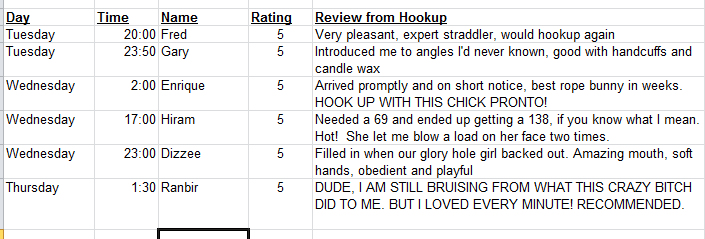
You saw many good people shift to such a life, but to see her hookups tabulated like this was too much for me to bear.

“You were always a good data aggregator,” I croaked, fighting back tears. You really couldn’t cry in a climate devoted to pleasure. Crying was forbidden, although you could find a grief hookup if you were careful with the phrases you typed into the search engine.

“Come on, Alex. You asked the question.”

“You didn’t have to do it that way.”

“Are you trying to slut shame me?”

“No. Your life is your life.”

“I’m trying to help!” she said with a freakish enthusiasm. “I was only trying to encourage you! You’re a smart man and you deserve to be a success! I want you to be a five!”

The hell of it was that she really meant this. She really believed that the cold presentation of her dalliances somehow justified her life. It was almost as if she had no memory of the status downgrade. Even the best of us couldn’t always remember the past. We were doomed with the deficiency of our collective memory.

“I’d like to get out of the car.”

“But we’re only ten minutes away. You don’t want to get sick, do you?”

I didn’t, but my stomach was in torrid knots. I was doing everything in my power not to throw up. I didn’t want to fuck anyone after seeing that list. She had known every part of me for five years. We had shared words together that had been burned like the old NYPL catalog. Part of me wondered if my full tabulated essence was memorialized in some way on that tablet.

“Okay,” I said. “Just so long as I’m not cramping your style.”

“Not at all. You know I couldn’t see you when you were a three.”

“You couldn’t love me when the ratings matrix kicked in.”

“Now, Alex, do I have to downvote you? I’m giving you a ride so you can earn your credits! You know we can’t talk about the time before. You’re lucky I didn’t invoke my executive privilege when you started asking your questions. As the Ruler says, ‘Questions are a millstone to progress. Answers are no substitute for pleasure.'”

I was still feeling reckless. Why wasn’t I there with the hopeless cases on the Baio Bridge? Because I had lives to save, that’s why.

“Do you really like being a citizen of New Amagaca?”

“I’m going to pretend I didn’t hear that, Alex, but, yes, it’s been treating me very well.”

“I’m sure.”

“Why can’t you have fun like everybody else? I’ve felt so liberated ever since I changed my focus!”

“What about love?”

“What about love?”

“What about what we had?”

“Alex,” she whispered in a very worried tone. “You know there’s a heavy status fine if you even consider romance.”

“Alright. Romance is dead. Revoked by Ruler decree. So what are you doing these days?”

“They now have me working on the new city grid. Speaking of which…”

She knocked on the window separating us from the driver in the peaked cap.

“Petey?” She turned to me. “You’re near the Citadel, yes?”

“Two blocks away. Near 48th.”

We were stuck in traffic. I was going to be late. The partition slid down.

“Petey, is there any way that we can speed things up?”

“I’m afraid not, Miss Farrell. Bumper to bumper.”

“Oh dear.”

“I’m going to be late.”

She opened her portfolio and took out a military-grade Toughbook. One of those rugged beasts designed to withstand an EMP.

“You’re not going to be late.”

“How?”

“Well, I shouldn’t be telling you this. On the other hand, I could sentence you to death if you spill. So here goes! The Ruler has been developing a new strategic defense grid in every Amagacan city. But we had an infrastructure in place before the Great Turnover. Do you remember the eye in the sky?”

“The elaborate surveillance system that the NYPD had put into effect. They had added audio sensors.”

“It was in the early stages of being weaponized! Watch this!”

I couldn’t really see what she was doing, but, from my vantage point, it looked like she was logging into a shell account. I looked out the window, watching two men paste a new poster of the Ruler onto a fraying billboard.

“This is like that Don DeLillo novel.”

“Don who?”

“Come on. I wasn’t the biggest fan and he wasn’t all that of a favorite. And this wasn’t one of his better novels. Cosmopolis. You remember that one?”

“I don’t know who Don DeLillo is.”

“The only thing missing in this limo is the floor of Carrara marble. And you know damn well who DeLillo is.”

“No, I don’t. Quiet. I’m concentrating.”

I had five minutes to get to the Abrogation Department. There was a chance I could get out and huff it. But as I was considering my plan to be timely, there was a giant rumble outside the car. A gray drone, roughly the size of a storefront, was hovering in the sky outside.

“Aha! It worked!”

“You summoned that?”

“Watch this!”

The drone flew in front of us. I looked ahead and saw that two trucks were tying up traffic.

“Let me check.”

The tapping of keys.

“Nope. Non-essential goods.”

“What do you me….?”

The drone fired a rapid burst of bright purple lasers into the two trucks, targeting the fuel tanks. There was an explosion. The trucks burst into flames. I watched one of the truckers dive out the melting frame of his door, howling at the top of his lungs as the flames charred his body. From one of the spires above us, a sniper locked his rifle on the trucker and put him down with a swift head shot.

“Jesus!”

“Don’t you love new technology? Now let’s see if this works!”

The drone then fired a white spray. The window was cracked and the air around us smelled antiseptic. Some of the cars pulled over, not wishing to be victims of the drone. The spray subsumed the ruined trucks with a fast foam. The drone then hovered above the truck. Two robotic impediments looking like outsize claws designed by a sociopathic MIT genius hopped up on one too many James Cameron movies pushed from the drone, rapidly flattened the truck into scrap metal, and proceeded to lift these resources with it up into the air, where the loud roar dissipated as it flew to who the hell knows where.

Petey put the pedal to the metal.

“It worked!” shrieked Dottie. “We’re going to get you to work on time!”

“You just killed two people.”

“Well, Alex, you’ll probably save two people today when you’re taking in your case load. So it all evens out! I can’t wait until the IT people hear about this.”

What the hell did death mean anymore if everyone was a potential experiment for new tech?

The limo rolled up to my building.

“Dottie, can you do me a favor?”

“Aren’t you going to say thank you?”

“Thank you. I say that only because I have to. Can you do me a favor?”

“Anything for you, four star Alex!”

“If you ever see me wandering around a sector you’re canvassing, please don’t contact me again.”

“Oh.”

“Yes, oh. It was nice knowing you, Dottie.”

I left the limo. I had two minutes to get to my office. As the limo rolled off, I stumbled into the alley where I smoked cigarettes and took deep pulls from my flask after learning that a repeal I had painstakingly tried to make happen did not go through. I threw up, found the polka dot handkerchief already soiled with Grace’s Thursday upset, straightened my tie, and scanned my retina at the security booth for another long day at work.

Next: Elevator Romp (Chapter 7)

10150 / 50000 words. 20% done!

The Daily Seven: A NaNoWriMo Novel — Table of Contents

I had absolutely no intention of writing a NaNoWriMo novel in real time. And yet, on the morning of November 1, 2017, I ended up imagining a death house in which seven people were selected by a computer algorithm to die each day in the near future, in which a fascist government named New Amagaca had replaced America. Four days later, I have now written 8,000 words of a crazy and hastily written novel that I am now calling The Daily Seven. I don’t know if I will go through with this or not, but here is a table of contents for readers wishing to follow along:

Chapter 1: The Daily Seven (November 1, 2017)
Chapter 2: A Pot of Tea (November 2, 2017)
Chapter 3: We’ll Always Have Brunch (November 3, 2017)
Chapter 4: Every Subject’s Soul is His Own (November 4, 2017)
Chapter 5: The Betrayal (November 4, 2017)
Chapter 6: Bumper to Bumper (November 5, 2017)
Chapter 7: Elevator Romp (November 6, 2017)
Chapter 8: The Intake (November 7, 2017)
Chapter 9: The Limits of Moral Depravity (November 7, 2017)

The Betrayal (NaNoWriMo #5)

[Table of Contents]
Start at the Beginning: The Daily Seven (Chapter 1)
Previously: Every Subject’s Soul is His Own (Chapter 4)

“You,” I said.

Her name was Dottie Farrell and I had once loved her with all my heart. It was the kind of love where you made homemade chicken soup when she was sick, cooked three-course meals when she wasn’t, felt that you could share every skeleton kicking up dust in your closet, woke up every morning to ensure that the now luxurious whiff of coffee curled into every stray corner of our shared tome-lined apartment, held her in your arms when she had doubts about her career and America’s then waning legacy, negotiated detentes between pugnacious family members, and gave every bead of sweat and then some to hold onto a marvelous woman you only wanted to love deeper and grow old with.

When the Great Turnover had been more of a joke rather than a fearsome political reality, I had taken Dottie’s hand, sashayed the two of us into a cab as the racist driver yammered on about the Muslim ban (and we both gritted our then chattering progressive teeth), and escorted her up the steps near the edge of Fifth Avenue into the Met’s roomy, always reliable sanctuary. This had all gone down just six months before the new regime decided to incinerate this great museum (and all the art within it). But we could not know then that the jihad against art, which had then been little more than a deranged thought experiment from the far-right Republicans who were becoming the new normal, would actually be carried out. We could not possibly foresee that the idea of New York as the art capital of the world, with its free museum days and its eccentric tapestry trade, would so easily slip from our happy quotidian grasp. We sauntered past a bust of Alexander Pope and took the elevator to the rooftop garden, ignoring Adrián Villar Rojas’s ribald sculptures to take in the glorious green view of Central Park. It was a crisp day in early autumn, back in the days when we still had autumns and the earth hadn’t yet shifted to a stark two season year. The high winds lapped at Dottie’s blonde curls, pushing them into an intoxicating whirl, with the sun somehow brightening her eyes as if they were delicate porcelain in dire need of a fine light. Dottie and I had been together for five blissful years. There had been more ups than downs. Our friends said we were meant to be together as our hair turned gray and the crow’s feet crinkled against the corners of our lively eyes. The perfect couple that gave everybody hope as we all suffered through the hellish nonstop headlines.

We moved in together after nine months of dating, renting out a near palatial apartment in Jackson Heights. Two years later, we made the bold choice of wedding our books, somehow believing in the permanence of love as the world came closer to burning, selling off the remaining dupes to the now firebombed Strand and spending the loot on a lavish low-key dinner of pork rillettes and shimmering scallops and a bottle and a half of fine claret. A year passed and I took her to the same place again when it became more dangerous to leave the house and you needed fixers to get you from Brooklyn to Manhattan. The candles glowed and her olive cheeks deepened and the brisk beauty and sharp wit that I had known in the day and night of a more hopeful time somehow persuaded me, as all of us were then still struggling and then still polarized with disbelief, that love could indeed conquer all. I dropped to my knee and opened the case and asked her to marry me as a costly trio of violinists hired on short notice played Sara Bareilles’s “I Choose You.” Dottie said yes and we made love three times that night.

Six months later, as the court system was being dismantled and I was doing everything I could to preserve due process when the Ruler declared martial law, she had called the police to drag me out of our apartment. I escaped being cremated in the camps only because I had a few surprisingly loyal friends in high places that I knew from the weekend basketball game. People who still felt pity for a former civil liberties lawyer who was now down and out. People who somehow knew that even a cynical man like me might rise like a phoenix, if not to save the day then to at least preserve some small scrap of a world that had once prided itself on bonhomie and camaraderie.

Our phones were then being hooked up to the ratings matrix. We were being asked to turn over our driver’s licenses and burn our social security cards. It was impossible to walk through the streets of Brooklyn without smelling the burning corpses of people who had been shot by well-groomed thugs after daring to say no. The Great Turnover took us all by storm. We would no longer be able to vote, but we could make democratic choices against our neighbors. We no longer had the Fourth Estate, but we did have social networks, although anyone who dared to talk about politics quickly disappeared. As the world fell apart and the last of the resistance was marched to the camps, Dottie prioritized surviving over the enduring independent power of our love, as so many people did.

And now Dottie had somehow found me in a sector of the city that I might have recognized only four years before if the Ruler hadn’t razed the buildings and massacred entire neighborhoods. She was doing very well. She was looking very sharp. And the man in the peaked cap was malleable clay within her exacting fascist fingers. The limosuine’s door was open. I had thirty minutes to get to work. I had no other choice but to step inside the car. What other option did one have in New Amagaca?

Next: Bumper to Bumper (Chapter 6)

7874 / 50000 words. 16% done!

Every Subject’s Soul is His Own (NaNoWriMo #4)

[Table of Contents]
Start at the Beginning: The Daily Seven (Chapter 1)
Previously: We’ll Always Have Brunch (Chapter 3)

Grace never told me where she worked or what she did or whether she liked her English muffin lightly toasted or extra crispy, but no one ever chased these harmless subjects anymore. “What do you do?” — once the darling question of small talk that tied the room together — had lost its meaning not long after the Virginia Massacre and the subsequent race riots and the purges and the Congressional assassinations had forced the government to roll into every city with humvees, assigning us our new vocational roles at gunpoint, the social contract extending into free-form fucking (even though most of us managed this quite well on our own before the Great Turnover). Grace and I agreed to meet again. She even reconsidered learning backgammon.

We exchanged numbers just before she clipped on her cubic zirconia earrings, smiling her finest Duchenne before the inspection camera to verify her singlehood, and we rated and reviewed each other for the quality assurance elite (“Five stars. Expert at reverse cowgirl. Attentive to cock. I’d do her again,” read my vulgar and now far too common lie). I left the singles housing unit wearing the previous day’s threads, wondering if my martinet manager would notice that my beige jacket was the same as yesterday’s. There was a good chance he wouldn’t. His paperwork never stopped.

I had taken a slight risk wearing beige to work. Beige wasn’t necessarily a deal breaker, but it was mildly rebellious given that we had been asked to adorn our starved bodies with loud and bright hues to promote universal pleasure. Beige was my answer to the final movement in Shostakovich’s fifth symphony, not that any New Amagacan knew about classical music. Under the Ruler, you were lucky if you heard someone deliver an especially famous Shakespeare quote. The great secret of his autocratic success was to tire us out, insinuating that any work of art which stimulated the mind was akin to eating one’s cultural vegetables, so that, in our collective fatigue, we would never remember any significant artistic achievement from the time before. Culture had not been banned. The First Privilege had guaranteed us some remaining rights. But if you hoped to stop the population from caring or thinking about anything substantive, you had to create a climate in which the beauty of a baroque quatrain was as unappetizing during one’s spare time as a gratuitous backbreaking task.

I ambled along the sidewalk, which was being hosed down with exacting fury by two moribund men with hardscrabble cigarettes sticking from their lips like toxic lollipops. My phone revealed that they were both single and both twos and that neither had hooked up in quite some time (it was never easy for twos), which accounted for why they had been assigned to sweep the streets. One had to be careful with twos. They were more prone to crime, which could not be entirely eliminated by the Ruler even with his zero tolerance policy. But very often, a two’s infractions were never severe enough to warrant public execution. The expense of trucking away a two to a reeducation camp was too risky in a fragile economy. I suppose, if we had unlimited resources, the Ruler would have pushed harder. But it was also important to give every able mind a chance at redemption. Sometimes when you went out to brunch — and everyone went out to brunch, especially after the Ruler had reminded us — you would see a four obliging a two. (Giving spare credits to an under three was punishable by death under Protocol 47.) Then you would go to church and see the same four standing on the dais, without the two in sight, being extolled for being a good Amagacan. The next weekend, you would see the four with another two and the ritual would repeat and, very soon, the four would become a five, getting an item placed in the news feed and an assignment in charge of some vital municipal task. Meanwhile, the twos would disappear, sometimes becoming ones and leaving themselves vulnerable to a swifter daily seven selection. I knew that life as a two was difficult, but this was one of those problems that we never talked about. Status warfare was the cost of a greater New Amagaca, much as we had been blind about class warfare in the days before the Ruler. The last journalist who dared to write about this topic had been shot by the producer on the nightly news, with the bonanza ratings from the live stream rapidly superseding anything he had to say.

The two twos toodle-ooed me as I stared down at my malfunctioning GPS, hoping that the network would clear up so that I could find the swiftest subway to work. The street sweepers probably knew the city better than I did, but, when it came to consorting with citizens who were two stars beneath you, you really had to give rather than take. That was the way it worked. Ask only of others in your rank. If you dared to ask a favor of a two, you would have to hookup more frequently to sustain your four rating. Because talking with someone beneath you was considered an act of weakness, even when the propaganda dictated that everybody was worthy of a good pleasurable life under the Ruler.

Grace’s neighborhood was devoid of street signs and my GPS still didn’t work — even though I could make out the mile-high Burj Amagacana glistening in the distance. Which meant that I was very far away from work, unless I could find a subway that could take me there fast. I had thirty minutes to report to my auditor job or get downranked to a three. There had once been a time in which you could hail a shared vehicle, but such conveniences were now a month’s salary and largely belonged to the fives. Two years before, I had gone to a specialist to repair my status rating. And it had taken me a good year to climb to a four.

There was the option to use a sick day, but calling in sick would mean doctors taking me to a sybarite facility, where medical professionals would force me to hookup with six sick strangers a day until I got well. I would actually have to fuck these people — for there was no privacy for the infirm. The Ruler has bought into the anti-vaccination argument that had proven popular before the Great Turnover and believed only in hookups as the secret to good health. So you would have cancer patients locking lips with old citizens suffering from dementia. I often wondered if this had been a callous and crafty way of letting the sick die. This was the only healthcare we had. Bona-fide doctors were reserved for the fives. Still, a few popular pornographic stars had emerged from the sybarites. As the New Amagacan regime carried on, you learned that there was a kinky niche for everything.

There was also the matter of my caseload, which I really didn’t want to fall in the hands of Greta Zioto, an adjuster who was far more ruthless with my cases than I could ever be. Despite her very high deportation approval rate, she still found the time to plan fiestas for the office. It was almost as if the parties inspired Greta to be more heartless. The people who asked for our help always seemed to get in Greta’s way and she much preferred spending her afternoons going to the Consumer Center, justifying lavish budget allotments, and spending far too many government-issued credits on party supplies. Until Greta came along, our barebones office was a place where we all hung down our heads and did the best we could to save lives. But Greta, who was well connected with the fives, made parties happen twice a week. The abrogation unit, which had repealed many ones and twos and gave them a second chance, soon spent more of its time putting on a blindfold, growing cheerier as they swatted around at a swinging piñata, leaving Greta to reassign dozens of cases to the death camps. But some of us still took our duties quite seriously.

So I had to get to work. There was more on the line here than an unwanted fuckfest. If I got to work at a timely hour, there was a good chance that I could repeal a few cases and stop at least some of them from being selected for the daily seven. This was what I did twelve hours each day and why I couldn’t sleep. I ended my day at the cafe across from the daily seven because I needed to be reminded why I slept only four hours a night and how increasingly rare it was for anyone to weep.

“Mister Schuld?”

“That’s me.”

The voice came from a smiling man wearing a peaked cap.

“Did you go straying from your sector again?”

The man elbowed me on the side and winked.

“Yeah, you might say that.”

“Well, we don’t want you to be late for work! Do we?”

“Uh, I can’t pay for this.”

“It’s all taken care of, Mister Schuld. Don’t you worry!”

“By whom?”

“Me,” said a very familiar voice that I had not heard since the rough and tumble days rebuilding my status history. “Hello, Alex.”

Next: The Betrayal (Chapter 5)

6874 / 50000 words. 14% done!