How BookExpo America Turned Into A Ponzi Scheme for Booksellers, Exhibitors, and Readers

Imagine being forced at gunpoint to attend the world’s most useless corporate retreat without a compassionate euthanasist offering suicide capsules and you have a pretty good idea of what BookExpo America has turned into. The conference is now so cheap that the badges no longer come with lanyards, leaving one to pin the back of the badge to one’s coat using the feeblest metal imaginable. The printed schedules don’t list all the sessions, much less offer a detailed description. The website is unnavigable, leading one to use arcane Google skills to extract the most basic details. And the information offered at ABA is less helpful than the world’s most ineptly written self-help book.

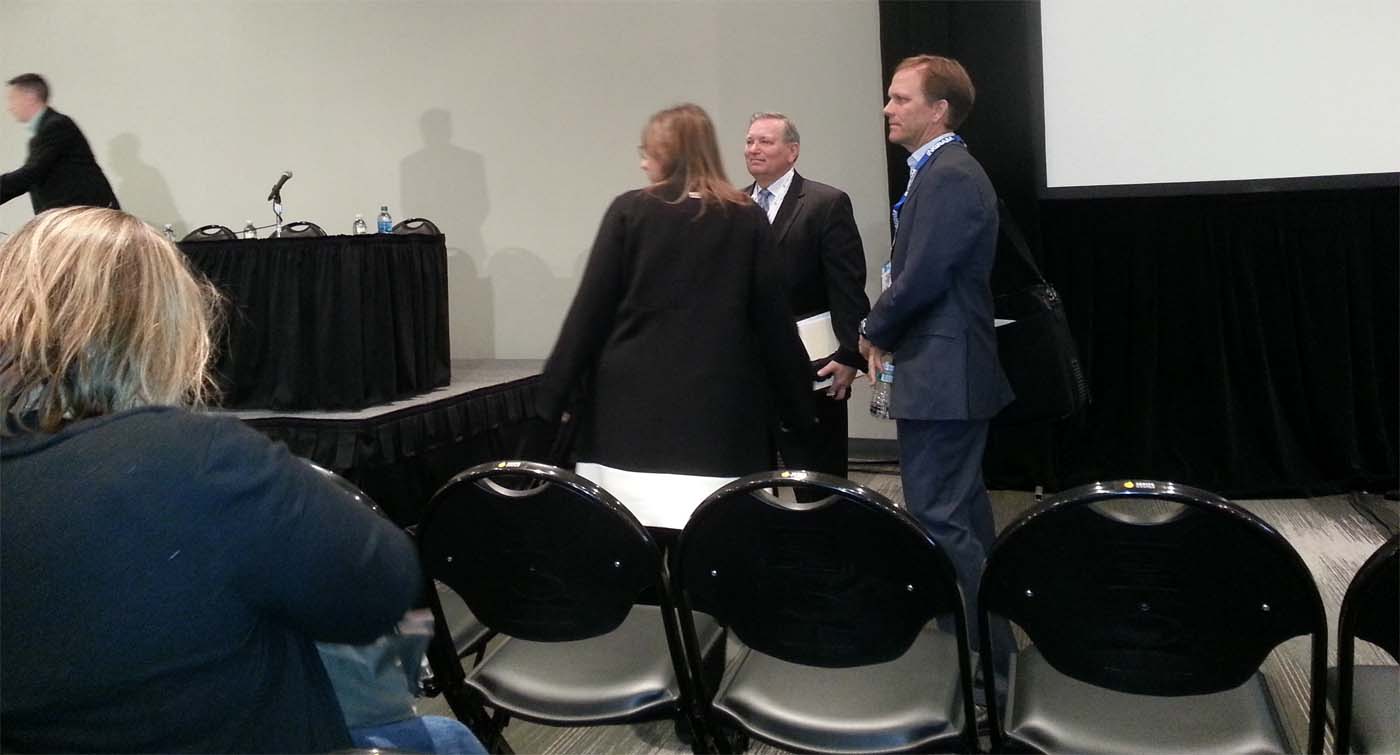
In short, this trade show is now a racket. And everybody knows it. On Wednesday afternoon, John Ingram looked especially embarrassed to be spouting off such horseshit as “To me, it’s about engaging community and creating innovation” at “The Future of Bricks and Mortar Retailers” panel. And I genuinely felt sorry for him. Was there any need for Ingram’s time to be wasted like this? There was no mention of the recent Amazon-Hachette dispute, except in knowingly veiled code. And that approach seemed especially condescending given that the great and irreplaceable Maya Angelou had passed away that morning.

I couldn’t help but contrast this panel against Richard Russo’s candid and inspiring words (with much healthy vitriol directed at Amazon) to booksellers only two years before. Indeed, BookExpo now carries a bizarre prohibitionist instinct. For the first time ever, there are signs forbidding people from filming the panels, as if tired sentiments about the “either and” future of print and digital were on the level of Coronado discovering the Seven Cities of Gold. The annoyingly peppy moderator Dominique Raccah kept referencing a “pre-interview” she conducted with the five participants, as if this atoned for the vapid predictability of her questions. I had to stop myself from approaching the stage to pin a gold star on her lapel for the job well done she courted. I counted twelve disappointed souls storming out, the telltale screech of the heavy doors competing with the unfathomably soft levels of the amplification system. The crowd was half as numerous as last year.

Now I’m no stranger to complaining about BookExpo, but I’ve always found something that I could take away from it. Yet this year is easily the worst of the nine I’ve attended. It is slapdash, slipshod, motivated by a kind of naked avarice more cartoonish than The Wolf of Wall Street. It was clear from the giant posters devoted to Jodi Picoult and David Mitchell that the chief goal is to eliminate the trade element entirely and turn this into a Comic-Con for books.

How did it get like this?

Well, BookExpo went after the book trade until much of the small and midsize exhibitors could no longer afford to pay for the exorbitant booths (the pricing remains secret, but like anything in business, getting the right rates are about who you know). Then BookExpo somehow persuaded bloggers to pay for the privilege of feeling special with the Book Bloggers Convention (still happening this year, but will it be around in 2015?), fleecing these amateurs of their hard-earned pin money. But the bloggers aren’t nearly as plentiful or as influential as they used to be. BookExpo remains stuck with Jacob Javits Center through 2017. So what do you do? You turn to ordinary readers, viewing them as boobs that fit the Barnum ideal. You charge them $30 a pop, get eight thousand of them to pay, and hope that the reckless math holds out with BookCon, a new last-ditch attempt to salvage your Hindenburg by opening the show to the public on Saturday.

“I always joke that every BookCon fan should have at least six figures of student loan debt,” said BEA flack Lance Fensterman to reporter Boris Kachka. “We’re trying to find the passionate fan base.” One can’t help but ponder the perfidy of this statement. BEA isn’t about sharing the wealth or even learning from the booksellers. (At the B&M panel, Tattered Cover owner Joyce Meksis was rightly cheered for the 500 to 600 events she organizes yearly.) The strategy involves fleecing the last few dollars from the public and encouraging them to demand free books from the publishers, who will in turn have to pay for galleys that are usually offloaded to avid booksellers. And no one seems to see the disastrous conflagration ahead at the air station.

The people who make books their business are not to be blamed for this. I watched many of their spirits brighten once they emerged from the crippling Kafkesque church of Jacob Javits Center. Their minds purred upon their escape, pondering the creative accounting they’d need to exact to justify the raid on the minibar. Yet while Jacob Javits’s dull white corridors still retain their architectural power to crush robust souls, it was more empty this year, even emptier than it usually is on the first day. The publishers and booksellers are going elsewhere to do their deals. Most people know that this is not their space. BookExpo has failed to learn that you don’t just need a showroom for books. You need heart, soul, knowledge, and instinct. While Fensterman and his cronies are cynical enough to believe that people will give that all up for a pittance, I remain quite confident that this gargantuan exposition won’t last long beyond the Javits contract. Unless someone replaces the lifting gas.

Paula Bomer (The Bat Segundo Show #546)

Paula Bomer is most recently the author of Inside Madeleine. She previously appeared on The Bat Segundo Show #375 and The Bat Segundo Show #481.

Author: Paula Bomer

Subjects Discussed: How physically scarred characters inspire dimension inside characters, Flannery O’Connor’s thoughts on the grotesque, how character details create mystery, Dorothea Lange and the Dust Bowl, Jim Thompson and Freud symbols, when “toxic” becomes a cliched adjective to describe people, the tendency for people to seek versions of their family later in life, young people trying to make their own world, when people who make you feel like crap are confused with the right relationship fit, how structure emerges from the liberation of space, contrapuntal tension in “Inside Madeleine,” spending two years working on a novella, the 1980s fashion of people having eating disorders, strange relationships with food, eating disorder considered as a prototype for cutting, transient mental illnesses, Ian Hacking’s Mad Travelers, The Taming of Chance, train fugue, death rates and anorexia, disorders as a misunderstanding of control, exploring marriage through intimacy, Ted in “The Mother of My Children” compared with Greta’s husband in “A Walk to the Cemetery” and men in “Inside Madeleine,” sex as the defining quality of a relationship, the benefits of marriage, Jonathan Franzen’s thoughts on sex, the importance of bad sex scenes in narrative, Girls, Lena Dunham’s audience confrontation with body image, how the physical leads into the emotional, Dr. Ruth, sex described on 1980s radio vs. the ubiquity of Internet porn in 2014, setting stories in Boston and South Bend, Indiana, writers who have to wait ten years to revisit material, writing material intermittently over very long periods of time, whether stories set at home are easier to finish, writing Baby over a long period of time, Bomer’s idea folder, “Outsiders” and Bomer’s boarding school story aspirations, memories as ways to trigger imaginations, Bomer’s unpublished novel set in Berlin, the difficulty of setting a story in a place you’ve never gone to, Christina Stead’s The Man Who Loved Children, Annie Proulx vs. Richard Ford on being a stickler for location vs. making place up, locational accuracy as an act of preservation, getting the reader to believe, the lifespan of a novel, being a young girl in the 1970s and the 1980s, being called a slut and slut shaming, hookup culture, literal blindness juxtaposed against other forms of blindness, when text isn’t enough to know what’s going on with characters, going through old papers and photographs, how anthropological texts became an unexpected muse, hoarding, contending with clutter, when tough people are internally fearful, the abstract nature of what we represent through writing, writing a story compared with painting a floor, how houses become interesting because of lazy interior decorating, the minor surrealism of “Breasts,” the 1998 animated short “More,” magical glints, Bomer’s upper limits of fantasy and magical realism, subjective magic as a method of revealing urban trappings, Samuel R. Delany’s idea of pornotopia, religion in “The Shitty Handshake,” “Lightning,” Bill Burr, Scientology vs. the Catholic religion, belief and fantasy, “Two Years,” subverting titillation, taking out various Sonyas in stories to preserve certain continuity threads from Nine Months, Philip Roth, being taken seriously while also going into uncomfortable places, Sabbath’s Theater, Chaucer’s ass-kissing in “The Miller’s Tale,” Dante and scatology, Ulysses, Germans and nudism, the human reality of walking around repressed, the carnal way that apes greet each other, using the word “compartmentalize” too much, literature as a vicarious outlet for reader and author, the class divide, Thomas Piketty’s Capital in the Twenty-First Century, the realities of class and capitalism, difficulties getting healthcare insurance, preexisting conditions, how dinner table political discussion stifles conversation, how swiftly Brooklyn has changed, Hal Ashby’s The Landlord, cab drivers who kicked you out of the car, subway muggings from decades ago, New York in the early ’90s, questioning why writers don’t get B-sides, being forced to move elsewhere because of the rich, and the alien notion of being in several stages of life so fast.

EXCERPT FROM SHOW:

Correspondent: One thing we didn’t actually discuss the last two times we chatted was your interest in the external. Many of your stories here feature side characters who have their skin pocked or acned or stretched or otherwise maimed in some sense. Anya has acne scars in “Reading to the Blind Girl.” You have Polly’s chicken pox scars in “Down the Alley.” There’s Maddy’s beginnings in “Inside Madeleine.” How much do you need to know a character physically before knowing her internally? How does a damaged physical appearance help you find unexpected internal qualities about a character? Are there any disadvantages or advantages in concentrating upon the external?

Bomer: I actually was greatly affected by an essay, or a nonfiction piece, by Flannery O’Connor, who complained about some other writers who she didn’t appreciate. Because she said, “I can’t see these people.” And then I was revisiting Flannery O’Connor and it seems quite simple. But you see her characters. And she explains how they look. It’s a little old-fashioned, but I think it works for this collection in particular. Especially dealing with external damage or how our bodies affect what’s going on inside of us. There’s a huge New Age movement about that. You have to do all these things inside your body to glow or whatever. But, yeah, interesting that you point out their scars and deformities. That too would be the “Grotesque in Southern Fiction” essay of Flannery O’Connor. And I was unware until you pointed that out. But now that you’ve pointed that out, oh, that is a theme

Correspondent: But I am curious to get into this notion of how a character looks. I’ve actually been discussing this quite a bit this year with authors — especially in relation to sustaining a mystery. How you see in mysteries that you don’t really know the protagonist, how the protagonist looks like or what not. And that’s part of the way of getting inside the character internally. And I’m wondering what motivates your need to really see them externally before you can see them internally. Do you think there’s a kind of mystery or a tension here sometimes when you’re advancing a story?

Bomer: Well, I hope there is mystery, not necessarily the classical mystery novel, but definitely you want to be discovering things in a story as you go along. And I hope I can accomplish that. I don’t know — I’m thinking of the story “Cleveland Circle House.” That story came to me and the opening is all about how she looks. Like her neck’s too big, her chin’s too long. I can’t remember exactly. But that story came to me first with this young girl’s face and how one person loves her for it and thinks she’s amazing and another person doesn’t think much of her at all. Like her parents, in other words, have this very different reaction to who she is physically and as a person. So that started the story.

Correspondent: Much as the back started “Inside Madeleine”? The back of the mother at the very beginning.

Bomer: Oh yeah.

Correspondent: I love the way you fixated on a physical part like that.

Bomer: Yeah. And the dynamic being she’s always there with her mother’s back. That weird separation and how they’re trying to bridge that separation by feeding. That was very obviously something I was trying to do and I did it in a repetitive, somewhat experimental way. Not as traditionally structured narrative.

Correspondent: It’s weird. Because the beginning of that story made me think of a Dorothea Lange photo for some reason. The hardened back. I was thinking, “Gosh, if we see her face, will she look like something out of the Dust Bowl?” (laughs)

Bomer: That’s pretty funny. I don’t think we ever really see her face.

Correspondent: No, we don’t!

Bomer: No.

Correspondent: I’m telling you. There is mystery here!

Bomer: (laughs) So when mysteries — I’m not as well-read in mystery as you are, but I do know that Jim Thompson, who I don’t know if you’d call — I guess he’s more noir.

Correspondent: I call everything “literature” myself.

Bomer: Yes.

Correspondent: It just happens to be categorized in the mystery section sometimes.

Bomer: Right. I’m with you. But Jim Thompson, you see his characters, although all the male characters, I’m thinking now, kind of blend together. But the women are specific. One of my favorite is how she’s really beautiful but she has long gray hair and he’s dealing with all these weird Freudian mom issues, like he often does in his stories. Her looks are a very big part of her character and his relationship to her and how he likes the fact that she’s got long gray hair, even though she’s also very young and sexual in a way. So the dichotomy of that. I guess I think that drawing, getting an idea of what people look like — weight issues are a big part of it. This book deals with the external and how it affects our place in the world. Polly, with her going through puberty, which is a horrible time and all you care about is what people think about how you look when you’re twelve.

Correspondent: Well, I mean, this leads me to wonder if external description is almost a mere…

[DOG BARKS]

Bomer: Sorry, guys.

Correspondent: It’s okay. We can have a few dogs bark on this podcast. Keeps the tension going. It makes me wonder if external description is in some sense almost a mirror that you can hold up to the reader, as an author, to confront either the world or to confront the notion or the worldview the reader brings into your stories. Is that safe to say?

Bomer: Yeah. I would hope so. That would be wonderful. Because I definitely put thought into how I’m describing them, what I decide to focus on, and it affects how they are seen in the world and accepted by their communities or relationship with their professor. The one you mentioned, Anya, the fact that she has pock marks endears her. It makes her vulnerable to the student and makes the student feel that she can bridge this teacher-student gap, and really have an intense friendship almost with this woman. Or at least lean on her in ways that are very gratifying. And that’s definitely — I have something where I love vulnerability in people. So basically I project that in various ways throughout all of my books. But maybe this one, because they’re all kind of coming of age, they’re in that really more insecure phase in many ways.

Correspondent: Well, that’s interesting. We have a teacher/student dynamic. But there’s also a student/student dynamic in many of these college stories. So you almost have to have two dynamics to get inside what these protagonists are dealing with. I’m wondering how that kind of relationship developed in the blind girl story and also “Cleveland Circle” as well.

Bomer: Yeah. Well, definitely a theme that I’m exploring throughout this is young women, or girls, and their relationship to other young women and girls. I don’t paint a pretty picture, I’m afraid. And even thought there is…it’s not all bad. But most people I know throughout their lives, they’re going to discard some relationships. And those relationships, because they’re…oh god, I was going to say toxic. And that’s so cheesy.

Correspondent: Well, “toxic” we can use.

Bomer: But I think there’s a book called Toxic People.

Correspondent: (laughs)

Bomer: This whole silly psychology.

Correspondent: Why is toxic cliche now? I’m curious.

Bomer: Because of a book, right? It’s like the “inner child.”

Correspondent: Well, “toxic” isn’t on that level of “inner child.”

Bomer: Okay. I hope. Maybe.

Correspondent: We can use it during the course of this conversation. It’s okay.

Bomer: Okay. I appreciate it.

Correspondent: You can use anything.

Bomer: Using the word “toxic.” I’m actually trying to think of another way of describing it. But one thing for certain is that I do believe — so this is another psychobabbly thing — when you’re young, you’re kind of reliving relationships, maybe even your family relationships. And you kind of seek out the person who’s going to be some of the negative things that happened at home. And I’m not saying that everyone is completely damaged or whatever. But most people have some bumps in life, in their family, in their social life. And then I take it to a bit of an extreme. Because to me, that’s more interesting from a literary standpoint. And I don’t always. But in this book, I would say a lot of it is quite extreme. And definitely these characters, a lot of them are attracted to these people who aren’t very nice to them and who they either worship. Because they have things that are small or are skinny or they seem confident. And then they end up getting kind of hurt by that situation. Or the opposite, the occasional “Oh, this person’s vulnerable and therefore I can be vulnerable around them.” And so there’s this safety in relationships.

Correspondent: You’re sort of suggesting that people are looking for a new family when they go to school. And this is the great fluid organizational structure that you can bring into narrative, which requires organizational structure.

Bomer: Yeah. Definitely. That’s a very good way of looking at what I’m trying to do, in particular with this book.

(Photo credit: Robert Martin)

The Bat Segundo Show #546: Paula Bomer III (Download MP3)

This text will be replaced
Why Trigger Warnings Threaten Free Speech, Original Voices, and Thoughtful Discourse

“Don’t be so gloomy. After all, it’s not that awful. You know what the fellow said. In Italy, for thirty years under the Borgias, they had warfare, terror, murder and bloodshed. But they produced Michelangelo, Leonardo da Vinci and the Renaissance. In Switzerland, they had brotherly love. They had five hundred years of democracy and peace. And what did that produce? The cuckoo clock.” — The Third Man

On February 26, 2014, a UC Santa Barbara student named Bailey Loverin pushed “A Resolution to Mandate Warnings for Triggering Content in Academic Settings” through the Associated Students Senate. The resolution called on professors to issue “trigger warnings” for students on “materials with mature content” taught in the classroom — whether it be a difficult film shown for context, material assigned for reading, or even a casual conversation on a tough issue. Loverin cited her own discomfort sitting through a film, one which she has refused to identify, depicting sexual assault. The class’s unnamed professor, according to Loverin, provided no warning before the film. Loverin claimed that it was harder for her to walk out of the movie, because doing so in the dark would apparently draw attention. (I have consulted other interviews with Loverin to establish the facts. Loverin did not return my emails for comment.)

Loverin has stated that she’s a survivor of sexual abuse, but she has not suffered from PTSD — the chief reason proffered for the “trigger warning” resolution. In an interview with Reason TV, Loverin said, “We were watching a film. And there were several scenes of sexual assault and, finally, a very drawn out rape scene. It did not trigger me. I recognized the potential for it to be very triggering.”

Loverin is not a psychologist, a sociologist, or a medical authority of any kind. She is a second-year literature major who has become an unlikely figure in a debate that threatens to diminish the future of free speech. Yet Loverin isn’t nearly as extreme in her views as the trigger warning acolytes at other universities.

Rutgers’s Philip Wythe has claimed that trigger warnings are needed for Virginia Woolf’s Mrs. Dalloway (for students suffering from self-harm) and for F. Scott Fitzgerald’s The Great Gatsby (apparently a literary gorefest on the level of an episode of The Walking Dead). Oberlin threatened to issue trigger warnings over such traumatic issues as “heterosexism, cissexism, ableism, and other issues of oppression,” before the policy was sensibly pulled for further reconsideration.

Loverin claimed in an opinion roundtable for the New York Times that the UCSB resolution “only applies to in-class content like screenings or planned lectures and doesn’t ban the content or excuse students from learning it.” The resolution offers a suggested list of “rape, sexual assault, abuse, self-injurious behavior, suicide, graphic violence, pornography, kidnapping, and graphic depictions of gore” as trigger warning options. Students who feel that they “have a negative emotional response” (note that it is any “negative emotional response,” not necessarily PTSD) “to such content, including distressing flashbacks or memories, should be allowed to leave the classroom or skip class altogether without being penalized.” And while there certainly isn’t any direct prohibition, there is still the unsettling possibility of professors forced to soften their materials, which leads one to wonder how they can adequately teach war, genocide, slavery, or imperial conquest in the classroom. Another question, one that has remained unconsidered by trigger warning boosters, is whether or not skipping class over material that easily offends will be used as a catch-all excuse for students to shirk their scholarly duties.

In the Reason TV interview, Loverin said, “Being uncomfortable, being upset, being even a little offended is different than having a panic attack, blacking out, hyperventillating, screaming in a classroom, feeling like you’re under such physical threat, whether its real or perceived, that you act out violently in front of other people.” It certainly is. Yet there is no evidence to support Loverin’s claim that there is a widespread epidemic of students acting out violently in class over a movie. The PTSD Foundation of America observes that 7.8% of Americans will experience PTSD at some point in their lives. But most people who experience PTSD are children under the age of 10 or war veterans. Furthermore, an NCBI publication reveals that intimate group support among fellow trauma victims (CISD) and rigorous pre-trauma training (CISM) are effective methods for helping the PTSD victim to move forward in her life.

There are some connections between media and PTSD, such as a study published last December which observed that some Americans who watched more than six hours of media coverage about the Boston Marathon bombings experienced more powerful stress reactions than those who refrained from watching the news or who were directly there. Another UC Irvine study found that 38% of Boston-area veterans who suffer from PTSD and other mental disorders experienced some emotional distress one week after the bombing. But these studies point to (a) people who already suffer from PTSD, (b) PTSD victims being exposed to media for a lengthy duration, and (c) PTSD victims in close proximity to a recent attack.

astronautfeldstein

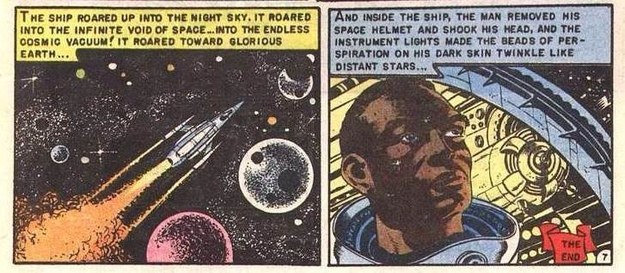
It is certainly reasonable for a professor to ask her class if any student suffers from PTSD, but the trigger warning approach is uncomfortably similar to the Comics Magazine Association of America’s crackdown on comic books over gory content in 1954, which led Charles F. Murphy to wrongfully conclude that reading violent comics leads to juvenile delinquency. As Saladin Ahmed recently pointed out at BuzzFeed, Murphy’s Puritanical Comics Code — a kind of self-regulated and equally self-righteous “trigger warning” system of the time — forced a black astronaut to be made white in order for Al Feldstein and Joe Orlando’s “Judgment Day” to run. (Before the Comics Code, the story would have appeared without a problem.) The pro-trigger warning crowd also refuses to consider the benefits of confronting trauma. If Steve Kandell hadn’t possessed the courage to visit the 9/11 Memorial Museum 13 years after his sister was killed in the attacks, then we would not have learned more about that tourist attraction’s crass spectacle and its deeply visceral effect on victims. There was no trigger warning at the head of his essay.

Discouraging students from confronting challenging topics because of “a negative emotional response” may also result in missed opportunities for humanism. In her thoughtful volume A Paradise Built in Hell, Rebecca Solnit examines numerous instances of people reacting to disasters. Contrary to the reports of doom and gloom presumed to follow a disaster, people more often react with joy and a desire to reforge social community. Those distanced from disaster tend to become more paralyzed with fright. No less a literary personage than Henry James, who read sensationalistic accounts of the 1906 San Francisco earthquake, imagined that his brother William underwent some perdition: “I feel that I have collapsed, simply, with the tension of all these dismal days,” he wrote in a letter. “I should have told you that I have shared every pulse of your nightmare with you if I didn’t hold you quite capable of telling me that it hasn’t been a nightmare.” But William. who was impressed with the rapid manner in which San Francisco came together, replied, “We never reckoned on this extremity of anxiety on your part.”

Only a week after Loverin’s resolution was passed, a group of anti-abortion activists had one of its banners, which featured a bloody picture of an aborted fetus, plucked by professor Mireille Miller-Young. A YouTube video capturing this incident features the professor pushing Joan Short, one of the Christian activists and the person operating the camera, after she attempts to retrieve her sign from an elevator. At the 2:46 mark, Miiller-Young can be seen kicking Short’s shoe out of the elevator bank.

triggerreport

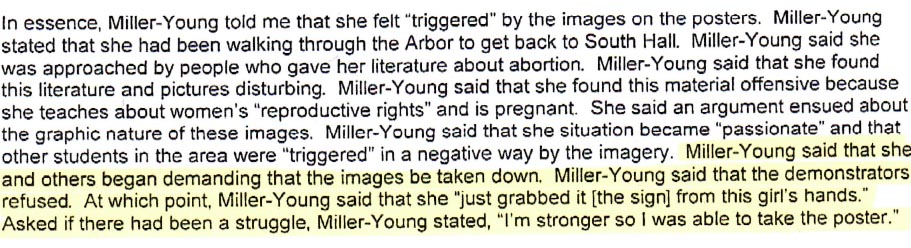
The police report, which I obtained from the Santa Barbara Independent‘s Tyler Hayden (the PDF can be viewed here), cites “triggering” as one motivations for Miller-Young’s actions. Miller-Young asked the Christian activists to remove the sign. They refused. Miller-Young grabbed the sign and destroyed it in her “safe space” with scissors. “I’m stronger,” said Miller-Young, “so I was able to take the poster.”

As a hard progressive and free speech advocate who is strongly pro-choice and as someone who finds gory pictures of aborted fetuses to be a repugnant response to civility, I am nevertheless appalled that a supposedly enlightened figure of authority like Miller-Young would use “trigger warnings” as an excuse to not only shut down another person’s perspective, but to completely destroy the sign used to present it. These activists were not harassing young women outside of an abortion clinic, yet Miller-Young claims in the police report that “she felt that the activists did not have the right to be there.”

Many ostensible liberals have attempted to paint “trigger warnings” as something harmless, yet they refuse to see how appending a precautionary warning can lead to a chilling curb of free speech. And like Miller-Young, in their rush to condemn, it becomes clear that they are less interested in comforting those who are sensitive and more concerned with painting anyone who disagrees with them as either “a jerk” or someone who delights in the suffering from others. On Twitter, two privileged white male writers with high follower counts revealed their commitment to petty despotism when opining on the trigger warning issue:

We have seen recent literary debates about unlikable characters, an essential part of truthfully depicting an experience. But if an artist or a professor has to consider the way her audience feels at all times, how can she be expected to pursue the truths of being alive? How can a student understand World War I without feeling the then unprecedented horror of trench warfare and poison gas and burying bodies (a daily existence that caused some of the bravest soldiers to crack and get shot for cowardice if they displayed anything close to the PTSD that they felt every minute)? How can one understand rape’s full hurt and humiliation if one does not wish to become familiar with its baleful emotions? How can any student comprehend climate change if the default response is to ignore the news and play a distracting cat video that will amuse her for two minutes?

I realize that the trigger warning police mean well, but human beings are made of more resilience and intelligence than these unlived undergraduates understand. Hashtag activism may work in a virtual world of impulsive 140 character dispatches, but it cannot ever convey the imbricated complexities of the human spirit, which are too important to be stifled and diminished by a censorious menagerie of self-righteous kids, including middle-aged genre writers who can’t push their worldview past adolescent posturing that’s as preposterous as Jerry Falwell claiming emotional distress over a parody.

Will the Cecily McMillan Sentence Dampen Occupy’s Future?

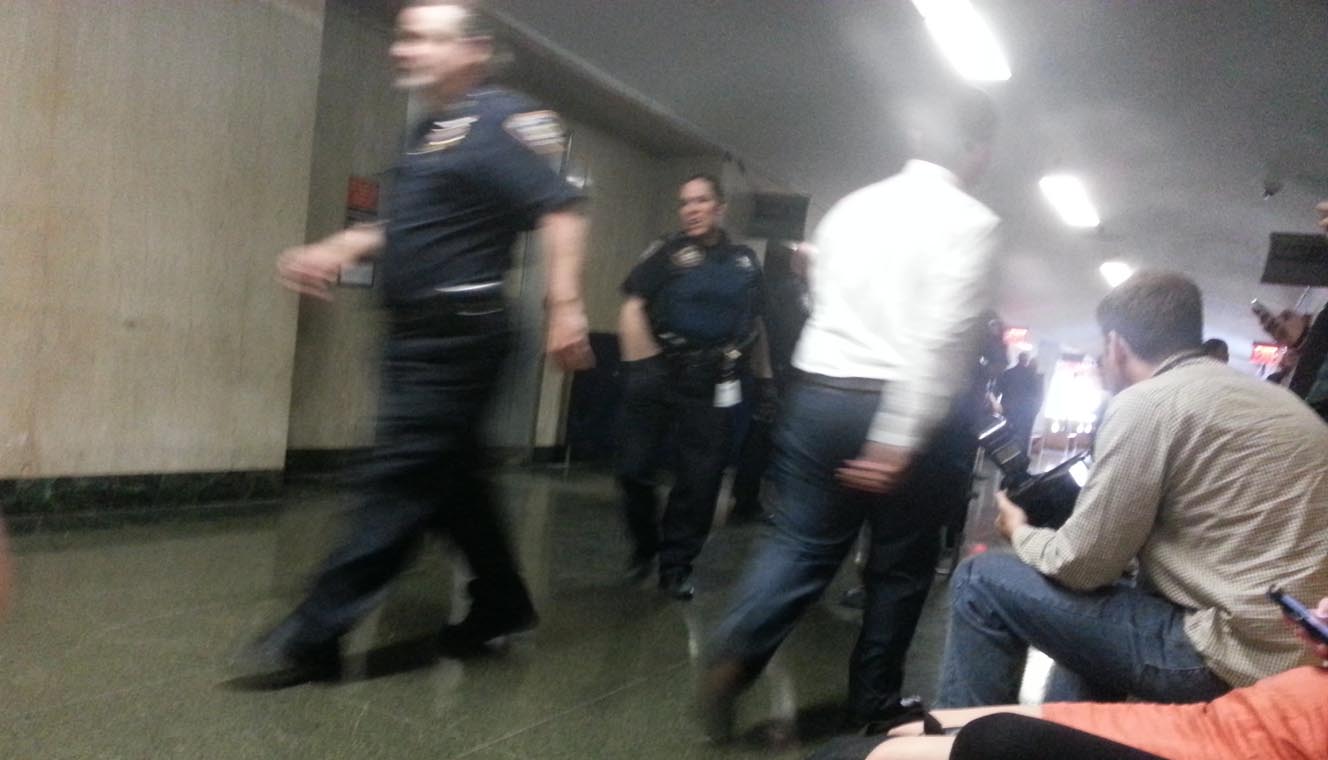
It took six working stiffs to assemble the magnetometer in front of Judge Ronald Zweibel’s chamber: one held the long left unassembled side, a second knelt down trying to figure out how this white plastic dolmen attached at the top corner, a third held the flashlight, three more police officers stood behind them to the right. It was a tableau that could have been stage-managed by the late filmmaker Theo Angelopoulos: deliberately slow, long, a good deal of fuss over something extraneous.

On Monday morning, the eleventh floor of the New York City Criminal Court building filled up with a time-honored mix of optimistic activists who believed in justice and cynical reporters who boasted over who had been the first to cover Occupy. Most had to wait in the hall outside the courtroom, tapping their feet on green marble stepped on by countless innocents.

Then the two metal doors opened and an activist, not calling for a mike check, quietly informed all surrounding parties that Cecily McMillan, a young woman who had been found guilty of assaulting a police officer on the most draconian and iniquitous of pretexts, was sentenced to 90 days in jail, with five years probation. This was a far cry from the maximum sentence of seven years, but just long enough to annoy anyone with a social conscience. Just short enough for any random party to wonder what the fuss was about. Just perfect enough to trivialize a movement.

McMillan’s attorney Martin Stolar attempted to persuade Judge Zweibel to commute the sentence further. The judge would not budge from 90 days. McMillan read a statement. The judge would not budge from 90 days.

It was impossible to attend the sentencing and not feel as if you were inhabiting some preordained role as awkwardly rigged as the magnetometer. Once the courtroom had filled to capacity, it was pushed unceremoniously to the side of the door in minutes, as quickly as McMillan’s sentence.

Cecily McMillan will do her modest time and spend the rest of her young adulthood checking in with the authorities, released from their tendrils only after the last remaining flames of idealism have been doused from her spirit. She is, after all, on a leash. Can she still be a revolutionary? Or even the moderate that some Occupy activists have presented her as? Those who remain part of Occupy will preach to the choir, calling for more appeals and more petitions.

But Occupy succeeded not because of political stridency. It was amorphous enough to enliven the variegated strains in our national conscience. The movement still carries a formidable strength in finding quick organizational remedies to inflexible bureaucracy, seen with Occupy Sandy and still very much in place on Monday morning when several activists rapidly collected the phones that weren’t allowed in the courtroom with improvised identifying slips handed to owners. But I am not so sure what it can do beyond this. After the sentence, the crowd gathered across the street from the courthouse and sang songs and attempted to conjure a responsive plan to the McMillan sentence (they are also rallying tonight at Zuccotti Park), yet the strategies now feel flat and old hat. All because of a sentence that will be interpreted by most as no big deal. We certainly have the New York Police Department and Judge Zweibel to blame for this. But there may be a deeper problem.

As I stood in line, hoping to get into Zweibel’s courtroom this morning, I chatted with an African-American woman who identified herself as Aanis. She was waiting for another case in another chamber. She wondered if this seemingly indomitable group would stand up for her the next time she was arrested. But most ignored her. And as the Occupy protesters disseminated literature, passing me up because I’m the kind of man who tends to go to the courthouse wearing a suit and tie and they presumed I’d be uninterested, I had some idea of what she was talking about.

Porochista Khakpour (The Bat Segundo Show #545)

Porochista Khakpour is most recently the author of The Last Illusion. She previously appeared on The Bat Segundo Show #249.

Author: Porochista Khakpour

Subjects Discussed: Lyme disease, the thrill of not knowing yourself, messy house syndrome, bird mythologies attached to various nations, Marco Polo and the roc, drawing from the Shahnameh, the inspirational value in Googling feral children, what artists talk about on smoke breaks, when readers hold an author morally responsible for fictitious animal abuse, BASE jumping, the Freedom Tower video, going blonde for Elle, making lunch with caviar and Wonder bread, being a white demon in a dark world, Toni Morrison’s advice on writing the book inside you (with mangled paraphrasing), being obsessed with Latin American and surrealistic writers, the appeal of the grotesque, being young and adversarial, when novels become unanticipated memoirs, when the “unreal” is more real than real, David Foster Wallace, Infinite Jest, Karl Ove Knausgaard, hard realism vs. surrealism, Stephen Dixon, hyperrealism, when realism becomes too polished or manicured, dry literary modes getting in the way of depicting reality, Carol Shields, harmful MFA diets, James Salter, Richard Yates, John Cheever, academics who misinterpret authenticity, finding the human in the idiosyncratic, the freaks, and the outsiders, why Bret Easton Ellis’s work is dismissed, Glamorama as an underrated novel, Khakpour’s review of Helen Oyeyemi’s Boy, Snow, Bird, the myth of perfect novels, why risks and originality are important to sustaining unique fiction, attempting to track what went wrong with risky American fiction during the last twenty years, the dangers of likable books, Dinaw Mengestu’s All Our Names, Yiyun Li’s Kinder Than Solitude, why young American readers are so conservative, millennials who avoid politics and history, when reading choices are impacted by economic crisis, what happens when the youth experience of bouncing around jobs is taken away from American life, needless obsessions with “being good,” when favoriting and liking intrudes upon the sincerity of genuine compliments, why hierarchies now look stupid, ridiculous formalism vs. overly casual forms of address, speed and anxiety, the threat of phones that entice us with buzzing notifications, contemporary anxieties over art that confronts, the remarkable human capacity for inventing needless popularity contests, being part of an immigrant group and fitting in, being true to yourself, ridiculous calculations set up by publishers, when New York publishing types forget regular readers who crave something different, why women’s magazines have embraced The Last Illusion, doing something daring because the universe is indifferent, blind ideological labels that cause nuance to be overlooked, “TWITTER NEVER FORGETS”, suspicion attached to sincerity, the apology cycle, media training’s assault on the real, healthy anti-authoritarian impulses, illegal methods of making money, the trap of fancy restaurants, the mistaken assumption that all writers live middle-class lifestyles, consumerist impulses that get in the way of the writing life, the appeal of New York City (when one can barely afford it), being exposed to subcultures, finding places where outsiders are accepted, Y2K and 9/11 as efforts to destroy New York, New York’s openness, medical arbiters named after guitar gods, how storytelling can combat injurious forces against the individual, inhabiting your own narrative, adopting a uniform of neon orange socks and a cowboy hat for school, pranks as a form of existence, prank phone calls, dialing up a radio station and pretending to be other people, talking in a baby voice as a professed Playboy Playmate, testing the notions of what people are willing to believe, learning international calling codes as a child and asking people in Nairobi to speak Swahili, physically digging holes to China, being paralyzed by knowing we’re going to die, Elisabeth Kübler-Ross, getting the big death questions out of the way on the first date, the benefits of not caring vs. paralyzing thoughts as a kid, dramatizing how people believe in illusions, betrayal and panic attacks, differing emotions that emerge from PTSD and betrayal, fear and illusion, magical thinking, the Y2K panic in San Francisco, Y2K as a cultural embarrassment, failing to consider American time before 9/11, Asiya perceived as a villain in The Last Illusion, why a 500 pound character is the soul of The Last Illusion, eating insects (and associated ethics), being inspired by paintings, how different generations have viewed women, the absence of parents, family structure as a safeguard against feral children, destructive ways of being to survive a fractious childhood, Kafka’s response to Kierkegaard’s Fear and Trembling, Kafka’s notion of the other Abraham as a solution to the parable’s heroic failings, father figures as impostors, having a checkered employment history, work as an enslavement of faith, saturating a novel with pre-9/11 paraphernalia, celebrating the autodidact, awkward paths to manhood, masturbation, connections between reading fiction and empathy, how online skimming is discouraging people from reading ambitious fiction, how to get more people to read Ulysses, trends in longform, the recent fetishization of Gay Talese, Renata Adler’s resurgence among young people, the double-edged sword of “legitimized” indie presses, marketing savvy entering into alt lit considerations, hostility towards works of ambitious fiction, Rebecca Curtis’s stories, Leslie Jamison, the impact of the VIDA Count, trying to get young men to read, reading around the world to atone for American literary inadequacies, Borges’s Ficciones, and hopes expressed for future punks.

EXCERPT FROM SHOW:

Khakpour: I’ve got gallows humor for miles, but I’ve been having so many difficulties because of a recent relapse of Lyme disease. So I’m finding everything a little extra challenging. But maybe also a little bit thrilling. Because who knows what will come out?

Correspondent: What’s the thrill of this predicament?

Khakpour: The thrill is that I actually don’t entirely know myself. And so…

Correspondent: You’ve found out more things about yourself.

Khakpour: (laughs) Well, sort of. I’ve been teaching and lecturing and sometimes I feel like this disease attacks your softer tissue. Everywhere. Your brain and your organs and everything. At certain times…

Correspondent: I thought that the brain was a harder tissue. All that work. Especially your brain.

Khakpour: In my case…

Correspondent: No.

Khakpour: …it’s pretty dim.

Correspondent: Oh, I don’t know about that.

Khakpour: It’s weird. I remember certain things that I thought I had done away with and then certain things I will completely forget. You know, I have that sort of senile dementia.

Correspondent: But, see, I’m like that without Lyme disease.

Khakpour: (laughs)

Correspondent: So I think actually, if that’s the case, you’re the most formidable intellect who has ever appeared on this show.

Khakpour: (laughs) Thank you. It’s amazing. I looked up this thing called messy house syndrome.

Correspondent: Messy house syndrome!

Khakpour: And I thought that it literally just meant, “Your house is messy.”

Correspondent: Or your house is not in order. In some family dynasty sense.

Khakpour: (laughs) I think it’s this thing. I’m not sure exactly how to pronounce it. There are various names that involve forms of senile dementia that are related to it. And it is an interesting umbrella term for various forms of cognitive dysfunction that I very much relate to. But I don’t think it’s permanent. I hope it’s not permanent. I’m enjoying it a little bit. My emotional range is quite stunted.

Correspondent: It’s kind of a temporary vacation from possibly thinking all the time.

Khakpour: Well, I’ve short circuited a lot with thinking.

Correspondent: Well, you’re associative, I think.

Khakpour: (laughs) Exactly.

Correspondent: Which some people call a short circuit, but actually is really kind of liberating. So you have this little caesura in the usual great Porochista universe.

Khakpour: It’s interesting. I used to be so obsessed with altered states and I would do drugs to achieve them and all that.

Correspondent: Now you’ve got the ultimate altered state. The ultimate natural high.

Khakpour: Exactly. So in some ways, it’s kind of amazing. But it would be nice if I knew it would end soon. I think it will.

Correspondent: And yet you have been nothing less than perspicacious so far.

Khakpour: Okay. Thank you. Phew. (laughs)

Correspondent: Let’s get into the book. So Marco Polo, he popularized the legend of the roc. The Greeks, they have the phoenix. Slavic folklore has the firebird. In short, I don’t think there’s a single culture in the world that does not have some form of a mythological bird. America has the bald ego…the bald eagle. The bald ego as well! (laughs)

Khakpour: (laughs) The bald ego as well! I was going to say.

Correspondent: The bald ego and the bald eagle. And not far from the years of your novel, in 1999 to 2001, which is when yours is set, the bald eagle was actually placed from an endangered species to a threatened species and now is actually off that list altogether. Because the bald eagle made a comeback. So beyond your inspiration from the Shahnameh, I’m curious what drew you to the bird as this malleable mythological symbol. To what extent were you interested in not only transcending culture across nations, but even subcultures, perhaps bird-related, within this nation?

Khakpour: Oh. That’s so interesting. I love that question. Yeah. There’s a lot of avian themes in everything I write. It’s strange. It was in my first novel as well. And then I just naturally gravitated toward it here. I was at a residency where everybody was working very hard. And it was one of my first residencies. And I had no interest in being there almost. I was just tired from the first book. And I just decided I was going to read during my residency time. I brought a copy of the Persian Book of Kings, the Shahnameh, the Dick Davis translation that came out a few years ago. And I was flipping through it and remembering my father reading it to me in Farsi. And there was always just this one story that I always would make him reread. And it was the story of Zal and his friendship with this giant mythological bird, the Simorgh. It’s strange to even say “friendship.” I mean, the Simorgh was this guardian. And so essentially raised him. So anyways, that was in the back of my mind. While I was flipping through it at night in this residency, I would go on smoking breaks and there was this one other lovely artist there who was the only other smoker and she was also kind of pretending to do work. And we would just talk about our lives during these smoking breaks. And one time she said to me, she would just go on these rants and she said, “Whatever you do, never Google ‘feral children.'” And I said, “Wait! Why did you say that? What?” And she said, “Oh no. I’ve just been bored. I’ve been Googling things late at night.”

Correspondent: As one does.

Khakpour: Yeah. And then so I thought, “Okay.” I went there obviously. It was late at night there one night. And it was very horrific. And I’d always been interested in both the “reality,” but also the hoaxes that have been attributed to feral children. So then I found this case, this Russian case, of a bird boy who’d been essentially partially raised in a cage and could only chirp. Maybe it was a hoax. Maybe not. And immediately I combined that with Zal in my brain. And the two just kind of mashed up seamlessly. The next day at our smoking break, I told her. I said, “I think you just helped me come up with my second novel.” I’d had the other thread of the second novel, which really involved the magician and the last illusion. But he was only — I could always tell that he was 50% most of the story. There was a whole other thread. So I don’t know. Then I came to that and it was actually interesting. I came to realize, “Boy, you’re obsessed with birds and flight and all that. What is that about?” And there’s a made up myth in the first novel that involves burning doves actually. It’s sort of the myth behind the narrative of the first novel.

Correspondent: This is what it sounds like when the doves fry.

Khakpour: (laughs) Yeah.

Correspondent: Sorry.

Khakpour: So many people scold me about that scene. It’s funny. People come to the readings. And I only started reading from it late in the game. And I would have these oftentimes older women who would come to me and say…

Correspondent: Older women?

Khakpour: Yes. Who’d say, “Why would you have such scenes of animal abuse?” And they would accuse me of having harmed animals myself. And I was just so horrified. I was, “No, this is fiction.”

Correspondent: People get very sensitive to animals being harmed in fiction, I find.

Khakpour: Totally.

Correspondent: I mean, they are more willing to impugn an author for a fictional animal abuse more so than any real animal abuse.

Khakpour: I know.

Correspondent: It’s really odd.

Khakpour: Incredibly. I know. And people were very disturbed by that. But anyways, you brought up so many good points about the cultures in the U.S. too. I think, I mean, there’s a general awe that comes when you think about flight, right? It’s one thing we definitely can’t do. We can do it in these wonky adorable human ways. Hang glider. Sky diving.

Correspondent: BASE jumping.

Khakpour: Yeah, BASE jumping. Right.

Correspondent: That amazing video from the Freedom Tower.

Khakpour: I know.

Correspondent: I’m not even going to tell you how many times I saw it.

Khakpour: Same here.

Correspondent: It just gave me such a cathartic thrill.

Khakpour: Oh yeah. I started collecting a lot of those ideas, or collecting a lot of those instances and looking at their videos and all that, when I was writing this. And that figures — even the idea of stunts that involve flight or falling — big in this book.

Correspondent: How many times did your dad read you the legend of Zal? I’m curious. Because this seems to me that it was deeply imprinted upon you as a child.

Khakpour: Yeah.

Correspondent: And we always go back to the tales we’re told as children to find meaning and inspiration as adults.

Khakpour: Over and over, I would ask him to read this. He would keep going. There’s many amazing stories in the Shahnameh. There’s so many beautiful and incredible — you know, it has that feeling of The Canterbury Tales and The Old Testament where you can go to it for unlimited inspiration. But I was frozen on Zal. I related to him so much. Because there was also — you know, in my first novel, there’s a whole thing with I Dream of Jeannie. This blonde genie and the weirdness of that to me.

Correspondent: And here you are blonde as well. (laughs)

Khakpour: Yes. For an article.

Correspondent: It was in the prophecy! (laughs)

Khakpour: Yes. Exactly! Now I am one of the fakest blondes ever. So that was a fascination. The other thing that was interesting in the story of Zal was that he was born essentially something like an albino. It’s unclear from the text exactly what they meant. But he had a certain whiteness of skin and a lightness of hair. He basically had white hair. And that was why he was cast out. And I think for an Iranian immigrant new to the U.S. — at that point, we’d only been a few years in the U.S. — I was so fascinated by issues that surrounded race and ethnicity in the U.S. vs. Iran and what that all meant. So Zal to me was just — I didn’t know what to make out of this story. He was somehow what Americans might consider the ideal of beauty. Maybe even some other cultures of course. And yet he was cast aside. Basically left in the wilderness to be raised by a bird.

Correspondent: There were a lot of uncleared mysteries in the original tale.

Khakpour: Yeah.

Correspondent: And maybe this is perhaps what captured your imagination and led you to flesh it out and transplant it here in New York.

Khakpour: Exactly. Yeah. And I had been so anxious about fitting into America at that point. And I knew — I couldn’t even really relate to my own parents. I mean, they were of a different socioeconomic class than my brother and I. So here were two upper-class Iranians in their twenties who were fairly gutted about not being able to do fancy things. You know, my mother would be upset that we couldn’t have a childhood where we went shopping in Europe. And my father was meanwhile making us only Wonder bread sandwiches with butter and caviar on it.

Correspondent: Butter and caviar?

Khakpour: (laughs) Yeah.

Correspondent: Wow. That would make the lunch trade a little bit more convoluted.

Khakpour: (laughs)

Correspondent: “I’ll give you the caviar for the apple.”

Khakpour: (laughs Yeah. Exactly. It was a very confused issue concerning nationality and ethnicity and all that.

Correspondent: And class.

Khakpour: And class. Definitely. So I was constantly thinking about this. And when I would get tired, late at night, when he would read me these stories, I’d have horrible insomnia. I would sit with him and he’d pick up where he left off. I would just ask him, “Could you read this story one more time?” He seemed to give me both a combination of hope for the outsider — because at the end of the Zal story, he’s a great warrior and he’s a great hero of the Persian Empire. And even his whiteness starts to be discussed as silver. It’s very striking. He suddenly becomes the embodiment of strength and power. But there’s a lot of conflict in this story too. And there’s a lot of darkness in that story too. And that really got my wheels turning at a young age. And I feel like I’ve always waited to have an opportunity to do something with that story. And it sort of got me when I didn’t even know that I was looking for it.

(Photo: Darcy Rogers)

(Music provided through Free Music Archive: Jose Travieso’s “Zombie Nation.”)

The Bat Segundo Show #545: Porochista Khakpour II (Download MP3)

This text will be replaced