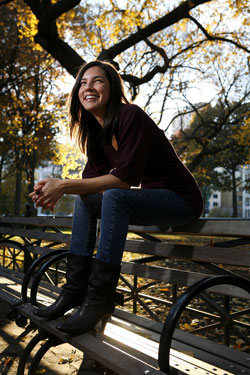
Sloane Crosley appeared on The Bat Segundo Show #209. She is the author of I Was Told There’d Be Cake, which was recently sold to HBO for series development.
Condition of the Show: Placing the authors and book titles under too much scrutiny.
Author: Sloane Crosley
Subjects Discussed: Marie Antoinette, caring about perception, Veganism, the personal essay as a series of impersonations and observations, on being perceived as “nice,” the text as a prism between author and reader, negotiating the balance between writer and publicist, putting on the “nice face,” assumptions of lying, Oregon Trail, being nice vs. being true, exuberance, imposing internal censorship, the harsh nature of the wedding essay, why things were cut out, David Rakoff’s Fraud, Roberto Benigni, issues that cut into identity, filtering candor, whether personal essayists “tell it like it is,” David Sedaris, defining the nature of truth, using composite characters and disguising real people, speculation and judgment, lax Judaism and free association, criticism through metaphor, the relationship between adjectives and specificity and keeping the floodgates open, inverting language, Twin Peaks, dealing with sentences in essays that contradict each other, on not being prepared to turn sixteen, the original version of the book set up at Harper, the role of Gawker in Crosley’s career, online etiquette, the elusive “they,” being beholden to the BlackBerry, and stealing wi-fi.
EXCERPT FROM SHOW:
 Correspondent: In “Lay Like Broccoli,” you write, “Being a vegetarian in New York is not unlike being gay.” But I must ask you. Why care so much about how you are perceived? Because that’s essentially what this is all about.
Crosley: That specific essay or the whole book?
Correspondent: Well, that specific essay. But also the whole book. Because there’s a bit of hiding behind the essays.
Crosley: Well, is there? I think it’s more that clash between trying to grow up and trying to realize who you actually are once you become a grown-up. So I’m not actually hiding behind any specific concern I have about people’s perceptions, but more just trying to figure out who you are. It’s like you’re trying on different cells. I was telling someone the other day that my favorite part of In Cold Blood — I assure you this makes sense for an interview about a humor collection.
Correspondent: I’m sure. Go for it. Please.
Crosley: My favorite part of In Cold Blood is actually this tiny detail where he finds Nancy’s diary and he’s going through it, and obviously it becomes a huge part of the book. But he talks about the actual handwriting and the different various inks and the different colors she would use as she’s trying on different cells, as if to say, “Is this Nancy? Is this Nancy? Is this Nancy? ” Now granted, she’s what — sixteen at the time> So in an ideal world, I would have less colors of ink and different styles of handwriting to try on at twenty-nine years old. So when I say the thing about the vegetarian thing, and the vegan thing, it’s more observational than something I’m actually petrified with living with on a day-to-day basis.
Listen: Play in new window | Download
 Correspondent: This idea of first-person narration that is somewhat removed — maybe this is more of a classical sense of the short story, in the sense that today, contemporary short stories are, as you point out, more of a gushing therapy session. Maybe that’s what we’re talking about.
 Correspondent: I’m wondering if certain artists may have changed their names because the comic book industry was considered a great calumny for many of these various artists and writers. Did you face a problem along those lines in tracking people down?
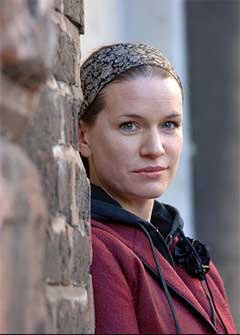 Hall: I think familiar territory is always of comfort to a writer. I find the North of England, where I’m from, fascinating. It’s a very dramatic landscape. It’s kind of a Wordsworth country. So you’ve got the Romantic sense on one hand. And then you’ve got the strange past battling with the future. I suppose Hardy did this to an extent as well. You pick a territory. And even if it’s rural, you have human beings working within that arena. So human drama is going to arise out of those interactions. And I’ve always felt, even though the settings are sometimes quite remote and underpopulated in my fiction, there’s enough going on. You can explore ideas of civilization, breakdown of civilization, human emotional dramas. All the rest of that. But I think what’s interesting with Daughters of the North is — even though we’re casting ahead maybe thirty, forty years from now — and I think British science fiction and speculative fiction does this a lot — there’s this idea of play. When catastrophe happens, everything is knocked back to the past. And so here is what you’re left with. Day of the Triffids. This strange science fiction going on. But at the same time, everybody’s going down to the pub like they always have.