Richard Russo recently appeared on The Bat Segundo Show #301.
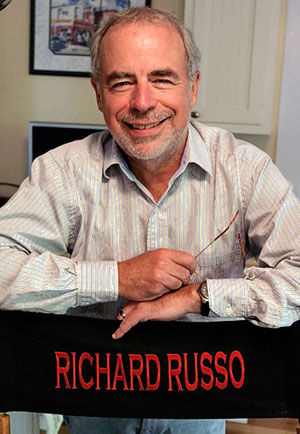
Richard Russo is most recently the author of That Old Cape Magic. He previously appeared on The Bat Segundo Show #152.
Condition of Mr. Segundo: Shoving Cape Cod mackerel down his throat.
Author: Richard Russo
Subjects Discussed: [List forthcoming, but lots in the latter half of the show about the Newsweek piece and the perceptive problems with close third-person.]
EXCERPT FROM SHOW:
 Correspondent: Bon Jovi’s “Living on a Prayer.” Why “Living on a Prayer” over “You Give Love a Bad Name?”
Russo: (laughs)
Correspondent: Was “Living on a Prayer” the tune that was more applicable to weddings here?
Russo: Ed, Ed, you’re trying to make me feel regret now, aren’t you? Because that would have been perfect as well.
Correspondent: Was it more about living than love? With the emphasis in the book.
Russo: It was the result of my wife and I having gone recently to a number of weddings and being absolutely fascinated by the way young people my daugghters’ age react to the song. Because it is so much before their time. And for a lot of young people — 28, 29, 30 — it is a kind of anthem And the way they not only know the words, they have a kind of routine worked out on the dance floor. Those in the know have this routine on the dance floor that involves the fist-pumping, which they do in unison. Sometimes forty or fifty of them, young people out on the dance floor, to a song that is just so much before their time. But they’ve adopted it. So it was a wonderful way to show a bridge between those generations. And Laura, who does such a kind act in that redeems her father, at least temporarily. It just fit that slot so nicely. It also suggests that when Griffin begins this novel, he’s had a tiff with his wife. But it’s really just a tiff. I mean, he has a kind of tenure in his job. He loves his life. He loves his wife. He loves his daughter. Everything is right. And yet by the end of the first half of this book, he’s living on a prayer. And he knows it. Whereas he didn’t in the beginning.
Correspondent: But it’s interesting. Because your timing is absolutely perfect! Recently, on YouTube, there’s this video that’s been going around, that 18 million people have seen, of this elaborate dance at a wedding all set to music.
Russo: Oh really? I hadn’t seen it.
Correspondent: Well, I know. I don’t think you’re much of an online guy.
Russo: (laughs)
Correspondent: I wanted to talk about the notion of the home in this book. There’s a sentiment that is expressed: “You aren’t a real adult until you have a mortgage you can’t afford.”
Russo: Right.
Correspondent: Griffin is pressured into home ownership. And he and his wife often sift through the real estate catalogs, splitting up properties into Cannot Afford It and Wouldn’t Have It As a Gift.
Russo: Right.
Correspondent: And then also, 13-year-old Sunny Kim says, “You have a lovely home,” later on in the book. Home though is not necessarily where the heart is in this. This is a couple that is united by home as a piece of property, as opposed to a place where one can establish a family. This is a couple that settles on The Great Truro Accord and actually figures that this prearranged stratagem will aid them in deflecting every curveball of life thrown their way. So I wanted to just ask you why the home, of all things — or even just property in general — would be the central place for this couple’s failure to (1) deal with life and (2) come to the real terms that they are their parents and that they share a lot of family qualities. That’s a lot of points. I’ll stop there.
Russo: No, no, that’s — yes, I’m overwhelmed by the question. The other conflict, of course, is that Griffin’s parents, of course, are confirmed renters. So their notion of a home is something which recedes before them. Like the Cape itself. I mean, home for them is a place that you can only visit. And so, for Griffin, home is something that he is really reluctant to go to. Joy loves her parents’ home. She loves the vacation home. The same home that they rent every year. For her, home is a central place, as you said. It is the place where love resides most powerfully. And I think I would also expand that to say that home, like marriage, is not just a private thing. Just as marriage institutionalizes love in some way, home institutionalizes family. So when Sunny Kim — the outsider — comes in and says, “You have a lovely home.” He’s saying, “You have a lovely daughter with whom I’m in love. You have a lovely marriage to which I aspire. You have a lovely home that I would like to live in one day and you have a lovely nation that is now my adopted home.”
So just as your question is big, my answer is kind of big. In the sense that the notion of home, by the time we get to the end of this book — especially that final Sunny Kim scene — that notion of home has gone from something at the beginning — it was two people separating real estate property on a place they can’t afford into those two categories — Can’t Afford It and Wouldn’t Have It As a Gift. And by the time we get to the end of the novel, it’s almost something that you would expect to be taken over at some point by Department of Homeland Security. (laughs)
BSS #301: Richard Russo II (Download MP3)
Listen: Play in new window | Download
 Correspondent: You seem to veer between these really lonely tales and these outright satirical tales. After the whole incident where your novel got serialized at Harper’s, I’m curious if there’s some hesitancy on your part to pursue satire. Is that why Castle‘s so dark?
 Correspondent: But the writing that you did. The times that you had. Surely now, decades later, you remember those times. They matter more to you than the brand name on that sneaker. And not only that. But it seems to me that you had a situation. I had a similar situation in terms of having hand-me-downs and that kind of thing.
 Mieville: Fundamentally, what this is about is taking the logic of everyday borders — the logic of political boundaries — and extrapolating them just a little tiny bit. But the logic is the same. It’s an exaggeration, but it’s not a radical break. So in terms of the rules of physics and all that sort of stuff, it is at least 96% sure that they are the same as in this world here. This is not a magical realm in that sense. That’s not how this works. And that’s quite a big difference. Because that short story [“Reports of Certain Events in London”] was very much about the kind of implicit dream logic of the psychogeography of London, and literalizing that metaphor and the city as an uneasy beast. This is slightly different. In some ways, this is much more to do with a genuine juridical legal reality of the world. As I said, it’s extrapolated. But to that extent, it’s very realistic. The logic of the strangeness is actually a logic that exists in the real world. It’s a little bit exaggerated, but that’s all. So to me, they feel quite different. But that’s not to invalidate your point. Because like I say, it has much to do with reception and subconscious stuff. But at a conscious level, they felt different to me.
 Correspondent: You bring up Gresham’s law a few times in the book. That principle in which bad money drives out the good. Your example involves watered down milk over purer milk. But as you point out both in the book, with the idea of Americans having less spending money for T-shirts and lettuce, and in this particular idea that you just said in your last answer about looking for the ultimate bargain, if we have indeed become accustomed to our watered down milk, why then would we start accustomizing ourselves to purer milk? Or this higher aspect of craftsmanship? If there is no economic incentive for us to do so, then surely are we trapped in this cycle of bad money driving out the good?