Kim (Modern Library #78)

(This is the twenty-third entry in the The Modern Library Reading Challenge, an ambitious project to read the entire Modern Library from #100 to #1. Previous entry: A Room with a View)

Three years ago, my jocular compadre Lydia Kiesling pointed out that Kim‘s festering reputation as an imperialist watermark had hindered her from a serious plunge. She rightly identified a “Post-Colonial Burn Index” for this type of literature, whereby enduring high and mighty white males braying in turgid and self-congratulatory sentences about their entitled position was an experience about as pleasant as being repeatedly kicked in the teeth by a herd of Thoroughbred racehorses that had been paddocked too long without option of rotary gallop.
While Lydia found Kim to be a pleasant surprise, I felt Kipling’s “masterpiece” to be largely repugnant: the kind of pernicious slog that turns good people into Aryan crusaders if they don’t move on quickly to something else. The book’s enticing aesthetic of geography, esoteric terminology, Arabic names, Jainist neologisms, and now commonplace food wasn’t enough to shake the deeply unsettling feeling that Kipling, despite his welcome overtures, really wanted all of India to remain subservient to the Anglo way, perhaps because this was the only way he could reckon with his nostalgia for a time long passed. This novel was his swan song to India. And while the book is sometimes an engaging adventure, it is too fraught with covert condescension.

Among many disgraceful stereotypes, Kim is a novel which describes how “Kim could lie like an Oriental,” how “[a]ll hours of the twenty-four are alike to the Oriental” and describes both “the Oriental’s indifference to mere noise,” how “Orientals understand speed,” and how a project “[falls] back, Oriental-fashion, on time and chance.” There is a Russian agent who announces late in the book, “It is we who can deal with Orientals.” (This sentiment of “dealing with Orientals” is later echoed by Hurree.) But the fun doesn’t stop there. There’s an odious drummer-boy from Liverpool who badgers Kim when he “[talks] the same as a nigger.”

This is far more insidious than Kingsley Amis writing of Kim‘s problematic meticulousness, “if he says coriander when he means cardamum I will let it go.” As my homeboy Edward Said wisely observed in Culture and Imperialism:

…yes, Kipling can get into the skin of others with some sympathy. But no, Kipling never forgets that Kim is an irrefragable part of British India: the Great Game does go on, with Kim a part of it, no matter how many parables the lama fashions. We are naturally entitled to read Kim as a novel belonging to the world’s greatest literature, free to some degree from its encumbering historical and political circumstances. Yet by the same token, we must not unilaterally abrogate the corrections in it, and carefully observed by Kipling, to its contemporary actuality.

The depictions of residents from the Far and Near East as lesser beings have been held up as criticisms of racism by some Kipling scholars. But given that the novel goes out of its way to grant thirteen-year-old Kimball O’Hara, “burned black as any native,” the luxury of swinging both ways as sahib and a boy capable of disguising himself in “native-fashion,” there’s a decidedly privileged feel to Kim’s picaresque adventures which gives any 21st century reading experience a sour and regressive taint.

So what is Kim‘s appeal? For me, the lama is the novel’s high point. He finds Kim in Lahore. He sets out with the boy to seek the physical manifestation of their respective visions (for Kim, a Red Bull in a green field; for the lama, “The River of the Arrow”). He serves as a remarkably patient patriarchal figure throughout. The novel felt more honest when Kim used the lama’s otherness to skimp out on train fare or when Kim was free to get into wild adventures without obligation or mimesis.

The sympathetic socialist critic Irving Howe is perhaps the closest in describing why the novel is still worth a soupçon of consideration. Howe observes that Kipling was “a jingo and a bully, or defender of bullies,” but identifies Kim as a work that involves seeing the world “as an apprehension of things as they are” and “accepting, even venerating sainthood, without at all proposing to surrender the world, or even worldliness, to saints.” But one of the chief frustrations about Kim is that, for all of Kipling’s erudition about India, he is blind to his own inherent prejudices.

No matter how liberated Kim may be, he is still identified by how he is seen or how he is “suited”:

The pallor of hunger suited Kim very well as he stood, tall and slim, in his sad-coloured, sweeping robes, one hand on his rosary and the other in the attitude of benediction, faithfully copied from the lama. An English observer might have said that he looked rather like the young saint of a stained-glass window, whereas he was but a growing lad faint with emptiness.

Is not Kipling complicit in how his characters are seen by the reader, who may be an “English observer” of another sort? In the gnarly opening chapters, we see Kim “flat on his belly” while a tall man stands “erect as an arrow.” And this is hardly the first time the novel resorts to a descriptive style where “erect” positioning is so closely identified to social station or caste.

Unlike Edmund Wilson, who complained about how the novel doesn’t live up to “what the reader tends to expect,” I don’t have any particular problems with the book’s inconclusive finale. Fiction has no obligation to answer everything. Kipling’s efforts to reconcile the book’s spiritual side (the Buddhist idea of the Wheel of Things, as introduced by the lama) with its espionage side (the Great Game of geopolitical conflict “that never ceases day and night”) smack of a desperate effort to sandwich disparate ingredients into a luncheon that cannot possibly satisfy everybody, let alone account for the complexities of a massive nation. It is fundamentally impossible for either Kipling or Kim to make a dichotomous choice when there is, quite literally, so much territory covered on the Great Trunk Road, on board the “te-rain,” and along the “long, peaceful line of the Himalayas.” (In deference to the lama’s portent, there are quite a number of “rivers” in this book, often through rail and road.) The Middle Way may be the “path to freedom,” but the river that the lama does eventually find cannot be found on any map.

But I am with Wilson in calling out Kipling’s failings to confront a very real crisis. I am hardly alone. Even the enthusiastic biographer Martin Seymour-Smith was to confess, “Kim is not, for me, quite the masterpiece that it is for many critics,” believing the problem to stem from the novel being simultaneously a children’s book and an adult’s book. Seymour-Smith also posits the interesting theory that Kipling’s failure to return to India and confront its considerable change is one of the reasons it is not quite right.

Kim lacks the imagination and the deft command of Kipling’s shorter fiction. But this novel was such a despondent read that I don’t think I’ll be reading this blustery Nobel laureate again for at least another decade. If I want a Great Game, I’ll drag out Cranium or Twister from the closet.

Next Up: James Joyce’s Finnegans Wake! (This will take a very long time!)

A Bend in the River (Modern Library #83)

(This is the eighteenth entry in the The Modern Library Reading Challenge, an ambitious project to read the entire Modern Library from #100 to #1. Previous entry: The Death of the Heart)

There are so many unpardonable cruelties collected in Patrick French’s gripping (and authorized!) biography, The World Is What It Is, that it’s difficult to know where to start in condemning V.S. Naipaul’s boorish behavior, while also praising his prowess on the page. And yet I can’t quite do that either. I’ve read A Bend in the River twice, and I have to conclude that the book’s pat pronouncements about colonialism, even with the adept take on self-deception and willful naïveté, aren’t especially staggering. By the time the shopkeeper Salim shows his colleague Indar around the African town where he lives and reveals how little he knows (“All the key points of the town I knew could be shown in a couple of hours, as I discovered when I drove him around later that morning”), it was abundantly clear to me that he would never know.
Perhaps the mid-career rise of Naipaul’s rep was all in the timing. French suggests that “[a] rising disillusion with the post-colonial project in many countries lead to Vidia being projected as the voice of truth, the scourge who by virtue of his ethnicity and his intellect could see things that others were seeking to disguise.” But Naipaul does deserve props for depicting how a revolutionary leader (referred to as “the Big Man”), even after the aloof establishment of a McDonald’s-like Bigburger restaurant and a dubious university, steers an unnamed African nation to the same scorched earth which existed before. And this, along with a sad and desperate historian named Raymond and the many ruined monuments seen from previous regimes, makes Bend a rock-hard reading experience for the strident geopolitical junkie. (When I first read Bend, I had this image of Wolf Blitzer shouting aloud passages on CNN, demanding reader responses from Romney and Santorum. I did my best to shake off this terrifying vision of the dreaded bearded bloviator. But my imagination revolted. Because not long after this, I had a weird dream where Blitzer kidnapped me and ordered me to burn all books aside from Naipaul. Blitzer then set himself on fire and began laughing like a psychotic, refusing to let me extinguish the conflagration. And I woke up. This may explain, in part, why it’s taken me many weeks to get to this essay.)

The Andrew Seal types will tell you that the novel’s appeal involves how Naipaul has demonstrated how order is not necessarily in opposition to complexity. And the academic Fawzia Mustafa has rightly suggested that Bend is very much about how one’s relationship to Africa is determined through a misread. (Miscerique probat populus et feodera jungi, a commemorative plague at the dock, is deliberately misread throughout the book.)

But this still doesn’t make up for Naipaul short-changing the African people, who are little more than crude caricatures serving this allegorical exercise. There are marchandes like Zabeth, who pick up supplies from Salim’s store and have “a special smell” that is “strong and unpleasant.” There is the houseboy Ildephonse, who becomes an ad hoc restaurant manager who turns “vacant” when his bosses leave. This leads Salim to conclude:

I noticed this alteration in the African staff in other places as well. It made you feel that while they did their jobs in their various glossy settings, they were only acting for the people who employed them; that the job itself was meaningless to them; and that they had the gift — when they were left alone, and had no one to act for — of separating themselves in spirit from their setting, their job, their uniform.

Granted, the matryoshka-like idea here is that Salim, the Indian émigré who has set up shop and plays squash at the Hellenic Club and is often clueless about how much he is reviled by apparent pals and locals, is the imperialist mirror image to what he sees. The Africans — especially the family servant Metty (nicknamed this because of his interracial background) — develop sentiments that Salim refuses to see. Even outright revolution is beyond his scope. There’s one stirring moment in which Salim visits a school with Indar and is challenged by a student: “Would the honourable visitor state whether he feels that Africans have been depersonalized by Christianity?” Yet Salim refuses to ken these kernels of discontent, later remarking, “I thought how far we had both come, to talk about Africa like this.”

So Naipaul’s novel made for a frustrating experience. On one hand, he wants to expose Salim’s inherent hypocrisy and nastiness. But I have good reason to believe that Naipaul himself embraces it, which is probably why this ugliness smoulders off the page. So while I can admire Naipual’s hard-hitting imagery (“smooth white lips of bread over mangled black tongues of meat”) and his knack for myopic maxims (“We make ourselves according to the ideas of our possibilities” and “The airplane is faster than the heart”), I’d be lying if I didn’t say that I’ve been eagerly anticipating a reading life without Naipaul. (Not quite. Like a Romero zombie, A House for Mr. Biswas is on the Modern Library list at #72.)

A Bend in the River isn’t a bad book. It isn’t as overrated or as desperate to please as Midnight’s Children.* But I don’t think I would call it a classic. While one should take care to separate the author from his work, I have learned that Naipaul has largely drawn from his life. (Indeed, if you read French’s book, it can be handily argued that “V.S. Naipaul” is Naipaul’s favorite subject.) I’ve really wanted to understand why so many people would refuse to question such a flagrant sociopath. Naipaul is a good writer, but he’s certainly not great if we stack the smug scamp against Conrad, Doris Lessing, Chinua Achebe, or Ngũgĩ wa Thiong’o. All could easily clean Naipaul’s clock.

How has Naipaul mined from his life? One monstrous moment bubbles to the brim. Here’s Naipaul writing his mother in 1956, remarking upon a fellow boat passenger:

Poor thing, she was so frightened at the thought of travelling alone for the first time out of Trinidad at the age of thirty-five. She palled up with me and begged me in case of any alarm or trouble to come and look after her. The red nigger woman is really delightfully simple. You know, in ships, the chairs and tables are all chained to the floor to prevent them from rolling about the place when the sea gets rough. I told the woman that the tables and chairs were chained to prevent people stealing them. And, she believed it. ‘Eh, eh,’ she said, “But look at that, eh.” And again: passengers in different parts of the ship are assigned to different lifeboats (there are 6 on the Golfito). I told her that she had to find out which lifeboat was hers because, in case of any trouble, they were not going to let her get into any old lifeboat. In fact, if they found her in the wrong boat they were going to throw her into the sea. It was, I told her, the origins of the phrase ‘to be in the wrong boat.’

It is already mind-boggling enough to consider anyone who would practice such unmitigated spite towards a woman who was harming nobody. It is another thing altogether to boast about such baleful behavior to your own mother. Naipaul is clearly a man whose central pleasure involves terrorizing any figures “who are nothing” or “who allow themselves to become nothing,” to invoke, as French has with his biography title, A Bend in the River‘s famous opening.

As we read Bend, we learn that the writer and his antihero aren’t terribly different. Here’s Salim responding to poor Ferdinand, when the latter expresses a desire to find a better life studying in America:

I said, “Why should I send you to America? Why should I spend money on you?”

He had nothing to say. After the desperation and the trip through the rain, the whole thing might just have been another attempt at conversation.

Was it only his simplicity? I felt my temper rising — the rain and the lightning and the unnatural darkness of the afternoon had something to do with that.

I said, “Why do you think I have obligations to you? What have you done for me?”

The same question might likewise be addressed to the vile Vidia.

* * *

“I love you because you are so mean,” wrote Eve Babitz to Naipaul shortly after Bend‘s publication. But why should we celebrate an author who offers little more than meanness in life and in art? I ponder the type of blindsided reader who would only pine for the negative. Because it sure as hell isn’t me. Sure, I may have been seduced by Elizabeth Bowen’s brand of cruelty in the last installment, but there was enough carefully orchestrated character flinging to keep me intrigued. With Naipaul, the prose was often so slick that I felt my soul being clogged up by a BP-sized oil spill. I haven’t even brought up the unintentionally hilarious affair with Yvette, which is so rooted in preposterous male fantasy that one wonders if Vidia has ever understood women. (This is the same man who has the audacity to claim that women cannot write.)

“Carrying on” may help you negotiate the frontier, but that passive place doesn’t help you connect with other people or overcome your assumptions. That’s certainly Naipaul’s point. Yet I came away from this novel thinking that Naipaul was just as much monstrum horrendum, informe, ingens, cui lumen ademptum as his characters.

* — And since I’m being a little hard on Rushdie, in the interest of balance, I should probably relate this remarkably insensitive Naipaul anecdote. Naipaul has remained so committed to steely misanthropy that he refused to sign a petition supporting Salman Rushdie after Khomeini issued his fatwa, adding (according to the French bio), “I don’t know his books, but I’ve been aware of his statements. I found them usually left-wing and trivial and antiquated.” And he didn’t stop there. Naipaul would call the fatwa “an extreme form of literary criticism.” It’s one thing to dislike Rushdie’s books. It’s another thing to employ one’s literary sensibilities as justification for murder.

Next Up: Wallace Stegner’s Angle of Repose!

The Bat Segundo Show: Insulted by Authors

Bill Ryan recently appeared on The Bat Segundo Show #384. He is the proprietor of the website Insulted by Authors.

Condition of Mr. Segundo: Insulted by humorless people.

Guest: Bill Ryan

Subjects Discussed: Taking unexpected tumbles in life, why insults are the best way to pop the cherry of the author-reader relationship, being the son of a scientist, dodging dodgy publicists, being identified as “The Bill Plus Insult Guy,” picking away at the celebrity industrial complex that has been built up around the author, being frightened by Salman Rushdie, whether there is something inherently wrong in asking an author to insult the reader, difficulties with humorless authors, Nicole Krauss’s post-profanity titter, how the prelude to an author interaction sets up strange expectations, Rick Moody’s refusal to sign older books, book autograph prospectors, being afraid of preconceptions, taking the denial of an insult personally, when joie de vivre is mistaken as a threat, hero worship and naivete, the protective personality traits of authors, looking at the dilemma from the “why not an insult?” position, ideal readers vs. material readers, Banksy, being inclusive of quirky ideas within a marginalized medium, non-monetary value and books, and the dangers of being drawn too close to the apotheosis of fame.

EXCERPT FROM SHOW:

Ryan: Salman Rushdie was in my top four of insults I’d love to get. The Mount Rushmore of insults or whatever. I was so frightened ahead of time for some reason, despite the fact that this is a guy who’s reading a children’s book in front of a crowd of people who showed up at an art gallery. To hear someone read a children’s book. I was nervous! Because it’s Salman Rushdie. And I approached him. And I have tweaked my approach, depending upon the author. Like with Salman Rushdie, I was very deferent. “Mr. Rushdie, I’m sorry to be the kind of person to ask you this. But if you have a moment, if that’s okay, could you add an insult to my personalization?” And I’m worried almost that the fact that I’m scared, intimidated by the very thing that I kinda want to break down, is maybe a problem with my scientific approach. (laughs) Do you know what I mean?

Correspondent: Well, maybe it’s an emotional approach. Because here you have Rushdie. You hope that he will defy your expectation, that he will insult you. And what does he do? He decides, “Why do you want to do that?” And it’s sort of a big letdown. It’s almost like maybe you were nervous about setting yourself up for this letdown. Is that safe to say?

Ryan: It’s like: What did I do wrong? Okay. Exactly, yes! The scientific approach where I was waiting in line and I had everything lined up like a series of actions that I had just lined up in my mind. And I’m like, “Okay, I’m going to approach Mr. Rushdie. I’m going to set down my book. Very gently.” I’m going to say, “Mr. Rushdie, thank you very much. Blah blah blah. By the way, my name’s Bill. Insulted by Authors.” So I went back over after the fact. And for whatever reason, I got really really nervous and really excited. Just the fact that I’m disrupting whatever silly little convention that there is behind the whole signing of a book. I may be blowing it up way, way too big in my mind. But afterwards, my heart was pumping. And I was like, “Okay, what did I do wrong? What was it that Mr. Rushdie didn’t understand about….”

Correspondent: Just call him Salman. (laughs) Mr. Rushdie? He won’t appear on this program. So we can go ahead and be informal about him. If it’s any consolation.

Ryan: (laughs) So Salman. Yeah, I had to go over for the next twenty minutes. And I actually, literally, sat right outside the signing — or stood right outside the signing — and was breathing deep. And all these people.

Correspondent: Breathing deep?

Ryan: Yeah. I was breathing deep. I was actually…

Correspondent: Hope you weren’t hyperventilating.

Ryan: A little bit! A little bit, man. This is how much I put into this for whatever stupid reason. And all these people who had heard me talking to myself in line slowly filtered out around the corner. What did I do wrong? How can I perfect this asking for an insult? How can I make this more accessible to the Rushdies of the world? But also equally accessible to the AL Kennedys of the world.

Correspondent: Or the Amy Sedarises.

Ryan: Exactly. Exactly.

Correspondent: Well, on the other hand, what do you to deal with the reality that some authors — particularly the Old World, anti-online, anti-Tumblr, anti-Twitter types — they’re going to go ahead and say, “I’ll never stoop to that. Because I am an author.” Rushdie may be one of the last ones. Along with say, maybe, Richard Ford. I don’t think he would insult you.

Ryan: Probably not.

Correspondent: Philip Roth might, I think.

Ryan: I’d like to think that.

Correspondent: (laughs) I’d like to think that he would. Cynthia Ozick might, if you could get her.

Ryan: Yes!

Correspondent: But, on the other hand, you’re dealing with a lot of self-important authors who, let’s face the facts, are humorless. So where does the challenge kick in? Is it less about trying to bump your head against the wall? And more about seeing how they will react? I mean, it was actually rather astonishing to me to learn that Allegra Goodman would refuse to insult you and that post has not gone up, I noticed.

Ryan: Not yet. Not yet. I went through a transition between — I still don’t quite know what I’m trying to do with all this. Like I’m just trying to have fun. And I’m a book collector, in general. And I treat books as objects in addition to being books. Which is somewhat tragic, I’m sure. But also — whatever. I mean, everybody has something they’re trying to change about them. But I feel like everyone would be able to give me an insult if I somehow approached them in the right way or it was the right situation. Or something. There’s all these other outline — like little things that can mess with my amazing idea, incredible idea for insults.

Correspondent: You think you can develop the perfect pretext for any situation.

Ryan: (laughs) Exactly.

The Bat Segundo Show #384: Insulted by Authors (Download MP3)

This text will be replaced

What Characters Read Books on Television?

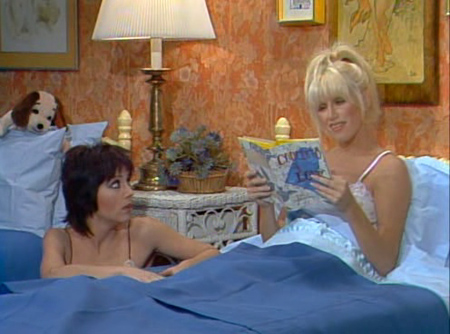
The above screenshot is from a Three’s Company episode called “The Lifesaver,” in which even the dimwitted Chrissy Snow could be seen reading a book. The novel is Concerto of Love (fictional, of course) and Chrissy had only reached Page 4. But it does have me wondering. In 1979, even sitcom characters who were more than a few cards short of a full deck were still committed to reading in some form. Can we say the same thing in 2010? What television reading moments have you seen lately?

UPDATE: Here are some observations from Twitter.

Ron Charles: “Isn’t that odd. There are rarely any books in their homes…”
eBookNewser: “There is an episode of the Rockford Files where Jim is reading some kind of detective novel. Tom Select is in the episode.”
Mark Athitakis: “Best-read character on a show currently on the air: Brian Griffin” and “‘Mad About You’ may be the exception that proves the rule.”
James Othmer: “Draper: Meditations in an Emergency; other Mad Men selecs: Lady Chatterly, The Best of Everything, The Sound & the Fury.”
John Williams: “I imagine Lisa Simpson is pretty well read for her age.”
Mike Cane: “Well, duh, CASTLE. But he also writes them.”
Colleen Mondor: “Has anyone mentioned Rory on THE GILMORE GIRLS yet? It was a hallmark of her character.”
Levi Asher: “hmmm … the youngest kid in “Good Times” was often seen carrying or quoting from a book … Dale Cooper … Lucy Ricardo.”

Needless Counting Exercises

Words, being silly little units of language reflecting emotional and synaptic activities, are subject to frequent bursts of growth which are known to frustrate the unadventurous reader, possibly causing a regrettable series of eructations. The ambitious novel containing many words is greeted with suspicion, as if all minds are expected to conform to some craven concision. The slim novel may likewise be received by those eagerly wishing to plant plaints, but these impatient toe-tappers are often considering the words-per-ounce (and unspoken words-per-dollar) text stat introduced by the seemingly unstoppable commercial forces of Amazon. But if the novel is any good, it will invite a return visit, irrespective of length. So why perform a counting exercise? It’s not as if you’re likely to count the number of times you make love to your sweetheart — a taboo recently investigated by Kevin Sampsell in his memoir, A Common Pornography. But you will count the number of books you’ve read in the last year or the number of pages you have left. If passion (or bodily fluids) are exchanged through such bookkeeping exercises, then is this not equally crass? A novelist has likely made love or masturbated during the creative process, likely relieving the remarkable tensions that accumulate. Some readers may very well be lucky to engage in carnal relations with the author as he eats poorly and catches a few winks in sketchy hotels during the course of a book tour. But think about this. If you cannot sleep with the novelist, you have a book in your hands that, if it is good, will elicit a similar sensation. And while you may expire after fifteen minutes in the boudoir, with a book, you may very well keep the blood pumping and the balls bouncing for several weeks. And nobody has to know. Given the established covenant between novelist and reader, one does not have to fret about adultery. For all this is perfectly legal. One may be vexed by stains, either of a literal or metaphorical nature. But then I’m the one emitting the gushing comparative point. More chaste-minded readers may consider the novel a fantasy, an escape, or an edification — and such pursuits may not necessarily drift towards the explosive rumination that I am imputing. Does one parallel lead to more dutiful marking of notches on the belt? Perhaps. But it all seems a needless counting exercise that defeats the purpose of reading.