Six Easy Pieces (Modern Library Nonfiction #88)

(This is the thirteenth entry in The Modern Library Nonfiction Challenge, an ambitious project to read and write about the Modern Library Nonfiction books from #100 to #1. There is also The Modern Library Reading Challenge, a fiction-based counterpart to this list. Previous entry: Pilgrim at Tinker Creek.)

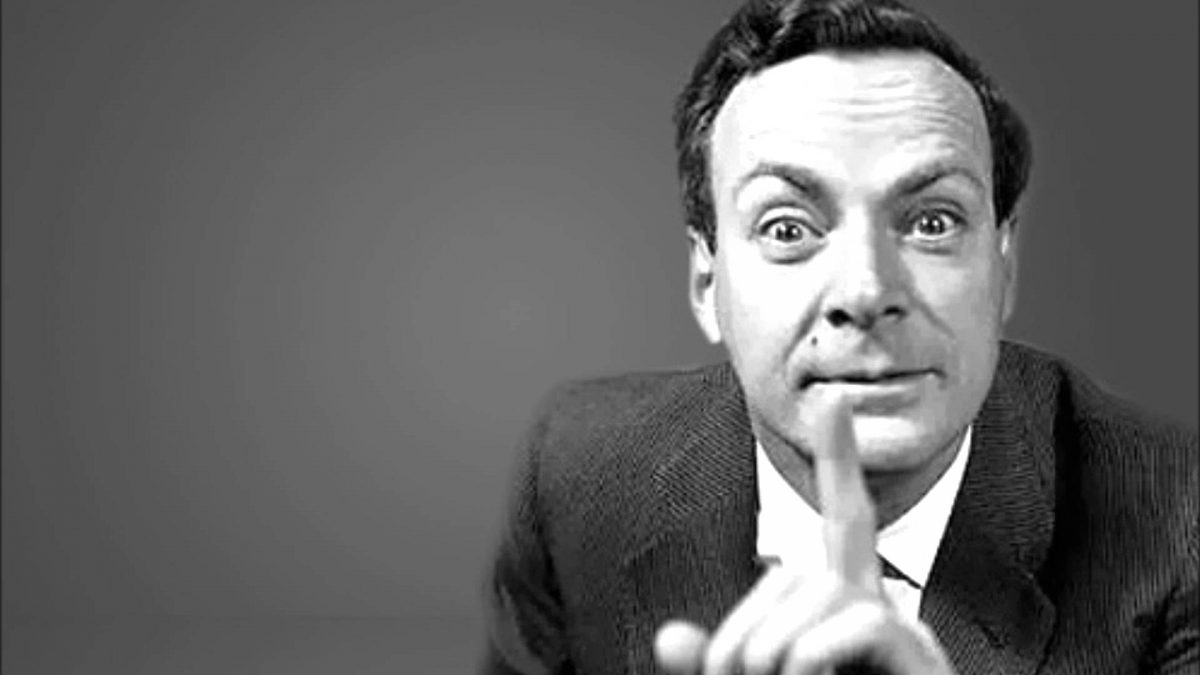
mlnf88Richard Feynman, exuberant Nobel laureate and formidable quantum mechanics man, may have been energetic in his lectures and innovatively performative in the classroom, but I’m not sure he was quite the great teacher that many have pegged him to be. James Gleick’s biography Genius informs us that students dropped out of his high-octane, info-rich undergraduate physics classes at a remarkable rate, replaced by Caltech faculty members and grad students who took to the Queens-born superstar much like baryons make up the visible matter of the universe. The extent to which Feynman was aware of this cosmic shift has been disputed by his chroniclers, but it is important to be aware of this shortcoming, especially if you’re bold enough to dive into the famed three volume Feynman Lectures on Physics, which are all thankfully available online. Six Easy Pieces represents an abridged version of Feynman’s full pedagogical oeuvre. And even though the many YouTube videos of Feynman reveal an undeniably magnetic and indefatigably passionate man of science who must have been an incredible dynamo to experience in person, one wonders whether barraging a hot room of young nervous twentysomethings with hastily delivered information is the right way to popularize science, much less inspire a formidable army of physicists.

Watch even a few minutes of Feynman firing on all his robust cylinders and it becomes glaringly apparent how difficult it is to contend with Feynman’s teaching legacy in book form. One wonders why the Modern Library nonfiction judges, who were keen to unknowingly bombard this devoted reader with such massive multivolume works as The Golden Bough, Dumas Malone’s Jefferson and His Time, and Principia Mathematica, didn’t give this spot to the full three volume Lectures. Did they view Feynman’s complete lesson plan as failed?

Judging from the sextet that I sampled in this deceptively slim volume, I would say that, while Feynman was undeniably brilliant, he was, like many geniuses, someone who often got lost within his own metaphors. While his analogy of two corks floating in a pool of water, with one cork jiggling in place to create motion in the pool that causes indirect motion for the other cork, is a tremendously useful method of conveying the “unseen” waves of the electromagnetic field (one that galvanized me to do the same in a saucepan after I had finished two bottles of wine over a week and a half), he is not nearly on-the-nose with his other analogies. The weakest lesson in the book, “Conservation on Energy,” trots out what seems to be a reliably populist metaphor with a child named “Dennis the Menace” playing with 28 blocks, somehow always ending up with 28 of these at the end of the day. Because Feynman wants to illustrate conservational constants, he shoehorns another element to the narrative whereby Dennis’s mother is, for no apparent reason, not allowed to open up the toy box revealing the number of blocks and thus must calculate how many blocks reside within. The mother has conveniently weighed the box at some unspecified time in advance back when it contained all 28 blocks.

This is bad teaching, in large part because it is bad storytelling that makes no sense. I became less interested in conservation of energy, with Feynman’s convoluted parallel clearly becoming more trouble than it was worth, and more interested in knowing why the mother was so fixated on remembering the number of blocks. Was she truly so starved for activity in her life that she spent all day at work avoiding all the juicy water cooler gossip about co-workers, much less kvetching about the boss, so that she might scheme a plan to at long last show her son that she would always know the weight of a single block? When Dennis showed resistance to opening the toy box, why didn’t the mother stand her ground and tell him to buzz off and stream an episode of Project Mc²?

Yet for all these defects in method, there is an indisputable poetic beauty in the way in which Feynman reminds us that we live in a vast world composed of limitless particles, a world in which we still aren’t aware of all the rules and in which even the particles contained within solids remain “fixed” in motion. Our universe is always moving, even when we can’t see it or completely comprehend it. Feynman is quick to observe throughout his lessons that “The test of all knowledge is experiment,” which again points to my theory that Feynman’s teachings, often accentuated by experiment, were probably better experienced than read. Nevertheless, even in book form, it is truly awe-inspiring to understand that we can still not accurately predict the precise mass, form, and force of all the cascading droplets from a mighty river once it hits the precipice of a waterfall. Such mysteries capture our imagination and, when Feynman is committed to encouraging our inventiveness through open and clear-eyed examples from our world, he is very much on point. Thanks in part to Feynman reminding me just how little we silly humans now know, I began to feel my heart open more for Tycho Brahe, that poor Dane who spent many years of his life refining Copernicus’s details and determining the elliptical patterns of planetary orbits. Brahe worked out his calculations entirely without a telescope, which allowed Johannes Kepler to sift through his invaluable measurements and forge laws that all contemporary astronomers now rely on to determine where a planet might be in the sky on any given night of the year. Heisenberg’s uncertainty principle hasn’t even been around a century and it’s nothing less than astounding to consider how our great grandparents had a completely different understanding of atoms and motion in their early lifetime than we do today.

Feynman did have me wanting to know more about the origins of many scientific discoveries, causing me to contemplate how each and every dawning realization altered human existence (an inevitable buildup for Thomas Kuhn and paradigms, which I will take up in ML Nonfiction #69). But unlike such contemporary scientists as Neil deGrasse Tyson, Alan Guth, or Brian Greene, Feynman did not especially inspire me to plunge broadly into my own experiments or make any further attempts to grapple with physics-based complexities. This may very well be more my failing than Feynman’s, but there shall be many more stabs at science as we carry on with this massive reading endeavor!

Next Up: G.H. Hardy’s A Mathematician’s Apology!

Pilgrim at Tinker Creek (Modern Library Nonfiction #89)

(This is the twelfth entry in The Modern Library Nonfiction Challenge, an ambitious project to read and write about the Modern Library Nonfiction books from #100 to #1. There is also The Modern Library Reading Challenge, a fiction-based counterpart to this list. Previous entry: The Golden Bough.)

“Either this world, my mother, is a monster, or I myself am a freak.” — Annie Dillard, Pilgrim at Tinker Creek

I was a sliver-thin, stupefyingly shy, and very excitable boy who disguised his bruises under the long sleeves of his shirt not long before the age of five. I was also a freak.

bedroomI had two maps pinned to the wall of my drafty bedroom, which had been hastily constructed into the east edge of the garage in a house painted pink (now turquoise, according to Google Maps). The first map was of Tolkien’s Middle-earth, in which I followed the quests of Bilbo and Frodo by finger as I wrapped my precocious, word-happy head around sentences that I’d secretly study from the trilogy I had purloined from the living room, a well-thumbed set that I was careful to put back to the shelves before my volatile and often sour father returned home from the chemical plant. In some of his rare calm moments, my father read aloud from The Lord of the Rings if he wasn’t too drunk, irascible, or violent. His voice led me to imagine Shelob’s thick spidery thistles, Smeagol’s slithering corpus, and kink open my eyes the next morning for any other surprises I might divine in my daily journeys to school. The second map was of Santa Clara County, a very real region that everyone now knows as Silicon Valley but that used to be a sweeping swath of working and lower middle-class domiciles. This was one of several dozen free maps of Northern California that I had procured from AAA with my mother’s help. One of the nice perks of being an AAA member was the ample sample of rectangular geographical foldouts. I swiftly memorized all of the streets, held spellbound by the floral and butterfly patterns of freeway intersections seen from a majestic bird’s eye view in an errant illustrated sky. My mother became easily lost while driving and I knew the avenues and the freeways in more than a dozen counties so well that I could always provide an easy cure for her confusion. It is a wonder that I never ended up working as a cab driver, although my spatial acumen has remained so keen over the years that, to this day, I can still pinpoint the precise angle in which you need to slide a thick unruly couch into the tricky recesses of a small Euclidean-angled apartment even when I am completely exhausted.

mlnf89These two maps seemed to be the apotheosis of cartographic art at the time, filling me with joy and wonder and possibility. It helped me cope with the many problems I lived with at home. I understood that there were other regions beyond my bedroom where I could wander in peace, where I could meet kinder people or take in the beatific comforts of a soothing lake (Vasona Lake, just west of Highway 17 in Los Gatos, had a little railroad spiraling around its southern tip and was my real-life counterpart to Lake Evendim), where the draw of Rivendell’s elvish population or the thrill of smoky Smaug stewing inside the Lonely Mountain collided against visions of imagined mountain dwellers I might meet somewhere within the greens and browns of Santa Teresa Hills and the majestic observatories staring brazenly into the cosmos at the end of uphill winding roads. I would soon start exploring the world I had espied from my improvised bedroom study on my bike, pedaling unfathomable miles into vicinities I had only dreamed about, always seeking parallels to what the Oxford professor had whipped up. I once ventured as far south as Gilroy down the Monterey Highway, which Google Maps now informs me is a thirty-six mile round trip, because my neglectful parents never kept tabs on how long I was out of the house or where I was going. They didn’t seem to care. As shameful as this was, I’m glad they didn’t. I needed an uncanny dominion, a territory to flesh out, in order to stay happy, humble, and alive.

The maps opened up my always hungry eyes to books, which contained equally bountiful spaces devoted to the real and the imaginary, unspooling further marks and points for me to find in the palpable world and, most importantly, within my heart. I always held onto this strange reverence for place to beat back the sadness after serving as my father’s punching bag. To this day, I remain an outlier, a nomad, a lifelong exile, a wanderer even as I sit still, a renegade hated for what people think I am, a black sheep who will never belong no matter how kind I am. I won’t make the mistake of painting myself as some virtuous paragon, but I’ve become so accustomed to being condemned on illusory cause, to having all-too-common cruelties inflicted upon me (such as the starry-eyed bourgie Burning Man sybarite I recently opened my heart to, who proceeded to deride the city that I love, along with the perceived deficiencies of my hard-won apartment, this after I had told her tales, not easily summoned, about what it was like to be rootless and without family and how home and togetherness remain sensitive subjects for me) that the limitless marvels of the universe parked in my back pocket or swiftly summoned from my shelves or my constant peregrinations remain reliable, life-affirming balms that help heal the scars and render the wounds invisible. Heartbreak and its accompanying gang of thugs often feel like a mob bashing in your ventricles in a devastatingly distinct way, even though the great cosmic joke is that everyone experiences it and we have to love anyway.

So when Annie Dillard’s poetic masterpiece Pilgrim at Tinker Creek entered my reading life, its ebullient commitment to finding grace and gratitude in a monstrous world reminded me that seeing and perceiving and delving and gaping awestruck at Mother Earth’s endless glories seemed to me one one of the best survival skills you can cultivate and that I may have accidentally stumbled upon. As I said, I’m a freak. But Dillard is one too. And there’s a good chance you may walk away from this book, which I highly urge you to read, feeling a comparable kinship, as I did to Dillard. Even if you already have a formidable arsenal of boundless curiosity ready to be summoned at a moment’s notice, this shining 1974 volume remains vital and indispensable and will stir your soul for the better, whether you’re happy or sad. Near the end of a disastrous year, we need these inspirational moments now more than ever.

* * *

“Our life is a faint tracing on the surface of mystery.” – Pilgrim at Tinker Creek

Annie Dillard was only 28 when she wrote this stunning 20th century answer to Thoreau (the subject of her master’s thesis), which is both a perspicacious journal of journeying through the immediately accessible wild near her bucolic Southwestern Virginia perch and a daringly honest entreaty for consciousness and connection. Dillard’s worldview is so winningly inclusive that she can find wonder in such savage tableaux as a headless praying mantis clutching onto its mate or the larval creatures contained within a rock barnacle. The Washington Post claimed not long after Pilgrim‘s publication that the book was “selling so well on the West Coast and hipsters figure Annie Dillard’s some kind of female Castaneda, sitting up on Dead Man’s Mountain smoking mandrake roots and looking for Holes in the Horizon her guru said were there.” But Pilgrim, inspired in part from Colette’s Break of Day, is far from New Age nonsense. The book’s wise and erudite celebration of nature and spirituality was open and inspiring enough to charm even this urban-based secular humanist, who desperately needed a pick-me-up and a mandate to rejoin the world after a rapid-fire series of personal and political and romantic and artistic setbacks that occurred during the last two weeks.

For all of the book’s concerns with divinity, or what Dillard identifies as “a divine power that exists in a particular place, or that travels about over the face of the earth as a man might wander,” explicit gods don’t enter this meditation until a little under halfway through the book, where she points out jokingly how gods are often found on mountaintops and points out that God is an igniter as well as a destroyer, one that seeks invisibility for cover. And as someone who does not believe in a god and who would rather deposit his faith in imaginative storytelling and myth rather than the superstitions of religious ritual, I could nevertheless feel and accept the spiritual idea of being emotionally vulnerable while traversing into some majestic terrain. Or as Pascal wrote in Pensées 584 (quoted in part by Dillard), “God being thus hidden, every religion which does not affirm that God is hidden, is not true, and every religion which does not give the reason of it, is not instructive.”

Much of this awe comes through the humility of perceiving, of devoting yourself to sussing out every conceivable kernel that might present itself and uplift you on any given day and using this as the basis to push beyond the blinkered cage of your own self-consciousness. Dillard uses a metaphor of loose change throughout Pilgrim that neatly encapsulates this sentiment:

It is dire poverty indeed when a man is so malnourished and fatigued that he won’t stoop to pick up a penny. But if you cultivate a healthy poverty and simplicity, so that finding a penny will literally make your day, then, since the world is in fact planted in pennies, you have with your poverty bought a lifetime of days. It is that simple. What you see is what you get.

This is not too far removed from Thoreau’s faith in seeds: “Convince me that you have a seed there, and I am prepared to expect wonders.” The smug and insufferable Kathryn Schulzes of our world gleefully misread this great tradition of discovering possibilities in the small as arrogance, little realizing how their own blind and unimaginative hubris glows with crass Conde Nast entitlement as they fail to observe that Thoreau and Dillard were also acknowledging the ineluctable force of a bigger and fiercer world that will carry on with formidable complexity long after our dead bodies push against daisies. Faced with the choice of sustaining a sour Schulz-like apostasy or receiving every living day as a gift, I’d rather risk the arrogance of dreaming from the collected riches of what I have and what I can give rather than the gutless timidity of a prescriptive rigidity that fails to consider that we are all steeped in foolish and inconsistent behavior which, in the grand scheme of things, is ultimately insignificant.

Dillard is guided just as much by Heisenberg’s uncertainty principle as she is by religious and philosophical texts. The famous 1927 scientific law, which articulates how you can never know a particle’s speed and velocity at the same time, is very much comparable to chasing down some hidden deity or contending with some experiential palpitations when you understand that there simply is no answer, for one can feel but never fully comprehend the totality in a skirmish with Nature. It accounts for Dillard frequently noting that the towhee chirping on a treetop or the muskrat she observes chewing grass on a bank for forty minutes never see her. In seeing these amazing creatures carry on with their lives, who are completely oblivious to her own human vagaries, Dillard reminds us that this is very much the state of Nature, whether human or animal. If it is indeed arrogance to find awe and humility in this state of affairs, as Dillard and Thoreau clearly both did, then one’s every breath may as well be a Napoleonic puff of the chest.

Dillard is also smart and expansive enough to show us that, no matter where we reside, we are fated to brush up against the feral. She points to how arboreal enthusiasts in the Lower Bronx discovered a fifteen feet ailanthus tree growing from a lower Bronx garage and how New York must spend countless dollars each year to rid its underground water pipes of roots. Such realities are often contended with out of sight and out of mind, even as the New York apartment dweller battles cockroaches, but the reminder is another useful point for why we must always find the pennies and dare to dream and wander and take in, no matter what part of the nation we dwell in.

Another refreshing aspect of Pilgrim is the way in which Dillard confronts her own horrors with fecundity. Yes, even this graceful ruminator has the decency to confess her hangups about the unsettling rapidity with which moths lay their eggs in vast droves. She stops short at truly confronting “the pressure of birth and growth” that appalls her, shifting to plants as a way of evading animals and then retreating back to the blood-pumping phylum to take in blood flukes and aphid reproduction more as panorama rather than something to be felt. This volte-face isn’t entirely satisfying. On the other hand, Dillard is also bold enough to scoop up a cup of duck-pond water and peer at monostyla under a microscope. What this tells us is that there are clear limits to how far any of us are willing to delve, yet I cannot find it within me to chide Dillard too harshly for a journey she was not quite willing to take, for this is an honest and heartfelt chronicle.

While I’ve probably been “arrogant” in retreating at length to my past in an effort to articulate how Dillard’s book so moved me, I would say that Pilgrim at Tinker Creek represents a third map for my adult years. It is a true work of art that I am happy to pin to the walls of my mind, which seems more reliable than any childhood bedroom. This book has caused me to wonder why I have ignored so much and has demanded that that I open myself up to any penny I could potentially cherish and to ponder what undiscoverable terrain I might deign to take in as I continue to walk this earth. I do not believe in a god, but I do feel with all my heart that one compelling reason to live is to fearlessly approach all that remains hidden. There is no way that you’ll ever know or find everything, but Dillard’s magnificent volume certainly gives you many good reasons to try.

Next Up: Richard Feynman’s Six Easy Pieces!

Battling the Digital Babysitter: The Case for Reading and Curiosity

BORN READING
by Jason Boog
Touchstone, 336 pages

On November 27, 1960, only a few months after Green Eggs and Ham was published, Dr. Seuss called for a movement more modest than the Ham and Eggs pension drive. Seuss argued that “children’s reading and children’s thinking are the rock bottom base upon which this country will rise. Or not rise.” He was deeply concerned about the increasing junk being published under the guise of juvenile fiction and he rightly pointed out how children were “eagerly welcoming the good writers who talk, not down to them as kiddies, but talk to them clearly and honestly as equals.” (In the same manifesto, the good Theodore Geisel also promulgated the fanciful claim that he was “mayor of La Jolla,” but this hardly detracts from his salient points.)

Eight years before this, Seuss had written another essay on how people laughed less as they grew older, with the fun “getting hemmed in by a world of regulations.” Yet even Seuss’s imagination could not have foreseen our world of digital devices, with the horrifying 2011 video of a one-year-old baby flipping through a physical magazine, her hand squeezing on fixed text and hoping to push it across a malleable vortex, and with her little fingers, yearning for any toy, trying to flip a photo because she believes that the page is a tablet. The parent, with the toxic cruise control bravado of a privileged Google Bus commuter who refuses to see the world beyond his soy vanilla latte and gluten-free muffin, offers the smug, self-congratulatory, and ire-inducing caption, “For my 1 year old daughter, a magazine is an iPad that does not work. It will remain so for her whole life. Steve Jobs has coded a part of her OS.”

With tablets and smartphones increasingly replacing television as the screen-based babysitter of choice for the overtaxed parent, we have very little knowledge on what this will mean for the next generation of readers and thinkers. With Common Core literary standards introducing preposterously dogmatic regulations (“Retell stories, including key details, and demonstrate understanding of their central message or lesson” reads one such farcical instruction) into classrooms with the same blindly faithful haste as the digital devices, any reliable advocate for imagination and salutary tomfoolery is left to wonder if we are preparing a generation that will surrender its wonder and humor earlier, without the pull of palpable paper to trigger some potential to raise this broken nation.

As a childless man often on call for friends with kids who demand yet another vivacious in-home performance of my free-form vaudeville show, I didn’t realize how much I cared about any of this until I read Jason Boog’s thoughtful Born Reading. (I also recommend Boog’s recent appearance on Colin Marshall’s excellent podcast, Notebooks on Cities and Culture, which discusses many of the issues in the book.) Boog harbors no illusion that we can go back to the analog ways, but he has gone out of his way to document his reading experiments with his daughter, Olive. He recognizes the overcrowded field of parenting handbooks, pointing out in the book’s early pages that he won’t be offended if the time-challenged parent doesn’t read beyond the introduction. But even with the book’s self-help thrust with sections devoted to a “Born Reading Playbook,” Boog’s volume is worth considering as a whole. Boog is candid enough to cop to enjoying Don Ho’s kitschy ditty “Tiny Bubbles,” but he also recognizes the nefarious ways that diabolical software developers sneak hypnotic advertisements into apps that are ostensibly intended to “educate.” We often forget this Faustian bargain, if we even bother to remember it at all.

The smartphone is only seven years old and the iPad, at the age of four, is only a year away from entering kindergarten. How are these new and ubiquitous technological tools shaping our real and decidedly more irreplaceable children? Boog rightfully points out, through the statements of Lisa Guernsey, that the conversations that adults have with their children before the age of two are more valuable than any interactive bauble. If a parent is too beleaguered, perhaps she can find a bedtime solution with the physical book, with its promise of enticing worlds beyond the real, its firm hold requiring neither wi-fi nor batteries, and its manifold possibilities for acting out stories. Last year, in a well-publicized report, the American Academy of Pediatrics recommended that parents discourage media exposure for children under the age of two. The AAP also suggested that children over that age should never spend more than two hours in front of a screen. Yet there remains the ineluctable lure of the digital babysitter. Put your kid in front of a screen playing mindless entertainment and, voila, even you too can get a few household chores done! But because the new screens are portable and more regularly used, even bright children such as Olive are tempted to imitate their parents, often resulting in workaround mimicry to postpone the inevitable moment when real digital devices will be as close to them as Barbie dolls and Matchbox cars:

Even before she turned two years old, Olive would mimic my cell phone cradle with various phone-shaped objects. I designed a pretend computer out of a cardboard box and an abandoned computer mouse, and Olive would dutifully plug in the mouse and press imaginary buttons on the box just like daddy.

Boog is extremely diligent in limiting his daughter’s digital usage, yet smartphones and tablets also offer undeniable value in summoning an immediate response to a child’s question. Boog describes calling up several images of Brahams after Olive asks what the famous composer looks like. In the analog days, parents offered approximate and often quite wrong answers to a child’s endless string of whys. But now that the highly specific answer has become commonplace thanks to Google, there remains the more troubling problem of how to encourage imagination and curiosity when nobody can be leisurely wrong anymore. Maybe the key for healthy digital implementation among toddlers resides in only using digital devices to promote curiosity. It is certainly an ethos that Boog subscribes to:

Reading for discovery can change the course of your child’s life. You can help him or her maintain a natural curiosity throughout school. This precious flame of scientific wonder can be snuffed so easily. Don’t let your child lose that sense of wonder. Follow up science books and apps with zoo visits or natural science museum trips. Make sure that part of your home library is dedicated to science, gross or scary as it may be.

Providing a toddler with limitless words and endless options for discovery can mean the difference between a child armed the tools to succeed and one who gives up in a tougher world of standardized education. Betty Hart and Todd Risley conducted a famous study revealing a thirty million word gap between low and high income kids. This disparity revealed lasting effects later in life. But with enough active parental participation, it is possible to make a book stick. Boog describes repeatedly reading Dick and Jane and Vampires to Olive, often acting out the story with gusto. The book became such a fixture that Olive demanded the book at all hours.

For cash-strapped parents who don’t have the resources to fill their child’s bedroom with books, there is also the public library. Judy Blume’s oft-quoted suggestion that children should be allowed to read whatever they want holds true even in this hallowed space, which is not merely a secular temple for books, but a place for many kids and parents to come together. If Boog’s book ends on an appropriately grim note when considering the draconian Common Core standards, very much at odds with unhindered reading and free-flowing curiosity, it is nevertheless a welcome reminder that merely asking children to regurgitate knowledge is a recipe for chaos as the gap between the rich and the poor grows to its highest level since 1928. If we want to lift our nation beyond this crippling inequality, then it is vital for us to reject any measure that prevents parents and educators from talking with children as equals. The Seussian ideal will allow the next generation to embrace and challenge knowledge rather than have facts drilled into their heads with all the delicacy of a bureaucrat fumbling around with a jackhammer.

(Image: mbeo)

The Taming of Chance (Modern Library Nonfiction #98)

(This is the third entry in The Modern Library Nonfiction Challenge, an ambitious project to read and write about the Modern Library Nonfiction books from #100 to #1. There is also The Modern Library Reading Challenge, a fiction-based counterpart to this list. Previous entry: Operating Instructions.)

mlnf98In the bustling beginnings of the twentieth century, the ferociously independent mind who forever altered the way in which we look at the universe was living in poverty.* His name was Charles Sanders Peirce and he’d anticipated Heisenberg’s uncertainty principle by a few decades. In 1892, Peirce examined what he called the doctrine of necessity, which held that every single fact of the universe was determined by law. Because before Peirce came along, there were several social scientists who were determined to find laws in everything — whether it be an explanation for why you parted your hair at a certain angle with a comb, felt disgust towards specific members of the boy band One Direction, or ran into an old friend at a restaurant one hundred miles away from where you both live. Peirce declared that absolute chance — that is, spontaneity or anything we cannot predict before an event, such as the many fish that pelted upon the heads of puzzled citizens in Shasta County, California on a January night in 1903 — is a fundamental part of the universe. He concluded that even the careful rules discovered by scientists only come about because, to paraphrase Autolycus from A Winter’s Tale, although humans are not always naturally honest, chance sometimes makes them so.

The story of how Peirce’s brave stance was summoned from the roiling industry of men with abaci and rulers is adeptly set forth in Ian Hacking’s The Taming of Chance, a pleasantly head-tingling volume that I was compelled to read twice to ken the fine particulars. It’s difficult to articulate how revolutionary this idea was at the time, especially since we now live in an epoch in which much of existence feels preordained by statistics. We have witnessed Nate Silver’s demographic models anticipate election results and, as chronicled in Moneyball, player performance analysis has shifted the way in which professional baseball teams select their roster and steer their lineup into the playoffs, adding a strange computational taint that feels as squirmy as performance enhancing drugs.

But there was a time in human history in which chance was considered a superstition of the vulgar, even as Leibniz, seeing that a number of very smart people were beginning to chatter quite a bit about probability, argued that the true measure of a Prussian state resided in how you tallied the population. Leibniz figured that if Prussia had a central statistic office, it would not only be possible to gauge the nation’s power but perhaps lead to certain laws and theories about the way these resources worked.

This was obviously an idea that appealed to chin-stroking men in power. One does not rule an empire without keeping the possibility of expansion whirling in the mind. It didn’t take long for statistics offices to open and enthusiasts to start counting heads in faraway places. (Indeed, much like the early days of computers, the opening innovations originated from amateurs and enthusiasts.) These early statisticians logged births, deaths, social status, the number of able-bodied men who might be able to take up weapons in a violent conflict, and many other categories suggested by Leibniz (and others that weren’t). And they didn’t just count in Prussia. In 1799, Sir John Sinclair published a 21 volume Statistical Account of Scotland that undoubtedly broke the backs of many of the poor working stiffs who were forced to carry these heavy tomes to the guys determined to count it all. Some of the counters became quite obsessive in their efforts. Hacking reports that Sinclair, in particular, became so sinister in his efforts to get each minister of the Church of Scotland to provide a detailed congregation schedule that he began making threats shrouded in a jocose tone. Perhaps the early counters needed wild-eyed dogged advocates like Sinclair to establish an extremely thorough baseline.

The practice of heavy-duty counting resulted, as Hacking puts it, in a bona-fide “avalanche of numbers.” Yet the intersection of politics and statistics created considerable fracas. Hacking describes the bickering and backbiting that went down in Prussia. What was a statistical office? Should we let the obsessive amateurs run it? Despite all the raging egos, bountiful volumes of data were published. And because there was a great deal of paper being shuffled around, cities were compelled by an altogether different doctrine of necessity to establish central statistical hubs. During the 1860s, statistical administrations were set up in Berlin, New York, Stockholm, Vienna, Rome, Leipzig, Frankfurt-am-Main, and many others. But from these central offices emerged a East/West statistics turf war, with France and England playing the role of Biggie on the West and Prussia as Tupac on the East. The West believed that a combination of individual competition and natural welfare best served society, while the East created the welfare state to solve these problems. And these attitudes, which Hacking is good enough to confess as caricaturish even as he illustrates a large and quite important point, affected the way in which statistics were perceived. If you believe in a welfare state, you’re probably not going to see laws forged from the printed numbers. Because numbers are all about individual action. And if you believe in the Hobbesian notion of free will, you’re going to look for statistical laws in the criminal numbers, because laws are formed by individuals. This created new notions of statistical fatalism. It’s worth observing that science at the time was also expected to account for morality.

Unusual experiments ensued. What, for example, could the chest circumference of a Scotsman tell us about the stability of the universe? (Yes, the measurement of Scottish chests was seriously considered by a Belgian guy named Adolphe Quetelet, who was trying to work out theories about the average man. When we get to Stephen Jay Gould’s The Mismeasure of Man several years from now, #21 in the Modern Library Nonfiction canon, I shall explore more pernicious measurement ideas promulgated as “science.” Stay tuned!) More nefariously, if you could chart the frequency of how often the working classes called in sick, perhaps you could establish laws to determine who was shirking duty, track the unruly elements, and punish the agitators interfering with the natural law. (As we saw with William Lamb Melbourne’s story, the British government was quite keen to crack down on trade unions during the 1830s. So just imagine what a rabid ideologue armed with a set of corrupted and unproven “laws” could do. In fact, we don’t even have to jump that far back in time. Aside from the obvious Hollerith punch card example, one need only observe the flawed radicalization model presently used by the FBI and the DHS to crack down on Muslim “extremists.” Arun Kundnani’s recent book, The Muslims Are Coming, examines this issue further. And a future Bat Segundo episode featuring Kundnani will discuss this dangerous approach at length.)

Throughout all these efforts to establish laws from numbers (Newton’s law of gravity had inspired a league of scientists to seek a value for this new G constant, a process that took more than a century), Charles Babbage, Johann Christian Poggendorf, and many others began publishing tables of constants. It is one thing to publish atomic weights. It is quite another to measure the height, weight, pulse, and breath of humans by gender and ethnicity (along with animals). The latter constant sets are clearly not as objective as Babbage would like to believe. And yet the universe does adhere to certain undeniable principles, especially when you have a large data set.

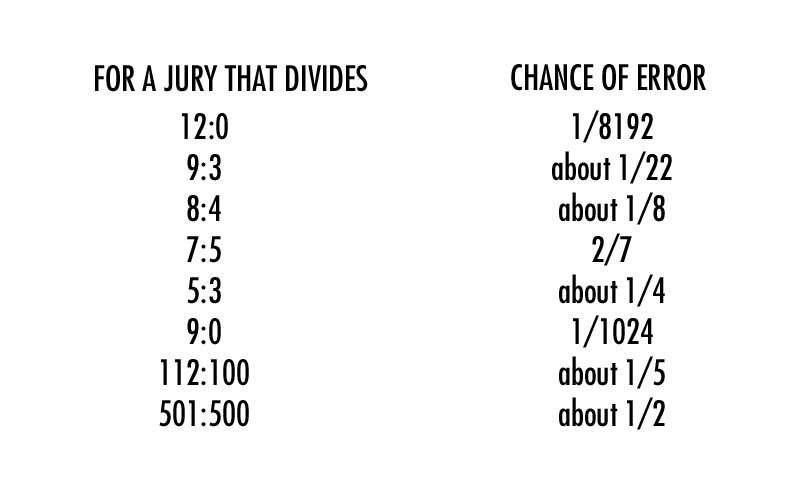
It took juries for mathematicians to understand how to reconcile large numbers with probability theory. In 1808, Pierre-Simon Laplace became extremely concerned with the French jury system. At the time, twelve-member juries convicted an accused citizen by a simple majority. He calculated that a seven-to-five majority had a chance of error of one in three. The French code had adopted the unusual method of creating a higher court of five judges to step in if there was a disagreement with a majority verdict in the lower court. In other words, if the majority of the judges in the higher court agreed with the minority of jurors in the lower court that an accused person should be acquitted, then the accused person would be acquitted. Well, this complicated system bothered Laplace. Accused men often faced execution in the French courts. So if there was a substantial chance of error, then the system needed to be reformed. Laplace began to consider juries composed of different sizes and verdicts ranging from total majority (12:0) to partial majority (9:3, 8:4), and he computed the following odds (which I have reproduced from a very helpful table in Hacking’s book):

hacking-juryerror

The problems here become self-evident. You can’t have 1,001 people on a jury arguing over the fate of one man. On the other hand, you can’t have a 2/7 chance of error with a jury of twelve. (One of Laplace’s ideas was a 144 member jury delivering a 90:54 verdict. This involved a 1/773 chance of error. But that’s nowhere nearly as extreme as a Russian mathematician named M.V. Ostrogradsky, who wasted much ink arguing that a 212:200 majority was more reliable than a 12:0 verdict. Remember all this the next time you receive a jury duty notice. Had some of Laplace’s understandable concerns been more seriously considered, there’s a small chance that societies could have adopted larger juries in the interest of a fair trial.)

French law eventually changed the minimum conviction from 7:5 to 8:4. But it turned out that there was a better method to allow for a majority jury verdict. It was a principle that extended beyond mere frequency and juror reliability, taking into account Bernoulli’s ideas on drawing black and white balls from an urn to determine a probability value. It was called the law of large numbers. And the great thing is that you can observe this principle in action through a very simple experiment.

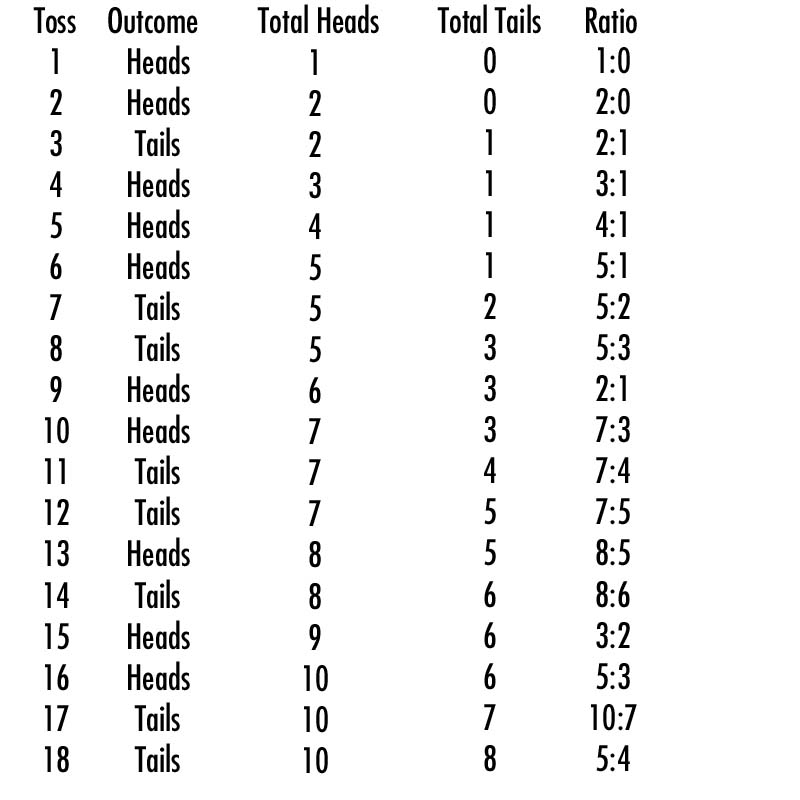
Here’s a way of seeing the law of large numbers in action. Take a quarter and flip it. Write down whether the results are heads or tails. Do it again. Keep doing this and keep a running tally of how many times the outcome is heads and how many times the coin comes up tails. For readers who are too lazy to try this at home, I’ve prepared a video and a table of my coin toss results:

edcointoss

The probability of a coin toss is 1:1. On average, the coin will turn up heads 50% of the time and tails 50% of the time. As you can see, while my early tosses leaned heavily towards heads, by the time I had reached the eighteenth toss, the law of large numbers ensured that my results skewed closer to 1:1 (in this case, 5:4) as I continued to toss the coin. Had I continued to toss the coin, I would have come closer to 1:1 with every toss.

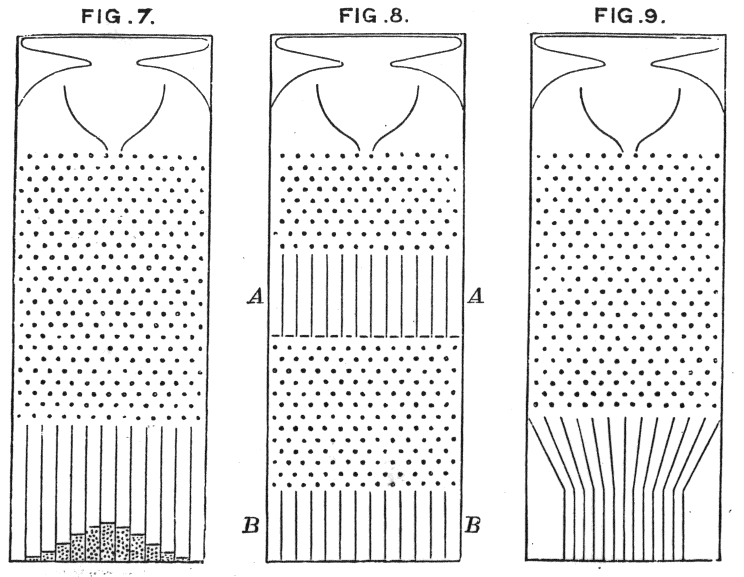
galtonbox

The law of large numbers offered the solution to Laplace’s predicament. It also accounts for the mysterious picture at the head of this essay. That image is a working replica of a Galton box (also known as a quincunx). (If you’re ever in Boston, go to the Museum of Science and you can see a very large working replica of a Galton box in action.) Sir Francis Galton needed a very visual method of showing off the central limit theorem. So he designed a box, not unlike a pachinko machine, in which beans are dropped from the top and work their way down through a series of wooden pins, which cause them to fall along a random path. Most of the beans land in the center. Drop more beans and you will see a natural bell curve form, illustrating the law of large numbers and the central limit theorem.

Despite all this, there was still the matter of statistical fatalism to iron out, along with an understandable distrust of statistics among artists and the general population, which went well beyond Disraeli’s infamous “There are three kinds of lies: lies, damned lies, and statistics” quote. Hacking is a rigorous enough scholar to reveal how Dickens, Dostoevsky, and Balzac were skeptical of utilitarian statistics. Balzac, in particular, delved into “conjugal statistics” in his Physiology of Marriage to deduce the number of virtuous women. They had every reason to be, given how heavily philosophers leaned on determinism. (See also William James’s “The Dilemma of Determinism.”) A German philosopher named Ernst Cassirer was a big determinism booster, pinpointing its beginnings in 1872. Hacking challenges Cassierer by pointing out that determinism incorporated the doctrine of necessity earlier in the 1850s, an important distinction in returning back to Peirce’s idea of absolute chance.

I’ve been forced to elide a number of vital contributors to probability and some French investigations into suicide in an attempt to convey Hacking’s intricate narrative. But the one word that made Perice’s contributions so necessary was “normality.” This was the true danger of statistical ideas being applied to the moral sciences. When “normality” became the ideal, it was greatly desirable to extirpate anything “abnormal” or “aberrant” from the grand human garden, even though certain crime rates were indeed quite normal. We see similar zero tolerance measures practiced today by certain regressive members of law enforcement or, more recently, New York Mayor Bill de Blasio’s impossible pledge to rid New York City of all traffic deaths by 2024. As the law of large numbers and Galton’s box observed, some statistics are inevitable. Yet it was also important for Peirce to deny the doctrine of necessity. Again, without chance, Peirce pointed out that we could not have had all these laws in the first place.

It was strangely comforting to learn that, despite all the nineteenth century innovations in mathematics and probability, chance remains very much a part of life. Yet when one begins to consider stock market algorithms (and the concomitant flash crashes), as well as our collective willingness to impart voluminous personal data to social media companies who are sharing these numbers with other data brokers, I cannot help but ponder whether we are willfully submitting to another “law of large numbers.” Chance may favor the prepared mind, as Pasteur once said. So why court predictability?

* Peirce’s attempts to secure academic employment and financial succor were thwarted by a Canadian scientist named Simon Newcomb. (A good overview of the correspondence between the two men can be found at the immensely helpful “Perice Gateway” website.)

Next Up: Janet Malcolm’s The Journalist and the Murderer!

Melbourne (Modern Library Nonfiction #100)

(This is the first entry in The Modern Library Nonfiction Challenge, an ambitious project to read and write about the Modern Library Nonfiction books from #100 to #1. There is also The Modern Library Reading Challenge, a fiction-based counterpart to this list.)

mlnf100History has produced such a rich pile of devious political figures who spend every spare minute scheming and plotting their rise that today’s aspiring aristocrats, who can be found working every connection to get their kids into bright educational citadels and reliable sinecures, cannot come close to such cutthroat monomania. Yet there are also those who blunder into top office like bumpkins crashing high-class weddings through the simple repetitive act of placing one foot in front the other. William Lamb, aka Lord Melbourne, Prime Minister of the United Kingdom for eight years (1834, 1835-1841) and the subject of Lord David Cecil’s generous biography, was one such man.

Melbourne was a ponderous speaker, a bookish man who reportedly dozed off in the middle of a conversation, a leader largely blind to the way people beneath his station lived, and a cautionary tale for any soul who avoids conflict. “He pondered, he compared, he memorized,” writes Cecil of Melbourne in middle age, just before his improbable political career begins, “the Elizabethan drama, for instance, he knew so well that he could repeat by heart whole scenes not only of Shakespeare but of Massinger; the margins of his books were black with the markings of his flowing, illegible hand.” Melbourne was so mind-bogglingly passive in his actions that he not only refused to intervene in his wife’s adulterous affairs, but he believed that each infidelity would pass with the fleeting speed of a common cold.

It’s easy to ridicule Melbourne and the people of that time (as the bitterly judgmental Carrie A.A. Frye and Philip Ziegler, another Melbourne biographer, have). Melbourne was cuckolded by Lord Byron. When Byron would no longer plant his flagpole in Lady Caroline Lamb, Melbourne’s wife gradually traded down in her boys on the side until she tapped Edward Bulwer-Lytton (best known today for inspiring a writing contest for wretched writing). Caroline would go on to write Glenarvon, an awful roman à clef which exposed the Byron episode and left the Lambs open to disgrace and derision. When his wife died, the lonely Melbourne sought solace with another Caroline (the remarkable Caroline Norton, a tireless crusader who would go on to campaign successfully for legislative acts rectifying the second-class status of women), there was an attempt at blackmail. When Queen Victoria ascended to the throne, Melbourne became her unlikely tutor and constant companion, wasting a good chunk of his late years because the young Queen required constant attention (much of it documented in Victoria’s journals, which are now digitized and accessible through arrangement with your library; Cecil is good enough to quote from many of these entries).

When I learned from Paul Douglass’s Lady Caroline Lamb just how abhorrently Melbourne had treated the largely forgotten badass Isaac Nathan, I began to grow less tolerant of Melbourne’s nonplussed nature. Nathan — a Jewish composer who wrote the groundbreaking Hebrew Melodies and suffered from the Jewish exclusion laws which denied him the ability to vote, run for office, or pursue justice in the courts against the scabrous opportunists who stole his lyrics, often without credit or compensation — befriended Caroline and set many of her words to music. Despite Nathan defending Caroline when she was disgraced (to the lively extent of fighting duels and even publishing a defense of her character in Fugitive Pieces after her death), Melbourne refused to pay Nathan for services rendered to the Whigs when Nathan really needed the cash, leaving Nathan humiliated and bankrupt and forced to flee to Australia, where he was to write Don John of Austria (the first opera composed and performed in Australia), became the first to research indigenous music and the first settler in this new and exciting country to be killed by a tram. (Don’t worry. Nathan died at 74. It was an accident.)

Melbourne’s clueless cruelty also emerged as organized labor became a more vocal part of British life. In March 1834, a group of laborers in Dorset started a trade-union and it was discovered that these men had administered secret oaths as part of the membership. Several of these men were arrested and sentenced to seven years of penal transportation. At the time, Melbourne was Home Secretary. Instead of overturning this remarkably harsh punishment, Melbourne asked the local magistrates about the temperament of these men. He was informed by these tendentious adjudicators that they were scoundrels. Melbourne, strictly on this point of secret oaths, confirmed this inhumane sentence. And during the next month, a group of thirty thousand marched to Whitehall to demand redress. He refused to see these leaders. And this austere decision set back the trade-union movement for years. As Cecil writes:

“So far from being criminals and revolutionaries, they were sober, respectable men enough, driven into lawless courses largely by ignorance and hunger and by the struggle to hang up their families on wages lately reduced to seven shillings a week. Melbourne was not to blame for not realizing their true characters. He was not there, and he had to trust to the reports of his subordinates.”

Melbourne also did not intervene when the revolting laborers of 1830 (during the Swing Riots) were sent to the gallows. Even Cecil is forced to accept the “painful and disturbing” prospect of an ostensibly kind-hearted man who wished to uphold the death sentence even when prisoners were not intended to be executed. Yet as callous as these consequences were, contributing to great unrest in the immediate years that followed, one has to remember that these terrible measures emerged in response to fears over recent turmoil in France and while parliamentary reform was being hashed out at a frustratingly glacial pace. There was a palpable anxiety that events across the English Channel would be reenacted at home.

How did such a man ascend to Prime Minister? Largely because there was nobody else. In 1834, King William IV needed someone who could keep variegated political factions together and, although the King didn’t care much for Melbourne, he liked him better than the other candidates. After all, this wasn’t exactly a position that you could leave open because you didn’t care for the present spate of résumés. Melbourne almost didn’t take the job. (Indeed, near the end of his stint as Prime Minister, he drifted forward with listlessness and exhaustion. Obligation seemed to be the only quality that kept him going.) An opportunistic little creep named Tom Young, who ensconced himself into Melbourne’s administrative circle through skillful cunning, was the one who played to Melbourne’s vanity and love for the classics, securing Melbourne’s commitment with the following words: “Why, damn it all, such a position was never held by any Greek or Roman: and if it only last three months, it will be worth while to have been Prime Minister of England.”

Melbourne was a weird Prime Minister. His strategy involved ridding himself of loud and querulous colleagues and keeping the new Government as calm as possible, even as he remained obdurate in his decision making. This approach did not sit well with some of the more boisterous statesmen. In a moment that could almost be pulled out of a David Lynch movie, Cecil describes Lord Henry Brougham visiting Melbourne’s house just after learning that he would not have a place in the new government. “Do you think I am mad?” shouts Brougham over and over again, his tone and gestures rising with violence as he repeats this question, almost anticipating the charismatic psychosis of Blue Velvet‘s Frank Booth. Yet the highly avoidant Melbourne could not fend off the King, assorted radicals, and any number of people who beseeched him for attention. “Damn it!” he cried to himself. “Why can’t they be quiet?” (In 1836, the aforementioned Norton blackmail episode went down, with Melbourne emerging largely unscathed even while living at Downing Street.)

I can’t entirely pardon Melbourne for some of his asshattery, but Cecil’s careful touch allowed me to understand and even empathize with some of Melbourne’s flaws, for he was also quite idiosyncratic. He stuffed his coats with endless notes. He would emit several strange sounds before beginning to talk. He would shout at random servants and ask them what time it was rather than consult a watch. These quirks allowed him to be liked by the right people, or, perhaps more accurately, tolerated because his actions were so endearingly inexplicable. Perhaps they felt sorry for him because of the Glenarvon episode, although Cecil doesn’t really address how that scandal besmirched his later life, long after Caroline was gone.

What I can say is that Cecil does such a classy job conveying the shenanigans of these often loutish patricians — the rampant adultery, the tolerated insane behavior, the strange manner that all this infiltrated British poetry and politics — that I was placed in the unusual position of fighting strong desires to throw my mind into the mire of the French Revolution, parliamentary protocol, and numerous other subjects. In the last two years, we have seen wild ideological sentiment (exacerbated by Twitter) and staunch stylistic preference (e.g., any polemical book on the lyrical essay) erode the possibilities of understanding human nuance. Melbourne reminds us that the more receptive we are to factual details that trouble or intrigue us, the more willing we are to commiserate with a person’s embarrassing qualities. Perhaps this was one reason why Melbourne was one of John F. Kennedy’s favorite books.

Cecil found both a subject and a tone that recalls John P. Marquand’s Pulitzer Prize-winning 1937 novel, The Late George Apley, published just two years before Cecil’s first half of Melbourne. He tells us baldly at the end that Melbourne’s death caused no great stir during the nineteenth century’s rampantly changing atmosphere. It is a crushing realization. Like Apley, Melbourne outlived his time and took in his personal and professional regrets with a resigned agreeableness. Melbourne’s life is often a sad portrait, yet we are somehow won over by him. Cecil’s book is a welcome reminder that if we’re going to judge someone, maybe we should buffet the impulse to castigate them with a smidgen of kindness, reserving our wrath for the real monsters. Without that vital flexibility that allows us to evolve, there may come a point when we outlive our time too. Sooner than Melbourne.

Next Up: Anne Lamott’s Operating Instructions!