Review: Daybreakers (2010)

The vampire film has needed a kick in the ass for quite some time. Popular audiences have endured the emo complacency of the Twilight films, suffered through the soporific bastardization of Bram Stoker with 2004’s Van Helsing, and settled for the mediocre Underworld trilogy — all relying on tired and tedious tropes that have made recent vampire movies about as desperate as a burned out bookkeeper flipping through a community college catalog for a new hobby.

But Daybreakers is a vampire flick with a brain: a fresh and much-needed corrective to the past decade’s measly offerings. It may be the best American vampire film (courtesy of Australia) since the original Blade. The film manages to deliver on its premise, set ten years from now, largely because it has taken the time to consider the social implications of a world populated mostly by vampires. Cars are equipped with a Daytime Driving Mode, with tinted windows permitting vampires to drive during the day. City buildings are denuded of windows, modified to include corridors high in the sky. A Subwalk has emerged as an adjunct to the subway, which permits vampires to amble beneath an urban world, protected from daylight. Homeless vampires hold cardboard signs reading STARVING NEED BLOOD and bare their fangs at the rich. Cafes now offer coffee tinged with blood, and self-important yuppie vampires still berate baristas. There are even gated suburban communities, whereby those who provide the blood are rewarded with secure enclaves.

But when 95% of the population relies on human blood to survive, and humans are being increasingly munched on, there’s bound to be problems. As one vampire puts it, “Life’s a bitch and you don’t die.” Daybreakers presents blood as a commodity that is just as exhaustible as oil, offering a subtly creepy Hubbert’s Peak analogy that aligns nicely with the distressing prospect of human genocide. But when any commodity declines, the poor will be the first to suffer. And it isn’t too long before those vampires who cannot afford blood are transformed into wretched winged monsters and chained “traitors” are led in daylight before an assembled shaded audience to demonstrate the consequences of questioning big business.

This premise is buttressed considerably by Sam Neill camping it up as a sleazy industrialist and by Ethan Hawke (playing a vampire researching a surrogate for the diminishing blood supply) approaching this material as if he has been cast in an Ibsen play. Michael and Peter Spierig — the writer-directors behind this fun little flick — wisely understand that any good vampire movie requires these varying levels of performance. They’ve even managed to recruit Willem Dafoe as a former vampire turned human vigilante, who brandishes a crossbow and proudly announces, “My friends call my Elvis.” I can’t really complain much about the process that turns Elvis human. It’s about as plausible as the semi-cheesy procedure offered near the end of Kathryn Bigelow’s great flick, Near Dark.

The Spierig brothers give this film a suitable fluorescent look, where each individual vampire carries the combined pallor of twenty Peter Murphy acolytes. They don’t hesitate to depict starving vampires hungrily licking walls, and that desperate hunger reinforces the narrative stakes. The filmmakers flounder somewhat near the end, largely because their characters can’t always match the conceptual complexity. One can level the same minor complaint against District 9, which replaced its interesting take on race with fights and explosions. But then one expects this sort of thing from a movie of this type.

But Daybreakers must be lauded. It is a rare vampire movie that comes layered with so many intriguing ideas. The 2012-boosting Roger Ebert has dismissed it, because of “fierce fights and bloodshed.” But if you cannot accept a vampire movie with “fierce fights and bloodshed,” particularly with so many socioeconomic factors at stake, that’s too bad. For Daybreakers has thought out its setting with more alacrity than much of its duller non-genre counterparts.

Review: Youth in Revolt (2009)

Michael Cera, a reedy actor known for grilling his thin mix of thespic tricks into crepe-like pipsqueaks quietly braying the predictable coups de foudre, is not necessarily a man to be disliked. But there doesn’t seem to be a filmmaker with the guts to discourage his predictable instincts.

Miguel Arteta would seem to be that man. The director has served up a commendable body of work (the underrated Chuck & Buck, The Good Girl, and episodes of Six Feet Under and The Office) reflecting his knack for getting quirky and engaging performances from his cast. But it does not follow that, just because you affix a beret and a moustache onto Cera’s boyish poise, you will be guaranteed a performance that treads beyond established terrain. These sartorial embellishments, which emerge with Cera’s unconvincing puffs at jaspers, are intended to create an imaginary alter ego to Cera’s established protagonist. But the results demonstrate that Cera lacks the possibilities of an Elijah Wood, coaxed into enjoyable cartoonish viciousness by Sin City‘s Robert Rodriguez.

The Cera predicament is especially troubling for Arteta’s latest film, Youth in Revolt, which, my Cera criticisms aside, is a fairly engaging diversion — one that caused me to laugh, even when the needlessly condescending interstitials (various animations, disastrously calculated to appeal to some misunderstood Williamsburg demographic) threatened to uproot the delicious anarchy buried beneath. These concessional interludes caused me to wonder whether a few nonconformist kinks were ironed out during the reported reshoots early last year, and whether a more dangerous film, truer to C.D. Payne’s subversive source material, was lurking under the restitched seams. The film business, being as secretive and as protective as it is, will no doubt stay mum on this point.

Cera plays Nick Twisp, a teenager who is “a voracious reader of classic prose” and who likes Frank Sinatra. He complains that he lives “in a city filled with women who have zero interest in me” (honestly, in Berkeley?) and is mercilessly ridiculed when he rents La Strada from a video store. His mother has a taste for dumbbell fuck buddies (the first played by Zach Galifianakis, a noisy neo-Belushi whose supporting comedic turns I am becoming rather fond of). The promised Summer of ’42 moment emerges with a girl named Sheeni Saunders (played winningly by relative newcomer Portia Doubleday), who takes to Twisp’s naive disposition and expands her lips further after he unleashes an alter ego: a lumpen lothario named Francois Dillinger, the alter ego I quibbled with above.

Dillinger persuades Twisp to do bad things. Arson with $8 million in damages. A ruse involving sleeping pills. All in the service of winning Sheeni’s heart with dangerous behavior. Much of this is fun, but Cera’s plodding one-note performance prevents this gleeful mayhem from living up to the disastrous possibilities of a Frank Oz-directed comedy.

It is troubling that Arteta casts so many of his supporting actors right, while failing to elicit much out of Cera. Adhir Kaylan nearly steals the movie as Twisp’s pal, Vijay, imbuing his character with romantic neuroses that are far more plausible than anything Cera has to offer. Fred Willard is cast as a naive and burned out activist, and demonstrates once again that he’s brilliant at getting inside the surprisingly dimensional mentality of a clueless buffoon. I failed to mention that Jean Smart, who can do little wrong, plays Twisp’s mom. Even Steve Buscemi manages to show up as Twisp’s dad.

There are also some amusing oddball moments, such as Sheeni’s father revealed to be a lawyer, who proceeds to cite conditional legalese when Twisp arrives to hang out with Sheeni. Sheeni’s family lives in a preposterously baroque trailer with multiple floors. And in a surreal flourish, a car, for reasons that I won’t divulge, is trapped within the Twisp living room.

Many of these eccentricities existed in Payne’s novels, and they have been adapted well by screenwriter Gustin Nash (and uncredited polisher Mike White) into the requirements of cinema. It’s just too bad that Cera isn’t up to the material’s feral exigencies, and that Arteta (or some other unknown production force) has neutered the promise of a teen comedy as reinterpreted by Preston Sturges. This film is very good in spots, but why diminish the insanity?

Review: Did You Hear About the Morgans? (2009)

morgans

Sometime ago, I attended a screening for Did You Hear About the Morgans? I apologize for the lateness of this review. I have been occupied with more important things, such as clipping my toenails. I wish I could review this film properly, but that would be a bit like putting together a 4,000 word essay devoted to one man’s case of athlete’s foot. The upshot is that there is truly not much to recommend about this film, although I have seen worse films and this braindead offering served as a diversion between deadlines. It was possessed of nothing and permitted my mind and spirit to become actuated, seeking fun and greater things.

I should probably note that Susan E. Morse, fired by Woody Allen sometime after The Curse of the Jade Scorpion (possibly one of the key reasons why Allen’s more recent films have been less than stellar), edited the film. But aside from this, I leave the readers to do the detective work and track down the cast and crew. They are, for the most part, not worthy of having their names repeated here. But I do feel bad about what happened to Susan E. Morse, even though Woody Allen needs her more than Morse needs Woody Allen. What follows are some of my random notes taken throughout the film. This is what is known as a lazy review. But since the filmmakers have been extraordinarily lazy in putting this film together, it makes considerable sense for me to afford it the same level of disrespect. The collected notes will provide content for this site while I do interesting things (such as clipping my toenails) and it may be of some use to those who, for whatever reason, are still on the fence about seeing this movie:

Phone call against black. Long-winded. Premiere boutique. Real estate firm in this economy? Nonsense. Ice sculpture disaster.

“The perfect combination of classic architecture and understated elegance.” — some statement explaining this film?

Speaks French. Pregnant. Skyline shots. A black hole. Park Avenue? Really? 1991 fantasy. Not the New York I know. Not the New York Woody Allen knows. Hugh Grant tired. Sarah Jessica Parker tired, but peppy. Jackie and Andy. Assistants. Two assistants. More interesting than leads. Needless class warfare. Columbus Circle. “There is now a galaxy named Meryl.” — she’s still interested in this guy? He’s an attorney? Really? “Can you please stop being so agreeable.” Why not just punch someone?

He slept with someone else. A little less love for a while. Many years. Preposterous murder subplot. Really, this kind of crime in the East Side? Did the writer even visit here?

Keeping safe. Big black guy. Scrawny white guy. Unfunny racist joke. Real estate. T-shirt. Sent a police officer up. Shot. Shouting. I long for Preston Sturges.

Couple across the street looking through window. Liked this the first time in Ghostbusters, possibly before. “There’s an emergency.” Gay subtext in shower. Attorney with loads of free time in New York? Yeah, right. “I’ve had bagels in other parts of the country. I don’t even like Connecticut.” Such appeal! Will the killer shoot these snobs?

“If you want to lie, you’re out of options.” Manichean approach. Couple acts like they are in their twenties. Was that original script before getting Hugh and SJP?

A week at most. Sam Elliott kicks ass. Mary Steenburgen kicks ass. But why is there no chemistry between SE and MS? Wyoming. Cliches. City Slickers-style music.

Taxidermy. Encounter with a grizzly bear. Shouldn’t he be writing this down? Bargain Barn. “It’s huge. I had no idea.” But New York has Costco! Big guns. PETA. People for Eating Tasty Animals. Heard that joke in redneck bowling alley in early 1990s. Stilted blocking. Trapped.

One room. One witness at a time. Ten years ago. John Wayne and Clint Eastwood mostly. Cliched DVD selection. A computer. Make a quick call. There’s a code.

“Look, Paul, I know how hard you’re trying.” Not hard enough.

“And I don’t trust you anymore.” Paul or screenwriter?

Rodeo Round-Up magazine. All meat in the fridge. Who plays the assistant? “I’ve never turned my oven off.” “I thought I could actually keep my cells dividing.”

“I feel my organs shutting down.” “I can’t breathe. The air’s too clear.” Grizzly bear. Spraying him in the eyes. “I’ve always dreamed about Chicago.” “Laughter really is the best medicine.” Thank you, but I’m waiting to laugh.

307-179-9048. No 555 in telephone number?

Fertility experts. Stuttering Hugh. He’s in his forties and he’s still stuttering? Four Decades and a Funeral? I’m sorry, I’m sorry, I’m sorry. Apology to audience?

“Without him, I’m superfluous.” Oh please. Someone get bell hooks on her ass.

Shooting at the audience. “This is nothing. You should see how long it takes for her to order dinner.” Quicker than this movie?

“I think I have a welt.” Too much typing, Mr. Screenwriter?

Chair — moving inside the house.

“I am told that it is the only place.” Remington 270. “I called around and got a table near the mayonnaise.” New York neurotics. Wilford Brimley smoking. Cast as a badass! Beat them up, Wilford! Liberals in town: “Thirteen, not fourteen, and we know who they are.” People take trucks in this town? Truck return policy? “I Googled her.” — one of several modern references placed in at last minute, if script sitting in drawer.

Smells like a burrito. Need a will. Stun gun. “It is an ever-fixed mark that looks on tempests and is never shaken.” Which Shakespeare sonnet is this again?

Wait a minute, he’s British and been in New York all this time? Google Maps. Google paid someone?

“Crazy Little Thing Called Love.” Hypocrisy. Second big rock as landmark. Joke now told four times, still not funny.

“You risked your life for me. That’s so nice.” Barf.

Review: Nordwand (2008)

nordwand

It’s safe to say that Nordwand (known as North Face in the States and presently hitting the film festival circuit, to be followed by a rolled out release) is a better movie than Clint Eastwood’s The Eiger Sanction. Yes, the 1975 film has a few decent mountain climbing scenes. But it also has such preposterous moments as George Kennedy convincing Eastwood to carry beer in his backpack as they climb a mountain, so that he might guzzle the cans at the top. Eastwood’s climb up the treacherous north face of the Eiger mountain is, oddly enough, not too dissimilar from the one chronicled in Nordwand, although Nordwand is based on real-life efforts. And you could look up the names. But then you’d know the ending. And that wouldn’t be very fun.

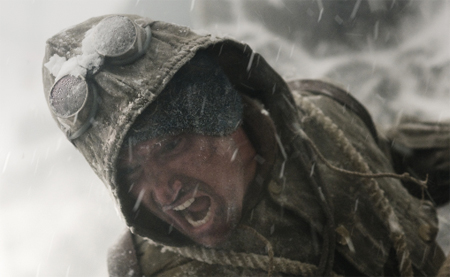
Harsh snow, wintry weather, avalanches, attempted rescue by railroad station. The perfect ingredients for mountain cinema and a regrettable reminder that you can step inside the theater in the winter, but you won’t shake yourself of the snow. So much for escapism. But Nordwand proves to be considerably more engaging than The Eiger Sanction, K2 (which featured a whiny Michael Biehn), and Vertical Limit (which featured a whiny Chris O’Donnell)– in large part because there is a race between Austrians and Germans at the heart of the storyline, thereby making this climb — at least on the German front — one of national pride (and considerable stupidity). But since the two main mountaineers we root for don’t whine, as their American counterparts do, we are all too happy to cheer them on.

The events, of course, are set during Nazi Germany. It is May 1936 — the year of Leni Rifenstahl’s Olympia and the beginning of Nazification. Rifenstahl, as we know, got her start with mountain films. And we certainly know that it’s 1936, because one German offers this mood-killing explanation for why the Germans wish to climb the North Face before a festive crowd: “The pride of facing a challenge, whether it be sports or politics.” Jews have been stripped of their civil rights, but you wouldn’t know it watching this film. The newspapermen sent to cover the spectacle are more interested in “the spirit of the German conqueror in battle with the mountain. That’s what makes a story.”

Nordwand does make a good story, in part because many of the mountaineers die and we even get to enjoy fingers freezing up and people shrieking in agony. I don’t know how much of the mountain climbing in this film is real and how much of it is fake. Frankly, I am presently too lazy to check. But it seemed convincing enough for me. One admires the spirit of the sensible and experienced Austrians, the film’s protagonists. They offer some pretty nifty side swinging moves that I can’t imagine any whiny American trying on a indoor rock wall. The Germans are determined to commit folly in the name of the Fuhrer. While this is certainly their right (as characters, that is), I was slightly disappointed that there wasn’t more nationalism drenching through clinched teeth. But my desires were somewhat placated by a rather splendid mountain cake wheeled into a banquet room.

Overall, I enjoyed Nordwand and can recommend it to those who like German mountain films, which are less whiny and more interesting than the ones that come from America.

Review: A Single Man (2009)

asingleman

Colin Firth’s swooning fan base has long accepted the unlikely heartthrob as an endearing bumbler. Firth has often played the sensitive (and quietly sensible) romantic populating both mainstream romantic fare (the Bridget Jones films and Love Actually) and projects that are considered highbrow by way of artistic association (Pride and Prejudice‘s Mr. Darcy or Girl with a Pearl Earring‘s Vermeer). Atom Egoyan was one of the few filmmakers to scrape away at Firth’s squeaky clean archetype in the underrated Where the Truth Lies, giving Firth a raw and dark character suggesting a grittier and seedier version of The Importance of Being Earnest‘s Jack Worthing.

But none of these performances — as good as they are — has quite permitted Firth to summon up the totality of his talent. Market forces, content to give the people what they want, have consigned Firth to a curious upper middle-class ghetto. Firth’s characters often cling to a steady yet shaky authority, largely because they have occupied some station for too many years. Firth has atoned for these limitations with a smooth vocal command and an almost Mitchum-like commitment to movement, counterbalanced by a somewhat uncertain gaze. (The “I like you very much just as you are” moment in Bridget Jones’s Diary comes immediately to mind as an example of Firth doing his best to defy cliche.) But this pigeonholing hasn’t always allowed an interior glimpse. Firth has perfected the nice guy. But nice guys often have more internal demons than they’re willing to impart. It’s too bad that so many screenwriters, paid very well to adhere to formulaic conventions, fail to express this in their labor.

I have quietly hoped that some talented filmmaker would figure Firth out, or that Firth might obtain enough clout to headline some pet project, permitting those delayed demons to roil in a more complicated role. Indelible British actors often find Hollywood at some point in their careers, but this doesn’t necessarily mean that they are completely understood. (Exhibit A: Malcolm McDowell.) The people in charge are, after all, more concerned about the coffers than with human complexities. And I never would have imagined that fashion designer-turned-filmmaker Tom Ford would be the guy to push Firth to the limit.

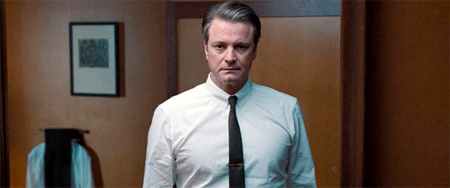
A Single Man is one of the year’s best films. And it’s not just because Ford has given Firth a perfectly attuned role, permitting Firth to stockpile Professor George Falconer’s grief behind restrained grimaces and meticulous domestic action within a quite literal glass house. For A Single Man is also cinematically committed to George’s isolation. George’s heartbeat drowns out the soundtrack. He never quite sees a person head on. The secretary with the bobcut who gives one of George’s students his home address is filmed in slivers, and George replies, “You have such a lovely smile.”

It helps immeasurably that Ford’s working from very good source material (Christopher Isherwood’s fine novel) and that Ford is smart enough to make this his own. When George addresses his students in class, he sits before them on the desk, with three cameras cutting left, center, and right — as if George is some kind of fashion model being photographed on a platform. But to some degree, he is. His academic role is the only thing he has left after losing his partner, whose funeral he isn’t even permitted to attend (“family only”). Ford’s dramatic tactic is an eccentric yet effective perspective, reminiscent of the way that the vanilla-minded Steven Spielberg found a way to channel drug addiction through fatherhood in Minority Report

It also helps that we have been given a vision of the early 1960s that, for once, doesn’t call attention to its time period. Sam Mendes’s disgraceful adaptation of Revolutioanry Road didn’t understand that real people lived and wrestled with serious decisions. (It’s possible that Ford may have had Mendes’s American Beauty in mind with one of his other interesting visual tics. Whenever George feels something close to happiness, the gray visuals brighten up a bit. This isn’t as distracting as it sounds, and it’s more understated than Mendes’s now dated CG flowers.) The much acclaimed Mad Men understands this better, but feels the need to cram some “shocking” measure of its characters against contemporary standards. Can the characters really be defiling women like that? The more important issue is why Matthew Weiner cannot simply let these flawed characters act without the enforcement of moral judgment.

But Ford lets George live without such constructive qualms. We feel his loss. We feel his sadness. George is often kind, as we expect a Colin Firth character to be. But with grief comes a mess of forgivable solipsism in his willingness to light a man’s cigarette, bring over a bottle of liquor, or swim in the ocean to prove that youth hasn’t entirely expired. If George died right now, would he be okay? It’s a question echoing from happier days in the past, but one that the audience remains constantly aware of. The film’s commitment to George’s perspective causes us to be deeply locked within his being, but it also pulls off the difficult trick of making us sympathetic to those trying to get George back into the land of the living. This group includes a Spanish stranger and George’s best friend, Charley (Julianne Moore), who has also negotiated the line. We know this by seeing the way she lives now: aging, smoking, drinking, applying makeup, bombarding George with calls.

The film’s willingness to celebrate life, and the connective failings of single people of all stripes, propels it well beyond a one-note exercise and inures it from Weiner-style judgment. It is to Ford’s credit that he injects some humor into the morbid mix, for grief is never entirely tragic. There’s an overeager gun store owner, and some physical comedy involving a suicide and a sleeping bag. Life isn’t some “I wish I knew how to quit you” melodrama that makes us feel tolerant, liberal, and morally superior. It’s a little girl who doesn’t understand what her father means by “light in his loafers,” but who sees the possibility in a sad man sitting in a bank. A Single Man invites us to see that possibility too, both within its mise-en-scene and in the more important world before our eyes.