Review: Dead Snow (2009)

deadsnow

Earlier this year, numerous enthusiasts exploded in their pants over a movie that had not yet snagged American distribution. If you were among the throbbing throng to take in the trailer — yet another eyeball-attracting rite encouraged by the Internet’s discouragement of cultural apostasy — you may very well have shouted, “HOLY SHIT! NAZI ZOMBIES! WELL, PINCH MY EARS AND CALL ME A JELLY DONUT! I MUST SEE THIS MOVIE! I MEAN, IT EVEN HAS FUCKING SUBTITLES!” It was the geek equivalent of a thirteen-year-old boy wrestling with a nervous urge to jump any girl in the room, settling instead for the Oui centerfold that some trucker had left behind in a public restroom.

In hindsight, it was probably the subtitles that seduced us. Subtitles, on the whole, suggest rueful miscommunication or a strangeness extant only because we don’t speak the language. And with subtitles applied to a high concept like undead Einsatzgruppen, we conveniently forget the trash cinema innovators who came before. Tommy Wirkola’s Dead Snow is not the first movie to feature Nazi zombies. There was 1977’s Shock Waves, which featured Peter Cushing as a Nazi scientist hoarding SS zombies on a boat. Before that, there was 1966’s The Frozen Dead, which involved Dana Andrews holding onto the heads of Nazi war criminals alive to attach upon ripe bodies for a new Third Reich. (I find it someone surprising that Dana Andrews, a white bread actor who had all the appeal of stale toast, was one of the involved parties. This is a bit like expecting Tom Hanks to be the first Hollywood actor to penetrate an orifice in a Hollywood film.)

While filmmaker Tommy Wirkola includes literal and visual nods to the first two Evil Dead films, April Fool’s Day, Star Wars, Indiana Jones and the Temple of Doom, Braindead (aka Dead Alive), and The Simpsons, don’t let these flagrant pop cultural references fool you. Wirkola has robbed from the mausoleum of horror movies that passed on in 1981: Jean Rollin’s Zombie Lake (undead Nazis assaulting isolated setting, emerging here from the snow instead of a lake) and Jess Franco’s Oasis of the Zombies (army of Nazi zombies guarding gold).

Which is not to say that Dead Snow is bad. While the zombies arrive much later than they probably should and the early character development doesn’t quite compensate for the reduced early gore, there is ample intestine ripping and even a few funny lines. “We should have gone to the beach like I told you,” says someone just after the kids start dying. This time, the kids who meet Muhammad at the mountain cabin are medical students — a smart creative decision permitting the characters to take on death and hack off limbs without flinching or freezing up. (One character even stitches up his own neck.) There’s great potential in having more educated youngsters stand in for the usual libertine losers. Alas, the interesting early chatter of how to use spit to escape an avalanche subsides to the accustomed lackluster scenarios.

This is a movie that knows it’s a retread — a dependable retread, but a retread nonetheless. The kid dusting off the mountain cabin kitchen at the beginning could very well be Wirkola himself. The cabin resembles the Evil Dead cabin. Wirkola even mimics Sam Raimi’s chainsaw montage from Evil Dead II (minus the “Groovy”). And it’s often quite frustrating that these characters are developed through Hollywood references instead of human behavior. One wonders if Wirkola even understands young people. These kids actually complain about playing co-ed Twister, failing to consider the libidinous possibilities. Why play Twister? “Because Hollywood told us that it’s so much fun.” But is that line an actual joke or contempt? The movie’s token film geek, Erlend, wears a Braindead t-shirt throughout and is commanded by his peers to stop talking about movies for an hour. But at least he gets lucky in an outhouse. The Seth Rogen archetype has made its way to Norway.

Here is a movie that’s skillful enough to have someone dangling over a cliff with an intestine serving as a rope, but that doesn’t have the instincts to make any of its characters Jewish. (And wouldn’t that present some interesting conflict?) Yes, we do briefly see the remnants of a Nazi lair. And the Nazi zombie leader (named Herzog, perhaps in deference to the filmmaker now gutting Abel Ferrara) does order his soldiers to “arise” from the snow. But wouldn’t these zombies be infinitely more interesting if they tried to mimic behavior from World War II? It’s too easy to have the zombies simply hunt down these kids for gold. This movie might have had real guts — pun fully intended — if these Nazis attempted to carry out the Final Solution.

Of course, any horror movie that stops for a moment of Norwegian hospitality — with coffee unappreciated by the guest — can’t be entirely discounted. Wirkola himself is a hospitable filmmaker and he’s off to a good start. It’s just too bad that he isn’t nearly as cavalier as Don Edmonds — the wild director of the first two Ilsa films who passed away only a few weeks ago. With such audience-friendly horror as Nacho Vigalondo’s Timecrimes and Sam Raimi’s Drag Me to Hell seen in theaters in the past six months, Wirkola is going to have to work harder to make schlock horror fun and dangerous again.

Review: Drag Me to Hell (2009)

dragmetohell

It cannot be an accident that one of Drag Me to Hell‘s central images involves loan officer Christine Brown eating a whole tub of ice cream without apology. And let’s be honest here. We’ve all been in that spot at some point. Christine, however, is lactose intolerant and she has a weight problem buried in her past. She does not care. She spoons down the ice cream anyway. It’s the ice cream that matters now. And while I don’t know how many uptight critics will declare this film some giant tub of ice cream, I’m here to tell you that Drag Me to Hell is one marvelous movie. It’s a grand and enjoyable gift from Sam Raimi — certainly more generous than his 2000 offering — and far more fun than I could have possibly anticipated. If you’re one of those types who’s forgotten the mad and anarchic joys of eating a whole tub of ice cream, then stick to the condescending remakes or reboots or revivals that are made solely to take away your dollars without granting you that cathartic liberation. (It’s worth noting that this movie does feature quite a lot of characters cavalierly asking for money. Perhaps it’s self-aware.) This movie, on the other hand, made me laugh and grin and holler and chortle like an undisciplined eight-year-old. Not many movies can do that. But this one did.

And it’s because Sam Raimi is clearly a man who loves movies. Not the junk shuttling out of the soulless factories supervised by Michael Bay and McG, but the silly stuff and the thrilling stuff. The loud sounds and spastic images that keep us returning to the movies. Raimi has a sense of humor that might be cruel if it weren’t so innocuously bizarre. The filmmaker who dared to insert a highly amusing and utterly gratuitous cabaret scene in Spider-Man 3 has gone even further here. And trust me: it’s all for the best. Here is a movie that introduces its protagonist stuck in traffic and listening to an elocution tape spouting forth such maxims as “There is no friction with the proper diction.” Here is a movie that features a nosebleed gone awry and gives David Paymer a line that is too goofy to be true. Raimi’s even slapped the old Universal logo from the 1980s at the head of his film. This is how movies used to be and could be again if only we wouldn’t settle for less.

Drag Me to Hell is not so much a return to Raimi’s roots, as some have suggested. It is a movie that successfully combines the eyeball-popping humor of the Evil Dead movies (don’t worry: eyeballs do pop here, despite the PG-13 rating), the fey dissolves of Darkman, the classy visuals of A Simple Plan (the deliberately framed crows are replaced momentarily by a cat’s coy positioning at bottom frame), Raimi’s more naturalistic experiments with actors in The Gift (here anchored by Alison Lohman’s earnest performance), and the empathy of the Spider-Man trilogy (thankfully not so sappy). Raimi, as it turns out, has been itching to give into his id all along. And we’re all the better for it.

If being a wild imp means having a vegetarian consulting a book titled Animal Sacrifices in the Services of Deities, then Raimi will go there. What I love so much about this movie is Raimi’s casual audacity. He’s balanced an earnest romance, some ridiculous and often side-splitting comedy, and some genuine jolts. A movie that dares to throw in so many disparate elements should not work this well. But it works because Raimi very much believes that it can work. And since he’s kept the budget fairly low, he doesn’t have to worry too much about studio interference. He’s given himself a safe place to experiment. But who knew the prototype would roll out like a top-of-the-line model?

“I know this is going to sound weird,” says Christine, “but I want to get my fortune read.” When was the last time you saw a movie in which characters were so straightforward about their oddball dealings with the supernatural? When was the last time in which you saw a filmmaker hold his camera on a staircase for suspense? When was the last time you saw a filmmaker commit himself to Val Lewton’s understanding of shadow over the crass CGI effects that are now de rigueur?

Raimi even subverts the usual gender roles, perhaps to atone for the infamous tree-raping scenes in The Evil Dead. The ledger is now corrected. The men in this movie are often hilariously inept — one whimpers at a diner; another boasts of his coin collection — and the women often kick ass. Raimi even explores cringe domestic comedy during one utterly disastrous dinner scene with the prospective in-laws. A psychic and a professor argue about Jung. The camera whooshes as feverishly as Evil Dead II. And the movie even evokes Tolstoy with its lively ending.

Let me be clear on this. If you do not enjoy this movie, then you simply do not have a soul. Drag Me to Hell is a wild masterpiece. And I don’t think I’ll see another movie this year that’s anywhere near as enjoyable. Sam Raimi has restored my faith in Hollywood movies.

New Review: Chuck Palahniuk

Chuck Palahniuk is regularly dismissed by the snobs. Despite his sales, you will not see a New York Review of Books or a Bookforum essay on the man anytime soon. The atmosphere is too retrousse. Here is an author who seems to be uncritically admired by his fans and just as unilaterally (and unfairly) condemned by the literary elite. But people do read the man and the man is not without talent. It is a foolish person indeed who does not submerge himself with some frequency into the common lake of the average Joe. You really don’t need a nez relevĂ© to appreciate the bas-reliefs of any structure.

Much as Jeff Vandermeer did earlier this week in the Washington Post, I approached Palahniuk’s latest novel, Pygymy, with this demarcated dichotomy in mind over at the Chicago Sun-Times. And yet the book’s voice proved so unusual for a popular book that I felt compelled to turn in an initial review mimicking its style. The editor wisely suggested that I rewrite it, permitting me to keep a paragraph. The review is much stronger as a result. One can indeed write a whole review or a whole book in a particular style, but the human heart must remain in conflict with itself. That makes this business worth the agony and the sweat.

Review: Terminator Salvation (2009)

terminatorsalvation

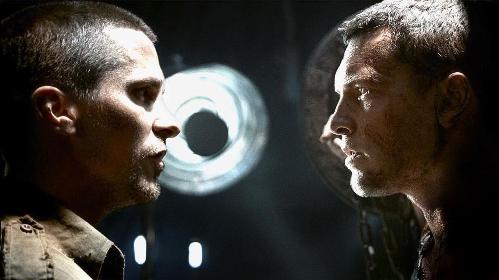
As resistance leaders go, John Connor is about as imposing as an out-of-shape hipster easily thrown out of the back door by an indolent bouncer. Christian Bale seems to think that growling all of John Connor’s lines in his Batman voice will somehow persuade audiences that he’s the savior of humanity. Alas, it only reminds us how badly The Dark Knight has aged just in the past eleven months. “If you’re listening to this,” he barks into a radio, “you are the Resistance.” Well, maybe we will be if more people lose their jobs. Because aside from the two-day coyote that Kyle Reese plops onto the dinner plate, these Judgment Day survivors aren’t altogether different from the bums on Venice Beach. And call me crazy, but you’re probably going to be dirty and more than a tad dispirited if you survive a nuclear apocalypse. Chances are that if Skynet is sending around HKs and scouts, and even some little mechanical critters in the water (an homage to Star Wars‘s trash compactor scene?), this evil empire is probably going to have the technology to intercept radio signals. It is, after all, self-aware. So why on earth is Michael Ironside barking his orders to invade Skynet over the air?

Terminator Salvation lacks the grit and the grace of the original, much less the pace and the pitch of the second film or even the idiotic fun of the third. It’s easily the worst installment of the series, although I enjoyed it more than the crappy Star Trek reboot. Which is to say I enjoyed the giant robot blowing apart a disheveled 7-11 (I guess he didn’t get his Slurpee, but I’m sure the producers will collect from the product placement) and Anton Yelchin brilliantly mimicking Michael Biehn as Kyle Reese, but somehow making the role his own. (A few words on Yelchin: He’s great. The kid will go places. Between Reese and Chekhov, he’s demonstrated that he’s that rare eccentric character actor who somehow sparkles even in dumb Hollywood blockbusters. Let us hope that the system will not corrupt him into a far less interesting talent.)

But I couldn’t care less about John Connor. You figure that he’d get some voiceover tips from listening to all those tapes of his mother (played by Linda Hamilton’s voice). But John Connor is so bland that I think his hopes of getting into the iTunes Top 100 Podcasts are slim at best, even if Skynet manages to kill all the podcasters. Bale was more interesting earlier in the year when an audio clip surfaced of Bale freaking out on set. In fact, I was hoping for a whole film featuring a psychotic Christian Bale scaring the hell out of his lieutenants. Instead, I observed a paucity of masculinity. We’re seeing less swagger in our action movies, and I’m starting to get concerned. (As it so happens, Ah-nuld makes a cameo appearance. He’s a nude and voiceless CG version with that silly swept hair from the first film. I kind of missed that silly swept hair. It seemed just right on a coldblooded killing machine. But rather conspicuously, Arnold’s penis is either missing on this T-800 model or permanently darkened by the odd lighting. This cannot be an accident.)

What does it say that I actually longed for a preteen Edward Furlong? With Bale’s Connor, we don’t even get the silly emo nonsense we got from Nick Stahl in the last film. Even Bale’s pathetic attempt to bark the trademark line “I’ll be back” was responded to with ridicule from the audience. Besides, a Terminator movie without Ah-nuld at the helm feels like a trip to Cabo San Lucas without tequila. You want to string up the travel agents who wasted your time.

The agents in question — represented by a team of screenwriters, some of whom were rewriting on the set and rewriting very close to the start of production — have attempted to atone for the lack of time travel by giving us a guy named Marcus (played by Sam Worthington) who signs on to be Helena Bonham Carter’s robotic bitch. Cyberdyne — not blown up, despite the second film’s events — has apparently transformed into a genetics company. And if you’re thinking that Harold Arlen songs are in Worthington’s future, you’re right and McG will probably send you a kewpie doll. Worthington isn’t a bad actor, but his character and motivations are utterly ridiculous. (Let’s put it this way. Ah-nuld’s silly line, “I know now why you cry, but it is something I can never do,” has more heft than the entirety of Marcus’s actions.) You mean to tell me that some random guy wandering around a Los Angeles wasteland and not knowing about Skynet for ten years is going to be immediately accepted by the survivors of humanity? And not even Paul Haggis, the Oscar-winning screenwriter, objected in the rewrites? With Marcus, we got silly Christ imagery when he’s executed in prison and silly Christ imagery when he’s strung up above a pit. Christ imagery may have salvaged David Fincher’s murky Alien 3, but it’s clear that McG is not good enough to follow in the mighty James Cameron’s footsteps. (Indeed, the film ends with Christian Bale wandering around a set very similar to the steely outpost at the end of Aliens. Whether this was a conscious nod to Cameron or not, Bale is so utterly inept and uninteresting that one longs for Sigourney Weaver to beat the shit out of Bale and lead humanity out of the doldrums. You know that she’d do it too. And she wouldn’t even have to use a funny Batman voice.)

To add insult to injury, the filmmakers have pissed away James Cameron’s odd but effective feminist subtext. The women of Cameron’s Terminator movies have always been extremely interesting, caught within an odd melange of libertarian and Third Wave sentiments. They are gutsy, feminine, strong, vulnerable, but also quite capable of going nuts. And they’re far more interesting than any of the men. When Josh Friedman signed on to do The Sarah Connor Chronicles (a rare intelligent program that has been sadly given the axe), he knew damn well that gender roles were one of the franchise’s secret ingredients. (The second season premiere ends with Garbage singer Shirley Manson — playing a T-1000 model — morphing from a urinal to her female form in the men’s room to settle a bit of corporate patriarchy. This moment represented what was quite possibly the most intriguing symbol of gender relations we’re likely to see in a television series in quite some time.)

But in Terminator Salvation, McG and his boys have given us three archetypes for women to choose from (discounting Helena Bonham Carter and former NEA director Jane Alexander, who surely must have needed the money to show up for such a thankless role): (1) John Connor’s wife, Kate, who is barefoot and pregnant and supportive, (2) Blair Williams, a boring by-the-numbers rebel who asks to snuggle up to Marcus for some body heat, and (3) Star, a mute girl, reminiscent of the feral boy from The Road Warrior, who is resourceful but not permitted to speak. It’s safe to say that, even accounting for Judgment Day throwing everything into whack, this doesn’t exactly consider 21st century developments. I understand that women can do far more than breed and kick ass.

For all the screenwriters paid for this silly movie, you think they’d come up with better lines than “That’s why I don’t trust you. I’m the only hope you have.” James Cameron’s dialogue has sometimes been silly, but at least the man knew how to make a goddam movie. At one point, Christian Bale shouts, “We aren’t machines. If we behave like them, then what is the point of winning?”

Which led me to wonder what the point was in watching this damn movie. I loved the Terminator movies growing up. I’m proud to say that they still held up last week. (If anything, the first film was even better than I remember. And I had seen it perhaps thirty times during my adolescence. Too bad that Ah-nuld went all soft.) I’m also proud to say that Josh Friedman has created a decent and thoughtful television spinoff. (It’s also worth observing that Friedman pretty much ignored the third movie.) For the powers that be to preempt Friedman’s efforts while advancing McG’s callow hucksterism is a sign that the machines have indeed won. The storm at the end of the first film came and went. It’s time to move on and ignore the Terminator franchise. There’s no fate but what we make for ourselves. And that includes avoiding bullshit blockbusters.

Review: Fighting (2009)

“Bob Semen is a freak but New York needs freaks. At his best he was hope for the hopeless and at his worst, no more than a lesson. An adventure to be lived and learned.” — Dino Montiel, A Guide to Recognizing Your Saints

New York does indeed need its freaks. But few artists wish to broach the terrible truth that the richer and cleaner New York under Bloomberg doesn’t particularly desire them. Those seedy characters lovingly portrayed in Richard Price’s books and Abel Ferrara’s films now occupy the realm of endearing fantasy rather than representative reality. Ferrara himself notably attempted to reclaim his lost New York in 2007’s Go Go Tales (largely shot in Rome’s Cinecitta Studios and sadly unseen here in the States beyond film festivals) and the same can be said of Price’s last novel Lush Life, which, as Salon’s Richard B. Woodward and others have observed, doesn’t quite possess the authenticity of today. That’s a stunner, considering how dead-on Price’s previous achievements were. But the bums lost and were pushed rather rudely into the patchy remnants of the underground, causing our best artistic practitioners to drift into the past. Still, maybe the current economic downturn will fire up a few slackers to take any rug they want from the house.

Because of all this, it’s no surprise that the New York depicted in Dito Montiel’s second feature, Fighting, bears little resemblance to current New York. In Montiel’s universe, a hustler can get away with selling an all-too-obvious Harry Potter ripoff just blocks away from the publishing industry hubs in Midtown, African-Americans shout loudly about Billy Joel tickets, landlords post overdue notices on doors to embarrass tenants (rather than sliding them under doors), and gamblers fail to do the most rudimentary background checks on bagmen delivering half a million dollars. Montiel’s Manhattan is as true as the blown-up photo of an aerial view sitting behind one man’s desk, accessible through a door containing an equally cartoonish illustration of money. All this is something of a surprise given Montiel’s heightened attention to detail in his last film, A Guide to Recognizing Your Saints. (Yes, modern subway trains did often roll by in 1986, among many other notable gaffes. But this low-budget film felt right for the most part; especially with one powerful moment between Shia LeBeouf and Chazz Palminteri, just after LeBeouf observes a death, in which the father-son power dynamic seesaws twenty times in a New York minute.)

The inflexible authenticity booster — that Walter Benn Michaels sort of blowhard — would see all this as a bad thing. (If you missed Michaels’s small splash in the pool tended to by the gated community, Michaels stated, in all seriousness, that American Psycho — a novel, incidentally, turning eighteen this year — recalled Edith Wharton’s novels of manners and that Ellis had written a truer novel than Philip Roth, Toni Morrison, and Michael Chabon. This is the kind of wild and tenuously supported claim that apparently has you spearheading a New York Public Library discussion. You can observe the glum video results here, where the rigid Michaels comes across as some Richard Dawson-like figure of the literary world, a man very much in love with his own voice waiting for nearly everyone around him to supplicate to his ostensible intellect. I was surprised he didn’t get up from his chair, kiss Susan Straight on the lips, and entreat the audience to “play the Feud.” After spending ten minutes reading his essay aloud like some hoary and entitled hybrid of Ben Gazzara and Lee Siegel, Michaels doesn’t seem to consider that American Psycho might, in fact, be a satire or a pastiche. That the brand names and the consumerism juxtaposed against savage violence has less to do with dutifully reporting on manners and more to do with sending up entitlement. Michaels seems unable to come to complete terms with Susan Straight’s concern for location over character, which she admits to him and which defies his generalization of what authors seem concerned with, or, for that matter, David Simon’s affinity for seemingly unreal books like Schindler’s List. To give you a sense of Michaels’s subtlety, the man not only rolls his eyes, but remarks on rolling his eyes. And if he happened to be in the hood, I suspect that this hotheaded attitude would get the man beat with a baseball bat — a la Montiel. Michaels is also shockingly out-of-touch with such writers as Stewart O’Nan, Richard Russo, and William T. Vollmann, all of whom have devoted much of their fiction to working-class and/or alternative perspectives. And yet Michaels’s flummery has been lionized. Because it’s the New York thing to do. Too bad a few freaks weren’t invited to sit at the table. But, hey, this is New York.)

The more intriguing question is whether there’s any value in the inauthentic. Should we dispose of a film like Fighting that is unapologetically artificial? Well, only a humorless cloghopper like Michaels would. For what it’s worth, I found myself pleasantly surprised to have enjoyed Montiel’s movie as much as I did, precisely because it seems to concern itself with deliberate fabrication as a response to a very real predicament of a city gone horribly gentrified. The movie feels like some bizarre homage to the action movies produced by Cannon Films in the 1980s. It’s almost as if the film is suggesting that even the kind of ridiculous bravado you got with Chuck Norris in Invasion U.S.A. would better serve New York than the neutered passive masculinity too easily settled upon today. The cinematography, much like those choppy action flicks shot in the pre-500 Tungsten days, avoids volatile high-contrast situations. It seems photographed directly for VHS. (The movie does end up employing a few helicopter shots for the climactic showdown.) But that’s part of the fun. Because Montiel’s metropolis is rendered as if some 1985 incarnation of New York merged with one prominently featuring billboards of the Legally Blonde musical. And the aesthetic resemblance here is so striking that I found myself extremely startled by the first appearance of a cell phone.

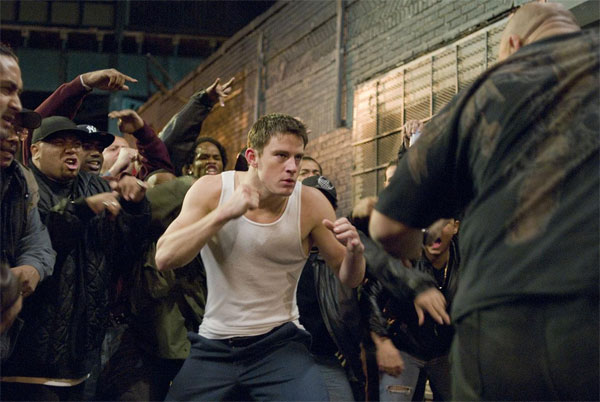
The fights in this movie, rather remarkably, don’t involve blood. These bouts are of the crunchy, bone-breaking, and drinking fountain-collision variety. The safe, crowd-pleasing type you’d expect from a Cannon movie. You could easily replace Michael Rivera with Billy Drago. My Cannon parallel theory may hold up when we consider that, just after every fight Channing Tatum is involved in, one of the gang members points his finger at the supine defeated opponent and laughs. And I haven’t even mentioned the cheesy subplot with Brian White’s Evan Haley. The rich New Yorker/poor small town implant vendetta between Evan and Channing Tatum’s Shawn MacArthur goes all the way back to high school.

Channing Tatum, incidentally, makes an iffy pugilist, both in look and in execution, but he does serve as a weird amalgam of Patrick Swayze’s Dalton, a young Patrick Dempsey, and Mark Wahlberg talking to animals. His character doesn’t smoke and he doesn’t quit have the guts to say, “I’m telling you straight It’s my way or the highway.” He desperately pursues Zulay Henao and insists on clarifying that a forced 20-minute breakfast in which he claims not to be hungry is a date. (I found myself inexplicably recalling the rather ridiculous way Richard Gere shovels eggs into his mouth in An Officer and a Gentleman during this awkward meet-cute moment. Perhaps the fights in this movie are meant to be as pleasantly incongruous as the smackdown between Gere and Louis Gossett, Jr. that comes out of nowhere near film’s end. My moviegoing companion seemed convinced that Montiel was channeling They Live‘s Nada. Now, in hindsight, I am skeptical of both claims. But this does demonstrate the free association risks that come with a particular aesthetic.) Montiel has better success with Shawn MacArthur when Zulay Henao’s daughter’s abuelita tells him to get the hell out of their apartment and refuses to understand his belabored gratitude in Spanish. Here is a MacArthur who doesn’t quite have the guts to say, “I shall return.” But he’s content to fight anyone he needs to for tens of thousands of dollars.

But the reason this movie worked for me as a guilty pleasure involves how something wholly inauthentic may very well have emerged from Montiel’s reality. In Montiel’s case, it starts with Bob Semen, cited in the quote that began this essay and one of the many gritty hues brightening the streets in Montiel’s memoir. Bob’s described in the book as running an “unbelievable illegitimate, straight-out false, television movie and modeling business on 52nd Street and Broadway, right upstairs from the Kit Kat Club.” (No surprise that this locale is where much of Fighting‘s action takes place.) Bob harbors grandiose dreams to turn Montiel’s band, Gutterboy, into a media sensation. One of his plans is a ten-million-dollar movie called No More Mistakes about the guy who invented the pencil eraser. (Which sounds as dubious as a ten-million-dollar

Bob never made it into Montiel’s film adaptation, but Frank the Dog Walker did. As played by Anthony DeSando, Frank is a languorous-tongued hustler who drawls out his vowels with a vaguely gay Queens timbre and expresses his dubious plans with spastic arm thrusting. And with Fighting, there appears to have been something of a schizoid split. Both Frank the Dog Walker and DeSando made it into Montiel’s second movie, but the double helix was split. Bob transmogrified into Frank, and this was a composite further altered by DeSando. But now Montiel has found an actor to carry these idiosyncrasies further, one who can improbably carry this somewhat preposterous but strangely entertaining movie.

Bob and Frank are now Harvey Boarden. And I don’t know if this movie could have worked without Terence Howard in the role, who improves on DeSando’s performance and improbably anchors the film. Here is a man who succeeds at his hustling in spite of his seemingly space delivery. He fills up dead air with little maxims picked up from his father and a steady drawl that involves lingering on one word across multiple sentences:

A: “I got a place around the corner. You can stay there until you find another place.” (“place”)
B: “We’re in a a $100,000 Mercedes. That’s where we’re going.” (“we’re”)
C: The “You tell…” that precedes Harvey’s efforts to delegate. (“you tell”)

We soon realize that it is these emphatic repetitions that has kept Harvey going. (And indeed, Fighting continues with the Altman-like overlapping dialogue rhythms that Montiel carried out in his first film.) Harvey may have stacks of Broadway tickets on his table. He may claim to be in the “tickets and sneakers” business. But he stays alive in this New York for the rich because he finds a way to inhabit each scene and demonstrate his worth through quiet repetition. And if the movie abides by the rule that a hustler is “someone who cannot win that wins,” then surely there is room for a world that cannot be authentic but that remains authentic in its convictions.

Make no mistake: this is a cheesy fighting movie. But Montiel knows very well that New York in real or fictive form needs its freaks. For those dwelling on the freaks being squeezed out, here is a movie that, for a time, offers hope for the hopeless.