Posts by Edward Champion

Edward Champion is the Managing Editor of Reluctant Habits.

The Follies of Emotional Expression

Lifestyles I'm Sorry Take Two

ITEM: September 1, 2009. A YouTube video surfaces. In the video, Van Jones calls Congressional Republicans “assholes.” The video is from an event in February 11, 2009. Jones was appointed by President Obama in March 2009. After considerable outcry from conservatives, Jones resigns from his White House position as Special Advisor for Green Jobs.

ITEM: September 8, 2009. President Obama delivers a speech before Congress. Rep. Joe Wilson (R – SC) shouts “You lie!” in the middle of the speech. Wilson apologizes, but the matter isn’t dropped. There are countless efforts to find ways to respond to Wilson’s words (is it racism as Jimmy Carter suggests a week later?). There is endless chatter by liberals and conservatives alike. More than a week later, Joe Wilson remains in the news.

ITEM: September 13, 2009. Serena Williams goes ballistic at the US Open. She is fined $10,000 for delivering a tirade at a judge. (She is also docked $500 for racket abuse. It was a tough racket.)

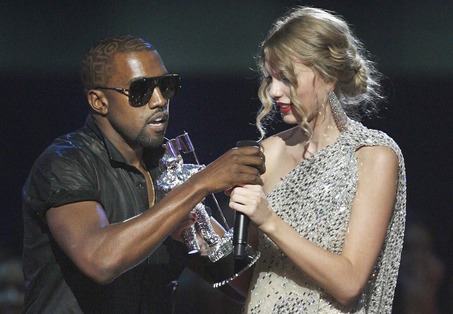
ITEM: September 13, 2009. Taylor Swift wins a Video Music Award. In the middle of her acceptance, Kanye West grabs the microphone out of Swift’s hands and shouts, “I’m sorry, but BeyoncĂ© had one of the best videos of all time.”

ITEM: September 13, 2009. President Obama is asked about Kanye West and Obama calls West a “jackass.” Efforts to prevent the tweet, the audio clip, and the video clip from disseminating around the Internet fail. Most side with the President.

One could probably include many other visceral explosions in recent history. Sherman Alexie, Alain de Botton, Alice Hoffman, Michael Richards, Christian Bale, or Don Imus all come to mind. But the above items all went down this month. We still have about two weeks to go before September’s over. It appears very likely that more public figures will erupt (or interrupt) with a subtlety worthy of Vesuvius.

But what do these reactions mean? And what is the appeal? It would be superficial to blame it all on the media, although the media is going out of its way to perpetuate these stories. (Arguably, as a questionable media source, I am going out of my way to perpetuate these stories, although I am trying to ruminate on it all instead of getting away from it.) Could it be that the tendency to fixate on these incidents involves some desire to make sense of these reactions? Maybe. I doubt that any of us could have predicted that POTUS would have managed to mix himself up in a Kanye West tirade, particularly when more pressing concerns like unemployment and health care are burning up national peat. But politics is now just as vital to the celebrity-industrial complex as sports, movies, and music. (It could hardly have been an accident that the FOX Network timed its announcement of Ellen DeGeneres as new American Idol judge to coincide with the President’s speech.)

Instead of trying to understand these visceral impulses, it has become the duty of every cultural observer to perpetuate the shallow headlines rather than plunge deeper. Are two words or two sentences really enough to denounce someone? Is this not continuing the soundbite culture? (No accident that Twitter, itself a bedrock of textual soundbites, was one of the major conduits through which these stories spread.) Should we not judge these people on a more complete impression? What resides beneath the comments?

Van Jones’s “assholes” admonishment came when the assembled group was trying to understand how bipartisanship could be an option when the Republicans remained obdurate. That’s a fairly interesting question, but it’s too bad that sensitive ears and Penn Ave propriety weeded Jones out.

Joe Wilson, as inappropriate as his actions were, was trying to express his passion. And isn’t understanding that passion, as unsettling as the motivations may be, the more important concern here? If we calmly listened to people, as Al Franken patiently did, wouldn’t this cut down on conservatives showing up at town meetings packing heat? Why not ask questions? Or see where people are coming from? Why did Wilson think that Obama was lying? And why aren’t we discussing the more interesting facts?

The Nation‘s Dave Zern observed that Roger Federer had a tantrum two days after Serena Williams, but Federer wasn’t upbraided in the press as severely as Williams. Is there a double standard? Does Federer get a free pass because he isn’t African-American and he isn’t a woman? Maybe it has more to do with celebrity figures fulfilling our expectations. After all, Federer is known more for his calm demeanor on the court. Williams, on the other hand, is known for her temper. Shouldn’t Federer’s incongruous reaction (“I don’t give a shit what he said” uttered on national TV) be rejoined with greater severity? And shouldn’t we praise Serena Williams for handling a future game with calm professionalism? Are we not just as guilty with our predictable responses? Are we true to our nature?

Kanye West acted like a jackass (a subjective view), but he never called Taylor Swift a jackass (the objective quote). He told Swift that he was “very happy” for her before turning his back and denying her moment. And yet President Obama, who used an ad hominem remark to respond to the whole mess, has neither given an apology nor been asked for an apology. (Contrast this with the Cambridge Police Department demanding an apology from Obama in late July, after Obama declared that the police had “acted stupidly” in the Henry Louis Gates arrest. Obama didn’t apologize, but there was a beer summit.)

Since the President has become involved in these public disputes with greater frequency, and he reserves the right to tell people that they “acted stupidly” or call someone a “jackass,” then perhaps he should start setting a better example for rational bipartisan discourse. Or perhaps he should abandon his “civilized” remarks and call people “jackass” from time to time. (Nixon was hardly a President to be proud of, but it’s worth noting that he had no problem using the word “cocksucker.”)

Maybe there’s something else at work here pertaining to executive privilege. The New York Times reported that New York City’s unemployment rate hit 10.3% in August, a 16-year-old high. The national unemployment rate still holds at just under 10% — the highest unemployment rate since 1983. As of April, two million jobs were lost in 2009. In tough times, when those who are fortunate enough to remain employed have a strong desire to stay mum and keep their jobs, and when millions of unemployed people can’t take any chances, it makes intuitive sense to look vicariously towards those who have this executive privilege of emotional expression.

But if emotional expression is so atavistic, shouldn’t it be predicated on egalitarianism? Is it not a double standard for Van Jones to be dismissed while Obama keeps his job? Subjectively, I happen to think that Obama was correct in both instances. But why can’t somebody who isn’t the President make such statements and not have to go through the endless rigmarole of apologizing over the course of multiple interviews? Why can’t we just accept someone’s apology and move on? If we don’t, then the purpose of an apology is useless or the apology doesn’t fit the apparent punishment for the crime. And if we don’t accept other people, which includes listening to their heightened emotional expression, then this runs counterintuitive to eclectic discourse.

If emotional expression is reserved only for those at the top, then should we really be surprised by the people who show up at tea parties? Should we really be surprised that Glenn Beck’s popularity has risen dramatically during the Obama Administration?

Perhaps these people are expressing extraordinary emotions like this because society has established unspoken prohibitions in the manner by which they communicate. As I type this sentence, I happen to believe that Salman Rushdie is a cunt. I could tell you why if you asked me. And if Rushdie were to explain himself, I would be happy to listen. If he had a reasonable explanation for his cunt-like behavior, I might change my mind. But because I have stated that “Salman Rushdie is a cunt,” people will see this and possibly believe me to be an asshole. But should such a sentence discount all the thoughtful and positive sentences I have ever uttered? And is my opinion of Rushdie so inflexible? By our present emotional expressive standards, this would certainly be the case if I had, by some lark, achieved the fame of Serena Williams.

But let’s approach this issue from another sideways shuffle. It is very possible that you, dear reader, harbor a feeling, however permanent or temporary, that someone that you know is a cunt. If that sentiment is permanent, and if it is not subject to change, then you may not be a civilized person. (Or, in Joe Wilson’s words, you lie!) But if you accept the follies of your emotional expression and you remain flexible enough to change it or to embrace it, then it is very probable that you are a civilized person, assuming that you aren’t a sociopath.

And now that I’ve thought about it, I don’t think that I believe that Salman Rushdie is a cunt. I believed it just now, but after thinking about it, it seems ridiculous to place a writer who has written a novel as great as Midnight’s Children into the same milieu as Hitler, Nixon, and Genghis Khan (to name only a few rotten apples, but, to give Hitler that cliched benefit of the doubt, he treated his dogs well). I have not thought to strike the sentence from this essay. But if this were published somewhere, I’m certain that very few editors would print the phrase “Salman Rushdie is a cunt.”

Is it reasonable to prohibit ad hominem or emotional expression? Or to dwell on it, as it crops up from time to time, as if it something to be skimmed over and over like a four-second tape loop? Only if you believe that humans — or, with the second rhetorical question, a select civilized elite — are capable of nothing more than profound enlightenment. Humans certainly do great things, don’t they? But if you’re naive enough to believe that they contribute nothing but thoughtful contributions, then I urge you to acquaint yourself with the many psychopaths who have chewed up the scenery over the course of human history.)

But let’s say that we accept emotional expression and slow down with these knee-jerk responses. We therefore give those who practice this perfectly normal tendency an opportunity to explain or atone. The eccentric contributors come out of the closet. Innovators who have held their tongues are permitted to communicate wild ideas and become part of the process. And we expand the repertoire of human behavior. There will probably be ugliness, but ugliness can be rectified without forcing horses to drink the water. Asking people to constantly apologize — often before a camera — is the action of an autocratic enforcer who has no faith in humankind. But when two people listen to each other without instantaneous judgment, you can plant seeds instead of chopping down trees.

Housing Works Report

The bloggers won tonight. But that’s only because our teammate Catherine Lacey knew her stuff. If I learned anything from the last time bloggers went up against an opposing team, it’s that men really don’t know anything, even when they think they do, and that they should hold their tongues. Sure enough, I held my tongue many times — in large part because Time Out New York mentioned something about cunnilingus after the event and for a more practical reason — the buzzer I was using had a two second delay and I was unable to answer questions I knew in my sleep pertaining to Star Trek II: The Wrath of Khan and Philip K. Dick.

Kenneth C. Davis was an extraordinary moderator, expressing considerable patience with the more obnoxious part of our team (i.e., me) while showing no diffidence whatsoever in repeating some of the more indecent answers (“Longfellow’s ‘Fuck'” and “Frankly I Don’t Give a Damn O’Hara” — again, me). Open Letters Monthly’s Sam “The Man” Sacks gets major props for going to the other side twice when we had a full table. And aside from the aforementioned Catherine Lacey, I must commend teammates Buzz Poole and Jason Boog for likewise demonstrating great skill and bravado.

I must also thank the dutiful audience for enjoying these hijinks and for stepping up to the opposing table. (Some audience members, including the one and only Miracle Jones, went up twice.) And, last but not least, gratitude should also be directed to Rachel Fershleiser, who organized the whole shebang.

I also saw some dude with a flipcam taking video. So presumably some embarrassing video will eventually show up on the Internets.

For those who attended, thank you very much for showing up. For those who had the stones to challenge the book bloggers, you likewise have my unwavering kudos.

Review: Cloudy with a Chance of Meatballs (2009)

cloudy

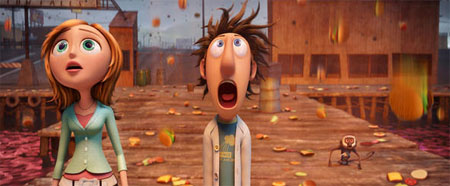
It’s safe to say that any imaginative soul will welcome the prospect of tasty food descending from the heavens. It’s a great idea. Not only does this cut down or entirely eliminate precious minutes in the kitchen, but it also benefits the lazy and profligate types who eat out all the time. Instead of driving to some restaurant, you could merely stick your hands out a window and await immediate results. You wouldn’t even need a microwave. Then again, if the food isn’t prepared to your liking, you’re not exactly in the position of returning it to the kitchen. Getting the ideal meal is more akin to scratching off a lottery ticket with a nickel. Maybe you’ll win. Maybe you won’t. But with so many free-falling viands, you have a pretty good law of averages on your hand. But what of quality? The food may come from the atmosphere, but if a chicken bursts through your roof during a candlelight dinner, chances are that the mood will be killed. These are gustatory dilemmas that Cloudy with a Chance of Meatballs, based on Judi Barrett’s book, is remiss to investigate. But then I was probably the only guy in the audience looking for philosophical arguments within a mainstream family film. I am sorry. But if you give me food fused with weather, you’re going to get my brain going.

These perfect food storms come from a whiny scientific punk named Flint Lockwood, who has somehow built a giant hidden laboratory without his father knowing and has a somewhat annoying tendency to speak in gerunds when building something. (The lab is accessible through an elevator hidden in a portable toilet.) Flint, voiced by Saturday Night Live regular Bill Hader, has come up with several rum inventions, including spray-on shoes, remote control televisions, monkey translators, and electric cars. But he now has an invention that can turn water into food. (Why he hasn’t considered turning his talents to the far more lucrative sideline of alchemy is a question this film never answers.) His scientific endeavors are misunderstood by his father (voiced by James Caan and largely hidden behind a unibrow and a moustache), a sardine shop proprietor too taken with communicating through fishing metaphors. Our man Flint is also menaced by Baby Brent, who appeared on numerous sardine cans in his callow infancy and who has been riding on this diaper-wearing fame ever since. It’s also worth noting that Bruce Campbell plays the town’s mayor, and this casting is every bit as pleasant as you might expect. Flint’s invention is let loose at the unveiling of a preposterous sardine theme park — with The Alan Parsons Project’s “Sirius” suitably matching this crass commercialism. Inclement weather soon takes on a new meaning. There is also Sam Sparks, a one-dimensional meterologist voiced by Anna Faris, who offers a contrived romance subplot and a tired geek vs. beauty dichotomy that’s out of step with the film’s scientific sympathies.

This nifty-looking universe — centered on a town located on “a tiny island hidden under the A in Atlantic” called Swallow Falls (no relation to the Maryland park) — hasn’t entirely accounted for the supreme messes arising from these food-related meteorological mishaps. Sure, there is a vehicle that drives around town, hurling leftovers into a giant pile. But surely great torrents of ice cream and spaghetti sauce would slick up the hamlet. There are rat-birds flying around the place, and they’re seen several times chomping away at the stray bits of food. But do they carry disease? (Indeed, why do we never see animated rodents for the bacteria-carrying vermin that they are?) And why doesn’t Swallow Falls have an exterminator? Furthermore, if the Swallow Falls population has been eating nothing but sardines during its history, why does Steve the Monkey — Flint’s happy servant, appositely voiced by Neil Patrick Harris –have a Gummi Bears fixation? Surely, his master wouldn’t know about Gummi Bears if there’s been nothing but sardines on the menu.

And when all this food falls from the heavens, why are the townsfolk familiar with it? I must presume that, despite the town’s limited resources (no exterminator, no doctor, no lawyer), all citizens somehow manage to take several months of vacation. But surely there are dishes here that they have never tried before. Come to think of it, the pelting cuisine is mostly American. We get burgers, steaks, pizza, nachos, jelly beans, and hot dogs. Lots of breakfast food but no frittata or smoked salmon? Foodies will be upset. For that matter, no Indian food? Chinese food? Mexican food? When some vaguely Italian spaghetti drops from the sky, one character shouts, “Mamma mia!” I will leave the PC types to argue over whether this possibly Anglo-Saxon, anti-multiculturalist conspiracy. In the film’s defense, I must point to Chief Earl Devereaux, a cop voiced by Mr. T, who scrunches his butt before dealing with his a stressful scenario and somersaults before writing a ticket. Poor Mr. T is assigned this mouthful by the screenwriters: “You know how fathers are supposed to express their appreciation for their sons.” That doesn’t quite have the ring of “I pity the fool,” but Mr. T does what he can.

How can one find plausibility in this giant peach of a premise? To cite another incident, giant pancakes fall from the sky, followed by two square dabs of butter, and then followed by a melange of syrup. Since all this is animated — in 3-D and in IMAX, ideal for a 420-friendly crowd were this not a family film — this is all very pleasant to watch. But the pancake dilemma also assumes that all three breakfast components will fall at precisely the right times and spatial coordinates. Likewise, a roofless restaurant has diners holding out their plates waiting for steaks to pelt down hard from the sky. The success of this operation hinges upon (a) the sky remaining sunny, (b) the steaks somehow magically landing in the desired plate positions, (c) the steaks not hitting these diners in the head and rendering them unconscious (there are apparently no lawyers or courts in this town; so I presume nobody in Swallow Falls is litigious), (d) the steaks maintaining an ideal warmth over the course of a fall of several thousand feet, and (e) the steaks landing on the plates without breaking apart or otherwise being split into inedible pieces upon impact.

You see the problems.

In an open letter to Alexei Mutovkin, the writer Ursula K. Le Guin suggested that plausibility within fantasy is uprooted by wishful thinking. And Cloudy, as enjoyable as the film frequently is, relies very much on wishful thinking. It is wishful thinking to expect a really cool idea like falling food to hold up. Then again, Roald Dahl managed to hold our attention with James Trotter back in 1961. So maybe we should blame the filmmakers. Expanding her thoughts further, Le Guin also wrote that a fantasy story’s plausibility rests upon “the coherence of the story, its constant self-reference.”

By Le Guin’s standards, Cloudy is a failure. And I suspect that because the film often lacks narrative coherence, it will not last very long in the heads of children hoping to ride this gleeful storm out. This film possesses too much energy for its own good. It feels the need to constantly insert characters doing funny things in the background. It is terrified of inserting a natural break, perhaps because we’re not meant to think too much about the world that the film presents. The film therefore lacks confidence, in large part because the coherence and the constant self-reference, as I’ve just demonstrated, fails to make sense.

(For parents, I should probably also note that I observed two kids having a difficult time near the end because of the film’s relentless tsunami of visual information. One boy retreated to his mother’s lap, crying and exhausted. Another was frantically waving his arms at the screen and began to jump up and down in confusion. The 3-D is certainly impressive at times, but little ones may get overwhelmed.)

I don’t mean to suggest that this film isn’t fun. But it doesn’t quite live up to its potential. It is more interested in perpetuating a concept than building a world. The filmmakers have avoided Ron Barrett’s illustrations from the book, opting for a peppy and textured look that does away with Barrett’s lines and shadings. But Barnett understood that a fantastic premise, particularly an unlikely one, needs a little reality to make it work, to make it coherent, and to avoid wishful thinking. Had this film opted for conceptual quality instead of quantity, it might have stood toe-to-toe with Pixar.

RIP Patrick Swayze

If you don’t enjoy Roadhouse, I’m convinced that you don’t have a soul. The fact remains that this cheesy movie wouldn’t be so magical had not Swayze understood the material so well. Watch how he sells the above scene. It’s all in the delivery and that modest Swayze head jerk. I liked Patrick Swayze. Who didn’t? He could take syrupy screenplays and give them backbone. Not unlike David Carradine, come to think of it.

Hate Mail Dramatic Reading Project #6

hatemail6A few weeks ago, I learned that somebody had been pretending to be friendly with me for quite a long time. This person was uninterested in explicating feelings or having any rational point of reference. What mattered most to this person was hostility. As you will soon see, the email was ridiculously petty and obstinately worded.

Therefore, my audio series — Hate Mail Dramatic Reading Project — must continue.

The following clip represents my dramatic reading of the hate mail in question, read in the style of a Miss Manners schoolmarmish tone. During the course of my reading, not only did the email feel like a pointless lecture, but I began to wag my fingers midway through the delivery. I have spent most of the afternoon keeping my hands in a folded position to prevent such gestural mishaps from occurring. And should you find yourself uncontrollably pointing while you are listening to the file, I apologize in advance for any finger-related inconvenience.

I plan to continue reading more hate mail. Again, I will be happy to read any specific hate mail that you’ve received. (If you do send me hate mail for potential dramatic readings, I only ask that you redact the names of the individuals.)

Click any of the below links to listen.

Hate Mail Dramatic Reading Project #6 (Download MP3)

This text will be replaced

Previous Hate Mail Dramatic Reading Installments:

#5 A hate mail read in the style of Richard Milhous Nixon
#4: A hate mail read in the style of a drunken Irishman.
#3: A hate mail read in the style of a quiet sociopath
#2: A hate mail read in a muted Peter Lorre impression
#1: A hate mail read in a melodramatic, quasi-Shakespearean style