From Here to Eternity (Modern Library #62)

(This is the thirty-ninth entry in the The Modern Library Reading Challenge, an ambitious project to read the entire Modern Library from #100 to #1. Previous entry: The Wapshot Chronicle.)

American history has always been a series of tranquil and joyful moments just before some terrible spill of the cosmic wheelbarrow. The ebb and flow of American life, as it has been and as it always will be, can be perceived as a recurring nightmare: of life, love, felicity, and possibility cast asunder in an unsettling uproar claiming some permanent end to innocence. The hanging chads and butterfly ballots ushering in a presidential monster, only to be eclipsed (and even normalized) sixteen years later by an even greater beast, a lusus naturae even more unhinged and more unsettling. The planes hitting the towers. A pandemic wiping out more than one million Americans. And, of course, the planes that attacked Pearl Harbor and stirred America from its slumber, shoving us into the Second World War.

In our rush to wrap our shivering minds in the warm blanket of nostalgia, as we recall epochs that were seemingly safer and stabler, we often forget that living did not stop and progress was not halted by the deafening clamor of sinister cornets warbling from left field. The best artists have always understood that each deep stab of history’s merciless dirk is answered by reflection and repose, of the battered and bruised emerging triumphantly from these setbacks with resilience and rejuvenation.

We were never like that. We were always like that. The push and pull continues unabated by the “winners” snorting with sow-soaked hubris at the top of the media food chain, with scant regard given to the unsettling totality.

Enter James Jones in 1951, whose massive masterpieces From Here to Eternity and The Thin Red Line are little remembered by anyone under fifty today.

I may very well be the last person under fifty to have signed on for the full James Jones experience. Not even the perspicacious film critic Glenn Kenny finished the Jones doorstopper that he named his thoughtful blog after, but I did.

* * *

From Here to Eternity is a peacetime novel bolstered by a trinity of misfits: a former boxer who grew up poor and who invites trouble named Private Robert E. Lee Prewitt (or Prew), a total maniac from Brooklyn who works in the kitchen named Private Angelo Maggio (in other words, a violent and unhinged toxic man who would be immediately canceled, if not arrested on sight, in 2024), and Sergeant Milt Warden, who is having an affair with Karen Holmes, naturally the wife of Captain Dana Holmes, who is the man in charge of G Company. Ther’s also Mess Sergeant Maylon Stark, who, while a minor character in Eternity, I mention here because Jones would take the names and temperaments of these men and reuse them for The Thin Red Line and Whistle, the next two books in his World War II trilogy. So in The Thin Red Line (another Jones masterpiece), Prewitt becomes Witt, Stark changes into Storm, Warden transmutes into Welsh. Then Whistle comes along and Witt is Winch, Prew is Prell, and Stark is Strange. It’s a clever move by Jones to show the interchangeability of certain personality types within the military-industrial complex. Thirty years before Richard Gere famously wailed “I got nowhere else to go!” in An Officer and a Gentleman, Jones understood the painful truth about rudderless men flocking to the military more than anyone.

Mention From Here to Eternity to anyone today and they will probably remember (that is, if they do remember) the famous love scene on the beach with Burt Lancaster and Deborah Kerr. But as undeniably romantic as this cinematic moment is, I would say that “Re-Enlistment Blues” probably captures the spirit of the book better than the waves sweeping across gorgeous Hollywood actors (and, hey, I’m not going to deny that Lancaster and Kerr are both incredibly sexy in that scene). I’ve taken the liberty of covering the song, if only to remind the world that it was Jones who wrote the lyrics (since fewer people read these days, why not set the record straight on TikTok?):

You see, Jones rightly perceived the military as an all-encompassing instrument designed to turn fuckups into soldiers through often brutal regimentation. (One can see the full unforgiving horrors against the more libertine and free-thinking men on display in the novel’s brutal chapters in the stockade.) In a December 8, 1939 letter to his brother Jeff, Jones wrote, “I, who am better bred than any of these moronic sergeants, am ordered around by them as if I were a robot, constrained to do their bidding. But I can see their point of view. Nine out of every ten men in this army have no more brains than a three year old. The only way they can learn the manual and the drill commands is by constant repetition. It is pounded into their skulls until it is enveloped by the subconscious mind. The tenth man cannot be excepted. He must be treated the same as the others, even if in time he becomes like them.” A little less than four decades later, Jones would hold to this unsettling truth in his compelling memoir, WWII: A Chronicle of Soldiering: “Men who had been raised to believe, however erroneously, in a certain modicum of individual free-thinking were being taught by loud, fat, devoted sergeants to live as numbers, by the numbers. Clothes that did not fit, when they could see clothes on the shelves that did fit…Being laughed at, insulted, upbraided, held up to ridicule, and fed like pigs at a trough with absolutely no recourse or rights to uphold their treasured individuality before any parent, lover, teacher or tribune. Harassed to rise at five in the morning, harassed to be in bed by nine-thirty at night.”

When From Here to Eternity dropped in 1951, few novelists — with the possible exception of Richard Aldington’s bracingly sardonic Death of a Hero — had dared to betray this unspoken memorandum of understanding. That the truth arrived in fiction six years after the surrender of Japan suggests that it was meant to be confronted, though not in expedient fashion. Three years before, Norman Mailer had merely presented the loneliness and dehumanization of his soldiers. But Jones was prepared to go much further than this, tackling military life with all of its blunt involutions. And it is testament to Jones’s great talent as a writer that Angelo Maggio — the anarchic id at the center of this massive novel — remains an inexplicably poignant figure, a character who charmed Frank Sinatra and, according to his biographer James Kaplan, caused Ol’ Blue Eyes to brood at night speaking his lines from the book and insisting that only he could play the part. (The role salvaged Sinatra’s then flailing career. Sinatra would go onto win an Academy Award for his performance in the 1953 movie. Indeed, it can be plausibly concluded that Sinatra would never have been Sinatra without James Jones. Without Maggio, Sinatra would have ended up as a forgotten crooner, some footnote in 20th century history.)

* * *

In stitching all these threads together, Jones was hindered by Scribner’s legal team, which demanded a low-salt version of the authentic soldier dialogue. Only a few years before, Norman Mailer had caved to the censors to get The Naked and the Dead published, using “fug” in lieu of a now commonplace word that one hears frequently from the mouths of enthusiastic teenagers (and causing Dorothy Parker to say, upon being introduced to Mailer, “So you’re the man who can’t spell ‘fuck.'”).

But Jones saw the revision as a creative challenge. In his poignant memoir, James Jones: A Friendship, Willie Morris (who was so tight with Jones that he finished writing the final installment of the World War II trilogy, Whistler, after Jones’s death) got the inside skinny from editor Burroughs Mitchell on how Jones approached this:

It was very hard work; Jim’s ear was so exact that you couldn’t easily remove a word from the dialogue or substitute for it. But he kept doggedly at it, and eventually he began to treat the job as a puzzle, a game, and was delighted with himself when he found solutions. It was characteristic of him, then and afterward, that when an editorial decision was made, a look of anguish would come over his face, he would get up and pace, and finally he’d either accept or say, “I just can’t change that,” looking even more anguished. Finally I reported to Mr. Scribner that we had cut all the fucks we could cut, although not the lawyers’ full quota, and Mr. Scribner cheerfully accepted the situation. That was certainly part of reason why, when Charles Scribner died suddenly, Jim insisted on going to the funeral. He said he knew that Mr. Scribner had been worried about Eternity — but he had gone ahead and published it.

In our present age of sensitivity readers and books being banned or unpublished for spurious reasons, righteous career-destroying ideologues are no less wild-eyed or humorless than their right-wing, anti-art, anti-Critical Race Theory, and casually transphobic counterparts — the kind of regressive dipsticks who wrongly complain about how Russell T. Davies’s new stories for Doctor Who are “too woke” because of pronoun recognition, Davies equipping the TARDIS with a wheelchair ramp (and proudly introducing Ruth Madeley as a disabled UNIT adviser), and the marvelous inclusion of nonbinary characters. But make no mistake: tyranny against expression is not confined to any political affiliation. It is difficult to fathom any modern day corporate publisher who would possess the stones to stick with an author’s artistic vision in the way that Charles Scribner did. (Only four decades after the publication of From Here to Eternity, a gutless vulgarian by the name of Richard E. Snyder, head of Simon & Schuster (which would gobble up the Scribner imprint in 1993), would kibosh the publication of Bret Easton Ellis’s American Psycho, before it was picked up by Vintage, where it would become a huge success (and be reinvented by the inventive Mary Harron as an unforgettable film adaptation mocking toxic masculinity, much as Ariel Levy and John Turturro recently adapted Philip Roth’s Sabbath’s Theatre for the stage in similar fashion). Thankfully, Snyder had the decency to drop dead of heart failure last June after living a long and spineless life lining the coffers of his corporate overlords by publishing “inoffensive” tomes.)

Jones wandered into the writing world a bit too late to get the full Maxwell Perkins treatment (he famously demanded to see Perkins in person as a young writer; Perkins received him and encouraged him, but passed away before he could devote his editorial energies to the entirety of Eternity), but he did have timing on his side, with the valves of permissible dialogue being slowly loosened in the early 1950s, culminating in the opprobrium that Grace Metalious would receive five years later for Peyton Place.

The uncensored version of From Here to Eternity was published by The Dial Press a few years back and, having read both the original and the uncensored versions, I would say that the latter is far superior. There are small differences, such as Maggio allowing a man to go down on him to land some extra cash:

“Oh, sall right. I admit its nothing like a woman. But its something. Besides, old Hal treats me swell. He’s always good for a touch when I’m broke. Five bucks. Ten bucks. Comes in handy the middle of the month.”

But these restored scenes really tell you about the quiet desperation of soldiers. They wait for payday. They augment their meager pay with card games in the latrine. They spend ridiculous amounts of money on sex workers. And they do this because, well, there is nothing else for them. In her incredibly underrated book Stiffed, Susan Faludi documented this problem in the 1990s from a variety of vantage points and concluded that the repugnant patriarchal cues and the way that American culture is conveniently superficial about anxieties that scar lives is equally applicable to men as well as women. And we cannot even begin to solve the underlying problems unless we are honest about all this. As journalists now lose their jobs and sites like The Messenger close their doors and kill their content without notice, it’s incumbent upon us to find the ballsy artists like Jones and stick up for them even when their honest sentiments are offensive or make us uncomfortable. More than five decades after its publication, From Here to Eternity still makes a valiant case for the need to tell and publish the truth.


Next Up: Willa Cather’s Death Comes for the Archbishop!

Audio Drama: “Pattern Language: Mirrors of the Soul”

We recently released the fourth part of our four-part Season 2 finale, “Pattern Language.” This is the sixth of six new episodes that we released biweekly this summer, representing “Phase III” of the second season. The second season of The Gray Area is now complete! We also have a live show coming up on October 16, 2021. Live show details here. You can follow the overarching story through this episode guide.

Here are a number of useful links: (The Gray Area website) (the iTunes feed) (the Libsyn RSS feed) (the Podchaser feed)

Here’s the synopsis:

Our intrepid heroes visit the New York Public Library to meet up with visiting literary scholar Merrill Malone, an eccentric and the foremost expert on Virginia Gaskell’s life and work, to get, once and for all, all the answers about the portals. What they don’t realize is that shocking personal revelations and the very ground beneath their feet will alter forever within the library’s seemingly pristine walls. (Running time: 55 minutes, 43 seconds.)

Written, produced, and directed by Edward Champion.

CAST:

Chelsea: Katrina Clairvoyant
Emily McCorkle: Belgys Felix
Professor Malone: Robert Garson
Jenna: Devony DiMattia
Miss Gaskell: Chris Smith
Maya: Tanja Milojevic
Ed Champion: Edward Champion
The Executive: Rachel Matusewicz
Audrey: Amanda Rios
Romero: David Ault
Joe: David Sinkus
The Guard: Graham Rowat
and Zack Glassman as The Receptionist

Incidental music licensed through Neosounds and MusicFox.
Additional music composed by Edward Champion

Sound design, editing, engineering, and mastering by a bald man in Brooklyn who clearly has some corporate identity issues to work out.

Thank you for listening!

Here are some behind-the-scenes photos and videos pertaining to this episode that we made during the more than two years of production we put into the second season.

Behind the Scenes:

View this post on Instagram

This morning, I recorded with the incredible @theblondebraveheart, who you may remember as Jenna in "Compassion Fatigue." I'll say nothing about what happens, but, as you can see, we do revisit an incident involving an Elizabeth Hardwick book. Fortunately, I had all of Hardwick's volumes on my bookshelves to help zero in on the motivation. I can't say enough great things about Devony's talent and commitment. It was @tim_torre who sent her my way in the first season and I will be forever indebted to him not only his performance in "Hello" but for this terrific referral, which was a tremendous act of generosity for this production. Devony and I carried on as if two weeks had passed rather than two years. I also cast her as another character because she had expressed interest in playing someone of that type. But as Jenna, Devony came prepared and energetic: someone who I can totally trust to give me just as many ideas as I suggest to her. She was such a joy to work with that I really couldn't settle for a performance that didn't contain a few nuances here and there, even on lines that most other people would be happy with. We conjured up a quick backstory entirely based on Devony's instincts as a performer and where she wanted to take the character. And it all happened far faster than either of us expected. One other fun detail: Devony is the third actor in a row who has showed up wearing power boots. Apparently, the women I conjure up are so punk rock that this sartorial detail, arrived at independently by all three, has become a subconscious style choice. And it is one that I consider a great compliment! Anyway, the turn that Jenna takes in the second season will surprise you, if only because Devony very much surprised me! Thank you so much, Devony! #audiodrama #acting #character #surprise #fun #elizabethhardwick #boots #punkrock

A post shared by Edward Champion (@grayareapod) on

View this post on Instagram

1:30 am. Nolita. I was restless. I HAD to get this out of me. So I holed up in a bar and whaddya know? I finished a 150 page draft of the season finale. It will definitely need a rewrite, but you're NOT going to see this crazy ending coming! Certainly it surprised the hell out of me. Thus ends the very labor-intensive and time-consuming "creating stories out of nothing" stage of Season 2. I'm a little delirious right now, but quite happy to begin the revisions over the weekend! Once I get this script in shape, we record the rest. And I can finally devote myself full-time to editing and releasing. Many thanks to my incredible cast for their faith and patience! This is going to be fun and weird! #writing #audiodrama #latenight #creative #script #nolita #fun #weird

A post shared by Edward Champion (@grayareapod) on

View this post on Instagram

This morning, I had a super fun recording session with @devonydimattia, who is always a joy to work with! In this scene, her character (Jenna from "Compassion Fatigue") is dealing with an eccentric professor. Two pages in, Devony had the character down. Five pages in, we were coming up with so many layers that I really felt we had exceeded what was there on the page. Also, the funniest part of today was that I actually got a better performance out of Devony when I read the lines in the voice of Ricardo Montalban from STAR TREK II: THE WRATH OF KHAN, proving that impersonating Khan is strangely useful in the production of audio drama. Thank you so much, Devony, for once again being so marvelous! #audiodrama #character #acting #act #recording #startrek #khan #professor #library #character #voiceover #performance

A post shared by Edward Champion (@grayareapod) on

View this post on Instagram

I had a very fun time this afternoon recording some season finale stuff with @katrinaclairvoyant and @devonydimattia! These two are always a blast to work with! What's great about these dual actor sessions is the way you discover details about characters by the way they bounce off each other. For today, I definitely needed that social energy. Because there are a lot of people in this scene! In this case, both Devony and Katrina found opportunities to inject some unexpected humor into these characters. I also noticed that both characters started mimicking their respective tics, almost sizing each other up, but said little (although I did laugh a lot), letting the two figure it out on their own and planting little seeds for why they might be feeling a certain way. You always want to guide actors gently, giving them just enough to imagine so that they can always surprise you. And these two certainly did! #acting #audiodrama #voiceover #collective #recording #drama #theatre #character #roles #humor #dimension #guide #seeds #imagination

A post shared by Edward Champion (@grayareapod) on

View this post on Instagram

I had a blast this morning with the incredible @robgarson, who came seemingly out of nowhere and perfectly encapsulated the role of an eccentric professor who has big clues about the Virginia Gaskell mystery. In addition to being a very smart and hilariously energetic man, Rob is also a fine mimic of many UK dialects. He was incredibly easy and very fun to work with and this was one of those sessions where we both fed each other little nuances about the character, who I wanted to be somewhat stylized but nevertheless real. This is actually the other side of the scene clip I put up with @devonydimattia a few weeks ago. And this very goofy scene is truly going to be a lot of fun when I stitch this all together. Thank you so much Rob! #audiodrama #acting #recording #voiceover #character #british #professor #actors #session #fun #mimic #drama #background

A post shared by Edward Champion (@grayareapod) on

Audio Drama: “Pattern Language: An Iris for Emily”

We recently released the third part of our four-part Season 2 finale, “Pattern Language.” This is the fifth of six new episodes that we are releasing biweekly this summer, representing “Phase III” of the second season. This story is part of the second season of The Gray Area. You can follow the overarching story through this episode guide.

Here are a number of useful links: (The Gray Area website) (the iTunes feed) (the Libsyn RSS feed) (the Podchaser feed)

Here’s the synopsis:

Emily McCorkle has landed the media appearance of a lifetime: a guest spot on the most respected talk show in America. But why is the host so concerned with her private details? And why are so many skeletons from her past making guest appearances? And who is the strange man with the hot dogs? (Running time: 38 minutes, 1 second.)

Written, produced, and directed by Edward Champion.

CAST:

Emily McCorkle: Belgys Felix
Ophelia Kakanakis: Carol Jacobanis
June: Monica Ammerman
The Fajita Demon: Pete Lutz
The Cunning Demon: Leanne Troutman
Morris Pressman: David Tao
Jimmy Markson: Heath Martin
Johnson: Hilah Hadaway
Emily’s Mom: Melissa Medina
Emily’s Dad: David Sirkus
Chelsea: Katrina Clairvoyant
Maya: Tanja Milojevic
Ed Champion: Edward Champion
Reporter #1: Glenn Bulthius
Reporter #2: Alice Fox
and Zack Glassman as The Receptionist

Creature Voices by Samantha Cooper and Rachel Baird

Incidental music licensed through Neosounds and MusicFox.
Additional music composed by Edward Champion.

Sound design, editing, engineering, and mastering by a bald man in Brooklyn who has become a TikTok junkie seemingly against his will.

Thank you for listening

If you’d like to support this independent audio production and learn more about how we made it, for only $20, you can become a Season 2 Subscriber! You’ll get instant access to all episodes as we finish them — months before release. Plus, you’ll get access to exclusive interviews and more than 400 minutes of behind-the-scenes commentary! Here are some behind-the-scenes photos and videos pertaining to this episode that we made during the more than two years of production we put into the second season.

Behind the Scenes:

View this post on Instagram

Part of my writing process involves performing all the dialogue out loud to make sure that it works. Rhythm, zest, and real emotion are all very important and this is really the only way to get it right! My bedroom is the venue for these strange one man shows (although I have sometimes taken these on the road to friends' houses to get feedback — one of my S2 stories caused a roomful of people who nudged me to read it to mist up, which was a huge surprise). I'm getting closer to finishing the season finale and here's a bit from it — oddly enough, this part was inspired by the idea of a two woman version of MY DINNER WITH ANDRE with a huge moral question at the center! I'm taking quite a few risks with this story and I hope I pull it off! (Incidentally, I watched MY DINNER WITH ANDRE three times before writing this section.) #writing #performing #dialogue #rhythm #zest #passion #art #mydinnerwithandre

A post shared by Edward Champion (@grayareapod) on

View this post on Instagram

This morning, I recorded with the mighty @monica.ammerman. who is also working on a new web series called @someonenew.theseries. I met Monica in an improv class a few years back, knew that she had comedic chops, and cast her in Seaaon 1 as Henrietta, Queen of the Knights, in "Loopholes " But I also had the sense that she could do drama very well. Comedic actors are often underestimated and frequently untapped on this front and I'm the type of guy who likes to cast actors based on what others DON'T see. But Monica, who is super great to work with, brought a lot of wonderful understatement to this character that had me seeing how quietly courageous she was. Nuance that the two of us tweaked together. Monica inspired me to get us asking questions about this character's religious upbringing. And this turned out to be a fun and marvelous recording session! Thank you so much, Monica, for going along for the ride! This is a very bold and experimental story and I'm grateful to have such keen collaborators unpacking the emotional ambiguities, which are essential to creating something that packs a punch! Here's a clip of us layering a short monologue about forgiving people. The take we ended up using (not this one) is incredible! #audiodrama #acting #character #background #nuance #ambiguity #subtlety #dimension #comedy #drama #improv #forgiveness #monologue

A post shared by Edward Champion (@grayareapod) on

View this post on Instagram

It's a wrap! Pardon my bad angle. But the Six Week Push is now at an end! Aside from some remote files I'm waiting on and a July weekend session, I have all of Season 2 in the can! Some 550 GB were recorded in the last year and a half. 120 speaking roles. 1,000 pages of script. Now I have to edit this thing. Many thanks to my stupendously talented cast, who brought so many surprising interpretations to these colorful characters and helped me to become a more daring and instinctive director. Pictured here are @belgys_felix and @caroljacobanis, who both did a terrific job recording today. Now I'm going to lie down for a bit! #wrap #production #audiodrama #recording #voiceover #actors #acting

A post shared by Edward Champion (@grayareapod) on

Carlin Romano Is Racist. And So Is The National Book Critics Circle.

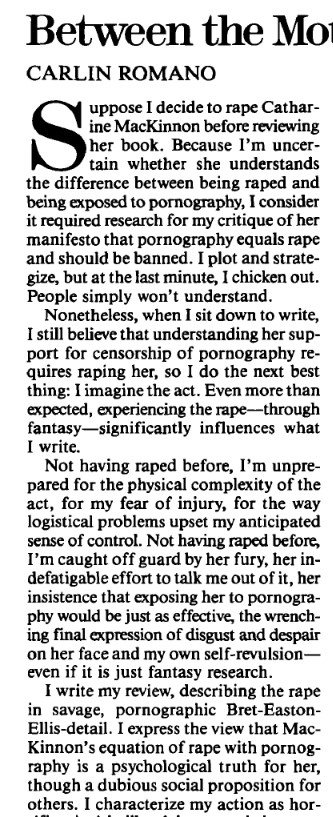
On June 11, 2020, Hope Wabuke — a distinguished Ugandan American poet who was on the National Book Critics Circle board — published screenshots from a disturbing internal conversation that involved how the NBCC would respond to Black Lives Matter. At issue here was how a seemingly august body of professional book critics would answer to recent events. One board member — a man by the name of Carlin Romano, who once opened a review expressing his fantasy of raping a woman author — was determined to “speak up” and claimed that he wasn’t the only board member who felt that racism and police brutality didn’t particularly concern him.

Romano took umbrage with the idea that white gatekeeping “stifles black voices at every level of our industry,” declaring this to be “absolute nonsense.” Never mind that The New York Times recently reported that the esteemed author Jesmyn Ward had to fight for a six-figure advance even after winning a National Book Award. Never mind Malorie Blackman sharing details about how a publisher had rejected a novel because a story featuring two black magical siblings wasn’t “believable.” (Meanwhile, Knopf publishes white author John Stephens’s The Emerald Atlas, which features three white siblings engaging in magic, to say nothing of the family-oriented magic contained in white author Alice Hoffman’s Practical Magic books.) Never mind that Dorothy Koomson tweeted on June 2, 2020 that her books were rejected because they “weren’t about ‘the black experience'” and how she was asked to make characters racist. No, as far as Romano was concerned, the struggles that African-American writers face to tell their stories was “ridiculous,” despite numerous examples.

Romano got even uglier, claiming that black writers would “never have been published if not for ecumenical, good-willed white editors and publishers who fought for the publication of black writers.” Amber Books? Black Classics Press? Third World Press? Triple Crown Publications? Life Changing Books? Any of the far too few African-American publishers who have stepped up to redress the systemic racism that the largely white-owned publishing industry has failed to remedy? That Romano applies “ecumenical” to his atavistic statement says much about his condescending views of writers of color. Apparently, in his view, any publisher who puts out a worthy novel that happens to be written by an African-American is an act of charity rather than an act of merit. James Baldwin? Toni Morrison? Octavia Butler? Ta-Nehisi Coates? Well, you’re lucky that your ass got through the door because Whitey decided to let one or two of you through the gates. Does Romano’s repugnantly racist sentiment here not reinforce the problems of white gatekeeping and not buttress the need for any and all literary organizations to be more inclusive? As far as Romano was concerned, the fact that countless people of color had to fight to be published — despite the fact that African-American novels have continued to be financially successful (Samuel R. Delany’s Dhalgren sold one million copies, Alice Walker’s The Color Purple sold five million copies, even Ann Petry’s The Street selling one million copies in 1946, the list goes on) — did not get in the way of his sentiment that black people needed to be fawning and grateful, much in the manner of slaves, to white publishers. Romano doubled down on this racism by writing, “In my 40 years in literary and publishing life, I’ve seen far more of [sic] white people helping black writers than of people black people helping white writers.” In other words, Romano believes that black people should devote their already disadvantaged positions to spending all their time promoting white writers.
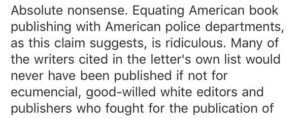
In short, Romano articulated in very clear terms just what he wants the system to be. And his deplorable viewpoint here is no different from an antebellum slaveholder. Romano’s despicable vision is this: White editors serving as gatekeepers. Black authors dancing with joy at the honor of having their neutered visions “represented.” Romano’s statement is, in short, a racist screed against literary merit and inclusiveness. That Romano cannot acknowledge any white bias that has prevented great literature from being published, even as he demands that African-American writers jump up and down over concessions that their white counterparts would never have to face, is nothing less than a pompous white xenophobe revealing his true colors.

But Romano didn’t stop at mere racism. It is a common truth that atavistic barnacles like Romano often feel the need to tout their own superiority, irrespective of its shaky foundations. In perhaps the most risible part of his vulgar message, Romano claimed, “I myself have probably written more articles and reviews about Philadelphia’s black literature and traditions in my 25 years at the Inquirer than anyone living, black or white.” Do you hear that, Black Writers Museum? Do you hear that, African American Children’s Fair? Do you hear that, Hakim’s (the oldest Philly black bookstore, since 1959)? Even though all of you have done far more for black Philadelphia than Romano, Romano wants you to bow down at his professed magnanimity! It’s Romano who’s doing the heavy lifting here, not you!

One would think that the NBCC Board of Directors would instantly denounce such atavistic viewpoints. But President Laurie Hertzel, a white woman who would appear to be the NBCC’s answer to Amy Cooper, was nothing less than fulsome about these backwards views. She claimed, “Your objections are all valid, of course.” She also claimed that Romano’s views “shine unlike anyone else’s.”

I emailed Hertzel about her unquestioning support of Romano’s racism. She replied, “Rest assured that I do not and have not endorsed anyone’s racist comments.”

In other words, Hertzel and nearly the entire NBCC board are not so much interested in looking inward as they are gaslighting the narrative entirely. Nor can the NBCC actually name and hold Romano accountable — as was seen in this self-serving and half-hearted announcement posted on Thursday night.

I attempted to contact many of the NBCC Board of Directors — in large part because the only board members to acknowledge the exchange and take something of a stand against this racism were Carolyn Kellogg and Richard Z. Santos.

The remaining twenty NBCC Board Members have said nothing. In fact, shortly after I contacted Michael Schaub about his neglectful duties to stand against racism, this self-serving Texan, who was recently criticized for his insensitivity to trans human rights, blocked me on Twitter.

The NBCC Board has a duty to denounce Romano’s racist remarks. With their silence, one can only conclude that the following National Book Critics Circle board members are more than happy to uphold systemic racism. Systemic racism butters their bread. It ensures that they can continue to get gigs. That these people fail to call out racism and that refuse to do so even as Party City has done a better job firing racists speaks to their willful and open advocacy of white supremacy in the National Book Critics Circle.

Here is a list of the NBCC Board Members who presently advocate racism and white supremacy with their silence:

Laurie Hertzel, NBCC President
Kerri Arsenault, VP Awards
Jane Ciabattari, VP Events
Connie Ogle, VP Communications
Carlin Romano, VP Grants
Michael Schaub, VP Online
David Varno, VP Tech
Marion Winik, VP Treasurer
Jacob Appel
Colette Bancroft, The Tampa Bay Times
Gregg Barrios
Lori Feathers
Charles Finch
Megan Labrise
Jessica Loudis
John McWhorter
Katherine A. Powers
Madeline Schwartz
Elizabeth Taylor

Should any of the above individuals make a public statement against Carlin Romano and the NBCC’s systemic racism, I will remove them from the list. But I doubt that any of them will.

[6/12/2020 10:15 PM UPDATE: The NBCC Board page has dropped the following names: Laurie Hertzel, Connie Ogle, John McWhorter, and Katherine A. Powers. Presumably, these are the other four Board members who have resigned. Hertzel has also deleted her Twitter account.]

[6/15/2020 12:00 PM UPDATE: This morning, Carolyn Kellogg announced on Twitter that she had resigned from the Board. She cited “microaggressions and delays” in advance of drafting the Black Lives Matter statement. She also noted that the Board, instead of focusing on Romano’s racist sentiments, “focused on Hope’s breach of confidentiality in sharing a damning account of a poetry prize discussion.” Additionally, Kellogg noted that Hertzel called for the board to be dissolved following Wabuke’s leak. Following this call to dissolve the board (and efforts on other members’ part to facilitate discussion), Hertzel and two other members resigned in protest — not because of Wabuke’s concerns about racism, but because of the breach in confidentiality. Three more people — including Kellogg — have now resigned, including David Varno.

The instigator for this imbroglio was Romano. Romano has threatened to sue the NBCC and, according to Kellogg, even “shouted down a new board member on a Zoom call.”

Romano remains on the Board because the current NBCC bylaws, which can be found at this link, prevent the board from removing a member. The only way to do so is through a special meeting, which the bylaws declare can be called upon at the request of the president (for which the NBCC does not presently have one), any vice president (who would presently include Kerri Arsenault, Jane Ciabattari, Carlin Romano, Richard Z. Santos, Michael Schaub, and Marion Winik), or any five directors. As of early Monday afternoon, there has been no movement to call a special meeting. (UPDATE: Santos also noted that genera members can also call for a Board Member’s removal.)

As such, until there is a special meeting, Romano will remain on the board until 2022.

Kellogg concluded her message by stating, “I want to go on to point out that as the sole Black woman on the board, Hope should have been given extra support and liberty in leading our effort to craft an anti-racism statement. She was not.”

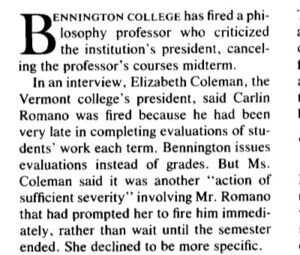
Further investigations into Romano have revealed a troubled history of abusive behavior. According to Ellen Akins, a friend of Hertzel’s, Romano went out of his way to target Hertzel, who is not a confrontational person. According to The Chronicle of Higher Education, in 2000, Romano was fired from his professorship at Bennington due to an “action of sufficient severity” directed at the president, Elizabeth Coleman. An insider at Ursinus College has also reported that there are numerous stories about Romano’s misconduct there.

Should anyone wish to share any stories about further Romano incidents, feel free to email me at ed@edrants.com and I will offer an update. Unless you specifically give me your consent, any and all communications with me will be kept in confidence.]

[6/15/2020 12:45 UPDATE: Ismail Muhammad, one of the board members who was actively working for diversity within the NBCC, announced his resignation from the board shortly after Kellogg’s announcement. He offered further details about what happened: “We were on the verge of winning a vote to release that statement by a solid majority, when Carlin Romano, at the last minute, derailed the process.”]

[6/15/2020 1:30 PM UPDATE: In an article filed by PW‘s John Maher, some new information has come to light. Anonymous board members noted that of the five members who resigned from the board (Hertzel, Victoria Chang, John McWhorter, Connie Ogle, and Katherine A. Powers), only one did so in support of Wabuke. The remaining four did so because of the breach in confidentiality. We know that this was Hertzel’s reason. So that leaves three inside Chang, McWhorter, Ogle, and Powers who resigned in opposition to Wabuke.

Amazingly, Romano himself is quoted in the article. In relation to the lawsuit threat, Romano said that he “alerted the Board I might sue it if I’m voted off the Board in violation of our bylaws and commitment to free discussion.” He denied shouting down the new board member, merely claiming, “We talked over each other at one point.”

Despite the racist tenor of Romano’s email, Romano claimed, “I’m not racist and I’m not anti-black. Quite the contrary. I just don’t check my mind at the door when people used to operating in echo chambers make false claims. A few Board members in recent years have sought to turn the Board, for decades committed to fair-minded judging of books from every political stripe, into a ‘No Free Thought’ zone, an ideologically biased tool for their own politics. In my opinion, they oppose true critical discussion. Good riddance to any of them who resign—the NBCC will be healthier without them. I’ll attempt to stay on the Board, despite concerted opposition, in the hope that I can help NBCC return to its earlier, better self.”]

[6/18/2020 UPDATE: Michael Riley, President and Editor-in-Chief of The Chronicle of Higher Education, was good enough to confirm with me that Romano is not involved with his august publication: “Carlin Romano has not written for The Chronicle of Higher Education since 2018, and, while he was a critic-at-large for The Chronicle a long time ago, he has not been in that role for many years. He holds no official title or standing with The Chronicle.”]

The Shameful Lies and Unacceptable Irresponsibility of Bill de Blasio

Bill de Blasio’s hideous curfew experiment has proven to be a spectacular and dangerous failure — an affront to human rights and basic dignity that is uniquely destructive to the City of New York and that has proven dispiriting for its people. The curfew, which started as an 11 PM cutoff on June 1st before shifting to 8PM during the last three nights, was intended to quell looters who had vandalized and pillaged stores in Midtown, SoHo, the Bronx, and other neighborhoods. Police presence in the streets was doubled. But it has become evident in the last week that the New York Police Department isn’t terribly concerned with curbing vandalism, much less serving and protecting the people in a fair and peaceful manner. This corrupt paramilitary police force, which has demonstrated an almost total incapacity to look inward, is more feverishly committed to abusing peaceful protesters and other innocents who merely happen to be in the neighborhood with wanton violence and indiscriminate abuse of power. It is an obvious truth that both Mayor de Blasio and even Governor Andrew Cuomo, who showed strong leadership in the early days of the pandemic, refuse to acknowledge.

As the Gothamist reported, there have been hundreds of people waiting longer than 24 hours to be arraigned in New York jail cells, with Justice James Burke ruling in favor of the police to keep holding them. In a followup report at The Gothamist, it was further revealed that many of the two thousand arrested during the last week were not even protesters. Here, the detainees — some recovering from profligate douses of pepper spray and other injuries — have been crowded in a cell without masks, soap, water, or medical care. Police, who frequently refused to wear masks, have believed they are immune from the coronavirus. But they also seem to feel that they are immune from being held accountable for their criminal conduct. (On May 31st, New York Attorney General Letitia James invited people on Twitter to share the many abuses for a sweeping investigation>)

These are not merely a series of mistakes. De Blasio’s willful malingering makes Mayor Dinkins’ handling of the Crown Heights affair look like a pardonable misstep. It is now abundantly clear that Bill de Blasio is the most irresponsible Mayor that the City of New York has ever known. His insistence that “the police showed a lot of restraint,” even as he has failed to view or acknowledge the considerable videos of police abuse, represents unquestionable negligence of his duties. His considerable deficiency, taken with Police Commissioner Dermot Shea’s complete failure to curb and discipline his officers for their out-of-control attacks, represent a bungling of command that is not merely incompetent, but that stands firmly against the NYPD’s professed credo to work “in partnership with the community to enforce the law, preserve peace, protect the people, reduce fear, and maintain order.” The NYPD has attacked delivery workers, journalists, doctors, and numerous others who stood peacefully in the streets.

What’s especially insulting is the way that de Blasio (and Cuomo) have been attempting to gaslight the public narrative by claiming that clear factual video of police brutality taken from reliable sources is somehow “opinion” or a “partisan attack.” This is not a matter of being Republican or Democrat. This is about whether a major American city should be terrorized by the authoritarian whims of a clearly abusive police force. With the curfew and his failure to hold the police accountable for their deadly behavior, de Blasio created the conditions in which the NYPD were free to indiscriminately attack anyone. It turns out that the police have been the real looters all along, disregarding the law and order that they profess to stand for in order to attack anybody they see. This is not merely a dereliction of the Mayor’s duties. It’s irresponsibility that should never be accepted from any public official in the City of New York.

The time has come for the Mayor and the Police Commissioner to resign. They have enacted policy that is harming the strength and spirit of New York and that is preventing this city from healing. These two men cannot be trusted to keep the city safe. They cannot be trusted to guide us out of a nightmare. They both must be replaced by real leaders who pay close attention, do not deny the facts, and have a limitless capacity to listen.