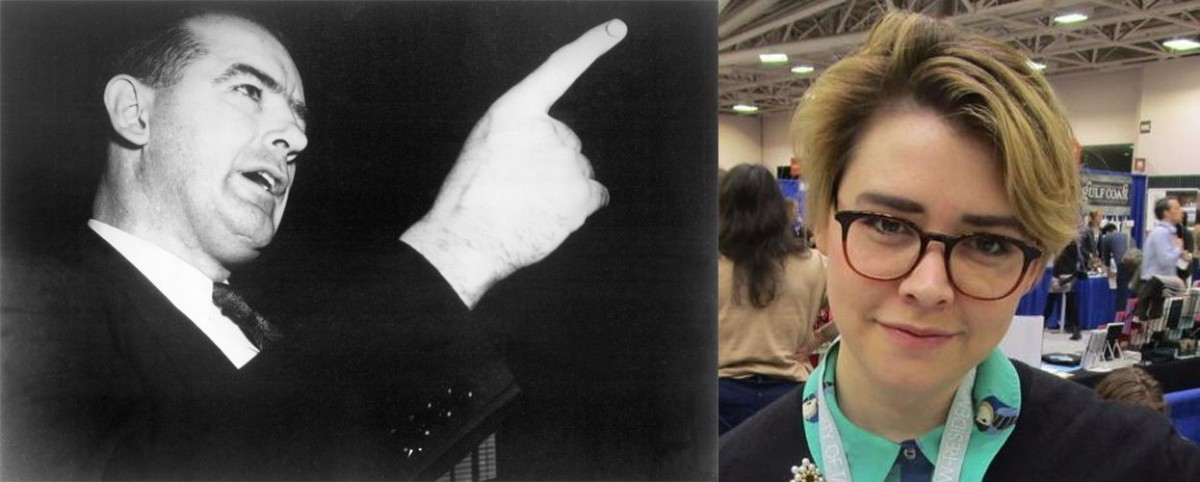
Sam Tanenhaus: You’ll Like Our Translation Pick Or Else!

Languagehat unearths a hilarious online expose involving Sam Tanenhaus’s failure to dictate to the masses. It seems that Tanenhaus attempted to strong-arm his readership into loving the Richard Peevar and Larissa Volokhonsky translation of War and Peace and his readers, begging to differ, express their preference for other translations. Peevar then shows up, defends his translation, is then humiliated, and then comes back again with a whiny defensive rejoinder. And Sammy Boy just can’t stand it! How dare the readers think for themselves? How dare they fail to recognize the Grand Importance of the New York Times Book Review?

Needless to say, I don’t have to analyze this week’s issue or dig up the Brownie Watch to tell you that this kind of hubris from Tanenhaus, his inability to listen to readers and his colossal misunderstanding of dissent among the blogosphere, deserves no brownies.

No brownies for you, Sam! Not this week, or for the next four weeks! Maybe if you considered that the people who read the New York Times actually have brains inside their heads, you might do better.

(Thanks, Kári!)

Bookmark and Share

Save the Blogs!

basement.jpg

Pictured above is a basement in Terre Haute. It is within this damp and miserable environment that 26-year-old literary blogger Jerrold Hysteria muses about literature, often mocked and belittled by newspaper critics who cower under desks the minute that they hear the words “Tanenhaus Brownie Watch” or “LATBR Thumbnail.” Mr. Hysteria has received forty-two phone calls from novelist Richard Ford in the past week: all of them collect. Mr. Ford seems to think that Hysteria is the litblog force that caused The Lay of the Land to be considered less worthy than Independence Day. Mr. Ford has a lot of spare time.

Mr. Hysteria, alas, does not have Mr. Ford’s luxuries. Why then would he operate in a basement?

“I don’t know why he pays attention to me,” said Mr. Hysteria by email. “I’ve only read The Sportswriter and didn’t care for it.”

Mr. Hysteria runs the literary blog Richard Ford Ate My Tuna Salad Sandwich and Didn’t Pay His Half of the Check and he is just one of many litbloggers who has been blamed for many of the current problems in literary culture. Mr. Hysteria has a Technorati rating. Mr. Ford does not.

Because of this, Mr. Hysteria, like many other litbloggers, needs your help.

Here is what you can do to save blogs.

1. Please tell Richard Ford to stop calling Mr. Hysteria. This is costing him serious time and money. He lives in a basement.

2. Please tell John Freeman that Mr. Hysteria would like to give him a hug and means no malice.

3. We’re also going to need someone who doesn’t mind traveling to Terre Haute and doesn’t mind basements to give Mr. Hysteria a lap dance.

There will be more published here on what you can do to save the blogs. We’ll be asking major figures, such as Lorrie, the angry chick at Starbuck’s who “doesn’t know what the fuck a blog or a book review is,” to weigh in here in the coming weeks.

This is serious business. There are men over thirty crying about this.

SAVE THE BLOGS! Starting with Mr. Hysteria in Terre Haute.

Bookmark and Share

Bookforum: All Male, All the Time

The latest issue of Bookforum has hit the stands and the Artsforum gang has made most of it available online. Of particular note: Christopher Sorrentino on the new Flanagan book, this interview with A.M. Homes, and Ben Marcus on Lydia Davis. What is not particularly good is that out of 35 reviews, only fourteen are written by women. That’s a mere 40% of reviews, with the bigger reviews going to men. And if we hold Bookforum to the Tanenhaus Brownie Watch standards, it’s severely lacking on this point. Not quite as bad as the NYTBR, but surely the Bookforum people can do better.

Bookmark and Share

Sam Tanenhaus is the Misinformed One

“I find they write about us, but I don’t find they write about authors and have that many interesting things to say about literature. Maybe I’m missing them? It seems to be more of a kind of a scorecard they keep about us and I think, well, let’s say they don’t like us and we’re doing a terrible job. All they’re doing is publicizing what we do. I don’t understand that. If they think that we don’t do enough fiction, well why aren’t you using your blog to write about those novels and say interesting things about them? Why not just tell us about all those books? It seems very parasitical after a while and the sort of echo chamber-ish and they get so much wrong. They’re so misinformed about so many things that it seems unfruitful to pay attention. They really don’t get what we do, or how we do it, and they don’t really want to know because if they do it would kind of undermine the attacks and all the rest. For instance, there was someone who was complaining that we weren’t using David Orr more often and that it was because I had some problems with Orr. I’m the guy who gave Orr a column and the reason why he wasn’t writing was because his father was seriously ill and he’d gotten some gig in Princeton. That’s why you weren’t seeing him more. So there’s this kind of conspiratorial view they have, that I’m here deciding, ‘Let’s destroy fiction by not reviewing it!’ or, ‘This guy writes too well, so let’s not publish him!’ That’s not the way journalism works.” — Sam Tanenhaus

This remarkably hypocritical statement comes from Sam Tanenhaus, who claims he “never reads blogs” and then proceeds to describe all manner of things that they do, based of course on the fact that he “never reads” them. This is akin to an astrophysicist being asked to speculate upon knitting, a hobby that this hypothetical astrophysicist never actually practices, and who then proceeds to denounce knitting as evil incarnate, wrong, misinformed, and the like.

But let’s take Tanenhaus’s claims here one by one.

“I don’t find they write about authors and have that many interesting things to say about literature.”

Yup, litbloggers never write about authors. They never take the time out to talk at length with a Booker Prize winner or ask Vikram Chandra about how to write a long novel, much less discuss overlooked titles or a National Book Award-winning book with the author himself. As for whether any of this is interesting to Tanenhaus, I could care less. It’s a matter of subjective opinion. But if Tanenhaus is ignorant enough to claim that litbloggers never “write about authors,” then clearly his opinion on this matter is about as worthless as an empty wallet at a Monte Carlo craps table.

“I don’t understand that.”

It’s clear with Tanenhaus’s recurrent hiring of Henry Alford, a man who wouldn’t know funny if South Park bit him on the ass, that Tanenhaus is the most comedically tone-deaf book review editor now working in the industry. (Let’s put it this way. Even Bob Hoover has a sense of humor.) Therefore, it’s clear that he’s incapable of comprehending a satirical analysis of his own publication (i.e., the Tanenhaus Brownie Watch).

“If they think that we don’t do enough fiction, well why aren’t you using your blog to write about those novels and say interesting things about them? Why not just tell us about all those books?”

See the Litblog Co-Op. See Maud, Mark and Jessa’s remarks on Scarlett Thomas’s The End of Mr. Y. See Sarah and Dan Wickett’s love for Daniel Woodrell’s Winter’s Bone. David Mitchell’s Cloud Atlas: you heard about it first on these pages. Sam Lipsyte’s Home Land: TMFTML. I could go on and on.

“They’re so misinformed about so many things that it seems unfruitful to pay attention.”

Support your examples much, Sammy Boy?

“They really don’t get what we do, or how we do it, and they don’t really want to know because if they do it would kind of undermine the attacks and all the rest.”

This is disingenuous. I have asked Sam Tanenhaus for an interview on four separate occasions, so that I might understand where he’s coming from and so I might corral my observations in line with the NYTBR’s production process.

He has refused every single time.

It’s clear that Tanenhaus doesn’t want to respond to any criticisms. He considers himself above questioning. He is, as you might recall, “under no obligation to acknowledge the brownie.” It was only my personal attendance of a panel last year that provoked a few answers to these questions. And even then, he could not provide satisfactory responses.

There is also the curious phrasing of “the attacks.” The attacks? What the hell is this? Pearl Harbor? Are brownies now a weapon of mass destruction? Tanenhaus can dish it out, but he can’t take it. I must again affirm that I have praised the NYTBR as much as I have criticized it. (See yesterday’s post.)

“For instance, there was someone who was complaining that we weren’t using David Orr more often and that it was because I had some problems with Orr.”

Let’s go back to the post about David Orr that Tanenhaus is mentioning:

I have no idea what’s made Orr’s work sparse in the NYTBR these days. Perhaps it’s Sammy T’s tone-deaf editorialship.” [Emphasis added]

“I have no idea” should be pretty clear that I had no idea. Then again, when you’re a guy cowering from bloggers, perhaps a cigar isn’t a cigar. My speculation doesn’t impute that Tanenhaus had any problems with Orr, nor is the word “problems” contained in my post.

“So there’s this kind of conspiratorial view they have, that I’m here deciding, ‘Let’s destroy fiction by not reviewing it!’ or, ‘This guy writes too well, so let’s not publish him!’ That’s not the way journalism works.

The use of the verb “destroy” is the telling detail here. It is a word one expects from Genghis Khan or a WWE wrestler, not a book review editor.

Fiction will continue to live on, whether Tanenhaus covers it or not. It is Tanenhaus’s loss that he cannot see fit to open up the pages of his “Review” to fiction’s glories. One of the assertions I’ve always casted here is why the NYTBR claims to cover serious fiction more than any other book review section in the country, when it recurrently skimps out on solid literary coverage. There is nothing conspiratorial about this observation. Frankly, when you stack up Tanenhaus’s NYTBR against John Leonard’s NYTBR, it’s a bit like pitting People against The New Yorker. There is simply no contest.

All litbloggers have asked is why a book review section with such potential falls flat under Tanenhaus’s watch. It’s a telling sign that this question has transmuted from genuine (albeit satirical) inquiry to “conspiratorial view.”

Of course, if Tanenhaus wishes to explain himself, my microphones remain ready.

[UPDATE: Michael Orthofer has much to say about Tanenhaus's remarks.]

[UPDATE 2: John Fox also has much to say.]

Bookmark and Share

No Surprise: NYTBR Slacks Off on Popular Fiction Too

Michael Blowhard observes that the NYTBR is a failure on the popular fiction front as well: “To use an analogy: imagine a movie magazine. It doesn’t announce itself as avant-garde, or as niche in any way. It’s just The New York Review of Movies. It purports, in other words, to be covering movies. You’d expect this magazine to have a point of view — who would even want a publication that’s indiscriminate, after all? But I think it’s fair to say that you’d be surprised if all the movies this magazine gave substantial coverage to were upscale arthouse films.”

And it looks like you can now watch the Book TV segment in its entirety. Levi Asher is correct: the humorless Tanenhaus is about as happy and enthusiastic about books as a chartered accountant is about opening his books to the IRS.

Other highlights (and really this does play like a Christopher Guest mockumentary):

Bookmark and Share

Sam Tanenhaus: Finding Chicks Who Write Nonfiction is Just SO GOSH DARN HARD!

Lee Kottner writes a letter to Tanenhaus about the NYTBR’s well-documented lack of women nonfiction coverage and receives a response. Tanenhaus claims, “The truth, at least as far as we can tell, is that there remain areas in which women authors tend to be less well (that is, less numerously) represented than men: science, philosophy, economics, politics, public policy, foreign policy, to name some obvious ones.” But, as Kottner demonstrates with a list of books, this isn’t the case at all. As Kottner puts it, “hat it’s not that women are underrepresented anywhere in publishing (except perhaps in science, which I’ll get to later), it’s that the topics we write about are not ‘important,’ e.g., interesting to men.” (via The Other)

As to Tanenhaus’s recent claim that litbloggers are sloppy writers, I would suggest that Tanenhaus, with a team of roughly ten, is sloppier than ten litbloggers put together. This site, with its blog and podcast (which came well before the NYTBR’s rigid weekly offering), is run by one person. That means one person moderating discussions, making calls, responding to emails, reading the books, setting up equipment, cleaning up the audio, and getting the word out. And all this with a full-time job, freelancing on top of that, and a social life. Give ten litbloggers full-time jobs and the resources to run a book review section and I suspect it would be filled with more passion, more enthusiasm, more controversy, more excitement and more grammatical precision than Tanenhaus has in his left pinkie.

I hereby withdraw Rachel the Hack. The point has been made. But if Tanenhaus is going to call litbloggers “sloppy” without evidence, then the time has come to reinstate the NYTBR’s grand measure.

browniewatch2007.gif

Bookmark and Share

Sylvester Stallone KOs Sam Tanenhaus

rocky.jpegSure, you could ask Sam Tanenhaus your questions and watch him ignore any query even remotely critical of the NYTBR. (Tanenhaus, incidentally, has refused mutlple interview requests to appear on The Bat Segundo Show to clarify some of the charges that have appeared on these pages.)

But why do that when a former box office titan is cheerily answering everything (and I do mean everything)? Everything from whether Rhinestone or Stop or My Mom Will Shoot! is his worst movie to his revelation that Dolly Parton is the ultimate woman.

From The Dizzies, comes a series of bizarre links to Ain’t It Cool News. Apparently, Sylvester Stallone took it upon himself to answer just about every question that was asked of him. From Dolly Parton to the use of three seashells. I even suspect that if I sent Stallone a package of brownies, he’d actually send a thank you note. Which is more than we can say for Sam “We Take No Chances” Tanenhaus.

Here are the links to Stallone’s ongoing Q&A:

Round 1
Round 2
Round 3
Round 4
Round 5
Round 6
Round 7
Round 8
Round 9

Bookmark and Share

Rachel the Hack

Long-time readers of this site know that we’ve often held Sam Tanenhaus’s feet to the fire. But with Rachel Donadio’s latest essay, it’s occurred to us that Donadio, perhaps working independently of Tanenhaus, may be one of the major problems with the NYTBR. While we applaud Dwight Garner’s “Inside the List” columns, welcome David Orr’s “On Poetry” (now regrettably behind a Gray Lady paywall), and believe Liesl Schillinger to be one of the NYTBR’s few assets, we suspect that the NYTBR’s very particular snobbish tone has much to do with Donadio.

Like most snobs of this ilk, Donadio is a writer who basks in reaching conclusions no more original than those of a struggling english comp student (witness this insulting review of a Berlusconi book; Berlusconi polarizes, who knew?). Donadio’s efforts to sound sophisticated frequently backfire (witness this elementary error in French; the Times, of course, “regrets the error”). And like most snobs, with Donadio, there is a needlessly triumphant sense of accomplishment in her reviews (“Time will tell whether McDonough and Braungart will make eco-skeptics eat their words.”), as if she has just won a spelling bee and is primed to wrest the prize from a PTA volunteer (or worse, the crying kid who came in second place).

So while we no longer keep up the Tanenhaus Brownie Watch, we are pleased to introduce a new series, which we hope will help everyone in understanding what makes this banal retentive writer tick.

rachelhack.jpg

We plan to keep an eye out for all future Rachel Donadio bylines. And unlike Ms. Donadio, we’ll offer substantive examples which demonstrate why Donadio may be the most mirthless book reviewer working in New York today.

Bookmark and Share

Memo to Tanenhaus: Liesl’s Your Only Shot

liesl.jpg

Dear Mr. Tanenhaus:

Nearly every serious literary person knows that your finger ain’t exactly on the pulse of contemporary fiction. Your coverage, even when it does concern itself with literature, often misses the mark. (This week’s issue, however, isn’t bad. But still, NO BROWINES FOR YOU! Just because I’m under no obligation to resuscitate the Tanenhaus Brownie Watch.)

This is troubling, given that you have long maintained that you are the shit, that somehow the name “New York Times” means something and that we are supposed to ignore the often ridiculous essays that pass for substantive coverage. (And, come on, Sam, was Alford snorting lines when he wrote this nonsense? Or is this the mark of an editor who thinks this and Joe Queenan’s solipsistic hit pieces are funny? For this, I sentence you to two weeks of Buster Keaton, Stanley Elkin and the Marx Brothers!)

However, there is one person among your roster of contributors who does know fiction and who actually loves books (Imagine that! Someone who actually loves LOVES loves books on your payroll! You know, like some of us upstart litbloggers and podcasters!). And frankly Sam, she’s your only shot at the NYTBR having any kind of journalistic credibility in the future.

I’m talking about Liesl Schillinger! This week, she wrote a fantastic review of Kate Atkinson’s One Good Turn that somehow escaped the dull, clause-happy house style you cling to like a barnacle to a scow or an attorney to boilerplate.

And yet you keep her in the background, often assigning her a book from Glamour instead of, say, the new Richard Ford book — which you assigned to that assclown Tony Scott, a man who doesn’t understand that he’s a film critic, not a book critic.

And yes I’ll even forgive her solecism against bloggers on the Pessl front.

If you have even a shred of editorial instinct, I urge you to have Liesl cover substantial fiction. During your tenure, you’ve been almost completely tone-deaf in your tenure in providing . But Liesl? Oh, I know me a fellow reader when I see one!

So what of it, Sammy T? The time has come to lay down the gauntlet. Are you writing for readers and literary people? Are you writing to get people excited about literature? Or are you writing for an audience that nobody but you seems to understand? An audience perhaps of humorless bureaucrats?

Very truly yours,

Edward Champion

Bookmark and Share

Tanenhaus: Just Say No to Podcasting

While I have given up the Tanenhaus Brownie Watch, did you know that Sam Tanenhaus is in the podcasting business? Every Friday, NYTBR editor Sam Tanenhaus releases a new installment through the New York Times website. And while you can’t access the podcast without iTunes and there doesn’t appear to be an archive of Tanenhaus’s past podcasts, you can, of course, listen to the latest installment.

I tried out the 7/22/06 podcast and, believe it or not, I actually felt a bit sad for Sammy Boy. He clearly doesn’t want to do this. He’s forcing himself to have fun. I can only imagine the initial meeting with Bill Keller.

“Sam, we need to be competitive. So we’re going to need you to do a podcast! It’s the latest thing with the kids.”

“Doesn’t my work for the Review stand on its own?”

“Oh absolutely, Sam! Keep those Leon Wieseltier hit pieces coming.”

“But why me?”

“Because you’re the Book Review editor! Who else would we approach?”

“Can’t Liesl do this instead? She’s down with this more than I am.”

“No, Sam. We need you! You’re the editor! You’re our voice. Do you need me to get the legal team on your ass?”

“Okay, fine. I’ll do it.”

Perhaps it’s a telling indicator of how he feels about being NYTBR editor. He’s getting by the best he can, but he really wants to go home and write a biography.

For those who don’t want to go to the trouble of listening to it, here’s a description:

A 1970s punk band, or perhaps, more accurately, a 1994 approximation of “alternative rock,” some local New York band that can be hired for a pittance, opens up the show, singing (I think; it’s hard to make out with all the poor man’s distortion) “I’m reading for the New York Times Book Review.” (No, I am not making this up.) Sammy Boy then introduces himself, thanking his audience for the letters, postcards and mail he’s received, only to attempt a gag in a dour tone, “Oops. My producer’s waving frantically.” He then remarks that the letters were to Dwight and, sounding as if he’s reading off of a script (written by somebody else?), he says, “But I told my mother-in-law to address those to me.”

Sammy T then introduces David Margolick, who wrote this week’s front page review. Then we get the NYTBR boosterism in evidence at the infamous BEA panel. “David, as soon as your review came in, it felt like a cover essay because of its narrative and emotional power. In fact, you begin with a rather chilling anecdote.” Now imagine these two sentences spoken in an opaque Brooklyn dialect, without any warmth or humor, without even the hint of a man letting down his guard. And you begin to see the sad scenario here. Bad enough that the podcast is devoted to propping up the Gray Lady’s dubious stature with questions and answers that feel scripted and possibly rehearsed, but Sammy Boy is so uptight (at least on air) that he’s incapable of maintaining even the illusion that he’s enjoying this.

Margolick, who is either terrifyingly articulate (in a troubling executive conference room kind of way) or reading from a script, responds to the questions in a banal flatline tone with such introductory phrases as “But I hadn’t thought about that, Sam..” and “I think the evidence is incontrovertible….” In short, Sammy Boy and the Times crew are terrified of the very human uhs and ahs that populate human conversation (have they edited these out?), the flawed tics that cause vernacular to take on that joie de vivre that causes others to give a damn about books. But why should they reveal their limitations? After all, this is the Times! The crown’s jewels! Not a single person can screw up here!

The human feel, however, does find a certain inroads with William Rhoden, who talks about his book Forty Million Dollar Slaves with some vigor and genuine interest. But I suspect it has more to do with the fact that Sammy Boy is away from the mike and gives most of the conversation to Rhoden. I suspect, in fact, that most of Sammy T’s segues and questions have been edited out, because Rhoden says, “You mention Joe Louis” midway through the conversation when Tanenhaus hasn’t even mentioned Louis. I listened to the Rhoden-Tanenhaus interview hoping that Tanenhaus would let down his guard, if only to bring a coherence to the conversational thread. But if Sammy T did, it’s certainly not presented on audio. And if Sammy Boy can’t reveal his faults, if he’s incapable of showing any warts or even a soupçon of humility or ignorance, what on earth is he doing podcasting?

Then Rachel Donadio talks about the bestsellers list and sounds suspiciously like a novice voiceover student doing her best to ape a FM radio news correspondent (I know this because I took a few voiceover classes in the late ’90s and recalled my own clumsy efforts, and I wondered if Times expenses were being siphoned Donadio’s way), clearly reading her words from a script and trying to offer a spontaneous inflection. And as if to impute that the Times podcast crew is having fun, some forced off-mike laughter is left in. I suspect that the crew was likely laughing over how absurd it was that journalists are now reduced to being radio or podcasting people.

Maybe it’s the fun-loving Californian in me, but I listened to this and wondered if Sammy Boy and his staff were trying to approximate fun, rather than approach any genuine threshold of excitement. Why couldn’t they let loose? Or is this how Manhattan faux intellectuals talk? Had I been the producer, I would have demanded that all the on air talent have a good glass of wine. Or perhaps I’d pass around a bong. After all, when you’re dealing with sticks wedged up orifices, desperate times call for desperate measures.

The lack of archival podcasts and the elaborate efforts one must take to listen to the sole podcast available (i.e., one must install iTunes) reveals just how ephemeral Sammy T’s crew hopes this podcasting fad will be. They’re humoring top brass for now, thinking that nobody will notice.

I wonder if he’d be so rigid if someone hugged him before each installment. If someone simply told Sammy T that letting one’s hair down is a peachy keen thing, then maybe the NYTBR podcast might be worth something.

But if Sam Tanenhaus didn’t feel up to the task, he could have easily said no. He didn’t have to go through with something so clearly odious to his sensibilities. The man clearly despises this part of the job, which makes me wonder how much he secretly hates turning out the Review on a weekly basis.

Bookmark and Share

In Praise of David Orr

While the Tanenhaus Brownie Watch may be discontinued, Levi Asher has picked up the slack with his “Reviewing the Review” blog posts. This week, Mr. Asher made the claim that “The Book Review continues to prove that it has no capability at all to review poetry.” While I can certainly agree that its poetry coverage leaves little to be desired, in large part because of the self-described “vulgarian” whims of its editor, I felt the need to leave a comment noting that there has been one critic during Tanenhaus’s run that has done a competent job at reviewing poetry: David Orr.

While I’ve had my quibbles with Mr. Orr in the past, Mr. Asher challenged me to limn just what it was about Orr that made him “very good.” It’s a fair enough question, seeing as how Asher has called Orr “hopelessly square.”

First off, if the NYTBR’s purpose is to profile smart and well-informed reviews that straddle the fence somewhere between layperson and elitist New York Review of Books subscriber, then any decent poetry critic must divagate within this territory. And I feel that Orr has done this quite well, daring to challenge icons, introducing poetry to a readership without making it dull, and shifting the focus away from a poet’s public perception to the words that the poet has written with a deft and playful touch. Take, for example, this recent review of an Elizabeth Bishop collection. It introduces Bishop to the uninformed and subtly guides the reader into contact with her poetry instead of Bishop’s reputation, establishing and comparing such qualifiers as “difficulty” and “subtlety,” and using these terms to segue into the text of “Vague Poem.” He playfully suggests that more people know the lyrics to “Total Eclipse of the Heart” than Bishop’s poetry, which suggests someone attuned to pop culture (certainly a lot more than a closet fetishist like Leon Wieseltier or Dave Itzkoff, who has only recently discovered that chicks write speculative fiction too).

Then there is this review from November 2004, which challenges the qualifiers behind The Best American Poetry series, clearly outlining the history of these compilations, while suggesting that the bar may be set too low and imputing that “poetry isn’t really an open system; it’s a combination of odd institutions, personal networks, hoary traditions, talent and blind luck” to the NYTBR’s democratic reading base.

Hopelessly square? Even Mr. Asher had to applaud Mr. Orr when he took Jorie Graham to task. What we have is a poetry critic with a mischevious streak that is far from Pat Boone. I’m under no obligation to acknowledge the positive, but Orr’s poetic review of Billy Collins’ The Trouble with Poetry was one of the few interesting reviews under Sammy Boy’s tenure. One does not expect such exuberance from a lawyer, much less from a publication whose editor cannot appreciate a brownie or an intelligent woman. But, alas, there it is.

I have no idea what’s made Orr’s work sparse in the NYTBR these days. Perhaps it’s Sammy T’s tone-deaf editorialship. But Orr was a welcome presence within a hopelessly corrupt publication. And I contend that if there was one thing Sammy Baby did do right, it was hiring David Orr.

Bookmark and Share

BEA: Do Not Question the NYTBR!

tanenhauspanel.jpg

PANEL: The Best American Fiction Since 1980
Moderator: Sam Tanenhaus, Editor, The New York Times Book Review
Panelists: Greg Cowles (The New York Times Book Review), Thomas Mallon, Cynthia Ozick, Liesl Schillinger

At last year’s BEA, I didn’t get an opportunity to talk with Sam Tanenhaus about his continued failure to provide coverage on today’s contemporary fiction. The numbers, however, don’t lie. And they’ve been documented by Mr. Orthofer, Mr. Asher and me (via the Tanenhaus Brownie Watch). Repeatedly, Mr. Tanenhaus has not only demonstrated a failure to profile contemporary fiction (with scant space afforded to translated novels, experimental fiction and first novels by first author) in any thorough capacity, but he’s been outright deficient (as also determined years ago by Dennis Loy Johnson) on having women reviewers cover today’s books. (Indeed, it was a telling sign midway through the panel when Cynthia Ozick called Tanenhaus on failing to cite any women writers among his examples of what constitutes great literature.)

I’ve tried to interview Sam Tanenhaus multiple times to give him an opportunity to respond to these criticisms. But his office has repeatedly refused my interview requests. So what better way to bring these charges to light then through a public forum dedicated to celebrating how the New York Times Book Review determining the best fiction since 1980? Of course, I had to sit through a lot of surprising degree of defensiveness about WHAT MAKES THE NYTBR GREAT. But when the mike was deferred to Thomas Mallon and Cynthia Ozick, the panel became far more interesting. These moments, alas, were too few and far between. Fortunately, both Megan Sullivan and Sarah Weinman were good enough to accompany me.

Tanenhaus introduced the panel, speaking in a flat New York dialect somewhere between a overworked detective and an undertaker who wanted to get back to the basement and fix up the corpses. He repeatedly boomed key phrases into the mike. “I HOPE you will be pleased with the results.” At one point, perhaps reconciling the guy taking copious notes with the crazed litblogger who sent him benign brownie shipments, he took unsubtle care to note that the next issue was “DEVOTED ENTIRELY” to fiction — featuring reviews authored entirely by women.

Tanenhaus was initially quite defensive and a bit punchy. I wasn’t quite sure why. But it soon became clear that he preferred to dictate how people should react to the list rather than encourage them to read particular titles. “I urge EVERYONE to READ A.O. Scott’s ESSAY!” He urged the BEA staff to close the door early on, so that he might keep track of who was entering and leaving the room. I wondered for a moment if Tanenhaus’s inspiration was more Benito than Birkets. I expected men to come in hawking T-shirts reading “the few, the proud, the NYTBR.”

Tanenhaus described the fiction selection procedure as “a chimerical process.” But I remained dubious about the fanciful nature of when Greg Cowles (apparently, Tanenhaus’s right-hand man) described how he had painstakingly collected the data and composed the letters to the 200 judges. I’m glad Cowles is proud of his labors. Any good worker should be. But I don’t see how having a few Excel skills and knowing how to use mail merge can be described in any way as “chimerical.”

Tanenhaus had settled upon the 1980 figure, because it was “too easy” to fall back to 1941. The original inspiration for the contemporary fiction came from a 1965 poll in the New York Herald-Tribune, where 200 authors, editors and critics had been enlisted to determine the best work of fiction. Invisible Man came first. In addition to proving himself a whiz on the computer, Cowles, who would no doubt pass any of those temp agency tests with flying colors, also announced that he had been adept with microfilm machines. He had actually taken a microfilm of the old Herald-Tribune and placed it into a microfilm machine. Clearly, such achievements, well within the abilities of any grad student working on a thesis, demonstrate that the NYTBR has gone above and beyond the call of duty. To give Tanenhaus and Cowles the benefit of the doubt, ask yourself this question: how many deputy newspaper editors do you know who can do this? Then ask yourself a second question: how many deputy newspaper editors do you actually know?

Tanenhaus didn’t go into the criteria on how he had selected the judges, save that it was “a jury of peers” which beckoned his attentions. He approached 200 people and confessed that many people had written back very angry letters. One unnamed author had suggested that he was “out-Oprahing Oprah.” There was also a good deal of argument over Donald Barthelmie’s 60 Stories, because the material had been published before 1980. So had the book. But it had won the American Book Award in 1980. Thus, it was eligible. There were also a few authors who had voted for themselves.

Such pedantics were tossed out by Tanenhaus again and again. And it suggested to me that Tanenhaus seemed more fond of the idea of being the cultural arbiter rather than the culture itself. It can’t be an accident that Tanenhaus referred himself thrice during the panel as a “self-appointed vulgarian.” (Presumably, this dud of a self-effacing joke was uttered because the audience did not laugh the first two times.)

Fortunately, the divine Cynthia Ozick, who looked bored out of her mind while Tanenhaus spoke, mercifully interjected, noting that it might have been better to nominate writers rather than absolute titles. But she did give Beloved high praise, calling it a deeply enshrined book, “elliptical, elusive, poeticized.”

Liesl Schillinger cited Zadie Smith’s On Beauty as an example of a book demonstrating “how strongly and vehemently we can disagree.” Well, disagreeing is one thing. But how is shouting “On Beauty sucks, dude!” an effective way of gauging contemporary fiction?

Thomas Mallon, who, along with Ozick, was the most interesting of the panelists, voted for Underworld. He suggested that Morrison had written better books than Beloved. But had he been nailed down to single out a writer, a la Ozick, he likely would have selected Philip Roth. Mallon remarked on the conservatism of his fellow judges. Where were the writers from the younger generation? He also remarked that fewer novelists were willing to write reviews, much less start feuds.

It was, indeed, the feud component that Tanenhaus picked up on and that seemed to interest him more than the conservatism of the choices. He noted that Chip McGrath had told him that it was almost impossible to persuade younger novelists to review their contemporaries without first reviewing the galleys. He suggested that this might be a “generational question.”

Ozick responded by saying, “I believe in temperaments, not in generations.” She pointed out that she had selected William Gaddis’s Carpenter’s Gothic, pointing out the distinct way that it used language.

Mallon noted that most of the writers who came of age between the 1930s and the 1940s were probably better nonfiction writers. He also noted that there was not as vital and vibrant a magazine culture now as there was in the 1960s.

Schillinger was asked about the silly V.S. Naipul essay by Tanenhaus and confessed that her favorite writer was Anne Tyler. But she did note, citing E.M. Forester, that because things change so fast, people can’t quite set their worlds down.

Revealing his middlebrow tastes, Tanenhaus openly confessed that he was surprised that Jonathan Franzen’s The Corrections, which he viewed as a high watermark novel of the last six years, hadn’t been selected. He then tried to get the conversation going on whether Updike was considered “a political writer.” Ozick noted that, “I think he thinks he is,” but pointed out that Updike was good with domestic politics.

Mallon believed that immigration would be the key political issue to invigorate contemporary fiction.

Sam Tanenhaus boasted how he does a podcast now.

Exposing the troubling similarities between marketing language oxymorons and the NYTBR’s troubling critical worth, Schillinger cited Curtis Sittenfeld’s Prep as “an instant classic.”

Eventually, the floor was open to questions.

I stood up and pointed out to Tanenhaus that the list of judges was mostly male and that this reflected a continuing trend by the NYTBR as a whole to give the majority of its reviews to men over women. I also asked how a weekly book review section that continued to prioritize nonfiction over fiction could legitimately put out a “Best Contemporary Fiction” list. I then revealed myself to be the Tanenhaus Brownie Watch guy and playfully asked why I hadn’t received a single thank you note for the brownies. “Is this a New York thing?” I asked.

Tanenhaus took considerable ire at this, booming into the microphone with all the joie de vivre of a stale jelly bean, “Where do we begin?” On the judges list question, he pointed out that the original list of 200 had a more equitable balance between men and women. But that women writers declined to be involved with the project more than men. He was again defensive about the NYTBR, suggesting that “we don’t fill quotas” and, instead of responding to my points, declared the NYTBR the best book review section in the nation. (Of coure, had I been permitted to interject on the fiction coverage in the Philadelphia Inquirer, the Washington Post, the San Francisco Chronicle or even the Baltimore Sun, I would have. But Tanenhaus clearly wanted to evade the issue.)

As to the question of the brownies, Tanenhaus boomed into the mike:

“WE ARE UNDER NO OBLIGATION TO ACKNOWLEDGE THE BROWNIES!”

And there, beyond the fact that this extremely silly sentence was uttered with seriousness, is the problem.

The brownies could be experimental fiction. They could be poetry. They could be novels in translation. But Tanenhaus simply will not “cater to anyone” or “acknowledge” them. In the Tanenhaus world, it is Jonathan Franzen or a particularly sycophantic deputy named Cowles who matters more than anything else.

And so I think my work here is at an end. I can now say with absolute certainty that the New York Times Book Review is hopelessly conflicted, hopelessly out-of-touch and worthless to anyone who cares about literature. It is beyond repair. And its head administrator has a limited sense of humor to boot.

Is it little wonder, given these attitudes and lack of flexibility, that newspapers have stopped mattering?

[UPDATE: Scott Esposito, who sadly isn't here, has thought quite a bit about the Tanenhaus list and has some thoughts on the subject.]

[UPDATE 2: Ron and Sarah have more of the specifics between the Tanenhaus-Champion showdown. And there is one key question that lingers: why did so many women say no to Tanenhaus's project?]

Bookmark and Share

BEA: More to Follow

More BEA reports to follow, including Chris Anderson’s speech presaging his forthcoming The Long Tail book and the Sam Tanenhaus panel, in which your correspondent questioned Tanenhaus about his male-centric offerings in a playful way, watched Tanenhaus take it personally and was answered with a very public damnation of the brownies that we had sent him in the past. “The NYTBR caters to nobody!” he insisted.

Quibble with me all you want, Mr. Tanenhaus. But the brownies were lovingly baked and sent to you, sir! They meant you no harm! Must you take out your umbrage upon a harmless slat of baked goods? The brownies, it seems, will remain denied. For good.

Bookmark and Share

The Tanenhaus Brownie Watch (Mini Version)

A list of the judges behind the “best book of the last 25 years.”

Total Number of Judges: 125
Total Number of Women Judges: 37 (29%)

No brownie for you, Tanenhaus!

Bookmark and Share

Has Sam Tanenhaus Improved?

Some people have emailed me about the Tanenhaus Brownie Watch, wondering if, in the absence of lengthy posts, I think there’s been any improvement. The following graphic should answer any and all questions.

samcetera.jpg

Bookmark and Share

Tanenhaus Brownie Watch: February 12, 2006

browniewatch1a.gif

It reappeared, as if from a silly dream. Or perhaps in Mr. Tanenhaus’s case, an honest nightmare he thought was over.

WEEKLY QUESTION: Will this week’s NYTBR reflect today’s literary and publishing climatet? Or will editor Sam Tanenhaus demonstrate yet again that the NYTBR is irrelevant to today’s needs? If the former, a tasty brownie will be sent to Mr. Tanenhaus’ office. If the latter, the brownie will be denied.

To determine this highly important question for our times, three tests will be conducted each week, along with ancillary commentary concerning the content.

THE COLUMN-INCH TEST:

Fiction Reviews: 4 full-page reviews, 5 half-page reviews. (Total books: 10. Total space: 6.5 pages.)

Non-Fiction Reviews: 5 one-page reviews, 2 half-page reviews. (Total books: 7. Total space: 6 pages.)

For those who remember the old game, in order to earn his brownie point, Tanenhaus must offer a 48% minimum of review coverage to fiction. Blurbs do not count. Comparative reviews do.

Amazingly, despite the mystifying coverage granted to Jackie Collins’ Lovers & Players, in which Collins, Hackneyed be her middle name, is characterized as some faithful and possibly misunderstood observer of Californian culture, Tanenhaus just beats out the number, garnering 54.1% of the coverage.

Brownie Point: EARNED!

Alas, the attention paid to Collins, complete with a photograph labeled “Jackie Collins and Jaguar,” as if a vehicle obtained with puerile and materialistic impulses is somehow pertinent to understanding Collins’ work as a novelist (though, of course, one can hazard associative clues), detracts from these hard-won inches. And so Mr. Tanenhaus easily earns a bitchslap.

BROWNIE BITCHSLAP FACTOR: Jackie Collins? Must you contribute to furthering an east wing on Ms. Collins’ palatial estate? How, by any stretch of the imagination, can Jackie Collins be qualified as literature? SLAP! (Minus .6 points.)

THE HARD-ON TEST:

This test concerns the ratio of male to female writers writing for the NYTBR.

Of the women reviewing fiction, it seems Tanenhaus’s continuing homage to pre-Susan B. Anthony America of chicks reviewing chicks (including Jackie Collins) still holds true, with the major literary title written by a woman (Deborah Eisenberg) going to Ben Marcus. I wonder if Tanenhaus was even aware of the irony in referencing Marcus’ most recent novel, Notable American Women, in his accompanying bio. Because from where I’m sitting, notable women simply aren’t that much of a concern in the NYTBR. The bio may as well have read, “Ben Marcus has a dick and Joyce Carol Oates does not. Hence, we assigned him this review.”

The nonfiction offering is even more dreadful, with six of the seven reviews going to men (including that indefatigable blowhard David Brooks) and only Alexandra Starr garnering a nonfiction title called, yes you guessed it, Lighting the Way: Nine Women Who Changed Modern America.

One would think that the recent passing of Betty Friedan and Wendy Wasserstein might have reminded Mr. Tanenhaus that, contrary to recent Supreme Court justice nominations, women can in fact write and think too. But I suppose Tanenhaus was too busy enjoying sherry with Bill Keller at the private men’s club, presumably after a long day of deer hunting and chewing venison.

Brownie Point: DENIED!

THE QUIRKY PAIR-UP TEST:

With the exceptions of Ben Marcus, Regina Marler and maybe James Gorman, none of the reviewers have been matched with anything approaching a quirky pair-up. Yes, give Pankaj Mishra the Indian novel! He’s Indian, right? We have the usual gang of dependable Gray Lady staffers. David Brooks, Jonathan Freedland, Jim Holt. Yawn.

Brownie Point: DENIED!

CONTENT CONCERNS:

Dan Chiasson’s first several sentences are preposterous. “This is an American tale, a very American tale.” This is trying to pad your word count, Dan, desperately trying to pad your word count. Between this and such ridiculous observations as, “One of the pleasures of reading the novel is experiencing its sheer variety of actual things.” Really, Dan? Thank you for that groundbreaking statement! I mean, hell, the next thing Chiasson will be telling us is that reading a novel also allows you to get from the beginning to the end of a book. No Brownie Bitchslap Factor here. Chiasson’s review is too unintentionally entertaining.

Leave it to David Brooks to offer an equally jejune paragraph: “These men, the psychiatrists concluded, had suffered a stunning mental shock in captivity. In the extreme environment of a P.O.W. camp, their minds had been altered.” You know, I’m no psychiatrist, but I can definitely offer you the same conclusion after about ten drinks and a three-paragraph summary of the book. Brooks’ review does terrible injustice to Rebecca Lemov’s World as Laboratory, a book that, quite interestingly, deals with cognitive readjustment through psychiatric experiments of varying degree. Of course, reading Brooks’ review, you wouldn’t know what Lemov’s level of research or scholarship was — in large part because Brooks himself seems to be having great difficulty understanding the concept. Perhaps Brooks is too busy maintaining that sturdy neocon carapace of denial about Guantanamo Bay. Bobos in Paradise? Try Bozo on Page 9.

While Ben Marcus’s review seems strangely concerned with cinematic parallels over literary ones, unlike Chiasson and Brooks, he cuts straight to the point and managed to gush without fawning too much. Pankaj Mishra’s review is similarly taut. But one ponders if these two reviewers were pushed harder or were allowed to flex their respective critical acumen rather than summarizing a book. (Mishra, for example, offers an interesting thesis pointing out that a novel set in the 1980s might better understand life after 9/11. But he seems unwilling or unable to follow through on this.)

Jim Holt’s review of Happiness: A History is fun and accessible. Chelsea Cain’s review of the Waldman novel isn’t granted enough space to ask whether Waldman follows through on how society expects women to conform.

As for Ms. Sittenfeld’s article, which many of you have emailed me about, the short answer is: Methinks she doth protest too much.

But here’s the long and more inflammatory answer: Aside from the fact that Sam Tanenhaus has ignobly bankrolled an article that is tantamount to a LiveJournal bitchfest, I’ve met very few writers who are so hubristic enough to accept that their idea of the novel as the only one that matters. Certainly, most writers are defensive by nature. And this is understandable. Because it’s a tough, lonely and backbreaking business. But just as the wisest humans understand that their life view isn’t the only one that matters, the smartest writers realize that their own views of their work aren’t the singular reference point. Is it not the writer’s function to just shut the hell up and listen when someone is being kind enough to offer a hard and honest take on their novel instead of the predictable flattery? Is it not the writer’s function not to take any of these thoughts personally?

Most authors have suggested to me that the perspectives they hear from others are not only of immense value to them as artists, but, much as teachers often learn more than students do in the classroom, I suspect that an author learns much about her work from what a thoughtful and erudite person has to say, or even how a less literary person grasps the story.

Perhaps I’ve been lucky. Or perhaps the reality here is that Ms. Sittenfeld simply has no appetite for ambiguity or varying opinions, much less any interest in evolving as an artist. It’s absolutely paralogical for any serious writer to state, “It’s pretty obvious that some readers say they hate your protagonist as a more polite way of saying they hate your entire book, but when I want to hear from people who hate my book, I prefer doing it in the comfort of my own home by looking at customer reviews on Amazon.” Such a sentence assumes not only a remarkably conspiratorial opinion of the human race, but it also implies that writing should be easy and effortless.

Cry me your body mass in tears, Curtis.

Writing sure as hell isn’t easy. If writing a novel were as simple as slapping together a sandwich, then we’d be up to our arms and legs with books. Because everybody would be doing it. (And by doing it, I mean getting the sucker published and sold.) Furthermore, given that the customer reviews on Amazon are — how shall we say this exactly? — mostly incohrent and toothless drivel written by slavish fanboys, how can any writer worth her salt hone her wares by customer reviews alone?

Is it possible that the NYTBR’s climate has grown so solipsistic and singular in thought that these precious gray areas are not allowed to germinate? Sittenfeld might have had a hell of an essay if a less sycophantic editor actually challenged her to come to terms with how other people view her novel, exploring whether any of this has might make her a better novelist. Instead, and this is not necessarily a judgment of her character — I don’t know the woman — but rather the perception I get from the essay, she comes across as a drama queen of the lowest order.

CONCLUSIONS:

Overall, as the NYTBR goes, this isn’t too bad of an issue. But it’s far from consistent. Tanenhaus’s recidivist reviewing pairup are uncalled for in the 21st century. And there are still troubling concerns in tone.

Brownie Points Earned: 1
Brownie Points Denied: 2
Brownie Bitchslap Factor: -.6 points
TOTAL BROWNIE POINTS REQUIRED FOR BROWNIE DELIVERY: 2
TOTAL BROWNIE POINTS EARNED: .4 points

brownieno.jpg

[UPDATE: For another take on this issue, see Levi Asher's.]

Bookmark and Share

To Do List

I have not forgotten about this stuff, but I wanted to address these failings publicly for all who have asked. Also, this gives you a great opportunity to publicly shame me. Go nuts, kids!

Bookmark and Share

Reviewing the Review

The Tanenhaus Brownie Watch will return again soon, but in the meantime, Litkicks is on the case.

Bookmark and Share

The Tanenhaus Ad Count

While the Brownie Watch may be on hiatus (I expect to revive it in December), I decided to analyze the ads in relation to the content. Here then is a rundown of the ads in the November 13, 2005 NYTBR issue:

PAGE 2: Full-page ad — HaperCollins.
PAGE 3: Half-page ad — Miramax Books.
PAGE 4: Half-page ad — Foucs Films.
PAGE 5: Full-page ad — Hyperion Books.
PAGE 6: Third-page ad — Norton.
PAGE 7: Full-page ad — iUniverse.
PAGE 8: Eighth-page sliver — Tor.
PAGE 9: Eighth-page sliver — Norton.
PAGE 13: Full-page ad — Bauman Rare Books.
PAGE 18: Third-page ad — Bloomsbury Children’s Books.
PAGE 19: Full-page ad — Penguin Young Readers.
PAGE 25: Full-page ad — Scholastic.
PAGE 26: Third-page ad — Random House Children’s Books.
PAGE 27: Third-page ad — Random House Children’s Books.
PAGE 29: Full-page ad — Disney Book Group.
PAGE 31: Half-page ad — Charlesbridge, Roaring Brook and Peachtree Atlanta.
PAGES 32-33: Two-page ad — HarperCollins Children’s Books.
PAGE 34: Eighth-page sliver — Minnie Dix.
PAGE 35: Eighth-page sliver — Tilly, a Deer’s Tale.
PAGE 41: Quarter-page ad — Tuxedo Blue, LLC (with a mispelling of Dr. Seuss).
PAGE 43: Half-page of column inch ads (Spirit of the Forest, Brown Barn Books, Alexie Books, Snicker Doodle, Times fillers).
PAGE 47: Eighth-page sliver — HarperCollins
PAGE 48: Full-page ad — Candlewick Press.
PAGE 53: Quarter-page ad — Nelson Current, column inches — Osprey.
PAGE 54: Half-page ad — Dr. Hisatoki Komaki.
PAGE 55: Full-page ad — The Great Courses.
PAGE 56: Quarter-page ad — Unviersity of California Press, quarter-page ad — Alyson Books, Eighth-page sliver — Bloomsbury.
PAGE 57: Full-page ad — Diabetes Danger.
PAGE 59: Half-page ad — Mysterious Press.
PAGE 61: Full-page ad — Bose.
PAGE 62: Quarter-page ad — Barnes & Noble, column inches devoted to Book Exchange.
Back Cover: Full-page ad — The Folio Society.

Now here is where things get interesting. Here are reviews that are more than a page.

PAGES 10-11: Two-page review devoted to Norton title The Rise of American Democracy. (Norton ad can be found on Page 6.)
PAGES 14-15: 1 – 1/3 page review devoted to Random House title The Lost Painting. (Random House ads can be found on Pages 26-27.)
PAGES 30-31: Page and a half review of FSG book The Baby on the Way and G.P. Putnam book Show Way. (No advertising conflict.)

So essentially if you’re a publisher that’s advertised in the NYTBR, you have a 66% chance of getting a review that lasts more than a page (at least this week). Of course, I’m sure that this is all just pure coincidence. The fact that a small publisher can’t get that kind of coverage, I’m sure, means nothing at all.

Overall, the NYTBR’s advertising doesn’t profile any specific titles that have been reviewed in its pages. However, there is one egregious spot where editorial and advertising merge. Gordon Wood’s review of The Rise of American Democracy is more of a summary than a response to the book’s scholarship. It is uncritical in the extreme, declares the work “monumental” and it is in every sense a puff piece. Interestingly enough, an ad for the book can be found on Page 6. The first blurb underneath the book? William Grimes of The New York Times. Quid pro quo? You make the call.

Bookmark and Share

A Special Letter from Donald Trump

To the Editor of Return of the Reluctant:

I can remember the day when Marla told me, “Hey buddy, toupee or no toupee, it’s the size of your wallet that counts. No matter how ugly you get, I’ll still happily jump your bone.” Five minutes after she said this, I was on the phone with my attorneys about a prenup. But as we all know, somehow I messed it all up.

You might call me a heartless tycoon. But I’m smarter and better than you. Feelings are the stuff that I reserve for scoundrels named Mark Singer, whose liver I am now using to wipe the floor of one of my many apartments. Let that be a lesson to my critics.

I like to think that my heart of anthracite is an advantage. It keeps my ego in focus. There’s a big DT in my bathtub and a mirror above my bed so that I can get a nice view of Melania’s merkin. Can you say as much?

Whether you like it or not, facts are facts and hubris is hubris. And when it comes to contending with the real pests of our society — namely, beady-eyed freelancers skipping from gig to gig, I know how to sway my muscles.

Jeff McGregor will never be published in the New York Times Book Review again, nor anywhere else. He will work as a waiter for the rest of his life. Because I am Donald Trump and he is not. My terror is great and it has struck godless fear into Sam Tanenhaus’ soul. Your brownie watches, Mr. Reluctant — Mr. Champion, Mr. Segundo, whoever you are — no longer apply. Just before publishing my letter, I made sure that Mr. Tanenhaus’ hair would turn prematurely white. Let his consternation serve as a warning.

Do not dare to cross my path, for I am a human Katrina who sold off his sense of humor on eBay three years ago for the princely sum of $2.2 million. That’s what I call business.

DONALD TRUMP
New York

Bookmark and Share

Bill Keller: Chickenhead of the Month

It’s been a while since we awarded anyone the Chickenhead of the Month. We like to reserve this special prize for a person making truly astounding leaps in logic.

Lo and behold! While we may be on hiatus from the Brownie Watch, we opened the NYTBR’s pages yesterday and found a fantastic dollop of silliness from none other than Bill Keller himself!

In a letter, New York Times Executive Editor Bill Keller responds to the Posner media essay that appeared a few weeks ago in the NYTBR. Keller has made a fantastic claim: namely, that the New York Times is in the business of providing something “more elevated and consequential.” If this is the case, how does this explain the continued ridiculousness of the Style Section? Or last week’s amazing devotion of Times resources to Bridget Jones? Or yesterday’s slipshod cover story in the Magazine, where an alternative source was served up by a bogus claim of “technological advances” and, as Mr. Birnbaum noted in the comments section, a wholesale refusal to reference Hubbert’s Peak?

If this is what Keller calls “more elevated and consequential,” then I shudder to think about what he considers conventional. What business does Keller have talking about a professional code when he has hordes of Times staffers devoting precious time and resources to distinguishing between a salwar kameez and a sari? How dare Keller pull this stunt within his own pages when, by his own admission a few months ago, his paper failed to cut the mustard in covering Iraq? When I think about professional code, I think of a a newspaper that dares to question anybody and anything — whether the Bush Administration or Hilary Clinton. It is not, as Keller suggests in his interpretation of Posner’s article, a matter of being either “liberal” or “supine,” but of being regularly active and constantly probing any and all subjects, where others would fall asleep at the wheel. That is, in a nutshell, journalism. And believe it or not, it is not nearly as partisan in the blogosphere as Keller would suggest.

Additionally, one wonders if Keller’s letter is a desperate ploy to give the NYTBR the illusion of intellectual debate. Despite a few brownie shipments sent to Mr. Tanenhaus and some successes, it has been clear to us that the Keller-Tanenhaus experiment has, for the most part, failed. Today’s NYTBR is more concerned with providing column inches to John Irving and Nora Roberts, giving odious reviewers like Leon Wieseltier and Joe Queenan more paychecks than they deserve, rather than reflecting culture and literature, much less providing an “elevated ” place to talk about it.

We suspect that the onus falls more on Keller than on Tanenhaus. We therefore grant Mr. Keller our “Chickenhead of the Month” award.

Bookmark and Share

Yes, We’ve Sold Out

Finally, one of our esteemed colleagues had the balls to point out the obvious. All this time, while we organized groups to discuss neglected authors, delved into the world of podcasting, and had the temerity to redesign this site so that it was easier on the eye, our purpose all along was to start reading junk like Dan Brown and J.K. Rowling. To hell with Chris Sorrentino, Lee Martin, Kirby Gann, or Elliot Perlman. Pay no attention to Soft Skull or Melville House. All along, it’s been our secret desire to lie to you about the hacks and the wastrels who continue to have their work published because it sells.

That’s because we’re apparently a “mainstream bookblogger.” We’re so mainstream that we successfully avoided the cut at Forbes — lest they announce our grand deception to embrace the capitalist system in all its totality. It’s why we flew to New York for BookExpo. We slept with at least fifteen publicists while we were there and had a tray of canapes served on a publicity manager’s back. We called her “Rover.” She barked every time we put a Ben Frankin in her mouth. Word on the street is that we’re now something of a “sugar daddy.”

We used our sizable LBC influence to ensure that a book as scabrous and mainstream as Kate Atkinson’s Case Histories won the last round. And rest assured, the book with the biggest publicity budget will win, come September. Substantial checks are being sent as we speak.

It was our maintream status, of course, that forced us to renounce the Tanenhaus Brownie Watch and that compelled us to avoiding any image-invisible content.

Selling out has, in fact, been the best possible thing we’ve ever done. And we encourage you to do the same. Because that’s the way things work in 21st Century America. The men with the fine suits always win.

So buckle up, kids. You can be sugar daddies (and sugar mommies) too!

Bookmark and Share

Brownie Watch on Hiatus

As others have pointed out, the NYTBR is once again an embarassment. It’s the same old song. Richard Posner’s essay is not so much a book review but an excuse to whine about the blogosphere. The writers remain, for the most part, male, offering dull and uninteresting coverage for dull and uninteresting books. The insufferable Joe Queennan continues to earn a paycheck.

We’re so disheartened by the NYTBR now that we must temporarily take leave of the Tanenhaus Brownie Watch if we are to remain emotionally and mentally stable. Too many of our Sunday newspapers have soaked up our tears. It is only the crossword now that gives us comfort. We cry for Tanenhaus’ choice. The adjective “Faustian” comes to mind. We sob over the dismal state of current book coverage. But most of all, since we have enjoyed delivering brownies to him (yes, they have actually been delivered) on the rare occasions that Tanenhaus has cut the mustard (with, of course, not a single thank you note or email from the man), we firmly believe that Sam Tanenhaus cannot and defiantly will not produce a weekly book review section worth reading. Thus, Tanenhaus himself has ensured that no brownies can be delivered and the onus comes back to us in the end.

So we’ve put our little experiment on hiatus. The point has been demonstrated time and time again. We’ve kenneled the little doggy away. And oh does he whimper!

But one day, when Mr. Tanenhaus least expects it and we have talked out this book review contretemps over with our therapist, the brownies will, once again, be rightfully denied.

Bookmark and Share

Not Fishing on Multiple Fronts

I had hoped to get to the Tanenhaus Brownie Watch this week. But I appear to be, once again, time-challenged. But congratulations to Maud for scoring a review.

Posting will be light over the next day, as I work on a few things on multiple fronts. Including this front.

In fact, it suddenly occurs to me that the notion of “multiple fronts” seems a contradiction in terms. How, for example, would multiple fronts apply when considering a full frontal nudity scene? In this case, there can be only one front. Even if you surgically implanted additional scrotums and nipples onto your body, it would still be only one front. Unless you could somehow be in two bodies at the same time while observing a partner or performer who was full frontal nude. In which case, the performer or the partner would be “multiple full frontal nude,” but completely unaware of the preternatural out-of-body experience that would make this term of art applicable not to the partner or performer, who is going to this remarkably enjoyable trouble of doing a “full frontal nude” and yet unable to enjoy this sensation in plural form.

In any event, it gets me too aroused just thinking about this. So for now, I’ll say tata.

[UPDATE: And I'd be remiss if I didn't mention David Kipen's most recent column, where he responds to readers who quibbled over his Harry Potter and the Half-Prince review (including one death threat) and identifies the qualities of a critic.]

Bookmark and Share

Tanenhaus Watch: July 17, 2005

browniewatch13.gif

WEEKLY QUESTION: Will this week’s NYTBR reflect today’s literary and publishing climate? Or will editor Sam Tanenhaus demonstrate yet again that the NYTBR is irrelevant to today’s needs? If the former, a tasty brownie will be sent to Mr. Tanenhaus’ office. If the latter, the brownie will be denied.

THE COLUMN-INCH TEST:

Fiction and Poetry Reviews: One two-page cover review of John Irving’s Until I Find You, one two-page Poetry Chronicle, 2 one-page reviews, 3 half-page reviews. (Total books: 15. Total pages: 7.5 .)

Non-Fiction Reviews: One 1-page Nonfiction Chronicle, three one-page reviews, 5 half-page reviews. Total books: 13. Total pages: 5.5.)

Could it be? Has Sam Tanenhaus actually provided more space in his pages to fiction and poetry than nonfiction? What we have here is 57%, well over the 48% fiction minimum. Further, he’s also thrown in a nice little essay by David Leavitt on gay literature, revealing to his perplexed upstate New York audience that yes, indeed, gayfic is alive and well and is actually qute mainstream. Something the rest of us all knew for at leat the past ten years. (I’m almost certain that Tanenhaus got the idea from K.M. Soehnlein’s essay on the same subject in Bookmark Now, which did a better job of contextualizing the development of gay literature and voicing current concerns about gay voice.) But it’s a nice gesture all the same.

Brownie Point: EARNED!

But while Tanenhaus passes this test this week, the big question that must be asked is whether his coverage for fiction and nonfiction is substantive and suitably reflective of a major newspaper.

The issue here again is one of priorities. It’s bad enough that John Irving’s latest treacle has been given the cover story, but Paul Gray’s review is largely composed of a plot summary, with only a brief allusion to the unfortunate didactic streak that has appeared in Irving’s later work. That might get you somewhere in a high school English class, but it doesn’t cut the mustard for a major newspaper. The strange thing here is that Gray didn’t care for the novel and proceeded to give Irving a gentle rap on the wrist instead of a critical essay. Given that Irving’s book is a mercilessly interminable 824 pages, this hardly seems fair to Gray, who earned the right to let off at least a little bit of righteous indignation by being assigned this book. Further, Gray’s almost tender tone hardly represents the hardball fiction coverage and “battles” that Tanenhaus promised years ago.

Further, there’s an altogether inconsistent critical tone in this week’s issue. And the blame must be placed at Tanenhaus’ feet for inducting too many half-page reviews that start off very well and then must be wrapped up in a New York minute, thereby defeating the whole purpose of solid review coverage.

Take, for example, Lesley Downer’s review of The Icarus Girl. Downer frames her review against Helen Oyeyemi’s colossal advance and whether the book is worth the hype. What we could have had here was a review that displayed insights about the UK publishing industry while placing Oyeyemi’s work in the context of other ethnic and multicultural authors emerging from UK transplants. But because Downer was confined to a half page, most of her paragraphs are plot summary and the moment is lost.

Indeed, it is self-defeating to go to the trouble of including a debut from a Chinese-American novelist when you can’t even guarantee enough column-inches for rumination. That’s a bit like trying to squeeze in a four-course meal into fifteen mintues. It simply can’t be done.

I would argue that The Icarus Girl and A Long Stay in a Distant Land would have served better as cover stories than the Irving book or, at the very least, one-page reviews.

But Tanenhaus’s ultimate disgrace this week is the Poetry Chronicle. First off, I’m not sure how a densely written paragraph per poetry collection can get anyone excited about poetry, much less convey what each collection is about. And it sure as hell isn’t enough space to come to the crux of a book. Constrained by this formula, writers Joel Brouwer and Joshua Clover are forced to come up with extremely fey generalizations while sticking to summaries no more distinguishable from a press release. Here are a few choice passages:

“The husband’s lacerated rhapsodizing over his distant wife’s foot-of-the-bed yoga practice, in the poem ”Anger,” is to die for; you can’t decide whom to like less, and that’s what keeps the poem interesting.” (Of course! Because poetry is all about narrative and people you like, rather than the careful voicing of emotions in a more abstract medium.)

“Moments later he drops the word ”obnubilating”; one can be certain he means it.” (One would hope so. After all, poets are always random and haphazard about the words they choose.)

“[Mark Leithauser's illustrative work] has an affinity also to the animations in Tim Burton’s movies, the sort of menacing comic melancholy that really spruces up a camel.” (I’ll show a camel the illustrations the next time I’m at Hertz Rent-A-Camel. Other than that, should camels be spruced up? Should they not instead have a definitive representative form?)

“Woo is obviously sympathetic, but he makes no effort to conceal his fascination with his mother’s decline.” (Huh? Is his fascination sympathetic? What of the language he uses to evoke this feeling?)

I’m sure the poetry enthusiasts are probably grateful that poetry has been recognized, but since it has been recognized here in such a jejune timbre, one might argue that it’s perhaps better left unrecognized. Because this flummery doesn’t count for criticism, summation, or even a generic yet genuine enthusiasm. In short, it serves no purpose. And for this, we must offer the appropriate rejoinder to the maligned poets who labored over their work for years and for little return, only to be answered by jackasses.

BROWNIE BITCHSLAP FACTOR: Halfass generaizations and nutty poetry capsules, Sam? Unacceptable! SLAP! (Minus .8 points)

If you want to get a sense of how the NYTBR can cover nonfiction, check out Samuel G. Freedman’s comparative review of two NPR books. The review frames NPR in appropriate historical context, points out the suprising lack of journalistic coverage on public radio, and takes Jack W. Mitchell to task for adhering to the NPR hardline and slamming Bob Edwards.

Small wonder then that Tanenhaus has devoted one page to Fantastic, an Arnold Schwarzenegger biography written by Lawrence Leamer, an author who built his career on glitzy biographies of the Kenendys, Ingrid Bergman, and Johnny Carson, while Christopher Hitchens’ Thomas Jefferson, a book that is more thoughtful, comes from an unusual perspective (Hitchens as Americanized Briton) and decidedly less of a wankfest, has received a mere half page. This is a prioritization completely out of whack with a weekly book review that expects us to read it seriously and doubly strange when we consider how often Tanenhaus employs Hitchens for his pages. And for this there can be only one solution.

BROWNIE BITCHSLAP FACTOR: Sycophantism over erudition, Sam? For shame! SLAP! (Minus .3 points)

THE HARD-ON TEST:

This test concerns the ratio of male to female writers writing for the NYTBR.

This week, we see thirteen male contributors and only six females. In other words, less than a third of this week’s contributors are women. As usual, they’re relegated to the fiction-happy kitchen: Three of the six have been assigned this week’s six fiction articles (and that’s not counting the Irving). Unacceptable.

Brownie Point: DENIED!

THE QUIRKY PAIR-UP TEST:

The David Leavitt essay previously noted counts for something, but I’m not certain that this would constitute a quirky pairup, given that it is a gay writer talking about gay literature, with Tanenhaus playing up this fact in his “Up Front” preface. A case might be made for Charlie Rubin’s quirky and entertaining review of William Buckley’s Oates novels (which shows a remarkable knowledge of the spy novels in question). But for the most part, we’re seeing the usual staffers assigned to the usual books. Not a lot of thinking being done outside the box on this score this week.

Brownie Point: DENIED!

CONTENT CONCERNS:

How exactly does one “star in an acting class”? Or are the copy editors asleep at the wheel?

Okay, so journalists were crazed about the real story behind Kathryn Harrison, but isn’t the subject of “what others find distasteful” the whole point of a Harrison book? Wouldn’t sentences be better devoted to how Harrison may have challenged cultural mores and what she has to say with them in her work?

Note to David Carr: Your review begins like a term paper, and a very profane one at that.

So we have one review of a translated book. Is it absolutely necessary to stick with the formula “magical realism = acceptable translated book to review?” There are innumerable others.

And I’d be remiss if I didn’t praise Alexandra Jacobs’ essay on the refurbished Our Bodies, Ourselves, which adroitly places the book in context.

CONCLUSIONS:

Brownie Points Denied: 1
Brownie Points Earned: 2
Brownie Bitchslap Factor: -1.1 points
TOTAL BROWNIE POINTS REQUIRED FOR BROWNIE DELIVERY: 2
TOTAL BROWNIE POINTS EARNED: -.1 points

There are some positive things about this week’s edition (as noted above). But, alas, standards are standards. Perhaps Tanenhaus’ quickest way to secure a brownie shipment is to offer more one-page reviews, allow his contributors to offer informed takes on books, shift priorities to truly important books (rather than sensational titles) and dare to mix things up a little. I think Tanenhaus is getting closer this week, but I hope he has the courage to say no to clipped and immediate coverage that ultimately says nothing.

brownieno.jpg

Bookmark and Share

Rose-Colored Glasses

It appears that the J in M.J. Rose’s name stands for “Julavits.”

Without naming names or citing any specific examples (or, for that matter, actually invoking an argument for why any of it is bad), M.J. Rose offers us yet another piece of flummery complaining about what she identifies as “whining” (and what the rest of us might call identifying and criticizing specific publishing issues so as to better understand them) on the blogosphere. Her ostensible point is “because there are over 195,000 books published a year and they can’t all get reviews in the NYTBR.”

Well, it’s clear that Ms. Rose fails to comprehend the argument. The amount of books being published is not the issue. It’s the substantive nature of how the current publishing industry is being covered and represented in print that the blogosphere is being taken to task. It’s not all bad. But as demonstrated here and at other places, it has been repeatedly shown that the NYTBR continues to give fiction (and specifically literary fiction) the shaft and maintain a balance of male-to-female book reviewers that is completely out of step with the current population (and, in particular, readers). (By the way, a Tanenhaus Brownie Watch is in the works for last Sunday.)

Second, what’s wrong with complaints anyway? Voicing grievances is often a good way to get a discussion going and it allows all of us to work together towards contemplating a solution. Plus, it serves as a catharsis for all involved. Publishing is a tough business, one that involves working on a book for years only to see a meager advance completely out of proportion with the labor expended. It’s enough to drive just about any stable person crazy.

But most importantly, there’s something important that needs to be said here. Why should anybody take an opinion seriously when the person who posits it continues to engage in a passive-aggressive approach to intellctualism without a specific example? I say this because Ms. Rose continues to perpetuate an image as a publishing wag, yet continuously refrains from stating her larger points, stopping at “You’ll notice I haven’t linked to any of the whining.” Either she’s afraid of offending or interested in getting out of her “arguments” when backed into a corner, presumably so that she can tell you in person, “Oh, I wasn’t really talking about you!”

If Ms. Rose has a beef with me or another blog, that’s fine. I’m not going to take offense. What I do take offense to is the idea of anyone presenting herself as an expert and then using their blog as some sort of reserved pulpit instead of contributing to the active discourse.

There have been many times where I’ve vehemently disagreed with many of the fine folks on the left, both publicly and privately. But I also respect them as adults — meaning that I know that they are grown up enough to engage in a conversation and not take some of my more exuberant views too much to heart (or vice versa). We’re all passionate about books and publishing, but that doesn’t mean we all think the same or can’t challenge each other.

So my question to Ms. Rose is this: Why not have the courage to say what you genuinely think so that some of us out here can actually understand your points? Or is that too much to expect from someone long in the habit of applying the hypocritical “etiquette” of Emily Post to the blogosphere?

Bookmark and Share

“Remember the Ladies, and Be More Generous and Favourable to Them Than Your Ancestors.”

I’ve let the Tanenhaus Brownie Watch updates slip for the past month. However, I’d like to ensure RotR readers that this Sunday, the weekly test will return, including the seminal male to female book reviewer test. In the meantime, the prolific Lauren Baratz-Logsted offers a guest essay over at Booksquare about bias against female reviewers. Ms. Baratz-Logsted offers her thoughts on this issue, takes up the troubling divide between male and female authors, and points to “[a] book review created by, for and about women; a book review that has room for Joyce Carol Oates, every single one of her books as they come out, but that also has room for all genres.” Until this utopian ideal happens, I direct readers to Domestic Goddess, a moderated e-journal devoted to womenwriters who pen domestic fiction, A Celebration of Women Writers, which has been attempting to collect online information on women writers for the past eleven years, Scribbling Women, and the Women Writers Project, which collects texts penned by women between 1400 and 1850.

Technorati Tags: ,

Bookmark and Share

I Need a Vacation

Okay, I fully confess (the dropoff in stats and Blogllines subscribers doesn’t lie!) that I’ve been biting the big one lately and that my posts these days leave much to be desired. (Hell, I can’t even find time for the Tanenhaus Brownie Watch.) There are reasons for this — namely, other projects and things that I’m working on, which are whittling away my wit faster than you can say summer camp.

So I’ve decided to throw in the towel for about a week or so and come back to this blog when I can offer half-decent posts again. A man’s got to know his limitations. And frankly I’m too tired and exhausted these days to offer anything intelligible about the literary world. But I’ll be back. Do visit the fine folks on the left in the meantime.

[ENTIRELY UNRELATED: In other news, it looks like Pearlstine is casting pearls before swine. Not pretty at all. About as cowardly a move as Elia Kazan, if you ask me.]

Technorati Tags: , ,

Bookmark and Share

Because Women Merely Put Out for a Lucky Stud, Marry and Reproduce, and Write “Chick Lit” Novels

I’ll have more to say about this nonsense when I get to the Tanenhaus Brownie Watch, but Sarah and Carrie have some interesting thoughts on the chicklit problem.

Bookmark and Share

Top o’ the Heap

Last night, I opted to chill out and sleep, seeing as how I hadn’t slept for more than four hours in a week and having a percolating brain to process the copious info I collected was better than being half-asleep at the wheel. This should demonstrate to Mr. Parr that I am, in fact, not as tireless as he claims. But more BEA coverage is coming, along with catching up with the Tanenhaus Brownie Watch backlog and several other fantastic things.

In the meantime, here’s some headlines from the literary front:

Bookmark and Share

Next Page →