The Bat Segundo Show: Gary Shteyngart II

Gary Shteyngart appeared on The Bat Segundo Show #352. Mr. Shteyngart is most recently the author of Super Sad True Love Story. He previously appeared on The Bat Segundo Show #121 and was ambushed by a Noah Weinberg type earlier in the year.

Condition of Mr. Segundo: Too old and too much of a hack for Conde Nast’s cryogenic chambers.

Author: Gary Shteyngart

Subjects Discussed: [List forthcoming]

EXCERPT FROM SHOW:

Correspondent: You’ve probably seen this video of this 11-year-old who’s being cyberbullied by 4chan. Did you hear about this? She’s going by the name of Slaughter. And there’s a video where her dad is shouting in the background. And it’s truly horrifying. Surely, I think people would still value their privacy to some degree. Or they would say, “This is going way over the line.” Harassing people. Providing every bit of personal information. I mean, that’s got to trump any seduction by technology.

Shtyengart: Who knows? Things happen so quickly. Our values are changing so quickly. I mean, one of the things that this book doesn’t state, but maybe believes, is that change is okay. Change is going to happen. The end of slavery was good. Racism, anti-Semitism, homophobia — the dilution of all these things in states outside of Arizona. That’s good. But change happens quicker than we’re able to accommodate it. Because we are really flesh and bone and certain whatevers going on in our heads. But there’s only so much we can do. And when we’re addicted to constant change that’s changing at a breakneck speed, what happens when the change overruns us and begins to condition this group mind that we have brought together? It begins to condition us more than we condition the group mind. That can be very depressing. I mean, going back to the television people — when television was revealed — there was a similar worry. But what this does is a little more insidious. It takes away our privacy, for one thing. But it also deputizes all of us to be writers, filmmakers, musicians. Which sounds lovely and democratic. But when a book ceases to become a book, when a book becomes a Kindle application, when it become a file — how different is it in the mind of somebody from any other file that you get? Sitting there at your workstation — if you’re a white-collar worker — all you do all day long is receive bits and bits of information. And in some ways, you begin to privilege these bits of information. But in another way, one email is as good as another. It’s all just coming at you. Streaming at you. You go home. What’s the last thing you want to do? The last thing you want to do is pick up a hard brick like the one I’m holding right now, open it, and begin to read linear text for 330 pages. It’s the last thing you want to do. Who the hell would want to do it? And I think that because America is such a market economy, there’s still a real love of storytelling. That’s why you look at something like The Wire, The Sopranos, Mad Men. You know, what they’ve done is they’ve very cleverly — and they’ve talked about this — they’ve repurposed fiction — the way it used to exist between covers — in a way that can be transmitted inside an eyeball, in a way that satisfies our craving for storytelling. But without all the added benefits that you get from a book.

Correspondent: Hmmm. Well, I don’t know about that. I mean, to some degree, by having jokes and by writing an entertaining book — which I think this is an entertaining book…

Shteyngart: Thank you.

Correspondent: …you are kind of contributing towards this entertainment-oriented storytelling.

Shteyngart: That’s right.

Correspondent: What makes you different, eh?

Shteyngart: Well, you hit the nail on the head with your big hammer. I still believe that fiction is a form of entertainment. In my crazy world, which may not exist, I’m still hearing about a book that I have to read. And I’m getting out of bed. And I’m running to the bookstore. And I’m buying it. In the way that people run to the cineplex. I’m excited. And that’s what I want fiction to do. If it doesn’t entertain me, then it’s work. When I was researching parts of this book, I had to read a lot of books that were not entertaining. And they were work. What worries me is the academization of literature. When it becomes just an academic pursuit, where we sit around, we create serious works that are then discussed by serious people in serious settings, and the entertainment value is nil. And we become a small tiny society that’s obsessed with things. In other words, we become where poetry is today. Utterly irrelevant. Beyond a certain beautiful wonderful circle of people. And the poetry hasn’t gotten any worse. The poetry’s great. And the fiction hasn’t gotten any worse. Some of it is amazing. But the way we approach these things has become too serious.

Correspondent: Well, to what degree should books be work? I mean, I’d hate to live in a world in which Ulysses was banned simply because it was considered to be too much work. I find it a very marvelous journey to just sift into all those crazy phrases and all that language. But it doesn’t feel like work to me. And I don’t think it feels like work to everybody. And we still have Bloomsday and all that.

Shteyngart: I’m not talking about Ulysses. I’m talking about self-important crap.

Correspondent: Like what?

Shteyngart: Well, I’m not going to say.

Correspondent: Ha ha! Very convenient.

Shteyngart: Very convenient. I’m not going to say. Madame Bovary. Talk about a page-turner. I can’t put that thing down. I read it all the time. Jesus Christ, and there’s still part of me that thinks, “Don’t do it. Don’t do it, Madame B. Stay away from that schmuck.” Because it’s so damn involving. It’s brilliant. It’s funny as hell. You know, the apothecary. There’s so many elements in it that are working. It’s perfectly researched. The language is just right. It doesn’t — I suppose it could be considered work. But it’s not any more work than one needs to do in order to gain the maximum enjoyment and understanding of these characters.

Correspondent: Yeah. But isn’t there some sort of compromise? Aren’t you trading something away for this happy medium? Are we talking essentially to some degree about approaching books and literature as if it’s a middlebrow medium?

Shteyngart: Oh what does it mean? Middlebrow, lowbrow, highbrow. These brows. I raise my brow at those brows.

Correspondent: Very bromidic

Shteyngart: The whole bromidic stuff is nonsense. What makes Jeffrey Eugenides or Franzen’s works — what makes them stay in our minds? They use whatever language they want. If they need to deploy highfalutin language, they’ll do it. If they need to use street slang, they’ll do that. The range is always there. And you try to capture a world. A place and time you try and capture as best as you can with the best people who you can deploy. The best characters you can deploy doing them. And to do that, you need to care about these people. Maybe I failed. But I certainly have tried with Lenny and Eunice more so than with anyone else. I’ve tried to live inside their skin. I’ve tried to make myself feel the love that they both have toward each other in this very difficult world. And you know, that doesn’t sound highbrow. But to me, it’s the most important thing I can do with my art.

(Image: Morbinear)

The Bat Segundo Show #352: Gary Shteyngart II (Download MP3)
This text will be replaced

Interview Whiteout with Austin Kleon

Austin Kleon is the author of Newspaper Blackout.

By permanently altering the original newspaper articles, how do you feel that you’re respecting the original authors? Why do you feel that this material is fair game for artistic appropriation?

I could tell you a big story about how I’m respecting the original newspaper writers by rescuing their ephemeral work from lining the trash bin or wrapping fish and turning it into something permanent, something poetic, something eternal…but that would be a huge load of bullshit. Truthfully, I’m a writer that was having trouble finding my own words, and decided to borrow words from the medium that produces millions of them every day and delivers them to my doorstep.

If I were to try to justify it, I’d say that what I’m doing is no different than what writers have done forever. They borrow words from the language, and they rearrange them into a unique order.

I truly love newspapers. I grew up with newspapers. My parents didn’t sit around reading novels, but we subscribed to two daily newspapers. My father-in-law, one of the best writers I know, has worked for a newspaper in Cleveland for over 25 years, and my uncle worked for a newspaper for twenty years before he decided to become a preacher. (A good career move on his part.)

I’ve resisted developing an iPhone or iPad Newspaper Blackout app because I think there is magic in feeling the newsprint in your hand and the words disappearing under that marker line. (I experimented with making poems on the iPad, but I returned mine back after a week.) I think the more that writing is made into a physical process, the better it is. The more writing is something you make with your hands, the more satisfying it is for me. Same goes for books. I like holding on to something.

Were there any legal hurdles from Harper Perennial with regard to fair use? (I’m assuming this is one of the reasons why you couldn’t use photos.) Did the original articles or the typography — that is, the material beneath the blackout — have to be altered in any way aside from the black marker? Also, did you photocopy any of the articles for “drafts” of your poems? What practice did you do? Can you offer an example or two on how you stumbled onto specific word patterns?

The lawyers took a look at the project and gave it the green light before we even signed a deal.

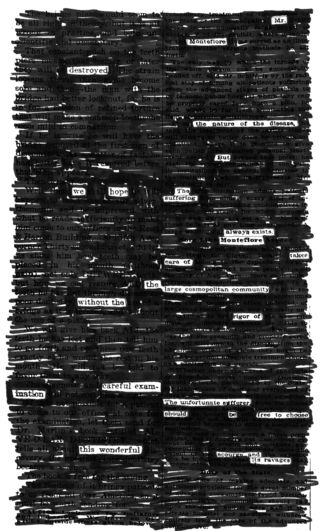
I stopped using photos a while back when I realized that using complete photos would move the poems out of the realm of fair use. (Occasionally I’ll use a little sliver or a crop of a photograph, like in this poem, “In A Honky Tonk In Texas.”)

What’s interesting to me is that I think legal constraints actually lead to better poems.

There are basically four factors that determine fair use: 1) how transformative it is, or “purpose and character” of the use; 2) the nature of the copyrighted work (usually if it’s non-fiction or fiction); 3) the “amount and substantiality of the portion taken”; 4) the “effect of the use upon the potential market.”

So some of my own rules are actually based on these factors: 1) I try to transform the text into a poem that doesn’t resemble the original subject matter of the article, or if it does, it parodies or reverses it; 2) I only black out newspaper articles; 3) I usually take less than a sentence or a phrase at a time and black out way, way more than I keep. When it comes to number 4, I probably have a positive (if tiny) effect on their market, by giving people another reason to buy newspapers!

What you see in the book are actual scans of the marker on newsprint. I didn’t do any photocopying to practice or create a first draft, although, there were some poems where I wish I had. (Permanent marker leads to all kinds of accidents.)

The book was made in a six-month period from June – December 2008. I cut up newspapers into little paperback-sized clippings, and kept the clippings all in a folder, and on the bus ride to and from work , and in the basement of my office on my lunch break, I’d pull out a clipping and get to work.

I wish I could show you or explain how these things happen, but usually I just see an anchor word or an anchor phrase that grabs my attention, and I just work out from that, slowly. (Here’s a time-lapse video of me doing one that might give you an idea of how it works.)

In some cases, we can see that you’re running low on ink (such as the poem on Page 39) as you’re slashing through the newspaper. To what degree did such practical ink conditions affect the form of the poem? (I ask because the Page 39 poem also begins with the phrase “Gasoline is running out,” thus mimicking the ink problem.) Additionally, were there specific “low ink” markers you kept nearby for specific textures or looks?

I wish I was that smart, but in fact, it was just a matter of whether the marker I had in my bag was low or not. I went through a few dozen markers making the book. It’s funny how the ones where the marker doesn’t completely cover everything look way more interesting. I resisted touching them up when I got back home because I liked the way they looked.

I read an article in The Believer about the history of the permanent marker, and was shocked to find out that government censors, back when they still used markers, would use red or brown markers, so you could still see the text that was redacted, then they’d run the redacted documents through a photocopier set on high contrast, which is what gives them that stark black and white look. After I read that, I toy ed with the idea of doing all my blackouts from now on in red ink…

The poem on Page 50, for example, certainly could not look the way that it does without physical contact with the article. On the other hand, I’m naturally quite suspicious about the arrows on Page 60, which were surely aided by scanning and digital retouching to get the precise look of the arrows. To what degree did you rely on digital enhancement for these poems? Were there any specific ground rules that you established along these lines?

There was actually little digital manipulation involved. When I scanned the poems into the computer I set the contrast way high (like a photocopier) so they got that high-contrast look, and then I cleaned up some of the leftover words around the black marker on the edges. In a few very rare instances, I would use Photoshop to fix a screw up where I accidentally marked over a letter. (Only to reveal a letter that had been blacked out, not to put in a letter where it wasn’t before.)

The arrows were made on the original newsprint with a ballpoint pen and the white space from the lines in between the words.

All the poems became image files, which, when they were sent to the publisher, had the added benefit of being incredibly hard to edit — in fact, aside from my editor pointing out a few weak poems, there wasn’t much editing done to the poems in the book at all.

There are actually typos on pages 50 and 84. Each page contains duplicate words, which can easily be fixed with a marker. (I’ve turned this into a shtick at book signings: “Would you like me to fix your typos?”)

Speaking of the little boxes that form thin flowchart lines leading from one word to another (there’s a very nice series of dashed boxes on Page 111 or, even more impressively, on Page 113), how did you arrive at the specific length and width for these little etchings? Did you ever consider using a portion of a letter to help create or nudge a shape?

All those little lines were constrained by the white space in between the words of the article. I honestly didn’t plan them out too much.

When you are highlighting a clustered phrase, such as “detectives gathered at the scene of a mystery” on Page 62, isn’t this a little too easy? Should not the reader’s eye be trained not to find the obvious patterns within an article, but the not so obvious ones?

I try to make it as easy to read as possible. I don’t want to have people struggling to make sense of the poem because they’re not sure in what order the poem is supposed to be read. I get a lot of poem submissions from folks on the Newspaper Blackout Tumblr, and sometimes I have to really stare at a poem to figure out how it’s supposed to be worded. It can be frustrating. And frustrating readers is the last thing I want to do.

On the other hand, I do like that the form can make people slow down and think about the language. My wife is a speed reader, and she finds it incredibly difficult to read these things, because it forces her to slow down and really focus on one word at a time.

Capitalized letters and only letters often serve as crutches (see Page 146) for you to get a poem out of what I presume was difficult material. But I’m wondering if you worked in a deliberately counterintuitive manner for some of these articles (i.e., did you see an obvious poem and deny yourself the pleasure because it was “too easy”).

I never deny myself the pleasure of an easy poem! Nine times out of ten, I’m usually tearing my hair out when I do these things, so when an easy one appears before me, I take it, because I know the next one won’t be so easy.

Why Did Scott Pilgrim Tank?

The Expendables was the top grossing movie over the weekend, raking in $35 million, and beating out Eat Pray Love‘s $23.7 million. The Other Guys finished at third, with $18 million, followed by Inception at $11.4 million and, somewhat astonishingly, Scott Pilgrim vs. The World at $10.5 million. The results have caused some to scratch their heads, while others have reacted with the fury of an aging FOX News anchor just a few steak dinners short of a myocardial infarction.

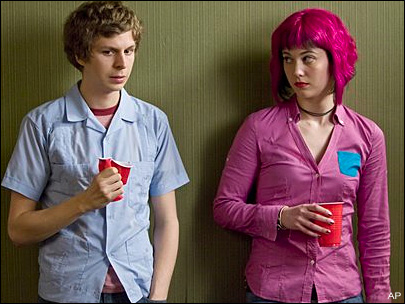
Scott Pilgrim‘s box office failure over the weekend has little to do with Jeffrey Wells‘s deranged dichotomy of “the rank-and-file” warring with “the elite geek-dweeb set” — an impractical characterization that one expects from a paranoid schizophrenic looking for a few magic beans that will grow a tin foil vine. But it was evident from some of the film’s early reviews that the old reactionary guard — which included the hysterical Wells and the frumpy David Edelstein — were going to trash the movie for its audacious syntax — namely, the very visual language that allowed Kick-Ass to make nearly $20 million in its opening weekend back in April.

I don’t think the lackluster business had much to do with Michael Cera. But it’s worth observing that Cera has yet to prop up a phenomenally successful Hollywood movie on his presence alone. He’s found commercial success as a supporting character, although Nick and Norah’s Infinite Playlist, a $10 million movie that grossed $33.5 million, might qualify as a modest success. But when one considers that Scott Pilgrim‘s budget was closer to $100 million, the decision to use Superbad/Juno momentum as a selling point wasn’t terribly wise. Cera, assuming audiences haven’t tired of him by now, will probably be just fine if he can figure out a way to reinvent his one-note Williamsburg hipster schtick and keep his acting roles confined to second bananas. The man lacks leading man gravitas, and now has the commercial track record to prove it.
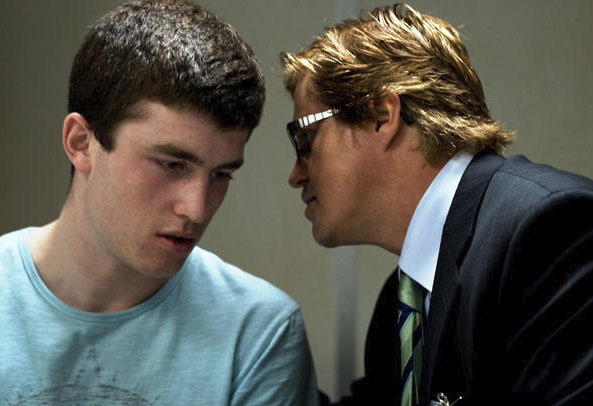
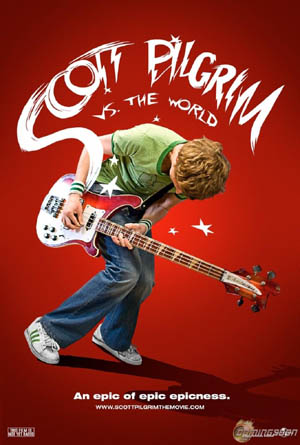
On the other hand, it’s possible that Cera can’t entirely be blamed for Scott Pilgrim‘s failure. One only needs to look at the moronic marketing quacks who pushed this movie as if they were lame ducks. Not only did the film’s bright red poster do everything possible to occlude Cera’s presence in the movie, but it failed to communicate what the movie was about. The “epic of epic epicness” tagline tells someone in the dark nothing at all about Scott Pilgrim. And you have to wonder how much money some Universal wordsmith was paid to whip up such anti-commercial inanity.

The first big mistake made by Universal — and there were many — was in failing to market this as a quirky date movie that a young couple might agree upon. (Or perhaps not. Abigail Nussbaum has offered a provocative post suggesting that Scott Pilgrim is misogynistic.)

The second big mistake was in opening Scott Pilgrim during a weekend in which the audience division came down to gender lines. If you were a man, you were expected to see The Expendables. If you were a woman, you were expected to see Eat Pray Love. The Expendables Call to Arms trailer, released a good month before the movie, permitted enough time for these demographic lines to become fixed. And Universal, rather catastrophically, failed to create a Scott Pilgrim trailer that used the movie’s humor as a self-deprecatory selling point to avoid both movies. (I should also point out that, despite my numerous requests to attend a New York press screening, Universal publicists failed to respond by telephone or email. This is not something I can say about the people at Lionsgate, who were very quick to respond, extremely friendly and accommodating. Guess which film received a 1,400 word essay here.)

While it’s true that Scott Pilgrim received a big Comic-Con buzz, it’s very clear that this didn’t translate into mass moviegoers paying to see the flick. It’s also clear from both Scott Pilgrim and Kick-Ass‘s respective takes that a more daring comic book movie isn’t going to translate into an Iron Man 2-style box office bonanza, even as audiences have signaled their desire to be challenged by plot-heavy movies like Inception. A risk-taking comic book movie with a $20 million budget can certainly make a healthy profit, but it’s a harder sell at four or five times the budget. This weekend certainly isn’t the end of movies like Scott Pilgrim. Just don’t expect future movies of this type to have large budgets or originate from the studio system in a good long while. Indeed, had Scott Pilgrim not been up against two pandering movies, it might have attracted more of the crowd. But apparently there’s gold to be panned when you use the Internet to pigeonhole prospective moviegoers into predictable demographics.

Review: Neshoba: The Price of Freedom (2008)

When it comes to examining vicious crime, it remains a common practice among American journalists and the general public to ignore the story once the suspect has been apprehended or the verdict has been delivered. We want our deadliest realities to confined away from us, sight unseen. But an astute human observer understands that resolution is never quite this tidy and criminals are not always reformed. Human lives continue. One monster’s acts will have consequences upon another life, often creating sharp yet silent obstacles that are too piercing to discuss.

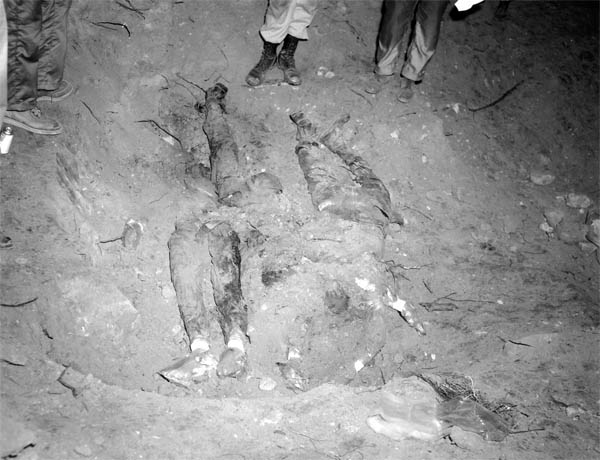
Thankfully a new documentary, Neshoba: The Price of Freedom, offers a rare angle that defies these conventional narrative trappings and attempts to tackle this wider canvas. The film focuses upon recent efforts to bring Edgar Ray Killen — an ex-Ku Klux Klan organizer who helped organize the vicious 1964 murders of three civil rights workers in Neshoba County, Mississippi — to justice. As the film is swift to observe (indeed, sometimes too swift), the ugly scab from this aftermath remains a painful eyesore that the Neshoba County residents haven’t entirely come to terms with. When, in 2004, a group of outraged citizens demands reopening the case upon the 40th anniversary of the killings, the documentary suggests a dichotomy between this multiracial coalition and predominantly white citizens who wish to bury this ignoble history. “What’s happened has happened,” says one man. “It’s been too many years,” says another. “I think he’s suffered enough.” (This latter statement, suggesting the idea that Killen’s ongoing “suffering” is worth more than the families of James Chaney, Andrew Goodman, and Michael Schwermer, mirrors another of the movie’s hypotheses — that, had not two white Jewish kids been killed among the three, the murders would not have received national attention.) Certainly after Killen’s conviction, the then 80-year-old had enough support within the community to raise $600,000 for an appeal bond — a development that the filmmakers skim over. Indeed, one of this documentary’s curious qualities is that it never quite captures the violent sting of the 1964 murders. But if the movie is making a good faith effort to chronicle the present atmospheric aftermath, perhaps this is just as it should be.

Killen himself features quite prominently in this documentary, which centers itself mostly around the reopened trial. And Killen’s stature as an entitled monster, along with his crazed rants about the illusory Jewish Communist conspiracy, make for fascinating viewing. Killen is so ostensibly religious that he has placards of the Ten Commandments spoked into his lawn. And despite his clearly racist fulminations, he insists that he’s not a Jew hater. But the film is ballsy enough to suggest that this vicious cycles often continue in unanticipated ways. Among its prodigious roster of talking heads include several family members and relations to the victims — one of whom calls out for Killen’s blood in a manner not dissimilar from the hate speech that Killen and his collaborators are so fond of. While Killen must be punished for his crimes, there’s an important question here of whether one becomes just as savage as a homicidal white supremacist when howling for blood. Western civilization, as Gandhi once quipped, would be a pretty good idea.

So while this documentary is sometimes quite pedestrian in its assembly (collected interviews, dusty archival footage, perfunctory vox populi interviews), it has the great advantage of being caught within the shoals of an important story.

Review: Animal Kingdom (2010)

The Australian import, Animal Kingdom, has been identified as something close to a masterpiece by several critics — perhaps because writer-director David Michod has been shrewd enough to populate his mobster epic with enough characters to rival a Tolstoy novel’s head count. But much like a Christopher Nolan movie, Animal Kingdom carries the stench of a film that thinks it’s more clever than it really is. Here is a film that knows how to balance its characters, but it doesn’t always give its fictive population time to breathe or inhabit a tableau. And very often the illusion is lost. Yes, the film does probe into a mob’s family dynamics, both biological connections and those tenuous ties forged out of sweaty necessity. Animal Kingdom is often interesting when pursuing fluid rites of passage — such as a surrogate father ordering his surrogate son about the importance of washing his hands. It maintains a static aesthetic, somewhat voyeuristic with its camera, where grocery stores transform into impromptu offices and bland subdivisions become killing fields for thugs to mete out vengeance. This ability to suggest a topography functioning on multiple levels, often unseen by the very people who reside there, did hold my interest. I also appreciated the moral sketchiness of the police, who prove more fungible in their allegiances than a politician offering his avaricious palm to the highest bidder, along with the cavalier way in which one man invades a kid’s privacy, walking into a bathroom while the kid is showering to deliver an order. Such grittiness invites modest comparison to John Cassavetes’s The Killing of a Chinese Bookie. Michod must be applauded for attempting to break free from the conventional yoke.

The problem here isn’t the execution, but the material. While Guy Pearce (as a detective investigating the operation) and James Frecheville (as an orphaned teenager inducted into the savage criminal life) both deliver strong performances, the movie is so bogged down in plot that it doesn’t quite have enough room in its suitcase for that pivotal mob movie atmosphere. Howard Hawks was courteous enough to give us those enticing Xes scattered quite delightfully across Scarface‘s mise-en-scene. Gordon Willis’s sepia pools of light in The Godfather and Michael Ballhaus’s famous Steadicam club scene in Goodfellas likewise cemented the visual feel of those two masterpieces. And even that dependable Method man Cassavetes, in The Killing of a Chinese Bookie, demanded that his nightclub scenes be shot through gels. Abel Ferrara’s films likewise understand this pivotal balance between the unctuous wheels of organized crime and a theatrical visual palette.

So if these are the standards with which to judge Animal Kingdom, then this particular mob movie doesn’t quite hit the mark. None of the characters here have the personality of Vincent Cassel playing the titular serial killer in Mesrine: Killer Instinct. This is a universe in which most human beings have thrown in their respective towels, no matter where they may be situated on the food chain, and it’s only a matter of time before animal nature kicks in. Yet this movie lacks the curiosity to investigate precisely how these figures got there. Yes, some move into the criminal world by accident or circumstance. But at the risk of dredging up a Heisenbergian aside, a movie so content to wallow in resigned sad sacks doesn’t entirely capture the human condition. Michod is happy to turn vaguely stable souls into animals, but he doesn’t have the courage to suggest indeterminacy. And this inability to fully embrace anarchism is more than a tad incongruous within a mob movie.

Animal Kingdom is certainly stylized in this prefigured inertia. The camera is often static. It is sometimes singular in hue, such as the dark reds captured within a hotel room, whereby figures begin to spin about as if caught in circular existential traps. There’s often the dim drone of a television set playing somewhere in the background or a menacing car in the distance. Michod certainly loves his corridors and often enlists his cinematographer Luke Doolan to shoot them deep. The film is also very solid in its framing. There are some conversations in which shoulders never depart from the shot. But when you have characters say “What’d you let me fall asleep for?” or offer such homilies as “You survive because you’ve been protected by the strong,” it becomes self-evident that Animal Kingdom‘s rigid philosophy is, like Nolan’s films, rooted in a libertarian-minded philosophy that doesn’t account for the full human spectrum. In a world that presents us with such delightful souls as Steven Slater cracking open a beer and shooting down a JetBlue slide, Animal Kingdom, to my minority mind, tackles a needlessly narrow focus.