The Onion Narrative

On the morning of Saturday, March 21, 2009, I left the house to purchase an onion. This action, in and of itself, might be considered meaningless. Most would consider this a perfunctory deed or an insignificant errand. There isn’t a foolproof way to capture all comparable actions occurring at the same moment (9:30 AM EDT), but why should any of us ignore the potential pleasures contained within such a routine act? Are we taking this modern convenience for granted? Is a trip to the store to be sneered at? If we view a produce run with contempt, do we therefore view a previous age of humanity with contempt? Why should it have to be about us? A 10th century Viking berserking his way across North America certainly didn’t have this option of a neighborhood market. The Viking’s diet consisted of what he was able to hunt and gather. I am certain that if the Viking learned of developments eleven centuries later, common to every civilized being, and further ascertained that we were complaining about what a pain in the ass it was to get an onion so early in the morning (for the Viking surely had to spend half of his day plunging through the river for some fish), he’d put a battleaxe through our skulls. And we might very well deserve it. (At the risk of self-aggrandizement, let the record show that I did not complain.)

What I hope to document here is one such act, which I style “The Onion Narrative.” Because my effort to obtain this onion exists in the past, fixed and immalleable and further complicated by the mind tinkering even as it accounts for what happened. I have provided diagrams (certainly not to scale) that have divided my Onion Narrative into three tidy stages. And to demonstrate how imperfect this process is, as an experiment, I attempted to recreate my Onion Narrative on video, following the exact same walking route and purchasing yet another onion. My recollection of the details isn’t nearly as precise as I’d like to think. The video confirms that I overstated the width of the food aisles in my diagrams. For the diagrams, I used only memory as my guide. And the video camera placed additional limitations. I was forced to adjust the narrative circumstances contained within my memory. Because I was holding a camera, admittedly a small one, I was nevertheless required to take a dollar out of my wallet in advance so that I could hand it to the register clerk. This way, I wouldn’t have to set down the camera and extract the dinero from my leather pouch. In addition, the price of the onion was different from the initial price. The onion itself was different. Moreover, the social conditions surrounding my journey had drastically changed. (For one, there were more dog walkers.) I’ll explore the implication of these details very soon. But for the moment, let’s concentrate on the original narrative contained within my memory.

The Original Narrative

We needed the onion to make breakfast. We had run out of onions the night before because we had used the last one in our kitchen to make some homemade soup. The market was only blocks away from where we lived. The task offered an opportunity for me to walk. And I also found it somewhat comical that I would be going to the market for only one item. Just some commonplace produce that cost under a dollar. Was this bad time management on my part? After all, if you’re going to go to the store, shouldn’t you go there for multiple items so that you might save yourself some trips?

I did not see the situation that way. Here were my priorities for this five-minute excursion:

Priority One: Obtain onion.
Priority Two: Go for a walk, commune with the world, get away from the damn computer.
Priority Three: Find random opportunities for recurring curiosity about others to take root.

I willfully revolted against my first priority by purchasing not one onion, but three. It might be argued that by purchasing one onion, I had fulfilled my priority and that the two additional onions represented a new priority that I had whipped up on the spot; a spontaneity that I had not anticipated until I arrived at the onion bin. A more austere type might wish to punish me for my failure to obey the set dicta, or for not following the subconscious directions to the letter or for exceeding my budget, as ridiculously minuscule as it was. (For what it’s worth, I only purchased one onion when I recreated the incident.) I suppose it all depends on how much value you place on the onion or whether you feel comfortable having an extra onion around the house. Nearly anybody can afford an onion. Or at least nearly anybody lucky enough to have a roof over his head. And perhaps purchasing two extra onions doesn’t really matter if you have, as I did, even four dollars in your wallet. But if you only have a dollar and you purchase two more, then you are forced into a position of potential embarrassment when the clerk is forced to put the additional onions back. The second onion, beyond your means in this hypothetical case, determines your social position, which is very low indeed. But maybe you have no shame and you wish to max out your meager budget. Or maybe you want to see how the clerk will react to such a dilemma.
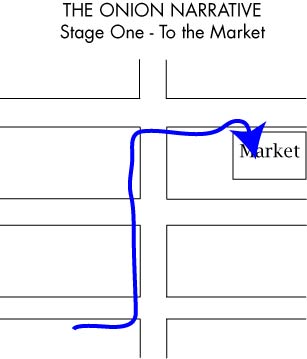
stageoneAs I progressed to the store (see the accompanying graph labeled Stage One), the first priority became less significant. I found myself considering the number of cigarette butts scattered on the sidewalk, which had proliferated considerably from last evening. This then led me to wonder if there was a higher percentage of smokers in my neighborhood than I originally estimated, or whether there were some people who who only liked to smoke on Friday night. But could I really make such a judgment when I wasn’t devoting my complete attention to how frequently the streets were cleaned or the people cleaning them? I then began to observe people as I walked. Over the course of my journey, I counted 31 people who were out and about.

31 people! And this was just over the course of five minutes. That’s 372 people in one hour, assuming that the rate of wanderers remains constant and that you don’t run into the same person twice. Given these numbers, small wonder then that we still obsess over the phenomenon of “running into someone.” And yet none of us, I think, are quite aware of just how many people we see or how many social or conversational possibilities we are presented with at any given time. We are often so fixated on our solitary task (in this case, the purchase of an onion) that we fail to consider our true insignificance.
Web

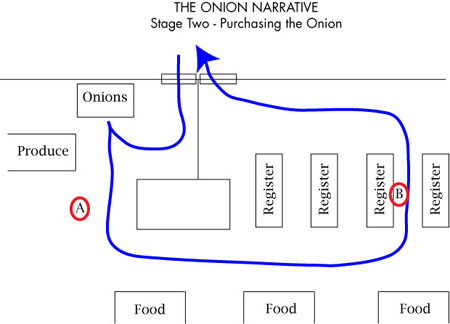
Since I was in a jocular mood, I’d like to think that I plentifully partook of these social opportunities. But there were only two people with whom I had direct contact with. And this was in the store. (I do not count the dog with a sad-looking face just outside the store who angled his head through two metal railings for attention and who I proceeded to pet and speak in a soothing voice to.) At Point A: A boy saddling along with his mother and carrying a glum expression. Recognizing the boy’s need to feel happier, I stuck out my tongue at him, and he smiled. At Point B: Some banter with the register clerk. A “Good morning” and “How are you doing?” and a “Thanks.” A smile. But nothing beyond that. Indeed, at Point B in the video, I did even worse. My recreated journey on video sees me communicating with nobody save the clerk, and my socialization was limited to “Thanks.”

I felt like a terribly selfish person when these details were revealed. Had the video made me more self-conscious? Was I less jocular? Or were the circumstances inveterate? Can we be exonerated if we aren’t really aware of how few people we talk with? Or is it incumbent on us to be more socially responsible? If it is socially acceptable not to talk with even half of the 31 random people we regularly run into on any given day, then are we any less culpable in failing to live up to the possibilities before us? In 2007, a University of Melbourne researcher concluded that political candidates sitting on the left-hand position of a stage are more likely to draw attention. Because the brain, when tracking a tableau, has a tendency to drift to the left. I must note that in Points A and B that the individuals were to my left. I also see that my own journey to and from the store had me situated mostly on the left side of the street. Therefore, if my brain was going out of its way to excluding people, it was possibly because my visual cortex was occupied with the buildings and edifices. Was I subconsciously going out of my way to avoid people? (Additional factors to consider: I learned later in the afternoon that I was in need of social engagement. Several opportunities presented themselves and were taken.)

What is also troubling in my video reenactment is that the only time I comment on anything is when I see a bus parked at a stoplight. This bus is in almost the exact same position as another bus was during my original journey. And seeing the similarity, I am forced to violate the conditions of my recreation: commenting upon the action. This would further support the “running into someone” theory. Consider what cognitive scientist Colin Cherry identified as the cocktail party effect, whereby a person has the ability to focus in on one talker while a steady chatter of conversation is going on. This was supported last year by a study that revealed the auditory cortex does a good deal of work in filtering conversation. And if your brain has robust basal ganglia, well, then you likewise may have a robust “irrelevance filter.”

I do not know how tough my basal ganglia are. But I am troubled by how smoothly my brain deems certain details irrelevant. How little it notices. How needlessly egocentric it is on a subconscious level. After the fact, I am going out of my way to locate the new, the unseen, the underdogs, the moments I didn’t seize, the people I could have talked to, the emphases I now find phony or false.
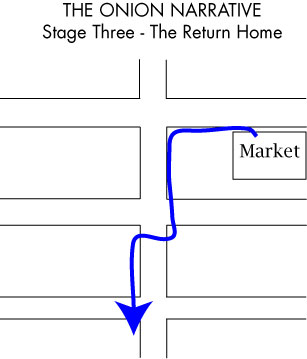
stagethreeStage Three of my journey seems less significant than the first two stages. By my own judgment, it is also the least interesting part of the video recreation. The onion has been obtained. I recall that during the original narrative, I found myself observing more people. I was not in a rush to get back. But on the video, I am circling around people rather than approaching them. I do not know if this is because of the camera or because I felt uneasy reproducing the narrative. And why should Stage Three be the least of the three? The primary goal has been obtained. The mind is at ease and can be more spontaneous with the rigid order out of the way. Or so one would think.

This exercise originated, in part, from ruminating over Roger Ebert’s recent post about the determinism of the universe, although the subject has long been on my mind. I am a secular type who does not believe in a deity, and yet, on some primordial level, my mind seeks to find connections and patterns. Even in thinking about why my mind reacted the way that it did, I am still trying to pinpoint a framework. How is this any different from Intelligent Design?

Among George Santayana’s great arsenal of pithy maxims is this one, written in response to William James’s the Varieties of Religious Experience: “Experience seems to most of us to lead to conclusions, but empiricism has sworn never to draw them.” I hope that I have been more explicit about my free will than James was, and yet I share with James a strange pleasure in vivisecting my experience. Of coming to terms with my subconscious limitations as a human being through diagrams and video reenactments. One should probably not approach life this way, because on a certain level, one must live with blind and uncomfortable truths. But is the truth really unraveled when we consider the structure beneath it? Or is the mind so hopelessly fallible, so determined in its determinist filtering, that human beings are doomed to repeat the same mistakes even when the horse has been led to water? This seems cynical rhetoric, but it’s quite liberating to know that, no matter how much you slice and dice up a moment, the mind remains a dutiful deflector.

New Directors/New Films: Unmade Beds (2009)

[This is the second in a series of dispatches relating to the New Directors/New Films series, running between March 25 and April 5 at MOMA and the Film Society of Lincoln Center.]

unmadebeds

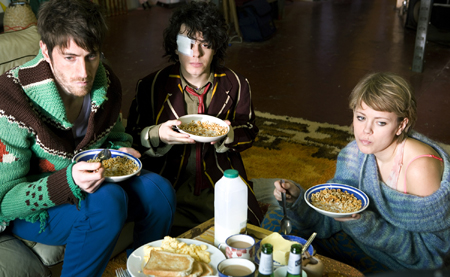
The title of Alexis Dos Santos’s second feature film suggests either a Chekhovian spright or a close kinship with Francois Truffaut’s Stolen Kisses, perhaps one of the most definitive portraits of young people ever burned to celluloid. Certainly there are many allusions to French cinema throughout: a Jules and Jim-like menage-a-trois and a belabored homage to the bear suit in Renoir’s Rules of the Game that suggests a lack of auterial confidence. But Unmade Beds is a plodding and episodic film that can’t quite locate the definitive comforter to keep its many bedhopping twentysomethings from toppling out of the boxspring. A movie involving aimless characters should work, if only because this involves people having to react to random scenarios and reveal who they are. Certainly in Axl, a 20-year-old rootless kid from Madrid searching for his dad, there is some promise. By Axl’s count, he has slept in some twenty beds over twenty years. But if his current lifestyle reflects a certain deficiency in his counting skills, I must report my distrust in this tidy philosophical number. Now in London, he goes out to party every evening and can never quite remember what happened the night before. This results in a stolen kiss from someone he was carnal with the night before. Somehow, he stumbles his way into an industrial flat where nobody seems to pay rent and there seems to be plenty of liquor (courtesy of a club named the Lost and Found). “How many people live here?” asks Axl. His new roommate (a parachutist enthusiast, as it turns out) replies, “No idea. It changes all the time.” Of course, you never know when the place is going to be used to shoot a dubious music video with people dressed in animal suits or when you might be asked to select one of the many ratty mattresses in the cellar. Having spent a portion of my early twenties bouncing around similar living arrangements, I commend Dos Santos for going out of his way to depict this uncertain bump and grind.

But let’s be clear on this. The film is on shaky ground, because it tries to balance the clueless frivolities of youth with a crude conceptual philosophy (“Two people will always be one plus one”). That’s a tall order for even the most talented filmmaker. And Dos Santos mangles this severely with his other major character, Vera (who is French!), who also lives in the flat and spends much of her time meeting up in motel rooms (one is numbered 353, a palindrome reflecting just how this will turn out) with a man who who later reveals his emotional complexity with a homespun song (“I’d like to spend the day with you / I’d like to spend the night as well” are some of the lyrics). Here is a lad that you might find charming if you really just want to boff a guy who will pick up the lodging bill. You can scrounge up a dozen of them without serious effort in Williamsburg. Vera and the man — I know that he had a name, I know that I wrote it down, I know that I can probably IMDB it, but he made such little impact on me that it scarcely seems worth the effort — settle into an affair in which no phone numbers are exchanged. Only meeting times and locations. Dos Santos attempts a semiotic significance by having the man constantly dash the tips of his fingers on stair railings. (Again, the French film imagery!) But we never really get a true sense of the desperate loneliness behind this relationship, save for one moment in which this couple dashes onto the next random train and a decently-directed sex scene that has the two nervously discovering their bodies. Unfortunately, every time these two meet up, Dos Santos has Tindersticks’s “Cherry Blossoms” play. And play again. And again. I mean it’s a good song and all, but — “Get in the morning.” Oh, shit again? No, Dos Santos! “Climb in beside you!” Yeah, I get it. For fuck’s sake, make it stop! “Watch the clock for half an hour.” No, make it stop! I hate this song!

It’s safe to say that if I were Stuart Ashton Staples, I would seek legal action against Dos Santos for making one of my well-known croons almost totally unappealing over the course of 93 mere minutes.

Axl does track down his dad. He’s a staid real estate agent who Axl welcomes to his jungle by pretending to look for an apartment. But will he confront him with the truth? It’s the allegorical unmade bed in action. That steady place where you can fall fast asleep so long as you combat your laziness and take some responsibility in the morning. One almost expects a flashing subtitle to spell this out and clue in that part of the audience who has fallen asleep. (I counted five dozers at the screening I attended.) There’s an odd backstory in which a young Axl pretended to be a superhero and leaped from a tall domestic place only to injure himself. This boyhood slip-and-fall, by no means comical, is revisited in the present.

But neither Axl nor Vera are half as interesting as a snotty bookstore employee who insists that Vera arrange all the books in their correct order. Dos Santos continually suggests that Axl and Vera will eventually be forced to confront the need for some kind of order in their lives. But he isn’t a daring enough filmmaker to suggest that these two might find order on their own terms. He’s good enough to reveal their wanton desires, but what Truffaut did so well with his Antoine Doinel films was to juxtapose his drifting slacker against the need to find a sense of purpose — even accidentally. This bookstore employee may very well be an allusion to the struggling writer in the Doinel films who is always hitting Antoine up for cash in the street. “At least this writer is trying to do something on his own terms,” Truffaut is almost screaming to us with these moments. “But Antoine is not. Will Antoine finally get it?”

Well, Axl and Vera never do get it. They don’t even come close to getting it. Vera keeps a Moleskine in which she neatly inserts her photos. But this is just killing time. That we don’t have any sense of where she might go or what she might do with her life is a major cinematic debilitation. We know pretty early on how Axl’s quest for his father will turn out. And we also know that without this pursuit, he’s nothing. Axl tells his father that he’s in business school. He clutches onto his father’s business card and makes random calls to him on a pay phone. But give him five years and he’ll be a wreck. He has only a schoolboy’s jacket he finds at the flat to cloak the internal qualities he can’t coax out. But shouldn’t we have some sense of what lurks behind these details? I’m not against films about rudimentary twentysomethings, but shouldn’t we be curious?

New Directors/New Films: Barking Water (2009)

[This is the first in a series of dispatches relating to the New Directors/New Films series, running between March 25 and April 5 at MOMA and the Film Society of Lincoln Center.]

barkingwater

Oklahoma, a state unfairly associated with Rodgers and Hammerstein, is a vast prairie with a pan-shaped territory suggesting a definitive cooking surface for the great American melting pot. It has been dismissed by East Coast elitists as a hotbed of virulent Christianity and backwater intellect. But as Will Rogers famously quipped to the state’s detractors, “When the Oakies left Oklahoma and moved to California, it raised the IQ of both states.”

It’s something of a relief to know that filmmaker Sterlin Harjo has dedicated himself to not only raising the stereotypical plateau with which his homestate is viewed and understood, but by documenting the state’s Native American population over the course of three films. It should be noted that Oklahoma has 25 Native languages, which is more than any other state. The lingua franca is so fascinatingly variegated that the Oklahoma Legislature passed a bill in 1990 that permitted a Native language to serve as the state-mandated high school language requirement.

Language of an altogether different sort is what makes Harjo’s third film somewhat interesting. Here is a young filmmaker struggling to collect the quiet experiences that older people often keep to themselves. At one point, our two heroes — Frankie, a man dying of cancer and hoping to clear up a few fractured relationships before passing on, and Irene, his ostensible soulmate — thumb a ride from a young couple from Tulsa. The young woman, Wendy, remarks to her husband about how adorable they are and how they might be able to forward to a future where they can be just as comfortable with each other. Her husband looks upon this lifelong commitment with a quiet horror. And when Irene brazenly announces that the two are not together, the young couple’s illusion is shattered. But a mix tape serves as a cross-generational point of reconciliation. One particular song proves so intoxicating to Frank that we see him torturing Irene later, playing the tune over and over again in a car. Since the man is dying, he’s excused for this apparent rudeness. But is it really rudeness? Or is this Frank’s way of expanding Irene’s rigidly parochial perspective? Is the lie that Irene committed years ago — a prevarication that Frank himself has quietly braced and has never attempted to clear up with anyone — worse than Frank’s auditory sleight?

That such character questions are buried inside this film is a testament to Harjo’s talent. Perhaps it’s the landscape itself that’s cloaking these concerns. Harjo frequently cuts away to shots of rusted stop signs and the flat terrain, as if to suggest that the patient and restricted Oklahoma culture may be responsible for some of these communicative failings.

There is one unexpectedly flamboyant scene at a diner that suggests an alternative Oklahoma. Irene, who only has a ten dollar bill for their journey, is in the habit of calling friends and relatives to get people to buy the two meals. She calls on a nephew that neither Frank nor Irene are particularly crazy about. The nephew and his friend are delightfully boorish. (The pal insists on ordering nothing but “a whole mess of bacon.”) And Harjo films this scene using wild and often low diagonals, even capturing the large deer’s head at the top of the wall. The glum waitress taking the order insists that every breakfast platter requires toast. And one gets a sense of the need to resist such rigid folkways by the bacon enthusiast’s baseball cap reading RESIST.

“That’s what I miss most about being young. Magic,” says one character at one key point in the film. And this sentiment reveals the film’s major flaw. Harjo doesn’t quite have the chops to present us with the magic dazzling at the other end of life: that jam-packed existential epoch just after sixty troublesomely incompatible with Hollywood’s commercial emphasis on the young and unshaped. Frank and Irene keep a very interesting enigma to themselves. But instead of permitting these characters to communicate the edges of this mystery with a telling look or a curious conversational fragment, Harjo spoils it all with that most amateurish of film narrative devices: the flashback. And once this mystery is revealed, Frank and Irene become thinner in character dimension than they have every right to be.

Here is an ambitious film that knows its underserved state very well, but it doesn’t quite know people as well as it should. But I harbor a faith that Harjo’s subsequent films will become more expansive as this young filmmaker matures with time. Let us hope that some benefactor permits him to make more films and hone his craft. His voice, as unformed as it is, is needed.

The Covenant

Some years ago, not long after Herb Caen’s death, I decided to make a series of pilgrimages to the San Francisco Public Library to dust my hands and wrangle microfilm. I had known Caen’s three dot columns for some time. Or, at least, I thought I had known. When Caen passed away, as others dwelt on his coinage of “beatnik” and “Baghdad by the bay,” I felt that it was my civic duty as a San Franciscan to begin at the beginning, which very few at the time had thought to do.

As it turned out, in the late 1930s, Caen had started off as a nightlife columnist, attending swank parties and banging out his observations. What’s rather amazing about this old school epoch is that the newspapers once hired about five or six guys to go around town like this. They’d drink a good deal at upscale hot spots and write columns about their social engagements late into the night as their heads crashed with the competing crassitude of too much gin. When scanning through the microfilm rolls for Caen’s words, I was stunned to see photographs of other dapper gentlemen next to other columns. And I suspect that, beyond the prohibitive cost of scanning and providing all this online, the newspapers may not want you to know that they once actually paid whole armies of columnists of this ilk. This was, in short, a newspaper in which plentiful voices were represented, even on a seemingly pedantic subject. Here was a cadre of niche-specific columnists gathered together under one umbrella. And with multiple newspapers in town, there was a healthy competitive spirit that encouraged the columnists to do better.

You might say that these columnists were the bloggers of their time. And Caen, with his little snippets, certainly reflected the compact summation that Izzy Stone would later offer by mail and bloggers would later present through the roundup format (which has subsequently gravitated to Twitter, where the act of reader engagement becomes more explicit). But these columnists were different because there was an odd journalistic quality attached to these activities. You’d think that columns about running into dilettantes and drinking martinis would be somewhat superficial. But despite this emphasis on swank social tableaux, Caen always had a good eye for observation. He noted odd conversations and paid attention to the details around him. And he did this without belittling what could easily be belittled. (To compare this with the present epoch, we’re now expected to see a report of a party or an event from some snarky Gawker type. Easy targets are eyed and assessed. But what do we really learn about how this world works? Does Gawker really have the longer view in mind? Would it not be better if it dared to detail or if it dared to establish an off-the-record trust with which to convey the scene?) Because Caen was able to establish a trust with the social scene he was documenting, he was able to acquire details and, decades later, his columns remain immensely helpful. For instance, I learned from these old columns that there had been a chain of stores called the Martha Washington Candy Shop. (This was essentially the See’s Candies of its day.) The chain had inexplicably folded and there simply wasn’t any information about it on the Internet. So I began jotting down all of these details, compressing them into months and putting them all into a short-lived blog that I called Raising Caen.

Herb Caen, as we all know, became indelibly associated with the San Francisco Chronicle. He was a revered figure (and many attempted to cajole or influence him) because of his details, and because of his voice. There hasn’t really been a Chronicle columnist on that level since. Unless you count Mark Morford (Steve Outing draws the line), who provides an often frenetic metrosexual voice to the Chron. Hiring Violet Blue was a step in the right direction. The vanilla newspaper simply had to come to terms with the fact that they were circulating in a sex-friendly metropolis. But here’s the thing about Morford and Blue. Neither of them are particularly good at using their voices to get at those important details about a location or an event. Blue does interview people from time to time, but opts for a predictable Q&A format. What if her editors pushed her to give us multiple sources or a description of a scene? What if an editor demanded that Blue provided those vital details that made Caen a draw? As for Morford, his problem is that he is so caught up with wild conceptual approaches and stunts that we often don’t get a sense of Morford either (a) in the thick of things or (b) engaging directly with the community. (The alternatives to this, of course, are the dutiful Matier and Ross, the bland and voiceless Debra J. Saunders, and dependable cultural columnists like Tim Goodman. But what has caused this schism between voice and journalist? Why must it be an either-or proposition?) The newspaper columnist, who once served as a vital chronicler and detailer, is now viewed as an apparent draw only in so much as she can present a perspective. The columnist, in turn, deals with the public through letters and emails.

But perspective, as important as it is, simply isn’t enough. What made Caen such a local household name was his ability to include his readership within his columns. If he found a particular morsel, he would always attribute the reader who included it. His readers therefore felt a level of engagement.

One must therefore ask why Roger Ebert, aside from his television work and his Pulitzer Prize, remains such a household name with the Chicago Sun-Times. It is because he also engages directly with his readers. Consider his blog. Read through the comments and you will find Ebert personally responding to comments in bold. Ebert, like Caen, knows that a columnist’s responsibility involves engaging with his readers. What has changed, however, is the manner in which that engagement is presented to the public. What was once a series of private exchanges now becomes open to public scrutiny and dissection. But by including the readers in the manner that he does, Ebert offers his readership a place for their own ideas. His site remains a draw. Trolls are discouraged and a spirit of civil disagreement is maintained because the readers know that Ebert may respond to their comments.

In the past several days, many have fawned over Clay Shirky’s “Newspapers and Thinking the Unthinkable,” as if Shirky’s obvious and belabored points about newspapers failing to seize the possibilities of the Internet were new. What Shirky fails to observe in his section on micropayments is that Paul Krugman was, in fact, a big draw for the New York Times. When Krugman was behind a paywall, there were ways of obtaining his column. An informed perspective seemed to matter. And this wasn’t all that dissimilar to the rampant Dave Barry piracy with which Shirky initiates his essay. For that matter, we must ask whether those who clipped out columns (and there were many who did this in the pre-Internet days) were any less piratical than those who pass along a link to an article by email or Twitter. The information, I suspect, has always wanted to be free, even before this notion became a hip catchphrase. It’s wanted to be free whether a second-hand newspaper swiped from a cafe or a printout of a microfilm decades later. The real question is whether the columnist is fulfilling a public need. And by “public need,” I am not necessarily referring to a mass market. (A recent Minnesota Post article pointed to small local papers still doing well. The number of adults reading small community newspapers actually increased from 81% in 2005 to 86% in 2008.) The real question is why newspapers have failed to provide an atmosphere in which tomorrow’s Dave Barry or Herb Caen might be allowed a voice.

Small wonder then that readers have turned to blogs as a substitute for this. Indeed, since expanding the word count of these posts, I have seen readers refer to my posts as “columns,” as if I am fulfilling some journalistic duty that I did not anticipate. I leave the comments open to everyone and permit anyone to take me to task, if they must. But some of the more heavily trafficked blogs have not, contrary to Caen or Ebert, respected the readership like this. Love or hate Boing Boing, one of its key appeals involves massive strings of comments attached to each post. But Teresa Nielsen Hayden’s egregious disemvoweling strikes me as anti-communal and disrespectful of the readership. This autocratic arrogance is not advancing the case for trust between columnist and reader. And it’s just as bad on other sites. There was a time when, if you want to leave a comment at one of the Gawker sites, you were expected to “audition” for it. (Thankfully, this control has been relaxed.) There is, in these sites, a fundamentally antidemocratic act of disengagement. The commenter must humble herself to the blogger, and not vice versa. All of this fails to acknowledge the fundamental democratic ripple floating from from the undulations spawned by any newspaper columnist.

Shirky is right to point out how the exclusive informational terrain of newspapers has transformed. A specific journalistic item can be disseminated in a 140 character tweet, and it’s no longer new news. CNN’s scrolling news ticker has likewise suggested that audiences want their news in capsule form. But the successful journalism at Talking Points Memo works because the investigative process is now a part of the relationship between journalist and reader. This approach now permits a journalist to carry out his work and to obtain helpful tips with which to pursue a story. The reader, again, is engaged with the process. And instead of print people and bloggers seeing this dramatic shift in the presentation of information as an opportunity to do better and to attract a greater readership, they have instead declared war on each other. The Washington Post‘s Kathleen Parker writes a vitriolic column bemoaning the “drive-by pundits” who are pointing to the deficiencies of present journalism. A South by Southwest panel labeled “New Think for Old Publishers” sees publishers who aren’t providing new information to a paying crowd, but demanding this information from the audience. Instead of the print people listening to the criticisms and learning from these developments, they ignore them and refuse to listen. And the bloggers, in turn, don’t always consider that there are virtues in long-form journalism. In many cases, they wish to tap-dance on the hospital bed of the dead tree patient succumbing to a terminal cancer. (Jeff Jarvis is by far the worst offender in this regard.)

And when Shirky declares

Round and round this goes, with the people committed to saving newspapers demanding to know “If the old model is broken, what will work in its place?” To which the answer is: Nothing. Nothing will work. There is no general model for newspapers to replace the one the internet just broke.

the idea-slinging optimist in me wants to muzzle the man. Nothing will work? Really? Is it possible that the medium itself doesn’t matter? Will the Seattle Post-Intelligencer‘s investigative work be any lesser because the newspaper is now only available online? (Indeed, the big question is whether or not the Post-Intelligencer becomes self-sustaining if the costs of print production are reduced. As Nicholas Carlson recently suggested, it would cost the New York Times twice as much to print and deliver the newspaper in one year than it would to send every subscriber a Kindle.) If the local papers in Minnesota are attracting more readers, might it not have something to do with this broken covenant between the reader and the journalist? Might it not have to do with the information itself? Have newspapers seen their subscription base dropped because they have failed to respect the readers? And have bloggers been hindered from teaming up along the lines of the 1930s nightlife columnists because this has become a zero sum game predicated on one’s authority and rank on Technorati? Are bloggers and newspapers guilty in not respecting the old covenant?

The New York Times‘s dreadful practice of referring to a “well-known consumerist blog” without citing the URL that first established the connection runs counter to this spirit of connectivity, and the demands of the covenant. Technology chipped away at the verdigrised armor that we all begrudgingly accepted before the Internet spawned what Parker refers to as “drive-by pundits.” And I suppose this is the fruit of Shirky’s “unthinkable” proposition: the idea that print and online journalists might join forces and a more effective economic model will emerge. Because a fusion of voice, the journalist-reader covenant, and investigative journalism will become a must-read central point for all concerned parties.

When Maureen Dowd fixates on Michelle Obama’s biceps, she is breaking the covenant. When Lee Siegel impersonates a reader and leaves a comment in a desperate effort to feed his own hubris, he is breaking the covenant (indeed, so much so that he should not be invited to be part of the process). When Jeff Jarvis or a clueless publisher lets ego get in the way of listening to what somebody else has to say, they are breaking the covenant. The readers are intelligent and they want to be engaged. They want others to synthesize the information so that they, in turn, can synthesize it. They look to any columnist or journalist or blogger and they want to be engaged and challenged. They want voice and they want to be a part of the process.

The nice thing about the covenant is that it doesn’t necessarily mean that the journalist has to capitulate to the readership. The journalist can be as subjective or as wild as she needs to be. The only part of the deal is this: The journalist must listen. Particularly to the points of view that seem unseemly.

The Bat Segundo Show: T.C. Boyle III

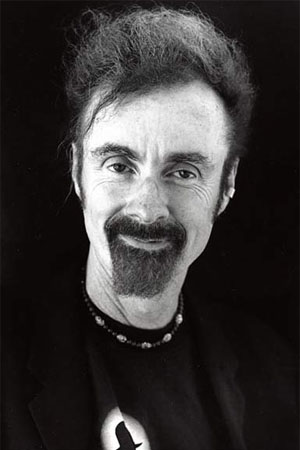
T.C. Boyle appeared on The Bat Segundo Show #273.

T.C. Boyle is most recently the author of The Women. To listen to our previous interviews with Mr. Boyle, check out The Bat Segundo Show #70 and The Bat Segundo Show #10.

segundo273

Condition of Mr. Segundo: Pondering new author taxonomies.

Author: T.C. Boyle

Subjects Discussed: How to conquer jet lag, Ellen Key’s The Woman Movement, the individual vs. the spirit of the time, feminism and Frank Lloyd Wright, notions of education, Miriam’s presence and hypercaffeinated prose, balancing the women in The Women, the ABAB narrative of the first section and Talk Talk, representing Wright through his women, novelizing a fictive novelist’s biography, Blake Bailey, the burdens of chronological order, parallels between Wright and Boyle, the question of what anybody really knows about history from hearsay, seeing the details through an ever-shifting prism, the novel as a suspect medium, Riven Rock, dashes, sentences, and parenthetical information, annotations and “the rest is commentary,” art standing above morality, balancing empathy and the satirical impulse, rejecting reader expectations, reputation and renown vs. not knowing, why cruelty is necessary, reevaluation, empathy and narcissism, and understanding an artist.

EXCERPT FROM SHOW:

boyleBoyle: I try to get it both ways. I try to involve you in something in a satiric way. And yet it should also move you. And of course, in this book, I had to do that because of the tragedy of Mamah, which will conclude the book. So you have to set the reader up for that throughout. And I think there is tragedy throughout the book. Tadashi’s life is incredibly tragic in many, many regards. So again, I’m playing one element against the other throughout. And there is commentary upon commentary upon commentary. And, for me, it opened up the structure and it made it fun. It made it invigorating. A lot of the footnotes exist to give you information that I would like you to know about Frank Lloyd Wright and his buildings and where he was at any given time. But a lot of them also, I just express surprise on the part of Tadashi. And I find the hilarious.

Correspondent: Well, the question is: Okay, the reader wants to know about the artist. And essentially you believe — your own particular view is — that the art should stand above any morality. This is interesting because we don’t know about the artists. And simultaneously, well, you do have many details about Taliesin, as well as the skies and the views and all that. But I’m curious if this almost runs counter to the impulse if you’re playing with the reader’s expectations. So that they will never know about the artist, even though this is, in fact, why they read your books. Whether that’s entirely fair to the reader.

Boyle: Well, don’t forget that when I am creating art, I don’t mean to be fair to the reader or unfair to the reader. Those questions lie right outside the parameters of what I’m doing. I’m dreaming something. I’m creating something for my own purposes. I deliberate to you. And I hope that you interact with it in some way. And obviously you do and other readers do. Sophisticated art, to my mind, doesn’t provide answers and doesn’t have an agenda other than art itself. So I think a book like this one, of all my books, is probably the one in which the reader will be most engaged to try and unravel the truth of what it is in its own right. And don’t forget. I’m not writing about an unknown figure here. Kinsey, as you know, was recognizable second only to the President in this country in his time. But by the time I wrote about him, everyone had completely forgotten who he is. No one knows who he is. And Kellogg too was lost to the mists of history. But again, Frank Lloyd Wright, there’s been a thousand books. There’s a cult. People are lined up in Chicago today, freezing, to get in and go on the tour. So this is someone who has been written about eternally and is very well-known. My interest is: How do I get a new angle on this?

Correspondent: So by him being more well known than Kinsey or Kellogg, you can then justify this notion of not knowing Frank Lloyd Wright. That’s what you’re saying. Of the reader not knowing.

Boyle: If this is your interpretation, I would say yes. But again, I think you do know him. You do see him from his point of view a few times. But I didn’t want to represent his point of view a great deal. Because then you know his motivation and you know what he’s thinking. I would rather have it — that’s why I called it The Women. I’d rather have him viewed from other perspectives so that you can make your own determination. And, yes, I think part of that determination is that he was incredibly narcissistic. Maybe one of the most narcissistic people who ever lived. And yet narcissism, as we talked about with regard to Peck Wilson in Talk Talk, can be very damaging to everybody around you. I like to hope and think that I am sympathetic to people whom I meet and with people who are close to me. And that far from damaging them, I might even be aiding them in some way. A narcissist like Frank Lloyd Wright though, or Kinsey or Kellogg, doesn’t view the world in that way. Everybody else is simply valuable, only as they fit into his regime. So I think that any reader, even the least sophisticated reader of this book, will have a portrait of Frank Lloyd Wright that may be more true than what you get from a biography.

(Photo credit: Christopher Felver)

BSS #273: T.C. Boyle III (Download MP3)

This text will be replaced