Roxana Robinson (The Bat Segundo Show #503)

Roxana Robinson is most recently the author of Sparta.

Author: Roxana Robinson

Subjects Discussed: The New York Times as a source of inspiration, writing a novel with a sense of time, the 2008 economic crash, the fate of the millennial generation, ailing veterans who are overlooked by society at large, unemployment, focusing exclusively on educated characters, writing about subjects you don’t know, talking with vets, being fair when using stories, Donovan Campbell’s Joker One, not using traumatic experience to preserve trust, distinctions between journalism and fiction writing, being terrified of white sedans, fear and panic triggers, why there isn’t a universal common experience among soldiers, getting to know a fictitious character’s family, the desire to visit Iraq, the need for embedded novelists, the present state of Iraq tourism, staying silent on creative details, playing tennis in inflatable courts, Ian McEwan’s unwillingness to discuss his current project, how giving away information on your latest project destroys momentum, whether self-preservation is an admirable choice in digital culture, setting Sparta in Katonah, New York, why houses are important in novels, celebrating a landscape that you love, why it’s essential to use an exact floor plan, Conrad’s miserable experiences in restaurants, California restaurant culture vs. New York City restaurant culture, not remembering the name of a restaurant but remembering the layout, Conrad vs. Joseph Conrad, how to relate the experience of returning to the States after four years of combat, celebrity magazines having more impact on American culture than soldiers, comparisons between Vietnam vets returning home and Iraq vets returning home, soldiers who are invisible, when all of America understands we did the wrong thing, why “Thank you for your service” is the wrong thing to say to a veteran, how to connect with a vet, having nothing but your military training to rely upon when moving forward in contemporary culture, women who tolerate patient aggressive behavior, avoiding female characters who are emotional doormats, balancing the need to advance the narrative with characters who serve in some ways as instruments, macroeconomics classes, difficult GMAT questions, Georgia O’Keeffe, similarities between Conard and O’Keeffe, unintended inspiration from significant artistic figures, biography vs. fiction, Conrad’s concern for cleanliness, intense shaving scenes in fiction, Marine culture and personal appearance, calls and responses, rage and depersonalization, minor quibbles from Heller McAlpin, vets and therapists, and the Marshall Plan.

EXCERPT FROM SHOW:

Correspondent: My understanding is that this book started with you reading a front page article in The New York Times in 2005 or 2006. But to my mind, Sparta seems to be more than that. It’s almost a response to certain socioeconomic conditions. Because what Conrad — this Marine returning from Iraq — has to go through is very similar to what a lot of unemployed men have to go through. There’s also the faint suggestion that this is the great terrible horror story right before the 2008 economic crash with the apartment near the end. So I’m wondering to what extent this became a response to conditions in the latter Bush years and how this tied into your research and getting this massive project started. Just to start off here.

Robinson: (laughs) Okay. Yes, as you are aware, it came about because I read an article in The New York Times. It was about our troops in Iraq and how they were given unarmed vehicles in which to drive and to go on patrols with, and how they were being blown up by IEDs and suffering traumatic brain injuries, which were then not diagnosed and treated. In my head, it wasn’t part of this economic crisis. I wasn’t really focusing on that and I think when I began to pay attention, it was before that happened. And what I’m talking about really isn’t the same as people losing jobs. Because this is a kind of transformation. And, of course, you’re right that someone who hasn’t a job has lost some essential part of himself or herself — if that’s been part of his life up until then. But this is different. Going to war, being trained for war, and being at war, and then coming back and being part of a community that has no understanding and no ability to enter into your own experience — that’s different.

Correspondent: Maybe a way of approaching this question — because there is, in fact, this Go-Go guy shows up near the end. There is mention of predatory lending. There is mention of securitization. It leads me to wonder whether when you’re taking on any kind of novel project, you need to actually have that sense of place. Because one of the reasons why this book extended beyond a mere character study was largely because I felt very much that I was reliving the last term of the Bush Administration. Warts and all, by the way. So this is why I’m asking. Was it really just a matter of talking to all of these vets — and visiting, I presume, the VA hospitals — to get a sense of time? How does a sense of time factor into developing this book?

Robinson: Yeah, that’s very interesting. You’re right. I do want to make sure when I’m writing a book that every part of it works. So when I place it, I usually set my books in the very recent past. A year or so. And it’s often quite hard to track down exactly what was going on. We all have a telescopic sense of time. So it’s hard to know exactly what happened. But yes I was very aware of the economy and how Conard’s generation shifted from happy-go-lucky guys into bundled assets and insider trading and all of that. That turned into an avalanche of bad debt and bad conscience. And yes, it was part of the way America had been led and led astray. And one was in Iraq and one was at home. So you’re right. You’re right. It’s just that I didn’t think of him as being someone who was without a job. But certainly you’re right about the whole ethos of America during that period.

Correspondent: I think the parallel I draw between Conrad’s situation and the scenario of many unemployed people of both genders is that we have increasingly moved, thanks to the Bush Administration, into a culture where those who seek help feel shameful of it, are not permitted to actually pursue it, are prohibited by funds. You’re supposed to tough it out. And the parallel I drew between Conrad and many unemployed people I know — who I’ve been on telephone support with — was substantial. Especially when he has this terrifying ordeal in the VA hospital where he’s told, “Well, you have to wait three months.” And he has a serious problem to take care of. So this leads me again to go back to this idea of looking at a situation — whether it be a heroin addict in Cost or whether it be a soldier returning back from Haditha in Sparta. Does focusing in on one angle of America allow you to tackle its many ills and to expose these common conditions that were putting our heads in the sand here over?

Robinson: Yeah. I’m always interested in consequences. And so when I explore one thing, I am always fascinated to see if there’s a network of fault lines leading out from whatever the central issue is. Cost is certainly not an indictment of anything. It’s simply an examination of a problem that’s more widespread than I understood when I started that project. And in Sparta, I was incredibly troubled to understand what we were doing to our troops at the time. I never supported the war. I never thought we should go there. It was more troubling to learn that there were not weapons of mass destruction and that there never had been. And so I wanted to bear witness to what it was like for one of our soldiers to go there and then to come back. And that exploration illuminates one part of the American experience for me.

Correspondent: Sure. Well, on this subject, I’m curious to ask you about the fact that the last two books take place in upper and middle-class environments and present an underexposed issue in both cases. And this leads me to wonder whether you’re trying to target a particular type of literary audience who may not in fact read the newspapers or the magazines or who may want to keep their heads in the sands. Is it your goal as a novelist to get otherwise erudite people to open their eyes a little bit by this socioeconomic setting? To really look into problems that they may not otherwise pay attention to? Especially in this culture right now, where it’s +1 everything and we’re supposed to like everything and we’re supposed to turn away anytime there is anything that is unsettling.

Robinson: I don’t really have a target audience. I don’t think in those terms. I’m a novelist. I’m not a journalist. I’m really not trying to persuade people of anything. As I say, I’m just bearing witness. And this particular part of society is the one that I know best. Educated people, not particularly rich, but who come from modest backgrounds. But they’re all educated. That’s sort of the main connection between all the books that I have written. But am I trying to tell a certain audience how to think?

Correspondent: Not necessarily how to think. But more exposing their eyes to the fact that, look, this problem is not going to go away. These people, they may be in your family. They may actually knock upon your door. You can’t just continue to read about, I suppose, domestic couples who are committing adultery. You know what I mean?

Robinson: Right. Well, yes, I’m not interested in easy targets. So the problems that draw my attention are ones that I find really compelling and really disturbing. I don’t know who my audience is. I’m not trying to reach a particular audience by choosing the people I do tend to write about. But there are always subjects that I find really troubling. And so if other people do, that’s great. But these are things that become very, very compelling to me.

Correspondent: So you are drawing upon your own background and you’re trying to just step outside of it so that you can understand another aspect of humanity, whether it be drug addiction or vets or that sort of thing.

Robinson: Yeah. I mean, I think that writing about subjects you don’t know is really important for a writer. Writing about circles and communities that are not your own is really risky. Because you’re going to get so many things wrong. So many signals. And so I’m not saying I would never do it. But I’m much more interested in exploring an idea and the way it reveals itself in a community than I am in trying to interpose myself in a community that I don’t know.

(Loops for this program provided by chefboydee, Keishh, MaMaGBeats, and Reed1415.)

The Bat Segundo Show #503: Roxana Robinson (Download MP3)

This text will be replaced

The Culture Novels of Iain M. Banks

This morning, the BBC reported that Iain Banks had passed away from cancer. In 2008, I was commissioned to read all of Banks’s Culture novels, which had been reissued by Orbit in the United States, and I wrote the following essay for another outlet. The publication rights have reverted back to me. I am reprinting the essay here. My condolences to the Banks family.

* * *

In an Iain M. Banks novel, you will find sour antiheroes sweet-talking corpulent cannibal kings, erratic robot drones so caught up in lending a helping hand that they overlook the telltale traces of emotional breakdown within those they serve, and a febrile zeal for blowing things up which suggests that Banks isn’t so much an author of bawdy and exciting adventures as he is a giddy eight-year-old with an elaborate train set scattered across a football field.

When not committing his considerable energies to such intense Bildungsromans as The Wasp Factory or bleak-humored narratives like The Crow Road, Banks inserts an M into “Iain Banks” and writes science fiction novels. Most of these speculative volumes concern the Culture, a utopian-anarchist society that extends across a sizable cluster of the universe. These Culture vultures gambol across the galaxy in ships with such eccentric names as Don’t Try This at Home and Serious Callers Only. Culture citizens live for centuries, and can even change their appearances if they grow discontent with their corpora. These conditions encourage these civilized sybarites to have more fun than a flighty Dalmatian discovering a chiaroscuro sea of spotty companions. Never mind that there’s always an intergalactic war going on.

Red Smith once suggested that writing involves sitting down at a typewriter and opening a vein. But Banks’s unique form of bloodletting appears more modeled on the Black Knight’s stubborn persistence in Monty Python and the Holy Grail. He writes one book per annum, devoting three months of the year to writing and the remaining nine months to “thinking” about the narrative. And while Banks’s idiosyncratic approach has resulted in twenty-two novels, his methods aren’t entirely foolproof. When writing Matter, Banks became so addicted to the real-time strategy game Civilization that he blew his deadline. One can detect the video game addict within the book’s early descriptions. An army is described as “a single giant organism inching darkly across the tawny sweep of desert.” Sid Meier should be proud.

Part of the fun in reading a Banks book involves watching this boisterous Scottish author figuring out his elaborate plots as he goes along. There’s a moment in every novel in which Banks eventually meshes his anarchic energy into the needs of a narrative. At the onset of Use of Weapons, a reworking of an abandoned 1974 manuscript that Banks once claimed “was impossible to comprehend without thinking in six dimensions,” the reader can’t entirely pinpoint just where the book is heading. One series of chapters depicts a Culture agent attempting to recruit a non-Culture mercenary named Zakalwe for a “Special Circumstances” mission for a planet that the Culture hasn’t yet contacted. The other chapters unfold in reverse chronological order, depicting Zakalwe’s previous assignments. But as Banks stitches together these threads, he ends Use of Weapons with a devastating insight into the consequences of following authority without question.

The early Culture novels were inspired by grand space opera and Larry Niven’s Ringworld books. The first, Consider Phlebas, begins with its hero, Horza, standing shirtless in a prison cell, his hands tied above him, as murky liquid rises to his nostrils — a scene that might have come from Flash Gordon. But as Banks carried on writing, he began to imbue his universe with moral quandaries. In the second Culture novel, The Player of Games, Banks’s protagonist, Jernau Gurgeh, is a galaxy-renowned gamemaster who cannot seem to find an amusement worth his while and has grown bored. (There’s also a wry symbolic motif throughout the book of Guregh stroking his beard, as if to suggest that he’s constantly in doubt of his smarts.) Gurgeh sets off on a deranged adventure in which his very life becomes the wager, and the pleasure that Gurgeh takes for granted is juxtaposed against the realities of a three-gender species with severe class and enslavement problems. When Gurgeh witnesses just what this species is up to, he returns to playing, but with a newborn chill and intensity: Banks describes Gurgeh’s face as “a flag hoisted by a soul that no longer cared.”

Excession (1997), perhaps the most elaborate and entertaining of the Culture novels, sees Banks probing into the Minds that control the many spaceships in the Culture universe. Anticipating the frenetic outburst of instant messaging and blog commentary by only a few years, Banks includes elaborate communication transcripts between these Minds within the text. Each speaker is separated by the infinity symbol, suggesting that there isn’t an end to the constant chatter. But Banks also makes his Minds more empathic and personality-driven than his pleasure-seeking Culture characters. Some of the ships even go “Eccentric,” turning unpredictable. Status, contingent as always upon who one knows, appears to matter even when a ship or character inhabits an unfettered anarchy. But as one Eccentric ship, the Shoot Them Later, tells another, “Just because I’m eccentric doesn’t mean I don’t know some big hitters.”

In this novel, it is technology that shapes the Culture’s social equilibrium. Banks even anticipates Linda Stone’s idea of continuous partial attention when he has one Culture diplomat named Genar-Hofoen bond with an obstreperous, four-limbed alien named Fivetide Humidyear VII. As Genar-Hofoen is in the middle of a diplomatic game with Fivetide, he is interrupted by an urgent message in his mind. He is forced to use a “quicken” gland and performs “the mental equivalent of sighing and putting his chins in his hands while…everything around him seemed to happen in slow motion.” Likewise, Genar-Hofoen considers transforming into an Affront (Fivetide’s species). But this technological panacea is juxtaposed against Genar-Hofoen’s existential plight. He’s escaping the entrails of a previous relationship — a woman named Dajeil, whom he impregnated and left after being unfaithful to her. So while Genar-Hofoen might find plentiful distractions within the Culture’s plentiful baubles, they remain distractions that are not unlike narcotics. One is left with the possibility of the Minds inevitably adopting similar temperaments. But at what cost to the freewheeling libertinism sustaining the Culture?

Banks’s willingness to address these ethical issues while keeping his books brisk and enjoyable makes one wonder why his name isn’t often uttered in the same breath as Kim Stanley Robinson or Greg Bear in this country. While Banks’s reputation has soared in the United Kingdom and Europe, he is sometimes overlooked in the United States. Perhaps with the Culture novels now being reissued by Orbit, there’s a good chance that American readers will at long last be seduced by his magic touch.

Lisa Hanawalt (The Bat Segundo Show #502)

Lisa Hanawalt is most recently the author of My Dirty Dumb Eyes. Please note the prefatory reading contains wild and rambunctious horse noises to simulate accompanying images in audio form.

Author: Lisa Hanawalt

Subjects Discussed: Language that perplexes Planet of the Apes aficionados, revolting against natural euphony, being a native Californian, San Francisco Bay Area people who end up in Brooklyn, Alternative Press Expo, Buenaventura Press, how UCLA grooms its art students, immersing yourself in the comics scene, the disadvantages of hyphenates, drawing animal humanoid figures, being a “horse girl,” the best horse sounds, interspecies relationships, childhood notions of marriage, crawling around on all fours, having parents as scientists, taxonomic qualities in genotypes, the inspirational qualities of illustrated guides, the single comic strip as batty syllogism, unlimited space, The Vow, “based on a true story,” scribbling notes after seeing a movie, War Horse, imagining that you’re a horse, venturing into surrealistic realms to get into personal truths, Hanawalt not drawing herself, Julia Wertz, how voice translates generic labels, artists who lean too much on pop culture, the horrors of Slate Culture Gabfest, recap culture, the artistic response as a way to avoid pop culture trappings, Hanawalt’s toy fair report, why the tangible and the physical is more rewarding than the pop cultural, going into a war zone, Sarah Glidden, Israel, being shy around strangers, David Foster Wallace, the comics answer to the footnote, the animalized person as a form of armor, ribald sexuality, wedding registries, seeking permission to draw friends within pieces, varieties of “in vino veritas,” art professors who are obsessive about faces, teachers who are too nice, sculpting, dogs who bark once a day, taking a break from two-dimensional work, visual cues from movies and visual cues from comics, having friends who are comics, the toy company pecking order, why power structures are interesting, commenting upon politics, the advantages of presenting yourself as an idiot, the New York Times‘s veto of “butt turkey,” restrictions from family newspapers, balancing artistic integrity and paying the rent, being read comics by her dad, not leaving the house, living in Greenpoint, shifting from hating to loving New York, anxieties about public transportation, the hermetic seal of a car, the use of colors to enhance personal stories, the unsettling nature of sickly blues, the pristine look of Apple advertisements, white space, enhancing Ryan Gosling’s costume in Drive, deepening visual observations with the sartorial, the pleasant sounds of dogs lapping at water, Roger Corman’s Twitter presence, judging people from what they wear, paying attention to men’s clothing, best dressed cartoonists, how Jason Diamond dresses, Johnny Negron, how people get offended by everything, feeling like you’re on display for putting yourself out there, blocking people, the appeal of lines, silly statistics, the New York approval matrix, and infographics as the perfect joke structure.

EXCERPT FROM SHOW:

Correspondent: I wanted to ask you about the title. Because in light of the Planet of the Apes story you have in this, I kept thinking that your title was My Damn Dirty Eyes.

Hanawalt: (laughs)

Correspondent: It’s like you deliberately designed a title to make Planet of the Apes fans, to just throw them off. I’m not sure if that was conscious.

Hanawalt: I didn’t even think about that until now. You just blew my mind. I didn’t think about that.

Correspondent: Especially since there’s the Rise of the Planet of the Apes review. And I was thinking…

Hanawalt: And that’s something I say to my boyfriend. I call him, “You damn dirty ape!” Whenever he’s doing anything.

Correspondent: So you generally say “my dumb dirty” instead of “my dirty dumb”? How did that get swipped? Swapped?

Hanawalt: It’s Dirty Dumb, right?

Correspondent: Yes, it’s Dirty Dumb.

Hanawalt: I actually tried it both ways and I just liked the way “dirty dumb” sounded. I thought “dumb dirty” is the more natural way to say it. But I just like…it sounded like a musical. Dirty Dumb. Dirty Dumb. I don’t know.

Correspondent: You were revolting against natural euphony, basically.

Hanawalt: Yeah. I guess so. People keep switching them in reviews and stuff.

Correspondent: I was determined to get it right.

Hanawalt: Thank you. I appreciate it.

Correspondent: So you went to UCLA. And I’m a fellow Californian.

Hanawalt: Oh!

Correspondent: Although I was a northern Californian and you were a southern Californian.

Hanawalt: No, I”m from northern California originally.

Correspondent: You are!

Hanawalt: Yes.

Correspondent: Where were you at?

Hanawalt: Palo Alto.

Correspondent: Palo Alto! Oh my god, I was born in Santa Clara.

Hanawalt: Whoa.

Correspondent: So we’re Bay Areaites.

Hanawalt: Yup.

Correspondent: So how did we both end up in Brooklyn? You first. Actually, you only. (laughs)

Hanawalt: (laughs) Me only. Well, I met my boyfriend. So that was big.

Correspondent: Oh! Well, I met a girl too. Oh my god.

Hanawalt: It’s a good reason to move.

Correspondent: How did we not run into each other until now?

Hanawalt: I don’t know. But that was not the official reason I moved for a long time. Just in case it didn’t work out. I didn’t want to say that. So I said it was to become part of a more vibrant comics community in Brooklyn, for more people of my age making comics here.

Correspondent: How did we not run into each other at Alternative Press Expo?

Hanawalt: I’ve been there.

Correspondent: I’ve been there multiple times. I covered it. I would go and I would interview everybody. Every person with minicomics there.

Hanawalt: Really? I used to go every year.

Correspondent: I went every year too. And I miss it. It was great.

Hanawalt: I would table with Buenaventura when I was there. I think I went 2008, 2009.

Correspondent: Yeah. Just a little after I did.

Hanawalt: We just missed each other.

Correspondent: We just missed each other. Well, now we’re talking.

Hanawalt: (laughs)

Correspondent: So you went to UCLA.

Hanawalt: Yes.

Correspondent: And you wanted to become a part of a comics community? Is that how you ended up in Greenpoint?

Hanawalt: Eventually. When I was at UCLA, I thought I wanted to be like a studio artist. Like an actual gallery painter. And that’s what they were sort of grooming me to be. But I guess once I graduated and didn’t immediately become a famous painter with solo shows in Chelsea, I was like, “Oh, I guess I’ll keep making these comics that I make at Kinko’s and write with my friends. Then eventually I got more into the comics scene as I started going to conventions and I met my first publisher.

Correspondent: So it was really kind of an accidental existence going into…

Hanawalt: Yeah, it was.

Correspondent: I read one interview where you said you didn’t feel that you were a cartoonist.

Hanawalt: Oh really? Did I?

Correspondent: Yes. You said that in 2010.

Hanawalt: Oh, I guess I changed my mind about it.

Correspondent: You are officially a cartoonist.

Hanawalt: Yeah, I do. You know, I make comics. If people ask me if I’m an artist, an illustrator, or a cartoonist, I say that I’m all three. And depending on my mood, I’ll introduce myself as one of the three.

Correspondent: And you can’t just call yourself a hyphenate or something.

Hanawalt: No, it’s just too complicated. And at that point, people — their eyes start to wander and they lose interest in talking with me. So….(laughs)

Correspondent: So what was the first animal humanoid figure that you ever drew? I was curious about that. They’re throughout your work. And I’m wondering when you started putting, say, lizard heads on regular people or pop cultural figures. Things like that.

Hanawalt: I started drawing cats as people when I was like five or six. And I was drawing myself. What I wanted to be when I grew up was a black cat that was also a human who wore an orange Hawaiian shirt. Because I was really into Weird Al Yankovic at the time. So I would draw my self-portrait as a black kitty cat. And then later I started drawing horses as people. When I was like seven, eight.

Correspondent: I know you were a “horse girl.” What does that entail? Did you ride horses? Did you enact a life as a horse? Did you do a lot of horse sounds? “Neeeeeeeeeigh” and all that?

Hanawalt: Yeah. I was a cat girl until I took my first riding lesson at eight. And it set off a bomb in my brain. And I just was like “Horses! Horses! Horses! I want to marry a horse. I want to be a horse. I just want to…”

Correspondent: You want to marry a horse?

Hanawalt: Yes. I used to want to marry a horse. I asked my mom if I could and she was like, “Maybe that will be legal someday.” She had a very…

Correspondent: A lax view on bestiality.

Hanawalt: I guess.

Correspondent: Interspecies relations.

Hanawalt: I didn’t know at the time that marrying kind of meant that you were sexually partnered.

Correspondent: Oh, it was a more romantic image!

Hanawalt: Yeah. Yeah. I mean, I was only six or eight. And I just wanted to be linked with a horse forever.

Correspondent: It’s sort of that moment where you’re playing with Barbie and Ken in the Dreamhouse. Then all of a sudden you realize, “Oh! They’re actually going to have sex as well.”

Hanawalt: Yeah. You figure that part out later. But yeah, I made a lot of horse noises. I drew horses. I crawled around on all fours.

Correspondent: Do you make horse noises to this very day?

Hanawalt: I can make a snorting sound. [highly commendable snorting sound]

Correspondent: Oh! That’s pretty good.

(Loops for this program provided by HardstyleRythm, ShortBusMusic, and Reed1415.)

The Bat Segundo Show #502: Lisa Hanawalt (Download MP3)

This text will be replaced

Lauren Beukes II (The Bat Segundo Show #501)

Lauren Beukes is most recently the author of The Shining Girls. She previously appeared on The Bat Segundo Show #409.

Author: Lauren Beukes

Subjects Discussed: Predicting the future, whether 2013 is more of an apocalyptic year than 2012, killer bunnies, laughing rats, H.P. Lovecraft, the best zombie dramatizations, explanation in narrative, trusting the reader with interesting definitions of how the world works, the Greek tragedy of time travel, killing Hitler, Kate Atkinson’s Life After Life, criss-crossing timelines, Looper, finding spontaneity in a careful foundation, E.L. Doctorow’s description of writing, developing the close third person perspective, working against the sophisticated predator stereotype, the catharsis of hurting mean characters, T.C. Boyle, fictitious injuries, time periods that are defined by pop cultural references, Studs Terkel, Forrest Gump, women’s rights, McCarthyism, connections between American and South African history, spies and informants, surveillance society, Todd Akin, Candyman, Spencer Tracy explaining baseball to Katharine Hepburn in Woman of the Year, interviewing real people, not understanding sports, the difficulty of forgiving people for political atrocities, Sarah Lotz, objecting to fictitious murders, living in Chicago, why the Midwest is an ideal setting for an American novel, the tendency to invoke Detroit with symbolism, parallels between Hillbrow and Detroit, Mark Binelli’s Detroit City is the Place to Be, Charlie LeDuff’s Detroit: An American Autopsy, the U.S. Radium Corporation’s exploitation of women, paying researchers, Radium Girls, quoting directly from a 1936 story in the Milwaukee Sentinel, Mad Dog Maddux, naming your company after an employer’s fictitious creation to secure a job, the annoyance of getting minor details right, John Banville, the invention/research spectrum, location scouting, women who are objectified by her scars, Murderball, the sex lives of the injured, characters defined by the interior, physical description, how visual photos serve as emotional reference, why fictitious sociopaths drink Canadian Club, Amity Gaige’s Schroeder, A Clockwork Oraange, Al Capone, Velázquez’s Las Meninas, and rabid eating.

EXCERPT FROM SHOW:

Correspondent: The thing about this conversation is that we’re doing this months before it actually airs. So what do you think’s going to happen in May or June when this actually goes up? Will the world even exist? What will happen?

Beukes: Well, you know, I think the Mayans were off by a couple of months.

Correspondent: I’d say that 2013 is more the apocalyptic year than 2012.

Beukes: Definitely. Way more apocalyptic. And I think actually we’re going to be overrun by killer bunnies that are taking revenge for the deaths of all the bees. And we’ll all be wiped out.

Correspondent: I learned recently that rats laugh. Did you know this?

Beukes: No, I did not.

Correspondent: Yeah. Rats actually laugh. If you tickle them, they emit this supersonic, high-pitched laughter that humans can’t hear. I’m not sure if this factors into your prediction or not, but I bring it up just for the hell of it.

Beukes: Well, we can use the rat laughter death ray. It’s kind of a sonic death ray which will explode all our cell phone devices and we’ll be cut open. I know I certainly will die without my cell phone.

Correspondent: Sure. Well, Lovecraft probably predicted this too. “The Rats in the Walls.”

Beukes: Absolutely.

Correspondent: Anyway, to your book. It is my view that the best zombie dramatizations do not involve an explanation. The zombies merely rise from the grave. And that’s it. It could be allegory. It could be gripping suspense. I bring this up because I think about the time travel in your book, which for the most part, except for the end, we don’t actually have an explanation for why this man Harper can jump from time to time. And when the explanation does come, I read it and said, “Oh, okay, that makes complete sense.” But I was so wiling to believe that he somehow willed himself into various times. So I have to ask you, Lauren Beukes the author, did you have an explanation from the start? Why did you feel the need to give the reader the explanation for the time travel? And is narrative hampered sometimes when you explain too much to the reader? What of this?

Beukes: I don’t like to explain too much to the reader. I like readers to bring their depth and experience into a text, and I think that makes it just way more interesting and exciting and personal. Overexplaining is boring. And I think you have to trust your reader. And I think you have to trust them with interesting definitions of how the world works. So I specifically went with the Greek tragedy model of time travel. You can’t kill Hitler. The more you try to kill Hitler, the more you’re just going to reinforce the events which will absolutely play out it always has been intended to play out. Which is not to say that there aren’t loops and paradoxes or that the ending doesn’t explain why everything has been happening.

Correspondent: Sounds like you’ve read Kate Atkinson’s Life After Life.

Beukes: Uh, yeah, maybe.

Correspondent: Gotcha.

Beukes: So I really wanted to just play with that. And the time travel is almost secondary to a lot of everything else. But everything has been immaculately plotted out. You know, I had this crazy murder wall with all these diagrams and strings and three different criss-crossing timelines, linking them and triple-checking that everything made sense. And for that one moment which they keep looking back to, everything is very carefully coordinated. There’s no Looper moment where Bruce Willis says, “Well, I could explain time travel. But we’d be here all day doing diagrams with straws.” No, I really did plot it out and make sure everything worked.

Correspondent: How does spontaneity work for you? If you have a foundation that you’ve set — with strings. I’m very curious about the strings. I mean, Will Self has his Post-It notes. You have the strings. How do you digress from that? How do you account for spontaneity? And does explanation sometimes get in the way of spontaneity?

Beukes: I think explanation can. The way I write, and I’m going to paraphrase E.L. Doctorow, is that it’s like taking a road trip at night. I know where I’m leaving from and I know where I’m going to. I always know my beginnings and my endings. And I know some of the major way points along the way. But the rest of the time you’re driving. It’s pitch black. You can see twenty feet ahead of you in the headlights. And you’ve just got to stay on the road and figure it out. And so the spontaneity and the play and the subconscious diversions, which is my favorite part of the writing process, happens in between.

Correspondent: So Harper, you knew how he did it.

Beukes: I knew how Harper did it. I knew why it happens that way. That ending was in there from the beginning.

Correspondent: Sure. Which leads me to ask you about the strange perspective. I mean, here is a close third person. And as we read more and as we start to understand how he views his victims, it’s very hallucinatory. Especially with Etta the nurse. We start to really know that he’s probably making this up and furthermore he doesn’t quite understand sometimes that he’s murdering these victims. This is interesting because you’re almost asking the reader here to share this blindness by making it third person. How did this stylistic tic develop out of curiosity?

Beukes: My previous two books were first person. And I really felt like I needed a break from that, that I needed to be able to step back a little bit. Especially because Harper was such a loathsome, vile person. Which doesn’t make us any less complicit, even though it’s third-person. It just felt natural for the book. I would love to give you an in-depth analysis, but a lot of it is relying on intuition. And I wanted Harper to struggle with it and I wanted you to see his struggle. I also did a lot of research into what real serial killers are like. And I wanted to avoid the sexy predatorial Hannibal Lector model. You know, the sophisticate who drinks Chianti. And most serial killers are awful, vile, pathetic human beings who have major sexual dysfunctions. And I wanted to get at that and the kind of real horror of like what that kind of monster is. It’s actually quite sad and pathetic and no less horrible. But not the sophisticated predator.

Correspondent: But it’s also an interesting way of possibly avoiding full immersion into this guy’s mind as both author and reader. I mean, if you during the course of your research are growing increasingly queasy about what human beings do, well you have a perfect safeguard here. Was that another aspect of doing that? Another advantage here?

Beukes: That could well have been a subconscious aspect. You know, the way I dealt with writing Harper was that I just messed him up at every opportunity. You know, if I could damage him in a scene, I absolutely would. I was like, “Okay, he’s in a fight with someone. I’m going to break his jaw. Awesome.” But then I had to keep track of the broken jaw and figure out how it was healing. Was it healed in 1984? Or was it still wired up in 1951? And that just added a whole another layer of complexity. So it was very cathartic to hurt him. But it didn’t help me with my planning.

Correspondent: So you were able to deal with this monster by beating the shit out of him.

Beukes: Exactly.

The Bat Segundo Show #501: Lauren Beukes (Download MP3)

This text will be replaced

BEA 2013: The Editor and the Translator

On Friday afternoon, mere minutes after the frazzled feline star of a viral video had been flown in from Morristown, Arizona and dragged against its will onto the Javits floor to receive the kind of superstar adulation that literary geniuses toiling for decades would die for a tiny piece of, three dozen people met in the rank underbelly of a cold corporate convention center to contend with issues of translated literature.

This was the clearest indication I have ever seen of what Chad Post has identified as the “three percent problem” — whereby a mere 3% of all published books in the United States are works in translation. The underattended panel made me hang my head in shame.

I had not known that Grumpy Cat was at BEA, nor did I care to meet the animal or wait in line upon learning of this intelligence. There were more meaningful ways to fritter away two hours of my life. Indeed, I had encountered Open Letter‘s Chad Post on the loud floor just before the panel and personally apologized for not doing enough for translated literature. He then told me about an insane man in Italy and secured my attendance.

There were several translators and foreign language enthusiasts in the crowd, including Michael A. Orthofer and Scott Esposito (both tireless proponents for literature in translation), but the panelists pointed out the paucity of editors in the audience and seized upon this absenteeism to talk freely.

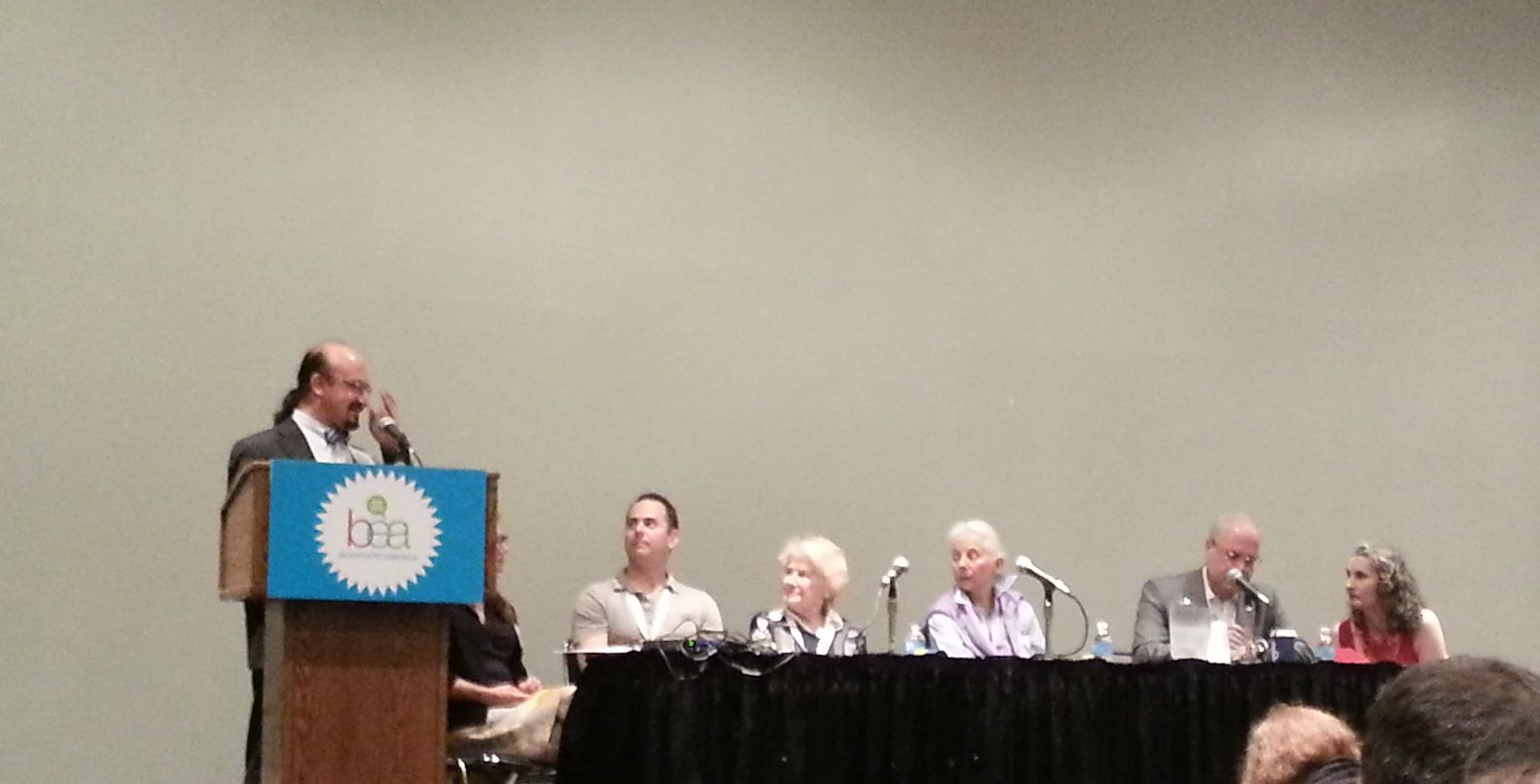
“In the long view,” said Susan Bernofsky, director of literary translation for Columbia’s School of the Arts, “we want to find an English language voice for our foreign language author. In the short run, editors want very different things. Editors want books that will read well in English and that sell. The translator wants to represent what the language said.”

Bernofsky pointed to FSG’s Elisabeth Sifton as an editorial paragon. Sifton gave Bernofsky carte blanche to translate Gregor von Rezzori however she wanted. He wasn’t especially edited in German. So he had wanted his English translation to be well edited, even if it meant obliterating whole pages and paragraphs.

I was not as well-versed on translated literature as the assembled crowd, but I was surprised by how liberal the editing process was. Post described going much further on a memoir that had a plodding section set in the 1980s. The ten page section began with the sentence, “I remember nothing good from those years.” Post felt that cutting everything that followed that sentence was an improvement.

Translator Mary Ann Caws pointed out to several fraught experiences she had encountered in her years. She described working on an anthology, where her translation was taken out of her hands and given to someone else who dumbed everything down. She described battles translating André Breton’s most famous poem, “Free Union.” The first two words of the original poem is “Mon amour.” One translation of the poem’s first line reads “My wife whose hair is a brush fire.” Another reads “My woman with her forest-fire hair.” The difference between “My wife” and “My woman” is substantial because of the connotation of the relationship. But Caws pointed out that “there’s a way of doing it without her or she” with phrases like “My dear one has gone into the streets of the city.”

Caws had also suggested publishing several translations around a sonnet to demonstrate the impossibility of a perfect translation. The editor replied, “How will they know which is the right translation?”

Victoria Wilson has been an editor at Knopf for forty years. And she insisted that cutting text has little to do with saleability, but how the book reads. “A book is going to sell if it’s 150 pages shorter,” said Wilson, who was also careful to note that she had published William Gass for twenty years.

“People ascribe motives to the publisher,” continued Wilson. “We’re all just people. I bought the book. I fought for the book.”

This was all constructive chatter, but the panel’s fireworks really started when Polish crime writer Marek Krajewski began speaking with gusto through a translator.

“In my mind,” said an animated Krajewski through his translator, “the editors who work with people who have huge egos really can’t adjust and are narcissistic. These kinds of editors treat their authors as total failures. There are editors, on the other hand, who tend to do work just for the sake of doing it. To justify their presence there.” Krajewski bemoaned editors who didn’t understand his work, including one who was “basically taking out the F words.”

“Some of them tend to be shy and don’t ask that any questions,” said Krajewski of his translators. He pointed to one who couldn’t be bothered to flesh out an abbreviation. “I had the full information. And I do know she knows how to do it. Well, sometimes, it happens that the editor is very detail-oriented.”

One of Krajewski’s books concerned multiculturalism, which turned out to be a problem for the editor and the translator. “It’s not only translating language,” said Krajewski. “It’s translating cultures.”

Bernofsky noted that she had just done a new translation of Jeremias Gottheif’s The Black Spider for NYRB Classics. Because Gottheif’s work was a horror story, the editing was much different from what she had usually experienced.

“The prose is not that amazing,” said Bernofsky. “Edwin Frank did a very heavy edit on some of the prose. He was editing both me and Gottheif. He rearranged the sentences.” Bernofsky signed off on the translation, even though the reviewer comparing the original with the translation will find it inaccurate. But for prose stylists like Robert Walser, Bernofsky said that she would “fight for keeping the complexity of the sentences.”

There was a question concerning changes in publishing over the past 40 years, in which the publishers were blamed for the drop of translated fiction in bookstores. “You can’t just look at the publishers,” noted Wilson. “The chains changed everything in terms of their ordering.” In other words, it doesn’t really matter whether a corporate behemoth owns a big publisher or not. The fate of translated literature in the States is entirely dependent on what the bookstores order. And while the recent health of independent booksellers has suggested new prospects for translated fiction, without massive orders from chains, it is often difficult for these books to be published.

This reality was simply too much for Chad Post, who began talking fast and angry.

“Every book out there is shitty,” boomed Post into the mike. “Mitch Albom? What the hell? We do not need him.”

There were some faint suggestions that Post was prepared to overturn the table, fire a pistol into the air, and demand the rightful liberation of the book industry.

“Malcolm Fucking Gladwell,” shrieked Post. “I’ve never been quite disturbed by the book business than I have been in the last few days.”

I squinted to see if the veins on Chad Post’s neck had popped out. I waited for Post’s instructions to don the balaclava carefully folded in my left inner pocket. I waited for Post to announce the Occupy Javits movement.

“I would shoot myself if I had to publish most of the books out there.”

With this suicidal statement in full swing, Post’s phone began to ring on stage. Mitch Albom’s people were coming to shut the wild-eyed revolutionary from Rochester down. Post was referred to as “that angry young man” by the next questioner.

To be clear, Post was not all froth and spittle. I could relate very much to his fury. We live in strange times when Amazon Crossing is the number one American publisher for translated fiction. As Post pointed out, it isn’t easy to secure advocates for translated work when the pitch is “Here’s a great book about a woman in Latvia who is depressed.” But perhaps with more passion, we’ll work out the kinks and expand the egregious percentage.